

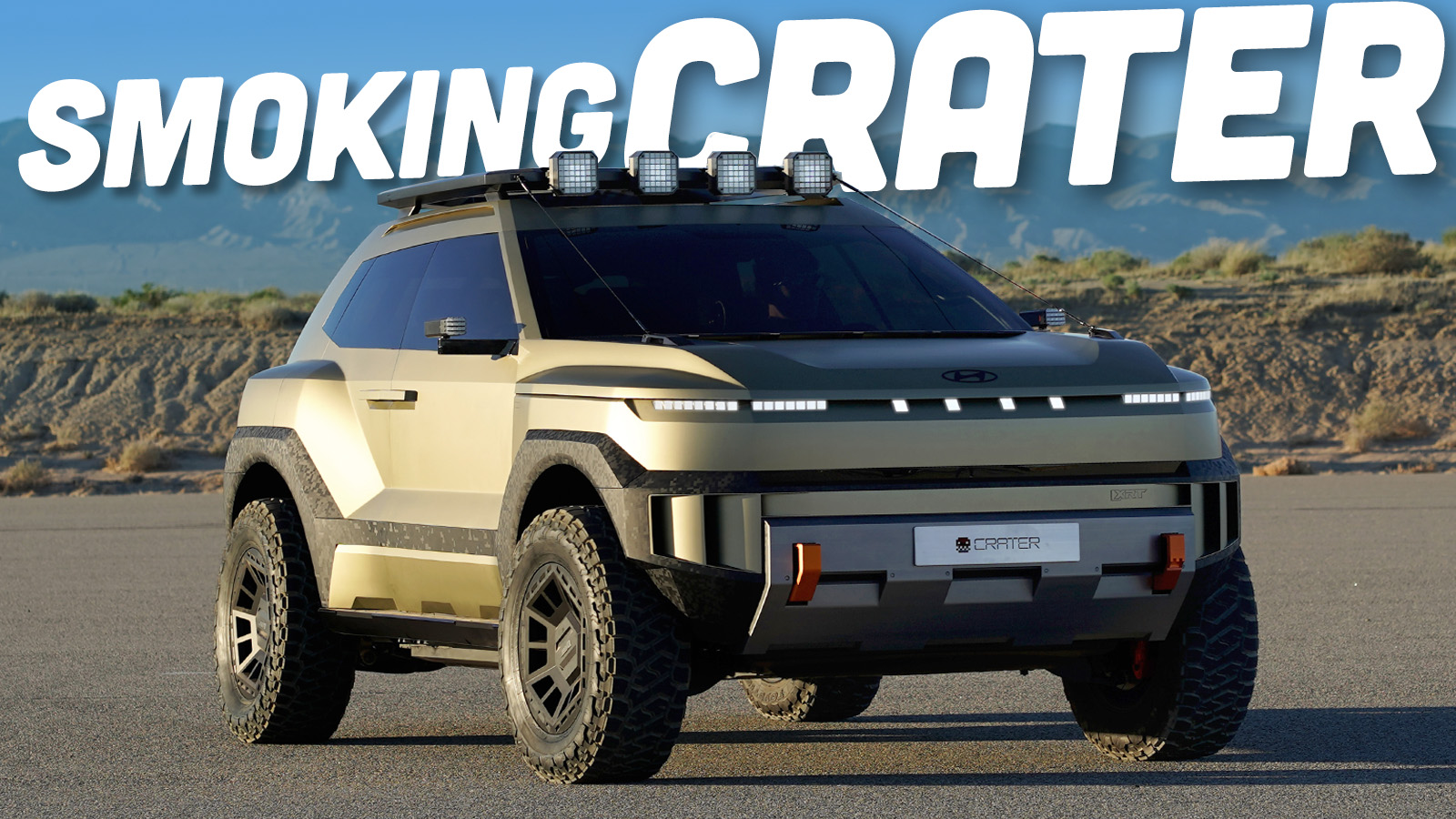
Hyundai’s design team is absolutely killing it right now. Pretty much everything in its lineup (and its luxury sub-brand Genesis’s lineup) looks incredible, whether we’re talking about the company’s gas-powered offerings or its EVs.
My personal favorite used to be the G90, the huge Genesis sedan that looks far more like a Bentley than even some Bentleys. But as I’ve been seeing them more on the road, I’m really starting to fall for the Ioniq 9, Hyundai’s big three-row EV. There’s something about the monolithic lines and simplistic profile that just works really well.


The company’s design achievements aren’t just limited to production cars, of course. Hyundai flexes that muscle on its concepts, too. Its latest, the Crater, is an off-roader that takes cues from the brand’s entry-level Kona SUV, and turns the off-roadiness dial to 11 with boxy flares, huge tires, a roll cage, and a bunch of other desert-running goodies.
Boxy Off-Roaders Are All The Rage Right Now, Aren’t They?

I mention the Kona above because the Crater has some hints of that crossover’s general design scheme, like the profile and the thin headlight strip at the nose. Hyundai doesn’t mention anything about the Crater’s powertrain, but it feels like it falls in line with the company’s production EVs, what with the pixelated exterior lights (there’s a set of auxiliary lights mounted on the roof that have pixels arranged as faces, which is fun).
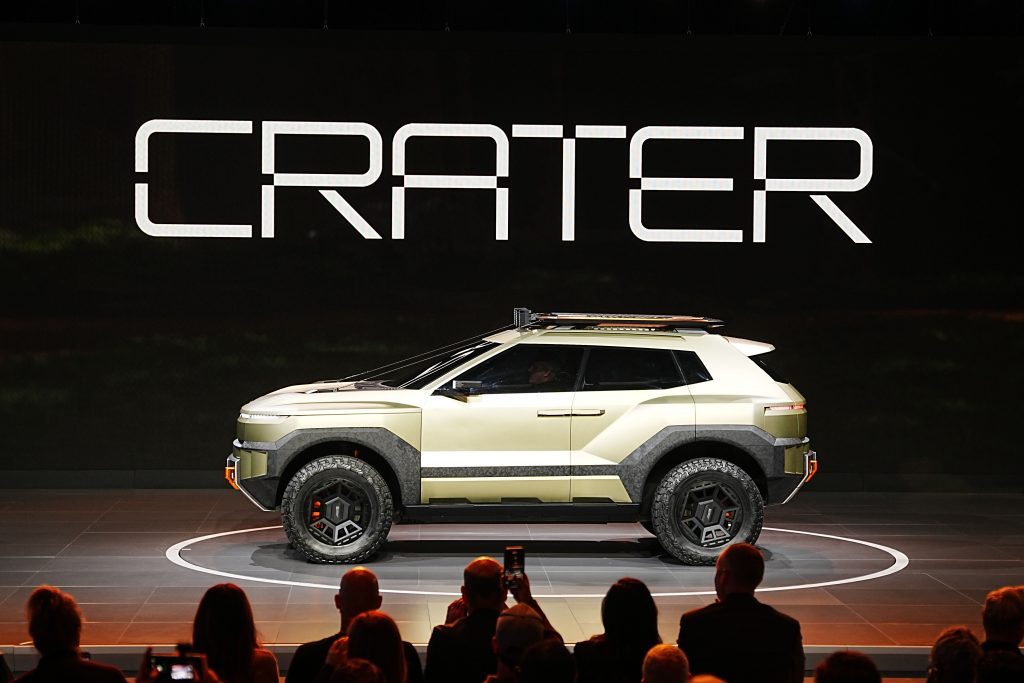
The elongated fenders do a lot to buff up the Crater’s footprint, as do the 18-inch wheels and their hexagonal pattern shape. There are lots of small details, too, like the limb risers, the cables that stretch from the hood to the roof to prevent low-hanging branches from striking the windshield.

Those side-mirror cameras can also be removed from the vehicle and double as flashlights in emergency situations, which is pretty clever. And one of those two recovery hooks sticking out of the front bumper can also act as a bottle opener (in different types of equally dire emergency situations).
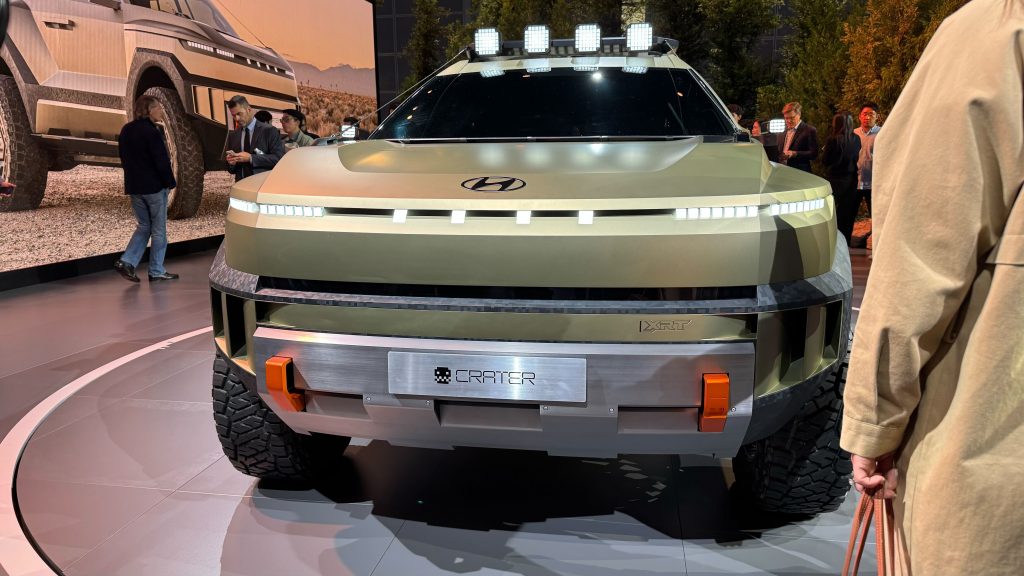
Hyundai describes the Crater as a vehicle that “captures the spirit of adventure,” with a design “inspired by extreme environments,” though it doesn’t say anything about what’s underneath the skin. There looks to be some kind of long-travel suspension setup, which would make sense for the photo locations, but other than that, Hyundai’s left us in the dark. Like most concepts, it’s likely just a design buck with no functioning drivetrain. Sometimes I miss the days when automakers would make up out-of-this-world specs for their concepts, knowing the public wouldn’t be able to confirm them.
There’s A Lot Going On In Here
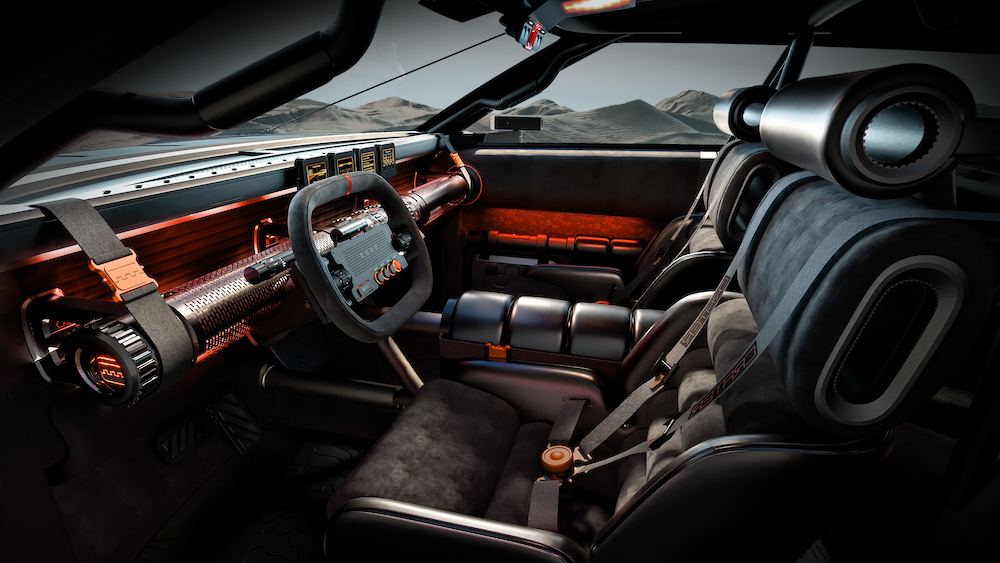
The Crater’s cabin is a collection of weird and amusing features. The seats use cylindrical cushions for the headrests that look like Bluetooth speakers. They aren’t Bluetooth speakers, but the car does have a removable wireless speaker you can remove from the center of the dash (something Toyota has already put into its production cars).

The steering wheel has terrain mode buttons built into its center, along with a pixel display that “reimages driver interaction,” whatever that means (I suspect it might be a typo and that word is actually supposed to be “reimagnes,” though my question still stands). There’s also the dashboard, which is just a long, orange-glowing, cylindrical unit that spans the width of the car and looks to be held up, at least partially, by two buckled straps. There are four more square screens in the center area of the dash that act as displays, similar to the funky hatchback concept Hyundai showed in September.

The Crater is a four-door, four-seater vehicle with a set of rear-hinged doors at the back. Opening the two doors on either side nets a good look at the built-in roll cage, which hugs the front seats and looks to go through the center console. If this were a real vehicle, I’d highly recommend driving it with a helmet—knocking your head on that cage in a crash would be bad news.
When asked whether Hyundai plans to put the Crater (or something like it) into production, chief designer SangYup Lee told my colleague David Tracy, who’s on the ground right now in LA, that “we don’t do a concept for an impossible La La Land car.” To me, that suggests there might be some hope such a vehicle could actually appear on dealer floors.
While Hyundai does have a solid track record of putting concepts into production, the one everyone wants, the the mid-engine retro N Vision 74 sports car revealed in 2022, has still not arrived (Hyundai said last year it should be coming by 2030, so at least there’s still hope). By my math, that should mean a Crater production car by 2033, right?
Top graphic image: Hyundai


Bit of a stretch, but the Meteor Crater in Arizona does let it slide into the western US naming scheme Hyundai likes so much.
Hyundai Crater?
I think that’s the pits…
What do you get when you cross a curren-design boxmobile with a Nissan Juke? This.
Not specific Juke elements necessarily, but the way it all fits together and the feel of the thing.
This looks, to me, like Lego was the designer. Crater is also an inauspicious name, since when sales crater, it is always a bad thing.
It’s a teaser for the upcoming generation of Hyundia Kona, the SX3. Of course, won’t be looking this extreme. But the Body itself is the new Kona.
This also has a modern atomic Honda Element vibe to it The Element, another beloved car that got killed that I’ve owned several of and adored. I still haven’t forgiven Honda for that and haven’t owned a Honda since. Still bitter over it. I still haven’t forgiven H/K for killing my Soul either. I would, however, accept this Crater as a peace offering and learn to be a fanboy again. Hyundai, just pull the trigger and build the darned thing! If you don’t, I will still hate you for killing my Soul and will never buy another one of your products.
I would love a modernized Element. Or a modernized Mazda MPV, with a bit of lift and a bit of modern box/butchification. And pointedly NOT Suburu-style butchification.