

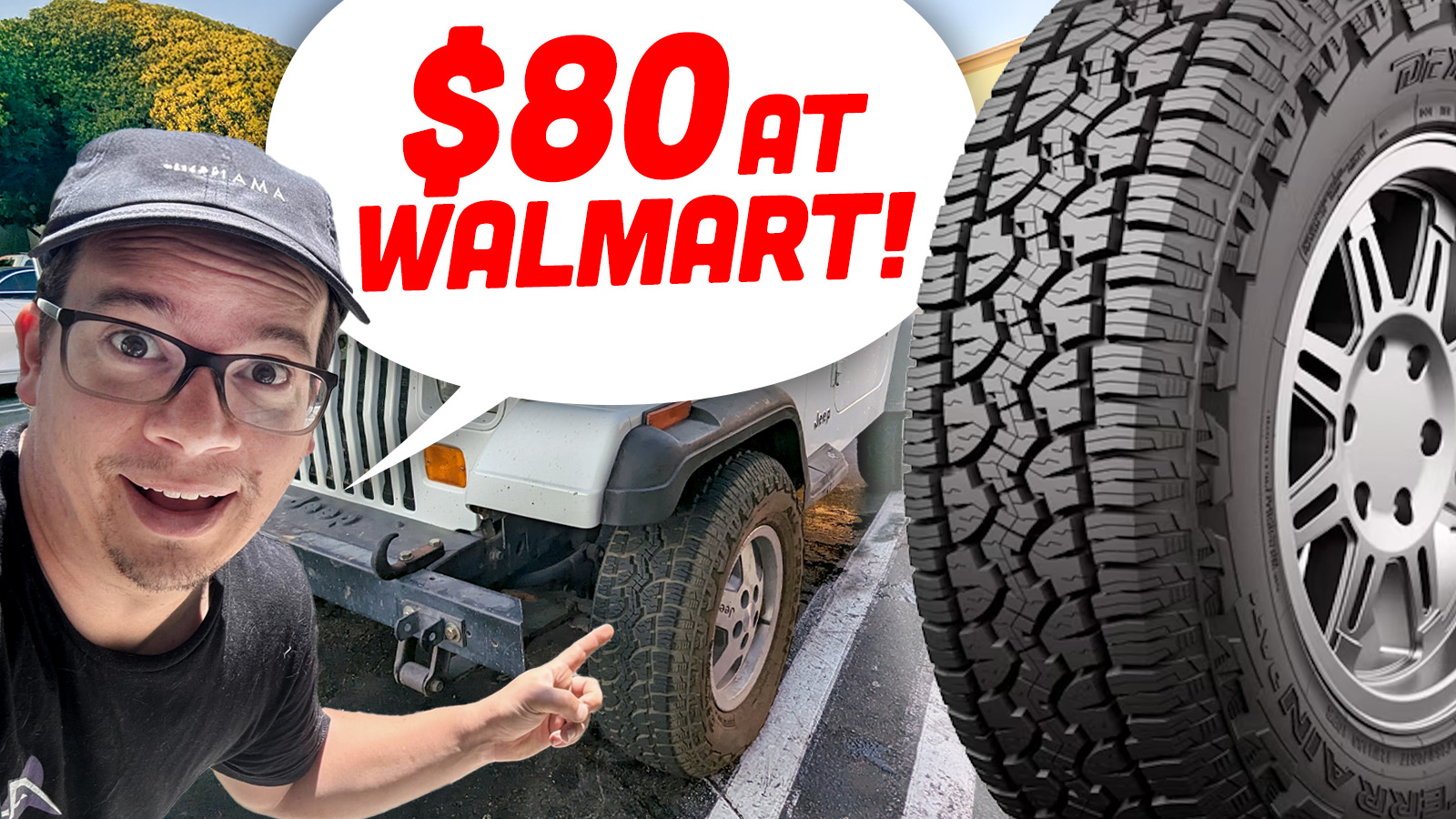
Eighty dollars. That’s all I spent on each all-terrain tire I have wrapped around my 1991 Jeep Wrangler YJ’s 15-inch five-spokes. Typically, I think tires are one area where one should not ever “cheap out,” but I took a risk this time at my local neighborhood Walmart, and I’m glad I did. Here’s why.
Oh I’m going to get some flak for this one. Mention “cheap tires” in any car-enthusiast community and you can expect to get eviscerated. And I get it! Tires are the glue between a vehicle and the ground; without good ones, you can kiss acceleration, braking, handling, fuel economy, road noise, and all sorts of extremely important vehicle attributes goodbye. Tires are just too important to compromise.


My philosophy for the longest time has been to purchase junkyard tires. My view was that I’ve purchased many used vehicles without immediately replacing their tires, so used tires have been good to me. More importantly, junkyard prices meant I could get high-quality, brand-name rubber for less than a brand new cheap tire. “A quality-brand tire is more important than the tire being brand new,” I reasoned after checking the tread depth with a gauge, reading the manufacturer’s date on the sidewall, and inspecting the tire closely for defects.
This strategy has worked out great for me. I’ve had all sorts of fantastic Michelins and Firestones and Goodyears and Nexens and BFGs and all sorts of other quality brands on my vehicles — all from junkyards. It’s just one of the many ways working on my own vehicles and frequenting junkyards has let me drive vehicles with components that are much, much more expensive than I could ever afford new.
But my move to California has put what I hope is a temporary halt on my access to cheap, used junkyard tires, so a few years ago when I bought my 1991 Jeep Wrangler YJ, I headed to Wally World.
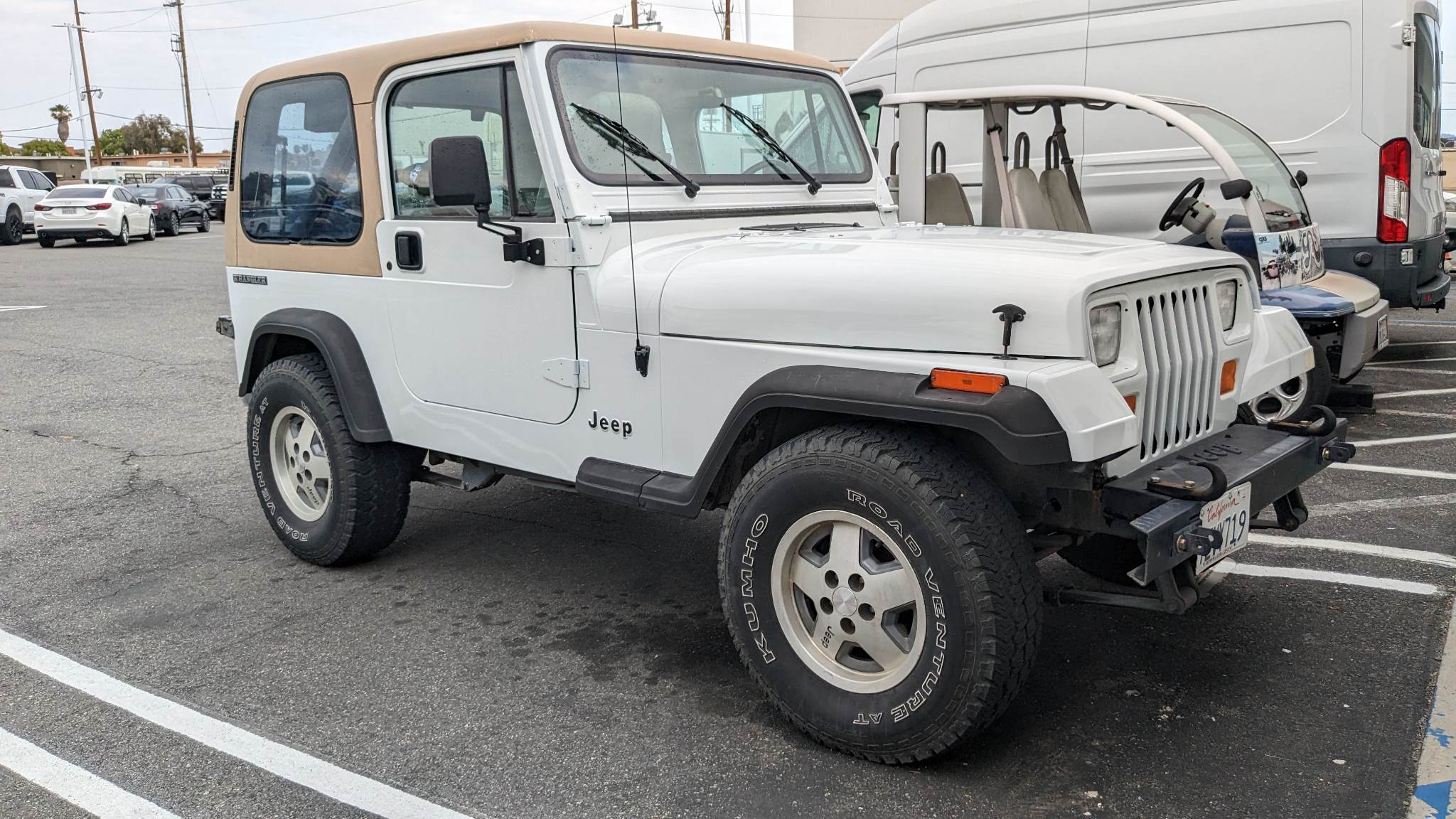
The Kumho Road Venture ATs that came on my Jeep were too large, and were rubbing on my rear fender flares. What’s more, they were old and dry-rotted. They had to go.
I wasn’t really up to spend a ton of money, but when my local junkyards and Facebook Marketplace came up short, I went to Walmart.com and filtered for all-terrain tires under $90. These are the two I got, with the very cheapest tire being one called a Dextero All Terrain DAT1:
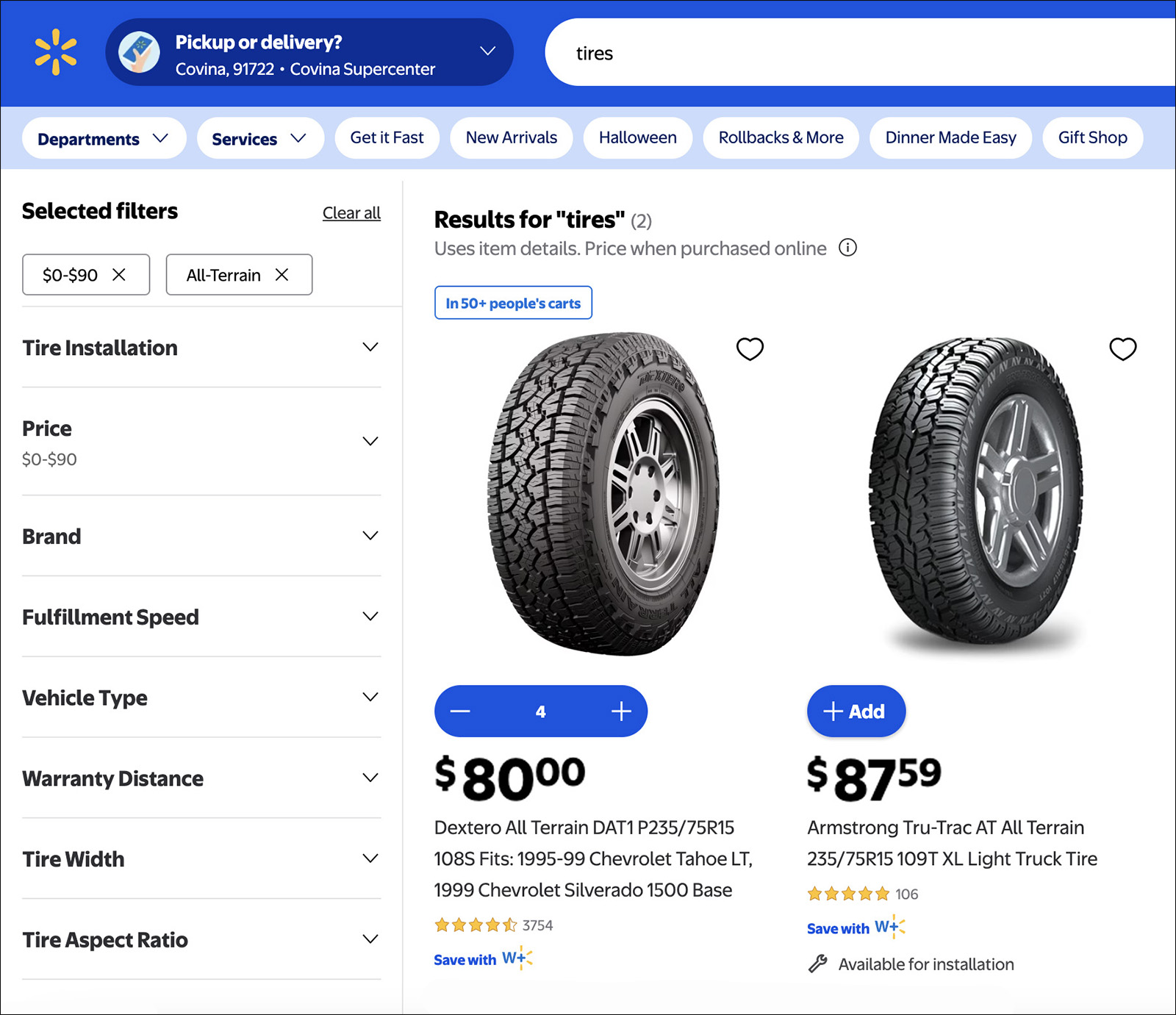
Only $80!
To put that into context, the average 235 75R15 all-terrain tire probably costs about $130, with the cheapest name-brand being the Goodyear Trailrunner A/T at $105 a pop at my local Discount Tire-equivalent. Multiply that $25 delta by four and the Dexteros save you $100 even over those cheap Goodyears.
Image: Walmart
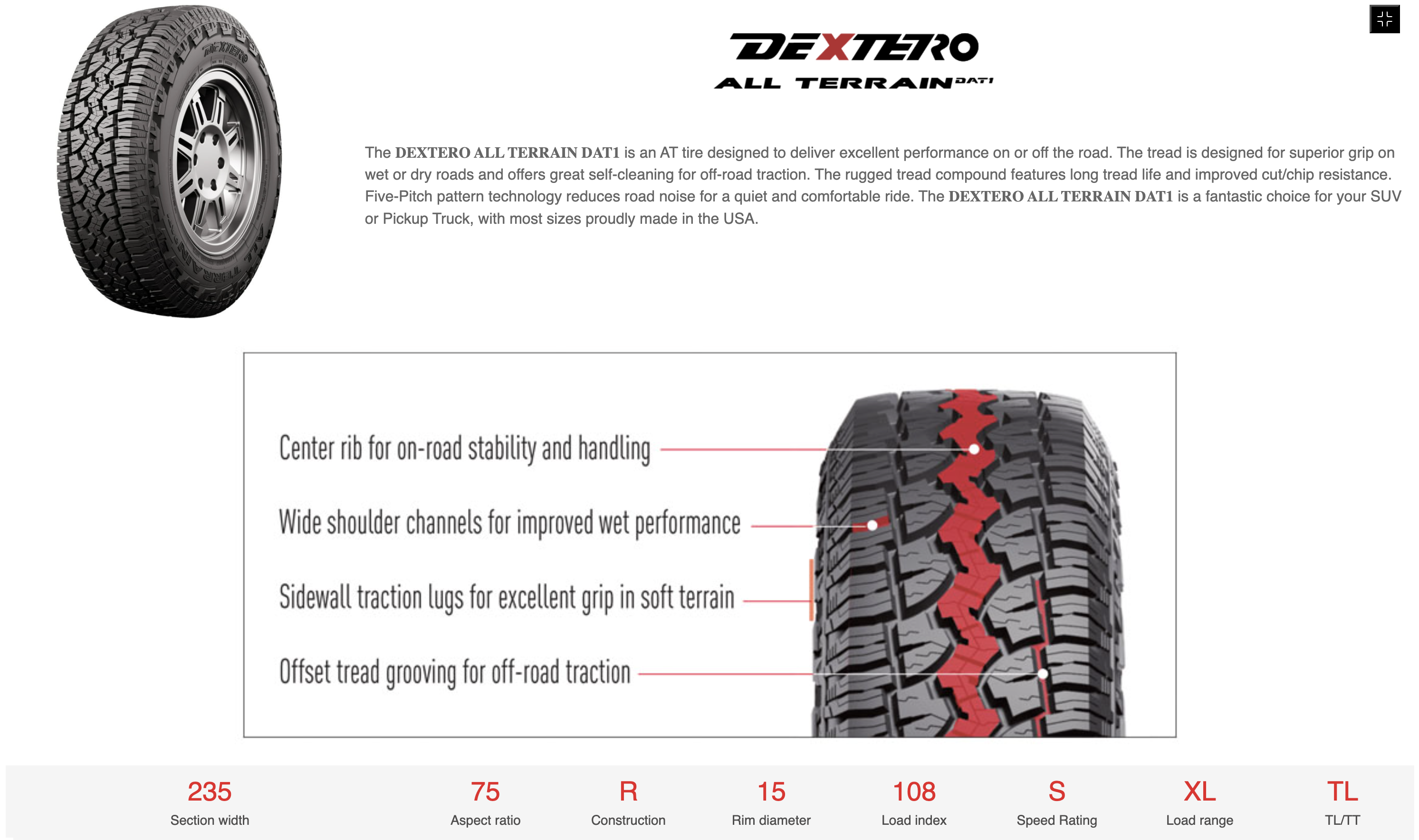
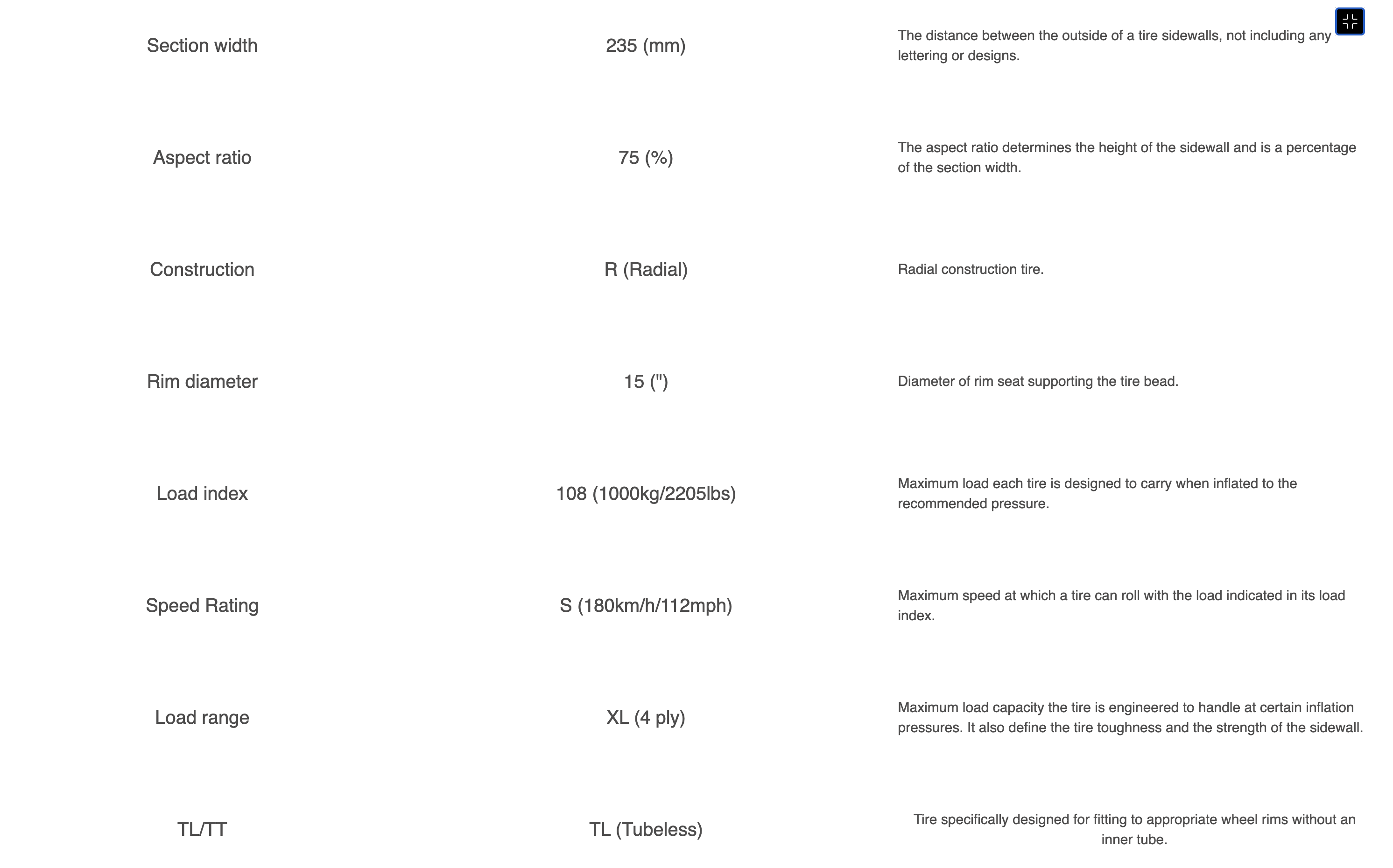
“But who the heck even is Dextero?” you might wonder. Well, according to the brand description on Walmart’s website, the tires are actually made in the good ol’ US of A!:
The DEXTERO ALL TERRAIN DAT1 is an AT tire designed to deliver excellent performance on or off the road. The tread is designed for superior grip on wet or dry roads and offers great self-cleaning for off-road traction. The rugged tread compound features long tread life and improved cut/chip resistance. Five-Pitch pattern technology reduces road noise for a quiet and comfortable ride. The DEXTERO ALL TERRAIN DAT1 is a fantastic choice for your SUV or Pickup Truck, with most sizes proudly made in the USA.
The brand itself isn’t American, though. It’s actually part of Singapore-based Giti Tire Group, which operates eight tire manufacturing facilities, with one having opened in South Carolina back in 2017. Still, the fact that these tires are made in the U.S. makes me feel less uneasy about buying them this cheap, and any remaining unease disappeared once I installed them on my YJ. These tires are surprisingly decent both on dry pavement and off-road.
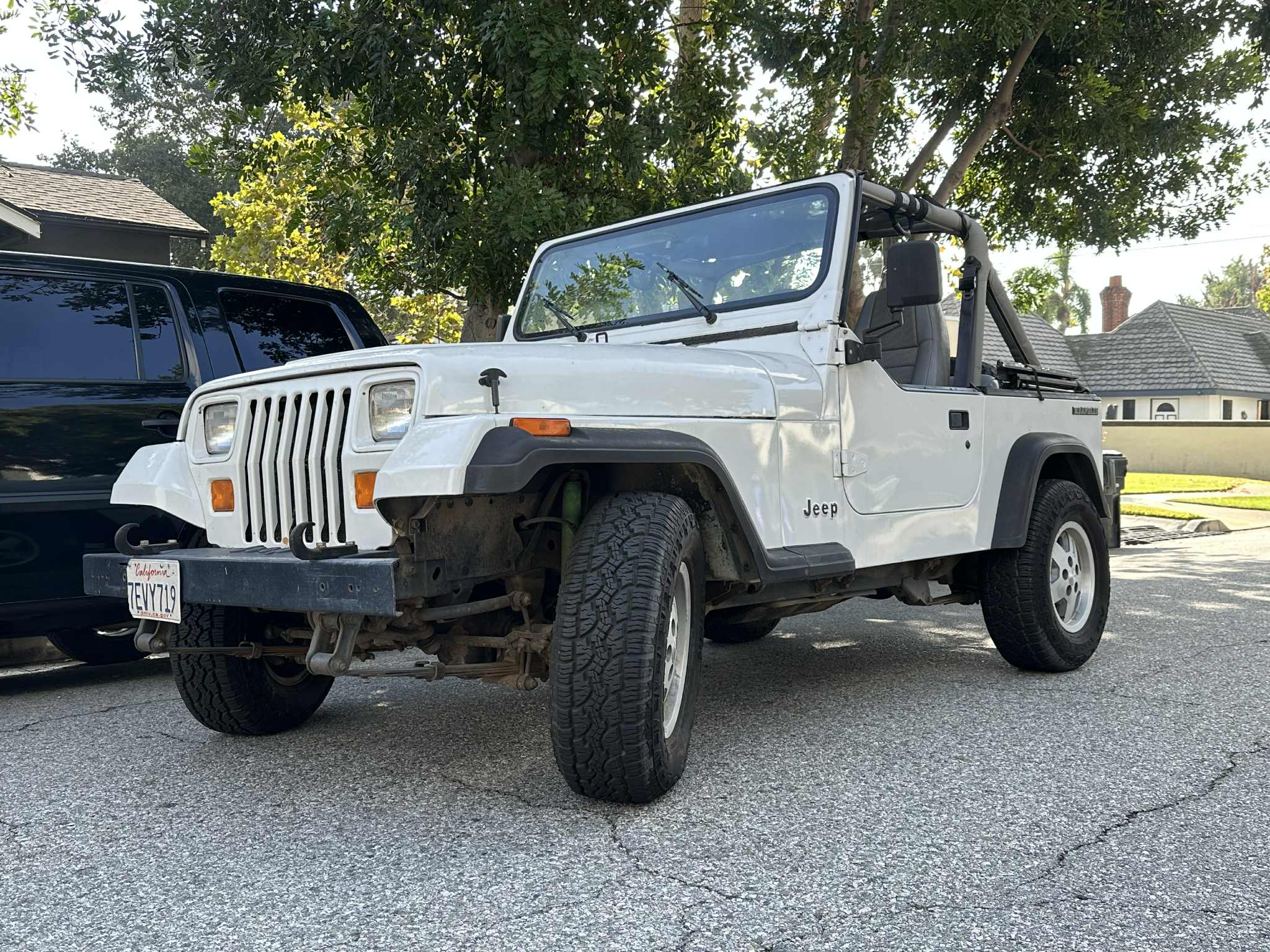
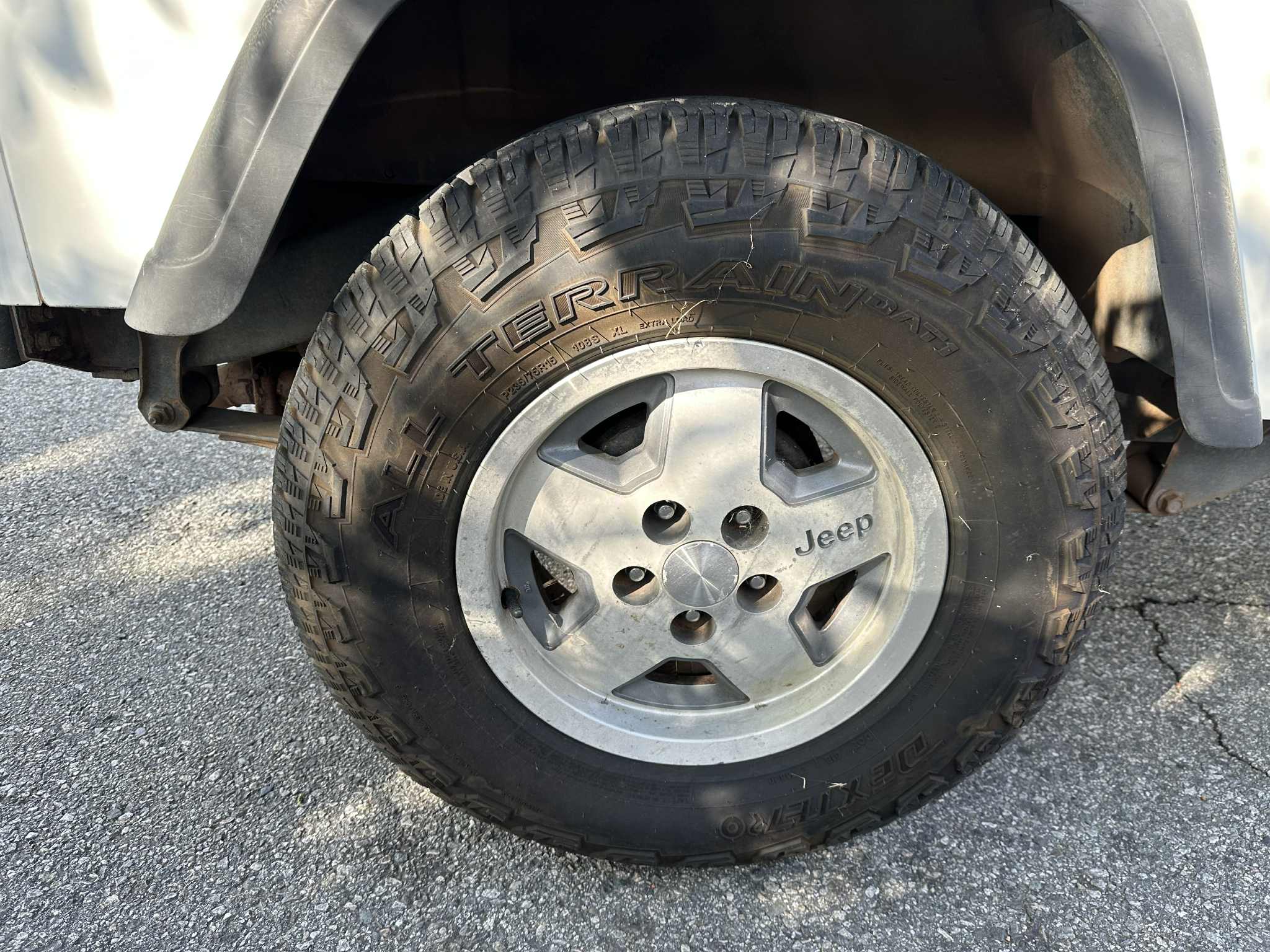
On pavement, the tires are fine. I’ve really only driven it on dry roads, so your mileage may very in the wet (admittedly, Southern California roads represent the easiest testing-ground for a set of tires, as there’s rarely any moisture, so perhaps my expectations for these tires were too low). Tire noise is good, ride quality/comfort is good enough to where I don’t notice it on my already-bumpy Jeep Wrangler YJ, grip is more than I need for my application, and fuel economy isn’t something I’m going to be able to test driving this old brick. Treadwear after 5,000 miles appears normal.

Off-road, the tires have great grip on dirt and rocks. I tend to air my tires down to 20 PSI when I’m off-road, and that made for good ride comfort to go along with the grip.
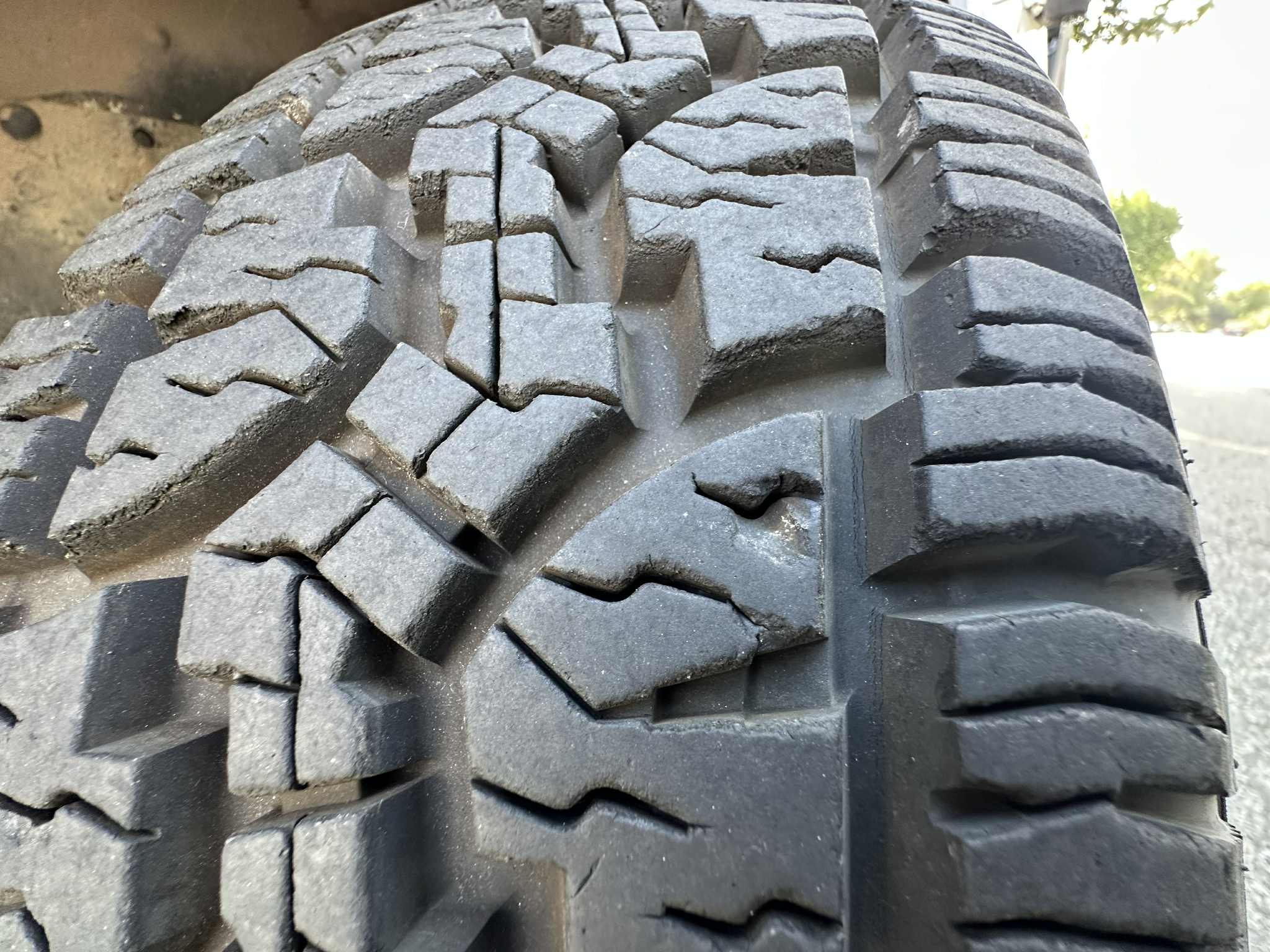
If there’s one complaint I have it’s that some of the lugs get damaged every time I go off-road. Here you can see some broken pieces and just general wear (of course, I’m sure if a more expensive tire would have fared much better.):
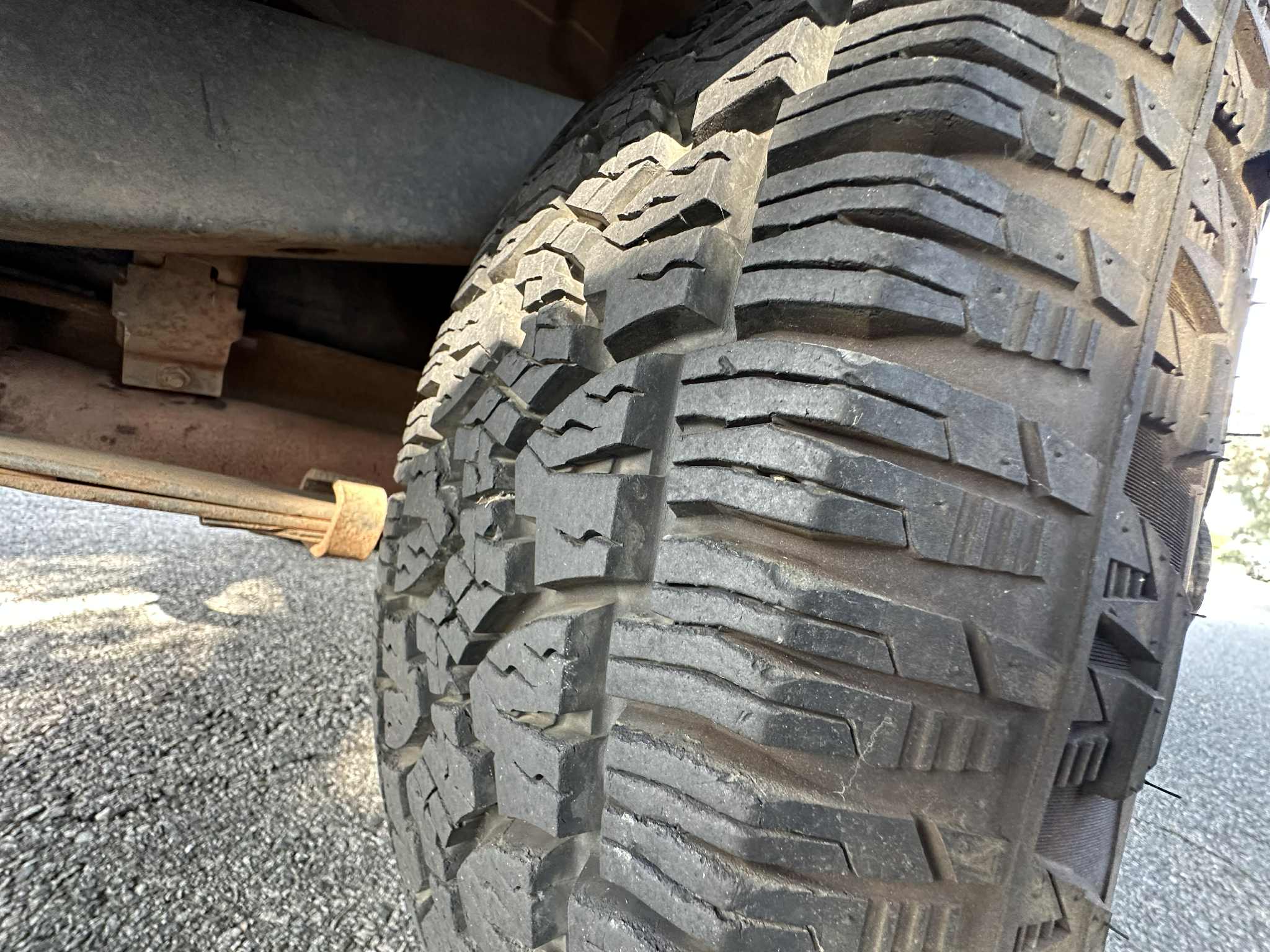
But for my use, these USA-made Dexteros have been fantastic and worth every penny of $80. At least on my old Jeep in Southern California conditions, I just don’t know that spending even another $25 per tire on nicer rubber would have netted me significant enough benefit — or at least not one I can prove with data. And that’s exactly where I like to operate: On the “knee” of the benefit-cost curve, right at the point where spending more cash yields diminishing returns.
I’m not the only one. The tires have over 3,700 reviews on Walmart.com, with an average rating of 4.5 stars. For the most part, based on my internet research, it seems these tires are considered a solid value.
P.S. For my wife’s car, I bought Michelin CrossClimate II’s at an outrageous $1000 a set. I will do this again when they wear out.



I shop Walmart a lot. If for no other reason than to revel in the brand names.
Unfortunately, they seem to have dropped Ling Longs.
Most of the off brands are from Southeast Asia.
I know that I’m late to this discussion. Many years ago, I put a set of Michelin tires on our 2001 Toyota Highlander. It replaced the dreadful Goodyear tires that were OEM. The handling was so improved, I thought that someone had modified the suspension when they installed the tires. These days we drive so few miles, I’m trying to determine at what age is it appropriate to replace tires due to UV and environmental degradation (northern CA) rather than tread wear. I just priced out a new set of Michelin and they run $250 each. Any advice on age limitation is appreciated. Although the price seems high, even given inflation, I will probably go with Michelin since it will probably be the last set of tires I buy. I’m getting up in years.
I just read where David is buying Michelin for Erin (NHRN). OK, good choice!
Also Nor cal here. I replaced the Michelins on my 3/4 ton dodge truck at 9 years from the date of manufacture. They only had 18,000 miles on them and still looked and drove great (lots of tread depth, no cracking on the tread or sidewalls) but I was selling the truck and wanted fresh tires on it for the prospective buyers. Michelin seems to have solved the sidewall dry rot problems that plagued the original 2005 era Michelin load range E tires on the truck back then.
Interesting article! I’m pleasantly surprised to see that there are good options for budget-friendly tires…not sure that’s the route for me though. Given the lack of options from Michelin for 15″ rims, at some point (hopefully not soon!) I’ll need to do some serious research.
I think it was mentioned elsewhere, but these are SMU of the GT Radial Adventuro AT3. With the punitive taxes on east Asian tires, making tires in the USA can actually make a compelling value argument. I was actually just look at these (the GT Radial version) for my new to me LR3 beater!
I just can’t do bargain basement tires. Wife’s car – bought used – came with a set of GT Radials, and they were the loudest, harshest riding passenger tires I’ve ever experienced, and were absolutely abysmal in the snow. Even though they had plenty of tread life left, I pulled them off for a set of discounted Goodyear Assurance WeatherReady that are so much better the wife (who never notices such things) even commented on how much nicer her car drove.
I just put a set of the Goodyear Assurance WeatherReady tires on my daily driven 2016 Civic. When the WeatherReady2 came out, the 1st gen went on closeout. I’ve been pretty happy with them, but I’m only about 7,000 miles in. My wife’s Odyssey has the Michelin CrossClimate2 tires. I will buy them again in a heartbeat. I strongly considered CrossClimate2 for my Civic when the time came, but the 1st gen WeatherReady was too good of a deal to pass up. Between my employee discount and an $80 rebate I got them for crazy cheap.
I’m a Honda service advisor and my favorite car repair is selling tires. I research tires daily for fun.
My mom’s 2020 Passat came with Gitis from the factory. No one in my family had ever heard of the brand before this. They were fine.
I’m fine with cheap tires for this specific use, but if you have a relatively quick and/or heavy car that you drive on the roads, spend a little bit more and get proper tires.
The problem with cheap tires is not that they self-destruct, explode or wear down in seconds, it’s that when you have an emergency and you need to brake quickly or avoid an obstacle, you’ll end up dead. Watch videos on braking distances and cornering grip on cheap vs good tires. It’ll open your eyes.
Is anyone else surprised at just how cheap even name-brand tires are for the Jeep? I have not bought a tire for under $200 in years. Even most ATs for my 2007 Ridgeline (245/65R17) are over $200 on TireRack.
The 15” wheels probably help with that. But around here(Kentucky) most places don’t keep them in stock and have to order them.
That’s a good point. I consider my Ridgeline old, but my 97 Miata is older (and also on 15″ wheels” and those can be found around $100. That said, performance tires for the Miata in 195/50R15 are all over $200.
Don’t have access to junkyard tires in SoCal? David isn’t looking in the right places, there are dozens of neighborhoods in San Diego (and I’m sure even more in LA) where you can find 3-4 shops offering “llantas usadas” on the same block. I’ve never had a problem finding a set of BFG all terrains with good tread and date codes within reason for $300-400 installed…
I need to get some right places in the San Diego area as my go to places used to be around Brown Field Municipal Airport and the pandemic took most of these places out of business.
Completely anecdotal, but I had cheap Walmart All Seasons on my Suburban, they were installed when I bought the truck and basically new. They held up great for 4 years and provided decent traction, but I had to replace them because there were large sidewall cracks at 4 years old. They lived a hard life being parked outside all the time, but previously I owned tires from Yokohama, Kumho, Blizzak, Michelin, Continental and never saw dry rot like that at 4 years old. I replaced them with Generals but sold the truck 6 months later so I don’t know how they held up, the Generals wound up being $115/tire after rebates but I think I could have gotten another set of Kellys for $15-20 less ea.
In my experience if you can wait, the rebates bring more reliable brand name rubber down in price. I normally start planning my tire purchases when I change from winters to summers so I usually have a season+ to shop.
I bought a set of Generals for my Jetta and liked them enough to buy a set of Generals to replace the Contis that came on our MDX. They were fine. I replaced the horrible Goodyear Eagle LS tires that came on my Accord with Contis from Discount Tire during a rebate deal. Oddly enough, my Jetta had also come from the factory with Eagle LSs, but they seemed a lot worse on my Accord. They still had a decent amount of tread left but would hydroplane like crazy during Texas cloudbursts.
I think it would be fun to work at Tire Rack and test tires all day. But I would have probably ended up working in shipping. Lol.
I haven’t had many BAD tires but I bought a used 3 series with Yokohama all seasons and an extra set of winter tires. My first winter with that car we got a very light snow that I didn’t expect, and I literally couldn’t make it the 3 miles to work the next morning, I had to walk up the hill back to my house to get the winter wheels/tires and roll them down to the car to change.
Those cheapo kellys on the suburban handled snow better than my friends expensive a/t tires with a 3-peak snow rating.
That sounds like a bad day. I had an early 90’s Olds 88 (FWD) with very ordinary tires. Not sure what they were, but other than braking on ice, it was pretty sure-footed. I think you would need studded tires to get much braking on ice.
Meh, I didn’t care about that job, and I never had a bad day with that car, maybe I felt different on that day but now its a funny memory. I am sure it was a spectacle to my neighbors.
I think you need studs for black/glare ice but I have been very impressed by Blizzaks on a snow/ice/slush mix.
It just sounded like a big hassle. I’m retired now and when the roads sound sketchy, I just stay home and eat leftovers. It’s pretty rare for roads to get like that here in Tacoma. It is hilly, so it is a consideration. I once was fully into ABS in my old Jetta and slid downhill through an intersection that fortunately no one else was going through. Pulled the hand brake and flipped around so the curb I hit was on the back end of the car. Which I figured was less fragile. No harm. No foul. I don’t need to do that again.
This spring I was looking for a set of off-roadish tires to replace the stocks on my jk wrangler. Ended up settling on Sailun R/T’s. Paid just a little over $1000 for 5. For a budget rugged terrain tire they have been great. Not too much road noise and they’ve been pretty respectable in the mud as well. The biggest complaint is that they pick up rocks like crazy but that’s to be expected. I’ve put about 5k miles on them and you can’t see an ounce of tread wear. Probably wouldn’t want them on my daily but they’re great for a weekend toy/cruiser.
There’s nothing wrong with a decent budget choice, and sometimes, buying expensive tires is straight up pointless. I few years ago, believe it or not, I “overtired” the A112, putting sticky Yokohamas on it that produced way too much grip for the chassis to handle. After that, I went for more reasonably Toyos, and the car just felt better on tarmac. I know that’s no really the same issue, but the point is to choose a tire for your specific needs and at a comfortable price range. Gas is expensive in California.
what is way too much grip? seriously asking here.
grip is the primary function of a tire…what are you talking about?
Thanks.
For lower-powered, lightweight sporty cars, if you’re not using it for some kind of times competition, too much grip makes the car less tossable due to the higher level of grip.
Tossable, as in easy to slide, or drift, etc.?
In 55 years of hard driving my experience is that you always want ALL the grip possible.
Please see auto racing for a real life explanation of grip…in essence it is exactly what makes a car tossable.
Grip is the reason for good tires in any situation.
Thanks.
Yes, easier to reach and explore the behavior of the car near its limits without going terribly fast.
For track use, you want all the grip possible. But if you want to get some nice steady state oversteer on a rural winding road in something like a Miata, you don’t want ultimate grip.
When the Toyobaru came out, they famously put the same tires on it as the Prius for this reason.
Thanks. I get what you mean now.
Not an argument here.
Yet experience has taught me, sometimes the hard way.
I want ALL the grip, all the time. And I have yet to find any non race tire that did not “break away” from its intended course either.
Just the same I will take maximum grip over drift, etc. anytime.
Appreciate the POV here.
Thanks! I agree with you on my more powerful car – I want all the grip on my Hemi Challenger, since I can overcome that with the throttle. But on my RX-8, I like having three-season tires but in the stock size.
Still, the most fun I’ve had in a car was driving my 1988 RX-7 in the snow. Perfectly balanced and you could really explore its behavior at very low speeds. I spent a lot of snowy nights in college in a nearby mall’s parking lot, seeing how far sideways I could get and still recover, and I probably didn’t exceed 25 mph.
I see your point and agree. My first car was a 69 Super Bee.
And I tend to appreciate handling and slow car fast a whole lot more the last 40 years.
I grew up in the snow so also did that at lot too. Great way to learn at low speed.
Whenever I buy a new set of tires I go to the school parking lot after hours and break them in by trying to learn their limits, within reason of course.
To me, too much grip is when your vehicle feels nervous at the edge instead of having a nice transition between gripping and a controlled slip that helps you through the corners. Granted, my suspension is very old school, so there’s a real limit to how much grip the car should have before it would become a hillclimb racer.
What is an A112? An Autobianchi? Or Lancia?
I don’t hoon around like I did as a kid, and at this point in life, I want as much grip as possible for the rare occasion I need as much as I can get.
Fair enough. It’s an Autobianchi A112 with an Abarth engine.
I do watch for an A112 Abarth now and then. There aren’t many in the US but there’s more than you’d think.
I remember seeing one a few years ago, perhaps with Utah plates? It was an early seventies car. I’m sure there are a few, you guys can import pretty much anything by now.
Can you actually tell the difference between good and bad tires on a Wrangler on pavement? They make smooth roads feel like dirt anyway.
I am long past cheaping out on tires, if for no other reason than I always found them to rarely want to stay in balance and develop weird pulls, wear weirdly, etc. As with all things, there is a happy medium, and I find most name-brand tires hit it pretty well. I have rarely been impressed by Michelins, various Pilot Sports excepted – those things are magic, though wasted on cars without sufficient performance to bother. I just get whatever name-brand I can find on-sale/closeout, and I rarely wait until I NEED tires, so I just start looking well in advance of getting desperate.
Every time I bring a car to the dealer they want to do an alignment and balance the tires – yes my cars are sporty and thus the specified camber will wear the outer blocks relatively fast, but the car is likely in alignment. And, if the car is driving smoothly do not let the dealer balance the tires – they are more likely to screw it up than make it better. I have found one tire store that, somewhat surprisingly, has so far done a good job (it’s my local Monro Store), and if I have an imbalance will take it there for half the cost of the dealer.
have not paid for or had an alignment for 45 years ever, except when having to replace front end stuff. so on ly did one or two since 1985 or so.
no issues. YMMV.
Yup. I just sold my 2005 Dodge 3/4 ton 2wd diesel truck a few days ago- bought brand new. I never did a single alignment. Not one. And it still tracked straight and wore tires exactly evenly on the original steering and suspension components with the exception of one set of replacement swaybar end links.
Yup – my BMW dealer wanted to do a tire rotation, wheel balance, and alignment (to the tune of $500) at every single free service on my 328! while the car was under maintenance warranty. For a car that tracked like the TGV, rode smooth as glass at >100mph, and wears tires PERFECTLY evenly. And the BMW Owner’s Manual specifically states in black and white that BMW does not recommend tire rotations.
But how many people fall for that BS? My 128i is going to get probably it’s first alignment since the factory did it soon, but only because I am replacing the front struts. Annoyingly not because it needs struts, but because the bump stops have disintegrated and it doesn’t make sense to JUST replace those given what a PITA taking it all apart is. Hopefully the good Indie shop here in town does decent alignments.
I am also not sure that modern cars easily go out of adjustment. In the old days you might have a centerlink with long arms and threaded tire rod ends that bend and warp and maybe twist, and a few other pieces that were adjustable, now you have a couple of relatively short tie rods coming off of the rack that are short and strong and that do not move around that much with use and typically no (front) camber adjustment (at least on BMWs)
Yes, generally unless something is bent or worn out, a modern car will rarely need one. Officially, toe is it on most modern cars, and if you are adjusting anything else something bad happened, or you are trying to do goofy things to the poor car.
4 leaf springs under a 30 year old YJ… honestly the tires do matter as the suspension really isn’t helping much. So a tire that takes the bumps better and provides a little grip is a massive improvement!
And that’s exactly where I like to operate: On the “knee” of the benefit-cost curve, right at the point where spending more cash yields diminishing returns.
I love that terminology, and will have to use it! (at least internally)
I think that’s about my philosophy too, and I’ve been studying Zener diodes, and the knee on their charts, recently, so the analogy makes perfect sense to me!
I remember first learning about Zener diodes and thinking “Zener” was old-timer southern slang* for what had to be actually called zenie or zena or something like that. As soon as the lecture was over I looked it up in the associated reading material and was mildly shocked that was indeed the correct name.
*this was at an Air Force electronics tech school in Biloxi MS being taught by a 60+ year old instructor with an appropriate drawl who happened to have “interesting” ways of pronouncing things…
I will never buy another all season tire besides CrossClimate 2’s (unless they come out with a 3)
They did recently release the 3: https://www.michelin.ie/auto/tyres/michelin-crossclimate-3
CC’2s are all weather not all season, version 3 is out but only available in Europe for now. Wonder why David would have a need in southern California.
He has a need because that’s what his wife wants.
Roger on the home boss!
She gets only the best. And we go skiing once every two years lol
All the mountain passes on various interstates and state highways. Like the I-5 Grapevine/Tejon Pass, where it does snow sometimes. Or Angeles Crest, Hwy 2, Highways 18, 38, 74 etc at higher elevations.
My sense is that, as with most categories of manufactured goods, pretty much everybody has benefitted from advances in materials and processes in the modern era (obviously with a few glaring exceptions).
In my (rather long) lifetime I have had problems with Michelin, Firestone, Goodyear, Continental, General, Cooper, Uniroyal, etc. brands with regard to defects like being excessively out-of-round, and premature tread separations – I never even got far enough to complain about things like ride quality or traction. Oddly enough the only brand (over 5 sets of them) that was basically flawless was BF Goodrich (but that’s anecdotal and irrelevant).
30+ years ago, anything made by Asian manufacturers (notable exception: Japan) was automatically suspect quality-wise, to say the least. Now they are on par with USA (or German) made, and in some cases better (e.g. electronics)
You have a good point. There’s a pretty good chance that the “cheap-o tires” David just bought very well may have been built with better quality control systems than the top of the line options available when his YJ was built.
This logic really only applies to tires available from reputable sources (ie. national chains with something to lose if they sell unsafe crap). Questionable internet sites and sources are still probably best avoided.
Rubber has a vast range of allowed recipe deviations and some components may be substituted when their prices get high – the better tire makers will have chemists that enforce high quality, but most will just hope the substitution is good enough. There is a surprising variation in batch to batch rubber production (at most places). It is possible to do an exact recipe, but the managers will want to make substitutions to save a few pennies.
I will defer to your deeper knowledge of the materials and chemistry. My point was simply that most manufacturers have the technical ability to manufacture to higher modern standards – whether or not they choose to is another matter…
Agreed they have the capability, but maybe not the economic spine to keep up the high quality if profits begin to get squeezed for any reason.
It’s good to see decent tires at the more affordable end of the spectrum, something for everyone. Our beater Dodge Dakota truck up north needs new shoes and I’m looking for some cheap off roads tires to replaced the old and approaching wear bar BFG’s. Those might just fit the bill, hope they come in 1998 sizes, lol.
I am curious how they are in colder temps, maybe a dab of slush (it’s a seasonal place but we get some freezing temps start and end of season) also rain and mud, because well… northern MI. Do not expect amazing or K02 level stuff but would be nice to have confidence driving and be safe.
Have the gamut in this house, Crossclimate 2 for wife’s suv (awesome), Firestone oem le2 for my truck (ok but wear fast), Michelin Pilot Sport 4S on Zl1 holy crap pricey but that car needs really good tires or it becomes a bastard… but the up north truck I need something good but not break the bank…
David don’t feel bad about Crossclimates yeah they are pricey but… I’ve been in some of those 100 year flooding events in Mi with them or ice and snow – specifically 1/4’’ ice on that I75 curve by Big Beaver in Troy by your old stomping grounds and it kept us safe and in control while all kinds of stuff was in the ditch… figured it saved us a tow at best or way worse wreck at worse..
David can we get an update after some other conditions?
if you don’t drive like a jackass even budget tires are “good enough” for traction. the more expensive tires shine when it comes to comfort, road noise, and tread life.
An Update would be great as well as maybe having David drive in a colder climate this December or January. I found a set of Firestones that basically turned into stones on winter in Northern Georgia. I was parked on a steep in in the winter (No snow or ice. Dry conditions.) and the truck started to slide down the road. It only happened that one time but I blamed the rubber compound at those tires at that time. (12 years ago.)
Now I look at tire harness when searching for tires.
South Alabama here. Had a set of Generals on my Toyota truck.
A TOTAL waste of money, and deadly to drive in both rain, and temps below 32 degrees.
Hard as a rock, and would at times actually spin out the truck in fast or emergency maneuvers, especially in the wet, or (rare) ice conditions.
I did a few 180s and 360s and even a 720 at 50+ mph with those pieces of crap. Of course this all happened at speeds above 50 mph.
In heavy traffic, on a 4 lane road.
Not fun at all.
I could not wait to replace them…
Never again.
I’m excited to take her CrossClimates in some snow.
I will not be doing the same with the Wrangler. It basically only drives when it’s dry.
I spent weeks in my search for 37″ tires for my Gladiator. I knew I wanted a agressive A/T or an MT. I looked at weight, mounted diameter, price, read every review and watched lord knows how many videos. I finally settled on Kenda Klever MT2’s. They werent the cheapest, or the lightest. This size can run from $300 to $600 per tire and I found myself about in the middle at $400ish. They have been on for 10 months and about 12k miles. Mostly daily driver miles but several trips to offroad parks with plenty of rock crawling. No big chunks missing (yet) and no appreciable wear. I expect to get 40k or so out of them.
David Tracy buys cheap ass tires you say?
I am shocked I say, shocked…
What’s an ass tire?
I replaced the awful OEM Bridgestones on my Mazda 3 with some $65 a tire Lexani LX-Twentys, and they are better tires in every way except treadwear. I was only after a temporary set of tires (waiting on CrossClimate 3 Sports to make it to the US), so getting 20k miles out of a set for $260 total didn’t really bother me. As it stands I have about 7k on them now and will be swapping my winter tires here in a couple weeks.
The second set of wheels were free and I put some Pirelli Cinturato Weatheractives on them. For those wondering why I didn’t just get a good set of tires in the first place, a LOT has changed in the last six months (tires were purchased a year ago) and I wasn’t expecting to need anything beyond summer tires so soon.
We did a lot of GT Radial branded tires (also made by Giti tire) when I had my shop, these are almost identical to the GT radial Adventuro AT3. If memory serves me correctly, the tread design here was purchased (or given to) Giti tire from a rejected Michelin concept design.
Again, this is going off what my distributor rep told me 12 years ago, whilst we were both half crocked on free Michelob, so take this with a grain of salt- But apparently Indonesian Giti radial was trying to make a big push into the North American market, and wanted to come to market with a much more aggressive and longer lasting all terrain than their previous offering, to try and build some brand loyalty through small indie tire shops.
I bought into it and picked the line up, and their truck stuff actually turned out to be terrific. My Customers were impressed with the wear for my “Economy” line, they were terrific to deal with over mileage warranty claims, and I even put a set of their Adventuro M/T tires on my personal Jeep, because they just looked so damn good.
Getting picked up by a retailer like Wal mart must have been huge for them, and while I’m normally “Either American, Japanese, or Michelin made or it’s not going on my car” the truth is this company entered the market right-By offering an actually GOOD product for a very affordable price. Just because “you get what you pay for” is true doesn’t necessarily mean that everything inexpensive is trash.
The #Poors deserve to have good options to purchase new.
Well said!
What is this, a scene from Shane Gillis’s TV Show Tires?
A few years ago I saw a red, white, and blue label on a new tire that said, “MANUFACTURED for THE USA!” “For” was in very tiny print. I laughed my buns off.
David, since you knew the WalMart tires were going to trigger many responses, I might suggest an expose on WalMart motor oil, (Then you can tell us what kind of oil goes into your sweet spouse’s Lexus.)
A long time ago on jalopnik he mentioned that he bought the cheapest conventional oil at tractor supply and ran that along with sketchy cheap Amazon oil filters.
Walmart oil is fine and good but Costco oil is significantly cheaper and is at least as good. Full synthetic.
Correct on Tractor Supply Co oil, but incorrect on cheap Amazon filters. I use only VERY GOOD oil filters (I watch all the filter teardowns). Walmart Supertech filters can be very good, as can industry-grade Purolator stuff.
Walmart oil is actually good!
I sure hope so. Once, Walmart oil was made by Quaker State. I’m no mechanic, but I sometimes change my own oil, and the old-=school mechanics who taught me you never use Quaker State unless you were planning on buying a new engine or a new car. When I once worked at Walmart, the cases clearly stated where the merchandise came from, And Quaker State was always on the label. Now when I change my oil and want to use cheap oil. I use Coastal or brands made by Coastal. It’s good product and I never have any trouble with it.
I have Walmart Goodyear Wranglers (perhaps the Authority?) and they are fine on dry pavement and have great off road traction but OH BOY are they bad in the rain. Literally has better grip on gravel than on wet pavement.
I bought Wrangler Authority all-terrains. HORRIFIC in snow.
Best snows are Nitto SN2 way cheaper than Nokian , Blizzak etc
Good to know. I will avoid snow with that vehicle.
That seems to be the thing with Goodyears. They’re good at the specific job they were built to do, but don’t have a lot of bandwidth beyond that. A trackday buddy tried the Eagle Supercar 3s and while they were a close match for Michelin’s Sport Cup 2s on track, the ride was apparently much harsher on-road perhaps due to overly stiff sidewalls.
I haven’t run Wranglers on anything since the late 90’s but your description sounds exactly the same as my experience. I’d routinely run 4Hi just on wet conditions to avoid the rear stepping-out during perfectly responsible driving in the wet. I’d have thought they’d have figured things out over the past 30 years but I guess there’s something to be said for consistency…
Traction rating B is not a joke!
Once watched my buddy have to give up trying to turn uphill from a stop sign on the same tires. Truck literally wouldn’t move.
I’ve got these tires. Just after buying my 96 Jeep XJ over a year ago, I had a plan to get tires. While replacing every bit of rubber and suspension, I shopped around for the replacements to the dry rotted white walls that came on the Jeep. After finally convincing myself that I didn’t need an 800$ set of name brand tires, these Dextero AT popped up. First thing I checked was country of manufacture and was surprised to see USA. Second was the reviews and they were all 4* and above. I chose the 29″ set and was blown away. They ride great, air down just fine, float over sand and dig through mud, and are comfortable enough for daily driving.
Living in Florida, I can give some insight into their behaviour while wet: at 70 mph in the rain on the highway they are planted and go where I point them. They do not feel like driving on the edge of traction while raining. Hit the brakes hard and I stop in a respectable distance. The only thing I recommend against (this goes for any tire/vehicle combo) is don’t plow through standing water. They’ve worn evenly after a proper alignment and will cruise at 30 to 75 ( and a few trips to 90 just to say I buried the speedo) with no vibration.
They aren’t super responsive but I certainly wouldn’t say they’re dull either. That’s probably from a tall sidewall anyway, I’d suspect.
Good feedback! I might have to look into them in a year or two when the tires on my Tacoma start getting into “sketchy old” status. It’s sad that they’ll still have a ton of tread but they’re already 5 years old and at the rate of consumption, I don’t expect a significant about of wear between now and ten.