

My name is Tyler Boland, and I’m a 22-year-old college student majoring in history at a liberal arts college in Reading, PA. Growing up there in Berks County, there was a strong culture and proud heritage in a working-class made up of family members of World War veterans. Both of my Great-Grandfathers served proudly in their service during World War II, one in the Navy, the other in the Marines. But there were several key elements that stirred my interest in history.
[Ed Note: When I heard what Tyler Boland was doing to preserve the voices of WWII veterans, I had to reach out. Here he is with two veterans’ stories about WWII Jeeps; they’re short, but any new story from a WWII veteran is as good as gold. Thank you eBay for enabling this piece as part of The Autopian’s WWII Jeep build series. -DT].


The first influence was close to home. My mother began her career in education as a history teacher. Growing up, my interest in American History centered around the major events that shaped our Nation’s role in the defense of liberties across the globe. At first, wanted to learn about early American history, but as I got older my interests started to change.
In the fall of my freshman year of high school, 2019, my third-period class was history. We were supposed to meet a Veteran who served in Iwo Jima in the Marine Corp. As my interest in WWII started to grow at this time, I was very excited. But the day before he was supposed to come into our school, he passed away, at the age of ninety-four. This was devastating, but it pushed me to find a WWII veteran whom I could speak with about the War.
After doing admittedly amateur research, I found a local D-Day veteran in my hometown of Reading named Joseph Zebertavage. I went to this 95-year-old’s house, very nervous, armed with only a pen and paper, not certain what I was going to ask this gentleman. After talking with him, I realized that what was delayed on that first visit to my school only proved to be the experience that launched my drive to learn everything I could about World War II history.
This first encounter with the Veteran took place in April of 2019. Later that Spring, in June, I decided to attend The Mid-Atlantic Air Museum’s World War II Weekend, the premier event of its kind for honoring our history through D-Day remembrance, vehicles and aircraft displays, war Veterans and speakers, battle simulations, and vintage aerial planes and flight demonstrations.
That year marked the 28th annual event. It was a formative experience that forever shaped my drive to learn firsthand, from those who served and were still living, what occurred during the trying time that was World War II. At the show, I met another WWII veteran, Matt Gutman, who was from the Allentown, PA area. He served as a Higgins Boat driver for the 1st Marine Division. Coincidentally, he served with one of my great-grandfathers, who served in WWII as a Marine. These proud and inspirational men helped fill the void of not meeting my great-grandfathers, who both died before I was born. “Why did you get started? What got you interested in this?”
The fact that I had two family members whom I had never met who were heroes drove me crazy. Since that realization, I made a promise I would interview as many WWII veterans as I could, regardless of their story and where they are located.
At first, it was hard finding them, but over time, I found more. My goal was to meet one hundred, and at this point, I have well passed that. What started off as a high school project has evolved into something more. I interview at least one to two WWII veterans every week. Not only do I interview them, but I do many events with them. I host dinners, take them to veteran events, and even partner up with veteran organizations to take them back to their battlefields.
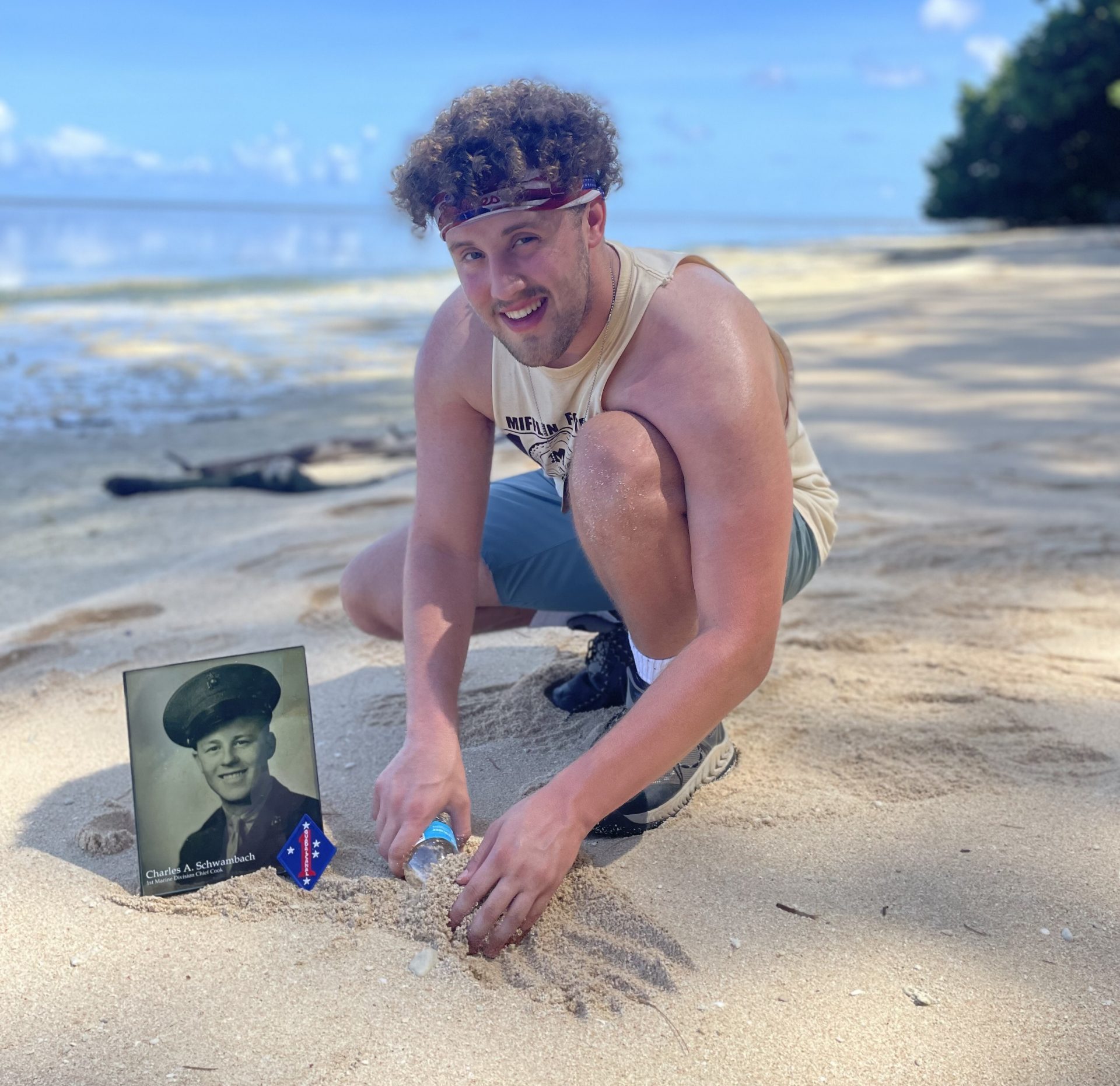
I could write hundreds of pages about the adventures I’ve had with this growing WW2 “hobby.” But the most impactful was the 42-hour trip I took this past May. I went across the world and traveled to the country of Palau. Within this island nation, I traveled to the island of Peleliu. Today it’s a peaceful, beautiful, hot paradise, but 80 years ago it was the site of one of the bloodiest battles in all of WWII. A battle that should’ve lasted three days took two months. It was so important for me to get there because of my great-grandfather. He had served with the 1st Marine Division and landed on Orange Beach. On this island, he received two Purple Hearts, which ended his fighting during WW2.
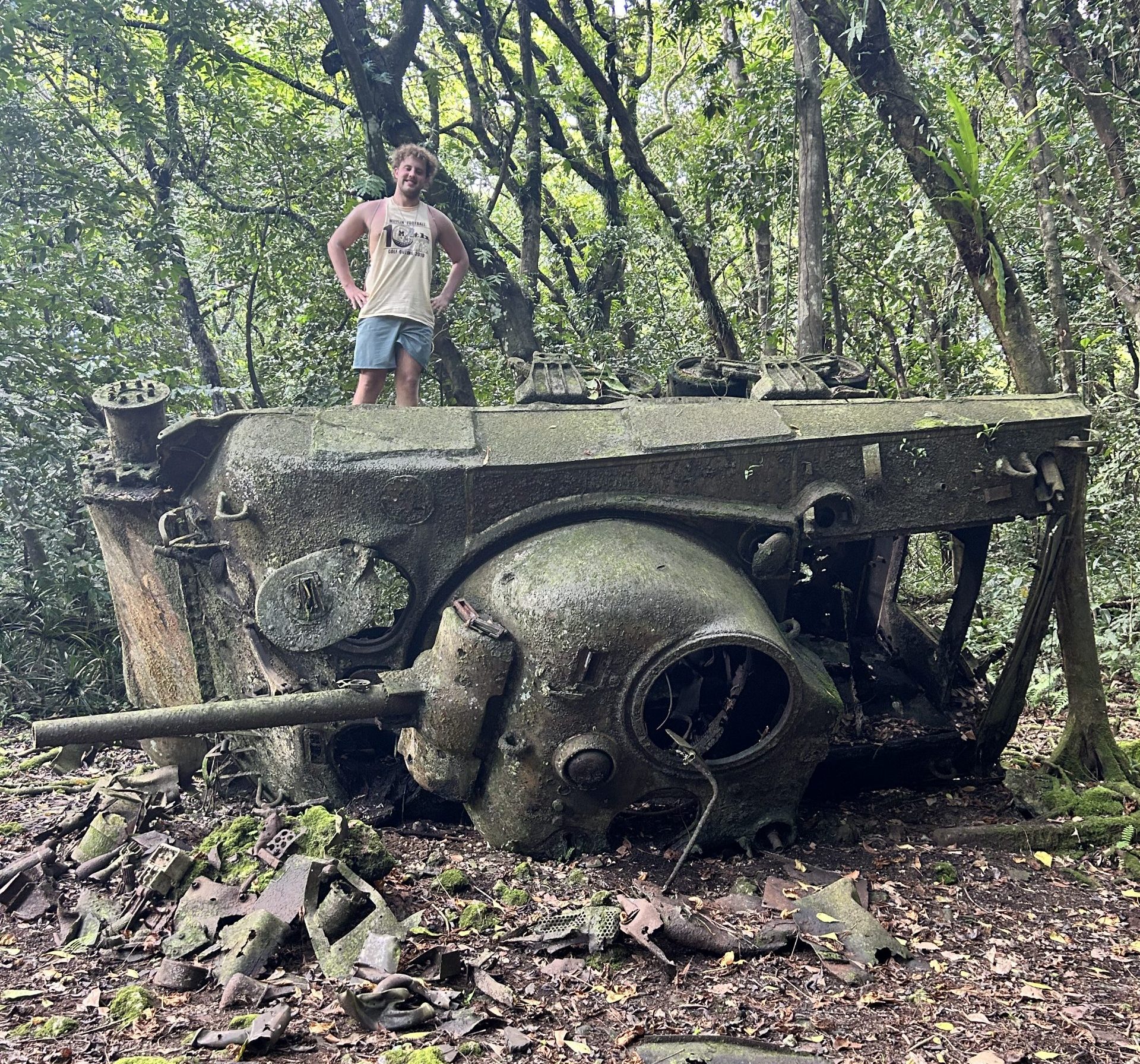
On this island, you can still see war relics that remain—tanks, planes, bombs, etc. I always say it’s like the war happened yesterday, but everyone just went home and left everything behind. It was a very emotional experience to go to this island, because I was the only family member of my great-grandfather to return there.
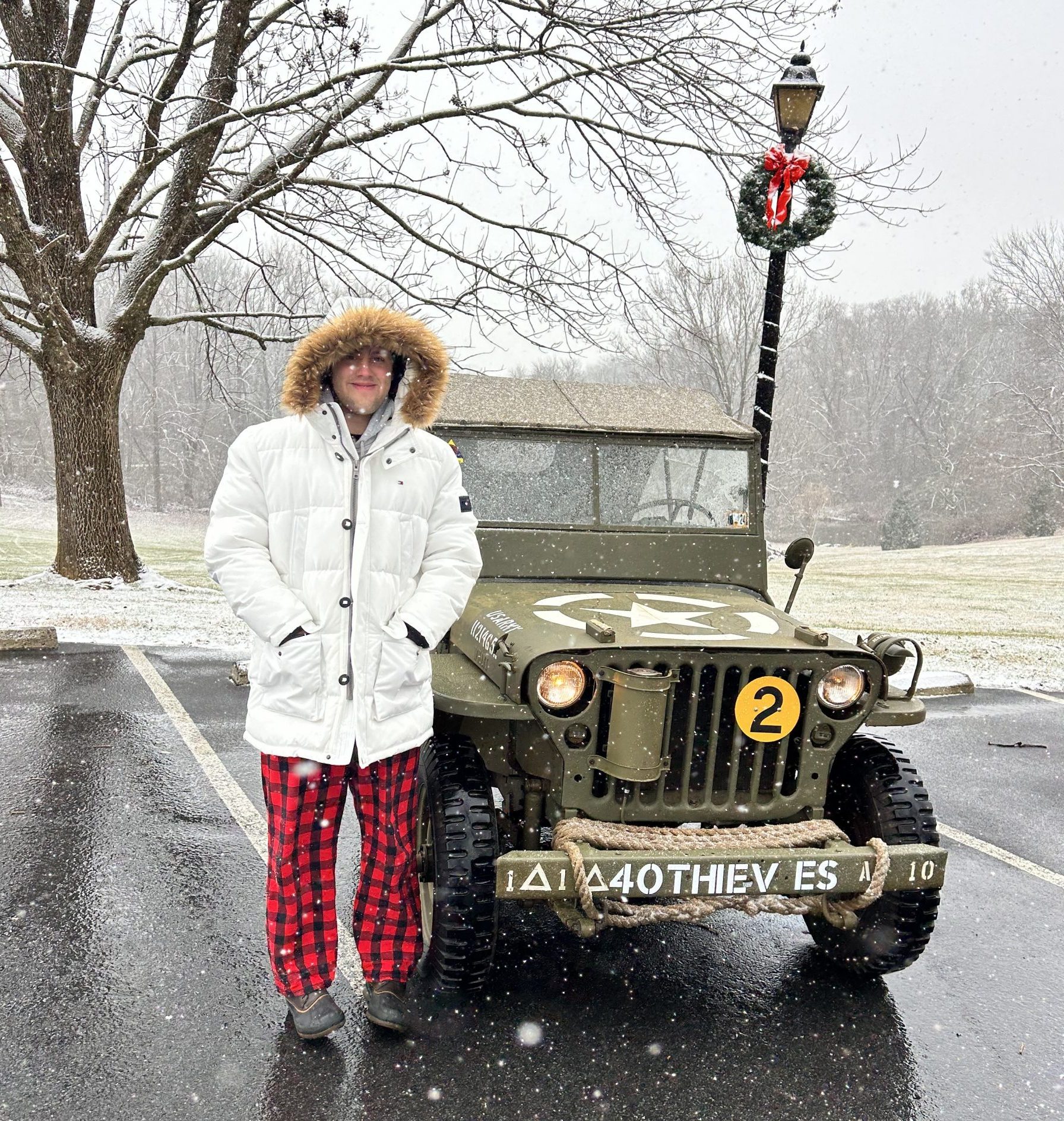
Within this journey, I bought a WWII jeep (Willys MB ’45). About two years ago, my father and I drove up to upstate New York and bought this beautiful jeep. But the jeep did not run. I had a vision that I was going to name my WWII jeep after my great-grandpa and restore it to drive my heroes around. After a year and a half, I did just that, and every 4th of July, Memorial Day, and Veterans Day, I take dozens of WWII vets in my Jeep, ride and honor them in parades in honor of my Great-Grandfathers.
It has been a good run so far. I now have a Facebook with 115,000 followers, a YouTube channel, and a website all called “Keeping History Alive.” I have interviewed hundreds of WWII veterans, traveled the world with them, and documented their stories to preserve them for history books. Along the way, my work has been featured on national news four times, and I even reunited two WWII veterans after 81 years, one of the craziest and most meaningful moments of my life.
As I always say, I am nothing special — I am just on a mission to find these heroes. A college kid with a camera. Anyway, let’s get to two of my more recent interviews in which I asked — on behalf of The Autopian’s WWII Jeep build backed by eBay — for some WWII Jeep-related stories:
Truman Christian (106th Infantry Division): One Jeep, Two Friends, and the Cost of War

Truman told me this happened around mid-March 1945, when he was with the 106th Division, 424th Regiment, Heavy Weapons Company D, holding a position along the Siegfried Line in the Ardennes. That’s here:
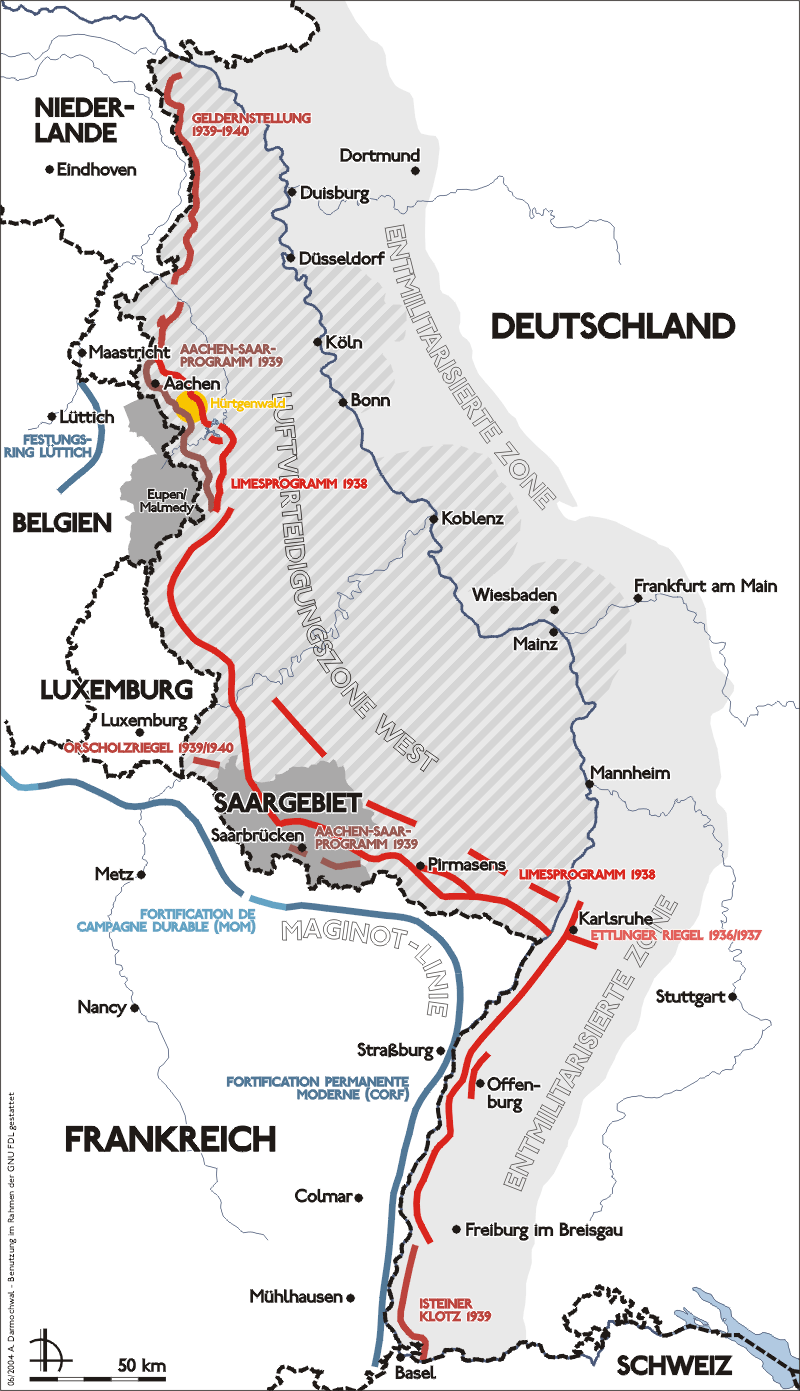
Conditions were rough, and the Germans watched every move the Americans made. Truman had become close friends with a motor pool guy named Tony Rudge — the Jeep driver who brought mail and chow up to the line. One day, Tony asked Truman to help him turn his jeep around on a narrow, snow-covered road so he could make a fast run over a hill before the Germans opened up on him. They had tried to hit him many times before. But this time, the Germans were ready.
As soon as they got the Jeep positioned and started moving, machine-gun fire tore into them. Tony hit the gas. Truman was sitting in the passenger seat, and the two of them drove out of there just in time. As they were speeding away, they could actually see the bullet holes appearing in the windshield, the gun rack, and the side panels — shots that missed them by inches.
Later, when they went back, Truman saw a bullet lodged in the metal of the passenger seat right at gut level — exactly where he had been sitting. Another was stuck in the canvas top bow near his head. Another had ripped through the gun rack inside the windshield, a shot that could’ve hit either man.

A week later, tragedy struck. Tony and the Jeep were disintegrated instantly when the wheel hit a hidden mine. The engineers had removed the top mines, but the tracks had worn down far enough to trigger a second one — a German trick. With that, they lost their mail, their chow, and Truman lost a friend he really cared about.
Even in war, Tony had a sense of humor and heart. Seventy years later, at a reunion in 2006, Truman’s old buddy Sam told him that Tony often kept small animals, like rabbits, under his jeep seat. He used them for trading or just to bring a little life to the soldiers along the line — a tiny reminder of home in the middle of the fighting. Truman imagines there were probably a rabbit or two under the seat the day of that attack, hidden among the chaos.

“Oh, the terrible price of war,” Truman told me. Even at 100 years old, he still remembers Tony Rudge — a guy who carried more than just mail and chow in that Jeep. He carried a little piece of humanity in the middle of a brutal war.
Russell Sattazahn (1st Infantry Division): Held Onto The Jeep By One Hand!

Russell joined the 1st Infantry Division — the Big Red One — in late January 1945 as a replacement, right at the end of the Battle of the Bulge. He was assigned to the 18th Infantry Regiment, G Company, and pushed straight into the cold and the mud as they headed toward Germany. For about two and a half months, Russell fought his way forward with the division. But on March 24th, 1945, everything changed for him.
Outside of Bonn, there was a little town called Uckerath that his company was ordered to take. They gathered in a barn, got the word, and moved out across an open field. By this point in the war, most towns barely had any Germans left in them. But for whatever reason, this town was different. The Germans gave it everything they had.
As soon as Russell stepped into that field, a German machine gun opened up. He dove into a bomb crater with another GI, but the shots were getting closer and closer, kicking up dirt right at their feet. Russell looked at the other guy and said, “I’m getting out of here.” And he stood up and ran. At that moment, he was the only man left moving across the field.
He could actually see the machine-gun rounds hitting the dirt at his boots as he sprinted. Russell finally reached an abandoned house and dove into the basement. German 88s were hitting all around them. As he stood up and pushed into another room in the basement, an artillery shell came straight through the house and exploded. The blast blew off his right hand almost to the elbow.
Russell lay there the entire night calling for a medic. No one came until the morning of March 25th. Two medics finally reached him. They asked, “Can you run?” And Russell said yes. He ran outside and threw himself onto a stretcher.

A medical Jeep pulled up — two stretchers strapped across the hood and two on the back. Russell was put on the first stretcher on the hood. The shelling started again, so the driver hit the gas. They hit a big bump, and Russell’s stretcher slid right off — but with his left hand, he grabbed onto the jeep and somehow held himself there. “Hey, take it easy!” he yelled at the driver.
Russell could have easily fallen off and been killed by a Jeep, the same vehicle that was trying to save him, if it hadn’t been for a check. After what felt like forever, they made it to the 96th Evac Hospital. From there, Russell was sent to Paris for more treatment and eventually sent home.
Now at 99, Russell is a proud WWII Army veteran. He wears his Purple Heart, Presidential Unit Citation, Bronze Star, and two battle stars with the kind of quiet pride you only see in men who truly earned it.



Excellent article and amazing work that you are doing Tyler. These types of stories really bring home what these vehicles were really about and why keeping them alive is a great hobby, but also so important as a physical reminder of the sacrifices of those who used them for their true purpose. I think both stories were a powerful mix of the bravery, horror and fear experienced by those soldiers as well as their ability to find humor and maintain their sanity in those moments. A wonderful addition to the eBay Jeep saga. Thank you.
I hope in 80 years our grandchildren aren’t asking current vets they’re “Jeep” experiences in WW3.
Excellent post!
My father (Leo) was the youngest of 7. He had a brother 2 years older (Bob). They were children during WWII, though there IS a WWII Jeep connection.
Their “shared” first car was a WWII Jeep.
Two fun Jeep stories.
1. My dad grew up on a Wis. dairy farm. He said when no one else was around the farm except himself and Bob and they were bored, sometimes they would take the utility tractor (which had a narrow front) and they would back up the Jeep to the tractor and connect them. Then put the Jeep in 4low. He said the tractor and the Jeep were really evenly matched. And of course they were always concerned about the tractor being pulled over backwards.
2. The other bored farm boys fun with the Jeep was on Fri. or Sat. nights they would find a steep hill and bet friends that they wouldn’t have the nerve to stay seated in the back of the Jeep all the way to the top of the hill. He said that they never lost a single bet.
Thank you Tyler. These stories deserve to be remembered, but those vets are taking their stories with them to the grave. My Dad did, for sure. The only time I ever got him to open up a little was for a writing assignment I got in eighth grade. He told a few stories of some shenanigans his squadron got up to, but he kept buried anything with real emotional weight.
Dad was a bombardier on a Martin PBM “Mariner” in the Pacific—a flying boat used mostly for Search and Rescue and anti-submarine patrols. He had signed up on his 17th birthday in order to go into the Navy and to the Pacific Theater. He heard about the fighting in Europe, and the harsh conditions, and wanted to avoid that if possible. And, he figured he’d be drafted on the day after his 17th birthday straight into the Army and straight to Central Europe. He had to bring his parents to sign a permission slip, and his mother cried the whole time.
Dad was very young to sign up, and he & Mom adopted me kinda late (age 38), so I have these first-hand stories, not “My Granddad” like everyone else here. He completed basic training, aircrew, and bombardier school in time to fight less than six months, before the war was over. I have his logbook, and it’s a whirlwind tour of the Central and Western Pacific: Kāne’ohe Bay HI, the Marshall Islands, Guam, Saipan, and Iwo Jima. He said he saw the flag go up on Mt. Surabachi—while he was getting a suntan, stretched out on the wings of his plane, floating five miles offshore! I don’t know whether I believe that story; Dad really had the gift of Gab.
I have a few more stories—the shenanigans I mentioned earlier—I could share but I have to get to work. Maybe I’ll come back tonight and reply to myself, so you can enjoy them, too. And wonder, like me, whether any of them are true.
RIP Jack Fite, 1925 – 1995. I still miss him every day.
Huh. Now that I think about it, I only have one more “shenanigan” story, but also a couple of things beyond that to add that…aren’t so funny. But I want to include them here—even though this article and the comments seem to have faded from into the background—just to kind of memorialize my Dad a little, and in case anybody has a chance to see them in the future. This is one of those posts that is important to save for the future; I got as much or more out of the stories that everyone shared in the comments as in the original article.
First, about the aircraft. “What’s a PBM?” Everybody knows the more-famous PBY, because a few are still flying and there are a bunch in air museums, and because Jacques Cousteau featured on prominently in his TV documentaries of the 60’s – 80’s.
The PBY is easily recognizable by the wing being up on a stalk of sorts, with a pair of large “blister” observation domes at the waist. The PBM was recognizable for a pair of bent wings coming out of the top of the 3-story tall fuselage, with a split tail at the back, canted into a Vee.
Smithsonian Air & Space Museum
“The PBM (Patrol Bomber, Martin) Mariner is one of the least known patrol aircraft of World War Two, yet it was also one of the most successful. While the Consolidated PBY Catalina (see NASM collection) proved to be one of the most versatile maritime patrol aircraft of the conflict, by the end of the war, the larger, faster, and more capable PBM supplanted it in many of its roles. Even though the Mariner entered service before the war, sufficient numbers were only available towards the end of the conflict to begin replacement of the numerous, but obsolescent Catalinas.
…snip…
The aircraft is on loan and displayed at the Pima Aerospace Museum in Tucson, AZ.”
The PBM was repurposed into several roles after the war, including serving with the Coast Guard. I’ve made it no secret that I volunteer with the USCG Auxiliary, so this connection is one of pride. One of my Shipmates, Steve Harrison, was an Air Force pilot in Vietnam, and after that transferred to the Coast Guard where he flew yet another flying boat, the Albatross. He joked, of all these amphibious aircraft, about their range when on patrol: hey, Steve! How far would one of these things go on a tank of gas? “Depends on how many sandwiches you have.” They weren’t the fastest things flying, but they’d get you there.
Towards the end and while waiting to be discharged after the War, Dad’s squadron participated in development of strap-on rockets called JATO, or “Jet-Assisted Take Off.” The seas of the western Pacific could be rough, so getting up and out of them fast was easier on an airframe. You could also take off in conditions that were too rough for a long takeoff run. By this time, bombing of the Japanese mainland had been taken over by B-29’s, and the PBM did a lot of Search-and-Rescue when those big planes had to ditch. JATO let the PBM conduct SAR on more days—a welcome addition to the bomber crews waiting around in shark-infested waters!
Dad had a couple of stories of his days in the Western Pacific that he would tell, and another that I heard from Mom, only after he had died.
He liked to tell about the various squadrons scattered around the little islands around the big Patrol Seaplane base on Saipan Island. For a long time, they got into a competition to see who could fly the biggest kite. The flight crews and Squadron leaders could keep the planes out of any flight paths, but as the War ground on better and better radars were developed, until Fleet HQ was finally able to figure out what was causing all these Bogies and Gremlins on the radar screens, and told them to knock it off!
He also liked to joke about one of his crew, and his thick, southern accent: “Tayl Gunnur Yokum.” Apparently, Seaman Yokum wasn’t very bright, and the accent played into stereotypes of people from the Deep South. I don’t tell those stories any more, and this might be another example of Dad taking jokes of the day and adapting them to his own purposes. Weren’t the Yokums made famous in old movies of the inter-war period?
After Dad had been gone a while, Mom told me why he might be so reluctant to talk about WWII. These squadrons, with their aircraft and flight crews, included extra crew members whenever possible. Yes, they were ready-to-fly replacements, but they were also rotated onto different aircraft as each one came up for a Patrol, to give the crew member a rest break.
Well, when the “extra” bombardier came up, Dad stayed behind at the seaplane base…and his aircraft and crew, men he had trained with and flown with for a couple of years, didn’t come back. Dad’s logbooks have an entry for “Pilot” on each line, and you can see where that changes from one name to another. Dad was probably 18 or 19 years old when that happened. I can’t help but think “what was I doing when I was 19 years old?”
Those are all the stories of WWII I have from him, but they’re first-hand—even if he’s probably pulling my leg for most if not all of them. (Dad was like that.) I hope these essays of mine are appreciated. I do enjoy sharing them, but for now, I’m done.
Jeff, out.
Oh! Duh! “Lil’ Abner Yokum!” Of comic strip and Broadway and movie fame! Including the requisite deep-South accent and comically-buffoonish behavior!
I’ve been had!
I appreciate articles like this one, I’m a Boomer who had great interest in WWII but didn’t when young understand why the Veterans didn’t like to talk about it .
My uncle Bill from the North Bronx learned to sail at an early age and so joined the Navy right after Pearl Harbor, not many were interested in submarines so he volunteered and served until there was some sort of mishap that resulted in his loosing his sense of smell . during the time he was hospitalized the Pacific Theater opened and he re upped and was on body recovery detail for the rest of the war, in a hot & humid area the bodies became putrid in a matter of 24 hours or so .
I kinda lost my way in the early 1960’s, thankfully a series of Veterans too the time and effort to teach me to be a better person, I owe everything I am and have to them .
-Nate
Great story. It’s interesting to hear about Peleliu. My father was older when he had me so he was a WW2 vet. After training, he was sent to Peleliu and was in command of what was called an LCI(R). These small ships had a ton of rockets that fired at a fixed angle on board and were used to do bombardment. At Peleliu, the stuck around and provided fire support to the marines and soldiers that were fighting on the island. They also hovered just off the shore to fish marine pilots out of the water when they were forced to ditch.
Dad had tons of stories about his time at Peleliu. 99.9% having nothing to do about combat, like getting the pedals mixed up on Jeep and running over a latrine, or trying to rest in a 2 man tent when the B-24s were taking off and blowing the tents down.
However, dad had NO stories of the invasion and fighting. Only thing he said was “all we managed to do was shred a lot of coconut trees.” and say the Marines had a really hard time of it.
Almost nobody knew anything about Peleliu for a LONG time. Unless you were a Marine or had read “With the Old Breed,” you didn’t know the battle existed. It wasn’t until “The Pacific” and video games featuring fighting at Peleliu that the stories of that battle became known.
PS, although he never did, Dad always wanted to go back to visit. He said the coral there was amazing.
Wonderful story and a wonderful project (journey?), Tyler. From a retired writer and editor just a short drive to the west of you,
Wonderful story about a great young man! Tyler, keep up the great work. And Autopian, please publish more of Tyler’s work, and similar writers.