

On paper, using hydrogen to power cars seems like a no-brainer. It’s the most abundant element in the universe, and the only byproduct of using it to power a car is pure water. The engines that use hydrogen to function exist today, right now, as do the methods to supply hydrogen at fueling stations.
Except, it’s still wildly impractical to own a hydrogen fuel cell-powered vehicle. The cost to actually produce and store hydrogen has spiked to astronomical levels in recent years, and with Shell having abandoned its fueling stations in the U.S. in 2024, there are now fewer stations where hydrogen-car owners can actually fill up than, say, five years ago.


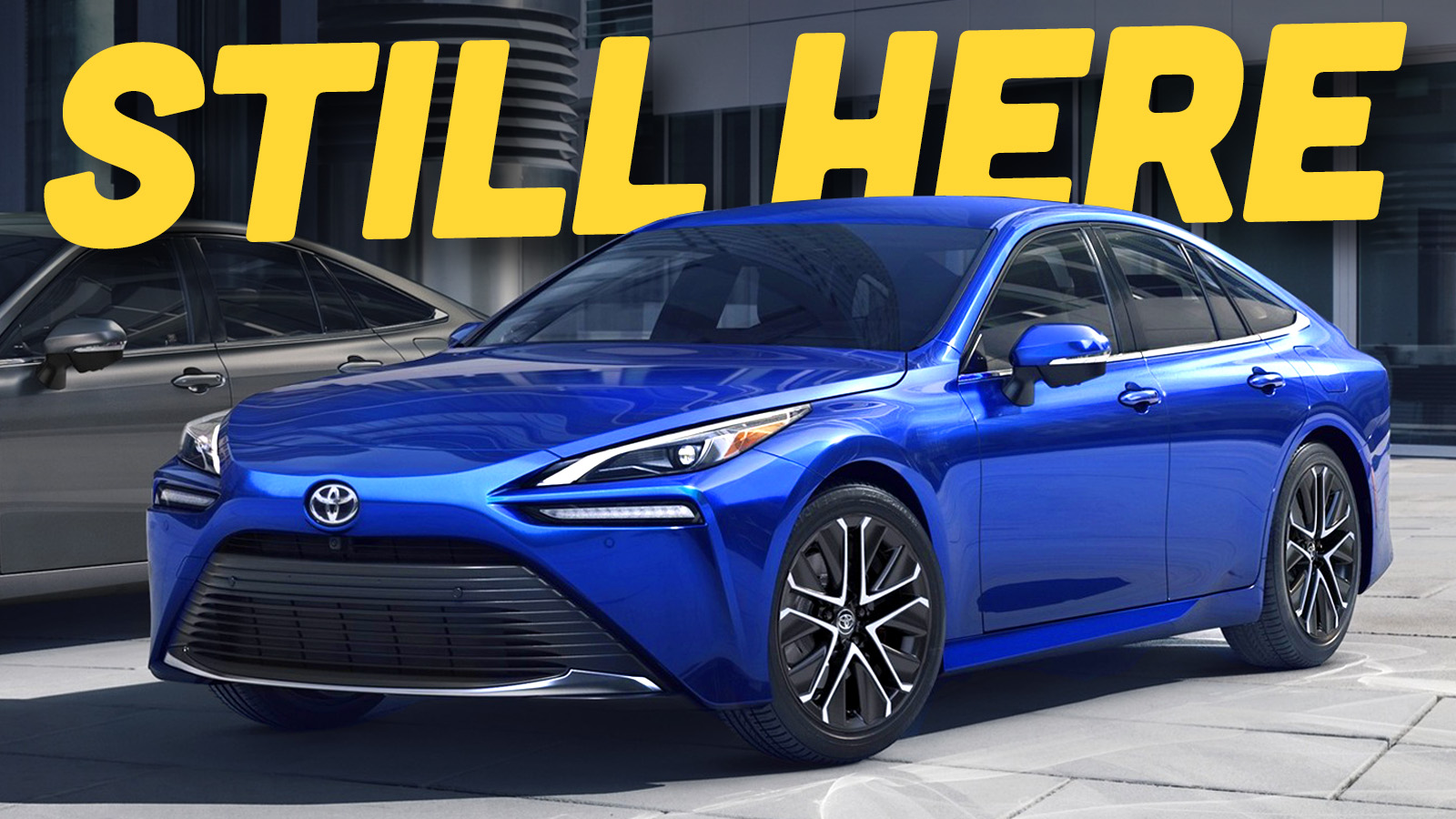
Yet Toyota won’t give up. It’s just renewed its sole hydrogen-powered car, the Mirai sedan, for the 2026 model year, virtually unchanged from 2025. The reason? It still believes in a hydrogen future.
The Impractical Truth Of Current Hydrogen Fuel Cell Vehicles
Those consumer-level filling stations I mentioned? Well, there are only 56 of them in all of North America, by my count. And the vast majority are clustered on the California coast, with a few sprinkled in the Vancouver area of western Canada, one in Hawaii, and two more in eastern Canada. So from the jump, buying a hydrogen fuel cell car limits your area of travel to those places.

Hydrogen fuel is also expensive. Former Autopian writer Lewin Day actually did the math on this earlier this year, which shows just how pricey it is to run a Mirai in 2025:
Do the maths, and it’s obvious that hydrogen car owners are now in an awful situation. Take the Toyota Mirai, for example. It will drive about 72 miles per kilogram of hydrogen. At current prices of $36/kg, you’re paying 50 cents per mile in fuel alone. If you drive 10,000 miles a year, you can expect to pay $5,000 for gas. Hydrogen gas, that is.
Compare that to an old Dodge Viper, which achieves 12 mpg in the city with its 8.0-liter V10. Presently, premium gas is sitting around $4.80 a gallon in California. That pencils out to 40 cents per mile, making it $1000 cheaper to run those 10,000 miles than the Mirai. Alternatively, you could get a Nissan Versa, which does 32 mpg, and run it on regular gas for $4.40 a gallon. You’d be spending less than 14 cents a mile on fuel, saving over $3 grand a year on fuel!
Toyota, realizing this might scare off the already minuscule buyer base for hydrogen fuel cell vehicles in America, began including complementary $15,000 fuel cards with every Mirai purchase, which would cover 25,000 to 30,000 miles of driving based on current prices. Hilariously, this has created a black market where people who are no longer driving their Mirais or have a fuel cell vehicle are selling “fills” at hydrogen pumps using their leftover cards.

And it’s not like these filling stations are reliable, either. A bunch of Mirai owners are actually in the process of suing Toyota over claims they were misled about the car’s practicality and ease of refueling, citing poor infrastructure, constantly broken fuel stations, and vastly limited supply. The lawsuit also touches on the Mirai’s intense depreciation, claiming the cars lose 90% of their value, due to all the shortcomings and limitations with regard to fueling and practicality mentioned above.
So, Why Is Toyota Still Selling This Car?
Despite the above facts, and the fact that Toyota has sold just 157 Mirais through September of this year (0.0008% of all of the company’s U.S. sales in that period), Toyota has nonetheless renewed the Mirai for 2026 virtually unchanged, save for a set of flashy 19-inch aluminum wheels. Why bother? Even Toyota’s technical chief, Hiroki Nakajima, admitted the car has “not been successful.”
At this point, it’s probably optics. Toyota, like BMW, Hyundai, and Honda, has heavily invested in a hydrogen future. In 2024, it renamed its R&D facility in California the “Hydrogen Headquarters (H2HQ).” Earlier this year, it reaffirmed its commitment to a “hydrogen society,” debuting its third-generation fuel cell tech, which it aims to use in heavy-duty trucking applications.
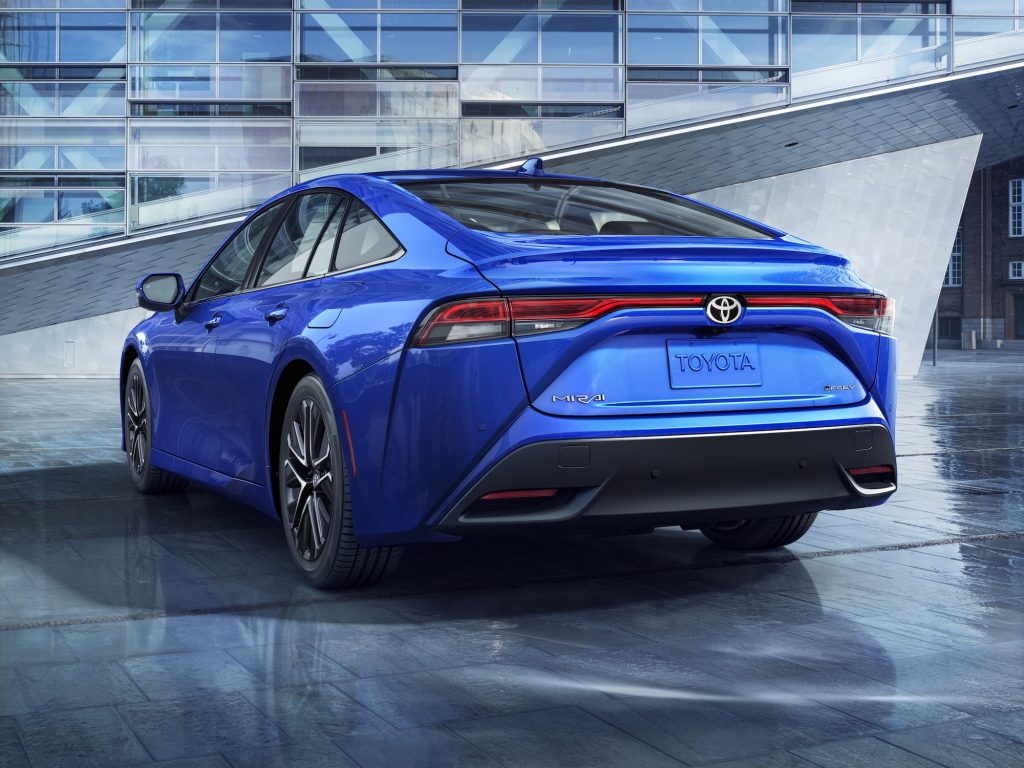
Toyota is going as far as to work with fuel station companies like Air Liquide and Iwantani to build more stations (and make current stations more reliable). It’d look bad if Toyota were seemingly all-in on hydrogen and canceled its only hydrogen-powered passenger car at the same time, even if the company basically sells none of them.
Hydrogen has been stuck in this impracticality loop for years now. It feels like EVs did back in the late 2000s and early 2010s, in that it’s limited by the infrastructure around it. But unlike the EV space, there hasn’t been a Tesla-like catalyst to launch it into the mainstream (not yet, anyway).
Still, hydrogen power has vast potential as a clean alternative energy for cargo boats, airplanes, and heavy commercial vehicles. Whether it’ll ever break out and reach that potential is unclear. But companies like Toyota want it to happen badly enough that they’ll continue to sell a car for a nonexistent market.
Top graphic image: Toyota




The partnership with Air Liquide is interesting. I’ve often wondered what it would take to fuel up at a local industrial gas distributor.
I admire what Toyota is doing, in this depressing world of efficiency-obsessed companies; Toyota is spending money on a long-term project, they don’t seek short-term profit but future results, that should be praised.
That’s bar none the most attractive Toyota product since the Mark IV Supra. Hopefully they use it on a more mass-market vehicle.
“On paper, using hydrogen to power cars seems like a no-brainer”
Only if you have no brain.
Hold up, Lewin is a former writer? What did I miss? 🙁
yeah, that the bit that jumped out at me!
And without a leaving roast?!
He left to focus more on his music, though he did do a little editor-at-large/guest writeup recently about shooting a music video with as many fun cars as he could lay hands on (two, it was two cars. It was a great story but a cursed production, seems like).
Yeah. That and the Air Liquide reference both got my attention on a sleepy Saturday morning.
Whoa, someone has been hitting the Wild Turkey as opposed to a wild turkey on Thanksgiving. Sure Toyota should have caved and learned their lesson from going Hybrid instead of full EV. Yeah given how the full EV Car market is a shit show. Maybe Toyota just killing it knows more than the average car hating liberals? Maybe? And I am not an expert but please provide the information about where you get an old Dodge Viper that got 4 mpg in the city when new is now getting 12 mpg. That is insane to write and insane to believe. The Viper got 8 mpg on the highway. Do we need a 3rd party fact check on the Autopian? I hope not and I hope the huge error will be corrected.
https://www.fuelly.com/car/dodge/viper
Willing to consider if they actually report the testing and set up as opposed to a table. I do notice the metric mpg is the same as the mpg. Which is unlikely
Fuelly is actual mileage reported by owners.
Summer of 2008, I had a 2002 Viper GTS and drove it from Chicago to Seattle. I recorded the odometer at every gas stop along with gallons dispensed. Cruising at 80-85 mph in sixth gear (which was very tall), it got 21.3 mpg over the whole trip, which is–and this is true–not 8. (EPA rating was 10/19/13, which are all–and this is also true–not 8).
Now this is good information
Color me crazy, but if Toyota wants to sell this car, then maybe they should open their own network of filling stations.
Throwing good money after bad, except in this case it’s bad money after bad. They knew better last year, and the year before that, and the year before that. This is an answer that Toyota insists on providing to a question that absolutely no one has been asking since 2014.
Figure it out, Toyota. It ain’t happening.
If they were smart, they could’ve made it a PHEV like Honda’s CR-V FCV so that buyers could at least commute easily on cheap electricity.
I mean, it already IS an EV to begin with. The fuel cell powers electric motors. They just really really really don’t want to install batteries.
…and they *do* have batteries, they’re just hybrid-sized, not PHEV-sized. Saw one at a used-car lot in Portland recently and wondered how much traction battery could fit if you removed the H2 tanks and fuel cell.
For a Toyota, it’s pretty good looking! Couldn’t they use that body with a more conventional drivetrain?
Edit: Whoops, turns out they do, the Crown! I didn’t know that was still a thing, but Wikipedia told me https://en.wikipedia.org/wiki/Toyota_Crown#S230
Crown FCEV:
https://toyota.jp/info/crown_brand/crown/fcev/
One sweet ride 😎
I remember having the hydrogen-as-auto-fuel discussion in my materials science class 50 years ago. It was a ‘no’ then and it hasn’t changed. Perhaps someday it will happen, much like fusion power, which has recently had a promising advance; see TAE Technologies, https://tae.com/. I’m partial to their approach and aneutronic process (no neutrons produced, so no radioactive inner walls created.
Wait, really? WHY? I swear that there are even fewer hydrogen stations in CA than when they started. I used to stop at the gas station in Marin that has an H2 station, and 9 times out of 10, it was out of order or out of fuel. (It looked cool, so I always peeked at it when I was there.)
Since we’re speculating, it’s equally likely that the data Toyota gets from the real-world usage of these vehicles is more valuable than “optics”. Most people don’t know what a hydrogen fuel cell even is, let alone that they can power a car.
Is the Japanese government still pushing hard for hydrogen? If so, this is probably a compliance car needed to get their government subsidies, not a real product they want to sell.
If it was, I guess I would expect to see Toyota’s domestic competitors making similar moves?
Looks like they still are.
https://www.enecho.meti.go.jp/category/saving_and_new/advanced_systems/hydrogen_society/
The people pushing hard for hydrogen are the oil companies. Guess where we get most of the hydrogen from.
I don’t see hydrogen as a viable alternative to gas or diesel personal vehicles.
Where I think there is potential – with big caveats – is public and commercial use where vehicles are based around a central depot. If someplace like a UPS hub or a school bus depot can be retrofitted with solar panels and wind turbines to generate (or supplement the electricity needed to generate) the electricity needed to generate the hydrogen for buses and delivery vehicles.
We say it takes too much electricty to generate it, but when I see the power requirements of server farms, it seems like it’s entirely doable.
Exactly. Just converting the various vehicles used at ports and airports would be a huge savings in emissions.
But in those use cases it would be much more efficient to just charge batteries in an EV than go through another step to turn the electricity into hydrogen on site, use more energy to compress it to 1000’s of PSI, fill a tank, then convert the hydrogen to electricity in a fuel cell to power a the vehicle.
This is not my wheelhouse but isn’t part of the calculus “emissions bad, evs and hydrogen cars no emissions, but evs need batteries, lithium mining bad”? Yes it’s certainly inefficient but if part of the goal is “less bad” there’s probably a turning point somewhere. Notwithstanding we use lithium in batteries for stuff besides cars, but I’m guessing a redistribution of demand is part of the point?
This is an oversimplification, but every time you change the format of energy generated into energy stored, you incur losses. Sometimes that’s acceptable: solar isn’t great in a snowstorm or hurricane, so having gasoline or diesel is a worthwhile chain of losses for the ability to have local, high density energy storage on demand.
Hydrogen falls apart as a (non-nuclear fusion) fuel because it takes electricity to generate it, it’s hard to store, it’s hard to transport (in part because it’s hard to store – hydrogen atoms and molecules are very very small). This is a big hand wave here, so if someone has a white paper proving me right or wrong I’m open to it, but tally up all the losses, costs, and electrical/physical inefficiencies, and 10 times out of 10 you’d have been better off doing anything else. The only thing it might have a leg to stand on is *tailpipe* emissions, which handily sweeps under the rug all those other emissions we generated along the way.
Thanks. Good point. So everytime the whole “most abundant in the universe” argument is trotted out, it’s basically a lie. I mean, it’s literally true, but not relevant to the use of it as fuel.
Valid, but there are different efficiencies to consider. A hydrogen fuel cell doesn’t have the degredation a battery cell does, and has shown to have a longer mileage life span. For utility fleet vehicles like city transit buses, school buses, etc, that are in service for 10+ years, it coudl be worth the trade-off. Then there’s also the weight difference and the wear and tear on infrastructure to consider. For something like a bus, it can be a 10,000lb difference, which is going add cost for brake maintenance, tire wear, etc. Every option has its pluses and minuses.
Except that at this point, fuel cells degrade. https://www.powerelectronicsnews.com/understanding-the-degradation-of-hydrogen-fuel-cells/
The only way I see Hydrogen becoming practical in the US is by starting with long range trucking and building a hydrogen fueling infrastructure with truck stops. That limits the number of initial filling stations you need, and then once you have that base infrastructure in place, then it can start to make sense for individual buyers to get a fuel cell vehicle.
Look Toyota makes plenty of money, I like to think they keep this around solely to get EV diehards riled up. If so, S-tier trolling by Akio.
No one ever discusses how much lighter these vehicles are.
I mean, c’mon! They could practically fly.
I’ve never sat in let alone driven a 2nd gen Mirai, but it’s not awful looking and the fact that it’s on the LS400 platform is appealing. I’m sure it’ll never be practical to turn this into a plain EV, but…
I had a neighbor a few years ago who had one, and I got to sit inside. It’s basically a Toyota Crown inside, but slightly older. Like if the Crown came out in 2020, it would’ve had the same interior as the Mirai. The LS runs on the same platform as both of them, but I believe the Mirai and Crown are more closely related, to the point where the Crown is pretty much an ICE-based Mirai.
There are still two or three in my neighborhood. One is in that very rich metallic blue, and belongs to a character of an old lady and her husband.