

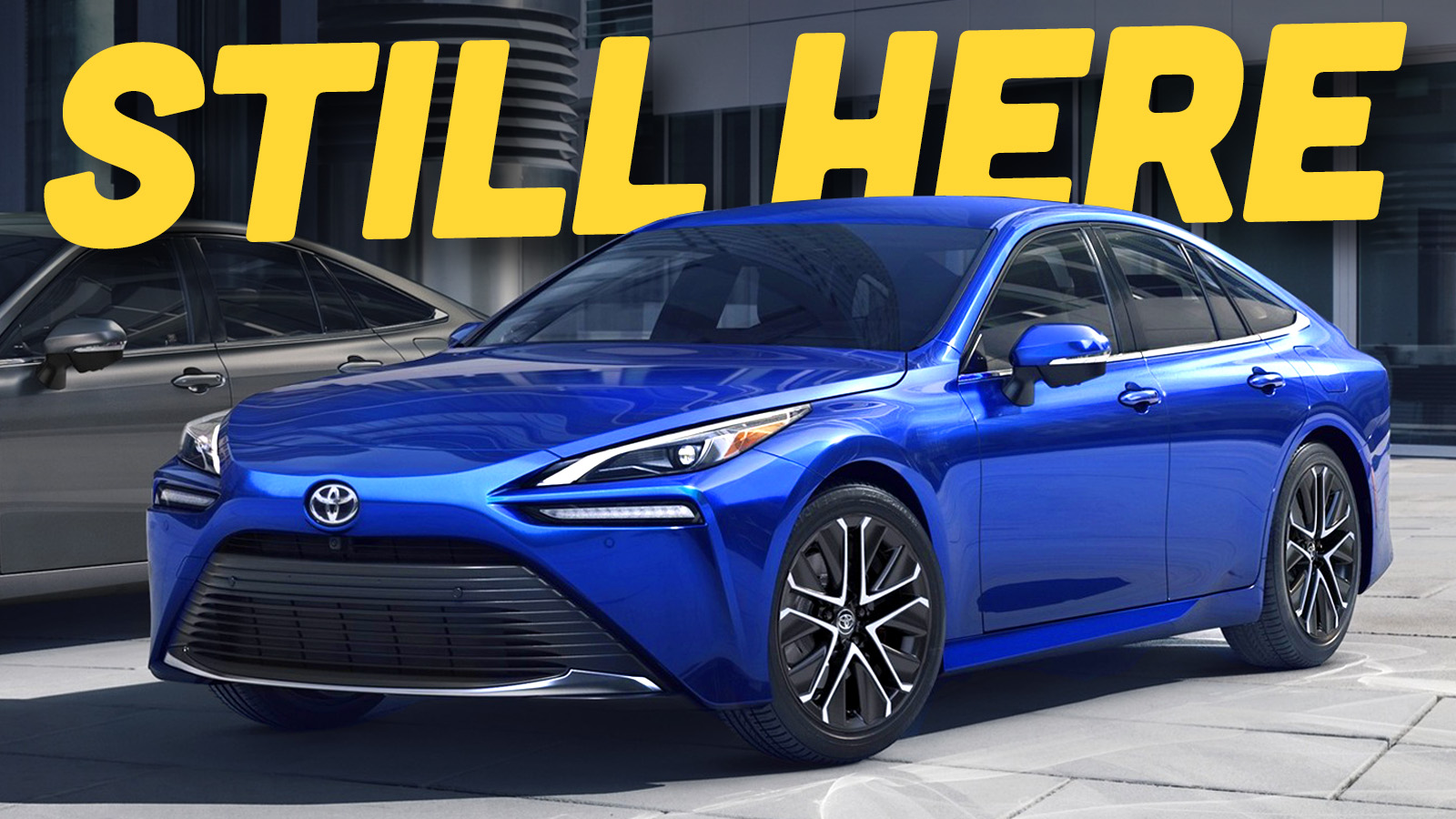
On paper, using hydrogen to power cars seems like a no-brainer. It’s the most abundant element in the universe, and the only byproduct of using it to power a car is pure water. The engines that use hydrogen to function exist today, right now, as do the methods to supply hydrogen at fueling stations.
Except, it’s still wildly impractical to own a hydrogen fuel cell-powered vehicle. The cost to actually produce and store hydrogen has spiked to astronomical levels in recent years, and with Shell having abandoned its fueling stations in the U.S. in 2024, there are now fewer stations where hydrogen-car owners can actually fill up than, say, five years ago.


Yet Toyota won’t give up. It’s just renewed its sole hydrogen-powered car, the Mirai sedan, for the 2026 model year, virtually unchanged from 2025. The reason? It still believes in a hydrogen future.
The Impractical Truth Of Current Hydrogen Fuel Cell Vehicles
Those consumer-level filling stations I mentioned? Well, there are only 56 of them in all of North America, by my count. And the vast majority are clustered on the California coast, with a few sprinkled in the Vancouver area of western Canada, one in Hawaii, and two more in eastern Canada. So from the jump, buying a hydrogen fuel cell car limits your area of travel to those places.

Hydrogen fuel is also expensive. Former Autopian writer Lewin Day actually did the math on this earlier this year, which shows just how pricey it is to run a Mirai in 2025:
Do the maths, and it’s obvious that hydrogen car owners are now in an awful situation. Take the Toyota Mirai, for example. It will drive about 72 miles per kilogram of hydrogen. At current prices of $36/kg, you’re paying 50 cents per mile in fuel alone. If you drive 10,000 miles a year, you can expect to pay $5,000 for gas. Hydrogen gas, that is.
Compare that to an old Dodge Viper, which achieves 12 mpg in the city with its 8.0-liter V10. Presently, premium gas is sitting around $4.80 a gallon in California. That pencils out to 40 cents per mile, making it $1000 cheaper to run those 10,000 miles than the Mirai. Alternatively, you could get a Nissan Versa, which does 32 mpg, and run it on regular gas for $4.40 a gallon. You’d be spending less than 14 cents a mile on fuel, saving over $3 grand a year on fuel!
Toyota, realizing this might scare off the already minuscule buyer base for hydrogen fuel cell vehicles in America, began including complementary $15,000 fuel cards with every Mirai purchase, which would cover 25,000 to 30,000 miles of driving based on current prices. Hilariously, this has created a black market where people who are no longer driving their Mirais or have a fuel cell vehicle are selling “fills” at hydrogen pumps using their leftover cards.

And it’s not like these filling stations are reliable, either. A bunch of Mirai owners are actually in the process of suing Toyota over claims they were misled about the car’s practicality and ease of refueling, citing poor infrastructure, constantly broken fuel stations, and vastly limited supply. The lawsuit also touches on the Mirai’s intense depreciation, claiming the cars lose 90% of their value, due to all the shortcomings and limitations with regard to fueling and practicality mentioned above.
So, Why Is Toyota Still Selling This Car?
Despite the above facts, and the fact that Toyota has sold just 157 Mirais through September of this year (0.0008% of all of the company’s U.S. sales in that period), Toyota has nonetheless renewed the Mirai for 2026 virtually unchanged, save for a set of flashy 19-inch aluminum wheels. Why bother? Even Toyota’s technical chief, Hiroki Nakajima, admitted the car has “not been successful.”
At this point, it’s probably optics. Toyota, like BMW, Hyundai, and Honda, has heavily invested in a hydrogen future. In 2024, it renamed its R&D facility in California the “Hydrogen Headquarters (H2HQ).” Earlier this year, it reaffirmed its commitment to a “hydrogen society,” debuting its third-generation fuel cell tech, which it aims to use in heavy-duty trucking applications.
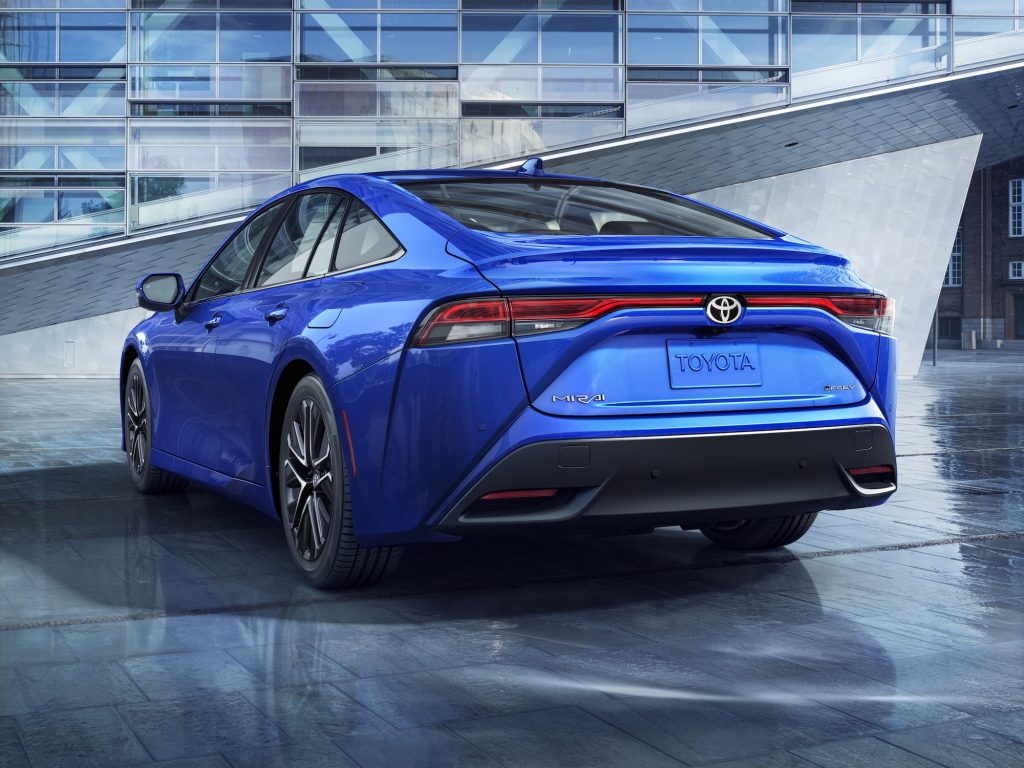
Toyota is going as far as to work with fuel station companies like Air Liquide and Iwantani to build more stations (and make current stations more reliable). It’d look bad if Toyota were seemingly all-in on hydrogen and canceled its only hydrogen-powered passenger car at the same time, even if the company basically sells none of them.
Hydrogen has been stuck in this impracticality loop for years now. It feels like EVs did back in the late 2000s and early 2010s, in that it’s limited by the infrastructure around it. But unlike the EV space, there hasn’t been a Tesla-like catalyst to launch it into the mainstream (not yet, anyway).
Still, hydrogen power has vast potential as a clean alternative energy for cargo boats, airplanes, and heavy commercial vehicles. Whether it’ll ever break out and reach that potential is unclear. But companies like Toyota want it to happen badly enough that they’ll continue to sell a car for a nonexistent market.
Top graphic image: Toyota


The problem with hydrogen is it’ll almost always be an energy source that is hilariously energy intensive to produce. Compare that with electricity which is already everywhere in developed countries.
Agreed. While the final use is clean, what is missing is how much pollution it takes to make it. And I have no idea what that is.
It depends. IIRC, current hydrogen is ‘produced’ by purifying it out of natural gas which is pretty much a sidegrade compared to gasoline unless it’s collected from a landfill. The other major method is electrolysis, which needs a ton of (potentially renewable) electricity that makes it economically unviable at current flat electricity rates.
Yep exactly! Short of having a world powered by nuclear powerplants with excess power reserves(which doesnt exist because why would a powerplant make excess power), it’ll almost always be less efficient in terms of energy than if you just threw that electricity directly at a car.
Add in the intensely limited refueling stations and their additional friction vs refilling with gasoline. That all means if hydrogen will work for your travel patterns, so will an EV with level zero home charging and never needing to darken the doorstep of a gas station.
“Earlier this year, it reaffirmed its commitment to a “hydrogen society,” debuting its third-generation fuel cell tech, which it aims to use in heavy-duty trucking applications.“
This is why Toyota and others continue. Cars are a cheaper way to do development on fuel cells for other applications where batteries simply do not work.
If you search on cars.com for the cheapest, used, low mileage Toyota in the US and sort by price, these will occupy the first couple dozen spots on the list. If you want a Toyota with 50k on the clock, this is the only one you can get for seven grand 🙂
Not sure I would even take one for free, since it would cost more to drive than my current 230,000-mile car. Probably nowhere near as fun, either.
For a guy with “joke” in his username, you sure missed the joke!
Yeah, I can be pretty dense sometimes.
Your post seems more true than funny. To me, I mean.
Hydrogen is the future- Our province signed some deal for a bunch of hydrogen filling stations with the founder of Nikola, that really went well
I honestly thought they stopped making these years ago. I’ve never even seen one in person, but given I live 2,000+ miles from the nearest filling station that’s not surprising.
There are at least two Mirais cruising the roads where I live in Victoria, BC. I have no idea where they are getting fuel. I hope to one day see one in a parking lot so I can ask the owner how they do it.
4001 Quadra St, Victoria, BC V8X 1K1, Canada, according to Google. The location appears to be an Esso gas station.
I see one of them fairly frequently. Also no clue where they fuel it.
Toyota should develop a hydrogen generator that people can put in their garage and use low cost solar to fill a tank during the day, and then refill the car at night or in the morning. Bonus points if it comes with extra capacity and a fuel cell to act as backup power for your house.
Yes I know electrolysis is horribly inefficient, but solar is cheap.
A Mirai holds 5kg of hydrogen.
A very efficient electrolysis system might require 39kwh to produce 1 kg of hydrogen, or 195kwh to fill the tank. Most home residential systems product somewhere in the 20-40kwh per day.
In the absolute best case scenario, it takes 5 days to produce enough hydrogen to fill your tank and you’re house is receiving almost zero of that solar power. This also says nothing of the expense to install solar ($15-25k) or to install an electrolysis system (cost lol).
I mean, c’mon.
Don’t forget you also get to worry about hydrogen leaks.
Can you even imagine lol! I’m moving 10 miles away if I find out my neighbor is producing and storing hydrogen on their property!
Eh. The hydrogen is lighter than air, so it goes straight up and away.
And is flammable at a wide range of concentrations.
Don’t forget this home electrolysis system is also going to have to compress the hydrogen to 10,000 psi.
Don’t forgot you’re also producing oxygen!
2024 Toyota Mirai gets between 64 and 72 miles per kilogram. Meanwhile my Chevrolet Bolt gets 156 miles from that same 39kwh.
The damn Hummer EV pickup would get 74 miles out of 39kwh!
Thanks for doing the math. That actually might work for someone like me. I would probably only need to fill the tank every 10-12 days, and I could probably build out a system that would do more than 20-40kwh per day.
I’m not saying that this is feasible RIGHT NOW, but rather it could be feasible with a little more effort and political will.
This is the absolute best scenario. The efficiency of the actual system you might be able to install at your home is probably half of the best case scenario. You might spend $100k for a system that at best will fill your car every 10-12 days.
I’m sure somebody will do this but it’s a terrible choice for 99.9999% of people and it definitely won’t spur the growth of hydrogen vehicles.
Hydrogen has made big inroads in the warehousing sector. Which is something I have seen zero press on. I think the concept of hydrogen is super cool, in a best of both worlds kind of way. I’m highly doubtful passenger vehicles will make the switch, but commercial vehicles might have a future.
The reason it works in warehouses is because the big companies value machine uptime and want to avoid toxic fumes especially in food warehouses. Someone like Walmart with massive, refrigerated warehouses essentially runs their power equipment like the Navy does beds. As soon as one shift ends, the next one starts. To have half your power equipment down for charging would require doubling the amount of power equipment to keep the same productivity. That’s why several companies have gone with PlugPower units instead of traditional battery (or even propane) power equipment. They still use the same Raymond or Crown equipment, but the battery unit is replaced with a fuel cell. In my experience a full fuel cell will last through an entire 10-hour shift for pallet jacks, but lift trucks need to refill more often. PlugPower applications are not isolated to just California.
…… and it just so happens that Toyota is one of the largest manufacturers of fork trucks and other material handling equipment.
This is true, I believe they also own Raymond, but the actual fuel cell does not come from Toyota or Raymond, it’s from PlugPower.
OTOH electric with lead-acid batteries works just fine at store level where a forklift is used an hour or two a day.
Do happen to know how much energy/kg of hydrogen is used per vehicle per shift?
I think the biggest barrier to BEVs for use in refrigerated warehouses is charge loss due to low temperatures followed by charge times. Li-NMC batteries are kinda borderline usable below freezing, which is good enough for passenger cars since they have active cooling systems that can heat the pack if needed, but further increases costs. Cheap LFP batteries that have revolutionized many sectors can’t be used here because they have even worse cold temperature performance. I think this is something Sodium-ion batteries could solve in the future with their excellent cold temperature performance, but it’ll probably take a decade for them to arrive in the US, unless we import China/CATL’s that are starting production about now and should have wider availability before 2030.
Then there’s the question of charging: In China, the lowest end PHEV batteries (where fast charging is the lowest priority) can do 30-80% in ~30 minutes. Midrange BEVs are doing 10-80% in 20 minutes, which might be fast enough to recharge between shifts and make opportunistic mid-shift top-ups viable.
I unfortunately do not have an answer to your question. I’m still hoping for solid state battery tech to pan out.
I think Sodium-ion batteries with traditional liquid electrolyte will solve the problem sooner. Solid state batteries promise a lot of things but I think it’s greatly overhyped. They’ll weigh a good amount less and take up a bit less volume, and allegedly they’ll have a little wider temperature window. They’re supposed to be much safer because they lack the typically quite flammable liquid electrolyte. Research prototypes claim that they can charge from 10-80% in only 10-15 minutes, which is significantly faster than EVs sold here, but you can already buy several EVs in China with conventional liquid electrolytes that can do the same or even faster. I think liquid electrolyte batteries are inherently easier to charge faster than solid-state. Plus, solid-state batteries will surely cost more for at least the next 2 decades.
The real news here is that they still sold 157 through September!
Who exactly are the 157 people that walked into a Toyota dealership, saw the Corolla and Camry sitting there then signed on the line for the car with virtually no refueling infrastructure and 90% depreciation?
I think they are fleet vehicles for a company with a hydrogen tank already on their property.
All of that is STILL expensive, though, unless subsidized.
It’s funny cause used Mirias may be the cheapest, newest, lowest mileage sedans on the market currently, haha. But I’ve been saying for years if Toyota (or anyone else) actually wants hydrogen to happen they need to do a Tesla and build their own infrastructure.
So, can I present this article to my wife when I tell her I’m buying a Dodge Viper for ‘economic reasons’? Look at the savings hon!
Baffles me why car professionals talk about this topic (hydrogen fuel and attempts by car brands to make it work) with a negative bias so strong that it could well be a clickety reel.
There’s nothing wrong with the tech (as the article confirms) and everything wrong with the infrastructure. For them this car is a research project and that’s worth appreciating when battery tech is toxic, EV infrastructure is a long way from mass adoption in the US and China will continue to dominate raw materials for batteries. The US needs 20 years to switch to a national smart electric grid – if they started now – and the current administration made sure it won’t happen anytime soon.
Complete lack of infrastructure and no reasonable path to fixing that is an awfully large problem to handwave away.
And how long to build out a viable hydrogen network? Hint: It’s a lot more than 20 years.
Also, this is a complete non-sequitur. The current EV charging network is dramatically better than it was even a few years ago, smart grid or no. I have no reason to believe it won’t be good enough for most people (there will always be edge cases, and for those people there will still be ICEs and hybrids) to use in far less than 20 years. And even if I’m wrong about that, hydrogen is still much further away because it has even larger electricity requirements than EVs and a bunch of other issues on top.
The big difference between building out EV charging infrastructure and hydrogen refueling infrastructure is the fact that we already have electrical distribution pretty much everywhere. It’s just a matter of installing an end point, like the charger I wired up myself in my home garage.
Meanwhile, the only way to distribute hydrogen is by truck, and once you’ve filled the tank at the station it has to be compressed to 10,000 psi – and the high pressure tank often has to be refilled between cars, so the concept of it filling like gasoline is a fiction. Then there’s the cost…
Really, hydrogen is a way to store and transfer electricity. It takes a lot of electricity to create it, then it gets turned back into electricity in the fuel cell. And it turns out we’ve actually figured out how to store and transport electricity pretty well for automotive use.
I think infrastructure discussion aside, carrying around a heavy power source with low-ish energy density is not the way to switch away from Dino juice. It’s a temporary solution at the scale of history. It can’t transfer to real heavy duty applications so it has a built in limit to adoption. Oil IS finite despite incumbents trying to squeeze the last drop so what will we do when it’s over? You can’t run a container ship or a fighter jet on batteries, never will.
My point was that Toyota still trying (so far the results are underwhelming, yes) deserves more than amused bafflement articles – at least from people who understand the industry.
I don’t think the article is saying hydrogen is bad technology. I think the point is the Miria has got to be the absolute least practical new vehicle you could buy. It might work for fleet applications but it’s wild Toyota offers these to retail consumers
“There’s nothing wrong with the tech”
There is plenty wrong with the tech.
The main thing wrong with it is the existence of lithium-ion (and now sodium-ion) batteries. It’s a way to get rid of tailpipe emissions and (via electrolysis) fuel vehicles without burning hydrocarbons.. but it’s basically an EV with extra (inefficient) steps.
You can use electricity to turn water into hydrogen, then more electricity to compress that hydrogen, then put it in a tank in a car, then use a fuel cell to turn it into electricity to fill a battery, then use that battery to power electric motors. Or you could just stick that electricity in a battery directly. Yeah, it needs a bigger/denser battery, but.. that technology is here today.
Toyota should offer EV and (gasoline) PHEV versions
I Can’t Believe Toyota Just Renewed The Mirai, A Car That Represents 0.0008% Of Its Sales, For Another Model Year
The future owner could say that, like my spotify wrapped for Sabrina Carpenter.
Man, I remember yesterday’s Morning Dump and people saying that “Toyota didn’t deserve that ridicule for their anti-EV stance”. But the fact is, them not investing in EV’s before the market segment slowed in the US was not “good business sense.” It was dumb luck.
If Toyota had good business sense, they wouldn’t have pissed away somewhere around $10 billion on fuel cell vehicle development that’s gotten them nowhere.
All they’ve done is cede future worldwide market share to China by being so late to the BEV game.
What you call dumb luck turns out was very sound policy implemented over years. Lots of folks saw from a mile away that EVs will stay a niche in the US for a long time, from battery tech limits to infrastructure, to raw materials and cultural headwinds. They were just more disciplined to implement their own decisions unlike zee Germans who jumped the gun.
So, hard disagree here.
And your problem is that you are only thinking of the US market. Toyota is currently the largest automaker in the world, and the majority of the world doesn’t have protectionist measures against cheap Chinese EV’s.
And your problem is failing to understand Toyota’s actual home, Japan, where the govt gives subsidies, perks, and advantages to those building out hydrogen technology. Until you account for any money given to them, and the monetary value of any advantages of keeping your home govt happy, you haven’t done the profitability analysis properly. sometimes, Its worth large sums of money to keep regulators happy with you, even if it never shows up on your bottom line.
This is the first comment to mention the Japanese government’s hydrogen subsidies. I’m not going to bother researching the numbers, but I’d bet you’ll find Toyota’s production of Murais exactly matches the thresholds to qualify for those subsidies…
I would be very surprised if the Japanese government gave any subsidies to cars not sold in Japan, so I would expect the production number to be at least 157 higher than the threshold
As I understood it, the Japanese government was pushing for the development and deployment of hydrogen systems. I’d suspect it was an attempt to position Japan as a global leader in the technology, regardless of where it may be sold.
I’ll admit though that this is based mostly on speculation, I haven’t really cared to do much research on this.
At this point they should have called the car “Albatross” instead of Mirai.
As foretold in the poem, The Rime of the Ancient Mirainer.
“The funds did from their coffers fly,
Like hydrogen to O,
“Encourage sales,” Toyota cried,
“With gift cards!” Still, no go.”
Mirainer. Brilliant.
I hope Mercedes saw your post, because it is touching, beautiful, and brought a tear to my eye. It needs to be featured as a COTD for certain.
On the one hand, Toyota says they’ve taken current ICE designs as far as they can go. Their next-gen engines are supposedly a total redesign that uses some of what they’ve learned from their hydrogen program to build more efficient gasoline engines. From that perspective, this is a cool engineering program that’s helping them build more efficient cars.
On the other hand, they’ve already learned what they were going to learn from the Mirai powertrain development. Especially since the car is being produced largely unchanged. So yes, I agree this program seems to be kept on life support purely for optics.
Anything they’re using in ICE development would come from the hydrogen combustion program, not the fuel cells used in the Mirai.
Good point! I’m out of excuses, this sounds like pure optics.
I’m guessing the only reason they’re renewing it for 2026 is because they have built a bunch already and the only thing they can do to get rid of them is slap 2026 VINs on them and hope for the best.
“hydrogen power has vast potential as a clean alternative energy for cargo boats, airplanes, and heavy commercial vehicles.”
No it doesn’t.
If anything, hydrogen has an even worse case for those segments as those segments are even more TCO-sensitive than the consumer-grade automotive market.
BEV and hybrid electric tech will kill any chance hydrogen has in those markets too.
Hydrogen vehicles will continue to be a glorified low-volume PR exercise designed to give the false impression to those who don’t know any better that a given company is being “green”.
I’ll play devil’s advocate. It’s a good idea to work on various solutions. Putting all of our eggs in one basket is how we ended up with the current state of things with fossil fuels.
They’re not all going to be winners. Plus, often this research creates breakthroughs and developments for other tech and/or industries.
Now I’ll play the devil’s advocate against the devil’s advocate… going BEV is not ‘putting your eggs in one basket’
And the reason for that is that there are all types of batteries made with all different types of materials. If lithium somehow became unobtanium, there are other battery chemistries we could revert to that don’t use that material.
Also with electric motors, there is a lot of variation there as well.
And to power EVs you need electricity. But electricity can be produced in all sorts of different ways and end users can potentially make their own electricity through solar, wind or even with gas/diesel/NG generators. Hell, I’ve seen cases where some people generated their own hydroelectric power with streams that go along or through their properties.
To my knowledge, all current hydrogen powered vehicles are BEVs, they’re just using a fuel cell as a generator.
And all current hydrogen vehicles even have battery packs too!
So yeah, they are technically Battery Electric Vehicles… but with a needlessly expensive, complex, impractical and inefficient way of charging.
Yup, cause research into something other than “MOAR BATTERIES” is important. Even if the tech is currently impractical.
We haven’t given up on fusion yet, despite decades and untold trillions in research & development.
Hell, if we figure out fusion, we could probably make hydrogen production affordable.
With fusion, even if you get the hydrogen generation for free, it doesn’t solve the problem of the energy needed for compressing and distributing that hydrogen.
Nor does it negate other issues like having to replace the expensive hydrogen tanks in hydrogen cars every 10 years for safety reasons… such as the explosion risk you have with any highly compressed gas… let alone a flammable compressed gas.
If hydrogen is a byproduct of fusion, it would make more sense to just use that hydrogen on site by running it through a fuel cell stack and putting even more electricity into the already-existing electricity grid.
And in that picture, Battery Electric vehicles, with no hydrogen tanks or fuel cells, once again make the most sense from an economics, infrastructure, efficiency and practicality perspective.
We compress, store, and transport LPG and CNG, and those tanks require recert or replacement every 10 years as well. Yet they have widespread adoption.
For vehicles and transportation? No we don’t. At least not around here in Canada.
In the case of CNG, we’ve actually gone backwards overall.
I recall in Ontario starting in the 1980s, CNG/NG was being pushed for everything.. electricity generation, your home heat, your bbq, your hot water heater, your dryer, your stove and for vehicles.
Shell even rolled out a network of CNG fueling stations around there.
And I was even considering getting a CNG vehicle.
Sidenote: Decided not to as there are many downsides to CNG vehicles like crappy driving range (worse than modern BEVs), tanks eating up a lot of trunk space, sparse fueling network and to get the best price for refueling you actually want to fuel at home overnight. But that involved buying NG equipment that cost thousands and would require annual safety inspections that would have cost hundreds of dollars… the cost blew away the savings.
And then the 2000s hit when the price of NG went through the roof.
And then for many things, NG was un-adopted.
And Shell shut down their CNG fueling stations.
And the Toronto Transit Commission converted their CNG buses to diesel.
And now the government isn’t saying NG is the ‘green’ option anymore (because it isn’t… though for home heating, it was a big improvement old oil furnaces.
And modern hybrids and BEVs have basically taken over for ‘cheap to operate’ vehciles
Yeah we still use LPG and CNG, but only in applications where it makes the most sense.
And that’s not in consumer or commercial vehicles anymore.
TSSA requirement to have propane cylinders be re-inspected every 10 years. Doesn’t matter if it’s under a BBQ, attached to a house (I just had mine inspected last year) or on/in a vehicle.
But aren’t those all commercial applications? This would require inspection compliance from individual drivers
Plus there will always be manufacturing defects. Think of how much press there is whenever there is a battery fire. Even if the odds are 1 in 10 million, mass adoption would require we all be cool driving cars that sometimes violently explode.
And even if there isn’t a manufacturing defect per se… but a tank that sustains some unseen damage that weakens it, but it ‘still seems fine’. Or of the owner keeps using the vehicle with a tank past its expiration date. Then one day, BOOM.
And that has already happened to both hydrogen and CNG buses… like what happened to this ‘Jesus bus’
https://www.youtube.com/shorts/xZ-c5Y7yo8A
Plus there is always the risk of a fire due to a spark and a leak while refueling… like what happened to this hydrogen bus
https://www.youtube.com/watch?v=-kxnjB7l3bE
Holy shit that first video is terrifying.
I think it’s a different problem. If/when fusion gets cracked, it’s (relatively) easy to build a few dozen massive plants and slowly expand as the tech is proven and refined. For hydrogen to work, you’d need to invest in tens of thousands of charging stations and hope the demand rises along with supply. Plus you’d have to be ok with the inevitability that a few of those stations would go kaboom every year.
Wrong. Hydrogen has one massive advantage over batteries- it is roughly two orders of magnitude more energy density than the very best batteries we can make in a lab today, to say nothing of those actually deployed in marketable vehicle.
All of those applications are far more sensitive to energy density than passenger cars.
Looking at commercial airliners in particular, the chance of a BEV commercial airliner barring a quantum leap in battery tech is precisely zero. This is because the energy consumption of an aircraft flying at constant speed scales with increases in mass as the doubling of a square. If you were to make an A320 or 737 with a BEV powertrain, you would end up with a functional range of maybe 100-200 miles, virtually all of which would be consumed by regulatory requirements for emergency reserves.
Hydrogen on the other hand is perfectly viable as a fuel for airliners and would actually increase their range and improve operating economics.
I will agree the economics of an H2 powered sedan are questionable, at best. But physics dictates different outcomes at different scales, and H2 is far more viable the larger, heavier, and faster your mode of transportation becomes.
“. Hydrogen has one massive advantage over batteries-it is roughly two orders of magnitude more energy density than the very best batteries”
That’s a false advantage that is more than negated by the hugely lower efficiency… not to mention other factors like a much greater explosion risk as well as factors like having to replace the expensive hydrogen tanks every 10 years for safety reasons.
Storing power in a battery and drawing power from a battery is far more efficient than spending a bunch of energy creating hydrogen, compressing the hydrogen to put it in a tank and then converting it back to electricity for an electric motor to use for propulsion.
Each of those steps hydrogen has to go through to be usable results in a loss of efficiency.
And the lack of efficiency and the far higher explosion risk greatly contributes to the bad economics associated with hydrogen.
Beyond low-volume glorified PR exercises, hydrogen has no future.
Cheap, abundant solar would mitigate inefficiencies. Replacing the tanks could still a big problem though.
It makes more sense to take the solar power and just put it in the electricity grid to be used to charge batteries or anything else people use electricity for.
Using it to subsidize inefficient hydrogen is the worst use-case for electricity generated by solar.
Electricity is not fungible, especially electricity from a highly distributed, low density, and geographically dependent source like solar. Using solar to make hydrogen, hydrocarbons, or any other more fungible form of energy storage is actually one of the best possible uses for it, and maximizes overall efficiency of the energy cycle.
You seem very stuck on raw conversion efficiency as a metric whilst ignoring much more important overall system efficiency that determines things like energy prices and environmental impact.
“Electricity is not fungible”
Neither is hydrogen.
“and geographically dependent source like solar.”
Oh really? Which part of our planet doesn’t get any sunlight at all ever?
But anyway… the good news is that solar can be complimented with other ways of generating electricity like wind and hydroelectric.
I would argue that electricity is far less limited than hydrogen.
And another thing to consider, without electricity to start with, you’re not gonna make any hydrogen… let alone compress or store it.
“You seem very stuck on raw conversion efficiency as a metric “
And that’s because it’s one of the most important metrics.
“whilst ignoring much more important overall system efficiency”
Just the opposite. I’m very familiar with the end-to-end efficiency. It’s hydrogen that has the worst overall system efficiency. That’s why I’ve mentioned more than once not just the generation, but the cost of compressing, storing and distributing it. Let alone the cost of the infrastructure for that compared to just using an electricity grid that’s already in place.
My dude, you don’t even know what system efficiency is. Otherwise you wouldn’t have made such a confidently incorrect statement without identifying what system you are actually talking about.
When you say airliners cannot be powered by hydrogen but can as BEVs because H2 is so inefficient, you are roughly 3000% incorrect. The use case matters.
“My dude, you don’t even know what system efficiency is.”
Well how are you defining it then? Because when I’m talking about it, I’m looking at it from an end-to-end perspective… from the point that the hydrogen is being produced right to the other end where it’s being converted into a form that enables propulsion.
The steps in between that cause a lot of the inefficiency (energy needed to make it, compressing it, distributing it and converting it back to electricity for an electric motor… unless you want to do something worse/less efficient like combusting it in an ICE.
“When you say airliners cannot be powered by hydrogen”
I didn’t say that. I say it’s not gonna happen on any large scale due to TCO and infrastructure reasons.
Just about anything is possible if you throw enough money at it.
“you are roughly 3000% incorrect. “
Technically I can’t be more than 100% correct or incorrect.
Um, Seattle?
I kid!!
A) Hydrogen fuel cells are but one type of hydrogen powertrain, and frankly not the option that would be used in a ship or an airliner. Hydrogen can also just be burned in an ICE, where it’s thermodynamic efficiency is actually better than hydrocarbons, plus leads to more exciting options like precooling.
B) Powertrain efficiency != system efficiency. As I have to repeat every few weeks on this site, the design tradeoff of BEV vs ICE is BEVs have a very efficient powertrain, but very inefficient energy storage, and ICE is the opposite. Energy = force * distance and force = mass * acceleration. The practical engineering results of this physical reality is that the heavier and faster and longer range your transportation need is, the more important the energy density of your storage medium, and the relationship is significantly non-linear. Batteries are very heavy compared to hydrocarbons or LH2, even accounting for tankage penalties. That mass has an inefficiency burned just in having to move it about, and when you are talking about a container ship or an airliner, that inefficiency vastly outscales any powertrain gains by an order of magnitude or two.
When I said a BEV airliner is not possible with current technology, that doesn’t mean “it’s just uneconomical”, it meant “physics doesn’t work that way.”
“Hydrogen can also just be burned in an ICE, “
Which has been done by BMW and others and the result was something with even worse efficiency and even worse from a TCO perspective.
That idea is even more DOA than using hydrogen with fuel cells.
“B) Powertrain efficiency != system efficiency.”
Yeah and from that perspective, the story for hydrogen gets much MUCH worse compared to using electricity and BEVs.
For one thing, the cost of building out hydrogen infrastructure is absolutely nuts compared to just using an electricity grid that’s already in place.
“ Batteries are very heavy compared to hydrocarbons or LH2,”
So are hydrogen fuel cell systems, tanks and other supporting hardware.
“When I said a BEV airliner is not possible with current technology”
Which is to say that you don’t know what you are talking about because BEV airplanes are already a thing for some small/light applications already.
https://en.wikipedia.org/wiki/List_of_electric_aircraft
And on that list, you’ll see some hydrogen aircraft too. But just look at the ratio of hydrogen vs BEV. And you’ll note that exactly ZERO of the hydrogen ones are in ‘production’ while the number of production BEV aircraft keeps growing.
Yes, happily we were not discussing passenger car scale reciprocating engines, but rather the giant engines used by freighters and the aeroturbines used in jets. These are somewhat different beasts.
Again, you do not know what system efficiency means. Hauling heavy batteries has consequences for energy usage. Depending on the application, those consequences range from acceptable to crippling. One size does not fit all.
I work professionally in the space, I do the math every day. Yes, there are some BEV planes in existance (I did design work on two of the ones on your wiki article even!). But guess what all of those have in common? They are small, short-ranged, and slow, because the application matters! Scale matters. Airliners are much heavier, traveling much further, and at much higher speeds than any aircraft on that list, but you keep asserting the BEV airliner as a natural invention that will come about any day now. This is incongruent with math and physics as we currently understand them.
“but rather the giant engines used by freighters”
For freight ships, my bet for improving emissions there would be to take advantage of wind through sails… which is already being done. It’s a bit of a ‘what was old is new’ situation.
“but rather the giant engines used by freighters”
For large aviation, my bet for reducing emissions would be on some sort of hybrid… where the regular jet engines are still used for takeoff. For cruising and for taxiing on the ground, the electric motors could be used for at least part of the time. I think I read a while back this is already being worked on.
“You keep asserting the BEV airliner as a natural invention that will come about any day now.”
It’s out now…in small/light applications and for things like reconnaissance aircraft.
For large/heavy aviation, as I said, I suspect a hybrid-electric setup would be most realistic.
Also if you know anything about large aviation and airlines, it is a highly TCO-sensitive industry. Efficiency matters A LOT.
From an efficiency perspective, I don’t even think hydrogen tech even has an advantage over conventional modern jet engines, let alone BEV tech.
And even with weight, I suspect BEV tech has an advantage when you go to lithium polymer batteries
Right now, I don’t see how scale will ever magically fix the fundamental inefficiencies, cost and infrastructure problems with hydrogen.
I have read and seen nothing convincing. And I’ve been following this now for nearly 25 years.
“This is incongruent with math and physics as we currently understand them”
In the commercial sector, I’d argue the Economics matters even more than the math and physics.
And part of that Economics picture includes the fact that far more R&D is going into battery/BEV tech than hydrogen. And there is also the other fact that the scale of production is night and day. Batteries and the related tech already is at scale and is growing.
And there is a simple reason for this… the tech is applicable to many more things compared to hydrogen.
And thus, in the long run, battery and BEV tech as a far better chance for a payback.
And that’s another reason why I think the use of hydrogen in transportation applications is DOA.
There is no realistic path to battery electric airliners flying trans-pacific routes in the realistic future. The math simple does not work.
I can see some sort hybrid electric where you have the main engines for takeoff and then a switch to electric for cruising. I read about a prototype like that a little while ago.
You still aren’t going to fly 9,500 miles from JFK in SIN.
Hydrogen airplanes are not economically viable in a world where we can run a plane on jet fuel. However, if the world actually does want to move to a carbon free future then hydrogen or synthetic fuel is the only technically feasible way to cross oceans in airliners. It will be much more expensive though.
“You still aren’t going to fly 9,500 miles from JFK in SIN.”
Not the whole way with current tech.
But I can see eventually the upper surfaces on a plane with integrated solar cells, a light lithium polymer battery pack and an electric motor of some sort for propulsion for cruising at least part of the way on a long flight and maybe most of the way for a short flight.
It’ll all come down to the cost of adding all that against the fuel saved.
There are human powered aircraft, too, but I’m pretty sure he’s talking about large, useful aircraft. That list is nearly all prototypes and demonstrators and the few “production” ones are either questionably so or powered gliders and ultralights. I don’t argue that cargo ships can be EVs because my EV-converted kayak does well and that might be a closer comparison as both types are displacement hulls where an airliner would probably be better compared to a very large planing hull.
“There are human powered aircraft, too, but I’m pretty sure he’s talking about large, useful aircraft. “
If hydrogen can’t even make it in small applications, I seriously doubt it has any chance in larger applications. Scaling up doesn’t make the fundamental inefficiencies magically go away.
And honestly, I don’t see large passenger electric aircraft happening either. I can see some sort hybrid electric where you have the main engines for takeoff and then a switch to electric for cruising. I read about a prototype like that a little while ago.
And for ships, the ‘green’ solutions I see there are taking advantage of wind through sails as well as maybe some solar in some applications. But wind would be the big one for big ships. Electric works great for small/slow boats at the cottage.
That’s similar to the same argument I have to keep making to car people about why the thermodynamically inefficient 4-cycle engine has beaten all more thermally efficient combustion competitors—it’s car efficiency in use, not powertrain on a test bench that matters, and that efficiency is measured by distance travelled per unit fuel consumed, not usable power per unit fuel consumed. Not much power is needed for operation under low and moderate load situations that are typical of daily driving, but they’re even competitive under high loads thanks to what’s usually a torque advantage and the large amount of energy available in gasoline.
I bet they already have the tanks and fuel cells to build another years worth of cars. So… 200 more cars at best?
“So… 200 more cars at best?”
Which should be good through 2027 for keeping it in ‘production’. LOL
I can’t believe they sold over 100 of these last year. I am pro-hydrogen, but can easily admit that there are a lot of issues with making it practical. IMO Toyota is doing this because theres a chance it might pan out and there seems to be commercial applications beyond cars.
A few breakthroughs and it could be a much more realistic option. And then Toyota is the only one with experience and has a huge head start. People do seem to really look negatively at it though, which has baffled me for years. As far as price comparisons. EV’s are in trouble because of Data centers eating all our electricity and prices going up, up, up. VS Gas though, well theres some serious head wind. Again, there needs to be some real breakthroughs in the industry. But if no one tries, how will they ever happen? Kudos to Toyota for trying.
Hindsight is 20/20. Toyota should have copied Tesla by building out the hydrogen fueling infrastructure similar to how Tesla built the Supercharger network.
Toyota is such a weird company. They’re typically very conservative. They stuck with hybrids when everyone else was going all in on EVs.
Them having this one super oddball car is like finding out the 70 year old organist at the seriously old school church in your community has a full compliment of genital piercings.
This is a very Torchpilled metaphor
I think I spend too much time on this site…
COTD
Oh, man, you had to put “finding out” in there. Now I can’t help thinking about how one would find that out. I gotta go bleach my brain out…..
MRI incident.
When these originally hit the market I thought these were the most attractive Toyota made since 2000. I kept hoping they would offer this body with the Prius hybrid system. Like what Honda did with their hydrogen chassis.
Since then, the crown, corrolla, and new Land Cruiser are finally bringing some reasonable design language back to mainstream Toyota products. But these are still a good looking car not just a good looking car for a Toyota.
I’m continually amazed by how many people cite the current-gen Mirai as the ugliest car of our time, because I also think it represents a refreshing return to elegant, restrained styling. My guess is that people are tarring it with the same brush that maligned the previous version, which had a more challenging look.
Maybe they’re confusing it with the Honda Clarity, which also had a hydrogen fuel cell option and *actually is* the ugliest car in recent production. There isn’t a single harmonious angle on it, and it’s all angles.
Oof the Honda Clarity was a dog
Such a waste.