

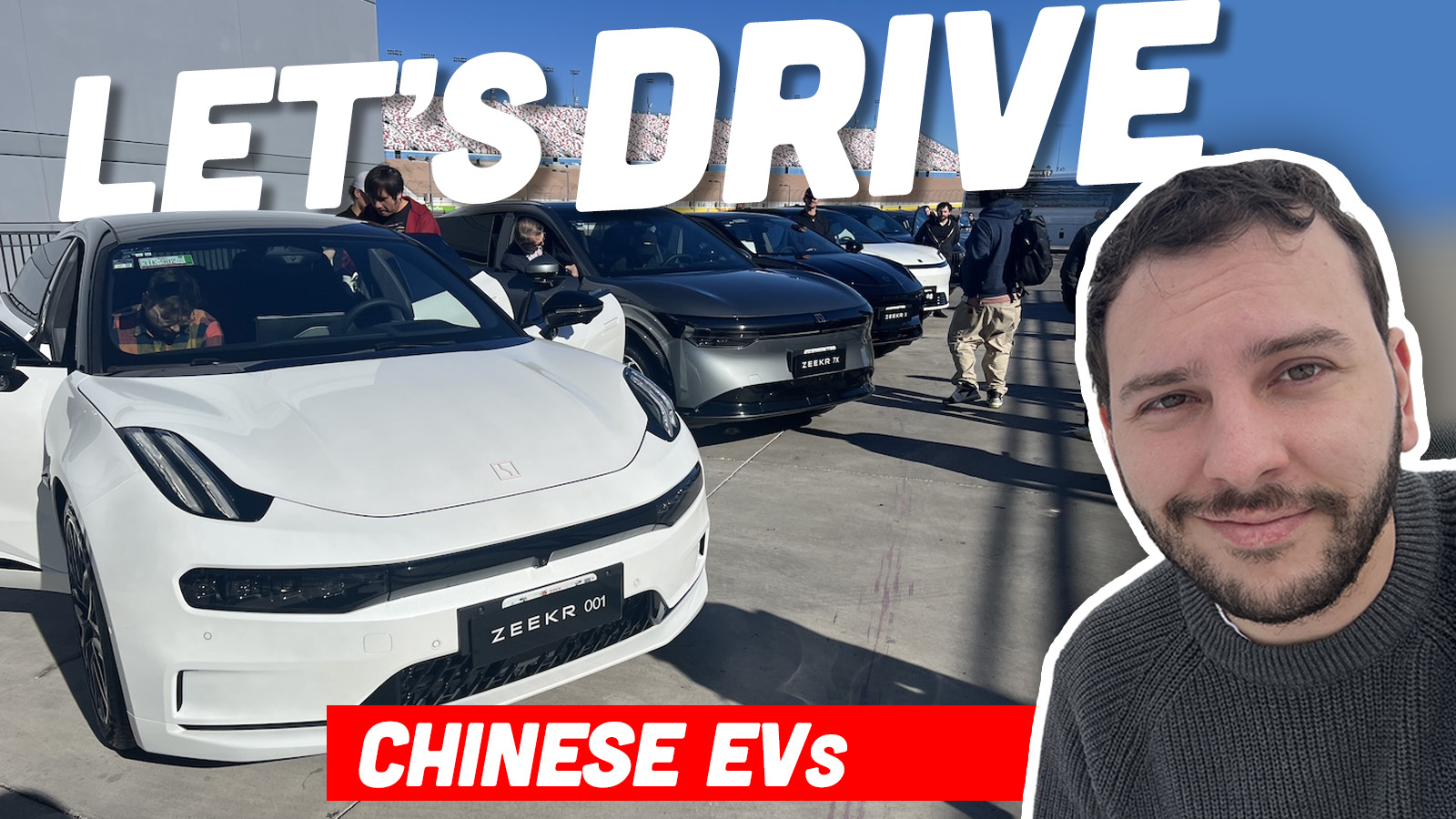
I’ve been working in automotive media for nearly 10 years. In that almost-decade, I’ve been invited on dozens of different press trips from a wide range of manufacturers, restoration firms, and tire makers. But I’ve never been to an event put on by a Chinese automaker. And I’ve never driven a car from a Chinese brand, though I have driven a Chinese-built car.
That all changed earlier this month when Geely, one of the biggest manufacturers in China, invited me to CES in Las Vegas to 1) learn about the company’s next generation of “Full Domain AI 2.0” in-vehicle tech, and 2) drive a handful of its cars across three of its brands. I suspect the AI stuff doesn’t interest you much, so I’m going to tell you about the second thing instead.


Instead of letting us loose on the streets of Vegas, Geely bused us out to Las Vegas Motor Speedway to drive its cars in a closed setting. While I admittedly didn’t get very much actual time behind the wheel, I can definitely report that Chinese cars are very real, and in most cases, extremely pleasant to drive.
The Part Where We Drove The Cars Was A Bit Dramatic
In total, Geely had, by my count, nine total vehicles for journalists to drive at the track. This was a bit of an issue, considering there were about 50 journalists present and only about two hours of total track time available. There wasn’t really any organization when it came to who got to drive what, or when. The result was a mad dash to get to the driver’s seat of each car, with makeshift lines forming in the pit lane, and a lot of crowding.
Rather than elbowing our way to the front to get the driving over with, The Autopian’s stalwart videographer Griffin and I decided it might be best to poke around the static display cars Geely had parked in the paddock while the lines died down. You can see what we found in the video above.
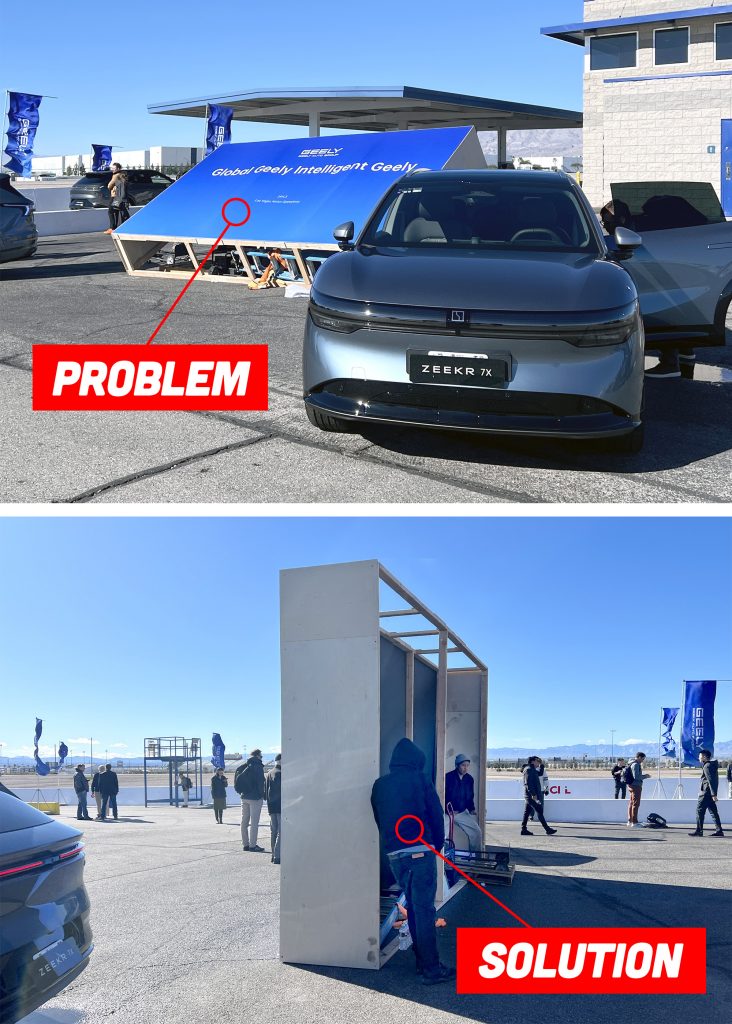
While we were doing this, Geely’s wooden billboard/sign thing it had in the paddock—which read “Global Geely Intelligent Geely”—was showing signs of collapsing due to wind. I caught the moment staffers pulled it down (it was later put back up, with big water jugs on its base to keep it from tipping over).
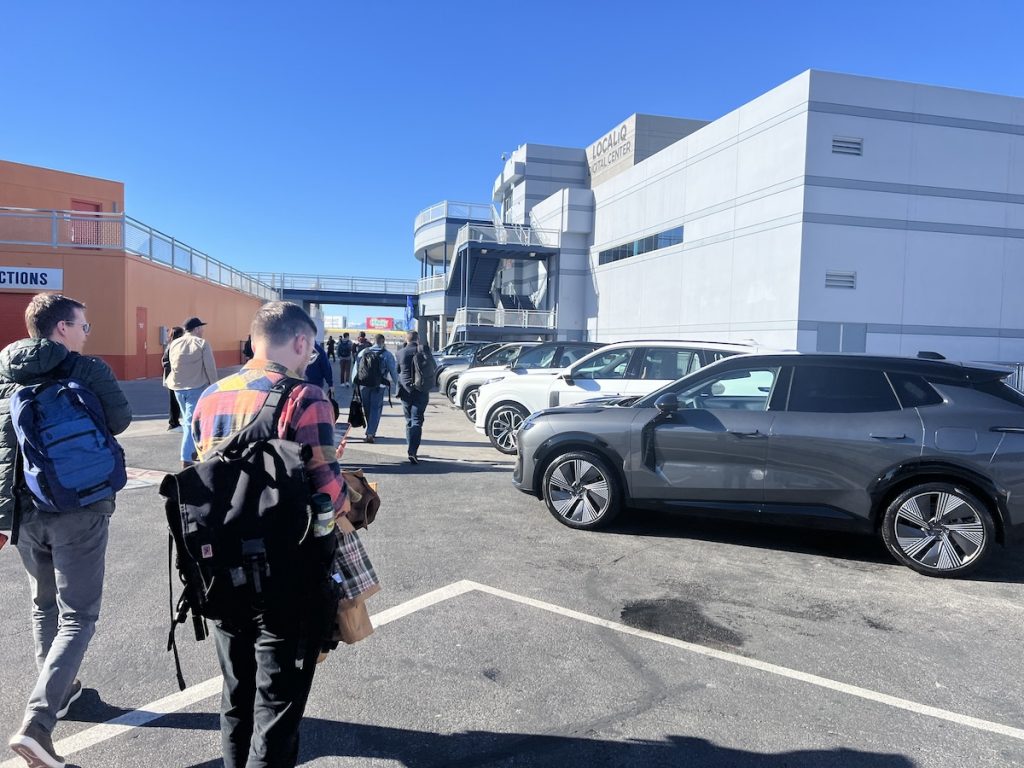
By the time Griffin and I got through checking out the display cars and began fighting for a chance at some seat time, event staff had cut each drive to just one lap, allegedly because people were frying the brakes (how a car can fry its brakes after just two laps, even at full tilt, is a mystery to me, unless the brakes are really bad at heat management. When I drove the cars, the brakes seemed to work just fine). Also, the one car I wanted to drive most, the Zeekr 9X, was not available to drive, despite Geely saying it would be in its invite letter.
I want to make it clear I’m not complaining—this was an event put on relatively last-minute, and the Geely people were extremely accommodating with our video requests, which I’m grateful for. Press events are hugely complex things to put together, and I’m acutely aware. I’m extremely privileged to have been the person selected to go. It’s not very often you get the chance to drive cars that aren’t destined for the American market, and for that, I’m thankful. It was just a little chaotic, is all.
The Cars Themselves Were Actually Not Strange At All
For all the buzz around electric cars and their position in today’s geopolitical climate, I was sort of expecting to be blown away in some capacity, whether by the tech onboard, the design, or the driving experience. But from the brief hour and a half or so I had with these cars, I came to a fairly unexciting conclusion: These are just normal cars.
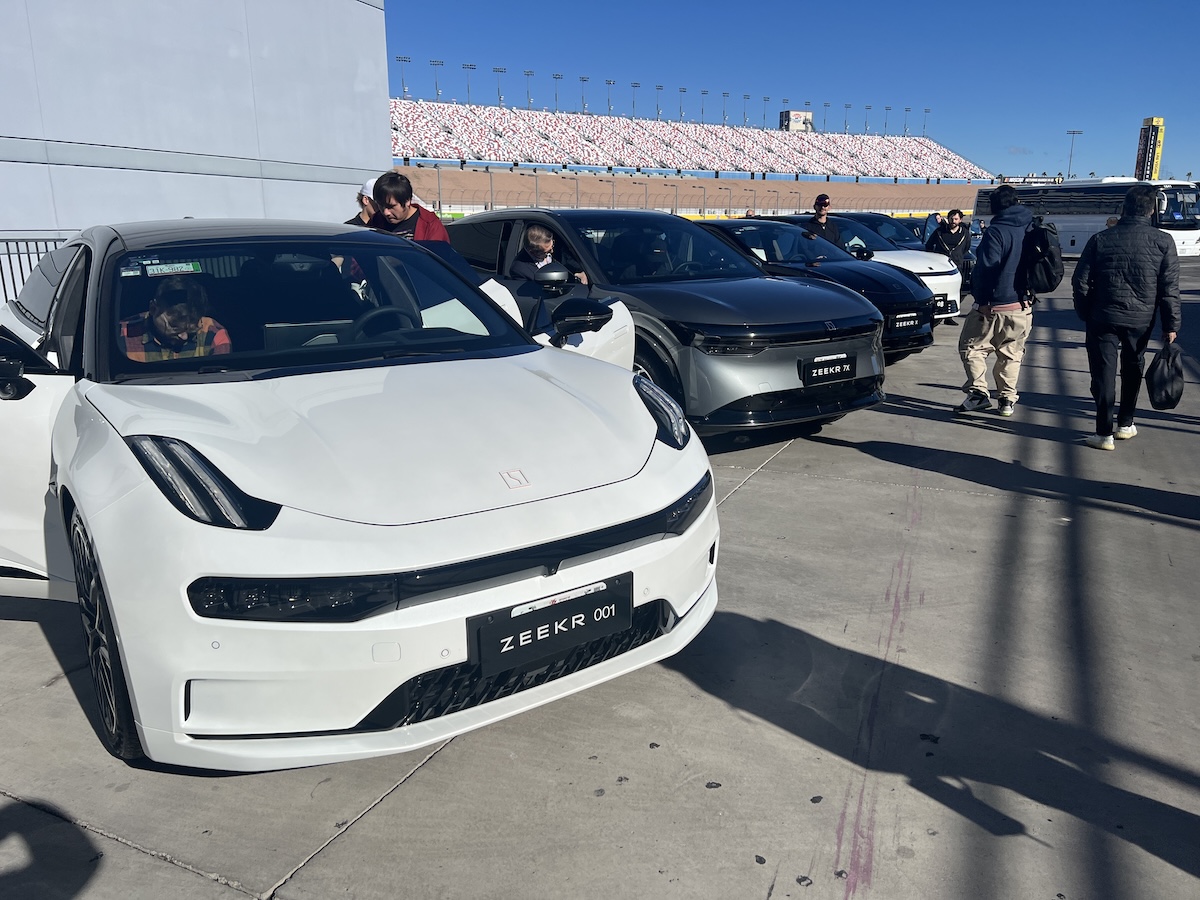
From behind the wheel, these Geely products are barely different from the Kias, Hyundais, BMWs, Hondas, Toyotas, Chevys, and Fords you see on the road every day in America. In most cases, the steering is light and unbothered, the suspension is cushy, and the powertrains are bland and washing machine-esque.
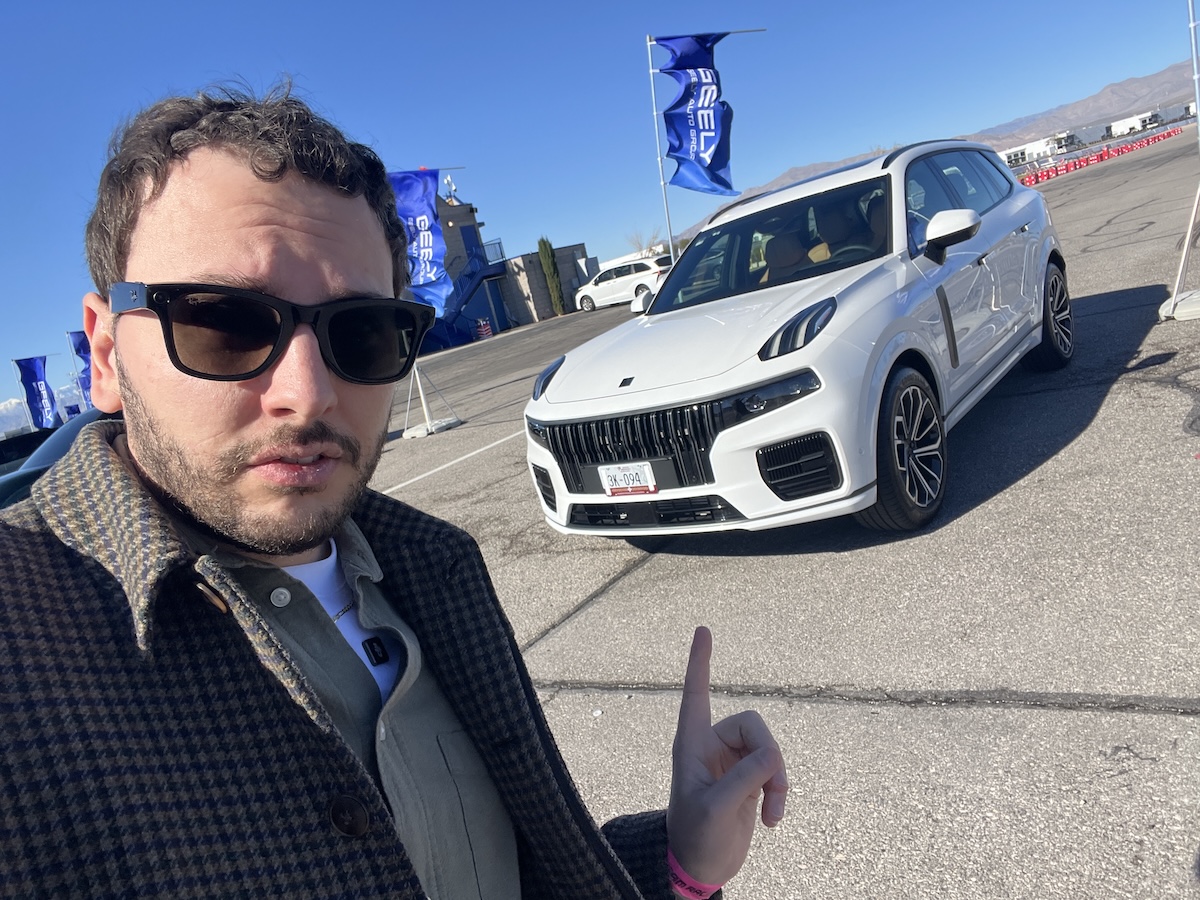
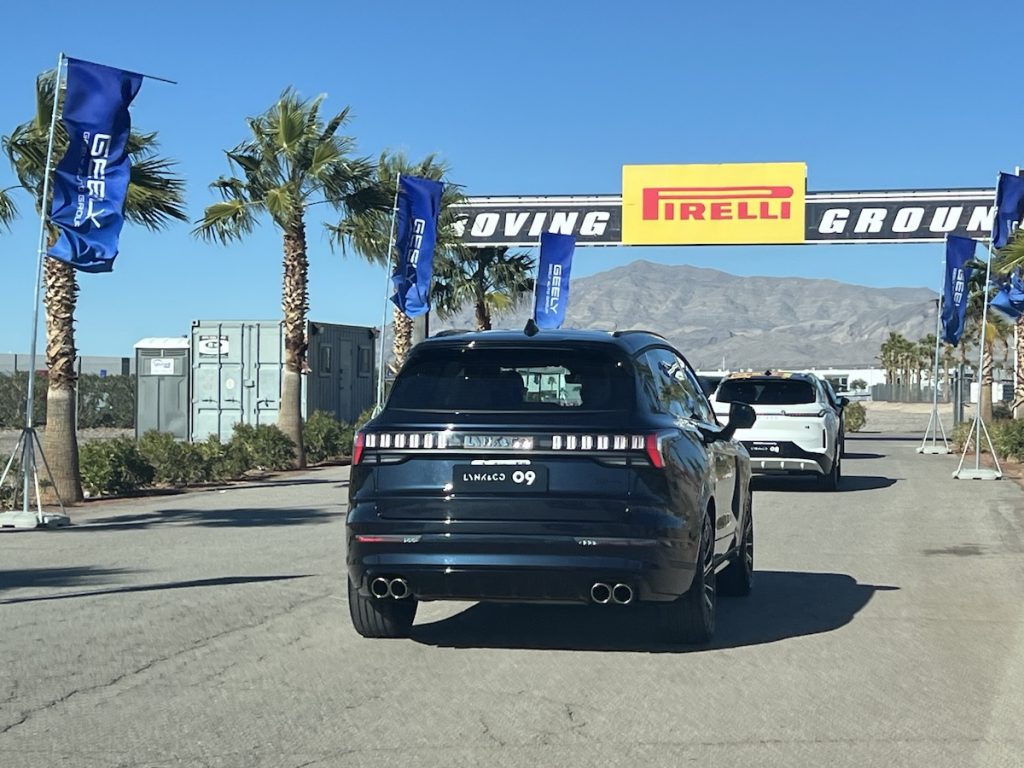
Take the Lynk & Co. 09, for example. It was the biggest car I got to wheel at this event. Despite having never even seen a Lynk & Co. vehicle in my life before Monday, it felt strangely familiar. That’s because the 09 shares its SPA architecture with the Volvo XC90, a car I’ve driven numerous times.

As such, the greenhouse is shaped pretty much the same, and the seating position is eerily similar. The interior layout is different, but not that much different. There’s a central screen for infotainment, a physical gear selector in the center console, and six seats (spread over three rows). I’m not sure if the seats themselves were the same, but they felt supremely comfortable, like the XC90’s. If anything, the materials used in the cabin were a tiny bit more plasticky than the premium stuff in the Volvo. There were also four screens: two on the dash, one for the gauge cluster, and a head-up display reflected onto the windshield.

On the outside, the 09 was the only car I drove that had actual exhaust pipes (four of them, if you were curious). Up front, there’s a big Land Cruiser Prado-like grille with vertical slats and embedded headlights, with DRLs up top next to the hood (a signature feature of most Lynk & Co. vehicles).

If I were blindfolded, I’d be hard-pressed to tell the difference in driving experience between the 09 and an XC90. The one Geely had for us used a pretty standard 2.0-liter turbocharged inline-four combined with a 48-volt mild-hybrid system, making 254 horsepower and 258 pound-feet of torque, getting power to the road via an eight-speed automatic. Was it fast? No, not really. But it was enough to comfortably achieve highway speeds. Was it memorable? No, certainly not. But it did the job just fine, which is really all that matters in a car like this.
Geely’s been selling cars in Mexico for about two years now, and the 09 starts at $949,900 MXN (around $54,000 USD). That undercuts the XC90, which uses a similar powertrain, by around $8,000.
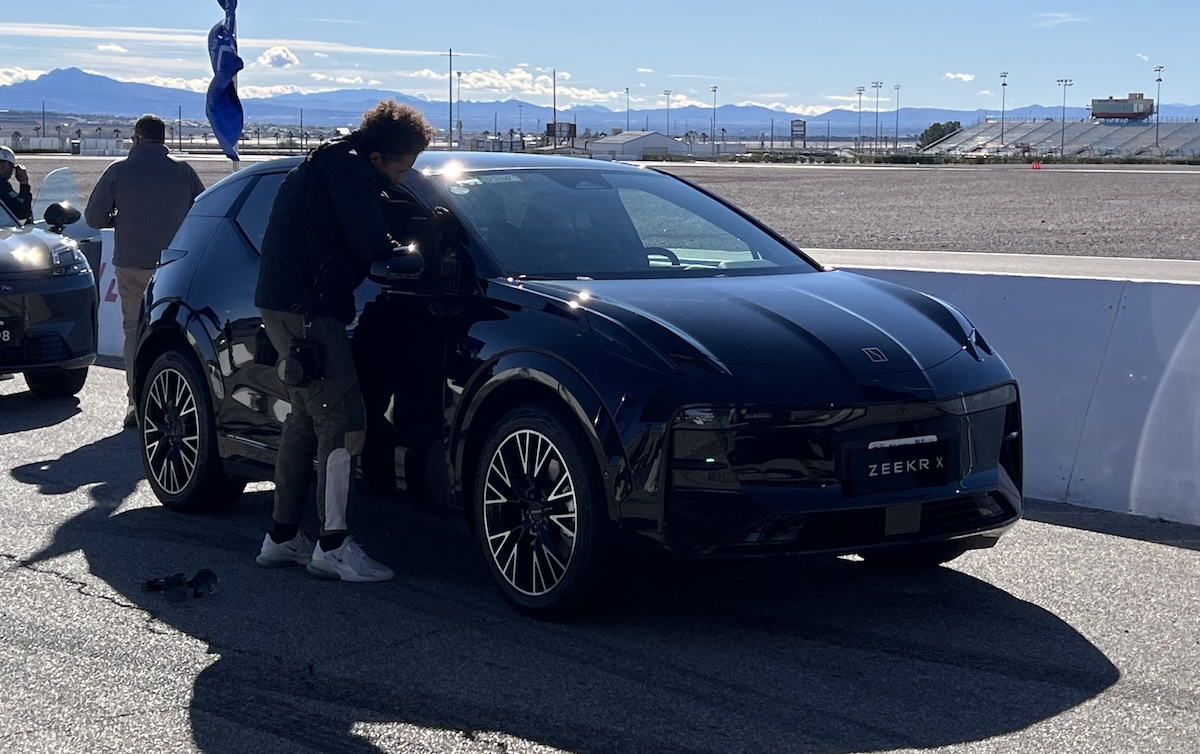
The Zeekr X, a fully electric car brought by Geely to the event, also shares its bones with a Volvo: the EX30. It felt not unlike that car, both in its funky design and its overall proportions. Introduced as a Tesla Model Y competitor a couple of years back, it delivers some damn impressive specs for the segment: The base version uses a 66-kWh battery pack attached to a single motor that makes 272 horsepower and delivers 273 miles of range on the European test cycle. And it does this all for 149,900 yuan (around $21,500 USD).
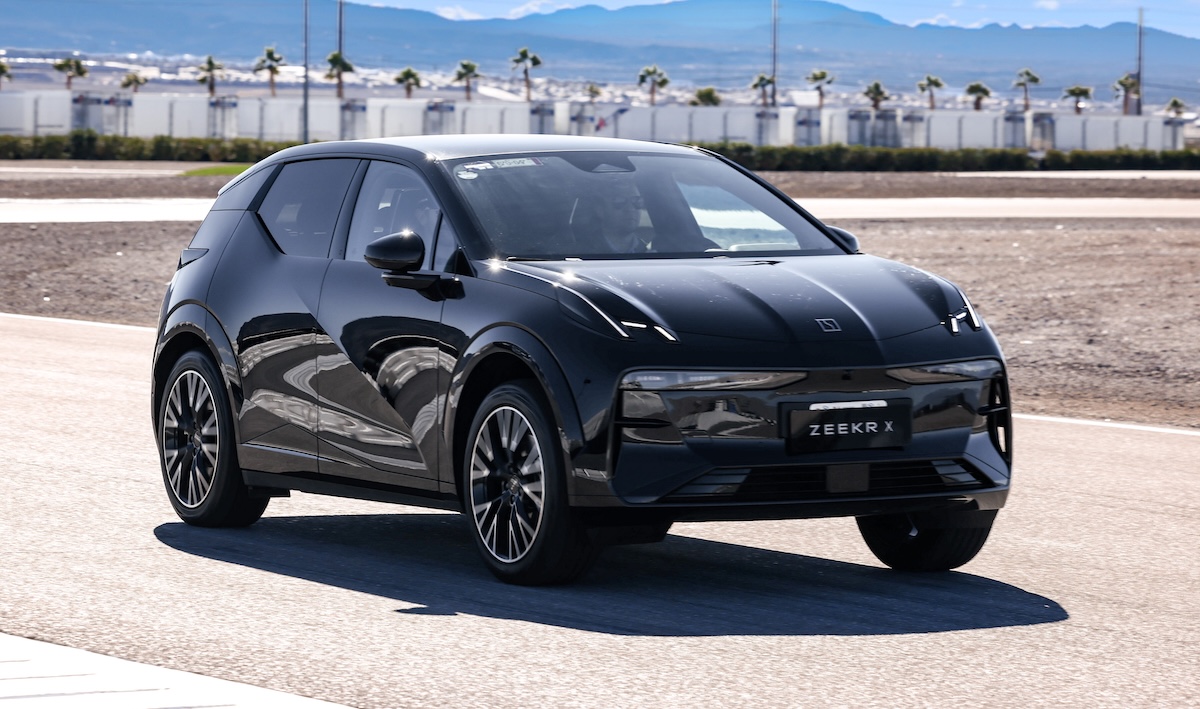
Being on the smaller side, the X was an enjoyable thing to toss around (for the one lap I was able to drive it, anyway). The rear-mounted motor delivered the type of peppy acceleration you’d expect of any EV, and while that pep began to die off above 70 mph, I think there’s only so much you can expect from a car that costs the equivalent of the cheapest new vehicle in America.
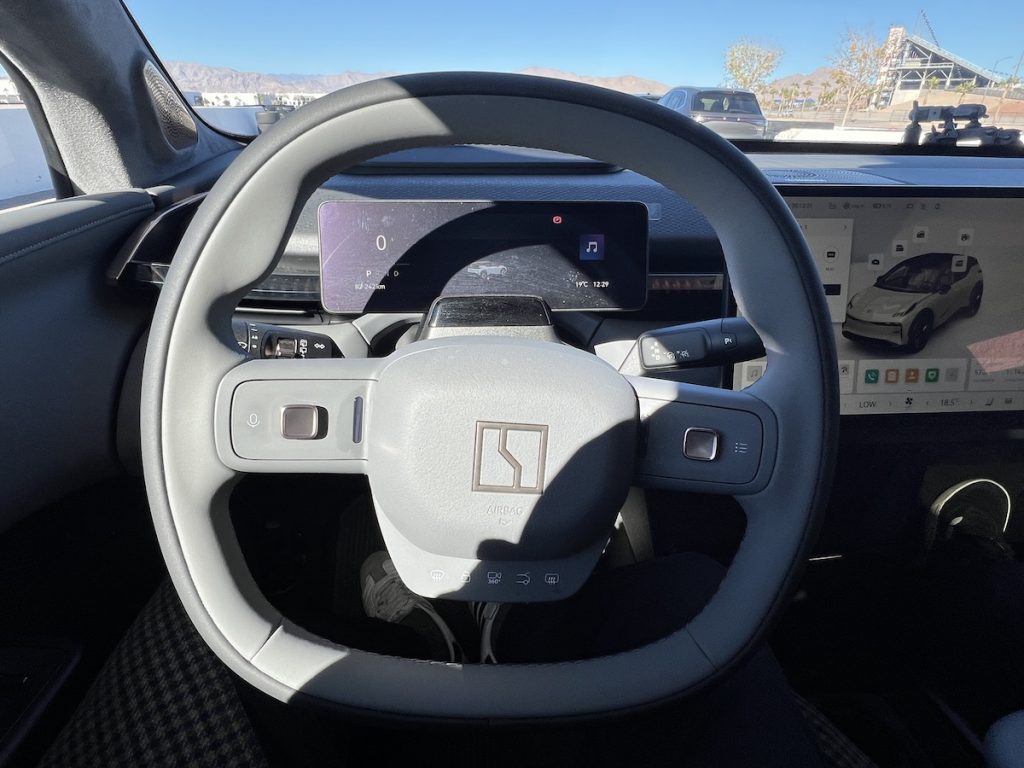
While I greatly enjoy the X’s interesting tall-hatchback shape, I liked its interior even more. It had a tiny screen in front of the steering wheel for vital data, and two unmarked D-pad-like controls on the wheel itself. I most enjoyed the five buttons under the airbag for quick functions like defrost, lock/unlock, 360-degree cameras, and the trunk release (even though I didn’t get to actually use any of them). It’s just smart placement.
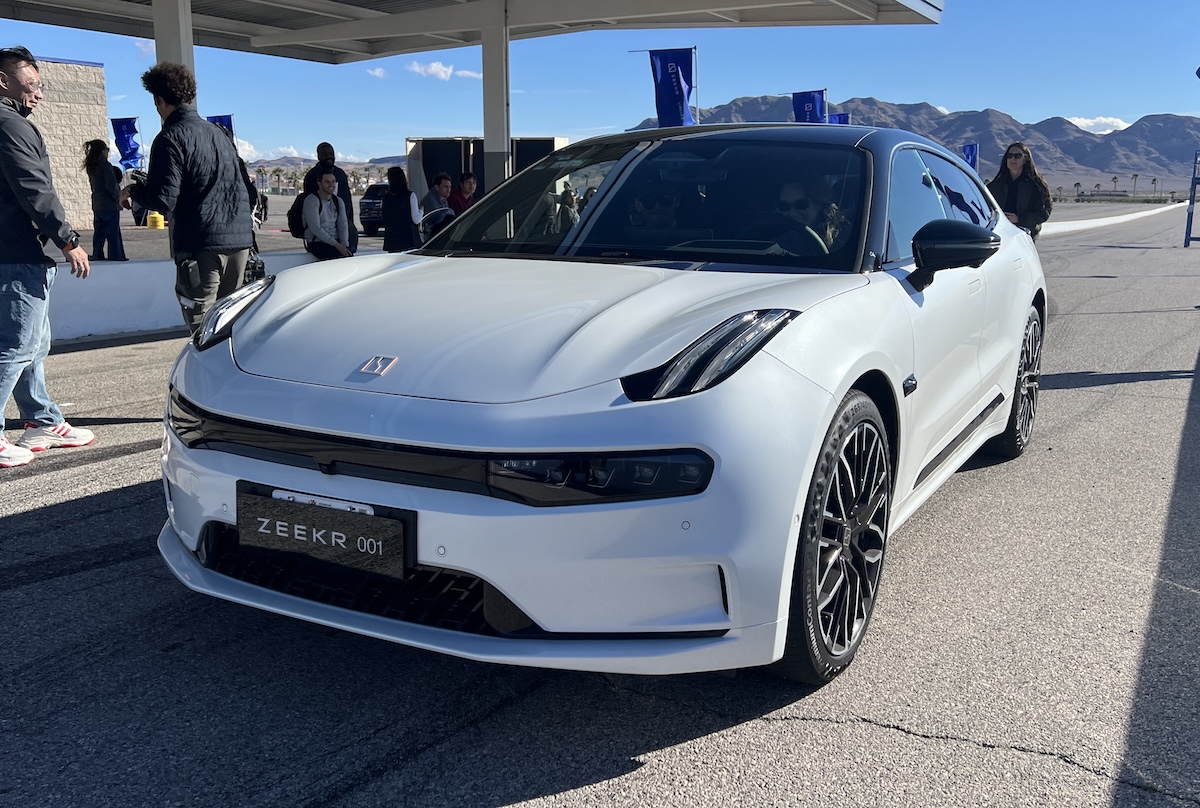
The company’s bigger, electric 001, meanwhile, was probably my favorite thing at the event. It’s a sort of hatchback-shaped wagon machine with two electric motors making a combined 536 horsepower, meant to be a budget competitor to the Porsche Taycan. With double-wishbone suspension up front and a multi-link rear, it felt great in the very few corners I took it through (though it also still felt like a heavy EV).
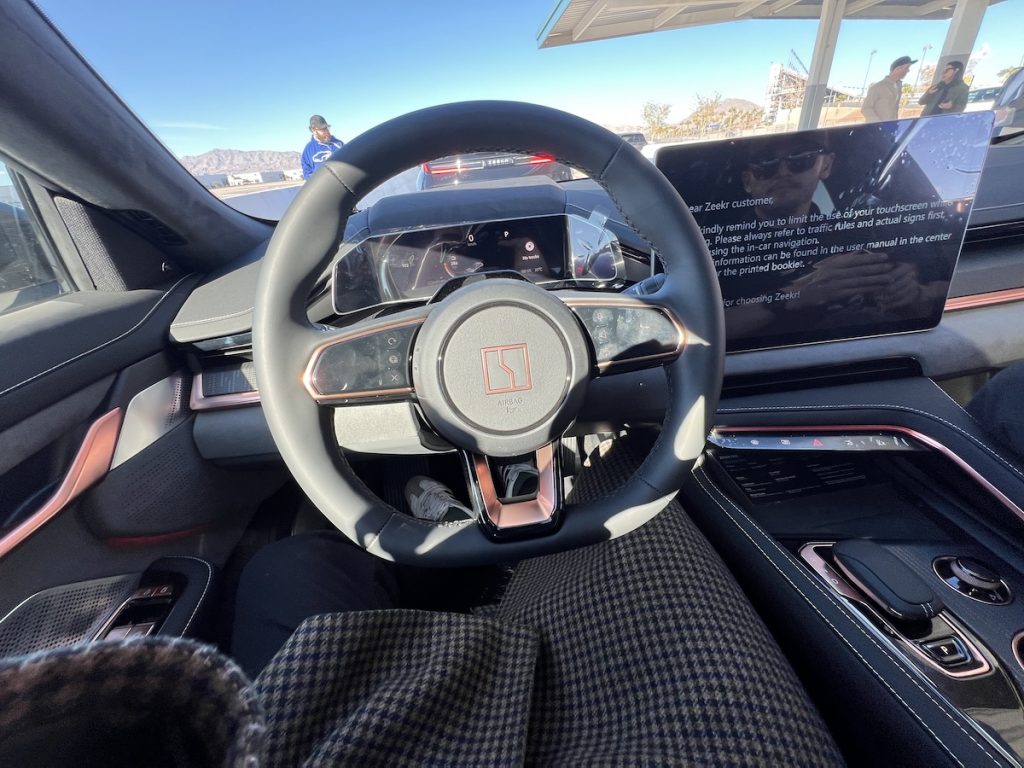
While the brakes left a bit to be desired, the interior made up for any shortcomings in the driving experience. Everything felt well put-together, and the materials were nice to touch (save for the piano black steering wheel buttons, that is). There were also splashes of copper trim everywhere, which I absolutely loved.
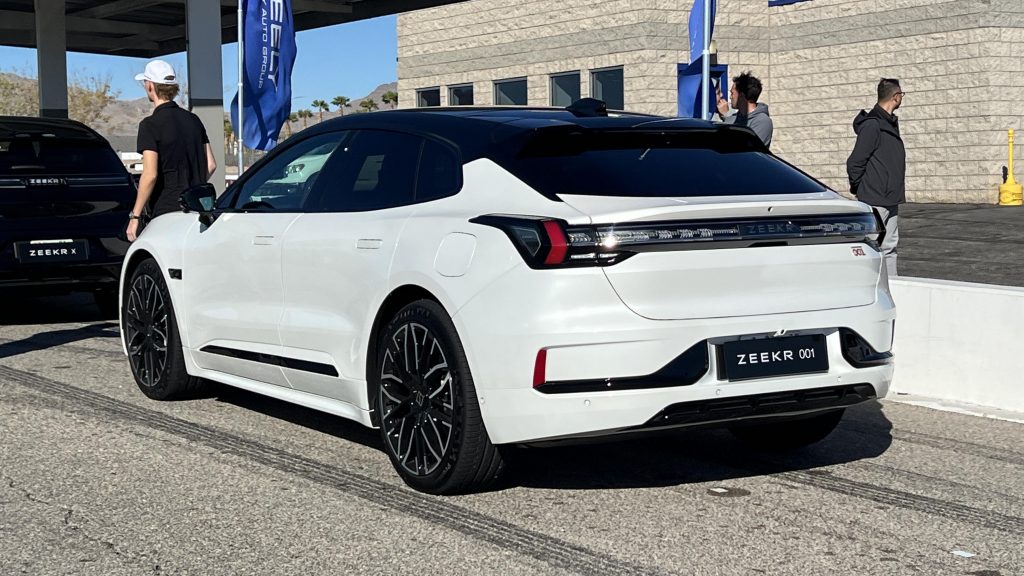
The biggest surprise of my truncated first drives was the Starray EX5, the only actual Geely-branded car available to drive at the event (Lynk & Co. and Zeekr are Geely subsidiaries). Like most other cars at the event, it was a crossover, but unlike every other car, it was purely gas-powered, with no batteries or electric motors to speak of. Under the hood is a 2.0-liter turbocharged four-cylinder making a respectable 214 horsepower, attached to a seven-speed dual-clutch automatic.
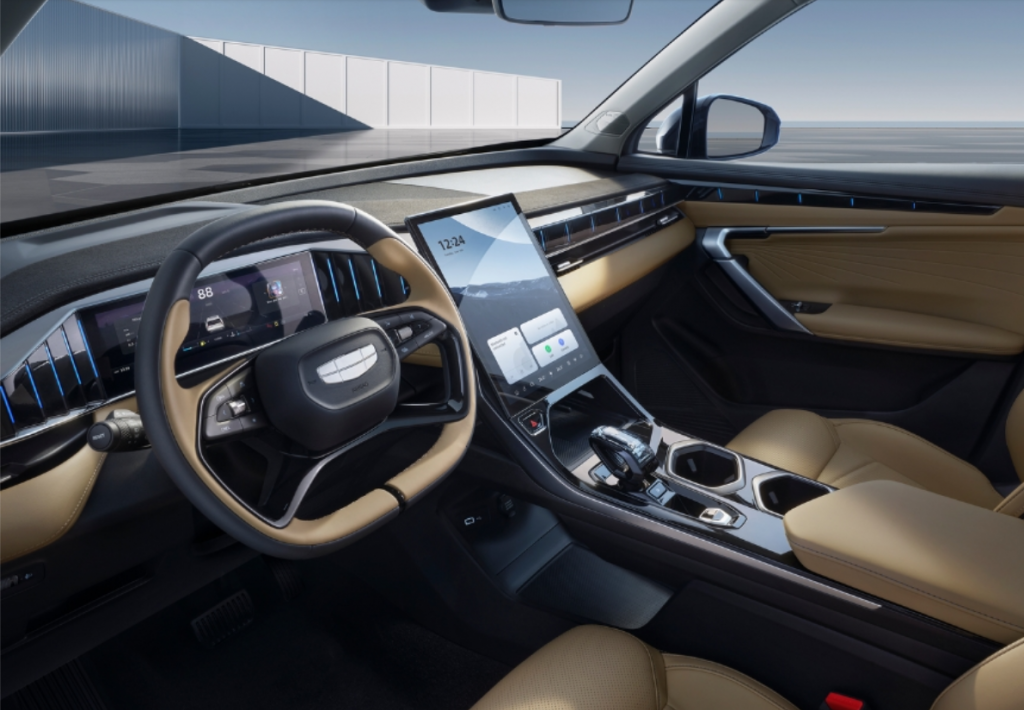
Despite its position as an entry-level vehicle, the Starray’s interior felt about as well-equipped as something one or two steps more expensive. There’s a huge screen in the center for the infotainment, and plenty of material that wasn’t hard, scratchy plastic.
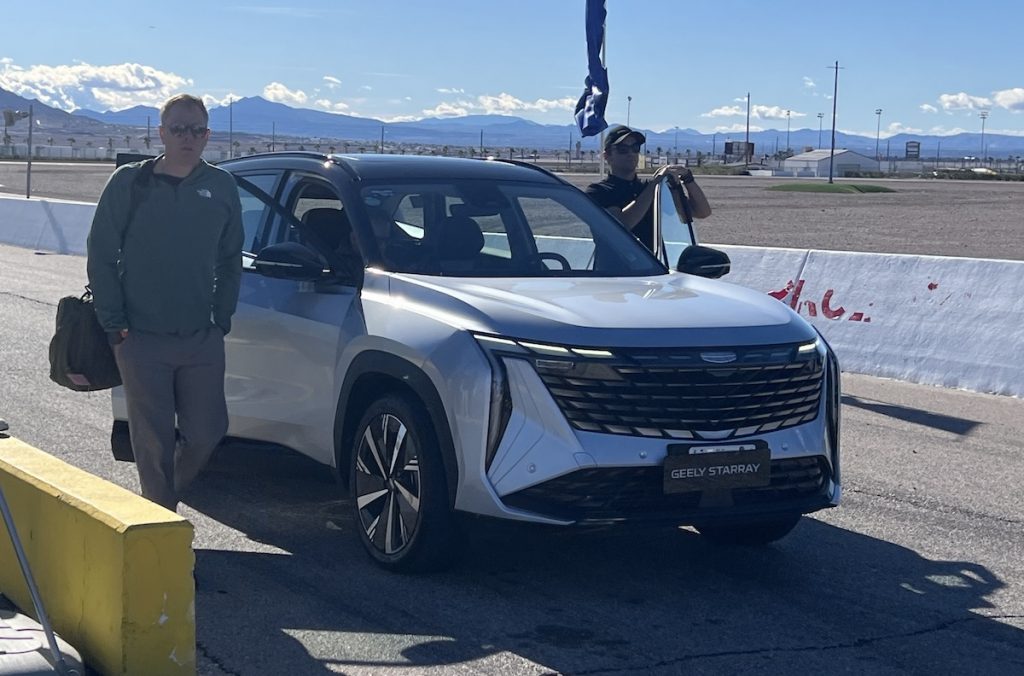
I think the reason I liked this car so much relative to cars like the electric 001 or hybridized Lynk & Co. 09 is thanks to its weight. The Starray was so much lighter than anything else I drove that day, which made it refreshingly eager around corners (for an entry-level crossover, anyway). As a budget-minded option, it definitely has potential.
Most of these opinions were formed over just one singular lap of a small, flat race track, and could (and probably would) change once I have more time with each car. But after this very brief experience, I can report there are no glaring features or drawbacks here that would scare off the average buyer.
The Big Question(s)
At this point, knowing how each of these cars drives is about the only thing I truly know right now. In terms of design, the cars left me impressed, whether we’re talking about the exterior or the cabins (especially in the Zeekrs). And to wheel, they’re all perfectly agreeable, and, in some cases, downright fun. Individually comparing them to anything sold in America is tough, though, since important figures such as range and efficiency could change drastically if and when any of these cars make it to the American market.
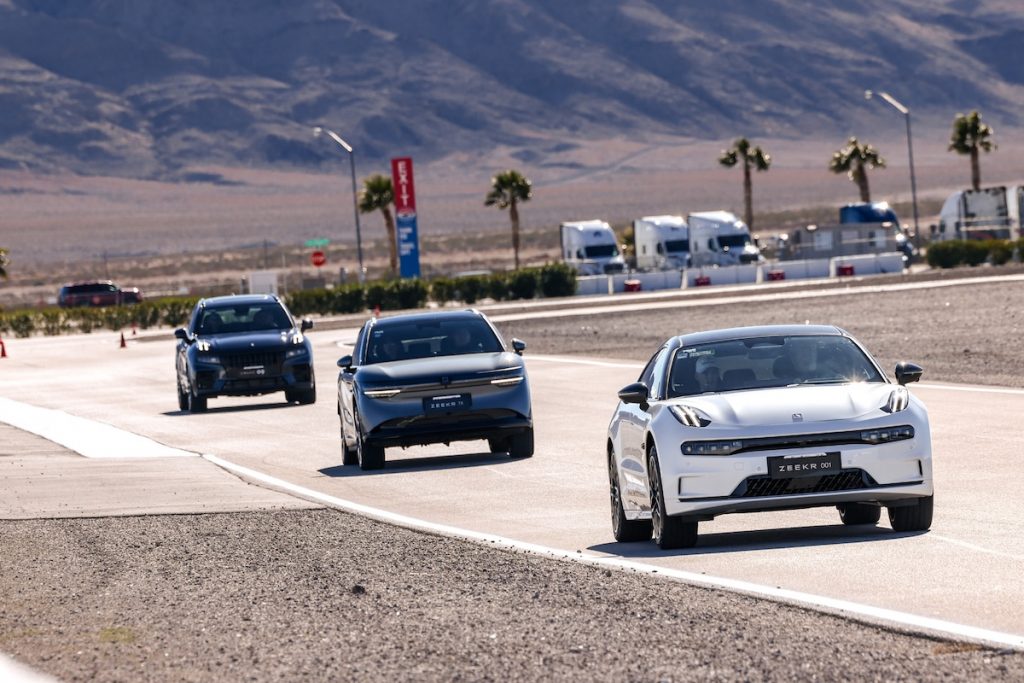
Price is the other obvious question mark. If we compare the price of these cars in their home market to the prices of competitors in America, the Chinese cars undercut others in the segment by thousands of dollars. Any attempt to import them to the U.S. would mean they’d be subject to huge tariffs (100% for EVs and at least 25% on other vehicles, according to Automotive News).
One way Geely can get around these tariffs and avoid shipping costs is to build vehicles in North America. Of course, it’s a bit more complicated than that. It’s not clear whether American buyers can even be convinced to buy anything from a Chinese brand, or if the government would even allow it. The cars themselves are as inoffensive as a modern car can be, but people who have been subject to years of anti-Chinese car rhetoric might still have some reservations. There’s no telling for sure until the cars actually start showing up here—if they ever show up here, that is.

There’s also the question of reliability. Many of these brands haven’t been around long enough to develop a reputation one way or the other, making long-term ownership essentially a big question mark. For what it’s worth, a Geely representative told me that in the two years it’s been selling cars in Mexico, it hasn’t had to deal with any huge, widespread mechanical problems (this is the manufacturer talking, though, so take that anecdote with a grain of salt).
In the meantime, I’m glad I got to drive them and tell you all about it. My hope is that Geely keeps a few of these cars around Stateside so we can get more quality time behind the wheel.
Top graphic image: Brian Silvestro


It basically sounds like an evolution of what Tesla’s been doing (slick, tech-forward cars of dubious longevity for people who don’t care about cars), although with marginally nicer interiors?
The Beaverton headline of Canada rejecting chaotic evil for lawful evil still applies here, I think.
My first question is why would they even spend the time and money to show off cars they can’t feasibly (presumably) sell here?
It makes me wonder if theyre making moves to make it happen.
They’re but probably will not until the current situation settles down, BYD, for example was about to open a factory in Mexico but didn’t happen for… reasons.
Because policy seems to change every 4 years, or in the current years, every 3 days. Those journalists are going to write about these cars, as we can read here, people are getting informed, the name of the brand is being read etc etc. Consumers are going to ask questions, dig for more information.
One thing is find strange is why they offer a single lap on a track. These cars are not for a track, especially not with the relatively low performance figures. Besides the fact you don’t want to drive an (EV) CUV or small SUV or whatever family sedan on a track, basically, ever. It is a smart way to lure in a lot of journalists who don’t mind to stomp on the throttle around a small track, else they might not even have shown up, but it doesn’t really showcase a car’s benefits, in 2 minute ride.
Perhaps these guys are trying to feel how they should approach the US market. These new brands aren’t here for the short term. They all want to build a multi decade legacy, as they already did back home in China. Maybe they can’t enter the US market in before 2030, but when it will be allowed or made possible, then they’ll be there and ready.
The Chinese car manufacturers are getting quite good at their introduction of a new model ; back home there aren’t that many issues (reported by owners) in the first months of operation. It seems the quality control is pretty good. Now we have to find out the reliability in the long term. And it looks like that will be figured out outside the US so once the US market opens (if?), then the cars will be good from the start for US buyers, which is nice to know.
Or perhaps Ford and GM wake up and start designing and building similar quality cars so if/when these Chinese cars are allowed in, then there are “Made in the USA” alternatives. Nobody wants a young market to be swarmed (zerged?) by a single foreign country with hardly any affordable alternative.
Brian, You love writing about these cars. You love China EV’s. That is clear.
Can you do a deep dive on the factories, conditions of the workers and the environmental considerations taken by these producers? I am sure they are up to the EU and North American standards. I’d just love to know more so I can see if its morally defendable to purchase one.
You’d be surprised, a lot is automated. More than in the US probably. If you worry about the quality of life of Chinese workers then you could ask the government to reduce the tariffs so those cars could be sold in the US, so the factories make more money so they can give higher salary to the workers. Or we can try to squeeze them out of all western markets, make their life miserable and then confirm that their lifes are miserable so we shouldn’t buy their cars.
What a useless response. “Screw over local workers for Chinese I don’t know”. We have tried that, globalization has failed us.
Everyone wants to go back to the days when a single guy supported a whole family, but that was when we made things here, and there was purpose for people.
Isn’t that what free market means? We forced open markets in Asia, heck we had wars over it, but when they finally want to sell goods here (first Japan, then China), we suddenly close our borders? Kinda double standard isn’t it. It’s going to be a difficult future if we keep thinking like that. China isn’t going to keel over like Japan did with the Plaza Accord. They’re already too big for that. Too powerful. Too much influence. Too fast to adjust to chances. The best bet for the whole western world is to become and stay buddies with this new emerging power and lead him in the right direction. Or we can try to use gunboat diplomacy and see when that will fail.
What part of globalization do believe has failed us? If you mean that it has mostly destroyed manufacturing in the US, then yes I would agree. What it certainly has done is lower the costs of most goods. I’m not saying I’m a supporter of globalization, but it is hard to have both domestic manufacturing and low costs.
I work for a company that makes products both here and around the globe. We have 6 factories in the US, and the products made here are nearly double the price of the products made overseas. We advertise on our website the products made in the US, and we have no problem selling everything we make, so there is a definite market of consumers who want to buy US made items.
My personal ethos is that I will pay a premium (if not too large) for American made goods, so long as they are at least as good as the competitors. It’s why I buy WeatherTech floor mats for my vehicles: Great products, reasonable price, helps support local/national economy
> so the factories make more money so they can give higher salary to the workers.
yeah that’s not.. how this works anymore. That link’s been broken since Friedman.
I’m not making that stuff up.
Key Trends in Asian Salaries (1995–2025)
To my last breath I’d never understand what happened to Japan.
Growing up in East Asia, Japan was the undisputed leader of… everything, be it economy, technology, culture, tourism, etc. It was the dream destination of vacation, the pinnacle of automotive and electronic engineering, cultural exports, etc. In the 1990s the Japanese GDP was bigger than the rest of Asia, combined.
Today, Japan’s GDP couldn’t even compare with just a few Chinese provinces. If I think of 10 technological products, not a single one comes from Japan. It’s as if the entire dot-com thing completely bypassed Japan. With the depressed exchange rate, people go to Japan because it’s cheap.
If Xi wants to screw with the new Japanese PM he just needs to egg them on with re-armament. Japan would probably implode faster than the Soviet Union.
I suggest to read here for more background on Japan’s stagnation for over 3 decades now ;
https://en.wikipedia.org/wiki/Plaza_Accord#Effects
https://en.wikipedia.org/wiki/Lost_Decades
Since AI can write it better than me in a compact sentence:
Anyways my point was that China has seen that, learned from that and will do whatever they need to do to avoid that. 30 years of stagnation would be the death for China, since they’re -also- dealing with aging of their population. While that helps with (affordable) housing for the young people and also solves labor surplus in the end, pressure on fuel and food while the country is shrinking ; the government will still want to see growth of GDP or at least the PPP (purchasing power parity) so people will feel their lives are improving.
Something you see -right now- in the US (and Canada and EU) where people are complaining that everything has become expensive. If groceries are $100 more expensive per month that SHOULD NOT BE A PROBLEM if you salary increased by at least $1200 a year. It would not feel like progress, but you’d have the same at the end of the year. However groceries are likely to have increased by way more than $100/mo and salaries haven’t increased or even got worse. So people will complain. Which puts pressure on politicans. So they will promise things. And they will break those promises because earning money in a fair way, is hard.
The US car industry should have been oblitterated by the Japanes car industry in the 80s and 90s. The US protected itself. Then it had to do it again against the Koreans. And now the Chinese. Many European countries don’t even have a (meanigful) car industry anymore. Think the UK. Or Netherlands. Or Denmark. Too small scales. Too much labor using people as ‘horses’. That’s not sustainable. The US should have embraced the Japanese cars and switched to newer (high)tech industries. Services. Financial industry.
Perhaps more agriculture and resources ; something the US has plenty of. The former would have allowed to cheaper food prices right now and the latter would have avoided global tension over rare earth minerals. Which aren’t rare, but are hard to refine. Dirty. So we let the Chinese do it. And now we are angry we let the Chinese do it. We want to do it ourselves. But we can’t because then everything gets dirty and we don’t want dirty in the US.
So we look at Greenland where we can do dirty things without making our backyard dirty. Which is a sad thing, but in the grand scheme of the last 150 years, it is nothing and for a historian looking at this in the year 2500, problably totally logic for the US to do. Annex stuff you need. Like in a game of Starcraft.
Having lived in China for my entire adult life, the opening of this article sounds very Chinese to me- organization and things falling over specifically feels very normal to me, but somehow I doubt that happens stateside often.
Also, I drive to work here in Beijing every day and have yet to see a new electric car break down or be stuck at the side of the road, so it seems to me that they are of decent quality.
I have yet to get to drive any of them, but from being a passenger it seems that they are not very smooth in traffic, though it could be the driver’s fault.
Anyway, it is pretty exciting to see the everyday cars for me on US soil and wonder what the future holds…
by the way, I am doing my part here to spread american car culture and have been driving a 5th gen Camaro in Beijing for 13 years now. As far as I know, I am the only westerner driving a muscle car here.
“… from being a passenger it seems that they are not very smooth in traffic, though it could be the driver’s fault.”
I find that first-generation drivers tend to use the accelerator as an on/off switch rather than as a rheostat – hence, passenger bobblehead syndrome (PBS)
Makes sense. I’ve only driven an electric car once- a modified tesla and just around the block, but it didn’t seem too tricky to control after a few minutes.
Other than that, I have a lot of experience (off roading) in my families golf cart we’ve owned for 20+ years.
Also, a good friend of mine has the Zeeker and keeps saying I can drive it, but we never get a chance to meet up with busy schedules and lives. She used to drive a modified Scirocco and says the Zeeker has a lot more heft and definitely not the nimble track machine like her VW was.
I mean, American consumers will probably treat Chinese cars the way we treated Japanese cars and then Korean cars. As a people, we’re basically consumers first, patriots second – we’ll make some noise about geopolitical whatever and maybe even human rights something, but give us a couple years and the fact that the Chinese EVs are cheaper and better than what the sad corpses of our domestic manufacturers are putting together will surely draw out our internal capitalist.
That’s pretty much what’s happening down here in Australia. Chinese cars started hitting the market in earnest around 5 or 6 years ago, largely via MG. Initial reactions were… Not great, but they’ve been improving dramatically ever since. This has been especially so in the last couple of years when we’ve witnessed a deluge of EV makes and models arrive, all of which significantly undercut efforts from the legacy carmakers.
My sister is currently leasing a GWM Ora (I think better known internationally by its amusing Chinese market name, the Ora Good Cat). It’s a retroish-styled EV around the same size and price of a Toyota Corolla. My sister’s family have been very impressed by the car, especially its rather nice interior, and they haven’t had any issues arise with it in the six-or-so months they’ve had it. Compare this to their Ford Everest, which they bought new and went back several times in the first few months for annoying little electrical issues.
My parents also went EV shopping late last year, but being conservative buyers looking to make an outright purchase, they went for a Kia EV3 instead. This is despite the fact they could have purchased a larger and better-equipped EV from one of several Chinese makes, including Geely, MG and BYD, for the same or even less. But they felt they were all still too new – and were concerned about which companies would actually survive the next few years – important for people looking to own the car for probably the next decade or so.
So I guess that’s a snapshot of the current perspectives now, people like my sister are willing to lease Chinese cars or otherwise own them short-term. But longer-term buyers like my parents are still probably going to stump up for legacy brands, at least for the next few years.
If you can lease a new brand, that would be best. I agree that outright buying a new brand should be financially extremely attractive to take the risk. The Xiaomi SU7 is a good example. The brand is ‘old’ but hasn’t made cars since roughly 2 years ago. Nobody can predict if they will be here in 5 years. Their current car seems to be good, but again, it isn’t even 2 years old so nobody knows if it will fall apart after 3 years.
That herringbone wool coat’s name is Carmine.
> If I were blindfolded, I’d be hard-pressed to tell the difference in driving experience between the 09 and an XC90.
You’d probably crash both.
Probably a good thing that Volvo had a hand in them in that case
You can’t even buy a DJI drone in the US anymore. What makes you think that a car packed with AI is going to be allowed to be sold?
Slight correction: DJI drones can still be sold and used. They just cannot introduce new models to the US market.
Existing inventory in the US can be sold, but my understanding is that any new equipment (even if it was previously certified) will be blocked by customs. I have a DJI Mini 2 that I crashed backwards into a tree, cracking its “fuselage,” but it still flies ok. Not sure I would fly it in the rain.
I bought a Mini 3 Pro, but have never unpacked it, since the 2 still does ok. I kind of wish I had bought a 4 Pro, but since I hadn’t even touched the 3 yet, it didn’t seem to make sense at the time.
They are truly amazing machines, capable of capturing amazing footage that used to take a very expensive helicopter, gyro-zoom, pilot and ferocious fuel and maintenance to deliver. A drone can do about 90% of what the Bell 206 JetRangers (what a cool name!) I flew in could or at least be routinely used for, and some things they can’t, like fly indoors or in really tight spaces outdoors.
A DJI drone is not going to be able to do 100+ knots following a car chase. Or be able to ferry station personnel from point A to point B. It doesn’t have a 50X zoom lens. But for most aerials, they’re pretty adequate, don’t burn $600+/hour of jet fuel and are very quiet and almost unnoticeable.
“I drove the cars co-developed by Volvo. They drove a lot like Volvos, what a surprise!”
Just to point out it seems most these cars seems to already be in the US in some variation under the Volvo or Polestar brands. Like the Zeekr 001 is and the Polestar 4 share the same platform and both cars seems to be both the same size wise.
Can you add the car model names to the photo captions? Especially those interior shots.
Intelligent Geely couldn’t figure out to cut some holes in the display (or face it perpendicular to the wind)?
Sorry, a nice interior doesn’t make up for shitty brakes.
look at the fictional vehicle name from the famous 1920’s era novel Babbitt:
“The long white trail is calling—calling—and it’s over the hills and far away for every man or woman that has red blood in his veins and on his lips the ancient song of the buccaneers. It’s away with dull drudging, and a fig for care. Speed—glorious Speed—it’s more than just a moment’s exhilaration—it’s Life for you and me! This great new truth the makers of the Zeeco Car have considered as much as price and style. It’s fleet as the antelope, smooth as the glide of a swallow, yet powerful as the charge of a bull-elephant. Class breathes in every line. Listen, brother! You’ll never know what the high art of hiking is till you TRY LIFE’S ZIPPINGEST ZEST—THE ZEECO!”
“how a car can fry its brakes after just two laps” … could this be one reason why these vehicles are apparently so inexpensive? tip of iceberg? of course the American makes were legendary for underspec’d rotors for a long time and did drag their feet on replacing drums with discs on the rear, also for a long time. anyone for leaf springs? 🙂 [i know, i know, a leaf spring is a perfectly fine nonlinear spring!]
Couldn’t are intrepid explorers carry a infrared temperature gauge and measure them?
Two possibilities:
1) That was just an excuse the organisers came up with to try and let everyone get some seat time.
2) Automotive journalists drove in a normal automotive journalist way, ie like a racing driver but with less actual skill.
I’ll take the wager on #2.
Regarding their reliability, MG cars (“British” chinese cars) stand for “Mucha Grua” (Too much Tow Truck), so reliability is not high on the list.
Celina 52 Truck Stop should have sponsored that big sign that got blown over. Instead of water jugs to hold the sign down…
Piss Jug Man would have been a great celebrity appearance. Guaranteed to keep that sign from tipping.
I still won’t buy one. Bridge too far for me.
I understand. But then again, I am driving my second Volvo XC60 and loving it, so it’s a fairly irrational issue for me personally.
Same with my Polestar 2 I have not had any concerns with it.
That’s what Grandpa said about Toyotas back in the early 70’s.
Sure, but I wouldn’t have bought a Soviet car during the Cold War, either.
You didn’t need to wait several years to buy a VAZ or Lada from the Soviets when you could get the same car from Seat or directly from Fiat.
Meanwhile you, and most other people, happily buy TVs, Computers, Phones, Tablets and Printers, Refrigerators, etc. from China…
Happily, no. Where I’ve got a choice, I’d avoid buying from China, but that’s extremely difficult for a lot of things. Even US-assembled appliances- which are common as it’s cheaper to ship the parts and assemble here – have many parts from China. I’d pay double for an iPhone actually manufactured (not just assembled) in the Western Hemisphere, but I know I’m an outlier here.
In cars, I have a choice (though again, some components come from China) so I make the choice accordingly. No Chinese cars for me, as long as I can help it.
100% tariffs on EVs and 50% on gas cars aren’t “huge”, those are yuge tariffs.
The anti-Chinese rhetoric is only going to get worse with the current administration.
Rightfully so
Just wait for the anti-Dane rhetoric.
“Do you know what Lego is doing to your children?!”, “Denmark: Workers rights or communist hellhole?”, and of course “Copenhagen terrorised by gangs of mermaids”.
“Legos are the worst. Have you ever stepped on one? It hurts like hell. I blame the Danish. You can’t even get a decent Danish anymore – all you can get are Bagels. Bagels are good, but not as good as Danish – At least good Danish, not the bad ones. The bad ones – like Hillary and Biden. They rigged the election. You know my Mother said I could be a good ball player? I would have been the best – I should get an award. Do you wanna give me an award? If I suddenly had that award, we wouldn’t need Greenland, tho I really want it. I wanted that election too – I really won it, but it was rigged. A rigged election…”
Wait,
Are you saying: they didn’t force you to go through a centre-display to turn on the wipers? And had displays in front of the driver? Didn’t have a yoke for a steering input? And otherwise felt like normal, proper, vehicles that were well put together without obscene panel gaps/orange-peel paint/trim blowing off at highspeeds?
It’d never make it in America.
No central gas pedal or manual spark control?
I want my cars to go further than 2.5 miles before needing a break.
I was hopeful you would get some seat time in the 7X as that is supposedly the must have car of the current Zeekr lineup.
Also, you can definitely cook brakes in two laps on a track, especially if those laps are back to back driver swaps. Especially in something that is a heavy, commuter car.
I was greatly looking forward to the 7X but alas, it wasn’t meant to be. There’s apparently one owned by Geely on the west coast right now, hopefully we can get some seat time in it eventually
If it is a POS.
Just change brakepads if you want to track your car. Problem solved. Doesn’t mean the whole car is bad. And you know this.
The current tariffs make them a non-starter. The only reason to take a punt on one of these unknown brands would be a significantly lower price.
I don’t hate the look of that Zeekr 001, but I keep in my mind trying to imagine what that would look like without the upper DRL lights. It looks kind of sleek in my quick MSpaint editings…
Here’s my amazing paint skills. I think it actually looks better with the bumps on its head. Too plain without.
https://i.imgur.com/NsWAxlw.png
Interesting, it reminds me of the discontinued Dodge Darts, just squished in the front a bit.
It reminds me of an Isuzu that may or may not have existed.
Edit: the Impulse.
The 001 was Zeekr’s first car, before they split away from Lynk&Co’s DRL-on-top styling. There’s supposed to be a refresh soon that might bring it more inline with the rest of Zeekr’s lineup.
Interesting stuff enjoyed the perspective especially as the event was on race track. The x is the most fascinating to me as I believe value for money on the lower end is where the Chinese cars will thrive for sometime. Hopefully they keep it around for it to be used by the press putting it in different scenarios.
Biggest question is can they hold that price with US safety testing and added cost of driving nanny requirements on cars under 10,000LBS GVWR.
That’s always the question and it’s always probably no. Unless the battery costs come down even further like with the mixed chem Na and LFP packs. But still BYD is probably the only one that can bring something in at anywhere near that especially with the terrifs and that’s only after they finish their huge factory city.
China NCAP is pretty similar to Euro NCAP, and so should easily pass NHTSA testing (which is fairly easy nowadays, IIHS testing is what makes USDM crash resting difficult). At this point, only little city cars cheaper than a BYD Seagull don’t come with the driver nanny stuff in China.
Not to mention IIHS is fully optional and only benefits the consumer. NHTSA is what matters for federalization, and it only involves something like a full-on 35 mph impact which is something any car built since the ’90s should be capable of without issue. I find it hilarious when people parrot safety regulation as a barrier of entry to the USDM because we actually have some of the most lenient crash test requirements globally.
To be fair the general public seems to care about IIHS results to the point where automakers consider it a disaster to get poor scores depending on the segment. But yeah, at this point it’s probably harder to comply with the US’s unique reflector laws than pass NHTSA with a C-NCAP or Euro NCAP vehicle.
NHTSA requires things that were previously not required via FMVSS rules. They change frequently and put a burden of cost ont he MFR to be able to certify the vehicle for on road use. That and Emissions are the two things most often cited for cost dilemmas for many cars in the US to be both compliant and cheap.
Just on FMVSS 127 alone, they are now requiring. (Driver Nannies)
FMVSS No. 127 & Updates):
An $11k USD mid-trim BYD Seagull has all of those ADAS features (though I’m not sure if it can quite do pedestrian AEB up to 45mph), so I expect basically anything that costs $20k+ in China to be easily capable of it. Chinese cars as cheap as ~$16k are getting serviceable highway semi-auton similar to GM Supercruise or Ford Bluecruise, and this is in China’s more chaotic traffic.
Geely is a relative straggler in the Chinese ADAS race, but they still easily crush the Euro-NCAP tests that FMVSS #127 seems to be replicating.
Why do the Zeekr 001 and Lynk & Co 09 have the exact same hood DRL’s?
Zeekr was originally created to be Lynk&Co’s EV subbrand (L&C used to only do ICEs and PHEVs until recently) and as their first model in 2021 the 001 shared the parent brand’s styling. The second model, the 009 MPV in mid-22 differentiated more but still kinda has the same high DRL philosophy, and it was only with their third model in late-23, the 007 that they decided to fully seperate the brands.