


I’m in Phoenix, Arizona at the moment, America’s only city that’s named for both a leading brand of tissue and a mythical bird. Go on, check and see! I’m here because Toyota invited me out to the opening of their new Toyota Arizona Proving Ground, a large facility where, based on the name, I assume Toyota leaves its dough to rest, ferment, increase in volume, and develop more rich flavor. Why an automotive company requires such an extensive facility is beyond me, but I suspect they’ll explain everything.
I think tomorrow I’ll be going to some ribbon-cutting ceremony – I hope to see a pair of giant novelty scissors, or I’m going to be very cross – and I think I’ll get to drive some things off-road and on a track, including, it’s been hinted at, a hydrogen-powered truck of some kind.


Which leads me to my Secret Agenda: I’d like to ask some Toyota engineers just why the hell they still make and “sell” the Mirai, their hydrogen fuel-cell car, and what they’re doing with hydrogen in general, and, you know, why. I was told I’d be able to do this, and I’m genuinely curious.
In fact, one of Toyota’s PR people happened to see our story this week about how baffled we are that the Mirai will continue to be sold, a car that makes up 0.0008% of Toyota’s American sales and, to their credit, suggested I talk about their hydrogen strategy with their engineers and other experts.
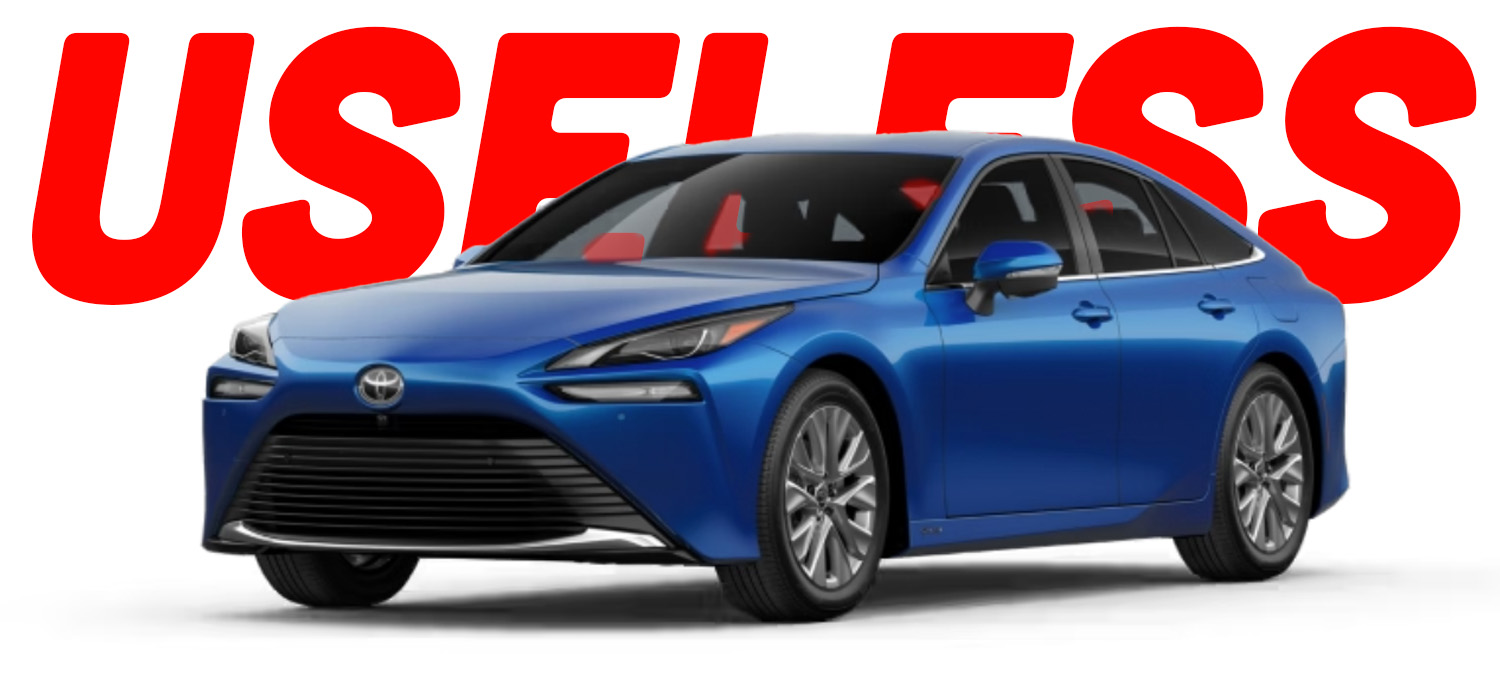
I think this is generous, since we’ve not really been kind to the Mirai in general, either, reporting on the many lawsuits owners have leveled at the company because Mirais have proven to be expensive albatrosses that can’t leave a few locations in California, because there is nowhere else to refuel them. We’ve come right out and said the car is a “fascinating waste of money,” because, let’s be honest here, it is.
I mean, it’s a car that I genuinely cannot think of any reason to buy. Would you recommend a hydrogen-powered Mirai to anyone? Sure, it’s well-engineered and built with Toyota quality, but you can only refill it in a handful of stations in the Bay Area and Southern California, and the fuel is way more expensive than you’d think, with per-mile costs being higher than battery EVs or gasoline cars. Why would anyone want one of these?
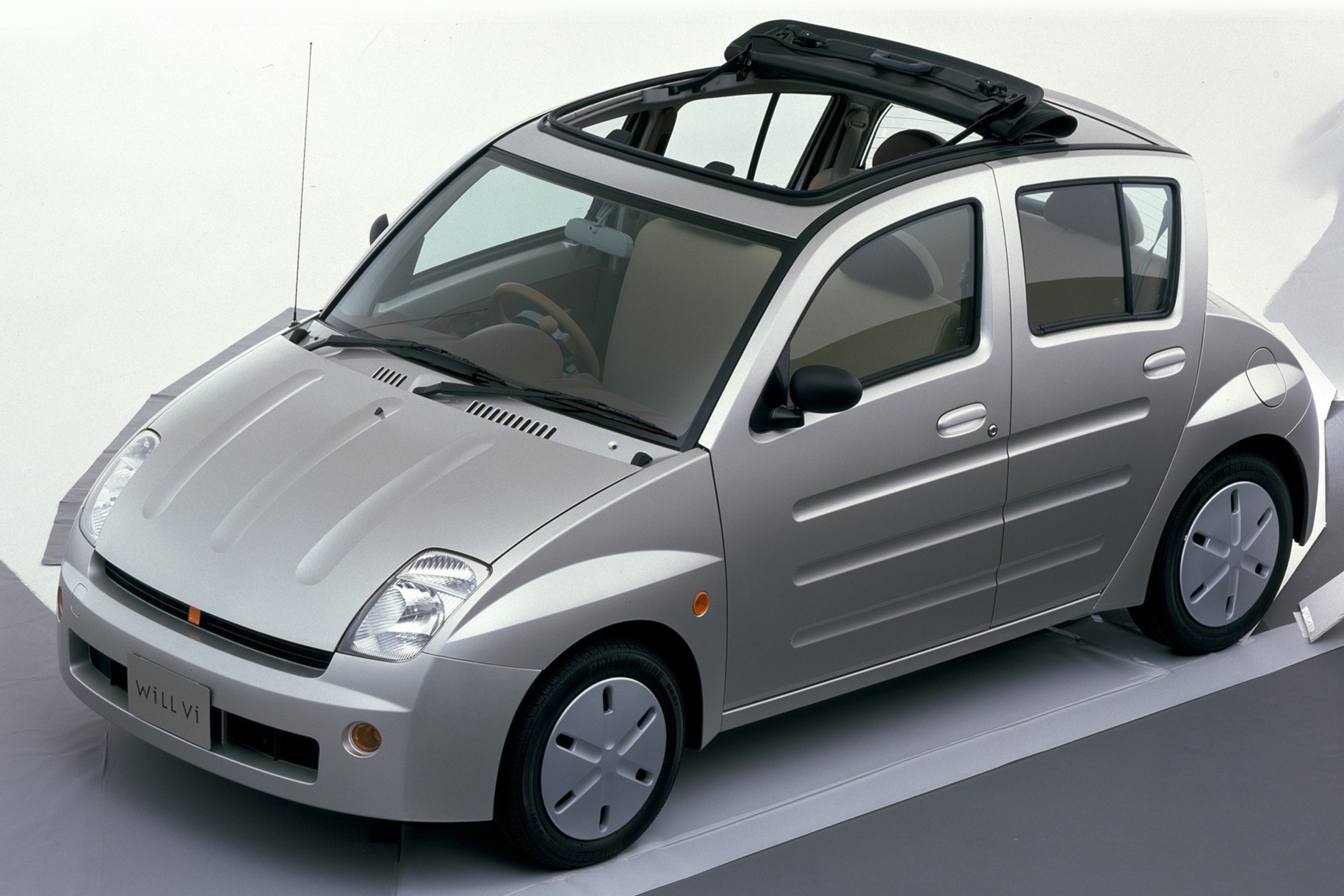
So, hopefully, I’ll get some answers to that mystery. And drive some stuff, and they say there’s a “surprise” here, too. I’m hoping it’s a new Will Vi!
Really, I’m not sure what to expect. But if there’s anything you’d like to know about what Toyota is doing or what a proving ground does or anything like that, tell me in the comments, and I’ll do my best to pass it along to the Official Toyota Officials, officially.
So, what would you like to ask Uncle Toyota?


Is their ‘deal’ mostly driven by possible use in their domestic market?
Ask them if they have considered helium as a fuel source for a flying car.
It worked for a house in the animated documentary film from a few years ago so it should work for a car.
I want to understand more about the fuel transfer system and tanks. I’ve always been a huge fan of concept of a hydrogen powered vehicle because the benefits of it (water vapor byproduct, abundance of the element, could likely retrofit current fuel stations) always seemed amazing and the challenges associated with using it (transportation, storage, and fuel transfer) did not seem impossible. In my mind, if we can transport nuclear waste safely, why cant we transport hydrogen? So I would love to know what steps they have taken to protect the tanks in a crash and what technology they are using for fuel transfer and storage.
Check out “Angeles Link”.
SoCal utilities uprating their gas pipelines to begin to blend in hydrogen for power plants and industrial customers.
Even the LADWP coal plant in Utah is converting to stored (underground) hydrogen and a NatGas-H2 blend.
To be quietly filled with 100% natural gas.
Nah, no basis to do that when they get paid, daily, to take the worthless solar off the grid and convert it to hydrogen. It’s pretty evident (the turbines are already in place and configured) that part of the pilot program is leveraging the *ahem* subsidized (ie free) solar glut to make the economics of the hydrogen electrolysis even more attractive.
Ironically, as the actual results come out of the Iberian Blackout, it’s clear that a root cause was the “prices go negative” effect– with numerous solar fields being curtailed to avoid “the bill in the mail” for the solar to be hauled away. Coupled with a chronic “off-frequency” inverter in one field? A cascading failure mode that blacked out a lot of Spain and Portugal.
Intermountain’s a pretty interesting test case, especially given how the capacity absolutely dwarfs dozens of ‘battery utility banks’ in CA. The output will, as it has been with the coal, be sent via a HV Intertie direct to Adelanto for SoCal. When it’s 115 in the Valley in August? That sustained capacity is a nice pickup, especially with rapid dispatch.
That is IMHO a VERY irresponsible and foolish use of hydrogen. Especially green hydrogen.
The current(ish) price of green hydrogen is $28-42/ MMBTUs vs $4/MMBTU for natural gas:
https://www.reneenergy.com/post/green-hydrogen-vs-natural-gas-a-deep-dive-into-the-future-of-energy
Why burn that extremely valuable green hydrogen when it can be sold to industries that need all the green hydrogen they can get? Ogden can make hydrogen, store hydrogen and send it back down the pipeline to customers that need hydrogen as hydrogen more than they need it to be burned for power.
Hey, take it up with LADWP. It’s THEIR project, not mine.
https://www.ipautah.com/ipp-renewed/
30% hydrogen to start, increasing to 100%
So, that is the plan– use the worthless solar, which they will be paid to drain off the grid, to make hydrogen– then store hydrogen underground and LATER burn hydrogen in an increasing mix with the natural gas in the Siemens turbines already sitting in the powerhouse in Delta, UTAH.
Yes, it obviously makes use of the wild over-investment in solar by the state of CA. And plays an “arbitrage” given the very, very high marginal cost of Peaker Supply to address Time-of-Day and seasonal demand variation.
tl;dr Most people quoting spot hydrogen prices don’t understand the number of forces coming into play to drive wholesale hydrogen prices way, way down. Toyota is predicting $2/KG. That $2 would drive a Mirai 65 miles, whereas $2 at my place here to SCE will drive a Tesla 10 miles.
If I were a.stockholder or a rabid environmentalist that would be my first talking.point.
“30% hydrogen to start, increasing to 100%”…
Which is fine as long as that hydrogen isn’t squandered by burning it in a turbine. It’s far too valuable for that. Might as well literally burn money in those boilers.
“Most people quoting spot hydrogen prices don’t understand the number of forces coming into play to drive wholesale hydrogen prices way, way down. Toyota is predicting $2/KG”
That is.nothing new,. People including you have been pinkie promising $1-2/kg green hydrogen for many, many years. And yet here we are with hydrogen still at eye bleeding prices and it’s still almost exclusively gray.
Then as now hydrogen is the fuel of the future and always will be.
Again, please take it up with LADWP. It’s not exactly like they’ve never done anything disingenuous. Oh. Wait. they promised for over a decade that they “were closing imminently” the coal plants across Arizona and the desert southwest. They fib, they “divest”, while still owning the coal generation. 30% of CA’s juice is imported. A lot of that is STILL coal. Go figger.
But, yeah, this program is happening. A gigawatt of electrolyzers and enough stored hydrogen to actually move the needle. The money is indifferent to your gaps in knowledge.
You sound like the usual “Armchair economists” bragging about the “miracle” in battery improvements…. Which are still only about 1.3% per year, not nearly fast enough to keep up with other tech. The market’s sick of the empty promises and sales are stalling out. Tesla’s shrinking. And Toyota hybrids are winning. Hybrid was always going to win.
Meanwhile, those battery storage plants keep burning down. Greenwasher’s gonna greenwash, but at least Ivanpah is closed, the desert can recover and the grown-ups at Toyota are clearly behind the wheel.
I wish I had $5 for every “miracle battery introduction” Green Press Nonsense article I’ve read in the last 15 years.
There’s absolutely nothing you’ve said that disproves LADWP won’t change their policy at the 11th hour and sell any hydrogen they produce rather than burn it. And I predict they will fall far, far short of 30%, much less 100%.
“You sound like the usual “Armchair economists” bragging about the “miracle” in battery improvements…. Which are still only about 1.3% per year, not nearly fast enough to keep up with other tech. The market’s sick of the empty promises and sales are stalling out.”
Ironic given how absolutely horrible hydrogen cars and the infrastructure are doing, even after nearly a decade on the market.
Lessee, the 2013 Mirai prototype had 10k psi tanks. The 2025 Mirai also has 10k psi tanks. That makes an annual storage density improvement of absolutely ZERO percent over the last 12 years.
“Tesla’s shrinking. And Toyota hybrids are winning. Hybrid was always going to win.”
Yeah? How are Toyota’s HFCs doing? 0.0008% of American sales? YIKES!
Nuclear waste only tends to leak a tiny a bit, but it is moleculary very dense Hydrogen leaks a lot because it is not. Atoms are really annoying.
So true. At a previous job we made vacuum chambers and we checked those for leaks using helium (connect a helium detector to the in-vacuum side of things, and trickle helium around the seams from the outside. Helium is extremely motile and would be pulled through even the tiniest little flaw in a weld. It’d find its way through ANYTHING and it’s BIGGER than hydrogen. I can’t imagine the challenge of trying to contain hydrogen on something the size of a city grid.
This is why i stuck with mechanical engineering. Very good points.
Water vapor is also a byproduct of FF combustion, burning wood and of cellular respiration for that matter. There is nothing special about emitting water.
As for CO2, hydrogen is responsible for plenty of that. See below.
Abundance of the element hydrogen is meaningless unless its in its elemental form. At the moment it all has to be generated from natural gas making hydrogen just a far less efficient way to use natural gas. There is a lot of optimism towards white hydrogen, that is natural reserves but so far only a few major reserves have been proven recoverable. Last I checked it was enough to supply the worlds light transport needs for maybe a week. Hardly enough to get excited about.
Keep in mind there is a huge demand for industrial hydrogen and THAT market, unlike transportation has no alternative. The best solution is for all white and green hydrogen to be earmarked for that market and only after that market is completely weaned off FF derived hydrogen should transport even consider hydrogen. Otherwise you’re only shuffling emissions.
Retrofitting current fuel stations – petrol stations and hydrogen stations have nothing in common hardware wise. The only commonality is the convenience store and cash register. So it’d be a complete knockdown to rip out the old and put in the new.
“In my mind, if we can transport nuclear waste safely, why can’t we transport hydrogen?”
We can. It’s not an issue.
“what technology they are using for fuel transfer and storage.”
Transport: mixing H2 with natural gas in a 20:80 ratio in NG pipelines, carbon fiber high pressure tanks (as in the Mirai) and zeolites. The latter are powders that adsorb hydrogen and allow far greater volumes to be stored at much lower pressures (by shrinking the molecular electron shells of the H2 molecule adsorbed (e.g. stuck) on the surface allowing tighter packing). AFAIK lots of papers have been published over the past several decades but lab results have so far have failed miserably to translate into real world products. They tend to only work for a handful of cycles and/or require prohibitive amount of energy to release the adsorbed gas. Maybe Toyota has made progress of their own, I dunno.
I didn’t get to respond to this earlier but I appreciate the walk through of the technology. My reading about HFC technology stopped a few years ago so learning about some of the newer limitations (industrial hydrogen vs transportation) was very enlightening. Anyway, it was appreciated.
No problem.
When are they going to roll out their nationwide Hydrocharger (TM) network and will the nozzle work with other vendor’s cars?
Wanna smell my finger?
Where is Toyota planning to get the hydrogen? Cracking apart hydrocarbons? Electrolysis on water? And how is THAT (whatever that is) better than existing electricity and battery technology
Well Japan WAS planning to get it from filthy Australian brown coal:
https://thediplomat.com/2025/04/australia-and-japans-hydrogen-partnership-navigating-ambitions-and-realities/
But now?
“Japan, recognizing these setbacks, is actively diversifying its international hydrogen supply chain partnerships, recently collaborating with Malaysia’s Petros and Petronas as part of its broader Asia Zero Emissions Community (AZEC) initiative.”
So Malaysian FF instead.
Have they considered using dirigibles to deliver hydrogen? This would avoid traffic and real estate costs. Simply run a hose down to the delivery point.
Oh the simplicity!
I’m picturing the hose getting loose and the whole dirigible flying around erratically and making a PBBBBBBBBBBBBBT sound, like an escaped balloon in a cartoon.
If you could just run a hose for it, one of the biggest issues would be solved. But it’s so low-density that to fit it into either a fuel-station storage tank or a vehicle fuel tank, it has to be compressed. You’ll lose something like 10-20% of the energy content of the fuel just pumping it into the next tank it goes into. It really doesn’t want to be small. By the time you’ve crammed it into a tanker truck, crammed it into a holding tank, and then crammed it into the car you’ve squandered a huge fraction of your energy. And all you’ve done at that point is move it into the car.
Ask why they keep creating Mirais and ruining consumer perception of hydrogen(too expensive, unattractive car, worse range than gasoline), instead of just sticking to the heavy trucking development where fuel cells have more benefits even with the lack of infrastructure. Also, what the heck Toyota?
Know what else Toyota makes? Forklifts. In a large indoor facility that operates dozens of forklifts (I work in expo, but there are warehouses and factories, too) it would make tons of sense to build hydrogen-powered forklifts and install a refueling facility right on site. I am really tired of inhaling exhaust from propane-powered forklifts. Ask them why they don’t make hydrogen forklifts.
Sort of a different Toyota though, Toyota Material Handling is part of Toyota Industries. Toyota Industries owns 8.5% of Toyota Motor Corp, and Toyota Motor Corp in turn owns 23.5% of Toyota Industries, but they have totally different boards and executive teams
I’m sure you’re right. The Toyota forklifts that I drive still use a descendant of the 1600 engine used in 1970s Corollas, just converted to propane. So I’m sure the two Toyotas can share engines, even hydrogen ones.
Oh they do, Toyota Industries has an auto parts division and even still builds complete RAV4s under contract to Toyota Motor at their Nagakusa plant in Aichi prefecture
The one I drive is (lead-acid) battery electric. Range isn’t really an issue but I have a hunch that raising the forks to the third rack eats more juice than driving the truck forward a similar distance especially with a rolling start.
You’re giving me flashbacks to when I worked in a warehouse full of propane forklifts. Oh the headaches….
” I am really tired of inhaling exhaust from propane-powered forklifts”
Try methane instead.
I grew up next to a dairy farm with 700 cows. They say methane is an “odorless gas”
I remain unconvinced.
It is. It’s the sulfurous compounds emitted along with the methane that set off your nose.
I would think BEV forklifts would be a decent solution. Mount the batteries low and they would be more stable than what has been considered conventional. But what do I know? I’ve never operated one.
It is the solution. A slow moving vehicle that never leaves its yard, and needs a heavy counter weight. It’s like, the perfect match for battery power. It works so well they’ve been doing it with lead acid batteries for literally a century.
What is their whole deal with hydrogen? Like, what’s that all about and shit
Oh I thought you’d never ask!
1. Do they plan to announce other means of converting H2 to mechanical work except the current inefficient oxidation process to make electricity? On second thought, if there is some secret way to rule the world with new energy they probably won’t tell you.
2. Are they planning a refueling infrastructure push like Tesla’s supercharger network? that turned out swell actually, now we even have a common standard. Or are they pulling a Betamax on US again.
3. Any timeline here until H2 can actually make sense through some combination of the above?
Actually, don’t mention the Betamax, could work out better that way.
“Do they plan to announce other means of converting H2 to mechanical work except the current inefficient oxidation process to make electricity?”.
I mean it’s 63% TE now with a theoretical max of IIRC 83%. That’s already entering diminishing returns. To get to 100% the exhaust would have to be at absolute zero which isn’t ever going to happen.
Well yea, and same-ish for an ICE. To detail my ask, I was referring to how that TE is achieved: now it’s like a quadruple handicap: electric motor- cool, Battery -nah, fuel cell it’s a headache AND dealing with H2.
So like: burning H2 would be easier? Can we skip the battery altogether somehow? It’s just such a complicated mess of a propulsion system while using a potentially epic fuel. What if the volumetric energy density was closer to gasoline? Imagining a 4gal tank lasting 12x as much as gasoline. That would require thousands of psi but hey that’s the future’s job.
For a potentially epic fuel even those who benefit the most from it hate using it:
https://arstechnica.com/science/2022/09/years-after-shuttle-nasa-rediscovers-the-perils-of-liquid-hydrogen/
There is no better use for hydrogen as a chemical energy source than rockets yet it sucks even for rockets.
“What if the volumetric energy density was closer to gasoline? Imagining a 4gal tank lasting 12x as much as gasoline. That would require thousands of psi but hey that’s the future’s job.”
About that:
“Hydrogen has the highest energy per mass of any fuel at 120 MJ/kg H₂ on a lower heating value basis, but very low volumetric energy density of 8 MJ/L for liquid hydrogen and 5.6 MJ/L for compressed hydrogen gas at 700 bar pressure, compared to 32 MJ/L for gasoline at ambient conditions.”
https://css.umich.edu/publications/factsheets/energy/hydrogen-factsheet
Add in the bulk of the tanks required to store that hydrogen under those conditions and the volumetric density is way, way worse. And those tanks have to be cylindrical whereas gasoline tanks can be whatever shape.
There has been hope for zeolytic storage media but despite many decades of research very little actual progress AFAIK has been made. At this point you’re better off betting the farm on nuclear fusion.
As the saying goes hydrogen is the fuel of the future and always will be.
Fuckin why?
I’d like to know how they are going to prevent the water vapor coming out of the exhaust from creating glare ice on the roads as it settles during the winter months.
Turn it into snow.
Can it do it fast enough when the temps are in the 32 to 30 range? I can see that happening in the -20 temps.
Probably not. Is glare ice a problem in the 32-30 range?
In certain areas, yes.
Then the solution is simple: Salt injection.
Talk about planned obsolescence!
Same way the water vapor in the exhaust of ice cars does.
But it has way more volume than regular ICE cars.
Nope.
A kilo of hydrogen burned makes 9 kilos of water (H2 + 1/2 O2 = H2O, e.g. 2g hydrogen + 16g oxygen = 18g water)
If we assume an average chemical formula of octane for gasoline we get C8H18 making only ~16% of the weight of gasoline as hydrogen, and the rest as carbon. So 1 kg of gasoline is ~0.16 kg of hydrogen.
C8H18 + 12 1/2O2 = 9H2O + 8CO2. Since only ~16% of the gasoline is hydrogen by weight we end up with only ~1.44kg of water per kg of gasoline burned.
Even accounting for the lower efficiency of ICE vs FC you’ll still get a lot more water out of a HFC tailpipe.
Cool. Thank you.
Couple of questions:
What kind of incentives might they be getting in Japan to develop Hydrogen, but more importantly what is the overall scheme / long term economic plan / cultural acceptance, etc. towards hydrogen there. Is it viewed as a way of having energy independence, works better in dense cities, etc. over there.
Cars are a great test bed where you can stress things out and find creative user “applications” breaking things before they get released to industrial environments where reliability really matters. Other than the semi project at the port of LA or Long Beach, what else is being done with it in the rest of the world and what other things is this tech being planned to be utilized in? Toyota Forklifts? Regional Airliners? Navy ships?
Is it possible to make something like a gasoline, diesel, methane, etc. fuel cell that both beats the emissions and efficiency of an ICE engine?
Airbus has built and is testing megawatt-class fuel cells, so there’s some progress being made there– and there are DARPA programs underway for ships and heavy goods transport.
Why bother? Jet engines are already up to 55% thermally efficient at cruise compared to the 63% TE of HFCs. Add in conversion losses, motor losses, lower efficiency under load and I think you’ll be on par at best with just burning that hydrogen directly in a turbofan. Dunno about a gas turbine generator, maybe the math is a bit more favorable but again its going to be load dependent.
Well one reason would be the P&W GT’s reliability and the LEAP engine hasn’t been that stellar either. For the size and shape and temperatures they’re exposed to, it’s as state of the art as you can get. I’m in no way arguing against them, but more playing devils advocate. I don’t think H fuel cells make sense in cars, at all, but they make a lot more sense in other situations where you need to carry the equivalent of 5,000 or 15,000,000 times the capacity of a Tesla to do what you need to do.
I don’t see how. .Compared to electric aviation it may look better but its only a slightly less worse option.
Hydrogen storage issues makes hydrogen a non starter for anything but short, MAYBE medium haul aviation but offer nowhere near the capacity of that exact same airliner running jetfuel. The Soviets did the best apples.to apples comparison of hydrogen, natural gas and jet fuel I am aware of in their TU-155 testbed back in the 80’s. That airliner lost 1/3 of its fuselage cargo capacity to the cryogenic tank and had only 1/3 of its range thanks to the lower energy density of hydrogen. The range loss was 2/3 on LNG. And that was with only 1 of 3 engines running on the test fuel. I don’t see how fuel cells.will make any of that better. Cost is a wildcard, I dunno if a FC/ducted fan can can be made cheaper than turbofans.
Hydrogen has other issues of course, it’s going to be very hard to overcome its horrible energy storage to volume and its storage requirements. It’s often touted advantage of high energy to weight is usually more than negated by its storage tanks.
But of course the (current) astronomical cost of hydrogen makes.this a non starter anyway.
Generating electricity with a gas turbine and you can sell the heat.
And in NYC you get those picturesque clouds of steam coming out of holes in the street punctuated by occasional explosions of superheated scalding mud.
I’d like to add another question, what is the lifespan of the tanks, fuel cells, pumps, o-rings, everything. What would a 30 year old Mirai be like to restore.
The biggest killer of cars is them sitting unused for 2+ years, EV’s rarely can survive that, ICE usually can. How do FCEV’s compare.
Bloom energy has been selling NGFCs commercially for several years now. The efficiency is the same as Toyotas FCs at 63% and the emissions are way cleaner than ICE since not only will they use less fuel for a given amount of power but since its not combustion there’s no soot, no NOx, nor SOx:
https://www.proceedings.com/content/069/069564-0104open.pdf
Have them explain how storing liquid hydrogen is more energy efficient than storing electricity because I can’t figure that one out
Non-chemists always assume it’s “liquid hydrogen” long term but the chemistry around hydrides and ammonia says there’s a lot of alternative means to carry the hydrogen atoms around without the “pressure and embrittlement” worries the internet seems so concerned about. Weekly we’re seeing huge discoveries of “geological hydrogen deposits” (N. Africa has a bunch and there have been discoveries in North America recently), which calls into question the “hydrogen leaks away through any material it doesn’t embrittle” meme.
Airbus feels strongly that batteries as a “way of storing electricity” (and they have a very valid basis in this skepticism) is a loser wherever you are constrained by weight– so continue to invest in hydrogen as energy transport, as do the SoCal utilities building out the Angeles Link programs.
Gooooooogle Airbus ZEROe
Airbus already has shown fuel cells into the megawatt range.
My man! Batteries will address 20% of the carbon generation emissions assuming 100% of cars are electric. Then what?
Good question. We took 95% of cars off the roads of LA County in April-May 2020…. and emissions? Went down a whopping 4%.
We could spend $2 Trillion buying an EV for everybody in SoCal… and we’d still have 95% of the pollutants we have today. Makes you think, just maybe, that batteries are solving the wrong problem, eh?
Curious, where do you think the 95% of remaining emissions are coming from? Where does that number come from? It sounds a little bonkers that taking millions of cars off the road would cause so little change, given that EPA and CARB rules have had a very large and visible effect on smog in the area over the last 50-ish years.
Hydrogen for industrial processes, like in steel hardening, coming from electrolysis instead of fossil sources greatly decarbonizes that industry, but that’s not really the same as utilizing fuel cells for propulsion.
I suppose it all doesn’t exactly address the first comment that we aren’t talking about LH2, but highly compressed H2 vapor, but neat to hear that non-leaky hydrogen storage may not prove to be impossible. I’m not in this industry and had not heard of “geological hydrogen deposits” as a thing before.
It’s actually a pretty well-known issue for the SMOG and compliance folks. Modern cars are SO clean that we’re well past the point of diminished returns– and that’s the case for not “piling on” even more emissions-driven regulations, constraints, design complexity and reliability trade-offs. It “appears” that GM’s quest for the last-bit-of-efficiency on all those dead V8 engines was their move to 0W-10 oil or whatever absurdly thin formulation they ended up with. On light passenger vehicles? We’re throwing billions to eek out the last few percentage, at huge second order costs.
By now there’s lower hanging fruit. Lots of fruit.
To the question you asked–
1) Power plants (there’s still a pile of fossil fuel plants in SoCal)
2) Heavy trucks, delivery, drayage, hauling (mostly diesel, ugly)
3) Trains– many of the container trains coming out of the ports are diesel and relatively dirty
4) Bunker fuel for ships, in-harbor generators, etc
5) Construction equipment- highway, building, excavation
6) Cement plants– very dirty and relatively unregulated
7) And, non-electrified buses
Literally, during the first week of May 2020 I was driving out to Palm Springs from DTLA, got to that rise heading up to Redlands and looked in the mirror (keeping in mind that NOBODY was on the freeways then. Lockdown City.) and all you coulld see blanketing the LA Basin was the usual brown cloud. Wow. I almost couldn’t believe it, but it was true. NPR did a report on what the SMOG folks were saying– “Yeah, all the cars are gone but most of the pollution ain’t from cars anymore…”
https://apps.npr.org/dailygraphics/graphics/air-pollution-los-angeles-20200511/
THIS. Thank you for the great write up here. Wild how we are still doubling down on passengers, but leaving so much on the table when it cleans to actually making things better. As an inland empire kid, I know that haze well. Made for some great sunsets in Redlands though.
I had an “aerospace industry” job offer in the Pomona area years ago…. Always felt like it would have been an interesting career path.
But my lungs are glad I stayed closer to the water.
LA is actively working to reduce at-pier emissions from ships, see:
https://portoflosangeles.org/environment/air-quality/alternative-maritime-power-(amp)
I’ve personally seen cruise ships hook up to the HV umbilical, and shut down their on-board diesels. In the grand scheme of things it’s probably a minor reduction in pollution, but every little bit helps.
Funny, I remember being in San Diego during the 2003 rolling blackouts, looking out at all those docked Navy ships wishing they could become giant mobile power plants.
The San Fernando Valley had a smog problem in the 1900s, and probably dating back to prehistoric times. LA had petroleum just leaking to the surface. That’s why LA county in the 1920s was the largest oil producing region in the world. Long Beach, Signsl Hill in particular. Beverly Hills is still pumping a lot of oil. https://en.wikipedia.org/wiki/Beverly_Hills_Oil_Field
Sounds about right.
What about CO2? That’s what EVs are all about. Modery gasoline powered cars are pretty much down to water and CO2 if they are running correctly, although I encounter many newish cars that smell like an old car running really rich,
Are you sure they weren’t just victims of catalytic converter theft?
Emissions of what exactly? And what were all the people who weren’t driving around doing instead?
In some parts of Northern California a few people stayed home and decided to use their fireplaces, that was a stinky mess, and home heating in general produces a fair amount of of pollution.
Hydrogen cars will do no better. They might even do worse since the vast majority of hydrogen sold is gray hydrogen and any green hydrogen used by transport displaces hydrogen used by industry which will inevitably turn to gray hydrogen.
Large scale storage is pretty easy. Literally a hole in the ground, or a pile of rocks in a salt mine will do. . Small scale moving it around in a car, that is not so easy.
A lot of us are following the Intermountain Coal Conversion closely— if that one works? A lot of the hydrogen-heytred will be proven baseless.
Battery storage at utility scale would be more plausible if those darn sites would stop burning down. I think Moss Landing has now had three complete-to-the-ground conflagrations in a relatively short operating period.
I was referring to hydrogen storage.
The local energy storage here is pretty fireproof.
https://sldmwa.org/about-sldmwa-facilities/oneill-pumping-generating-plant/
Jason,
Please inquire on the current status of the Toyota hydrogen-power drayage truck pilot project in the Ports of Long Beach / San Pedro. By reports that had been going well– a long duration, zero-emissions, deployment where high torque was a big benefit moving containers around the yards. Theoretically, the hydrogen bus projects were also succeeding in Asia, as well.
Anyway, their body language about the more “heavy transport” part of the mix might provide clues on how committed they are in passenger vehicles.
Thanks and have fun,
tom
This.
If they’re making all that dough then why aren’t they calling it a proofing ground? Sorry. And I don’t know about you, but I’m not putting any dang hydrogen in my oven! I don’t care if it makes the bread better!
If Toyota were to cut you loose on the public roads in a Mirai, would you be able to make it from the proving grounds to the nearest public hydrogen station in LA without too much range anxiety?
And if you ended up doing multiple laps of Quartzsite following and photographing interesting RVs until you ran it dry, just how screwed would you be? Or is that why they’re sending you instead of Mercedes?
For that matter why are you going and not David who’s the engineer and already in the southwest?
Are they going to build their own chain of hydrogen filling stations? Otherwise how are they going to solve that particular problem?
Right? Follow Tesla’s lead here. They wanted to make EVs viable and built a charging network. If Toyota wants us to use hydrogen so much, put up or shut up.
Yeah, Toyota’s following the example of the pre-Tesla EV makers – “here you go, just plug it in wherever, you’ll figure it out”.
In theory, they have several trials going in Heavy Goods Transport— so I think the long range theory was that if you had large hydrogen supplies in every Pilot Truck Stop in the country? The same folks that were always buying Benz and VW diesel wagons would have the same access to hydrogen in 2035.
Airbus also seems to be investing heavily in hydrogen engines for commercial aircraft– so you’d have huge regional supplies of hydrogen to fuel aircraft, which could be leveraged to heavy goods and passenger vehicles.
How much will you charge me to convert my first gen Tacoma to a Mirai drivetrain? I live close to a hydrogen station and won’t complain (or sue).
*Ryan_Reynolds_But_Why.gif*
Woah this sounds like a fun trip! Ask them if they’re planning on funding more hydrogen stations in at least CA but maybe more states. Seems like the Tesla approach would be the only workable one here. Any plans for home refueling? Is that even possible? I truly don’t know.
How do they feel their FCEV tech stacks up against Honda and Hyundai, who both also offer FCEVs in the US? What tradeoffs do they make as opposed to those other two?
Also ask them if they’re doing this because they make plenty of money and just want to troll BEV maximalists lol
Also if they let you drive a new Mirai please do a review
Ask them why they refuse to build out the infrastructure themselves. Cause no one else gonna do it.
Do they have plans to offer home hydrogen generating and compressing stations?
Does anyone?
I don’t see any sort of fueling station network being built any time soon, but a home model might be interesting to the sort of people who are interested in hydrogen-powered cars.
Ah you beat me too it, haha!
Honda did, once upon a time
I’ve always wondered why they built the Mirai in the first place. Why not a hydrogen fuel cell RAV4 instead?
I’ve heard you can combust hydrogen, like a traditional ICE engine. It’s not nearly as efficient, but could it theoretically be used this way to keep the manual transmission alive?
The problem is that hydrogen embrittles metals, like aluminum or iron. A major function of the cylinder wall is to, you know, contain the exploding gases, so you might imagine that embrittlement would be a bad thing.
There are coatings to prevent that, but they wouldn’t hold up to the heat and friction of a moving piston.
Honda begs to differ 😀
Well, more than Honda: Mahle invented it but Honda started using it on certain motorcycles in the 1980s.
Forgot to mention the thing I wanted to mention!
The coating I was talking about is called nikasil.