

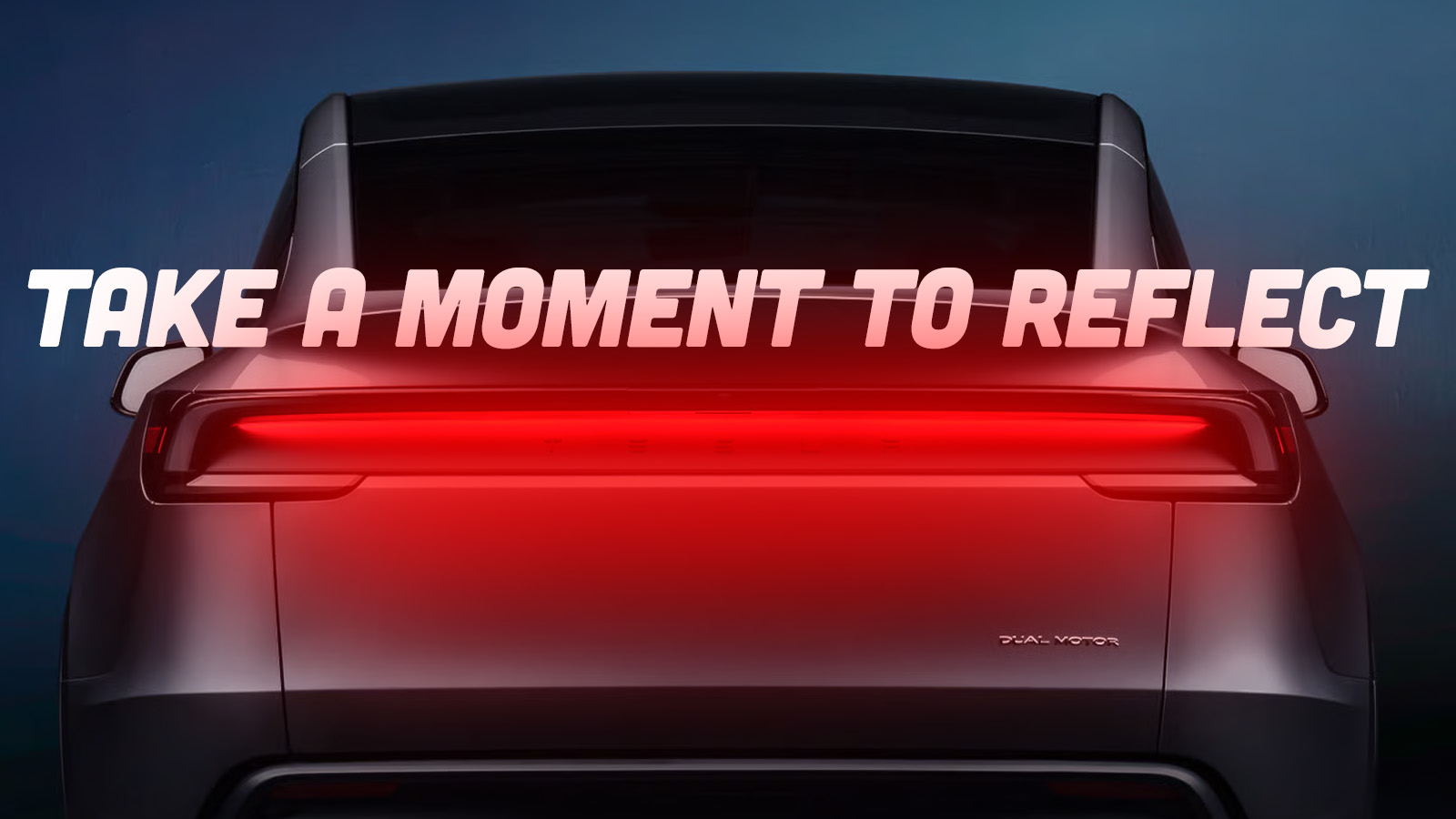
This has been a busy, rough week, and the constant grim grayness of the world hasn’t exactly been a help, so to unwind after work the other day, I went to a relatively new taillight bar in town, The Vermilionaire’s Lamp. It’s been pretty popular lately in the Taillight Community, mostly because everyone is getting sick of going to The Lumiére Rouge, and Flashing Amber’s was closed down again because they found a previously-thought-to-be-extinct strain of diphtheria in the communal bidet. When I showed up the other night, it was quite busy, and there was a bit of a commotion, as a group of Tesla acolytes was in the bar, surrounded by regulars.
Now, it’s not uncommon for Tesla fanatics to show up at a taillight bar; they always travel in pairs, and they’re just there to share the Good News about The Great Elon and his many teachings and predictions. Usually, they just get ignored and eventually leave or get kicked out by the bouncer when they keep insisting that people get in their Cybertruck and try out the latest version of FSD with them while they make reels talking about how many times it saved their lives by not driving into walls or whatever. This time, though, was different.


This time, they were actually there on real taillight business. The taillight community generally hasn’t been too interested in Tesla, as it’s never really given the community anything to be excited about. That all changed last year, though, when Tesla’s long-needed facelift for the Model Y was released. This update, known in Tesla circles as the “Model Y Juniper” was overall a pretty mild styling refresh, with one significant exception: it employs a new taillight design that features something that, I believe, no actual taillight has ever used before.
Here, take a look:
Model Y had a glow up
The first indirect reflective body-panel taillight of its kind pic.twitter.com/rTUvUIZK8J
— Tesla (@Tesla) January 30, 2025
Do you see what’s going on there? It’s not the full-width taillight business that deserves attention here, we’ve seen that since the 1960s. But it does have to do with how that full-width taillight bar is illuminated. The central bar there is acting as the baseline running light section of the taillight; the turn indicators, brake lights, and so on are in C-shaped units at either side, and are more conventional.
What’s interesting about this taillight is that it is the only known taillight where you are not seeing the taillight at all. The taillight assembly itself – the LEDs, the lens, the housing, everything – is actually hidden up under a lip on the rear deck. What is actually visible is only the light from the taillight, reflected on a little concave surface there.
Also, it’s worth noting that a by-product of this method is that a sort of puddle light-type swath of glowing redness appears on the ground behind the car, like some sort of mystical, angry rash.
Here’s a shot from underneath so you can see where the actual physical taillight is:
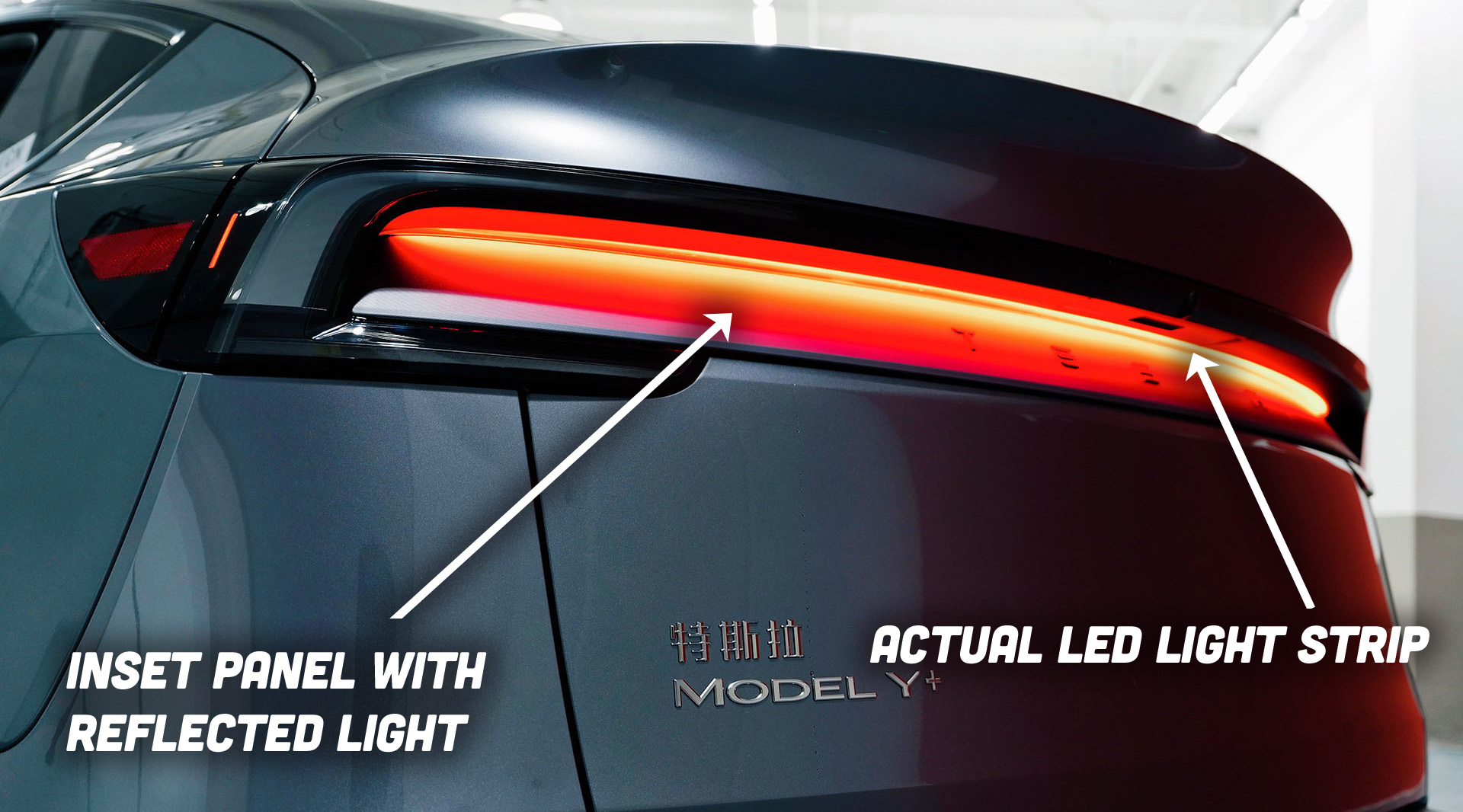
See that? All you actually see when you’re behind the car (and not, you know, rolling around on the road) is the reflected light. This should be perfectly legal as long as that reflected light meets all the size, color, and photometry requirements as specified in FMVSS Standard No. 108, which I must assume these do, since they’re on a production car that’s actively being sold.
While the application in a taillight context is new, the concept has been around for a while; I think the only other known attempt to use reflected light as the primary visible light of a vehicle signal light was as the side indicator repeater lamp of the 2003-2008 BMW Z4 (E85/E86):
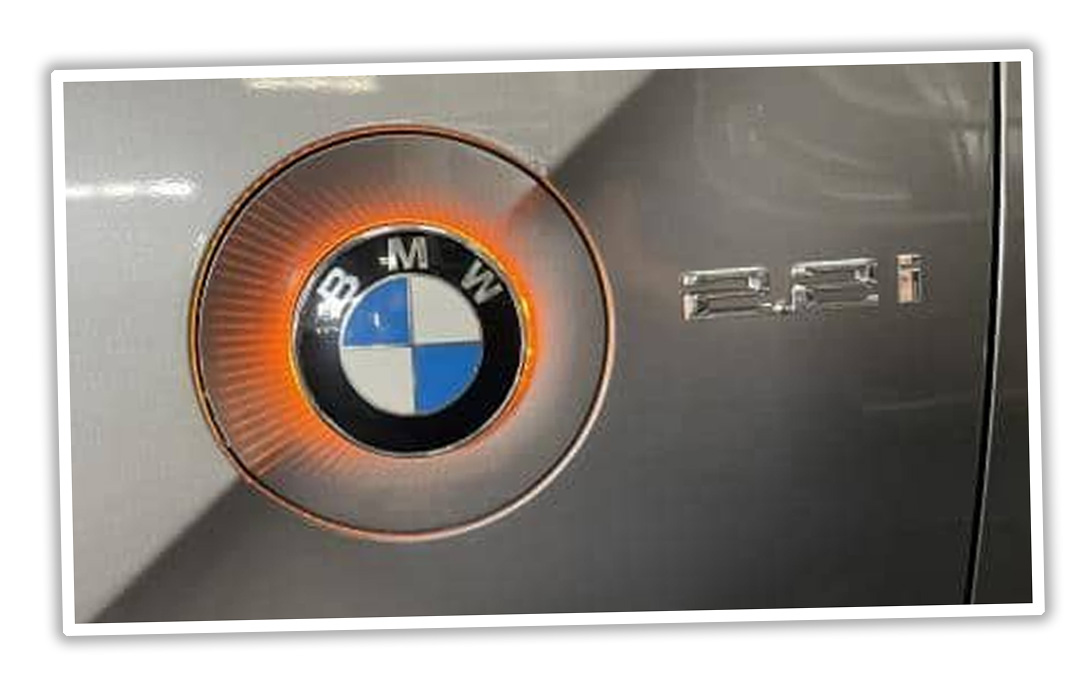
Here, the flashing amber light was coming from behind the BMW roundel, through a ring-like lens on the side of the lamp housing, so that only the emitted light was seen, reflected in the dish-like bezel of the indicator repeater. It had a starburst-like look thanks to the fluting of the lens, and was a pretty exciting and dramatic way to repeat a turn indicator. It’s one of my favorite details of that car.
And, of course, license plate lamps have always sort of worked like this, though their intent is different: they cast light to illuminate an unlit object, the license plate, where the Tesla reflected taillight’s light is designed to be viewed directly. It’s not illuminating anything other than itself, via that recessed channel spanning the rear of the car.
So, don’t let anyone tell you that I’ve never said anything nice about Tesla, because I’m saying it now: Tesla has made a genuine splash in the taillight world, and I salute the bold and experimental approach to the exquisite and ancient art of rear-of-car illumination.
Top graphic image: Tesla


I can’t lie but the Juniper and Highland has been particularly interesting cars from an exterior design and value POV, it’s a great appliance for people who see driving as a chore.
I can’t wait for some genius to cover the reflecting surface in a matte black wrap and end up with no visible tail lights whatsoever.
You know it’s going to happen.
I do like this design (but not the overall Model Y).
There is one vehicle (I forget which, maybe a BMW model?) that has bright LED’s for brake lights that point directly back. When I am behind them and they step on the brakes I am partially blinded and very frustrated. Those should be illegal.
As much as I still shrug at Tesla (Innovation, yay! Ridiculous build quality and design choices, boo!), I do like the new front light bars and love the above taillight design. That said, I do wonder one thing….how does it perform in fog/snow/low visibility? Both for simple projection reasons and the actual physical function (ie: what if the reflector section is dirty/has snow on it). For that matter, does Tesla employ a rear fog light that I am unaware of?
Tangential side note….was behind a Lucid Air at night for the first time. Also strikes an eye catching visual with its taillight treatment.
I saw one today on my way to work. I was whelmed.
I guess I can have by old guy story now.
Back in the early 2000’s there was an accessory company in southern CA that made licence plate frames with LEDs in them that used the licence plate as the reflective surface for the stop light.
They mostly made motorcycle gear but they did have car sized plate frames.
Unfortunately I don’t remember their name.
Actually a brilliant idea!
They stood out as being pretty dim in the recent SoCal rain.
I am not a fan of Leon, but the current Model Y is an excellent vehicle regardless of the taillight.
Anyway, I hope the haters are researching the CEOs and history of all the companies they buy from.
“The haters” are also kind of sick of people who “aren’t fans of Leon” still giving him a pass by stating that All CEOs and companies are like Musk. The very fact that people would have to “do research” to find some dirt so as to normalize Musk should tell you all you need.
I take it you are a Volkswagen fan, so you probably don’t need to do any research.
If the current owners of VW were openly and actively supporting AfD you’d have a good point, but so far as I know 0 of the pro-Nazi VW owners from pre-WW2 are still alive at this point, much less in charge of the company or actively using their profits to promote.. well, anything on account of being too dead for that.
That’s not the point. It’s not about haters and one target. It should be focused on the fact that capitalism has failed the planet by allowing corporations to govern and rule with financial might and a created dependence on products they control. Cars that need corporate controlled repair centers, food that is chemically designed to be addictive and leaves you hungry. We are now a society of laborers at all different levels, taught to fight one another so we don’t revolt against the true problem. The ruling class. History is repeating itself in an ugly way.
ok
Props to the wizard who dreamed that up, but I’d still rather drive a rusty, smoking Cavalier than own any Tesla rolling ponzi scheme.
I’ve owned my Z4 since 2009 and I never noticed the side markers made a starburst shaped pattern… maybe I’m never outside the car when they light up. Also, as a fellow taillight fanatic who has custom made modified taillights in their daily driver, I always appreciate the latest gossip and trends in the taillight community.
Give it some prednisone for that rash. Gosh I’m sure that taillight ensemble will get me to a Tesla dealer ASAP. Oh wait there are none. Since I’m in the Never Leon tribe it could fly and I still wouldn’t buy it
I’ve always thought the turn signals and brake light should be separate. When they are combined there is occasion for being confused just a moment by what you’re seeing (if the driver is tapping the brakes and indicating). It seems like this design would be good for German brands and Range Rovers. As far as I can tell they don’t have turn signals at all, so the solid line is fine for them.
They should be separated from running tail lights and from each other as well.
When I got my first Lancia I examined the tail light system carefully, and realized how genius it actually was, and I was under the impression that was the European standard by that date.
So disappointing to find most European cars falling short of that Carello design.
Upper and lower sections separated by a chrome bar.
Upper section discrete turn signal.
Lower section outer spot is the constantly on tail light, then separated from the larger brighter brake light to the inside by a reflector portion.
The Leon design bouncing off the ground may have incidental advantages since when high tail lights were introduced, those vehicles kept getting rear ended, as it turned out our perception of distance was keyed to lights closer to the road.
Additionally the FAA has proven an illuminated shape is far easier to recognize, even with very low levels of light, than intense point source marker lights.
Handling approval of night lighting for off road vehicles where standards far exceed federal road lighting requirements, as 360 degree visibility is a minimum, I always recommend bounce surface lighting to those failing initially to get their night license.
They always qualify, even with quickly improvised solutions once you can see a shape.
Just know that you are not alone. We all stand together demanding change that will never come (to USDM).
I saw the same group show up another night at the Incessant Incandescent.
I thought the gov shut that place down years ago.
It’s been renamed Ellie D’s.
.
I don’t know? Maybe?
#
And what happens when an owner foliates the car in matte grey/black?
You missed the glaring problem with this light – there are no side markers on the back and you cannot tell how wide this car is – its just a blob of red light going down the road. For me, there is no way to judge from the side where the end of the vehicle is. This just seems like an attempt to add more lipstick to a pig of a design (which personally I find nothing attractive about any of their models. And I don’t think their lighting is revolutionary.
There is a side marker light, since it is required by US law. It is small but it is bright.
honest question: is it really that important to be able to distinguish the dimensions of the vehicle from behind? Do I really need to care if that red light is coming from a scooter, car, or semi? Even in crap conditions, by the time you’re close enough to worry about a collision, you can almost always figure out what you’re looking at.
Front lights are another matter, as it’s good to know whether you’re looking at a motorcycle or a drunk over the centerline with a headlight out (two things that tend to correlate).
Narrow taillights reduce the margin of safety. A single central taillight creates “floating light” effect – and your brain struggles to judge width/distance. Distinct side marker lights meaningfully improve safety, especially in low-visibility conditions. If I have to pass or overtake this car and have that narrow single light how do I quickly judge the width of it. I just feel this design is form over function.
Ah. Passing makes sense, thanks.
The idea of ground illumination for extra visibility has been popular in the bicycle space for a while— look up laser lights for bicycles. There are a number of products that cast bright patterns on the ground.
Whenever some salivating, wild eyed olfactorily challenged Teslastan accosts me with this “revelation” I point out bicycles have had the capability for projecting FRICKIN LASERS from their tail lights for YEARS!
https://www.aliexpress.us/item/3256806493999421.html?gatewayAdapt=glo2usa4itemAdapt
That shuts them down real quick.
I would own those lights, but decided to quit riding on the public roads instead since the frickin lasers won’t stop someone from running me over when they are staring at a much smaller screen in their hand instead of the “windscreen”.
Worst bike lights are the strobes, correctly banned in Germany.
I loved the Z4 Amber side marker. It was such a novel and added charm. While I appreciate the concept of the reflected Tesla taillight, seeing it in person with the outbound taillights illuminated detracts from the effect and it adds a good hit of incongruity to the rear of the Y.
I could see that. Sort of like cars that have LED headlights but incandescent fog lights. Jarring.
My former 2016 Acura ILX a-spec had bright beautiful LED headlights and cheap halogen foglights.
As did my first gen leaf. Made the whole car look weird.
Headlights and fog lights should never be operating at the same time anyway.
I’m not sure that’s possible, at least in the US? Unless you are distinguishing DRLs from headlights.
In high school I liked the “look” of only fog lights during daylight. The only way to do that in my grand am was to drive with the handbrake engaged by one click.
How weird!
I’ve had very few cars come prewired for fog lamps, so I’ve always run independent lighting.
True fog lamps literally stop being effective run with low beams.
Even with good E code lighting, there is only a short crossover period where both work together before rain, fog or snow becomes too intense for standard lighting.
I always like having them for fog out of town, but now live where fog covered fields are common near the house.
Anywhere that it isn’t illegal to run fog lamps, or the more common driving lights cosplaying as fog lamps with headlights, it should be.
Yup. My only point of reference is knowing how useless/dangerous high beams can be in bad weather. I bet it must be so much better with just the fog lights. Guess I’ll never know…
It’s not hard to wire them to be independent.
If you’re not sure what you have, point at a wall.
You’re looking for a very wide beam, all even, with a razor edged cutoff on top.
They need to be easily adjustable too.
The denser the fog, the lower the light needs to be, or aimed lower.
In worst cases you only see black and white shadows.
Hopefully the edge of the road is one of those.
After getting stuck on a mountain ridge and driving forever by the center stripe I could only see looking out the door, I learned my lesson.
Unfortunately a bunch of cars don’t allow that (my old WRX turned off the fogs when the headlights were off, so they were essentially driving lights at that point). I love the fogs in my 996, though: they’re proper fogs.
I recently rented a 2025 Malibu LT and the lighting mismatches were everywhere. In addition to the front lights being problematic looking, the interior lights were also mismatching white LEDs and yellow incandescents.
For a long time, the only reliable fog lamps were quartz, but there are some options now
No. No, you don’t.
BMW’s innovation was wasted on its owners.
It’s actually on all their models now–maybe one day someone will get to see one in action.
Here’s hoping
That same model BMW Z4 had double front indicator bulbs. I think it was deliberately ironic. The front indicator lens is huge.
Also one of mine blew, and it took me ages to work out why they were flashing faster turning left than turning right because the front left lamp was still as bright as a normal indicator.
I think the shock of finally being used after 13 years is what blew the bulb.
This won’t work in the snow. Driving in snow ultimately leads to the rear of the car collecting a reasonably thick coat of snow, especially in recesses.
…and that wouldn’t happen on normal taillights?
Old school incandescent tail lights are warm enough to melt off snow and prevent it from accumulating. LED’s do not. This thing will be even more susceptible.
To a point. Unless you’re riding the brake the CHMSL (and other dedicated brake lights/lenses) won’t be on long enough to build up any heat. Depending on the setup, ditto reverse lights, turn signals, etc.
Don’t some fixtures have heat strips to discourage ice buildup?
Common on mirrors.
I’d never considered that. Anyone know?
Doubtful; in the case of snow, one is a direct light shining through some buildup, the other is indirect, having to both shine through any buildup and reflect off it it. Dirty up the panel and shove some snow up there, now it’s being challenged even further.
I’m sure it was only done that way because it was somehow cheaper to do
You say that like it’s a bad thing
Cost cutting for corporate gain, not consumer benefit is what he meant is my guess. It’s that sad trend where the consumer gets less or worse products at the same price or more than before. The corporation profits.
We banned this user, again, for violating our rules, attacking other readers, and constantly spewing hate speech at an author. – Ed.
If only it were so simple. I’m basically employed where I am for the healthcare benefits. Certainly not for the pay…
At some point it starts to feel like indentured servitude or forced labor. Sure you can quit at any time, as long as you’re cool giving up your insulin. I hope one day future generations will view this system for what it is.
I’m working on it so that those future generations, like my kids don’t have to live in this system. It will be a sad swing of history that won’t get repeated for a 3rd time.
You say that like he isn’t stockpiling grenade launchers for the Onceler’s arrival.
It doesn’t have to be a bad thing. Aluminum cans use a fraction of the material they did decades ago. I don’t think any of us mind, even if we don’t get any savings out of it. And millions (billions?) of tons of materials have been saved, semi trucks hauling them use less fuel, and so on.
Ditto I don’t really care that car companies figured out they can save half a square foot of leather by using cloth for the inside side of the seat cushion that no one sees.
But yeah, usually there is a clear loser and it’s usually the consumer.