


I’ve been working on cars pretty much daily for 15 years, and yet it never ceases to amaze me how foolish I can be with a wrench. On this WWII Jeep partner-project with eBay (a project that involves me building an entire WWII Jeep from scratch by April), stakes are higher than ever, and there is simply no room for error. And yet, I just made two huge ones.
Building a WWII Jeep from scratch is proving to be a thousand times harder than fixing up an already-existing Jeep (unless I were doing extensive bodywork with a welder and English Wheel, in which case, that would be harder). That may sound counterintuitive, since I’m dealing with brand new parts instead of rusty, crusty old ones that I’d have to remove, clean, and reinstall. But whereas with a restoration I’d be starting with a vehicle I know already functioned at some point — and that therefore had all the correct parts present — building a new car requires me to figure out which parts I need. Every tiny bolt, spring, seal, cotter pin, bushing — I have to know every single component in a WWII Jeep, and this has proven to be a challenge.


I often find myself trying to finish up a certain project, only to realize I’m missing a little part. And while eBay has many of the parts I need (and is often the only place to buy some of these parts), in terms of getting a project completed in an expedient fashion, waiting on shipping can be tough. The key, then, is to make sure I know the WWII Jeep inside and out — I have to know every component needed to make this Jeep function, as well as all of the dependencies, and I have to make sure I have it all here, ready to go. On time.
A good example is my steering system. I have pretty much everything I need: I snagged a new steering shaft from eBay, I got a beautiful New Old Stock steering tube, I ordered a nice old steering box, I have a brand new sector shaft — this thing is ready to be rebuilt: 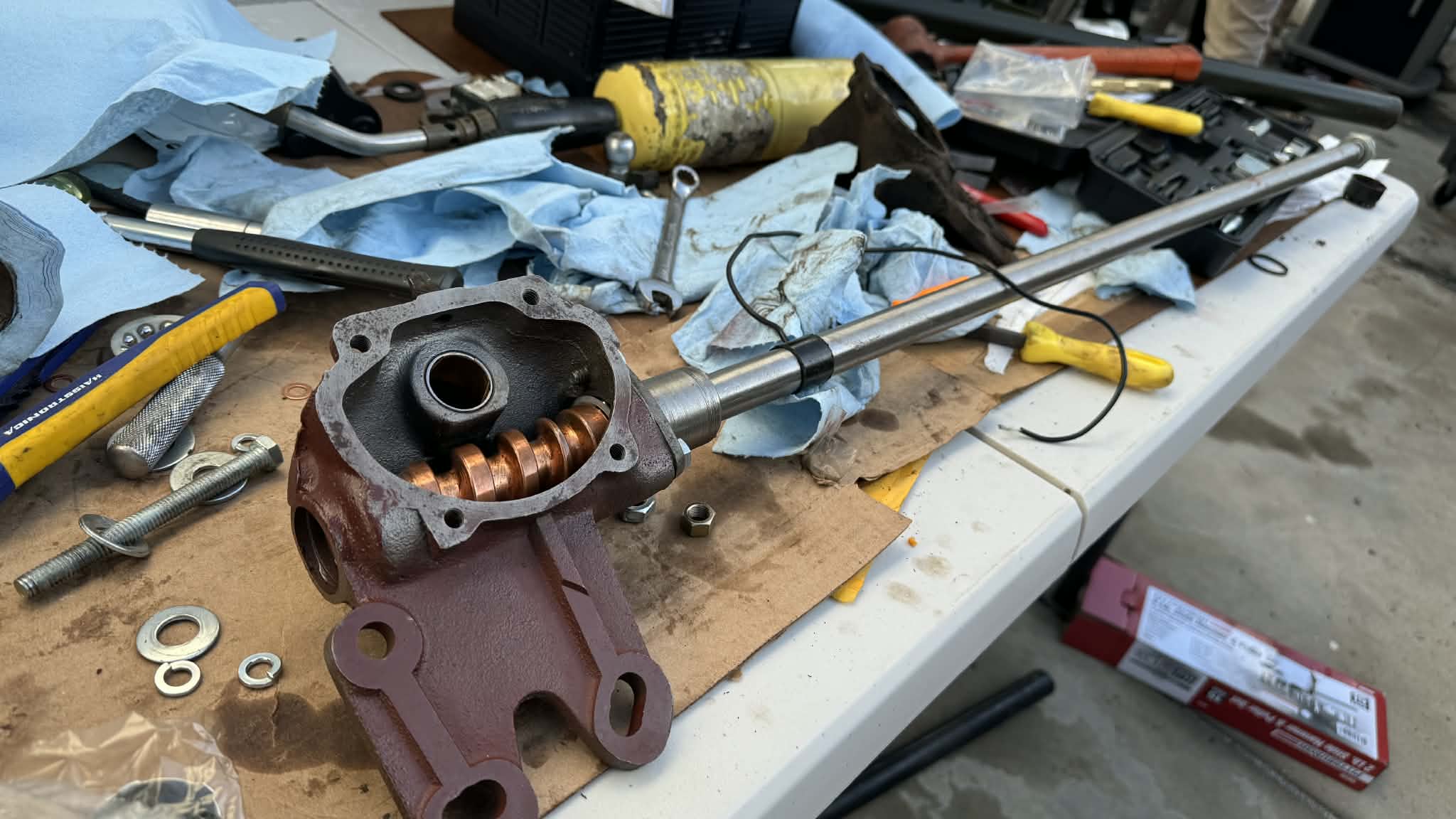
Except I forgot about that horn ring. That’s this little brass bushing that has to be pressed onto the steering shaft so that, when I push the horn button in the middle of the steering wheel, it grounds out a brush that rides along the bushing, thus activating the horn.

Here you can see the full installation process, courtesy of YouTuber Lets Build A Willys Jeep — a channel that has helped me quite a bit so far on this build:
Anyway, it’s a small omission, but one that will cost me two extra days, when I’d really like to install that steering system today.
This is just one example of the challenges I’m facing, but the two that have had a major effect on my morale are the self-inflicted mistakes.
I Cracked A Piston

In an effort to build a brand new WWII Jeep instead of restoring an old one, I purchased a brand new engine; that includes the block, crankshaft, connecting rods, and of course, pistons. This motor is absolutely beautiful, and it’s been coming together nicely.
With my friend Brandon having helped me get the crankshaft into the block, and with the pistons connected to the connecting rods via wristpins, I carefully installed the piston rings onto each piston, and then — after checking rod bearing clearance and piston ring end-gap (see below) and crankshaft end-play (I’ll get into that and more tech in a future article; this story is primarily about my boneheadedness ) — my friend Laurence and I set about dropping those pistons into each bore.


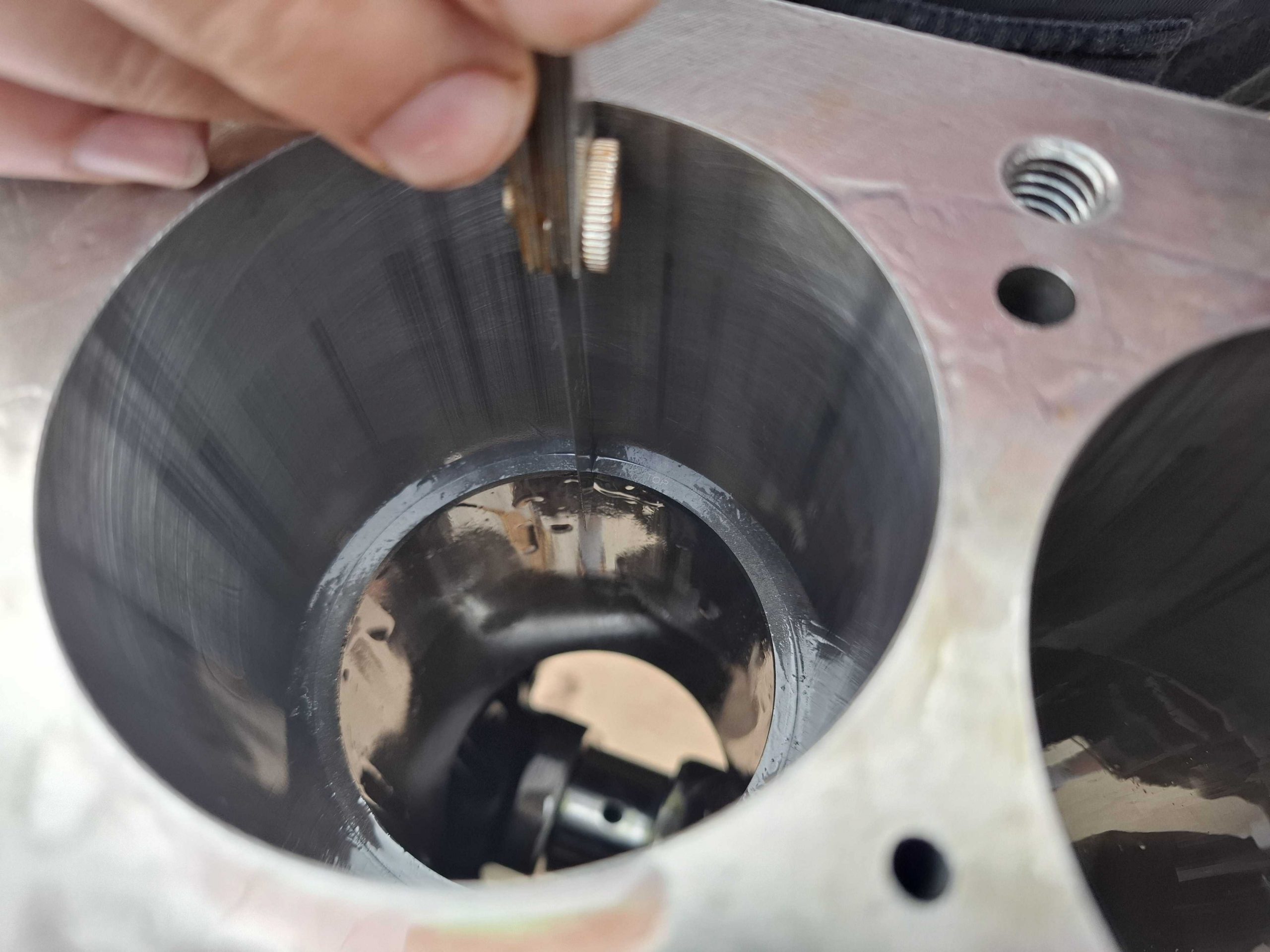
One by one, I compressed each piston’s rings, and then tapped the top of the piston until it slid into the well-oiled engine. Laurence stood watch down below, keeping the connecting rod end cap bolts (which we’d taped for good measure) from damaging the bore or the crankshaft.

I popped in piston one, tightened its rod cap. Then piston 2. Then 3.

All the while, I kept the pistons well lubricated so those rings wouldn’t get caught on the cylinder bores:


And then it was time to drop in Piston 4. Before compressing its rings, I went to clock all of them in the right orientation so that the ring gaps didn’t align (this prevents blowby); that’s when my heart skipped a beat.

Oh no.
It can’t be.
I looked closer.
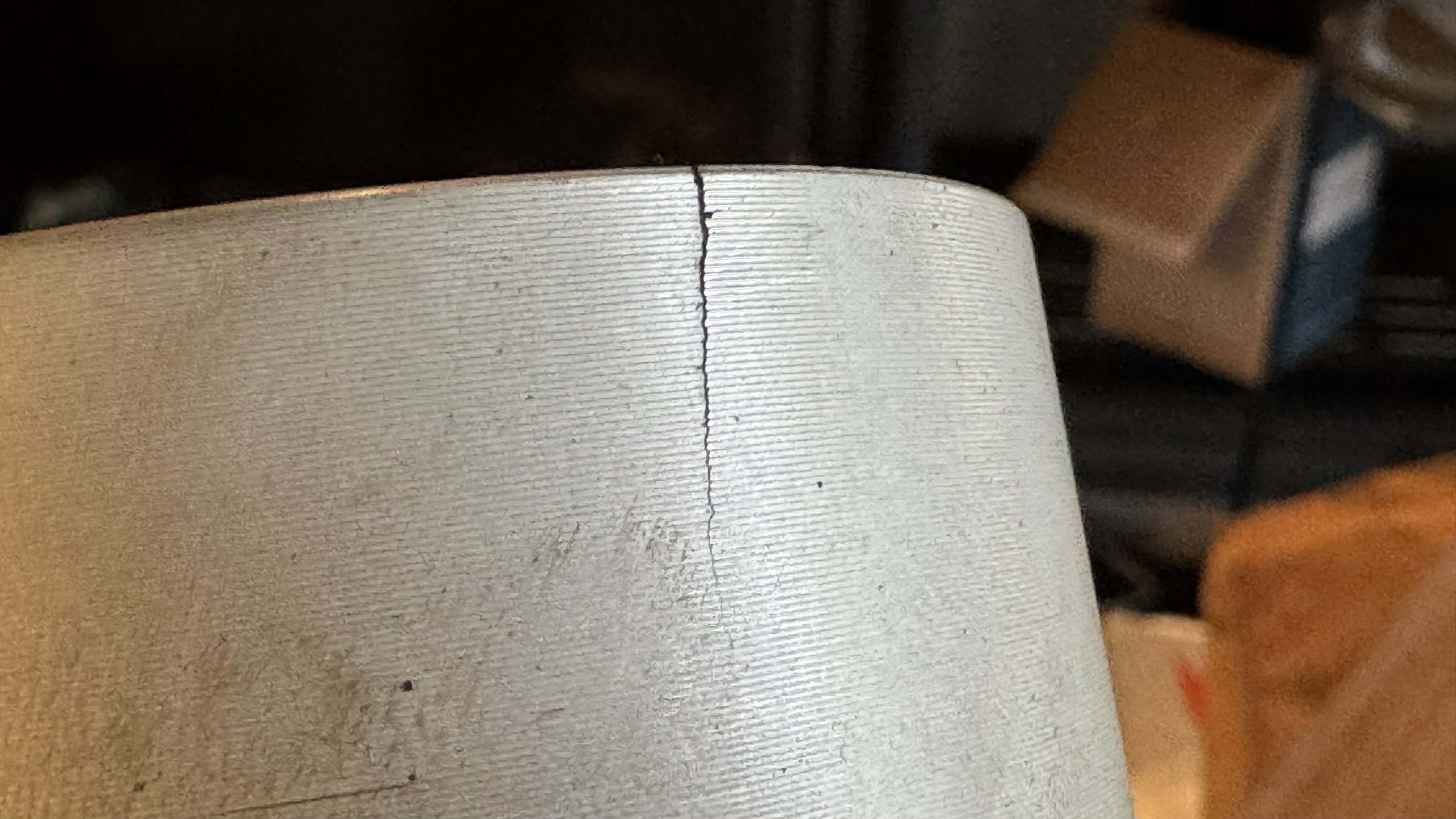
It was. How?! How did this piston get a crack in its skirt?!


I’m explaining what I think happened in the clip below.
View this post on Instagram
The new connecting rods came with rod-cap nuts that had been absolutely TORQUED to the moon, so to get those caps off I had to actually hammer them with a brass hammer. To do this, I threw the connecting rod into a vise. Well, the rod must have slipped in the vise, and the piston must have hit the vise as I hammered at the rod-cap. D’oh!

It could have been worse, because — for some reason or another — I had accidentally ordered a second set of pistons, which were waiting in the wings in a Silv-O-Lite box.
Still, I now had to remove the three pistons whose caps I had already torqued to the crankshaft journals, I had to remove all four old pistons from the rods, and I had to install the new pistons to those rods via their new wrist-pins. And of course I had to install the new rings, and then shove all the pistons back into the block. It was just annoying, and it was all my fault.
Wait, Where Is The Hole On This Timing Cover?
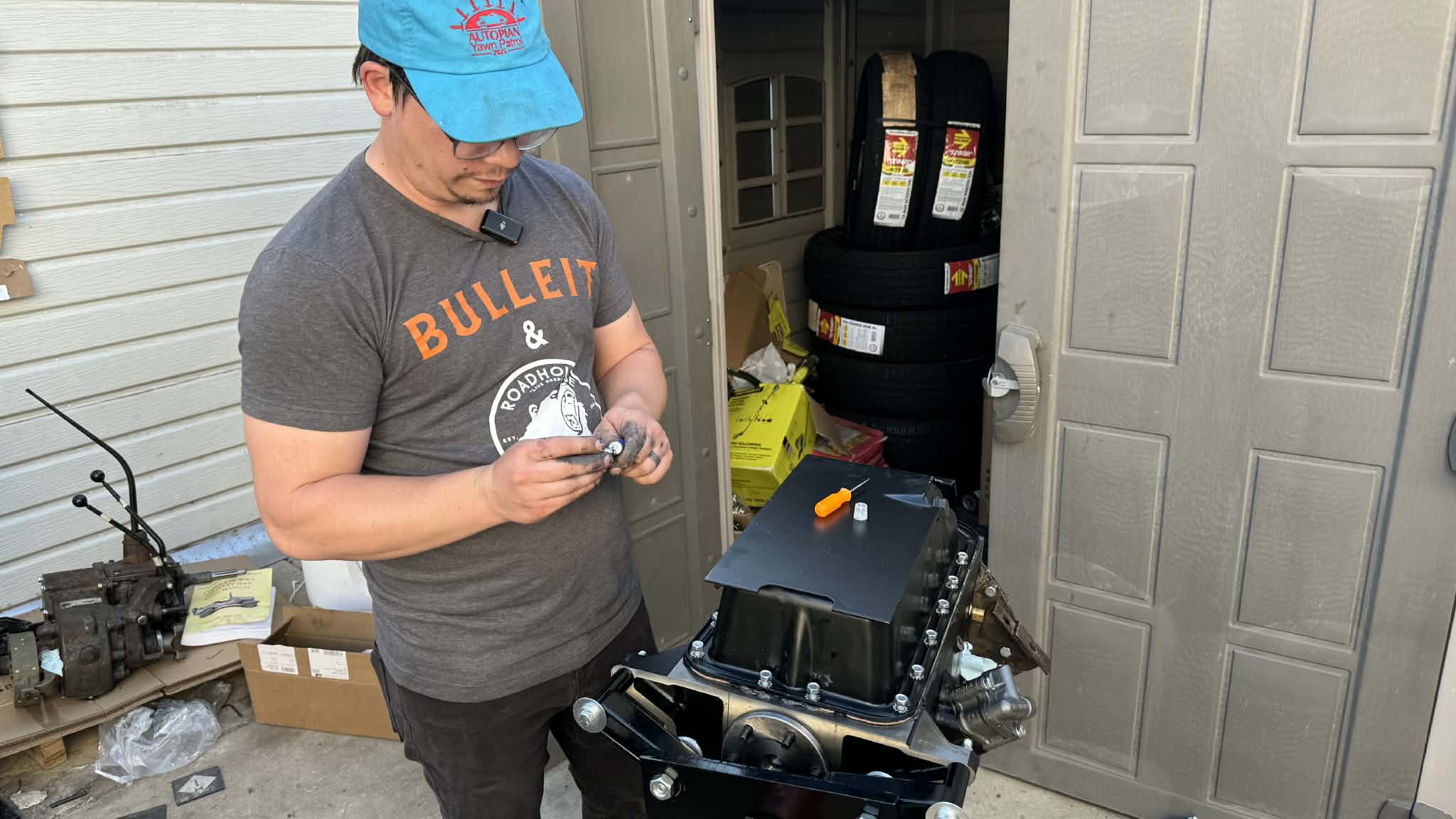
The second mistake is, arguably, even more bone-headed.
You see, just after I had thoroughly RTV’d my oil pan and timing cover down in an attempt to prevent leaks for which these Go-Devil engines are so well known, I went about setting up my oiling system.
One oil line goes from the block to the oil filter, and the other goes from the oil filter down to the timing cover (see red arrow and letter J below):

I hooked up the first line, and then I hooked up one end of the second line. But the other end… had nowhere to go. Where on this timing cover is this hole supposed to thread? Here’s the video showing me beginning to realize my mistake:
I then looked at the engine from my reference Jeep, and immediately realized I had made a grave mistake:

I had snagged the cheapest timing cover I could find on eBay. The listing’s description read: “Not sure the year…. 1940s? From an estate of old car parts. Stored inside. Priced to sell.” Looking at the cover, it looked just like a Willys MB timing cover, so I bought it for $40:


There’s a whole page online about various Willys Jeep timing covers; the resource shows a timing cover just like the one I bought, and notes:
TIMING CHAIN COVER WITH
CAMSHAFT THRUST PLUNGER STUD. THIS COVER HAS NO FITTING FOR THE OIL RETURN HOSE.MA AND EARLY WILLYS CARS WITH
TIMING CHAIN

Apparently I had bought a Willys MA or Willys Americar or some other 1930s-era/early 1940s-era Willys timing cover! I honestly was impressed that something that rare was on eBay, but mostly, I was livid.
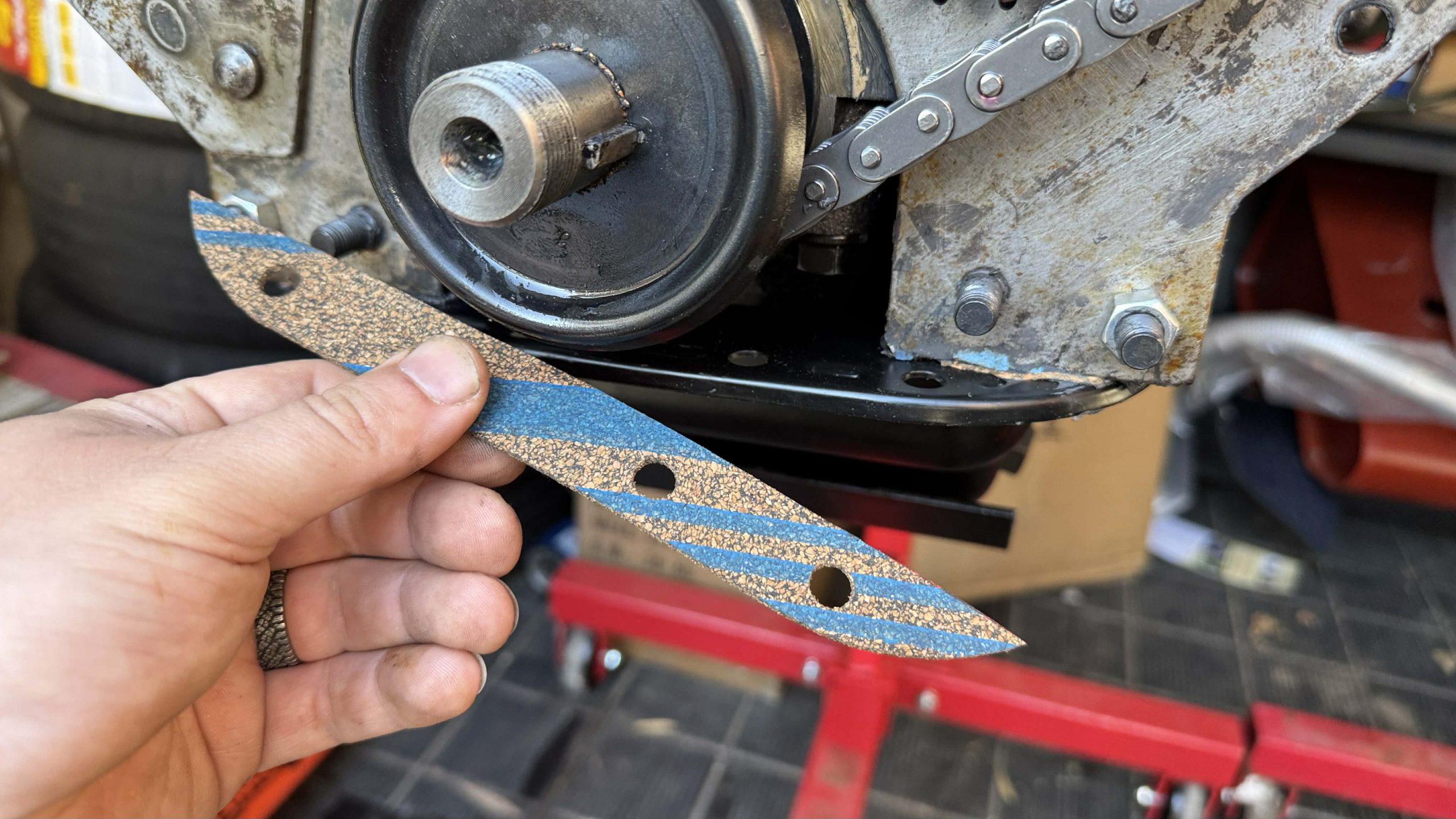
I now had to take my crankshaft pulley off, remove all the bolts holding the cover to the engine front plate/oil pan, take the cover off, cut the section of the oil pan gasket that was part of the timing cover gasket (a new kit comes with a partial gasket to replace the cut-off part of the pan gasket), scrape the ungodly amounts of silicone I had glopped onto that cover to prevent leaks, remove the crusty cover from the reference engine, clean that cover, install a new crankshaft pulley seal (a two-day wait, along with the new timing cover gasket) and reinstall the new cover.
Luckily, I had Laurence, the gasket-scraping king, who removed the old cover (see below) and cleaned the engine’s front plate with ease:
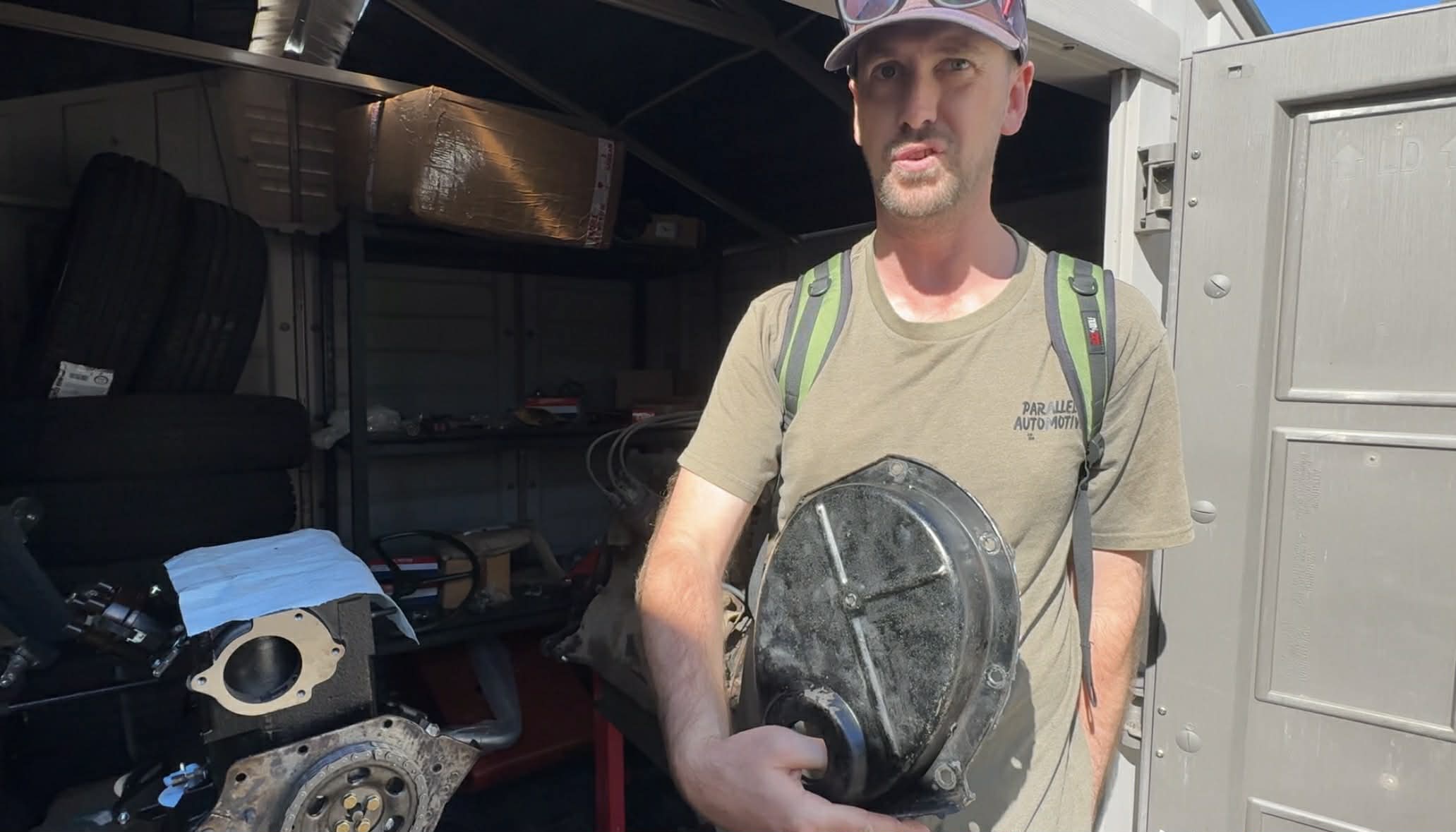
We eventually cleaned up the old cover and installed it. Do I have full faith that it won’t leak? No. Not at all. But I have hope, and that’s what this project is about.
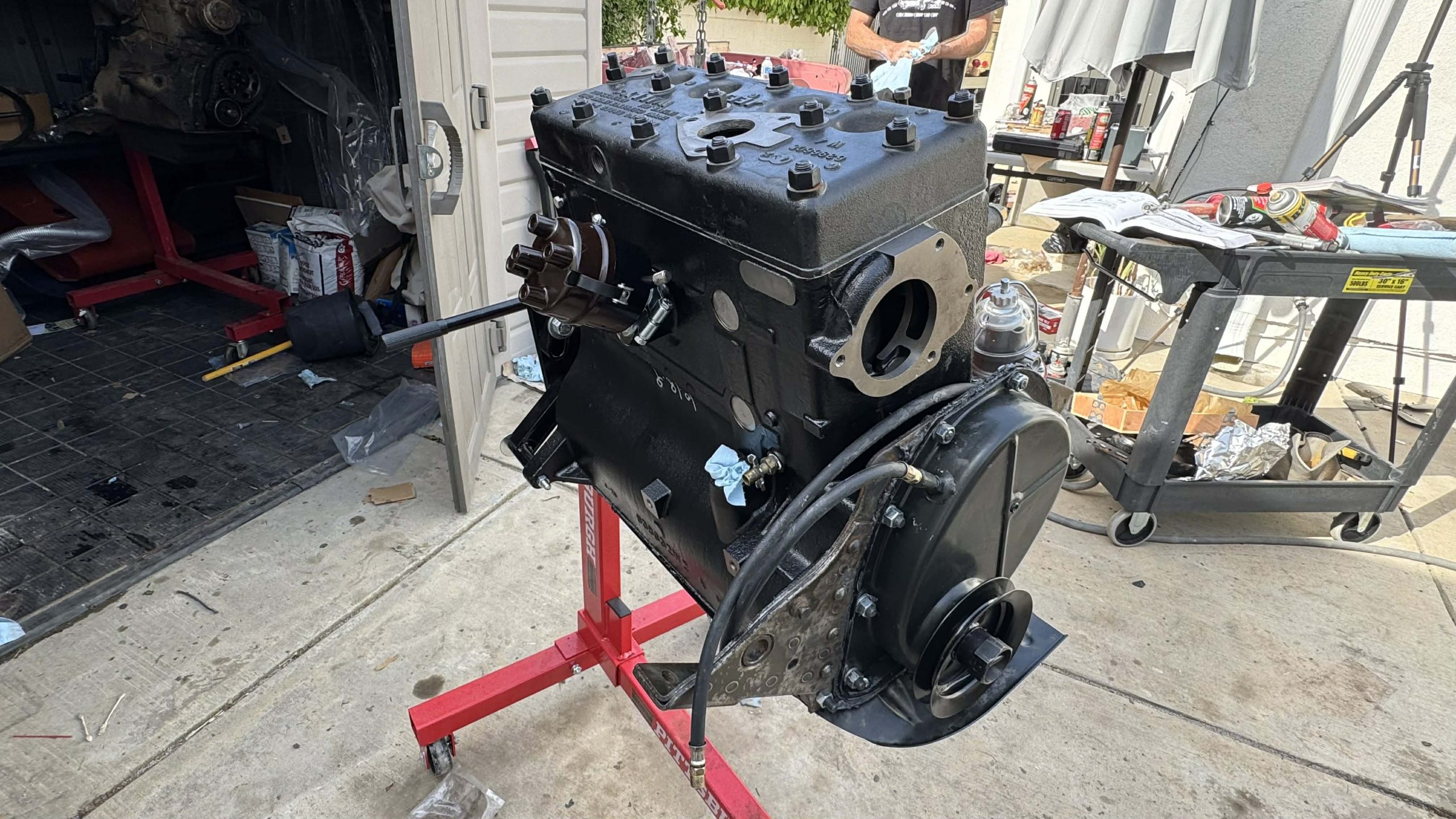
Here is the new cover in place; Laurence did a great job painting it:
My number one hope is that I don’t keep making boneheaded mistakes like these two. Then again, I’ve been making these silly mistakes since day 1. Maybe it’s time to just embrace them.
[Ed note: David mentioned the idea of building a brand new WWII Jeep to the team at eBay, and they loved the idea so much they said, “How can we help?” Their financial support and David’s Jeep-obsession are the fuel behind this crazy build. – MH]


We need to convince David that his next Jeep project is to make a crew cab MJ by back-halving an XJ at the c-pillar and welding the frame extensions for the MJ bed onto it.
Stupid question from a non-wrencher:
Why did you have to pull the 3 good pistons instead of just substituting a good one for the cracked one? Are they not interchangeable?
Lots of sets of pistons are sorted by weight when they are made, so that the pistons are weight matched to each other, and form a balanced set, otherwise they vibrate like crazy.
Thank you for answering.
Thanks for the info. I assumed that manufacturing processes would produce identical parts.
If he had noted all the weights of the piston/rod/ring/bearing assemblies he could have potentially matched the weight of the new assembly to the old assuming the new one was heavier and there was material that could have been ground off to get it to match.
Well they could weigh them all, grind a little metal off, and weigh them again until they all weighed the same except for the ones that they made a little too light by accident and had to discard, but that would be sort of insane unless you were building a one off engine.
Also you can mix and match rods and pistons to balance a set, it’s easier to remove a bit of metal from a rod without compromising it’s structure.
But really it’s just easier to weigh and sort parts into sets, especially if you are making thousands of parts.
Wow I can always feel sure that coming on this site will reveal something I never even wondered about.
Thank you for asking.
It happens to the best of us. All you can do is keep digging.
That is why the most used tool in my toolbox is my check book. Never has you can pay me now or pay me later been so true.
This is what happens when you don’t have a well lubricated goth supervisor on site.
David: “Lawrence has just gone to get the new set of pistons”
Me: “is he going past the drinks cabinet?”
A true professional knows to sit at the drinks cabinet silly rabbit
This is a tough project, and I’m glad that DT is sharing his missteps with all of us. This was destined to be a hellish project, and he keeps sharing with us the many reasons why that is.
I underestimated the complexity of this project when first proposed.
This is why people specialize, they do one or two and they have it down. I do not. Everything I do, I try something different, so every project takes longer and costs more, but I learn new skills and chalk that up to classroom cost. The big stuff is almost always the easy part, it’s the minor things that require a lot more figuring, getting some small and cheap, but critical part, then finding out you need another small, cheap, but critical part. Oh, the hardware store doesn’t have it because they don’t carry small, odd bits anymore? Off to Amazon, I guess, and the smallest package is a qty of 100 and apparently isn’t warehoused in the US, so now wait for it to arrive via slow boat from China and find a place to store 99 spares I’ll likely never use. Arrives, get it together, find that only works OK, but not good enough, so redesign, more small parts, repeat. This is why I stick to simpler things than cars.
That’s how I have new parts to make dozens of terrible guitars.
Actually I have learned always offer a buddy to assist them to learn on their projects before risking it on your own.
Even if I had friends who built stuff, it wouldn’t really translate to the one-off engineering I’ve had to do, but I can see how that would work for other people.
David you should do a cross-over with Freiburger or Péwé. Both are big jeep guys and live in the area
+1 for what appears to be the bulk container of assembly lube (with pump)
As others have mentioned, a lot of us have been there. What defines us is how we react and what we do next. I think you’re good there. 🙂
At least you’re not putting lubricant where there should be sealant, and sealant where there should be lubricant.
As the actress said to the Bishop
Thankfully most of The Bishop’s models are in the computer rather than physical, so less adhesive and lubricant required.
[The Subaru BRZ disliked that.]
Yeah that was quite a misstep on the early “86” cars
Well Molykote 111 is a lube and a seal, and is good grade, if you change your mind.
I don’t know it it’s a desert topping and a floor wax, you’re going to have to try that yourself.
Indeed, though that sounds pretty advanced for a humble Willys jeep.
You cow
Same story, except it was a cracked block.
Story: Bought a 2007 Mazdaspeed3 from a coworker as a fix and flip. It was blowing coolant out the exhaust, so it likely needed a headgasket. Pulled the head and it was, indeed, warped. Sent it to be machined. While putting it back together, a friend pointed to cylinder 3 and said “what’s that?”. It was cracked.
The remainder of the project was similarly as disheartening. I truly believe that the car wanted to die.
If building WWII Jeeps from scratch was easy, everyone would be doing it.
This sounds like a project that is only one small step easier than building a Saturn V rocket from scratch in your backyard.
Well after the first hundred or so it’s so easy that even Ford could do it.
For Saturn rockets they used Chrysler.
Seems for Sat Urn rockets the proper supplier would be Uranus.
Well Andy Griffith did that, but he did have a salvage yard. Anyone remember that show?
The good news is that you’re catching the mistakes before they become crises; instead of slamming it together, hitting the starter switch, and blowing up the whole works.
Silly mistakes are inevitable, bad mistakes are preventable.
Wish I could have been there to help out. I would have stood next to you, looked it over, shook my head and said “Yep. It’s cracked.”
I’m afraid I’m not very helpful.
Honestly, I need someone there. It’s not about knowing what to do, it’s about just having a friend there to make it more fun!
In the immortal words of Adele…
We could’ve had it allllll…
Rollin’ in the Jeeepppp…
You took the piston right in your hand…
And you cracked… you cracked… you cracked it in the sleeve.
Slow clap…
I have that CD!
If we were there not-helping David, we could sing along while we drank our wine or beer!
David: “Adrian, look what I’ve done now!”
Me: “Don’t worry I’ve made us cocktails!’
“Me: “Don’t worry I’ve made us cocktails!’”
What kind of cocktails?
When you’ve just screwed something up and are in a foul mood because you have to fix it, the kind of cocktail matters less than usual.
It’s more the therapy of standing there and just doing nothing whilst consuming a beverage.
“When you’ve just screwed something up”
So a screwdriver then, eh?
Maybe screwed driver?
Unfortunately, it then becomes an Oroboros.
Artillery punch.
The alcoholic kind.
So… Cotton Candy Champagne Cocktails for all!!!
What in the name of Oliver Reed’s liver is that? The cotton candy is taking up valuable alcohol space.
I figured it would be you replying ” Don’t worry I’ve got pictures and I’ve posted it”
I wish I could have been there too.
I would have walked over to you and said “I agree… It’s cracked. You want beer or wine?”
I was wondering if the lesson learned/next step here would be need more Australians, get Lewin on a plane with a bag of Start Ya Bastard!
Many years ago I was putting a 455 Olds motor together for myself in the shop I worked at after hours. somewhere around 10:00 I had 7 pistons installed and properly torqued when I discovered I had an extra ring spacer!! I then proceeded to backtrack all the way back to the second piston before I found where the extra spacer belonged. Needless to say it was a long night spent talking bad about myself!!
YIKES!
OK, I didn’t mention in this article that I accidentally mixed rod bearings between two different sets (one of which didn’t provide the bearing clearance I needed). I didn’t have to backtrack for this, because I had to remove all the pistons anyway after the crack, but it was silly. No wonder that crank was so hard to turn!
When cranking always apply plenty of lube.
I worked in a motorcycle shop for a while. Whenever a new mechanic would split engine cases for the first time, the shop manager would put an extra gear in the box of transmission parts. Then we’d all quietly laugh while he tried to figure out where it went.
One new guy (who asked me on his interview if the company drug tested), got the whole engine put back together and never said anything about the extra gear. He either actually found a place to put it, or just threw it out.
Your extra piston ring reminded me of that.
Must have done time at IKEA.
I was really surprised how expensive that engine was. I’d have just bought a used iron duke, or something. Off eBay, of course. 😉
I see the problem: you actually want this project to be PERFECT. On all of your old projects, good enough was… good enough.
On Cactus or POStal you would not have replaced all the pistons due to one being cracked. You would swap out the bad one and move on. You would have just rigged up a remote horn button elsewhere and kept moving.
Fact!
The truth is, this Jeep isn’t going to be perfect. But it’s going to be good.
Do you want an E-bay Jeep to take to Moab or a PERFECT recreation of a WW2 Jeep to take to Moab? You may be at a crossroads.
My crossroads has been solved:
Get something mechanically solid for Moab.
Bring home, paint it, make it mint.
I figured pragmatism would prevail. Good on you for all of this.
DT was never a pragmatist
I am, may be the source of my misery. I see a lot of my younger self in David… but I’m just not a risk taker. I’ve made a few career gambles… knowing the odds.
All old projects were always bulit to be good enough. Drain the old fluid, no chunks and metal shavings fall out, it’s good! You would never have rebuilt a used transmission, axles, transfer case on the old projects unless absolutely needed. I laud the effort on this one, but worry you are losing focus.
So going from government employees to private employees?
Hell he’d have used JB Weld to attach it and wrap some duct tape around it.
Bingo – the half-assery was the part we could all relate to.
The great Greek philosopher Mediocrates – eh, it’s good enough.
It’s all new to you.You’re learning for the next time.
Are you building a Jeep or inventing one?
I think he’s builventing one.
This is a neologism that I can get behind.
I’ll also add – I have a neighbor who basically builds old-school hotrods from scratch in a shed in his back yard. The vast majority of the time is spent waiting for parts to show up, and he’s obviously not trying to single-source. Realistic timelines are key…
He’s building a full set of 1930 Fords. Has finished the Sedan and Coupe, working on the Roadster currently, on the lookout for a pickup body and frame. He’s a retired dude in his 80s, so time both is and isn’t an issue. But it takes him a GOOD 2-3 winter seasons per car. He and his partner are snowbirds, he builds hotrods, she gardens to pass the winters away here in God’s Waiting Room. Lovely people.
Those aren’t one offs. A good plan would allow ordering all the correct parts at once.
The only thing they have in common is that the bodies all started out as 1930 Fords (or fiberglass recreations of one in the case of the roadster. Completely different otherwise. They are very much one-offs, just built to a theme.
(sees headline and doesn’t read article)
Would the mistakes be “starting” and “continuing”?
Ok, now that I have read the article, I can say this: you’re human. I have made mistakes in my wrenching adventures of the past, and I am sure to make them in the future. The challenge is part of what makes it all fun. If it all went 100 percent smoothly, it wouldn’t be an adventure.
And let’s not forget them time pressure. The old saw “hurry up and wait” exists for a reason.
I didn’t read the article yet, my brain saw the header as “COPS” which sent off a “Oh no it’s the Troy building inspector all over again” vibe.
Anyways going to read the article now, glad to see new posts from DT!!
Me too thought that David had gone all postal Jeep or something
I had an article last week!
You did! I’m glad to see one this week as well!
He went all postal months ago. This month it’s all shell shocked
Me too. Bad Boys theme started pumping through my head.
Screwing something up is a time honored tradition for every mechanic. The key is to laugh about it over a beer with your friends. Or write an article about it and post it online.
And if all else fails, remember all the times Click and Clack ended up having gotten something wrong during the “Stump the Chumps” segments on Car Talk.
Now, I need to mentally prepare myself for this spring, where I’m going to fix the engine tuning issues on my Bug…
One of my favorite “Maker” You Tubers Jimmy Diresta has a mantra he repats on every project he works on. “You go to school on the first one”
He’s got dream shops on his property. blacksmithing, metal fab, leather shop, CNC mill, laser cutting table, mig, tig, a mini sawmill, all the tools I could only dream of knowing how to operate. Even with all his years of experience and craft he still has to struggle through his first build of a new project. Accepting the failures as part of the process just changes the focus from I’m a screw up, to I’m learning, and learning requires failure.
So, ya, David don’t worry, happens to everyone.
…by the way, I don’t drink but while we’re all standing around in the virtual driveway I’ll take a Liquid Death if ya got one in the cooler. 😉
I don’t drink while I’m doing anything meaningful, it’s an occasional social indulgence. I think I’ve got a few behind the Arnold Palmers.
Stump the Chumps! I miss Car Talk.
NPR Releases an old episode from the archives on their podcast platforms. It’s still in regular rotation for me, Ray is doing “Limited” occasional solo episodes for subscribers to the NPR streaming platform.
Minor dilemmas all things considered. Most of us have done worse on much smaller projects.
Be kind to yourself. You’re doing the work of an entire company all by yourself.
…and it’ll likely leak less than one that came out of the factory new!