

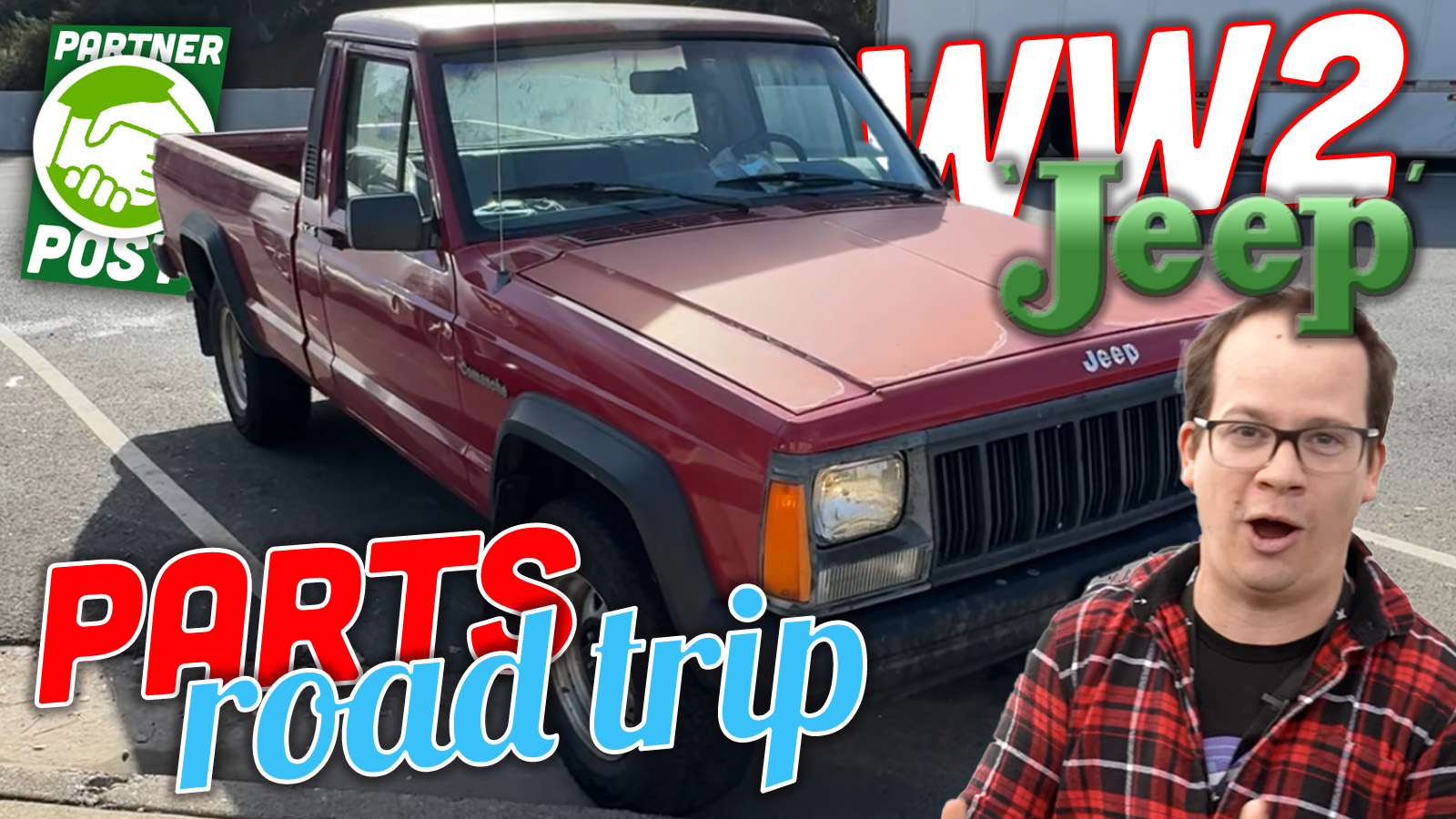
Tomorrow I’m heading to Longview, Washington to pick up a bunch of amazing parts I bought on eBay for my WWII Jeep project. Those parts — four axles, a transmission, a transfer case and maybe an engine — are not going to be lightweight, putting my new 1992 Jeep Comanche through its toughest test yet. Here’s a look at the trip ahead, and my thoughts on how well the Comanche will handle the job.
I had been going back and forth on whether to install new leaf springs on my Jeep Comanche in preparation for this trip. On one hand, I have no idea how old the current springs are, and my research showed that the standard replacement leaf springs from Dorman are known to offer a bit more ride height and stiffness, so they should be able to handle a bit more load.


But my current springs seem fine. The ride quality is great, and the ride height is pretty much within factory spec, which is 9.2-inches +/- 1/2-inch between the axle tube and frame. Why swap out my springs for less comfortable, stiffer ones just for a single trip? I do plan to haul things regularly, but rarely more than 1,000 pounds.

Speaking of, here’s my estimate of how much my Comanche will be hauling this week on my 2,000 mile round-trip:
- Axles: 150 pounds x 4
- Transmission: 70 pounds
- Transfer case: 80 pounds
- Engine: 400 pounds
- TOTAL: 1,150 pounds
I’ll probably buy another 200 pounds worth of stuff when I’m up there, if I had to guess, bringing me to 1,350 pounds.
My truck’s payload rating is 1450 pounds, and the sticker on the door pretty much echoes that. I have never loaded this truck with that much weight, but I did load it with 800 pounds — all at the very rear of the truck — and it still had some space for jounce (though the angle of this photo makes it seem like less room than in reality):

The springs are on the softer side, which I like for daily driving, but that could cause some sagging during this trip (i.e. I might bottom out on the bump stops). If I had more time, I might look into an airbag system, or maybe I’d just install the leaf springs I have sitting here. But alas, I know the current leaf spring’s bushing sleeves are seized in place, and swapping these springs out is going to be a nightmare requiring a Sawzall. Plus, again, I quite like these springs; the ride is great, unladen.
And so I have decided to explore something… a little different. They’re called air shocks, and while the engineer in me doesn’t love the idea of them, I think they’re going to work just fine for this application.

Having gained notoriety in the 1970s in the vintage American car scene, air shocks (these are called Gabriel Hi-Jackers) basically act as both an air spring and a damper, with the former helping the leaf springs lift up the rear of the vehicle. The reason why air springs seem like a compromise is that they require the shock mounts to do something for which they were not designed: carry a sustained load (i.e. support the vehicle instead of just taking shock loads).
View this post on Instagram
But half a century worth of testimonials seem really positive for what I’m doing here, which is only supporting a small portion of my load solely to keep my axle off the bump stops. We’ll see how it works out; I will load the truck up, drive around, and see if I like the ride. If all feels good, I’ll proceed, and if not, I’ll just grab a U-Haul trailer. I have options.
In any case, I’m excited to see what this little MJ can do, and I’m excited to pick up this amazing treasure trove of Jeep parts so I can really get this eBay WWII Jeep project under way next week; I am flying in the WWII Jeep king himself, my old Jeep-engineering buddy Brandon. Things are about to get crazy.
P.S. If you’re in the Portland area and want to hang out tonight, email me at david@theautopian.com!
[Ed note: David mentioned the idea of building a brand new WWII Jeep to the team at eBay, and they loved the idea so much they said, “How can we help?” Their support and David’s Jeep-obsession are the fuel behind this crazy build. – MH]



In (U.S.) Season 13, episode 4 of Wheeler Dealers Ed and Mike put air shocks on an old Chevy Luv. The real air suspension was over $1,500 so they took the discount and paid about $350 for the air shock system. They claimed it worked well and they sold it to the 99 Brewery to haul kegs around.
I miss watching “Motor Trend” TV, which I have been boycotting since the last corporate shenanigans.
I may need to look into air shocks for my F150. It sags alarmingly when towing because my big honking truck has a measly 1250lb payload. Fortunately I carry more bulky stuff than heavy stuff and rarely tow with a deadweight hitch.
You may wantt to take a UHaul trailer as a backup, in case things go awry. I realize that you could just haul it in the trailer but then we wouldn’t have your great follow-up article about hauling it in the bed. Good luck!
Used air shocks with my 1974 Plymouth Satellite to tow a boat all over SoCal, this is a decent solution, actually.
I added something like this to my ’92 XJ when the springs got a bit old and weak. Seemed to do the job.
Air shocks are the answer, but a Uhauler makes even more sense…..
David, if you feel like an adventurous detour, I’d suggest a short jaunt north to these freeway-visible junkyards/museums:
Also, if a sudden craving for a dinner-plate sized cinnamon roll hits you just south of Roseburg, I can recommend Heaven on Earth.
Didn’t the last cabover Jeep rescue in Washington give our dear hero trenchfoot?
I’ve got a pair of aftermarket fill-em-up yourself air-shocks on my ’94 Fleetwood. They’ve worked great for keeping the headlights out of other drivers’ faces during 1400-mile one-way holiday road-trips to Florida having the cavernous trunk stuffed to the brim with gifts, suitcases, and a big cooler.
Granted, I’d still prefer the factory’s automatic leveling system, but that seemed to have gone caput before I acquired the car.
Hmm. Air shocks. I would consider buying a set of these for the project Travelall, but the original leaf springs are flat as a board and I doubt they’d make a difference.
“I’ll probably buy another 200 pounds worth of stuff…” yep, driving through wine country…..
Be silly not to.
I can’t wait to read the article in a few months “I sold the perfect tow pig Chevy 1500 and now I miss it dearly”.
My sole nod to load ratings is to make sure the suspension still has a bit of bounce when it’s laden.
And that’s how I fitted about half a ton of stone into the back of a VW Polo. It was fine, although I did take it easy over speed bumps.
DUDE! You cannot possibly take i5 all the way and miss the most beautiful coastline drive in the world. I insist you invest the extra couple hours and drive at least a portion of the Oregon coast. You can jump over from Salem, Eugene, Portland (driving it unladen), or after picking up from Longview just head West to Astoria, about 45 minutes (Goonies town!) and then down the coast a bit.
On one of the cutovers you’ll hit the Evergreen Air Museum, home of the Spruce Goose!
Have fun, be safe!
That would be highway 99 through McMinnville, and Dundee in the heart of wine country, which hits the coast around Lincoln City. This provides an opportunity for excellent clam chowder in Depoe Bay or Newport
new springs, my guy, and that’s all
What could go wrong here, right?
Thanks DT for the content. Good luck.
At what point do we have an intervention for DT? <Unfolds letter> “David, I am concerned that the rusty Jeep path you have returned to is not ideal for Elise NHRN and your child. Your roles as a husband and father now take precedent and first financial consideration over anything else.”
reminder, the payload rating of the truck includes the weight of you and any passengers… might need a weight loss plan to keep it under 1450 all in
The rated payload is pretty conservative anyways. He’ll be fine payload wise. Now having to climb up the Grapevine on the way back to LA, is going to be the challenge. It’s easy to overheat an old car there.
Pretty sure payload includes a standard weight of the driver, assuming David is of standard weight. Passengers, luggage, glove box contents, etc all take away from payload for sure.
Leave the other engine, DT. It’ll give you a bit more if a safety margin, and you already have a brand new engine awaiting assembly at home.
As an engineer I’ll just say there’s nothing more satisfying than using something at the limit of its rating. That said, 2000 miles is a long time to be satisfied 🙂
Our 250k mile 99 XJ leaf springs sag under load. We just replaced the shocks this summer and I wish I considered air shocks for the rear. Oh well… Since the bump stops are trashed anyway I’m now thinking about sumo springs. We’ll see if it gets through the winter first…
The great thing about air shocks is that you can adjust them when you need to carry a heavy load somewhere and then reset them for normal driving. My husband has a work truck (older Chevy Colorado long bed) and sometimes he has to deliver something heavy. It’s a good solution for you.
I have run air shocks whenever possible since 1974.
They even made a set that fit my 91 Toyota single cab pickup.
No exaggeration here, we carried a load of rocks and other stuff 1,500 miles without issue at all. Stopped at a weigh station for fun and figured out we had close to 2,000 lbs. in the bed.
Dude, l love yer commitment to the bit but wouldn’t that sweet-ass Chevy be a much better hammer for this nail?
Or is it already gone and I’ve been remiss in my Autopian-ing?
It’s a Jeep thing. Nobody understands.
Well a lot of folks must understand given the massive number of bumper stickers saying so and/or the WDWoD (Whole Dash Worth of Ducks) on 99.7% of the 36,000 of the full-time on-road 4-door Wranglers in my little town of 25,000. I feel like I’m living in Jonestown with no desire to drink anything other than water.***
*** peak sarcasm, folks.
COTD
And of course I see this at 8:30 at night after a heck of a long day at work. It doesn’t sound like I’m going to be able to catch you, unless you’re still in town Tuesday night.
I saw this a day late dangit.