

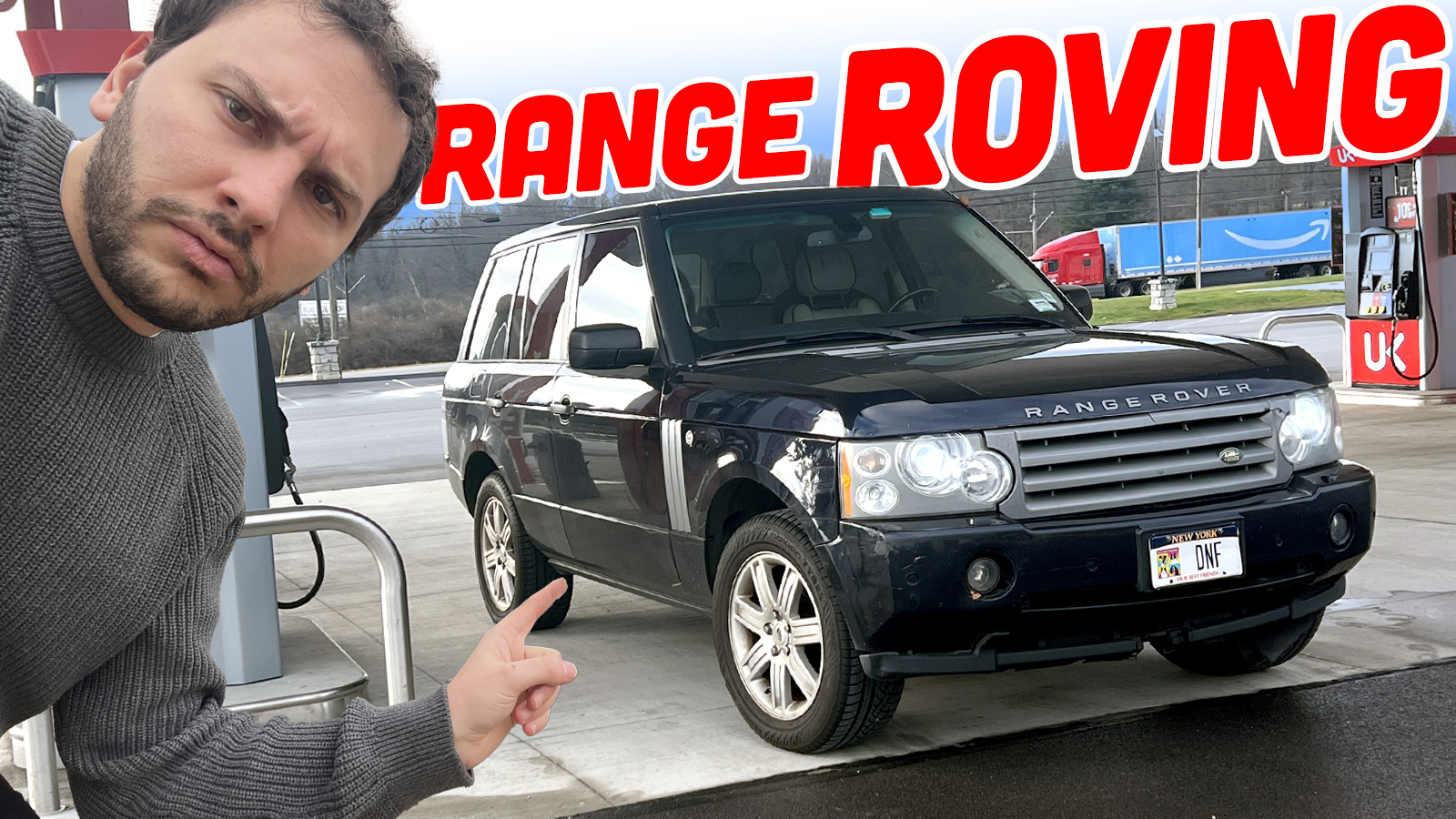
I absolutely love a good road trip. So when an opportunity arose to drive my cheap beater 2008 Range Rover 850 miles from New York to Chicago and back for Thanksgiving, I eagerly threw my keys into the ring.
Driving a beat-up British SUV with over 200,000 miles on the clock over that many miles sounds like a recipe for suffering and hardship, but I managed to arrive in the Chicago area without having to use my Premier AAA membership. The trip wasn’t totally stress-free, however. There were some (extremely minor) trouble points that arose throughout the journey—one of which I fixed, and another that fixed itself (hopefully).Spacer


The Drive Itself Was (Mostly) Free Of Panic
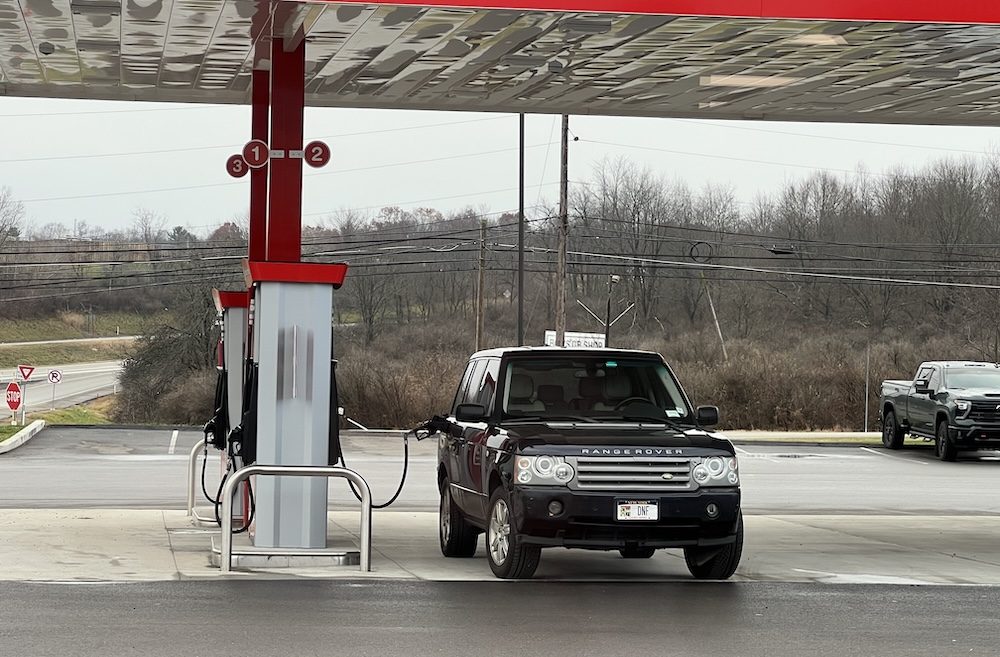
After a brief oil level check, my girlfriend and I set out from New York City at 5 a.m. and pointed ourselves west, running the route I explained in my last post on this huge hunk of a vehicle. I was most nervous during the first leg of this trip through New Jersey and Pennsylvania, having never really driven this car for more than two hours at a time.
My worries were mostly unfounded. The drivetrain proved healthy enough to traverse the long, shallow inclines that define eastern I-80, shifting between fifth and sixth gear to keep up with my cruise control setting based on whether I was going uphill or downhill. Once things flattened out in Ohio, it was easy, stress-free cruising.
There was a bit more wind noise coming into the cabin than I expected—I’m not sure why I was surprised, considering this Rover’s front end is one of the most flat-faced, brick-shaped noses ever put into production. Also, the car pulls noticeably to the left under braking, but it’s not bad enough that I need to drop everything to address it.
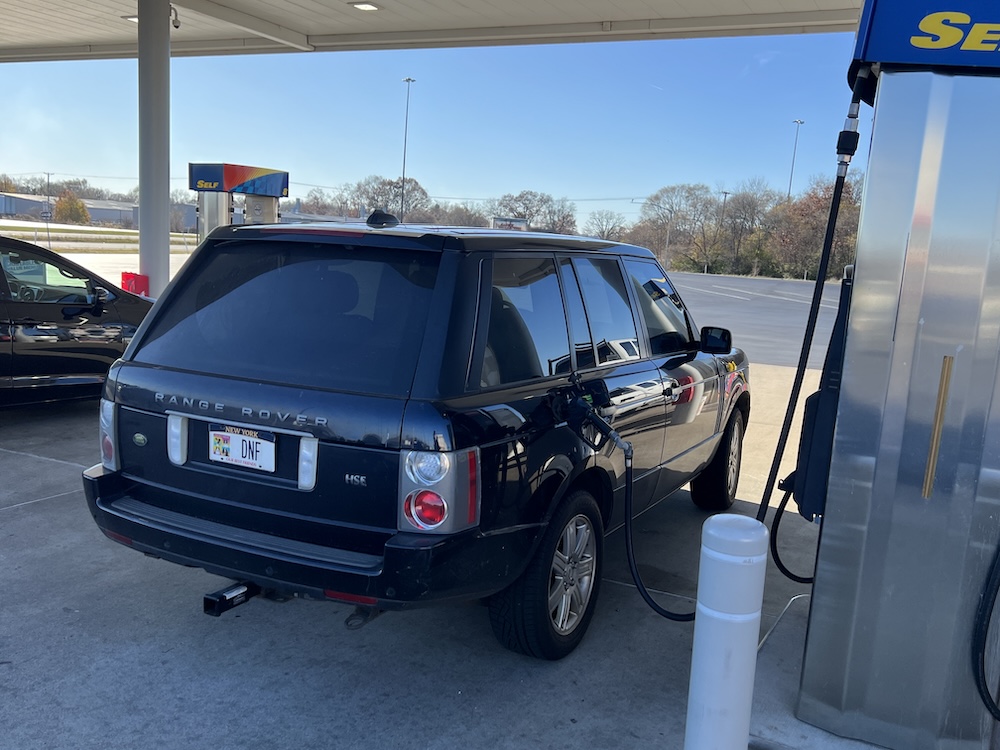
I was also pleasantly surprised by the Range Rover’s fuel economy. While driving around in New York City, I was getting around 11 mpg, which was pretty terrible. I knew it’d get better on the open highway, but not this much better. The car averaged 17 mpg for the duration of the trip, according to its onboard computer, meaning it was getting well over 300 miles to a tank. That meant we only had to stop for gas twice on the journey (versus three times, which is what I was expecting).
The Car Is Slightly More Broken Than Before
One issue that occurred about three hours into the trip was a notification from the onboard computer about a low-beam headlight malfunction. Turns out the right-side Bi-Xenon light had simply … stopped working. It was nearly daylight by this time, but I didn’t want to risk going back out onto the road just to have a cop pull me over for a broken lamp.
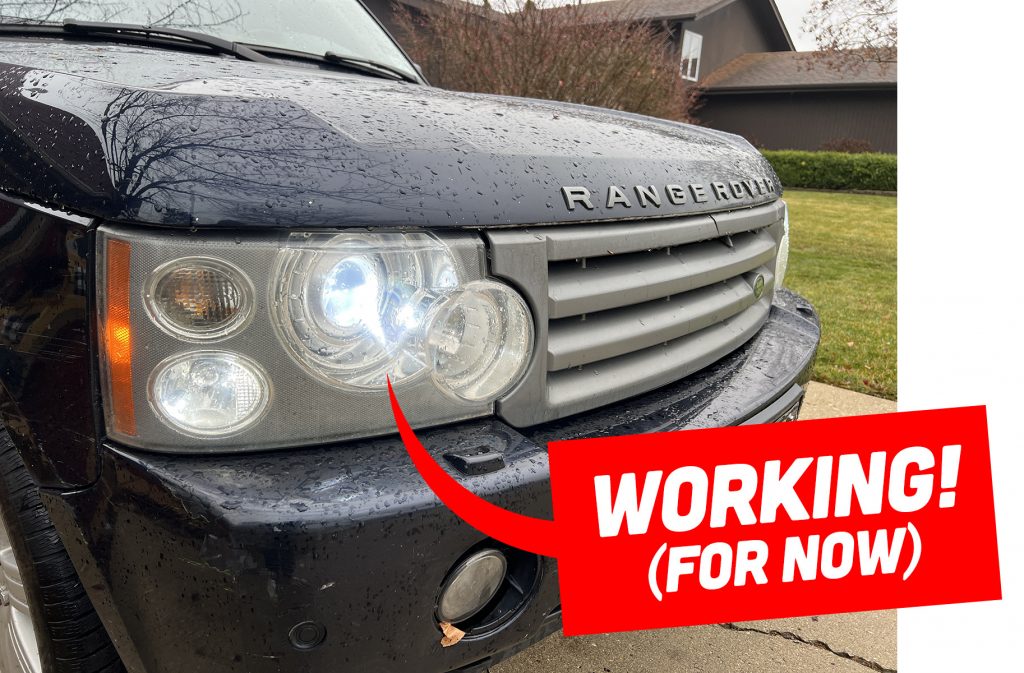
Before I started slapping on the housing or digging deeper into the connections under the hood, I tested the classic WiFi router-style fix of turning off the headlights, then turning them on again. By some miracle, this worked. The headlight came right back on, and it hasn’t given me any trouble since. The Range Rover gods are on my side (for now, anyway).
The only other thing that went wrong was a piece of plastic clipped to the bumper that had broken into two pieces and started flapping in the wind about halfway through the drive. I previously ziptied this piece to the bumper, but I guess that wasn’t enough to keep it secure. Instead of trying to reassemble the plastic back into its place, I simply removed the push-in-style plastic fasteners that were holding them to the car and chucked them in the trash.
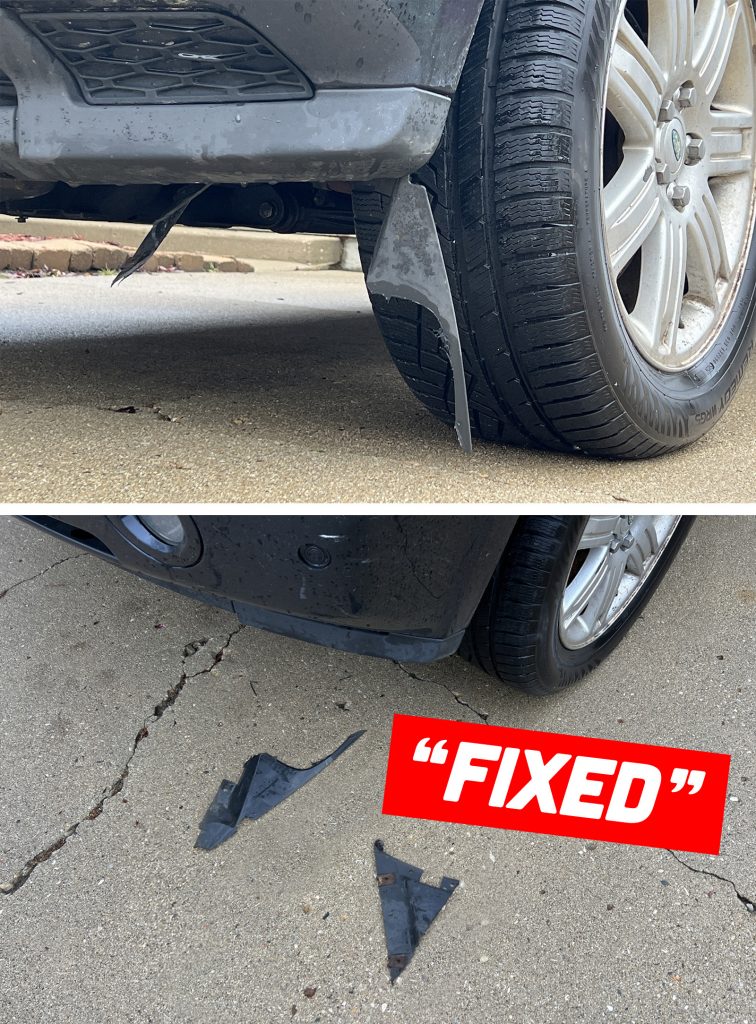
I’m sure these plastic chunks were once important for something, whether that was aero or holding other parts of the bumper together. But they’re gone now, and I don’t think it’s worth tracking down a replacement piece. Life goes on.
Wish Me Luck On Saturday
Since my arrival on Sunday, I’ve made another drive down and back to Chicago proper from the suburbs up north, where I’m staying, which took about two hours in total. The Range Rover performed well there, too. I plan to do at least two more of those drives while I’m here before heading back to New York on Saturday. These shorter trips will be a good gauge to monitor whether I need to fix anything more.
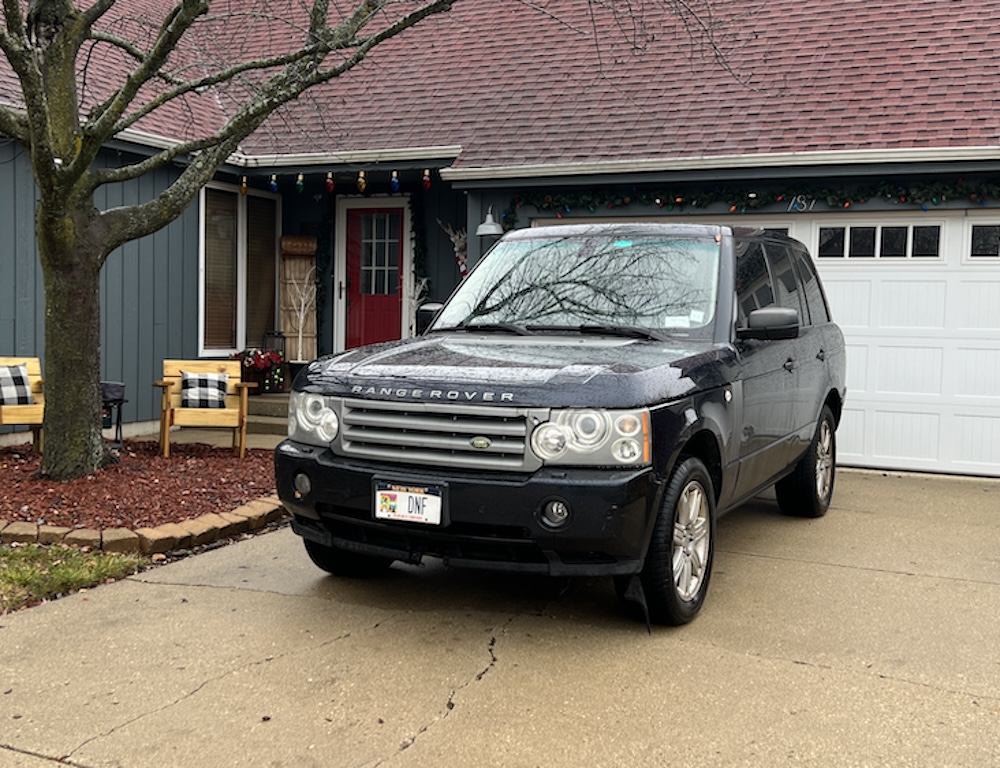
As for right now, there isn’t much else to address on the truck. It’ll be going back to New York fully loaded up with furniture and moving boxes, so I’m expecting slightly worse fuel economy (or maybe the same, since those hanging pieces of plastic likely created some problematic drag, and now they’re gone).
Having completed the drive here with relative ease, I’m pretty confident the Range Rover will make it back. But I don’t want to get too cocky, because that’s precisely where things go wrong. So, wish me luck.
Top graphic image: Brian Silvestro





This makes me want to replace my 2015 Silverado (220,000 miles) with a 2008 Land Rover. How utterly irrational and vain. I just think they look nice inside and out and would be very comfortable. Someone please tell me I’m an idiot.
Mike you’re an idiot 😉
Seriously though if you think it would make you happy make the switch. RRs have the added benefit of helping countless people become excellent mechanics or meet new mechanic friends
Thank you for that. I already have some good mechanics and friends to help me work on the cars here that are already broken. I got over the fever relatively quickly.
I LOVE (looking at) British cars. I’m a coward and would never own one. As someone who has owned mostly Japanese brands over the past 30 years, can’t fathom the idea of random bits falling off for no reason.
Point taken.
To be fair, in this case, those dangly bits that Brian took off are simple aero type inexpensive plastic bits held on likely with a couple of plastic trim Christmas trees. Sitting so low to the ground they are wear items that should be able to be replaced quite easily and cheaply.
Good Luck to you Sir! I would NEVER have trusted my old RR to make that trip!
If you replace the plastic thing it has to be slotted into the front, then the fasteners in the back line up. My passenger side one had a run in with a critter and was knocked partially out. Until I completely removed it I couldn’t figure out how it went in.
On the wind noise front check to make sure both the plastic covers on the a pillars are fully secured. I had a rattle and a wind noise coming from one of mine having a broken tab.
the one on the driver’s side definitely wiggles a bit, which probably explains some of the noise (not going to rip it fully off to inspect until I’m back home, but on the list)
Until I find one in a junk yard someday mine is secured by a piece of duck’s finest tape 🙂
“So, wish me luck.”
I’m wishing you luck… bad luck… because that will lead to hardship for you and more entertaining reading for me!
BUAHAHAHAAAA…
/jk
I salute your ‘Fix’, Sir.
Exactly my preferred approach !!!
I’m pretty confident the Range Rover……
These feel like famous last words.
It looks like your in-laws are in Antioch, just a stone’s throw from the Cheddar Curtain. You should make a quick run up to Mars Cheese Castle.
I owned a 2008 for years, none of this surprises me. You’re not going to run into any issues on the way home either.
I had a 95 lwb for a couple years. I remember when the rear trailing arm bushing disintegrated. I’d been driving mostly in town and the first time I got on the brakes hard on the interstate it proceeded to cock itself noticeably sideways and tried to steer me into the left lane. Sounds like the newer models still follow suit.
Rest assured I replaced the bushings on both rear arms the next week.
Sounds like that might be a good thing for Brian to work on in Chicago.
Truth be told, our 95 County LWB was a great long haul driver, regularly going from NJ to OBX and back with four adults, a dog and miscellaneous detritus. Always got 21 mpg too.
For something that should have been “unreliable”, I put my mom in that car to commute 60 miles a day too. Maybe it was the constant use that kept it going? Eventually it was passed to a friend and it dropped a cylinder liner at 185k.
When you’re back in the NE, Brian, the offer to be hosted by the Land Rover Experience Center crew in VT still stands. I can guarantee you’ll be impressed with the off-road tools your L322 has and how it manages to find traction where you least expect it.
Don’t worry, you’re not forgotten! I just need to find the time (and some underbody protection)
I just got back from a trip in my 2020 Range Rover Autobiography LWB. No issues, and it got 22 MPG out of a 5.0-liter supercharged V8. Not bad.
Later this week, I have another trip that’s 7 hours there and 7 hours back. I will be towing home a 2014 Kia Soul on a trailer.
Your 2008 is a fundamentally solid car, running-gear wise, and the 2006-2009 (2007-2009 if you want to avoid the BMW-era interior) L322s are arguably the most reliable modern ones, since they have the gen. 2 Jaguar engines. It’s just that they’re so old, they fall into cosmetic disrepair or otherwise need fixes that aren’t justified by their low value. At the same time, the L322 feels a lot more rugged and tossable than my L405, which rides more car-like and is a bit less of a Range Rover as a result.
I wouldn’t hesitate to own another 2006-2009 from a longevity standpoint. Just know that whatever you do will be a labor of love; resale value is in the trash on these.
Oh, and be glad you don’t have a supercharged. The supercharged L322s have clear taillight lenses with pearlescent blue bulbs that light up red. They are Osram Diadem bulbs, if I recall. And they’re $64 apiece. There are two types, as well: a standard brake light and a combo one with two elements for the taillights and rear fog lights. And non-OEM bulbs will still often trip a light-check error on all L322s, because the resistance isn’t quite right for the circuit.
I will start in 15 days a trip to Mexico (Below Arizona state, Sonora) in my 1996 Mustang V6 auto. The longest drive I have ever made in that car since I own it was to Toronto and it did fine. The check engine light has come on and off recently and it was emissions related, the car drives ok. I have a new fresh set of tires, brakes, oil, coolant replaced recently due to the water pump that was also replaced.
I have AAA membership, spare tire with air, jack and tools with me. I dont know what else I should bring but I decided to drive the Mustang instead of the 2017 Volt in case something goes wrong, it should be easier to fix.
My only concern is the transmission, it works as intended but I dont have the service history of it. Some people say leave it alone, I checked the fluid level and looks good, but if I service this and then sh!t happens while I am driving many states away, ugh.
Yeah I imagine a broken Volt would get you blank stares in Mexico.
To be fair, as I understand it a broken Volt will also get you blank stares at GM dealerships.
Touche – a lot of them, yes.
I suggest replenishing the broken plastic flaps before you go back so you don’t tempt the gods and they break that instead of, say, the fuel pump.
DNF is the perfect plate for a high mileage Range Rover.
David driving any number of rusted out junk piles across country, I get. Jason and son driving a million mile taxi more than across country I get. Both were cool adventures worth the readers time. But I don’t get this story line – it’s a guy and his girlfriend driving to his parents for thanksgiving in a Range Rover. What am I missing here? Not trying to be negative, I really don’t understand…
It is based upon the supposed reputation of Land Rover/Range Rover for hillariously poor reliability. Brian bought a well used example for a pittance and this is his first real trip in it.
This feels like it is attempting to make a huge deal out of something very mundane.
License plate checks out.
Let’s see if he makes it back before we say that it checks out. 🙂
Regarding the headlight malfunction, the Rover could probably do with a going through of disconnecting and checking/cleaning the contacts on the headlight and turn signal connectors or bulb contacts and sockets. Simple and likely to head off more annoyances.
And if it’s anything like the P38A’s and Discoveries/RR Classics that came before, cleaning the battery negative cable grounds at the frame (There are probably at least two down there, and they’re not hard to find) is worth doing every few years, and can head off a multitude of electrical and electronic gremlins. Really, it’s a good thing to do an any car every so often. Particularly on today’s electronic monstrosities. A less-than-perfect electrical ground is often at the root cause of strange and intermittent malfunctions and it’s not necessarily something that British cars have a corner on the market for. (But a chilly, damp climate is the perfect environment for galvanic corrosion to take hold, which is probably at the root of a lot of the tales of British electrical woes.)
This is not a terrible idea considering just how many electrical problems I hear about these things online. Will find time to do it when I get back home
I had a couple of electrical niggles going on with my Disco 1 — so minor I can’t even remember what they exactly were. There was no obvious fault in any circuit. But the chances of the main chassis grounds ever having been touched in the car’s entire life were slim and none, so I figured that going after the basics was worth it. Sure enough they were absolutely cruddy. A few minutes with a wire brush and some emery paper had them all cleaned up. And afterward, no more electrical gremlins whatsoever. Prince of Darkness, Begone!
And lately I’ve been dealing with my wife’s Grand Caravan’s 30-amp circuit that runs the radio, the blind spot sensors, and way too many other things acting up. Stuff just shuts off until you pull the fuse and let everything on that part of the CAN bus reset. Opening up the “TIPM” (glorified fuse block and central connection bus) revealed some bus bars that needed to be cleaned (and are often the reason behind costly TIPM replacements) and once that was done, the incidents became far fewer but still happened. Last night after it acted up again, I finally located the main grounds (the negative battery lead disappears into a huge wiring harness and the ground comes out unintuitively in another location, because Chrysler…) and cleaned them. I definitely got a much stronger spark when I reconnected the negative battery cable, so I suspect I may have been on to something.
Which brings me to another thing — with a fresh charge on a strong battery, you ought to get a nice, healthy spark when you touch the negative clamp to the post as you connect it. If the spark is weak or basically nonexistent, there’s a very good chance that the battery ground is in need of attention. It’s a simple thing to check; if there be electrical gremlins and the battery doesn’t yield a nice spark when connecting the negative cable, then the possibility of poor grounding (and therefore poor circuit connections throughout the car) is potentially a prime source of trouble.
People in Land Rover owner groups often swear by cleaning the battery and main chassis grounds every couple of years, especially if you drive off-road or even just if you use the Rover as your foul-weather car. And it does seem to make a difference.
Go ahead, laugh in the face of the gods of automotive smoke.
That, and Xenon bulbs themselves require a ballast to provide a high voltage current to light them, so turning them off and on may be just as good a fix if the ballast itself is just acting flaky.
You might want to look for a cheap bulb replacement and give that a try first. My old Tesla Model S had Xenon, and the exact same thing started happening. The light would be working fine and then randomly die. It turns out it was a known indicator of the bulb starting to go bad. I replaced the bulb, and the problem went away.
Anything for general consumer consumption that gets 17 mpg is a literal future human rights violation.
Shoot… 17mpg isn’t so bad. You’ve got to be lower than that to even start to add decimals behind it (my old Tacoma averaged 13.5).
17mpg in something with permanent 4-wheel drive definitely wasn’t something to sneeze at, especially when the Rover was new. Although, my Disco 1 tended to do more like 18-20 if I could just avoid stop-and-go traffic in general. But it did require high-octane fuel, so there was a bit of a price tag to get that mileage. But that was also what the owner’s manual stipulated. (And burned valves were a risk with using regular gas; the Rover V8 is a great and durable engine, but it’s particular about fuel in its later, fuel-injected incarnations.)
My old 70 442 got 6 when babied.
Could nt agree more but we are outnumbered. And with all the tailgating F150s, I may need to get a beater F250 and learn then something.
My 2003 GMC Envoy SLT 4X4 with the 4.2 I6 gets 10 mpg. In 2WD.
Might be able to get 12-13 mpg on a long highway trip.
If I had to go through a whole tank of gas in 4X4, it’s probably get around 8 mpg. As it is, when I fill the tank, the Distance To Empty shows around 196 miles. Which means when it’s at a 1/4 tank, it shows 50 miles to empty.
This is why it’s only our emergency 4X4 during the winters.
I recall those and TrailBlazers everywhere in the early to mid 2000’s. An old coworker had one. They complained something fierce when gas went to $2.25 in the little town we worked in. That’s $3.75 in late 2025 dollars.
It used to get around 18 mpg with the old Continental highway tires on it. But they sucked in the snow. All 4 wheels would just slide around when I put it in 4WD.
So I went with a set of General Grabber mud/snow tires and now I can drive around on 8 inches of fresh snow and unplowed roads and it grips amazingly well.
But it doesn’t like to pass gas stations anymore without stopping in for a fill-up.
Aaaand a brand new electric car built with rare earth metals that were mined in China using the worst mining processes ever invented are great for everybody? Life cycle wise keeping these things on the road is one of the best things you can do for the planet.
Excellent! Fingers-crossed the old girl purrs her way home again.
I’ve been thinking I will punish myself with a 20 odd year old luxury SUV in the near future. Maybe I will, maybe I won’t, who knows. But regardless, if I do so, I haven’t yet decided if I should go with one of these or a V8 Porsche Cayenne. Both are terrible for so many entertaining reasons.
Cayenne. Just don’t get the V8 that is susceptible to bore scoring. (And skip the air suspension – though I love mine on the Touareg.)
cayenne cayenne cayenne cayenne. I think 2008+ solved the bore scoring, but triple check. Go V6 if you’re particularly worried – I think they are mostly safe. The first gen GTS is a gem of an SUV.
Cayenne if you plan to stay on the roads. L322 if you want to go off roading with it.
I’m pretty sure a Touareg could keep up with the L322 off-road
’08-09 were the best years for the l322. Outside of normal wear and tear items (yes, suspension is normal wear item, as are brake calipers which could probably use a rebuild), you should continue to have mostly stress free driving. Those things are tanks!
Getting rid of BMW’s leak-o-matic V8 was certainly a blessing.
It baffles me how a company that is sooo good at making fours and sixes has never managed to make a V-anything that didn’t basically suck to own. Amazing engines to drive, but soo many dilemmas.
When *Jaguar* makes a better V8 than you did, you should ponder the error of your ways, LOL.
I had an M5 with the V10 and a stick and it was the best car I’ve ever owned (and relatively reliable considering what it was)
Oh c’mon… how many times did you have to change the rod bearings? Once? Twice? Still worth the price of admission if you ask me.
That they were fun does not IMHO make up for the pain vs. the sixes that are also fun and actually reliable. I just don’t have that much need for speed.
The M60 V8s were (and are) quite reliable. The M62s on the other hand…
They still weren’t as reliable as the contemporary sixes. Not even close.
Please, the trip is hard enough even going the correct direction.
Hahahahahaha sorry I’m still fried from staring at an empty roadway for 13 hours
I feel for you, I drive Pittsburgh to Chicago a few times a year typically. Ohio and Indiana are mind numbing. Do yourself a favor and stop by the Studebaker National Museum in South Bend on your return trip.
“I’m sure these plastic chunks were once important for something, whether that was aero or holding other parts of the bumper together. But they’re gone now, and I don’t think it’s worth tracking down a replacement piece. Life goes on.”
You might want to put something in there to replace them if they were intended to keep salt spray out.
The David Tracey special edition.