

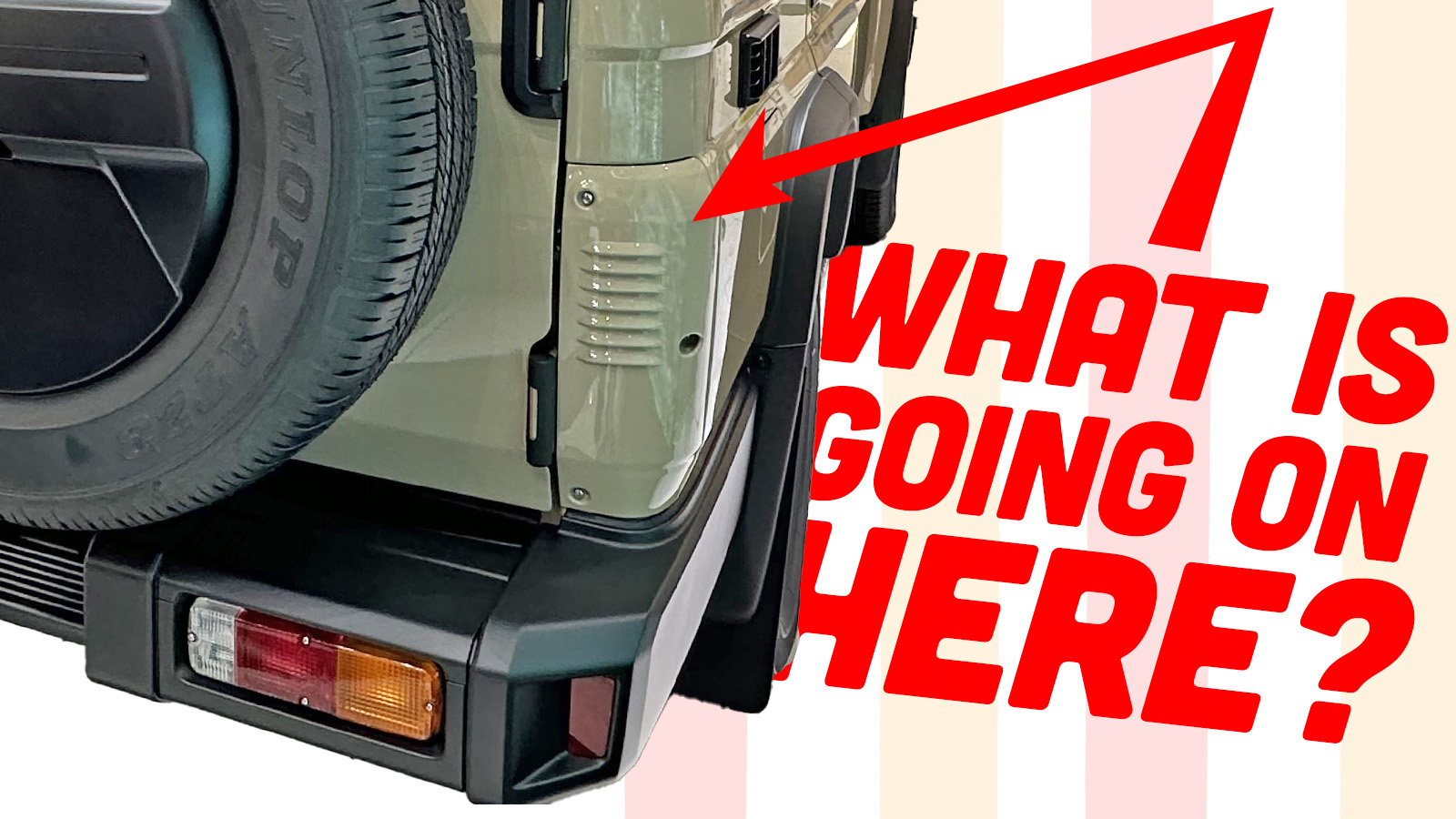
There’s been a lot of activity at all the local Taillight Community gathering spots, the bars, workshops, bath houses, abattoirs, gyms, studios and other taillight culture staples, and not all of it has been good. Rumors of DOT raids cracking down on allegedly illegal taillight lumen output and color temperature have put everyone on edge, and even what would normally be considered normal taillight-related discussion has taken on ominous tones. There’s just something in the air.
That’s the only way I can explain why a discussion of a change in taillight design of the legendary Toyota Land Cruiser 70, specifically the fourth major facelifted version, released in late 2023. This machine has been out for quite a while now, and I’m not clear why it’s only now I’m encountering people so invested in its taillight decisions, but holy crap, I’m encountering them.


A whole group took over the banquet room at the Crimson Candela just to discuss these taillights, which were being said to be an example of “taillight erasure,” which struck me as odd, because the Land Cruiser 70 still has taillights. So what is everyone on about?
Just so we are all on the same page, here’s what the taillights on these Land Cruisers look like:
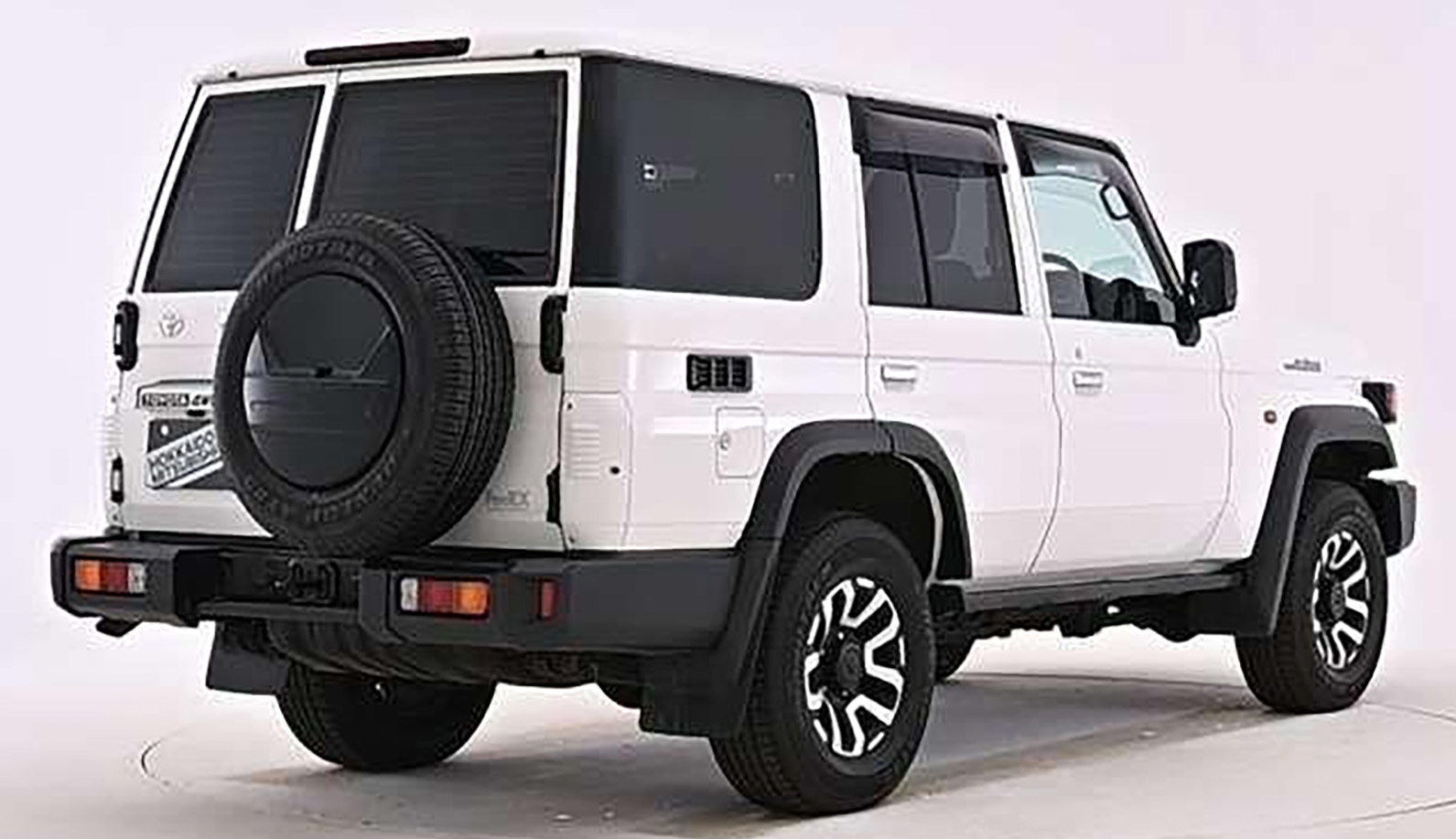
Okay, so at first glance, we just seem to be working with a pair of likely parts-bin, simple rectangular tri-color taillights, inset into the bumper. They’re not particularly inspired, but they get the job done, and remain visible even if the doors are open and aren’t obscured by the large externally-mounted spare tire. They’re a bit vulnerable to impacts, being on the bumper, but they’re also likely fairly inexpensive. Look – here’s one for just $10!
But wait; something’s not right here. What’s going on that corner? Specifically, here:
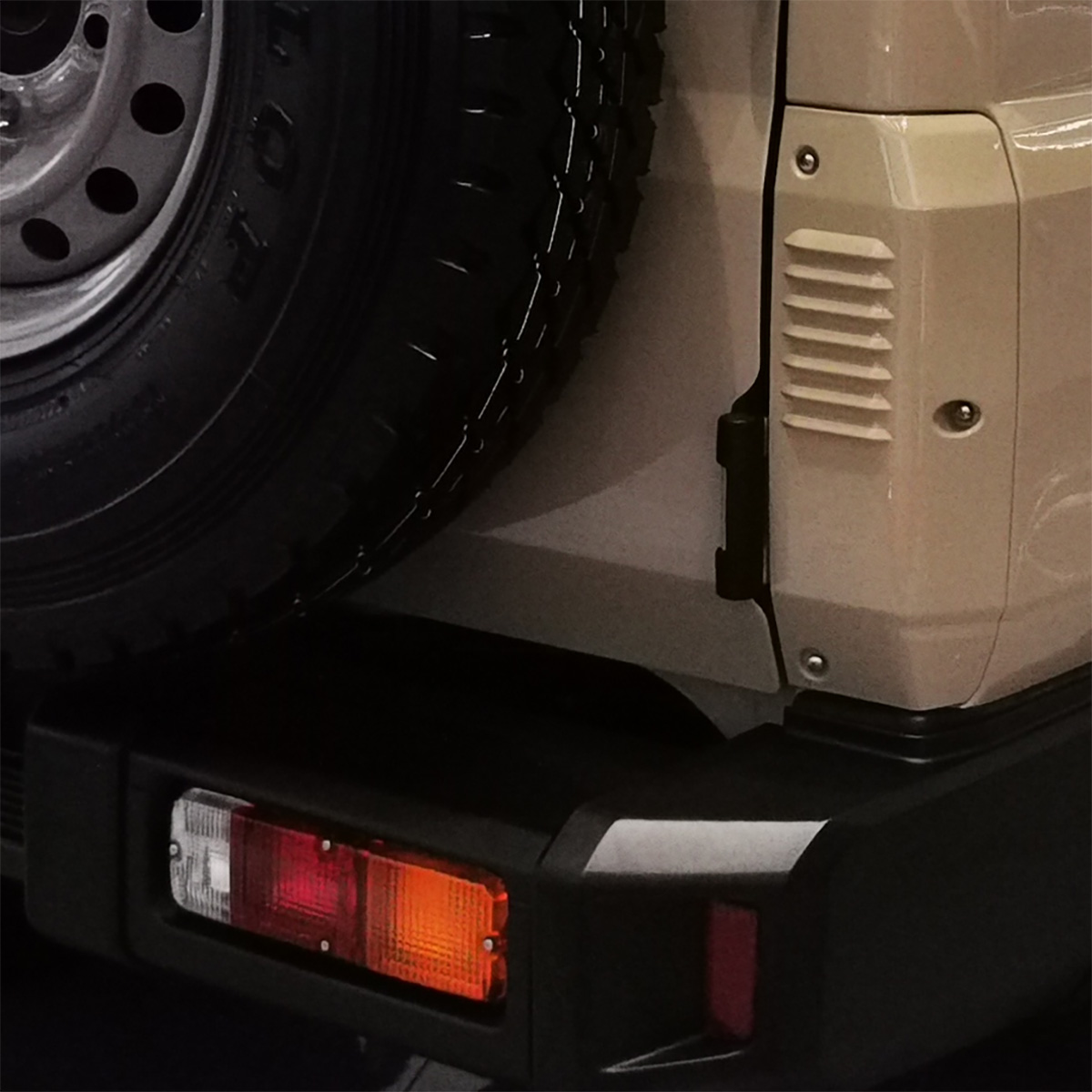
See that strange corner panel with the weird louvers? Why does that look so familiar, yet strange? Wait – could it be? No! But it seems to be – look, look at this:
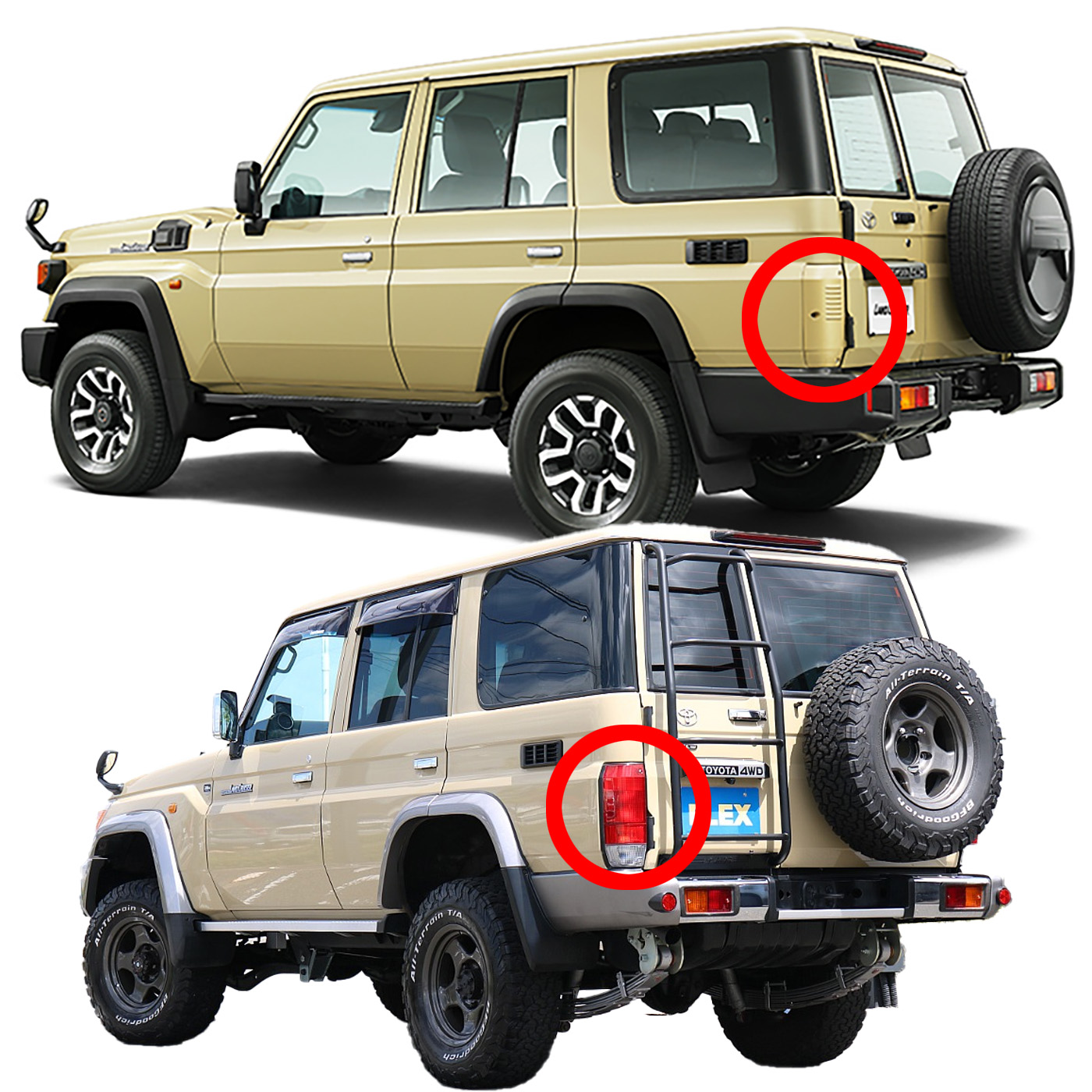
Holy crap. So, for reasons I’m deeply unclear about, the older setup, which included taillights mounted at the corners, have now been replaced with those odd body-colored corner caps? With weird, superfluous louvers, even, to, what, vent out all of that former taillight bulb-area air?
What was the thinking here? The old Land Cruiser 70 had bumper-mounted lights as well, incorporating what I suspect are redundant stop/tail/and turn signals, I suppose because the corner units may be obscured if the doors are open? The reverse lamp isn’t required to be visible at all times, so it’s fine only existing on the corner lamp. But maybe it’s to improve taillight visibility in situations like this:

Was this just cost-cutting on Toyota’s part? Why bother with redundant bumper lamp units when you could really just only have the bumper-mounted taillights? I mean, I suppose that makes a sort of cold, rational sense, but the act of replacing a substantial taillight unit – one that once carried, it seems, all functions (though I can’t quite discern if there is an amber turn signal area)–with a blanking panel feels, I don’t know, wrong somehow.
Let’s look at two similar pictures of the Land Cruiser 70 with the corner-mounted taillights and without. First with:
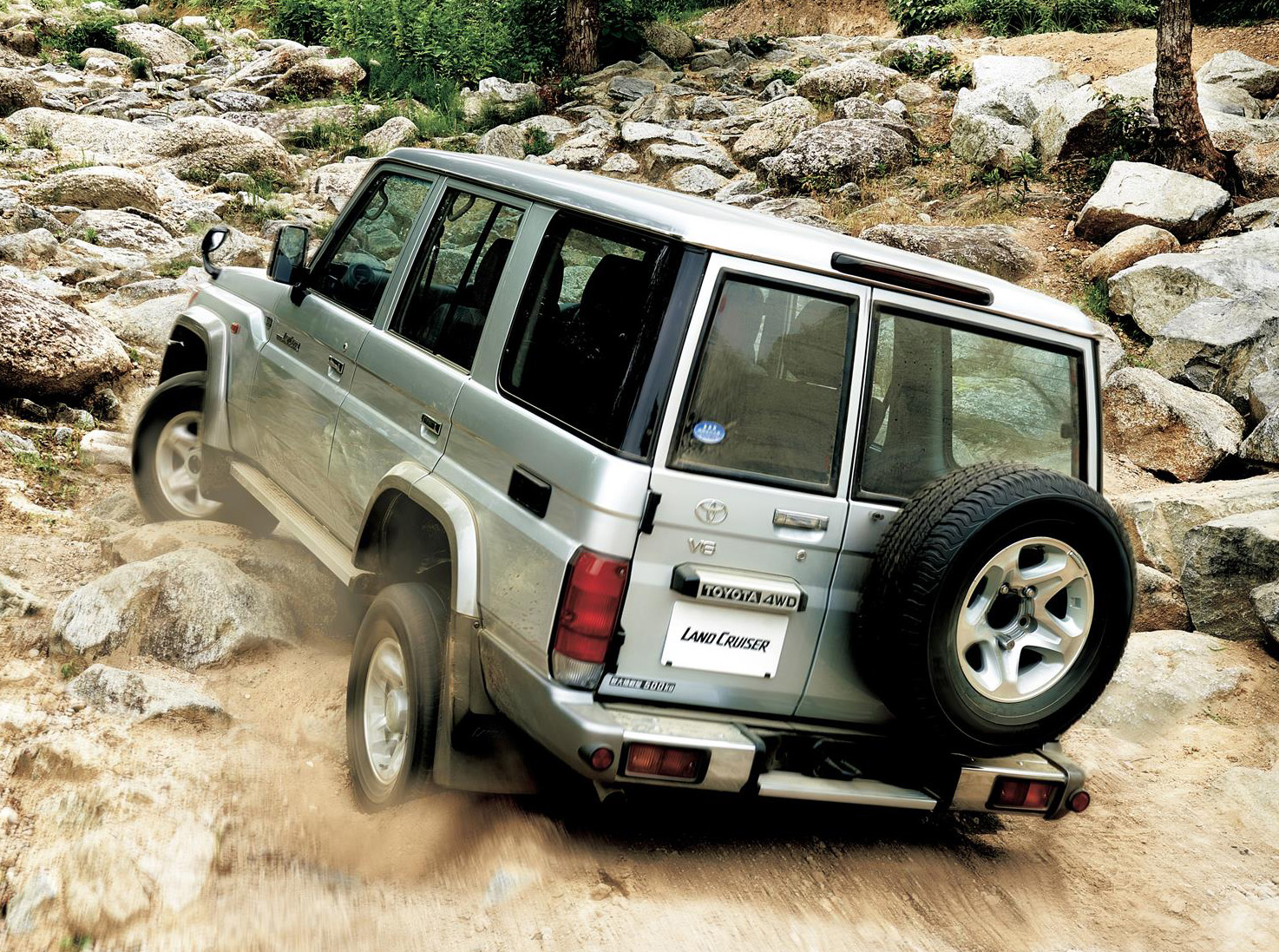
…and now without:

I mean, you can see why the word “erasure” is being thrown around. It’s weird.
I was trying to think of other examples of this – where a car had its existing, integrated taillights blanked out with some sort of body-colored cover and replaced with more tacked-on-looking units, and all I could think of immediately was how old Volkswagen Type 2 Microbuses were adapted to railroad work:
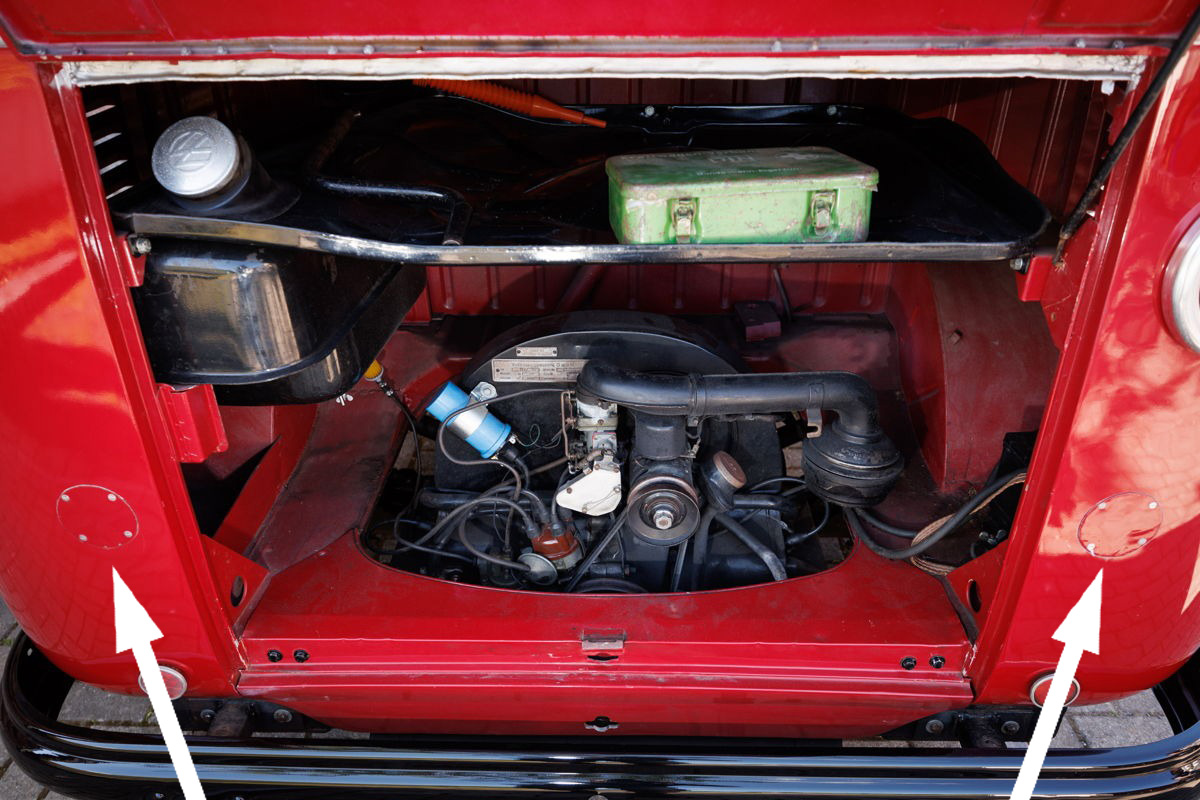
See what I mean there? The actual lights are blanked out. But on a mainstream production car? I can’t think of an example. I mean, a number of Euro-spec cars have blanked out side marker lamps in some silly ways, like these:
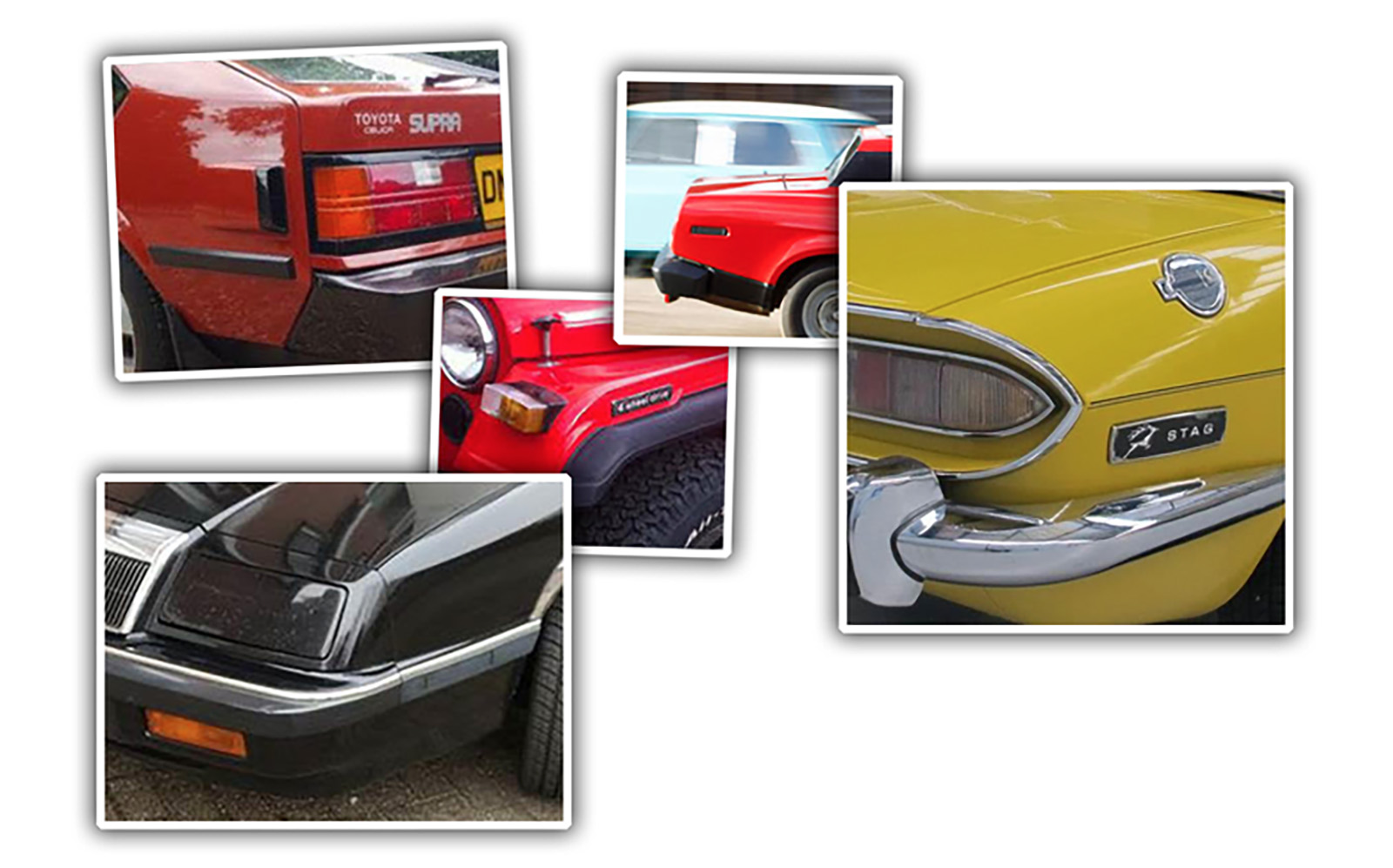
…but a full taillight blanked out? I’m drawing a, you know, blank.
Maybe I’m not thinking of something here, and if so, I’m hoping you’ll school me in the comments.
Until then, I think we may be looking at something strange and unique in taillight history; a taillight forcibly removed and relocated to a bumper, with its original dwelling place covered, guiltily, with a body-colored panel.
It’s sort of unsettling. No wonder everyone is acting so weird.
(Thanks for the tip, Dmanww!)


Can you reach out to Toyota to ask them? Automakers have answered weird questions from the Autopian before. You might just get lucky with Toyota.
JMHO, but the body-colored blanks look awful. It just seems like someone took a rattle can to the lights. Yes, out there on the corners they’re vulnerable, but honestly, how often do most Land Cruiser owners drive backwards through the jungle at speed?
We have 3 70 series Land Cruisers in my family. 2 of them are Canadian-market ones that are now relegated to parts car duties.
Only 1 of them has both taillights intact, and it’s the driver. All others were taken out by branches or stray rock chips. That is why Toyota did this. They finally realized that the place they were in for 40 years was too vulnerable.
The 40 series Land Cruiser had bumper-mounted units. They should have kept it that way the whole time.
Ill eat my shorts if the answer isnt either a. for multi-market lighting configurations without production line changes or b. Its just easier to do a blocking plate than it is to change the tub production.
I’m not sure if this might be some kind of way to limit illumination. Driving in areas during WWII 2 1/2 ton trucks had louvers on a secondary set of lights so soldiers could see them enough but we’re not showing from aircraft view. Maybe the other light could be turned off for hunting expedions so animals were not warned? My guess is a minimal lighting situation.
Somewhat unrelated: Here’s a link to a headlight sculpture in South Korea along the Cheonggyecheon. https://photos.app.goo.gl/iZVpJVxPNgoJFxWG8
But what’s under there?? The louvers imply that it’s hiding some kind of interior vent, but the shape makes me think it might be possible to actually install some lights.
That blinker fluid has to go somewhere.
Insert “aliens” guy gif saying “regulations”.
Nobody is gonna say it? “You can put your weed in it!”
Rear lights that wrap around the corners are more vulnerable than the ones recessed in the bumper, and much more expensive to replace. If the Landcruiser is being used as a Landcruiser should be used, and in areas where garages and supply chains are few and far between, say like on Safari’s in the Masai Mara, then using generic rear light assemblies that are much less expensive, as well as easier to procure from a part supplier in say Nairobi, and that will take up much less space in a Twin Otter luggage compartment, seems the sensible choice. And the smaller bumper mounted lights probably would not annoy the Cape Buffalo as much as the larger corned lights would. Do not piss off Cape Buffalo.
good point. For this vehicle’s use case the extra lights may be a net negative for the operator
I caught a fleeting glimpse
Out of the corner of my eye
I turned to look, but it was gone
Resist being comfortably numb
Democracy dies in darkness
The US spec 93 and 94 Landrover Defenders used an off the shelf bumper mounted taillight assembly similar to an Isuzu NPR, but kept simple marker lights in the normal locations. They did the same in front with bumper mounted turn signals. Then the 95 and 97 got larger diameter round lights in the normal places. US regs require a minimum size for some lights. The Sries Land Rover from 68-74 used noticeably larger turn signals compared UK spec too
In this strange warping of the space-time continuum, we see Jason Torchinsky stretch his taillights fetish to taildarks.
Seriously, I can’t imagine why anyone would bother to do this. The engineering for the lights is done, the lights are made. I think it might actually be more expensive, from a labor standpoint, to make the line assemble the cars without the lights as that would be a departure from the usual procedure.
There has to be a compelling reason from a dollars-and-cents point of view. That metal cover had to be designed and stamped and installed instead of the fully baked light that normally went there. How common a feature was this? And in what market?
Probably cheaper than updating/replacing the tooling for the quarter panel that includes the taillight cutout.
Correct and this is the right answer. The tooling or stamp for that quarter panel has been in use since the 70 series started.. through all front end changes, the rear quarter has been the same.. so they’ve paid for that tooling investment a thousand times over.. much cheaper to just design a cover.
But…why not just install the light? Why take the light off?
Maybe the better question, given that they are redundant, is why they were there in the first place and what’s changed to make them unnecessary? Dan G. makes a good point above that extra tail lights in the land cruisers native habitat just means more to break and replace, so why two sets of tailights to begin with? Looking at the origianl, 1985 LC 70, it has corner lights but not bumper lights. So a theory might be the bumper lights were added later due to a regulatory or safety research change, then the corner lights were deleted once the redundancy was noted. Or when some other regulatory change made the redundancy unnecessary.
The redundancy argument makes sense, but the removal from the corner instead of the bumper doesn’t.
I mean…it’s a bumper. If lights are going to get broken, you’d think they’d be in far more danger there than they were in the corner, where they are protected by – wait for it – a bumper.
Class 8 vocational trucks will sometimes mount the headlights in the bumper and leave the fiberglass uncut on the hood where the headlights usually go. It always looks weird.
I’d give an example, but unfortunately Google image search can’t find anything any more.
“6×6 bucket truck” found it. I knew instantly what you were talking about. https://cdn.ironpla.net/i/14085/903/1b5d3ba5-21e4-44e9-ab90-bbe22422651e.jpg
I mostly see it on cement trucks around here.
No, no. I don’t like that at all.
Jason did a piece on this a while back
The Datsun 180B (AKA Datsun 610 or Bluebird) in Australia had grey plastic blanking plates filling holes in the rear quarters where other markets had side repeater lights, but they also all came with little blanking caps to fill holes on the top of the front guards (fenders) where the Japanese versions had their wing mirrors.
The Suzuki RG250-WE1 2 stroke road bike as sold in Australia had the rear indicator lenses replaced with opaque black plastic versions covering the unused bulb holders, and indicators added to the rear fender that sat out on stalks – this was purely because the original locations were not spaced as widely apart as local regulations required. So the lights were actually there, but blanked off.
I was at the gathering at the abattoir. Nice place for a meeting until the conveyor belt took me down the corridor (in extreme comfort) towards the rotating knives.
youtube.com/watch?v=e2PyeXRwhCE
Sounds like a strange time, no matter which way you slice it…
*ducks*
Maybe it’s to accommodate some regulation to improve tail light visibility?
This is the answer – and not to improve, but to pass regulation. Notice how in many of the rear 3/4 views, the far side taillight is completely obscured by the spare tire. FMVSS states both lights need to be visible from 45 degrees cross-car, which the original configuration would not meet when equipped with the spare tire carrier.
Sure, it’s possible. But this vehicle has never been sold in the United States, and it sure won’t make it there now after being 40 years old and not passing nearly enough of the other safety rules to actually be saleable.
Toyota also makes chassis-cab versions, so this might just be a cost consolidation move. Why produce 2 different sets of taillights when every body style can now use the same ones?
It’s not for FMVSS, it’s for European ECE regs. Also see EUDM Daihatsu Rocky/Bertone Freeclimber models.
https://upload.wikimedia.org/wikipedia/commons/thumb/b/bb/1992_Bertone_Freeclimber_2_%283611211055%29.jpg/1920px-1992_Bertone_Freeclimber_2_%283611211055%29.jpg
As for why have both, I’m sure the Japanese designer who created the car with upright body-mounted lights didn’t consider the European market at the time, and when they realized they’d have to change them for homologation they went with a cheap bumper-mount that they wouldn’t want to ‘ruin’ JDM cars with.
The Suzuki Escudo (sold here as the Tracker / Sidekick) has a set of these and they are the strangest looking things, especially because in those the taillights are sculpted into the rear fenders a bit. They leave a little red reflector portion open.