


The Autopian writes about the BMW i3 a lot. That’s not terribly surprising, seeing as how our very own David Tracy has owned several. I don’t blame him; the i3 is an excellent vehicle that was way ahead of its time in the extended-range electric vehicle space.
Available either as a pure EV or with an optional ICE range extender, the i3 set the benchmark for weird, efficient city cars in America for nearly a decade. It looked unlike anything else on the road, and these days, thanks to the beauty of depreciation, you can pick up used, good-running examples from Facebook Marketplace for under $10,000.


That optional range-extender engine isn’t anything special—it’s essentially a two-cylinder motorcycle engine mounted under the trunk. The i3 could be optioned with it until it died in 2022. Hilariously, that means the i3—BMW’s first real foray into the electric car space—was the last production BMW to have a naturally aspirated engine.
Wait, Really?
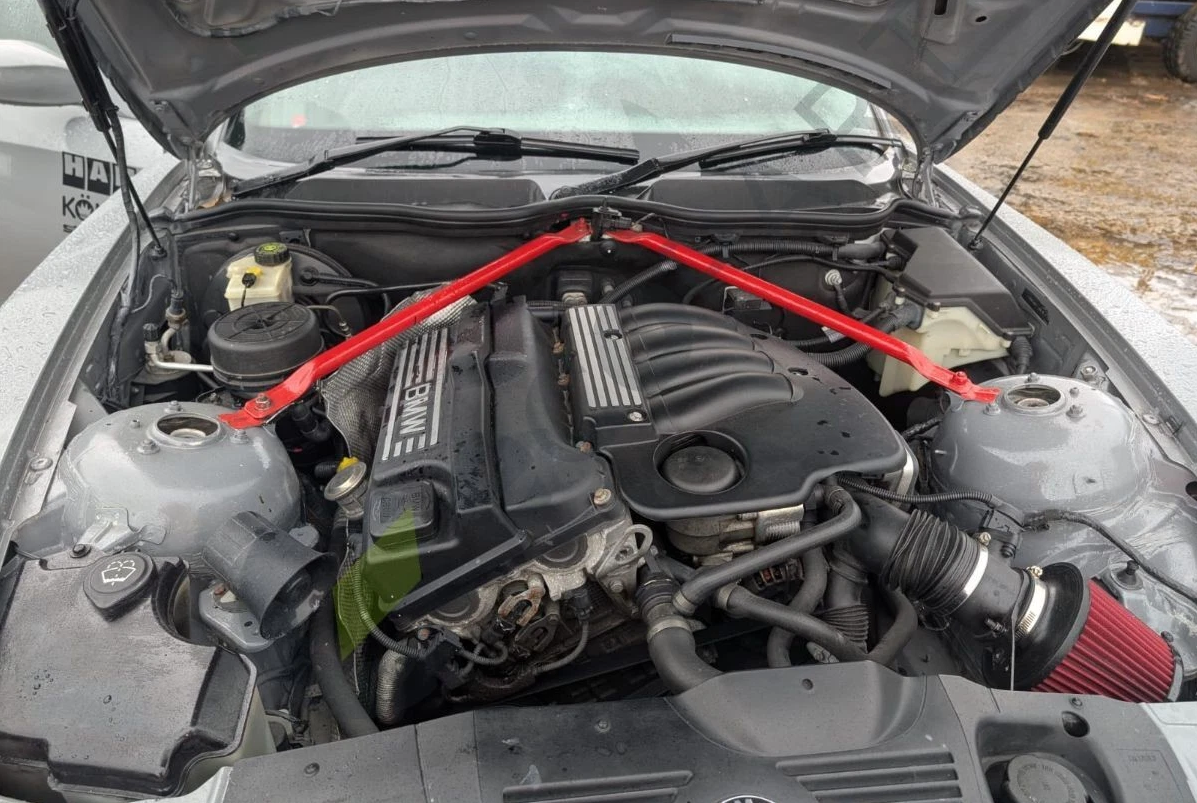
I first came across this piece of cursed knowledge while browsing my favorite Facebook Group, Oppositelock, where user Eric Wright pointed it out. When I first read it, I thought it couldn’t possibly be true. No way. I know the naturally aspirated inline-six, the N52 and N53, in the base-model 3- and 5-Series died in 2015. But surely there had to be a tiny naturally aspirated four-cylinder engine in Europe kicking around somewhere in BMW’s lineup.

It turns out there wasn’t. The 2.0-liter BMW N46 engine, a four-cylinder used in many of the company’s base models, was only used until 2015. After that, it was replaced by the N13, a 1.6-liter turbocharged four-cylinder borrowed from Mini.
Of course, if you want a BMW with anything bigger than six cylinders and no turbochargers, you’ll have to go even further back. The company’s last naturally aspirated V8, the S65, ended production in 2013 alongside the E9x-generation BMW M3. BMW made a V10, too, the S85, but that stopped production in 2010 when the E60-generation M5 and the E63-generation M6 went out of production. If you want a naturally aspirated V12, you have to go all the way back to 2008, with the E65-generation BMW 7 Series (though interestingly, Rolls-Royce used the same N/A V12 in the Phantom up until 2016).
The Ultimate Energy-Creation Machine
The funniest part about all of this is that the i3’s range extender is barely even a BMW engine. It was designed by BMW, sure, but it was manufactured by Kymco, a Taiwanese motorcycle builder that supplies BMW Motorrad with engines for motorcycles like the G450X, and for scooters like the C 650GT and the C 600 Sport.
According to InsideEVs, the i3’s range extender was, in fact, based on the C 650’s 647-cc parallel twin. In that application, it made 60 horsepower at 7500 rpm, but was limited to just 35 horsepower for use as a range extender (presumably, engineers wanted to keep the rpms down to cut noise, vibration, and harshness coming from the engine).

I’m almost positive BMW never realized the i3 was the last car it sold with a naturally aspirated engine. Otherwise, it might’ve done a run of special edition models towards the end of production in 2022 as a proper sendoff (at least, I hope it would’ve). Maybe one day the company will come out with some extreme, limited-production sports car with a naturally aspirated engine. But until then, the i3 will always have that extremely specific honor.
Top graphic image: DepositPhotos.com


If I’m not mistaken, the i3 shares its electric propulsion bits with the first gen Fiat 500e. Both cars were recipients of a ‘kit’ developed by Bosch to electrify cars. I don’t know how common or interchangeable any of it was. Short of a small sentence on the subject in +10 year old articles, there really isn’t much information on it.
BMW made its own motor in-house, but perhaps some of the electrical gubbins are off the shelf Bosch supplier stuff.
I’m guessing limiting the generator hp was for some emissions requirement. At least I hope so—the i3 can’t really sustain itself on the generator alone beyond 60-65mph and if you’re going up an incline, bad things happen. I think just about any i3 owner wishes there was a “boost” mode (don’t call it turbo…) and would happily take some added NVH . But that would also drain its 2 gallon tank faster. No free lunches I guess…
Used to know a guy who raved about his i3 and poo-poo’d my first generation Insight. Then I past him sitting by the roadside one morning. He’d drained the battery and was waiting for the little generator to get him charged up again. This was on the not-very-challenging roads of La Crosse WI. Seemed to me like a poor system that couldn’t keep the car moving while charging.
I haven’t had that happen (yet…) but have gotten limited to like 30-40mph climbing up a grade for a few miles. At least it kicks on before the battery is totally gone so you have some “buffer” to work with.
I think the problem is the use case: you usually only need the REx when you go on longer trips. And, when you’re on longer trips, you’re usually on the highway where the system struggles the most.
Just BimmerCode the Hold SoC feature, problem solved.
Yup that’s what I do. I’d argue the problem isn’t exactly “solved” given you have to a) wait until you are under 75% SoC before you can turn it on and b) remember to turn it on at the optimal time so don’t end up stopping for gas multiple times and arrive with a bunch of EV range left that you could have used.
It’s at best a clunky solution. If some engineering limitation or regulation made this the only solution, so be it. But if they limited the engine just for NVH, I think that was a bad choice. Like I said, just give the driver the option of a “boost” mode if and when they need it.
It’s even worse than just limiting the HP of the generator. In order to meet Californian regulations the petrol tank is deliberately tiny, so that the range using the APU is less than the range from the batteries. BMW even programmed the software not to use all the fuel in the tank. (There are ways around this)
Yup. It’s really something that they threaded the needle through all the CARB regs to make this work.
The world is full of unnoticed “lasts”. For example, I believe around 1967 or 1968 Dodge sold the last light-duty vehicle with a flathead engine (in the US), the Power Wagon. I don’t think many people paid attention to that, either.
Quick question does the range extender drive the wheels or recharge the battery? If running the wheels why? Wouldn’t having it kick on at say 75% charge and charging while driving work better? Then refuel and recharge and repeat?
It purely recharges the battery. It kicks on when the main battery gets down to 7% so there is some buffer for hills, passing, etc. In our i3, we have never had any issues with performance when the range extender was going. Biggest problem is that we almost never use it and the 2 gallons of gas in the tank may go bad so we have to run the charge down occassionally. Love that little car – blows all the jerks in their muscle cars off the line at the traffic lights!
Thank you for the information I have sorely neglected finding out about all the cars newer than mine
But my idea is probably better. Lol
Part is for compliance purposes—it’s not classified as an EV if the generator is running most of the time. I haven’t read the regs but my understanding is that they really want these things as only an occasional use/emergency use option and not for everyday driving. Hence the tiny gas tank and software that does not allow you to hold SoC (which is easy and popular to reprogram). It also doesn’t really “charge” the battery so much as match the load. Like if you run on the Rex, it still shuts down at stoplights. If it kicks on at 7%, you’ll end your trip at (approx) 7% even if it had the capacity to put more juice in the battery.
Well, let’s look at why forced induction engines exist:
Their purpose is for more power and greater efficiency from a small motor.
The ICE range extender of an EV has more in common with a home generator than an ICE engine which is used for propulsion – the former does not need more power or more efficiency. It just needs to keep the dynamo spinning at an optimal rate to generate electricity.
Which is why a little 2 cylinder is just fine.
Because force-feeding a generator would be dumb.
Much as I love my pair of I6 n/a BMWs, reality is the turbo 4 is better in every way but how it sounds (ignoring the timing chain issues in the early ones). Makes a LOT more power and torque, more efficient, more compact. Saab had it right all those years ago. But that said, especially in my 328! wagon when paired with the BMW Performance Intake and Exhaust, the N52 sings Wagner in a way that the fours will never, ever, ever be able to do, while being smoother than a baby’s butt right to the 7K redline. It sounds faster, which is better than being faster.
The emissions-hobbled N51 in my 128i isn’t QUITE as good, but it’s still a lovely thing too.
I like the N52, too. We have one in our ’08 X3 3.0si. I believe that iteration is the highest power regular production (i.e. non-SXX) NA 6 cylinder BMW ever produced at 268bhp.
Nope – North America never got the highest output version, which had direct-injection and 275hp.That is the N53.
I was unaware of the N53. All the data I can find show for their hottest configurations as:
N52 200 kW (268 bhp)
N53 200 kW (272 PS)
They both went out of production in 2013. So it sounds like we have a tie.
Yes, that was the end for all variations of the n/a N5X unfortunately. The turbo N55 went on for a few more years until the BXX engines replaced those too.
Turbocharged generators are actually pretty common – because a lot of backup generators run off of natural gas, which isn’t very power-dense. Generac uses a big-block Chevy V8, enlarged to 9.0 liters, and turbocharged for their 150kW standby generators. Sure, a larger displacement engine would probably work just as good, if not better, but, sometimes you’ve got to make what you have work.
It’s not the energy density of natural gas. To get that 150kW its burning 57.8 cubic meters of gas per hour.
https://www.generac.com/industrial-products/stationary-generators/150kw-industrial-generator-9-0l-mg150-9-0/
By my simple maths that is 642 kW at perfect conversion efficiency putting the efficiency of this generator at ~23%; typical for an older ICE but frankly is terrible by modern automotive hybrid standards. They could probably do much better with a pair of Prius engines, a modern aviation turbine or far better yet a SoFC from Bloom Energy.
That said this is intended for once in a blue moon emergencies so minimal cost and fast, reliable startup probably matter over efficiency. And perhaps cogen heat too.
I think power density and efficiency is kind of a big deal for a range extender. A tiny engine with a big turbo might be just the thing. At a constant speed and load turbo lag is irrelevant. I was looking at a power unit at a trade show that was a tiny engine with a big turbo, and the sales rep said that really you should think of it as a turbine engine with a reciprocating engine embedded in it to attach a power output shaft to.
I’d like to see a free piston generator sometime.
i could see them making a naturally aspirated car again in the future you never know .
Guess that W in BMW must stand for whimper.
Isn’t it ironic.
Don’tcha think?
Don’t you think?
It’s like Ms on your base model cars
It had free heated seats now you have to subscribe
It’s the early M3 that you just didn’t buy
And who would have thought,
It figures…
Don’t the auto manufacturers realize how poorly the subscription model worked for magazines and newspapers?
You win the Internet today. Bravo!
Well at least you have your boring SUV.
That I do, and it’s a Toyota, so I’m stuck with it until the Sun collapses into a Supernova. But at least in the meantime I have… (whispers it on a car website) my motorbikes to have fun with
You don’t need to whisper! Anything that moves (including tower cranes apparently) is celebrated here.
You really don’t need to whisper such things. Here, let me show you:
I HAVE FOURTEEN BICYCLES!! FOR *ReAsOnS*!!
See? All good.
*notes dim, flickering light of torches on the horizon*
Oops, gotta go!