

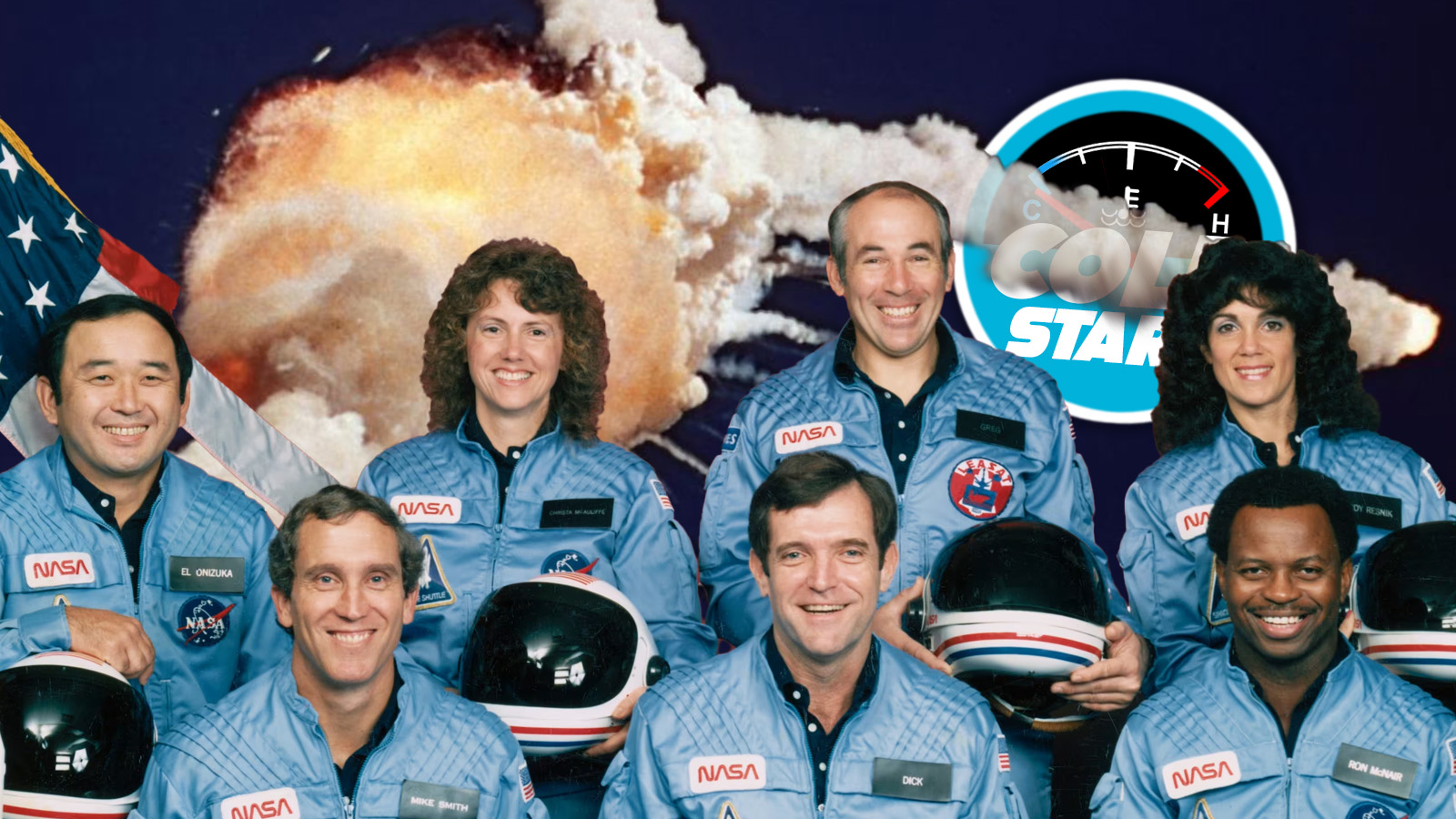
Like many of my generation, I watched the space shuttle Challenger explode on live television, while I was at school. I remember it very well, because I was a colossal space geek as a kid, and still am, as a kid well into his 50s. I was excited because it was unusual to watch a space launch in school in 1986 – the Space Shuttle program, while never coming close to reaching its predicted launch schedule of 50 or more flights per year, nevertheless proved capable of launching more frequent crewed space missions than ever before, with a peak just the year prior to the disaster of nine missions. Watching space shuttles climb that tower of flame and smoke into space had become almost routine. Maybe not “almost”; I think for most people a shuttle launch barely registered as news anymore. But this time there was a teacher aboard, so all of the schools paid attention.
The inclusion of that teacher was a huge deal; I remember the search that led to the selection of Christa McAuliffe, but more importantly I remember how it felt knowing that this was a real, normal person going up on that shuttle. She was just a teacher! I knew what teachers were like, I saw them get flustered and chain smoke in the teacher’s lounge and look exhausted and exasperated by me an all my fellow idiot kids – these were not superhumans, like I imagined astronauts to be, or at least DeLuxe-trim-level humans. They were people, and seeing a normal, bright but likely flawed person go on the shuttle really made it feel like things were changing, and soon space travel would be something we could all aspire to.


Of course, that’s not how it played out. I remember that I was in art class, which I loved, and I remember the big CRT television cart getting wheeled into the room so everyone could watch. I’d seen shuttle launches many times, and had memorized the diagrams and charts that were published in National Geographic, so I eagerly awaited each expected stage of the launch – the three main engines on the orbiter firing first, making their smokeless cones of barely-visible exhaust flame, then the massive bursts from the pair of solid rocket boosters mounted to each side, each one belching out huge columns of white clouds as they flung the whole shuttle stack into the sky, and then finally the two spent boosters ejecting, leaving the orbiter and its big orange fuel tank to continue ascending alone, until the cameras could no longer see it.
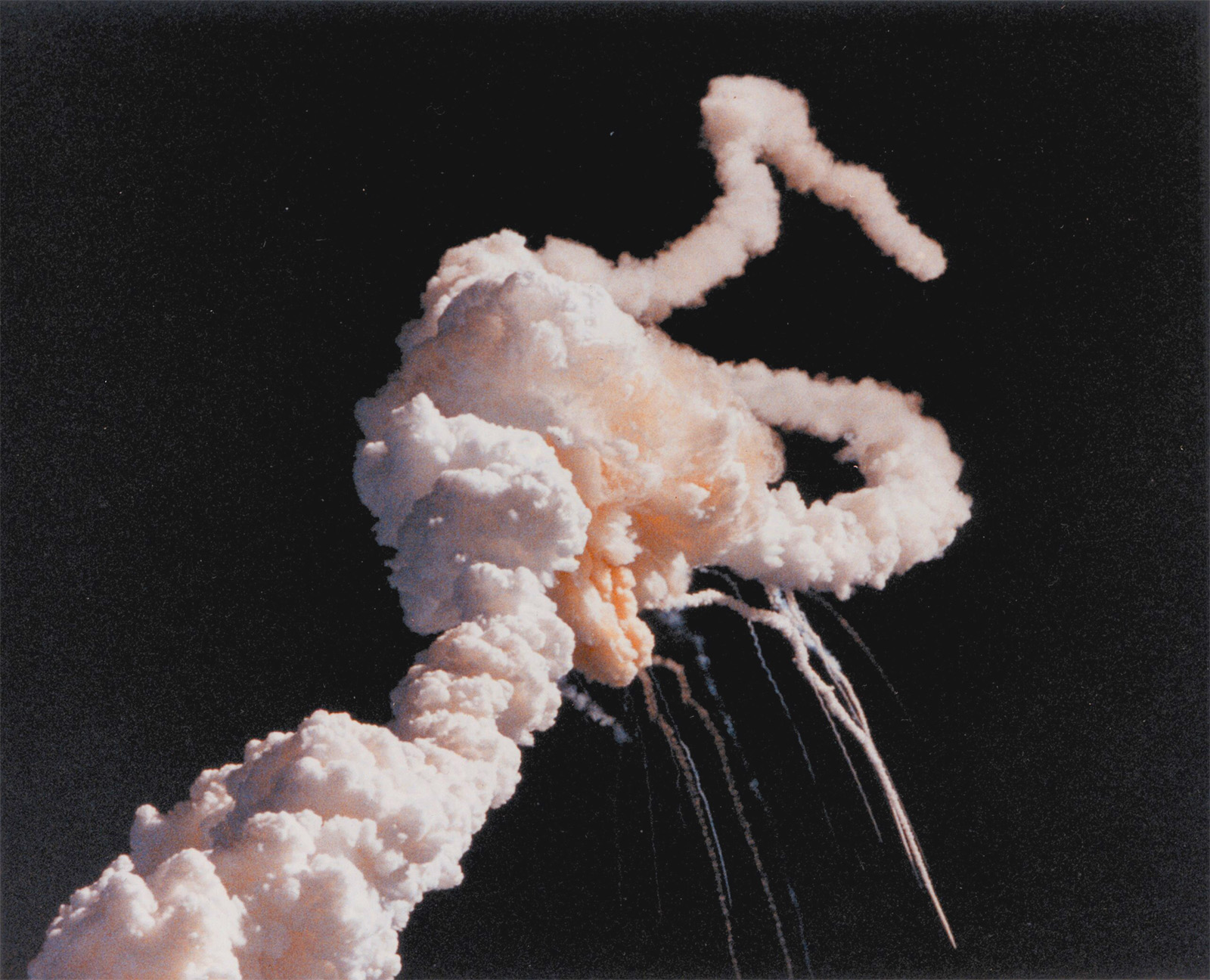
What I expected was not what I got, of course, and as soon as I saw that big ball of cloudy smoke and the two boosters careening around wildly and uncontrolled, I knew something was off. I remember that strange numb feeling for a few seconds while everyone was trying to figure out what the hell was going on, the announcers on the TV seeming confused, and most of my classmates pretty oblivious. That moment seemed like a very long time, but it wasn’t.
The realization of what happened soon came, both to the voices coming from the television and in our messy art room, with its big tables and stacks of pastels and paper and clay, student’s artwork of wildly varying quality lining shelves all around. There wasn’t a big uproar in the class, just a sort of sudden hush, like a huge tarp had been thrown over everyone as we all shared a moment of realization that, sometimes, no matter how well planned, no matter how smart the people in charge are, shit goes bad.
I think to appreciate the widespread impact of the Challenger disaster, you have to remember how much the whole thing was built up, and how hard a fall it was. The shuttle program was a huge success and a huge source of pride for America. These were the first actually re-usable spacecraft (though some in the program described them more as re-salvaged, due to all of the maintenance they required) and they were so much larger and more impressive than the dinky gumdrop capsules that came before.

We’d been launching them with seeming ease many times a year, and had gotten to the point where NASA felt confident enough to send up that teacher, to great publicity; the disaster couldn’t have happened at better moment, if the goal was to remind humanity about the concept of hubris. I feel like for those of us that saw it, there was one big common takeaway, even beyond the expected feelings of loss and tragedy about those seven people whose lives were ended that day. To some degree, they knew there were risks, and they willingly took those risks to do something they genuinely loved and believed in. That doesn’t make what happened less tragic, but it makes it a little easier to understand.
No, I think the more unexpected lesson that we learned then is that, to some degree, we’re all winging it. The people we trust in positions of authorities are still people, flawed people, and they make mistakes and are as susceptible to being influenced by the wrong things as any of us. I think there’s some seeds of the strains of mistrust of authority and expertise that many of us feel today, rationally or otherwise. And I also think once the initial shock and sadness filtered away, we were left with a good bit of cynicism. I remember that just a few days after the tragedy, gallows humor jokes about it were already spreading around the lunchroom. I’m pretty sure it was later that week when I first heard a kid ask “Why does NASA only serve Sprite on the space shuttle? Because they can’t get 7-Up!”
I mean, it’s a well-crafted joke, and gallows humor is always a part of dealing with a tragedy, but there is darkness beneath it, and I think we’re still dealing with some of those repercussions.
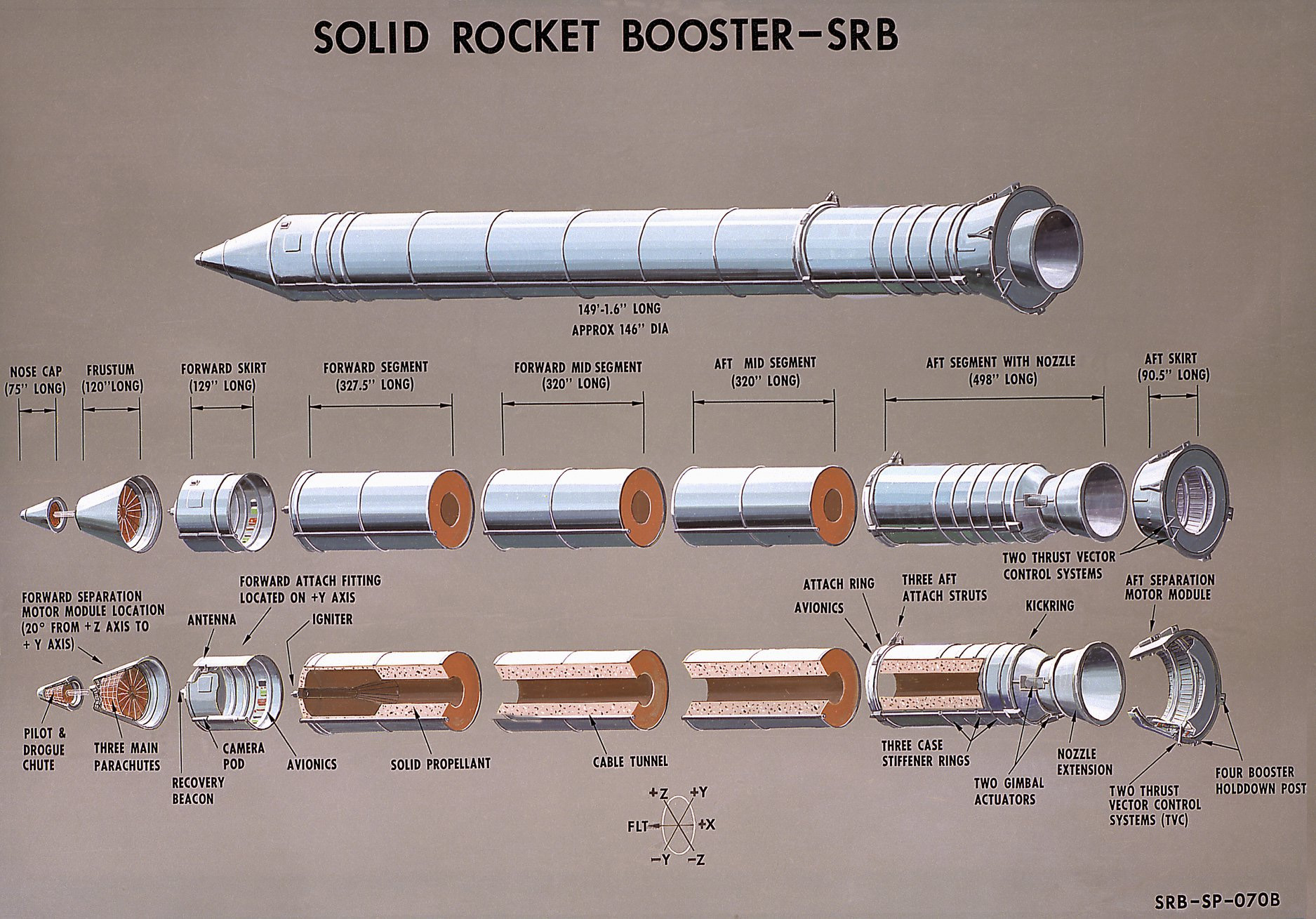
The reason the disaster happened was because of what seems like a small detail in the construction of the solid rocket boosters (SRB). The boosters were pretty remarkable machines – the largest solid rockets ever built, designed to be reused, and were constructed in several segments. The interfaces between those segments were more complex than you may realize, and relied on some rubber O-rings (can there be any type of ring other than an “O?”) to keep things sealed even while things were expanding and contracting based on thermal loads.
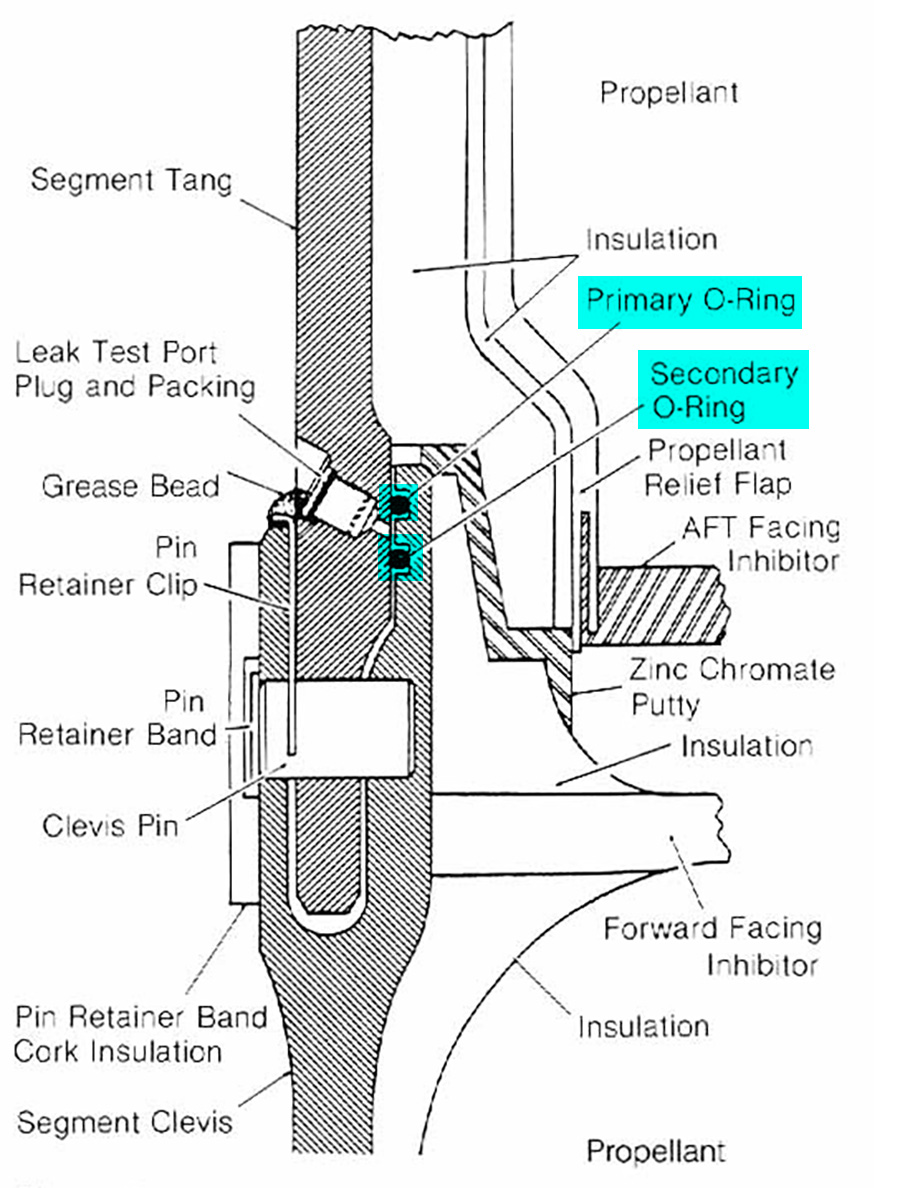
NASA and Morton Thiokol (who built the SRBs) were aware that these rings that sealed the joints in the SRB segments could have issues properly sealing due to loss of elasticity at low temperatures since the 1970s, but the issues were never thought to be particularly severe. NASA had observed these joint seals venting soot on other missions without further incident, and took this as proof that the issue was one that could be tolerated, instead of a symptom of something larger.
On the day of the launch, ambient temperatures were as low as 18 °F; the previously coldest shuttle launch had temperatures above 50°, and Morton Thiokol engineers actually expressed concerns to NASA about the elasticity of the O-rings at those temperatures before the launch, and were only confident in launching in temperatures 51° or higher; NASA managers didn’t accept these concerns as valid, and questioned if they expected the launch to be delayed until April.
The inability of these rubber O-rings to seal the segments caused plumes of hot gases to escape, which melted through the external fuel tank, causing it to break apart, and, from there, the entire assembly to be destroyed, crewed orbiter and all.
Famous physicist Richard Feynman demonstrated what happened to these O-rings very dramatically during one of the hearings about the disaster. He arranged to get a sample O-ring and place it in a clamp, then placed that into a glass of ice water, bringing the O-ring down to 32° F. He was then able to show, right there, that the frozen O-ring lost most of its elasticity and ability to return to its original shape at those low temperatures:
I think most of us know all of this by now; it’s been 40 years, after all. But I think it’s worth remembering, to honor the brave explorers who happily climbed into that delta-winged flying brick strapped to a massive column of fuel and two colossal firecrackers with only the goals of learning more about our universe, and how we can figure out how to explore it further, but also to remember that sometimes even the smartest people, the ones who actually make amazing things happen, make mistakes.
Sometimes huge mistakes. But that doesn’t diminish what they accomplish; if anything, it makes every success more impressive. The Challenger Disaster was a tragedy, but I do think we learned something. Some very specific things about solid rocket boosters of course – evolved versions of these same boosters are used on the new Space Launch System (SLS) rocket that will be sending people around the moon in a few months – but also something about, I don’t know, confidence? Over confidence?
Everything is so complicated. A bit of cold weather is what caused the failure of one of the most complex and carefully-engineered machines in all of human history. Everything is connected, every little thing affects every other little thing and on and on in a cascade of cause and effect that makes you dizzy. And yet somehow, we manage to pull things off, anyway.
We grope, we take risks, we fail, we try again. Seeing this disaster happen was sobering and shattered some illusions, but maybe those illusions were ones that should be shattered. Maybe we should have hope in things and people and ability, but not a blind hope. Maybe knowing that things can go wrong, horribly wrong, is a reality we should all keep in the back of our minds, and find a way to know it’s there and keep going anyway.
I’m not entirely sure of how the Challenger Disaster affected me or the so many others who saw it, but I know it did, somehow. I just hope I figure out how to turn it into something that honors those who died, and makes us better or smarter or something. At least not worse.



Around 1980, Ms. McAuliffe was my English teacher. In 1985, she was my wife’s Social Studies teacher. (We were not married at the time.)
I had flown from SoCal to Colorado and interviewed for a position working on a secure communication system for the shuttle just a few days before the Challenger tragedy.
The interview went extremely well. I was given a verbal offer and told that I would be receiving a formal offer in a few days.
Instead I received a letter telling me that for obvious reasons their programs related to the shuttle program were on indefinite hold.
I wound up moving to Oregon a few months later. One of the best reminders for me that “time and chance happen to all.”
We followed this mission pretty closely in my house as my Dad had applied for the Teacher in Space program and gotten fairly far into the process before bowing out. I was home sick with the flu so my folks brought the TV into my room so I could watch the space launch.
I recall being very confused after seeing the explosion as were my parents and then after an agonizing silence, my dad switched off the TV, went out into the hallway to confer with my Mom and came back into the room to explain to me what happened.
40 years as an engineer and the one thing I’ve learned is that a great engineer isn’t perfect, they’re just good at catching mistakes and correcting them before they fail in service. I’ve also learned how many tiny things come together to make any huge accomplishment and how amazing it is that so many of those tiny things succeed.
We have to learn from failure and respect those people who push the odds and risk their lives to help us do that.
I recently watched the Netflix documentary on the disaster, Final Flight. It’s worth checking out. Very sobering.
I was 6, just got out of the bath to watch the launch. Devastated when it happened. Met one of the launch safety engineers a decade ago, became good friends. Heard some very rough stories of this incident.
I was not born yet when this happened but one of the teachers at my high school was a finalist to be on that mission
I too watched it live in school. Sophomore year of high school.
And to make it more personal, one of my mother’s 1st cousins, a teacher in my hometown school system and my 6th grade science teacher (a great guy and a great teacher – and a car guy!) was one of the runner ups in the “teacher in space” program. It very nearly was HIM on that shuttle. Sadly, he died of cancer at age 79 in late 2020, which I found out just today as the anniversary caused me to Google him. I had no idea – there was no service due to the pandemic (sadly the usual way my family gets together). Sadly all the relatives connecting us have passed.
The first of the two big shocks watched live on TV in my life. I happened to call into my office from my hotel before going onsite after the first plane hit the WTC. My boss told me to turn on the TV, which I did just as the second airplane hit. I was in far northern WI – what a surreal day and week that was. Especially as the motel filled up with Canadians stranded by the closed border.
I was 10 years old in 5th grade in Delray Beach, Florida, which is about 170 miles South of Cape Canaveral. Even in South Florida we set a record low that morning of 31 degrees. It was a perfectly clear day because of that cold.
I was a HUGE space nerd at the time and was watching the launch from the school library.
I knew that the Shuttle would be visible at my location at around a minute post launch. It needed enough altitude to compensate for the curvature of the earth and for trees and buildings.
After about 1 minute after launch I ran outside so that I could see the rocket in the sky. I looked, and looked and couldn’t see it. I was confused. I knew where due North was and I didn’t see it. I ran back inside and saw the picture shown above of the askew boosters. I was confused. I was hoping that the shuttle had aborted and was gliding back to Earth. They showed the replay. I knew what happened instantly.
I was in shock. I was gutted. I wanted to work for NASA at that point in my life. Just utter devastation for me, personally.
That night I remember watching the news and crying. My mom hugged me and tried to console me.
I eventually went to go take shower and cried in the shower for what seemed like an hour. I couldn’t stop thinking about the crew.
That day has always stuck with me.
Rest in peace, crew.
I heard about it making a phone call home from a phone box outside Kensington Gardens near the Albert Memorial. My oldest brother, who knew I was a massive space exploration fan, told me like he was informing me of a death in the family.
I absolutely recommend this BBC podcast, and the whole 13 Minutes series.
I was on a co-op job posting at a manufacturing plant assisting in setting up CAD/CAM/CAE systems. I want out for lunch and caught the launch and disaster on a bank of televisions in an tv store window. Watching it was heartbreaking.
When I returned to uni, several profs used it as an example of complex systems failures. A bunch of us started attending Feynman lectures put on by the Physics dept when he solved the oring problem.
I still watch the lectures on utube when I get a chance. I’ve read several of his books as welll and highly recommend them all.
I read the reports on both Challenger and Columbia disasters. Dry but interesting reads.
I get exasperated at managers and technical people who are willing to toss testing over the side to make up for schedule slippage. Too many projects fail out or die due to these kind of decisions.
What has always maddened me (and still does) is how carelessly obvious system failures and their resulting close calls are written-off by thinking it’s apparently not that big a problem. No, it just hasn’t failed in the right way YET…
I used to work as a QA in a depot supporting aircraft maintenance and it’s shocking how nonchalant people (generally in management) still are about systemic failures.
When I worked for telecoms manufacturing (SW and HW) they took it seriously. Too many others didn’t IMO.
Too often they’d only be concerned with when they can get back to production, production of questionable components…
Probably more true today than in the 80’s and 90’s. Most commercial and business SW I’ve worked on over the last 25 years has been poorly implemented and was minimally tested. I blame Microsoft because I can.
My science teacher at the time was among the candidates to be the teacher on that mission. As in had made it through several rounds of the process. It was common knowledge in the school and she was on leave for a bit after and I think a lot of that was middle school age kids making inappropriate jokes.
I was working at a lab that was staffed mostly by ex-Aerojet chemists back when the first shuttle launched. They had all worked on the Apollo rockets and were still huge fans of NASA. The day that first shuttle touched down, the president of the company brought in a TV so we could all watch it. I remember being in the conference room with those guys and seeing how tense they were as it came in and how incredibly proud and happy they were when it came to a safe stop on the runway. Those guys had a much better understanding of the risks of those things than I did, and that never connected with me until the Challenger disaster. It brought home the fact that these really were wildly complex systems, and it only took one small failure to make it all a fiery death trap. It was an absolutely horrifying thing to see, and it was just as bad every time it was replayed on the news. The fact that there was a regular person onboard who had classes full of kids who knew her well and who had to see that happen just compounds the heartbreak.
I once watched a documentary on the space program (I’m sorry, I can’t remember the name but it was very good) where they claimed (and I’m heavily paraphrasing) that the primary reason the US beat Russia to the moon was the relative simplicity of the Saturn V (11 engines) compared to the N1 (42 engines). Basically, the N1 just had too many critical parts where any failure would be catastrophic and no realistic quality rate could overcome the numbers. They were simply rolling the dice too many times to where snake-eyes were a near statistical certainty.