


This morning I’m tanking my neighborhood’s property values with a crusty Jeep J10 on jack stands. I’m in the process of servicing the rear brakes prior to shipping the vehicle to Michigan, where I plan to sell it. Anyway, this “servicing” involves me not just replacing the brake shoes and hardware, but also repairing the wheel cylinders, which brings me to something that always blows my mind when I think about it: Cars before 1967 were absolute deathtraps. And not just because they weren’t designed for crashes, but because their brake design made crashes seemingly inevitable.
My Jeep J10’s rear brakes haven’t worked in months, and the reason is pretty obvious to anyone who steps on the pedal. The pedal feels soft and spongy instead of hard and firm, and one peek into the brake master cylinder shows: The rear reservoir is almost bone-dry.


Check it out:
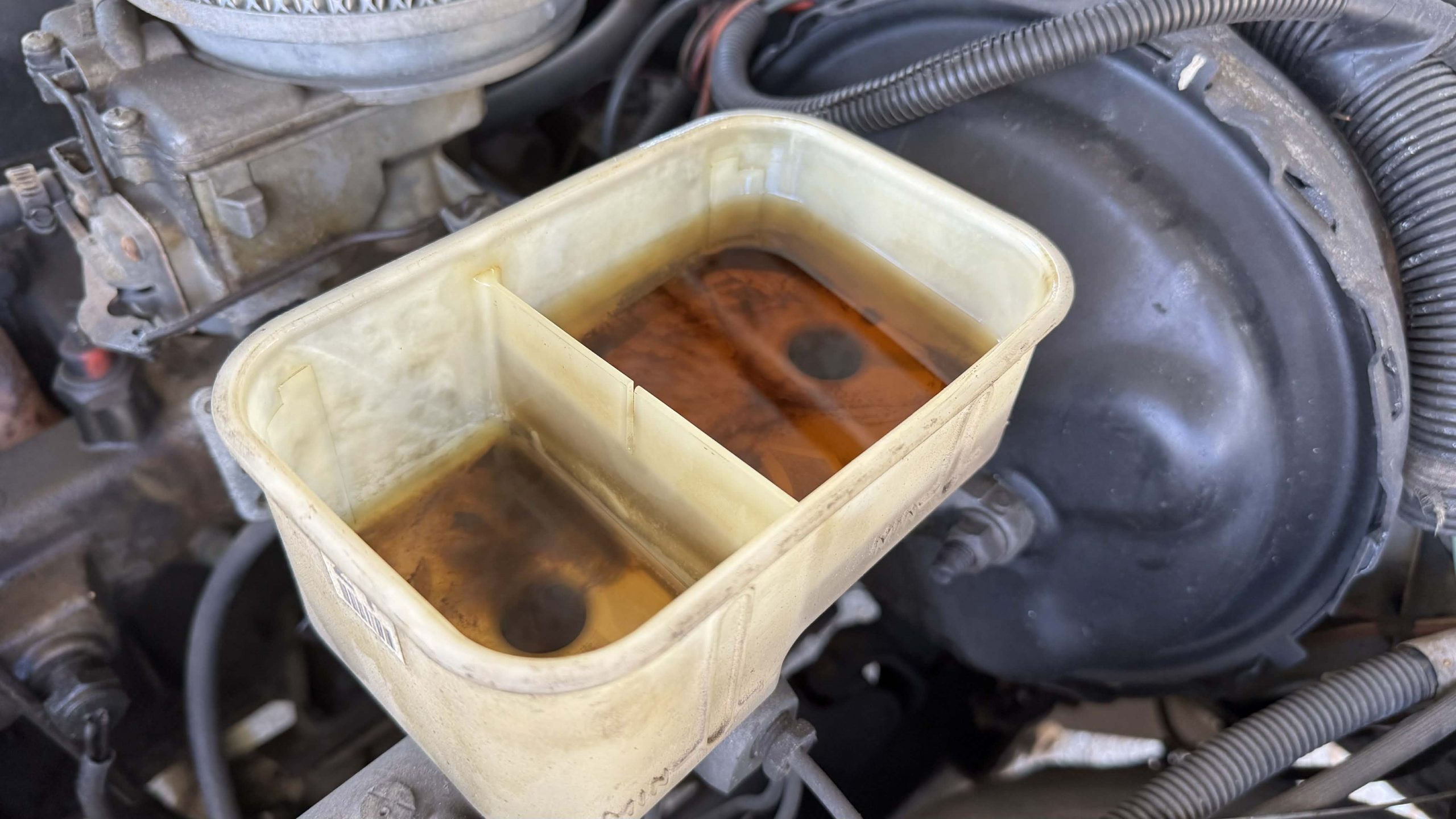
In other words, the fluid that my foot is supposed to push through the brake lines and hoses in order to activate the rear brakes has leaked out onto the roadway. This means I have absolutely no rear brakes.
Drum Brakes
Before I go into what the root cause is, I just want to briefly explain how drum brakes work. Instead of brake fluid coming into a caliper like this…


…and pushing a piston (or multiple pistons) against some brake pads so as to squeeze them against a disc like this…
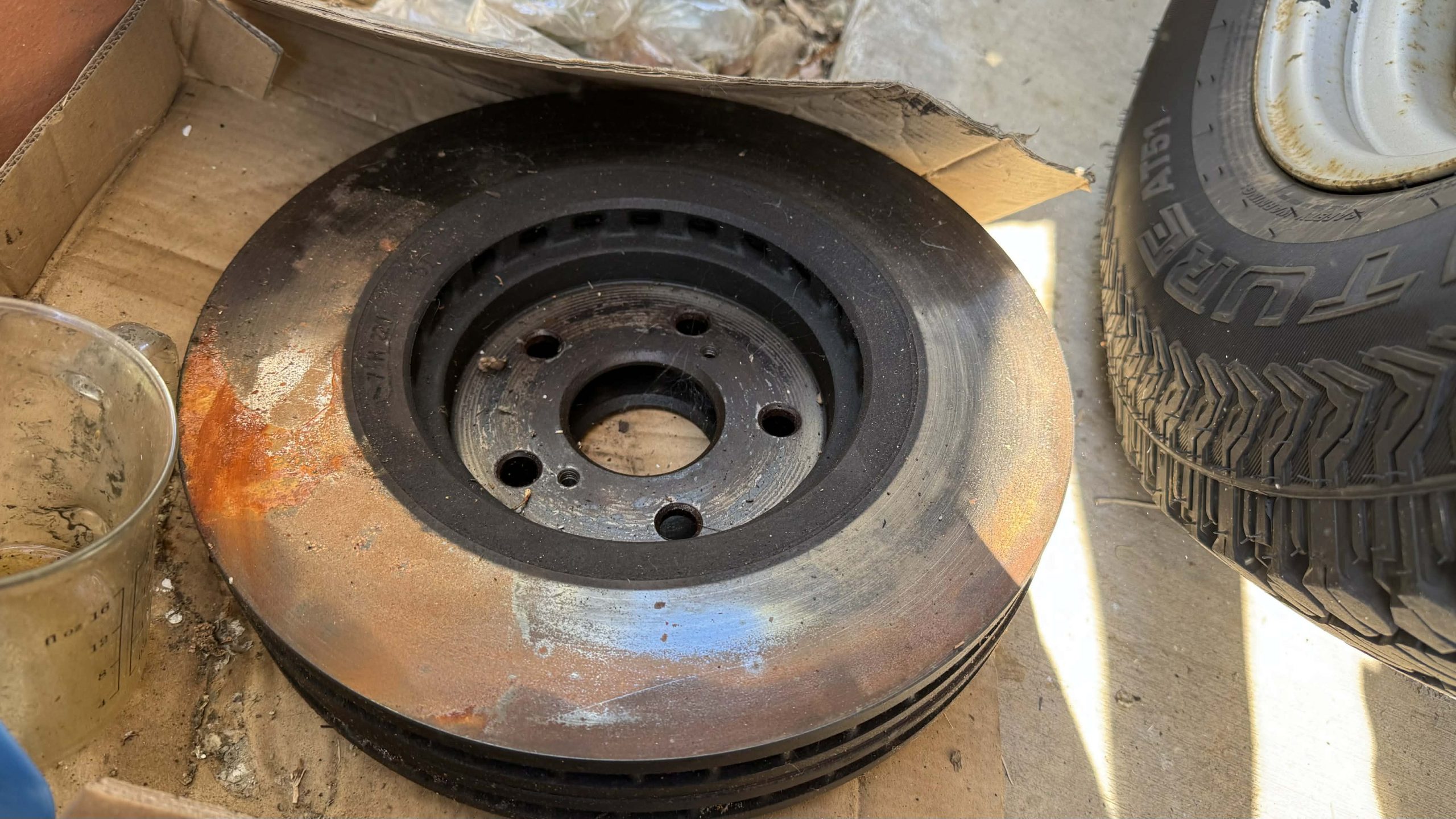
…drum brakes use a small wheel cylinder to “spread” some brake shoes against a spinning metal drum. A wheel cylinder is an extremely simple device containing two pistons — one on each end of, essentially, a smooth pipe (cylinder). Basically, fluid comes in from a brake line through this hole:

It enters the wheel cylinder at the center and pushes two pistons outward.
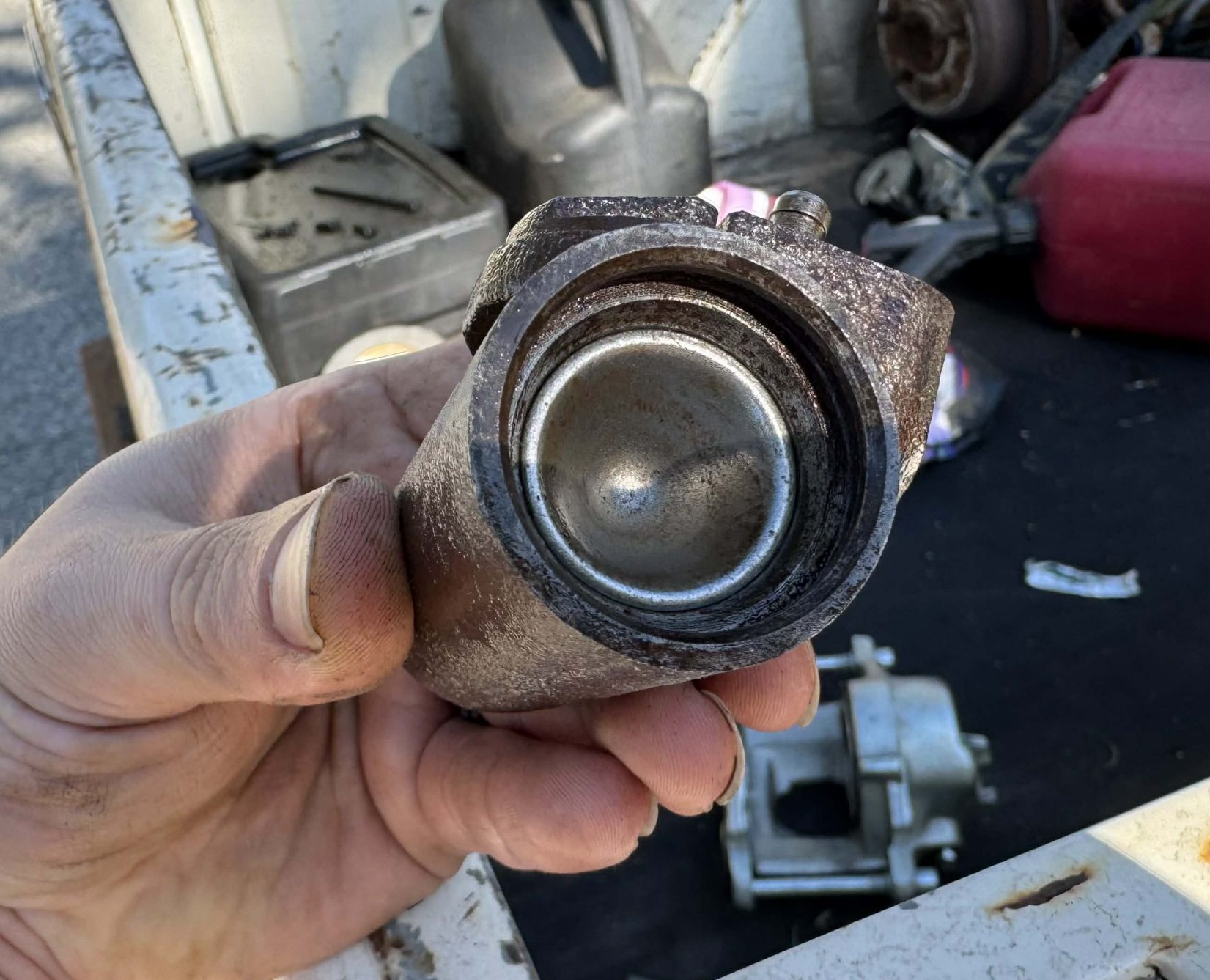
You can see the metal piston above and both of them (which each get a rubber inboard seal, with a spring between the two seals — and each piston gets a rubber outboard dust seal as well) in the image below:

The pistons moving outward spread brake shoes like these (the arrows are pointing to the brake shoe “liners” i.e. friction material)…

…against a drum like this:
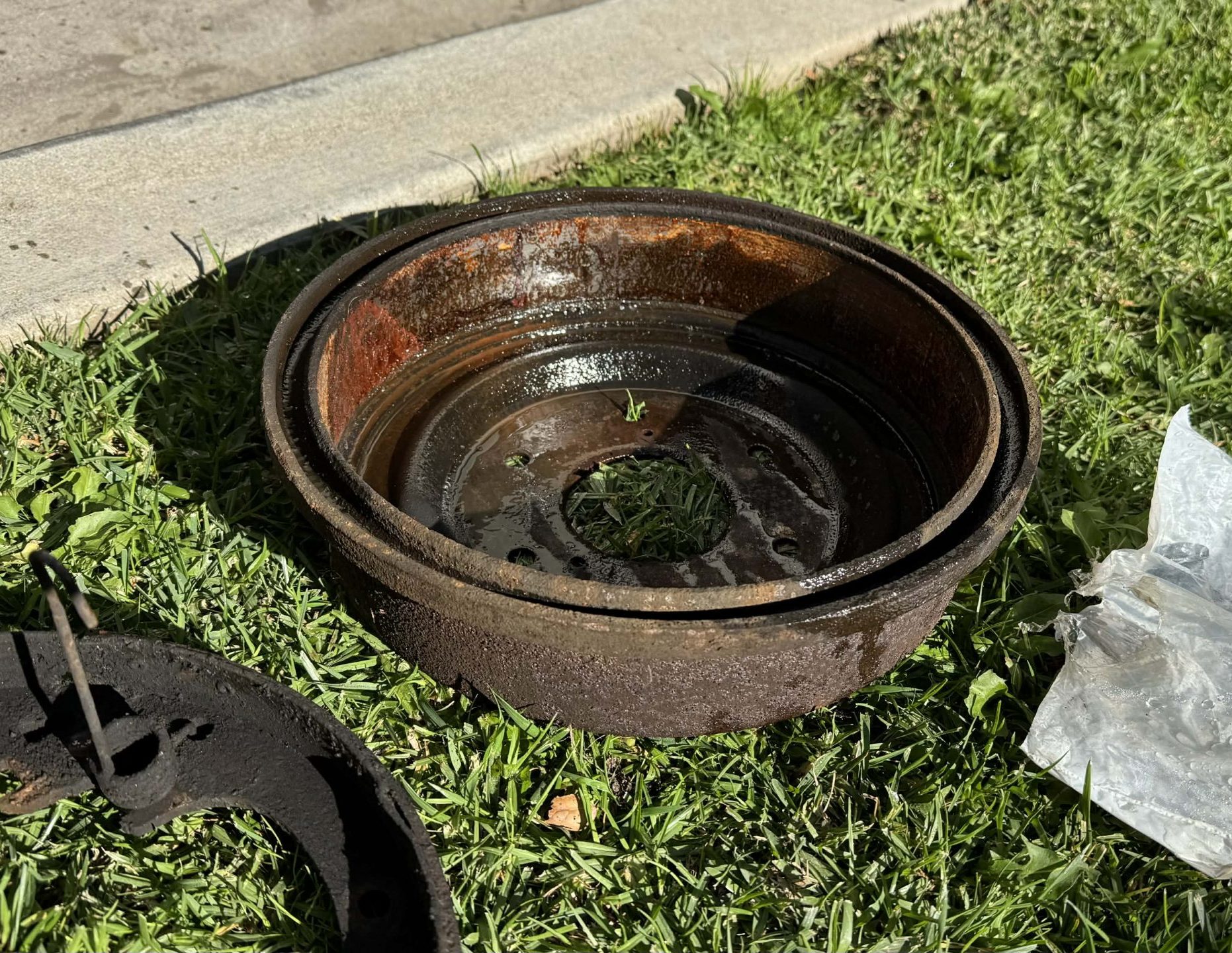
That drum has holes in it for the vehicle’s lug studs to which the wheels are fastened. Therefore, stopping the drum means stopping the wheels from spinning, thus stopping the car.
Drum Brake Systems Are Prone To Failure If Not Maintained
Anyway, with that out of the way, I want to point out what’s causing my Jeep J10’s brakes to fail, as it’s something I’ve experienced numerous times on older vehicles. Vehicles with drum brakes feature what’s called a brake adjuster crew. This is usually located on the bottom of the drum brake assembly, between the bottoms of the brake shoes. Here you can see it clearly:
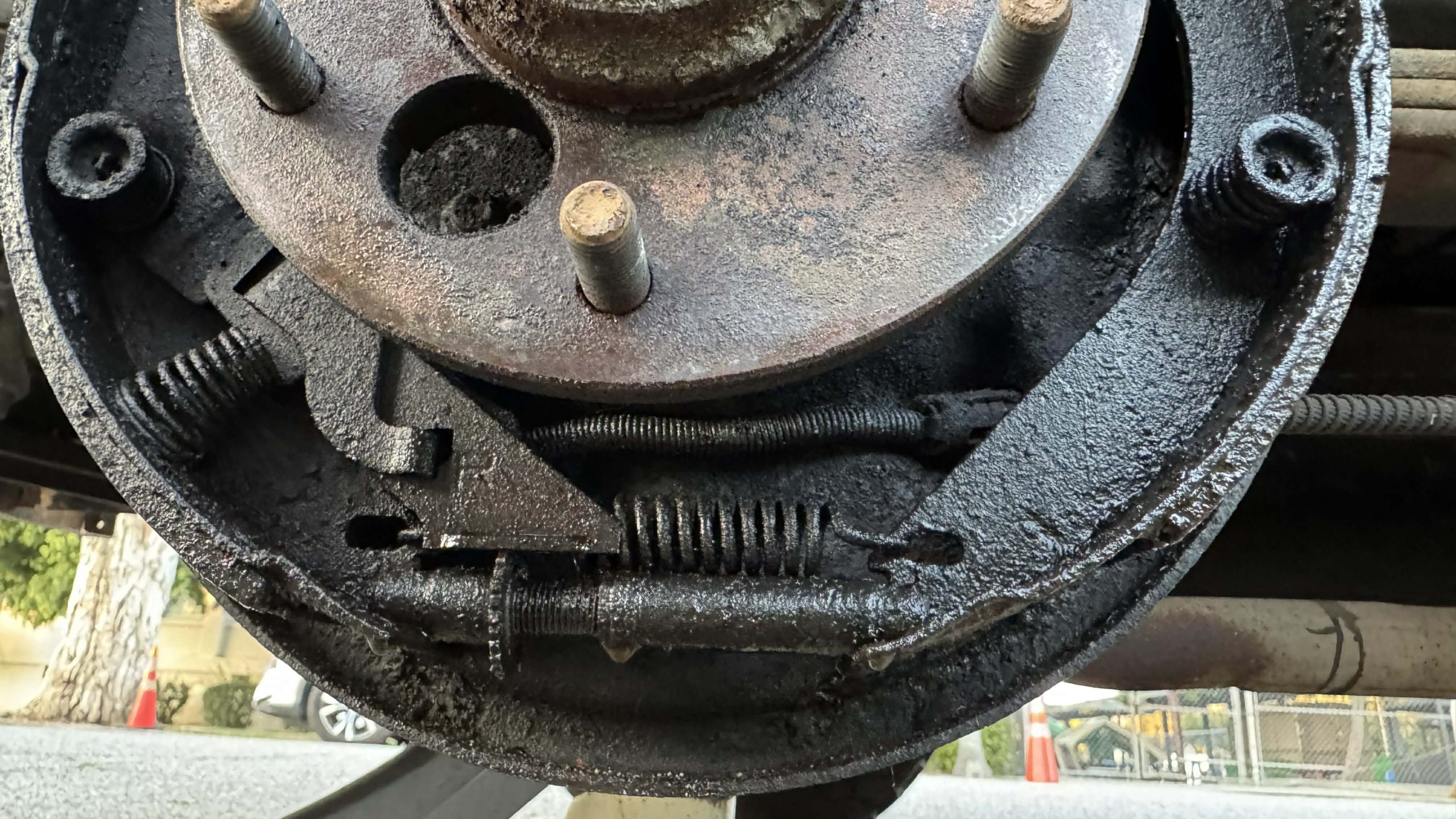
The brake adjuster screw’s job is to compensate for the wear of the brake shoes themselves as their material turns to dust during stops. The shoes become thinner, and the adjusters push the bottoms of the shoes outboard a bit more to compensate so that brake material is right up against the drum when the driver is not on the brake, that way those shoes can make healthy contact with the metal brake drums.
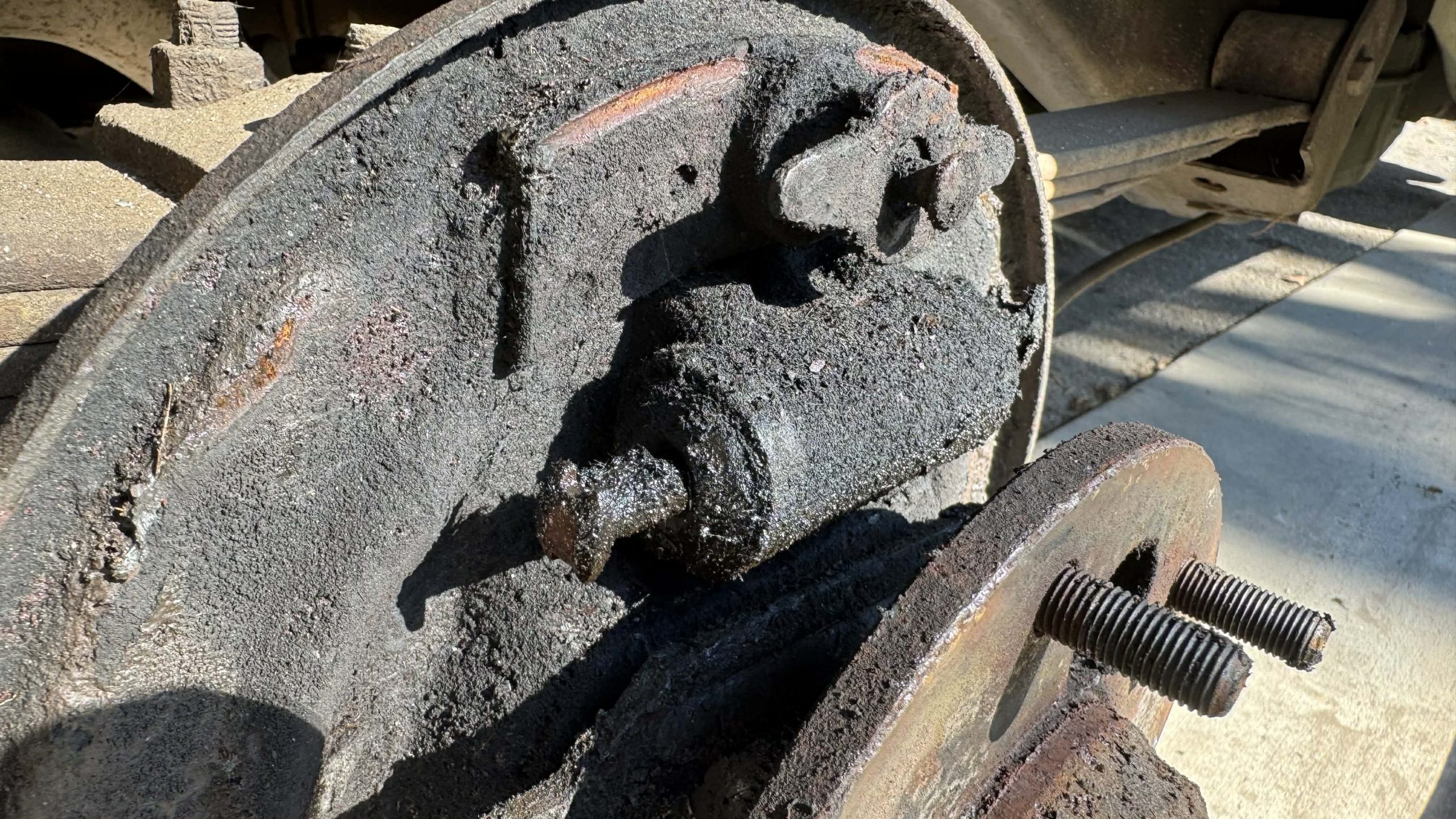
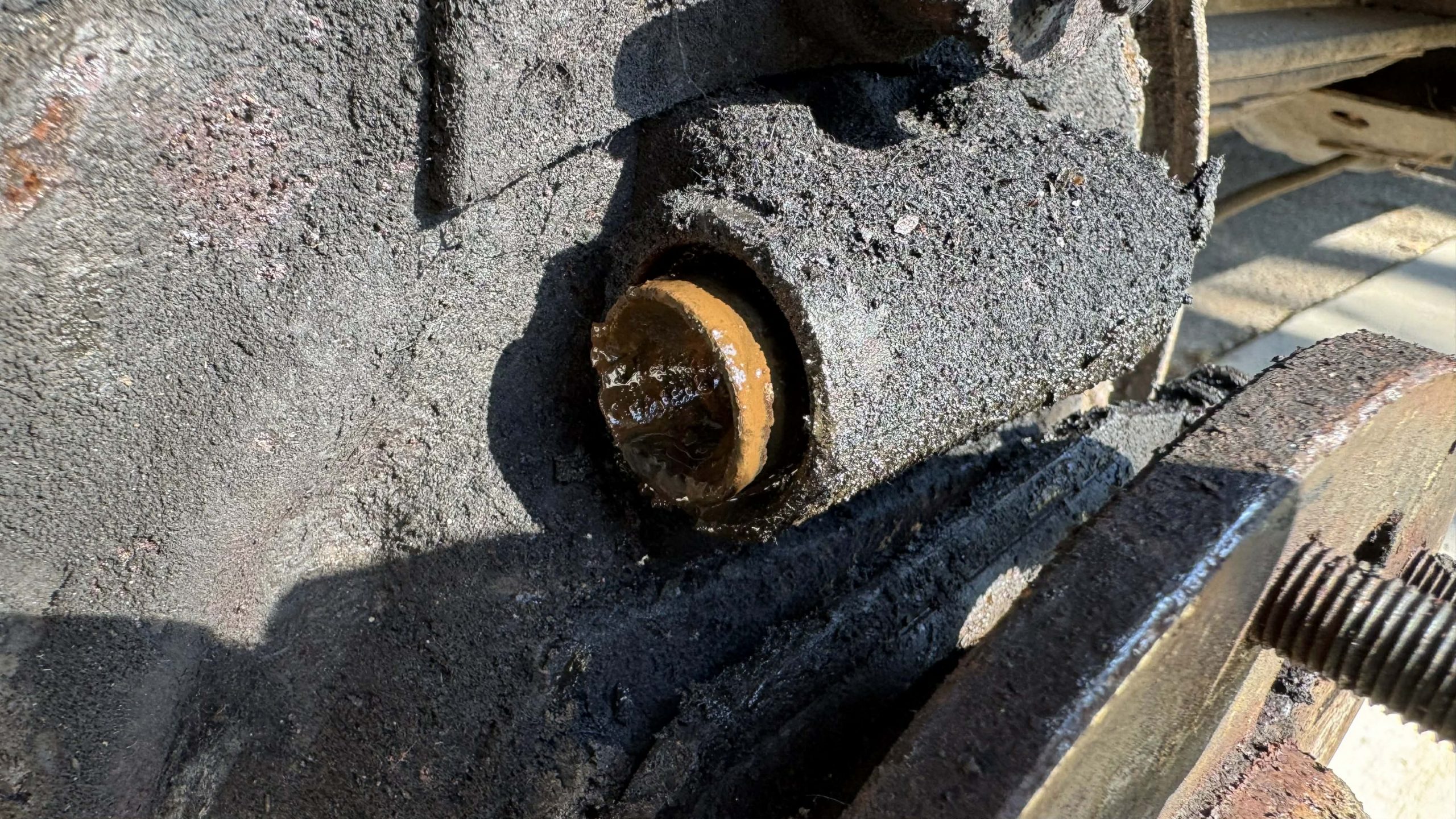
What happens pretty much all the time — and this happens with any threaded screw that isn’t protected from the elements — is that the screw rusts and seizes up. No longer able to rotate due to locked-up threads, the adjuster can no longer compensate for brake shoe wear, and eventually those brake shoes have to move a long distance in order to make contact with the brake drum. Since the adjuster hasn’t compensated and moved the shoes closer to the drum, the wheel cylinders have to do it, and this means those pistons have to move too far the cylinder to the point that they fall out, causing the fluid to escape. This is a major leak in a brake system. That’s almost certainly what happened with my J10:
Pre-1967 Cars Were Unforgiving If You Had A Brake Leak
Luckily, my Jeep J10 was built after 1966 (it’s a 1985), otherwise this rather common wheel cylinder failure would have led to complete brake failure, and I would have crashed into whatever was ahead of me. No, luckily — as shown in the brake master cylinder photo — I had fluid still in my front hydraulic brake system, so my front disc brakes were still working.
But, had this failure happened in a pre-1967 American car, I’d have been completely screwed thanks to a part I like to call “The Widowmaker.” This part is the single reservoir master cylinder:
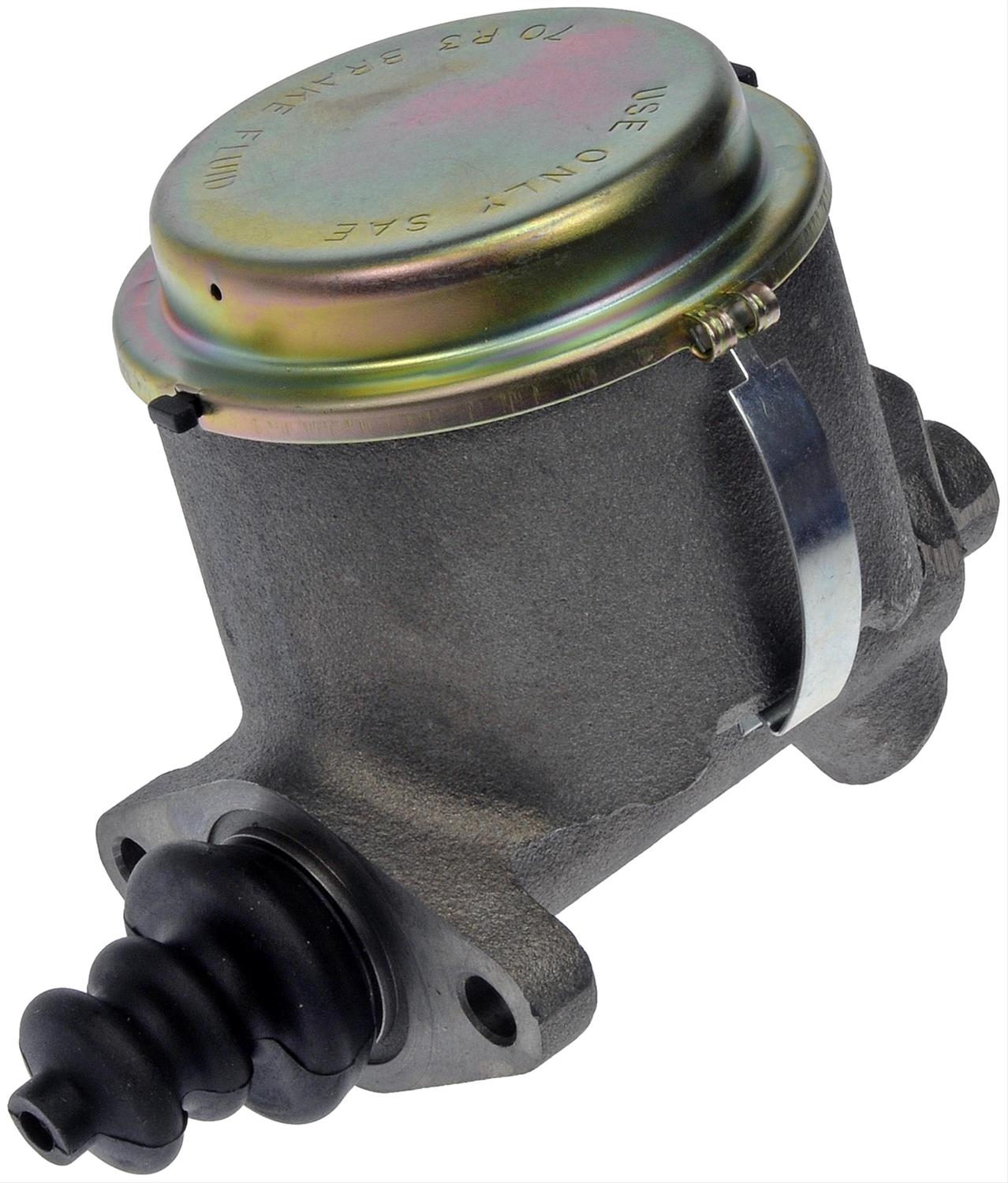
This is a single cylinder/reservoir that connects all four brakes hydraulically. This means that, if a wheel cylinder springs a leak or a brake line rusts out or an old rubber hose gets a pinhole, the brake pressure needed to actuate all four brakes will be lost. One single failure anywhere along this rather large brake system — a master cylinder, a bunch of brake lines, and a bunch of hoses — would lead to no brakes at all (except for maybe your parking brake, if you keep that cable nice and taught, and far too few people do).
There’s a reason why, in 1967, a dual-reservoir master cylinder was federally mandated. This new system means two wheels (for older cars, it coupled the two fronts and the two rears, though modern systems tend to couple each front wheel with the rear wheel on the other side of the car) are hydraulically coupled, so a leak in the system only leads to the loss of two brakes.
Many Old Cars Didn’t Make Brake Fluid Inspection Easy
But prior to 1967, almost every U.S.-sold car featured the Widowmaker, and what’s especially bad is that many of these Widowmakers were not in particularly serviceable locations.

For example, my 1954 Willys CJ-3B’s single-reservoir brake master cylinder was in the engine bay, below the driver’s toe-board, with a tiny access hole that made checking the fluid level (and filling it) extremely difficult.
Old Car Brake Systems Were Deathtraps
I’m amazed that, 59 years ago, every car on the road had a fairly failure-prone braking system that was extremely unforgiving if it did fail, and also not particularly easy to keep an eye on, either.
To be sure, oftentimes brake leaks are gradual, and they lead to a soft pedal that should let the driver know something is up. But sometimes leaks are big, and sometimes drivers might ignore a soft pedal, and if they do that long enough for all the liquid to drain out of the system, they might find themselves with a grille full of the car ahead’s rear bumper.
I know the old-timers are going to say “people just maintained their cars better back then because they had to,” and that probably has to be the case or else our grandparents wouldn’t have survived the 1950s. All I know is: Any car I own that’s pre-1967, I’ll try my best to fit with a dual-reservoir master cylinder, because I want at least a single line of defense beyond my park brake. Because the Widowmaker offered none.
Top graphic images: Ford; Summit Racing; David Tracy




Cable brake supremacy!
Torch – “C’mon David, gimme a break.”
David Lee Tracy – “One brake article, coming up!”
“Be sure to keep the cable taught”
“…would lead to no brakes at all (except for maybe your parking brake, if you keep that cable nice and taught, and far too few people do).”
Taut, David Tracy.
Oy vey…
Imagine what can happen if the brake cable is home-schooled.
Heard an old commercial on a 40s or 50s radio show, reminding listeners to get their wheel bearings packed with fresh grease every 5,000 miles.
The drum brake problem continues to exist in more modern cars, albeit less consequentially: the parking brake is often a drum brake INSIDE of the rear brake rotor. So while your stopping is handled by self-adjusting calipers, your parking brake is entirely mechanical and has to be occasionally adjusted with that little screw thing inside the drum.
As the parking brake shoes are rarely used when the car is in motion, it would seem like they don’t wear much. I’ve found the bigger issue to be stretching of the cable.
Yeah they only really wear if the parking brake is left on. The biggest issue I’ve seen with the drum in a rotor parking brake is that because they never wear and don’t get warmed up the web rusts. That rust travels under the adhesive and the lining comes off. So I now replace them once they are a dozen or so years old in my climate.
Yep, I’ve got this on the list for the ’63 Travelall, which has a single-pot cylinder. I pulled a dual-pot system out of a ’68 parts truck and will retrofit it next spring, when I add electric steering assist (pulled from a junkyard ’09 Versa).
One of the best upgrades I made to the Scout II was to pull the old 70’s era brake booster and retrofit a Hydroboost setup from an Astro van. The difference was startling.
I know the old-timers are going to say “people just maintained their cars better back then because they had to,”
Well, I’m now an old timer and lifelong Michigander, but was once a young and foolish (but learning) 16 & 17 year old, I had experiences with single-circuit brake system line ruptures and wheel cylinder blowouts. Most Michigan cars also typically had rust-seized park/e-brake cables, so drivers usually never engaged them after a few winters because they would stay engaged and not release.
One puckering drive was in my ’66 Barracuda, cranking the Slant Six through the 3-on-the-floor on a paved two lane country road with no houses or crossroads for about a mile and a half. Probably at about 65-70 MPH, I crested the hill and began to hit the brakes about1/8 mile before the intersection and stop sign. Boom! Pedal to the floor. Rusted park brake cables a no go. Downshift, downshift, put right two wheels on the shoulder, edging closer to the ditch, finally downshift to first without overrevving and made the stop before the intersection. Rusted through rear brake line was the culprit.
And not only seized self-adjusters caused wheel cylinder blowouts. Brake shoes worn? Drums past the limit to turn them? Not enough cash to buy new drums? No problem, just install new shoes, crank the self-adjusters all the way out, and eventually you may experience a wheel cylinder piston blowout due to the out of spec inside diameter of the drum.
Thank you, engineers, for dual-circuit diagonally split brake systems after 1967!
It took several years before the diagonal split systems came around and didn’t really catch on until FWD became the norm.
Another brake failure in an A body Mopar survivor!
My failure was more recent and at fault of the previous owner who put a brake pad in upside down with no retainer in my new to me 68 Valiant. I5 just north of Seattle is not the place to lose all brakes. Yes the drums in the back weren’t functional, and the e brake cable was also not tight enough. I had the 904 not the 3 on the tree, so stopping power was provided by my brother when we got into a parking lot.
Yikes! Fred Flintstone braking! Your screen name sounds like you’re a kindred spirit. When I have some time I’ll tell you the tale of my first car, the one I really loved, a 1964 Valiant. 🙂
To those with better memories than me is this the first article by DT about the importance of doing maintenance? I don’t think I have read any others. Lol
To everyone working on old brakes, please keep asbestos exposure in mind and take precautions. My sister worked on a deposition for someone dying from mesothelioma and it was essentially nightmare material.
bro, I thought that might have been you when I walked my two corgis around the neighborhood yesterday. I was thinking to myself that it’s funny that someone has car parts laying out by the sidewalk in a nice middle class suburb. Then I just noticed that gold i3 as I was walking away so I was like it must be David Tracy the jeep man. I also appreciate that a house up and around the corner had a sign that repped the Wu-Tang.
I would have grabbed a wrench and got to work!
he might have thought I was stealing his stuff! This is LA after all lol
I’m facing this realization. I’m resurrecting a 1979 Ford Fairmont that has been parked for 6 years and the pedal was super overboosted and went mostly to the floor before the brakes grabbed. I confirmed all the hydraulic parts weren’t leaking, adjusted the rear drums, and flushed the fluid, and it still largely feels the same. Given how the steering and suspension feel I am starting to think that the brakes were just that crappy from the factory.
I’ve got a ’79 and while the brakes may not be great, they aren’t as bad as you describe. I suspect you’ve got internal fluid bypassing in your master cylinder until the seals get to a non rusty area. I would replace the master cylinder – and not with a rebuilt one.
Hah! I swapped out the single for a double and did the additional line runs in my first car, a ’61 Mercury Comet. Drum brakes all the way around for that one.
At some point in the mid-90’s someone gave me an IH Scout 800 4×4 with a 304/auto combo, it was pretty beat but ran OK and everything was there except someone had stuck a 2wd front axle and just removed the front driveshaft. Over the course of a few months, I acquired a Scout II drum-brake open-knuckle Dana 30 and installed it(a touch wider, but oh well) and got it working pretty well except the braking was terrible, likely due to the mismatched front brakes and unboosted single-pot master cylinder.
I had to relocate the battery and do some sheetmetal cutting and welding, but I was able to shoehorn in a Dodge van power booster and dual-piston master cylinder, converting it to a dual circuit braking setup. Slightly more confident in the drivability, I went to visit my mother, who lived “over the hill” in Santa Cruz, California, the “hill” being a 2000 foot pass, fairly steep & twisty in places.
Yup, you guessed it, right at the steepest spot, one of the old front brake hoses blew, but I avoided rolling that old Cornbinder over and probably killing myself(those Scouts had no fixed roof and no roll bar) by actually being responsible for a change and adding safety measures. Even then as dumbass 20-something, I knew those single-circuit brakes were death personified.
The good thing about basic brakes:
It was the rare moron who would tailgate you at 60+mph.
Always have better brakes than the guy in front of you.
Maybe it had less to do with bad brakes than the self-lobotomy steering columns? Back then you only got one chance to not screw up, so only the brave but skilled, or the timid but cautious survived. (does this mean that the equivalent to tik-tok was faces of death?)
I had the brakes fail on a car from one of the wheel cylinders blowing out, but fortunately I was going fairly slowly and there was a handy tree to slow me down. I also was in the car when at parents MG had its brakes fail in San Francisco and they managed to make a left turn onto an uphill street which was exciting, and my mother often told of driving out if the Clairmont hotel in the Berkeley hills one night, and discovering the brakes in a 1940 Mercury station wagon weren’t working and taking about 15 blocks to stop. I think that was the first year Ford had hydraulic brakes, apparently Henry Ford didn’t think hydraulic brakes were a good idea.
Another amusing point of failure with hydraulic brakes is that if you have power brakes, the vacuum diaphragm in the master cylinder can fail and suck all the brake fluid into the engine. I have experienced that twice in two different Mercedes-Benz cars.
I suspect that one of the reasons that you don’t hear more stories about people losing their brakes in pre-1967 cars is that 1967 was also the year that seatbelts were made mandatory. .
For what it’s worth, Cadillac had dual circuit brakes in 1962.
As did AMC: The Old Car Manual Project Brochure Collection
My father had a 1962 Classic, and I remember this being a big deal.
The drive up to and down from the Clairmont hotel is something I have vowed never to take again. What a pain in the tuchus.
The true death traps are old single circuit brakes.
Bicycle brakes were pretty awful too until a few years ago when disc brakes became fairly universal. From spoon brakes that applied friction to the tire, to coaster (drum) brakes that would immediately lock the rear wheel, to cantilever rim brakes that were difficult to adjust, bike brakes sucked and a little bit of rain or mud would reduce stopping power to almost nothing.
Can attest to this…
This is a perfect example of why Unsafe at Any Speed is actually a really informative book, which every auto enthusiast should read. It’s amazing how hard the auto industry fought to keep from having to implement the most basic safety features, like dual circuit master cylinders.
BTW David, I believe 1968 is the changeover year for dual circuit master cylinders, not 1967. That’s also when side marker lights became mandated.
Dad (77) has an old copy, I have read it. While a mutlitude of scenarios are overblown, the overall premise is sound. We arer all better for these teachings.
It is 67. That’s the year VW added dual circuit master cylinders, making it easy to upgrade pre 67 buses and beetles as it was before the bigger changes in 1968
Alrighty then. I know the marker lights were ’68, but I guess if they were going to roll one out sooner, safer brakes was definitely the right call.
If I don’t know about it, it doesn’t exist.
They still do. Automakers fight every safety, emission, and fuel economy regulation. (In our defense buyers don’t want to pay for those things)
I know, but cars are so much safer now with such basic things. It’s amazing how much they cry that changing their window switches will bankrupt them, and then when they’re forced to do it anyways they somehow magically survive.
Of course it is crying wolf.
That doesnt change the fact that automakers have been forced every step of the way to make improvements
Biden era fuel economy standards are readily achievable even without a high mix of EVs. That does keep people from complaining and working to roll them back.
Frankly, it’s proof that not all regulations are bad. We’d still have cars that sucked as much as 60’s cars, if change hadn’t been forced. The banning of high wattage incandescent bulbs, bringing the cost of LEDs way way down, has been a good thing too.
People fought like hell to keep incandescents legal. All sorts of specious arguments about LEDs being unaffordable or of inferior light quality. Yeah they might have been 5x the cost but they lasted 20x as long and used 80% less energy…not that hard to do the math. The light quality was a more valid critique but now that tech has improved and we’ve all learned about “color temperature,” that’s gone too.
Anyone clamoring for the days of dealing with a dead bulb every week or so? No one wants to live in a nanny state, however here’s a good example of the government improving our lives via a regulation that was unpopular at the time.
Yeah, they sure did fight that one! Just last year I saw somebody buying old incandescent bulbs at a garage sale and bitching up a storm about LEDs. But it really pushed the technology into a much better place.
Buyers do want to pay for better safety and fuel economy. That’s why crash safety and mileage ratings are advertised. At least, car buyers do.
Share buyers don’t want to lose margin for safety, emissions, and economy regulations, and the lobbyists work for them.
People don’t want more expensive cars, but automakers have found no shortage of other ways to make cars more expensive.
When safety features are optional the majority of people do not buy them.
Given the choice between power and fuel economy most buyers chose power. They will even pay more to get more power / less fuel economy.
When CAFE standard were held steady through the 90’s and 00’s the fleet average actually dropped 12% as people bought larger and more powerful vehicles.
Like for like cars are cheaper today than 30 years ago.
Optional safety features are specifically the things that haven’t been seen as important enough to regulate. Though, I can’t even think of optional safety features offhand other than higher-trim headlights and maybe ADAS (though I can only remember examples of them being standard)? People want crash safety, and often pick brands they believe are safer.
One of the reasons people buy the bigger, more expensive cars is for perceived safety. See: https://xkcd.com/3167/ “Car Size”.
Cheaper, certainly. Not to be confused with “more affordable”.
Most safety features that are mandatory today were once optional: seat belts, airbags, ABS, Stability Control, AEB. All at one time optional but now mandated.
Like for like cars today cost the median household fewer weeks of income than decades ago. That is the definition of more affordable.
What is “like for like” and a “median household”? Because I don’t think it’s controversial to say “people are struggling to afford cars now”.
The definition of “afford-able” is that people are “able” to “afford” them.
The median household income is the average. The means in the number in the middle 50% above / 50% below. Take every household’s tax return, line them up from smallest to largest and pick the one in the middle. It is more accurate than using the mean because the mean is distorted by a small number of very wealthy households.
The median household income in the US was $83,730 in 2024.
Like for like is the same car purchased years or decades apart. A 1995 Corolla cost the median household 21 weeks of income. A 2024 Corolla cost the median household 14 weeks of income. A Corolla is 33% more affordable for the average household in 2024 vs 1995
Of course this doesn’t mean everyone is doing better. Some people do struggle to afford a car. Some people are seeing their income decline and moving down the social economical ladder. However the average household is not. They are doing better.
The Real (inflation adjusted) Median Household Income in 2024 was higher than in 2019. It is massively (36%) higher than in 1985.
Income data for the last 40ish years:
Median Household Income in the United States (MEHOINUSA646N) | FRED | St. Louis Fed
Real Median Household Income in the United States (MEHOINUSA672N) | FRED | St. Louis Fed
Median Family Income in the United States (MEFAINUSA646N) | FRED | St. Louis Fed
Real Median Family Income in the United States (MEFAINUSA672N) | FRED | St. Louis Fed
Mean Family Income in the United States (MAFAINUSA646N) | FRED | St. Louis Fed
I never met my grandpa because he was a passenger in someone else’s car (from the 60’s) that had brake failure and ran them into a tree. So yes, please check your older vehicles.
I’m really sorry. You honor his legacy by speaking on his behalf. For every person who comments “it wasn’t a big deal, we were fine,” there’s someone like your grandfather who can’t respond.
And, even for those adamant that they had the skill to survive, there’s someone with even more skill than you who died after getting t-boned by someone with less.
Just another reason why they advocated for ten kids per married couple back in the day. That was at you had spares when something happened.
Happy to say Cadillac was a little ahead of the curve on this one as they introduced dual-circuit braking systems in 1962. The tiny little fluid reservoir in the ’59 Caddy I had was indeed crazy. When I replaced the rear brake lines, the reservoir would run out of fluid before the fluid made it all the way back to the right-rear bleeder screw. Made it a three-person job to quickly fill and bleed the air out of that system – someone under the car, someone in the car, and someone steadily pouring in the brake fluid.
I’ve owned a few other cars with the single-circuit system and it is a rather hair-raising experience just thinking about something failing. I usually do a quick pump of the brakes way before actually stopping to see if there’s low or no pressure since I want as much time as possible to engage the emergency brake and/or figure out what to run into.
I still do the quick tap on the brakes to see if they are working, clean any dirt or water off etc. Recently there are idiots following behind that take offense at a tap on the brakes.
Mercedes-Benz had dual circuit braking in 1961 – with front disc brakes – on the 300SE.
I had a 1st gen Mustang as my first car. Lost brakes twice descending the MTN where I grew up in the 1980s. Lucky both times. Both times got enough residual braking ability to slow down and miss the red light at the bottom of the hill. Cause? The car was absolutely worn out in every way but I didn’t understand it. Drums were oversize, wheel cylinders popped open dumping the hydraulic fluid everywhere. Single circuit brakes so any failure was a total failure. Parking brake was useless b/c hydraulic leaks ruined the shoes. Transmission was a three speed and worn out so downshifts were difficult or impossible. Eventually learned and repaired it with mix of new parts and junkyard drums.
Fast forward a few years. Living in southern Europe. Daily driving a Beetle. No leaks but drum brakes which had one, maybe two hard 60 mph stops in them before they were hot and useless for a while.
These days I’m all about disc brakes, dual circuit hydraulic systems, etc. No point in making a classic pretty if I’m at risk of wrecking it…
Just last year, my old Buick popped a rear brake line (rusty). Thanks to dual-channel brakes, I was able to safely nurse the car home and replace the brake lines.
It’s the best automotive improvement in the history of cars. Prove me wrong.
This is what a Model T used: https://www.modeltford.com/item/1057-8.aspx. Literally a cotton strap that when you push the pedal it tightens around a drum in the transmission.
Back when I was in high school, I worked weekends and holidays at Legoland. The employee parking lot at the time was—maybe still is, I don’t know—accessed at the top of a steep hill, at the bottom of which was a busy, six-lane road (Palomar Airport Road).
Leaving at the end of a shift one day in my ’65 Corvair, I only discovered after turning out of the lot and starting my downhill descent that I had no brakes. Again, I am hurtling down the hill toward a major road, gaining speed at an alarming rate. The car’s an automatic, so engine braking wasn’t really on the menu. Thankfully, I had a green light and clear road ahead when I reached the bottom of the hill, and my little green deathtrap flew into a left turn onto Palomar Airport Road, me clinging to the skinny plastic steering wheel in terror.
A mile or so down the road, I pulled into a gas station and was able to time it right to pull into a parking spot in front of the mini-mart and pull the hand brake to bring it to a stop. Pop open my single-pot master cylinder—fortunately easy to access in the trunk, just below the base of the windshield—and, of course, it was dry as a bone.
Fun times. But, here we are more than 20 years later, and the car still has its original single-circuit master cylinder, so I guess I learned nothing.
Same experience but different place in a ’66 Mustang. Good grief!
Those who did not have a green light at the bottom of the hill unfortunately did not live to tell the tale.
along with all the folks who did have the green at the time…
Pedantically, you’re referring to cars built before 1/1/1968, not 1967. Although most manufacturers installed dual-circuit master cylinders for their MY 1968 cars (in the Autumn of 1967), some didn’t.
As a Certified Volvo Nut™, I know that the MY1968 122/Amazon models built before 1/1/1968 had single-circuit M/C, and those built after that date had dual-circuit designs. Us nuts refer to the later cars as 1968.5 models, although Volvo made no such distinction. All that, from the company known for building safe cars. Ha!
I thought it was 1967 MY?
I’m old. It may have well been 67 and 1967.5 models. Apologies.
I had two ’67 Austin Healey’s and a ’67 MGB/GT. None had dual brake circuits. My brother’s ’68 Sprite did, as did my ’68 Triumph TR250. For ’68 you also got mandatory shoulder belts, and if you are not buying into it yet, side safety lights. I know you know your lights and ’68 was the year US spec cars got the lights along with the other safety features including the safer brakes.
In the early years of those types of regulations it was cars built after 1/1/19xx. It is why for example the 1970 Mavericks built after 1/1/1970 have a locking steering column and those built before that date have the ignition switch on the dash. Just a few years later they started tying it to model year and defined a model year.
Unless you already have a buyer in Michigan lined up (it sounds like you don’t), why not list it on Cars and Bids or some other online auction site? Let the buyer take the hit on shipping.
Does David ever do anything the easy way? His struggles are the internet’s entertainment.
Would have been smart.
In reality, those auction sites are not the place to list cars that have any rust.
Business opportunity for a “Rust and Bids” auction site!!!
You said it was “rust free”. 😉
I hope for your sake the premium from selling the truck in MI is worth the cost of shipping and general hassle!