


This morning I’m tanking my neighborhood’s property values with a crusty Jeep J10 on jack stands. I’m in the process of servicing the rear brakes prior to shipping the vehicle to Michigan, where I plan to sell it. Anyway, this “servicing” involves me not just replacing the brake shoes and hardware, but also repairing the wheel cylinders, which brings me to something that always blows my mind when I think about it: Cars before 1967 were absolute deathtraps. And not just because they weren’t designed for crashes, but because their brake design made crashes seemingly inevitable.
My Jeep J10’s rear brakes haven’t worked in months, and the reason is pretty obvious to anyone who steps on the pedal. The pedal feels soft and spongy instead of hard and firm, and one peek into the brake master cylinder shows: The rear reservoir is almost bone-dry.


Check it out:
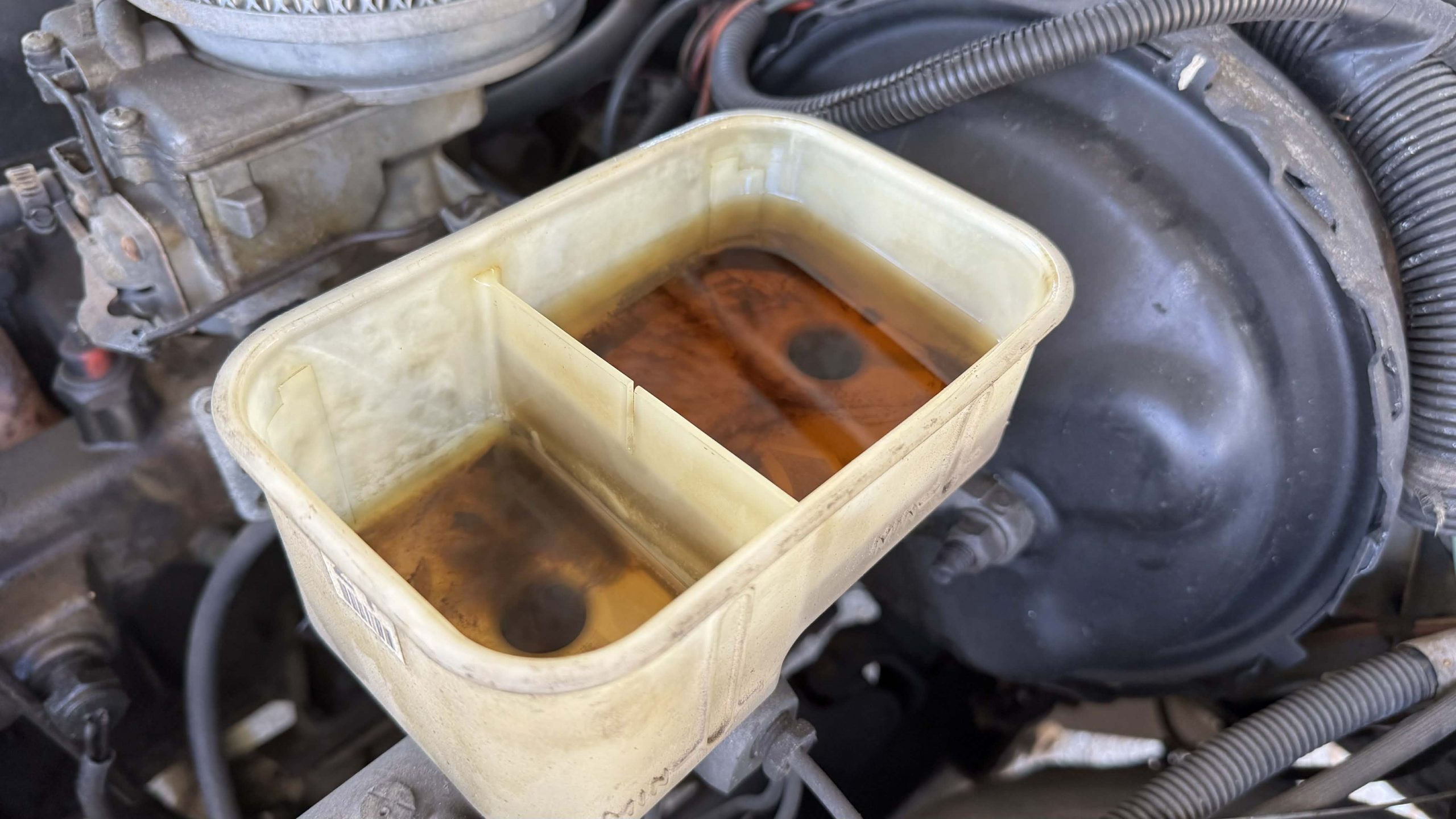
In other words, the fluid that my foot is supposed to push through the brake lines and hoses in order to activate the rear brakes has leaked out onto the roadway. This means I have absolutely no rear brakes.
Drum Brakes
Before I go into what the root cause is, I just want to briefly explain how drum brakes work. Instead of brake fluid coming into a caliper like this…


…and pushing a piston (or multiple pistons) against some brake pads so as to squeeze them against a disc like this…
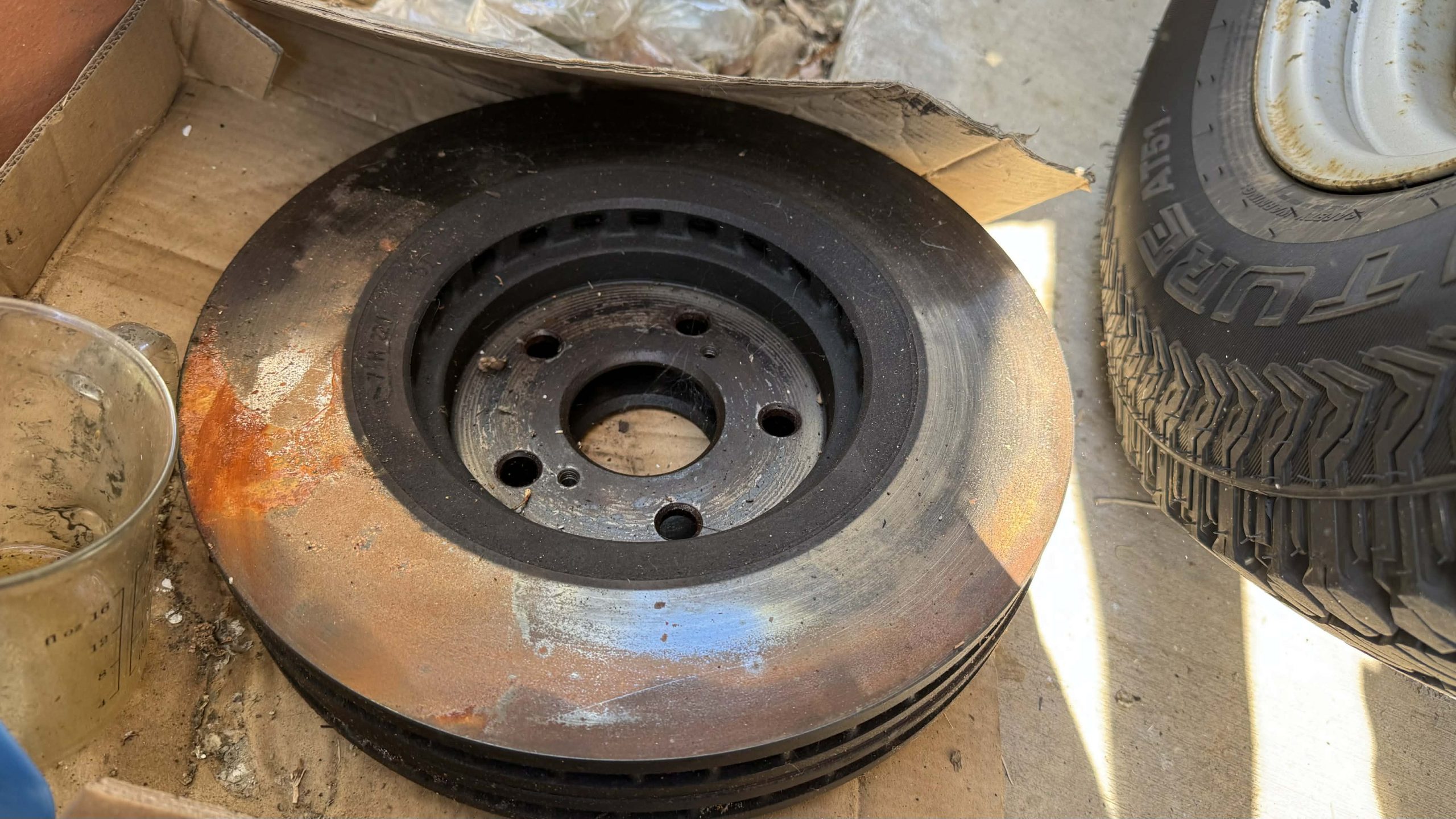
…drum brakes use a small wheel cylinder to “spread” some brake shoes against a spinning metal drum. A wheel cylinder is an extremely simple device containing two pistons — one on each end of, essentially, a smooth pipe (cylinder). Basically, fluid comes in from a brake line through this hole:

It enters the wheel cylinder at the center and pushes two pistons outward.
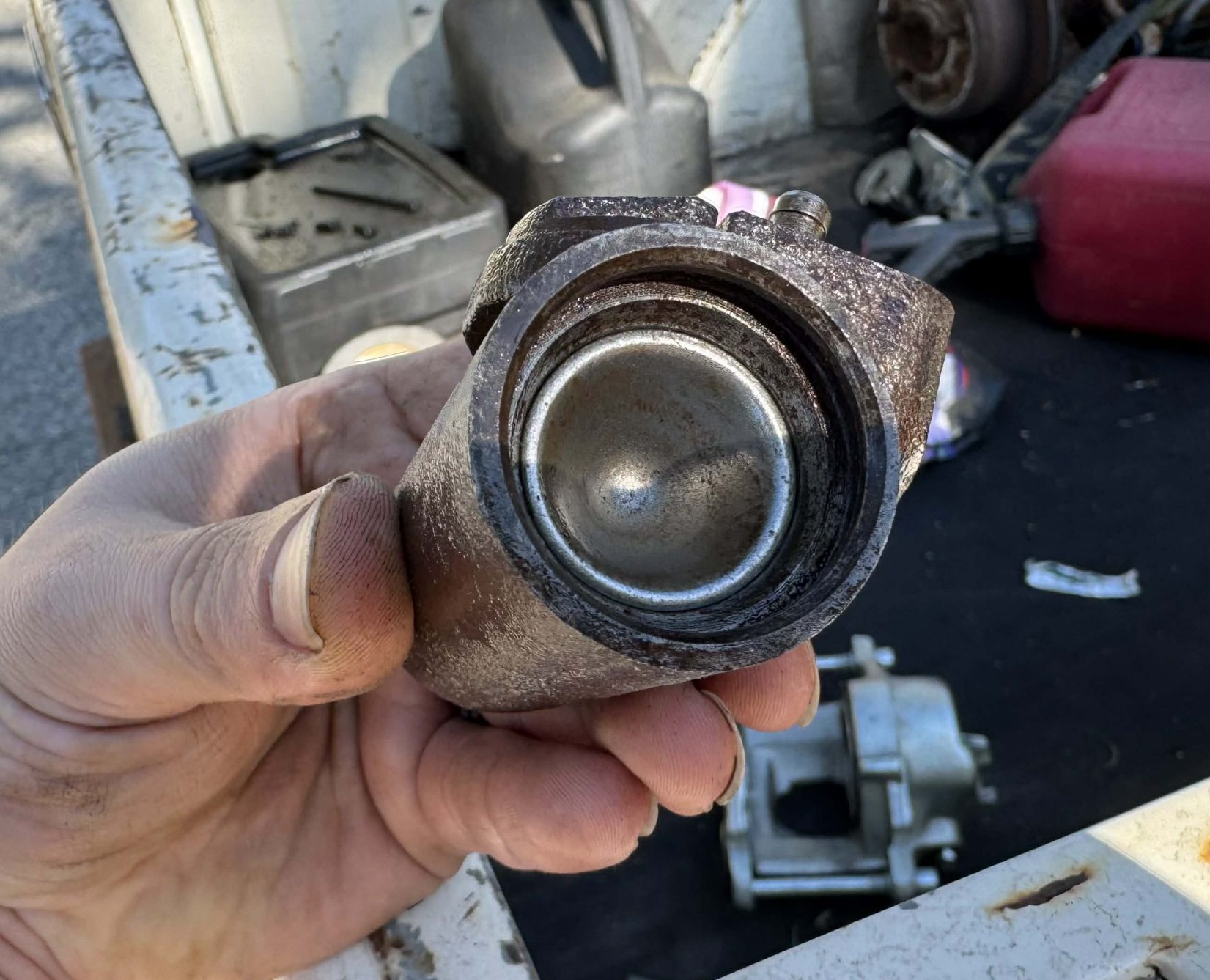
You can see the metal piston above and both of them (which each get a rubber inboard seal, with a spring between the two seals — and each piston gets a rubber outboard dust seal as well) in the image below:

The pistons moving outward spread brake shoes like these (the arrows are pointing to the brake shoe “liners” i.e. friction material)…

…against a drum like this:
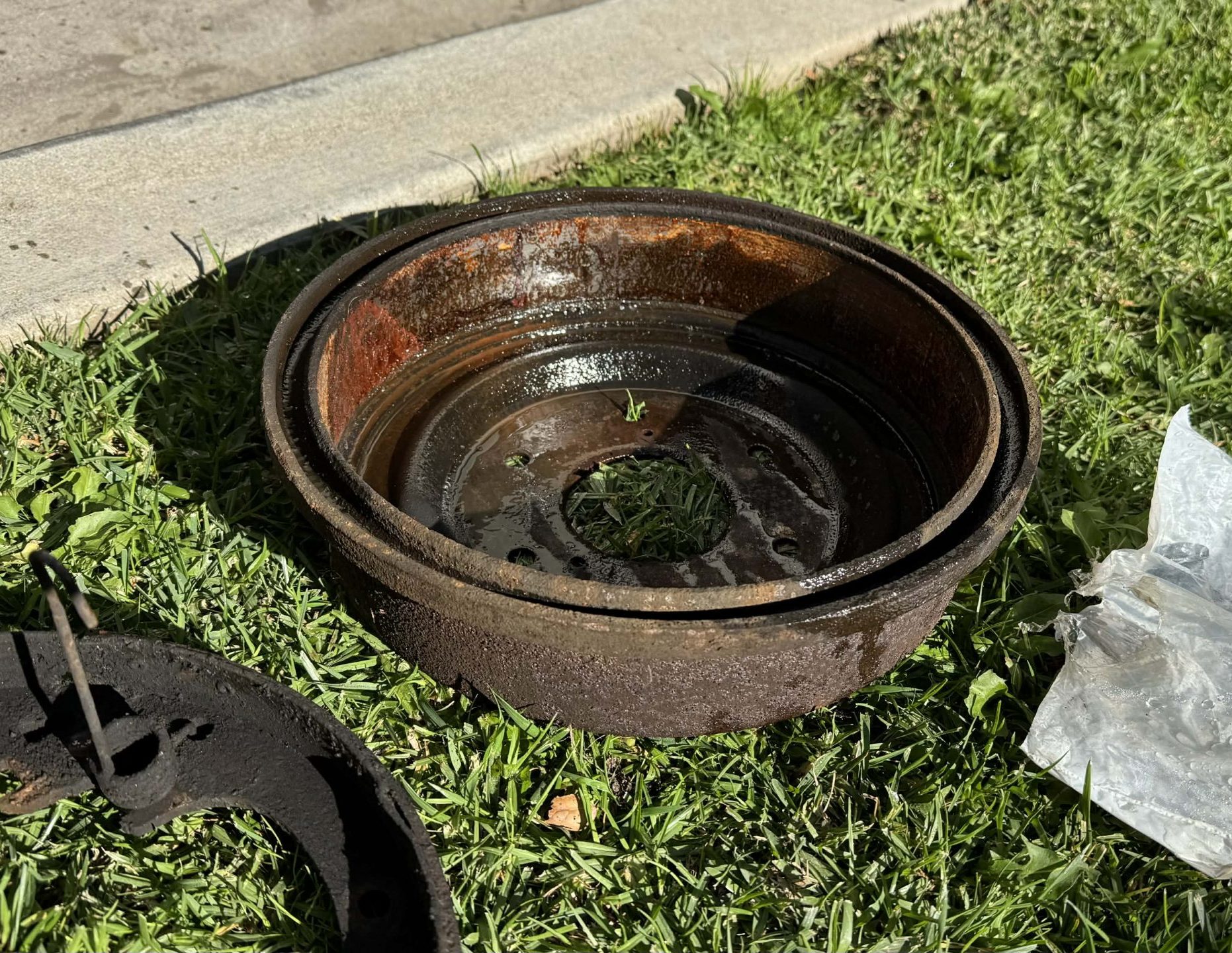
That drum has holes in it for the vehicle’s lug studs to which the wheels are fastened. Therefore, stopping the drum means stopping the wheels from spinning, thus stopping the car.
Drum Brake Systems Are Prone To Failure If Not Maintained
Anyway, with that out of the way, I want to point out what’s causing my Jeep J10’s brakes to fail, as it’s something I’ve experienced numerous times on older vehicles. Vehicles with drum brakes feature what’s called a brake adjuster crew. This is usually located on the bottom of the drum brake assembly, between the bottoms of the brake shoes. Here you can see it clearly:
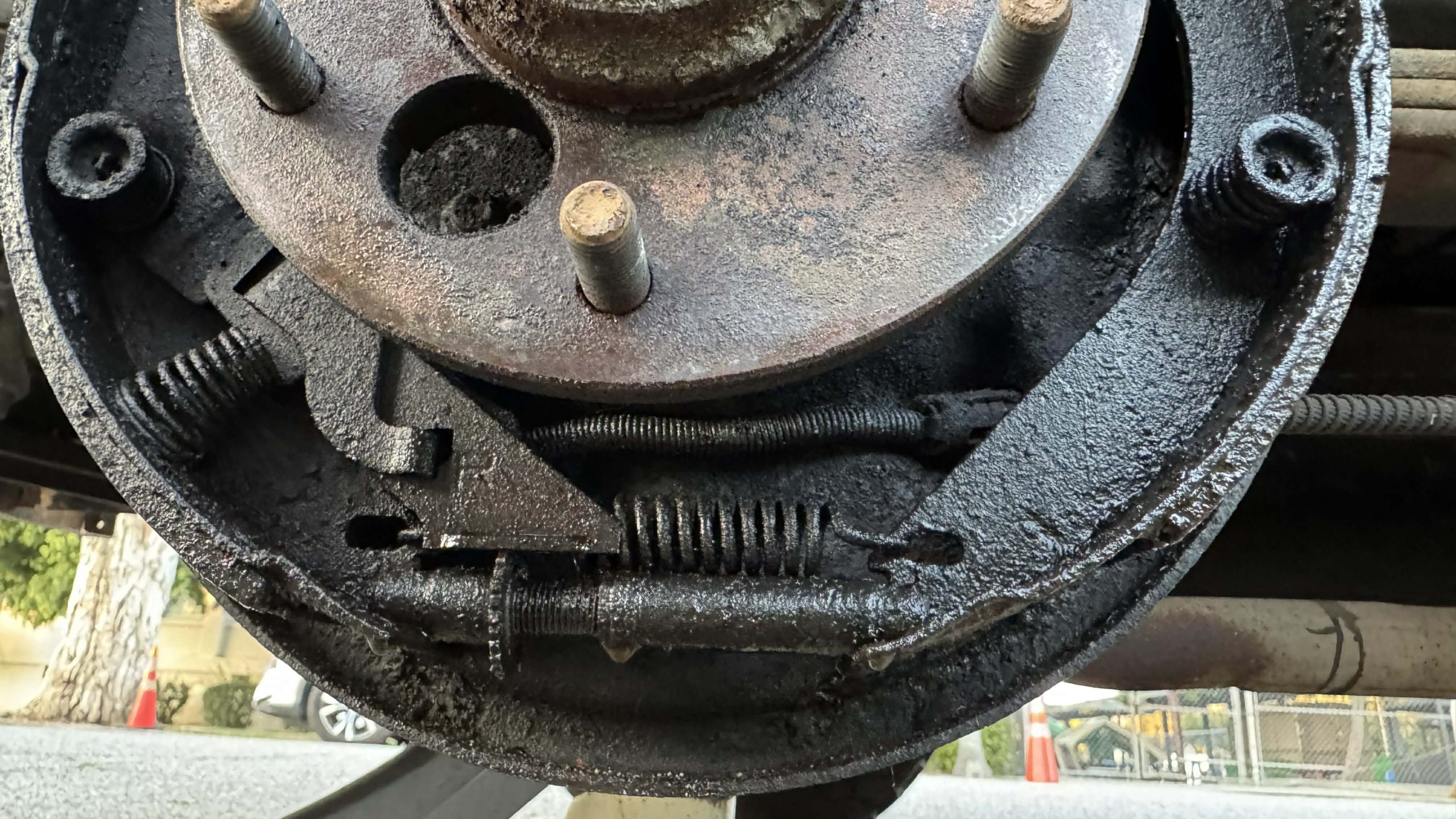
The brake adjuster screw’s job is to compensate for the wear of the brake shoes themselves as their material turns to dust during stops. The shoes become thinner, and the adjusters push the bottoms of the shoes outboard a bit more to compensate so that brake material is right up against the drum when the driver is not on the brake, that way those shoes can make healthy contact with the metal brake drums.
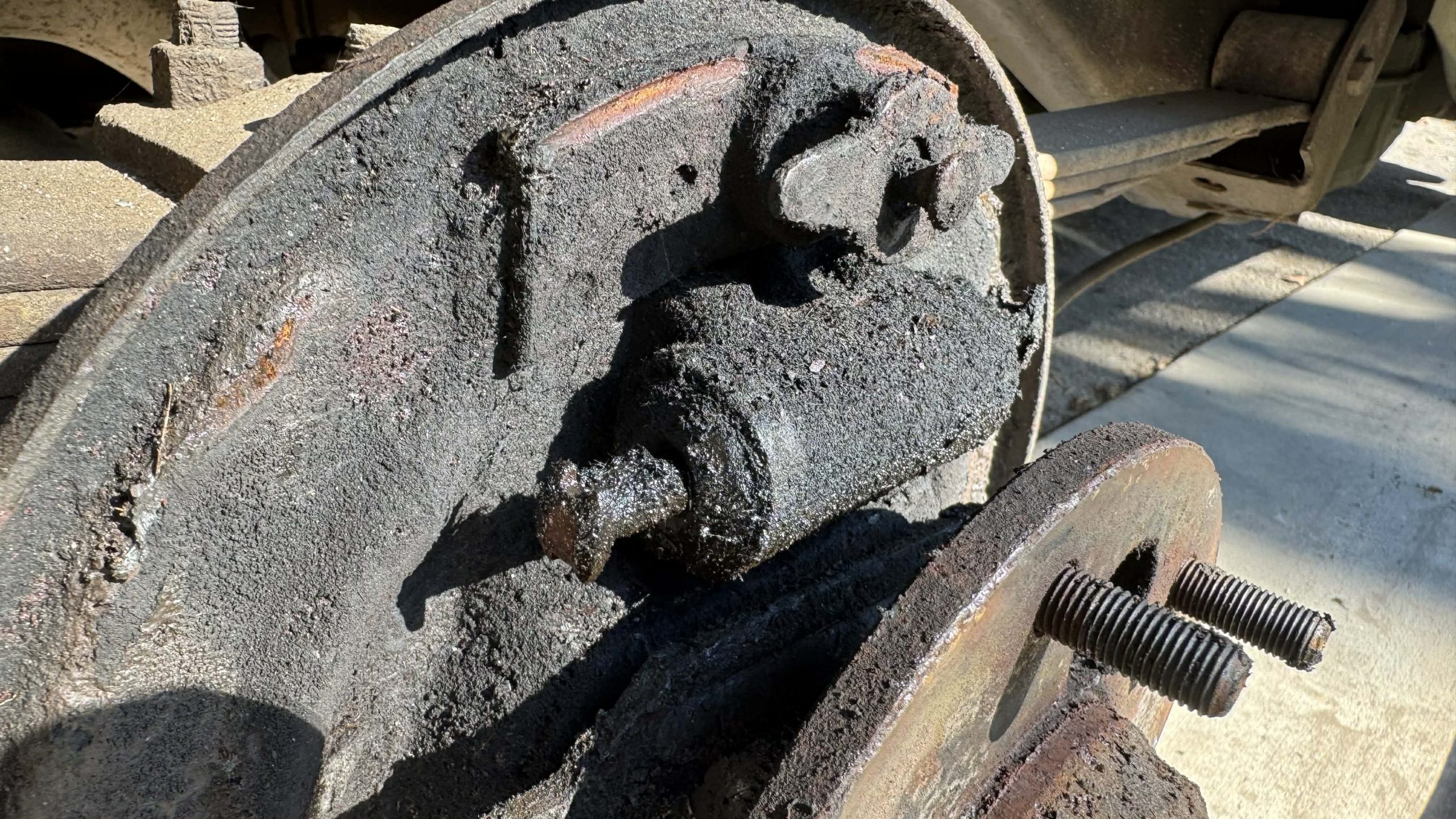
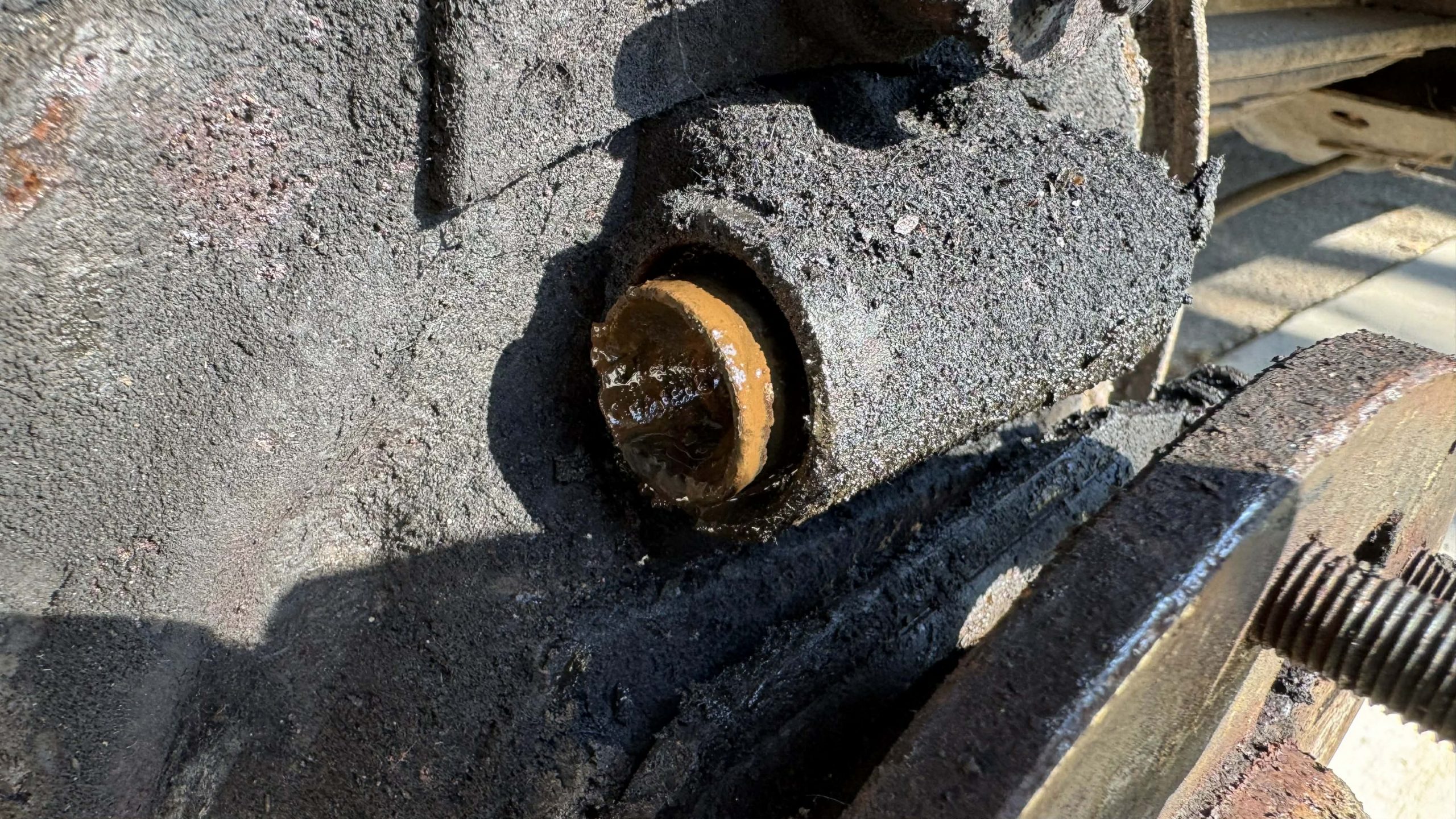
What happens pretty much all the time — and this happens with any threaded screw that isn’t protected from the elements — is that the screw rusts and seizes up. No longer able to rotate due to locked-up threads, the adjuster can no longer compensate for brake shoe wear, and eventually those brake shoes have to move a long distance in order to make contact with the brake drum. Since the adjuster hasn’t compensated and moved the shoes closer to the drum, the wheel cylinders have to do it, and this means those pistons have to move too far the cylinder to the point that they fall out, causing the fluid to escape. This is a major leak in a brake system. That’s almost certainly what happened with my J10:
Pre-1967 Cars Were Unforgiving If You Had A Brake Leak
Luckily, my Jeep J10 was built after 1966 (it’s a 1985), otherwise this rather common wheel cylinder failure would have led to complete brake failure, and I would have crashed into whatever was ahead of me. No, luckily — as shown in the brake master cylinder photo — I had fluid still in my front hydraulic brake system, so my front disc brakes were still working.
But, had this failure happened in a pre-1967 American car, I’d have been completely screwed thanks to a part I like to call “The Widowmaker.” This part is the single reservoir master cylinder:
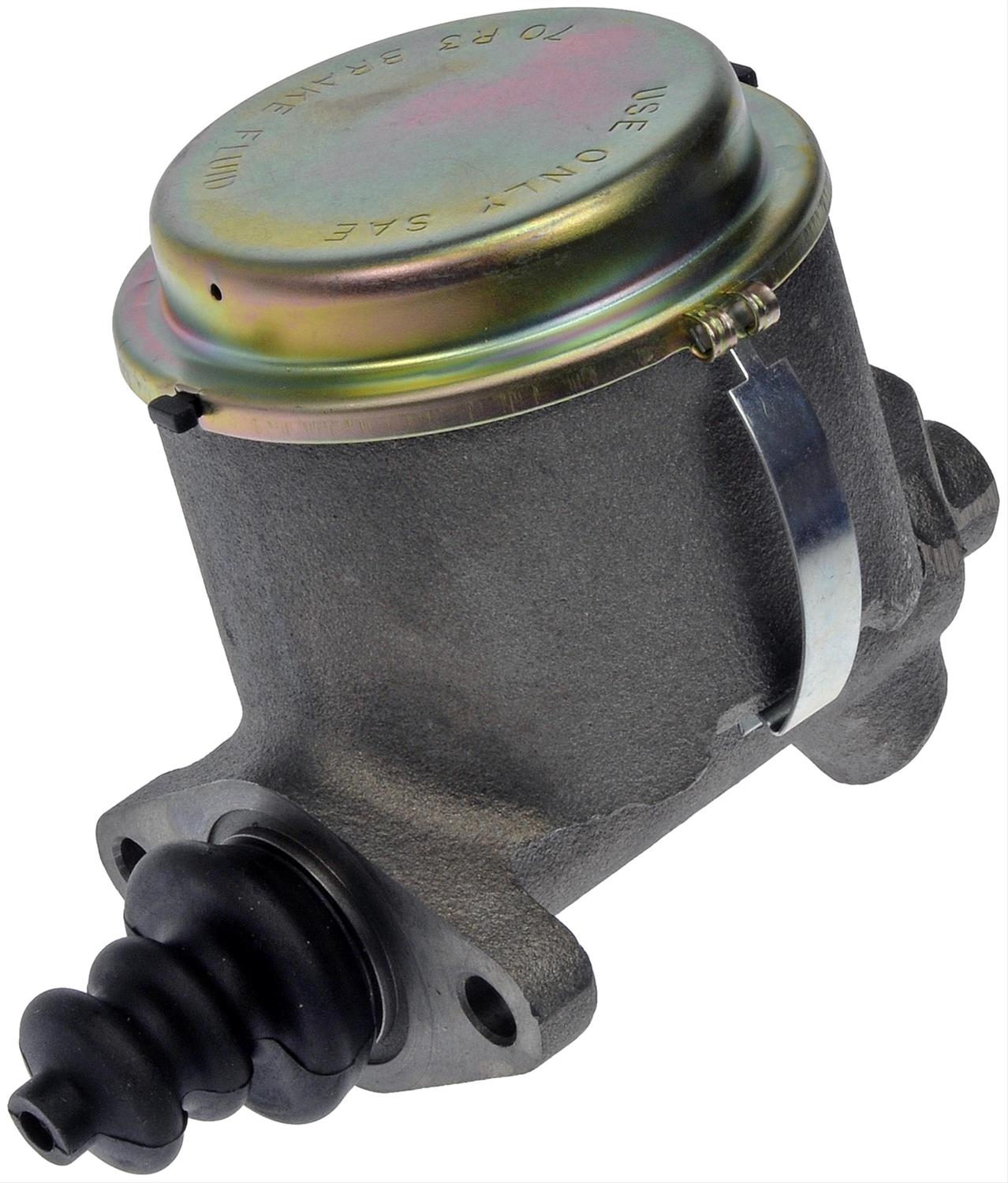
This is a single cylinder/reservoir that connects all four brakes hydraulically. This means that, if a wheel cylinder springs a leak or a brake line rusts out or an old rubber hose gets a pinhole, the brake pressure needed to actuate all four brakes will be lost. One single failure anywhere along this rather large brake system — a master cylinder, a bunch of brake lines, and a bunch of hoses — would lead to no brakes at all (except for maybe your parking brake, if you keep that cable nice and taught, and far too few people do).
There’s a reason why, in 1967, a dual-reservoir master cylinder was federally mandated. This new system means two wheels (for older cars, it coupled the two fronts and the two rears, though modern systems tend to couple each front wheel with the rear wheel on the other side of the car) are hydraulically coupled, so a leak in the system only leads to the loss of two brakes.
Many Old Cars Didn’t Make Brake Fluid Inspection Easy
But prior to 1967, almost every U.S.-sold car featured the Widowmaker, and what’s especially bad is that many of these Widowmakers were not in particularly serviceable locations.

For example, my 1954 Willys CJ-3B’s single-reservoir brake master cylinder was in the engine bay, below the driver’s toe-board, with a tiny access hole that made checking the fluid level (and filling it) extremely difficult.
Old Car Brake Systems Were Deathtraps
I’m amazed that, 59 years ago, every car on the road had a fairly failure-prone braking system that was extremely unforgiving if it did fail, and also not particularly easy to keep an eye on, either.
To be sure, oftentimes brake leaks are gradual, and they lead to a soft pedal that should let the driver know something is up. But sometimes leaks are big, and sometimes drivers might ignore a soft pedal, and if they do that long enough for all the liquid to drain out of the system, they might find themselves with a grille full of the car ahead’s rear bumper.
I know the old-timers are going to say “people just maintained their cars better back then because they had to,” and that probably has to be the case or else our grandparents wouldn’t have survived the 1950s. All I know is: Any car I own that’s pre-1967, I’ll try my best to fit with a dual-reservoir master cylinder, because I want at least a single line of defense beyond my park brake. Because the Widowmaker offered none.
Top graphic images: Ford; Summit Racing; David Tracy




I had my brakes fail on the highway with a single master cylinder once. I forget what exactly happened, but I believe this particular system had two half cylinders in the front brakes, and there was a crossover line. I THINK that line had been replaced, but not properly formed, and the drum rubbed through it. On the highway. Fortunately, when the brakes fully failed, there was very little traffic, and I was able to exit and use the e-brake. Made it all the way home that way, and got it fixed.
The foot actuated E-Brake was probably there versus a hand brake way back then so you did not have to think to much or take a hand off the steering wheel to apply it in an Emergency.
The other thing that kind of prompted the change was Front Disc Brakes. having the front line proportioned differently was easier done if the distribution block was separated by Front and back sections
It was a hand brake. Big ol’ lever coming out of the floor (split window VW bus).
My 64 Falcon blew the master cylinder. It was a frantic grab for the emergency break and luckily an easy stop. Luckily, i was just pulling out of my garage, had it been 10 minutes later, I would have been in a ditch/tree/bumper. Could not find a direct fit dual chamber to replace the windowmaker, so I’m every mindful and ever checking my breaks.
Gimmie a brake!
Dad never bothered to put brakes on the farm go karts, which helped me learn about the two backup systems available in all vehicles.
(1) Engine braking. Take your foot off the gas, downshift, and/or turn off the engine.
(2) Look for something, preferably soft, to crash into. A field of tall grass or a hay bail are great. The corrugated wall of the tool shed crumples gently if you hit between the posts. Trees, not so good.
Because for most of my life, the only airbags available were my lungs.
There’s a crew inside my drum brake that adjusts everything? Awesome!
Joking aside, cars 1966 and older tended to catastrophically break down before your brake lines rusted out, so it wasn’t a terribly common problem. 100k miles in the 1950s meant it was basically a beater, if the engine or transmission wasn’t already garbage.
It’s a good thing dual circuit brakes are a thing, but it was mainly because vehicles were getting better to the point where brakes/lines would fail before the engine/transmission did.
The Dangerous Nights Crew!
Counterpoint: every generation of brakes is massively safer than the one before. I’ve driven cars spread over 100+ years of production.
The easiest way to experience the improvements is to go drive a Model T in which the brakes are more of a suggestion box, with a cloth band wrapped around an oily drum in the transmission. That’s 1908-era tech. (The T also had mechanical rear drum brakes for emergencies. They wear out and go up in smoke fast if used for regular braking.)
Prior to the 1920s, most cars had rear-only mechanical brakes, or transmission brakes (like the T).
Four-wheel brakes came along on production cars in the late teens / early 1920s and transformed driving. They also pushed several smaller manufacturers out of business who couldn’t afford the development. But they were still mechanical and not self-adjusting or balancing.
One of the biggest features of Chrysler when the company debuted in 1924 was four-wheel hydraulic brakes, which helped naturally balance the force across the wheels.
It took a while for manufacturers to switch to hydraulics. Ford was still mechanically-operated until 1938. Crosley had mechanical brakes until early 1949. Hudson kept parallel pedal-operated hydraulic and mechanical brake systems as a safety feature until the end in 1957.
Crosley and Chrysler debuted disc brakes in 1949, though it would take twenty years for the tech to start to catch on.
Dual master cylinders 1967.
Antilock brakes were available in the ‘70s but started going mainstream in the ‘80s.
Automatic Emergency Braking (AES) has been standard in the US since 2022.
All of these systems worked within their design constraints. They just needed regular maintenance and alert drivers.
My new car with dual-circuit hydraulic four-wheel discs, anti-lock, and AEB is the best of course. But I don’t fear the old ways.
I was surprised that a base model 2007 Ford Focus ‘S’ I bought did not have ABS brakes. Thought all cars had them after the 90s.
That’s a good point. Some other comment said bike brakes used to be crap. That’s true, but only because we have a point of comparison. No one thought they were crap at the time — they were just brakes. I’m sure my parents told me how lucky I was to have modern brakes compared to what they had.
Braking tech seems pretty mature, but I doubt we’ve reached the limit. One day 2025 tech will be outdated too.
If dual-circuit brakes are safer than single circuit brake imagine how much safer quad-circuit brakes would be. But, you know, cost.
Part of the point of hydraulic brakes is balancing the force of braking across multiple wheels so one doesn’t lock up. You lose that with four circuits. Although with antilock it’s probably not an issue.
Assuming ABS functions at that point. By the time you’re getting one or more line failures in a car’s age, there’s a pretty good chance something in the ABS system doesn’t work anymore either.
Out of my 5 vehicles, 3 came with ABS, and works in 2. Excluding the race car that would have had ABS removed anyway, the rest are all OBD2 (1996+).
I have had some hateful experiences with ABS. the cost of parts, somewhat lack of interchangeability and in more cases than I want to admit, lack of parts on some of the more orphan or rare stuff. You learn to rebuild though and man that is no fun.
My motorcycle has one circuit per wheel, and that works fine. You can also mechanically link two or more master cylinders to apply an even (or adjustable uneven) force to multiple circuits.
It’s an expensive fix for a problem no one cares about.
If you’ve never been in a vehicle where one tire locks up significantly before the rest, it’s sporty.
Comparing a2 channel 2 wheel bike to a single wheel on a 4 wheel car is ignorant. The comparison would be to older cars with front/rear split dual circuits.
Oh I’ve had cars where one wheel would lock before the others, and stay locked until you took the wheel off and hit the calliper with a hammer. It’s character forming.
That’s exactly what happened to my truck halfway across the country a couple years ago. No rear brakes plus a 4,500 lb trailer is scary. I’m very thankful that the failure happened in the plains.
I would turn up the trailer brake gain and let the trailer drag you to a stop if the E-Brake/Low Gear in the trans was not enough.
Brake failure is not fun. I was driving back from VA to Indiana in my 92 D250 (it had been making some noises from the front end a few days before heading back home but the sound went away and the brakes felt fine but in hindsight should have pulled the front tires off to check the brakes) but next thing I know I am outside Columbus and my brake pedal got really squishy luckily my Cummins is a stick shift so I engine brake a lot with it. My dumbass thought “oh I can make it home” I actually got all the way to just outside Fort Wayne (probably about an hour and a half from home at this point) and a light turns yellow and I don’t think I have enough time to get though it so try to stop instead of going through it (which was a mistake) I slammed on the brakes and low and behold the back end kicks out on me and a spin off the road and hit road sign. So one of my front calipers had seized up but the back drums were fine though.
So moral of the story don’t be a dumbass like me. Check over your brakes when your pedal feels weird and probably don’t drive until you get it fixed. Though I did still manage to limp home glad I didn’t hit anyone haha.
Top tip: The “self adjusting” drum brakes on my 68 Dodge could be tightened up by braking briskly while reversing. Dual pot master cylinders could also still fail all at once, although rare, if any dirt got into the fluid and eroded the internal seals. But in those days, the emergency brakes were mechanical, so as long as they were adjusted you could come to a stop. But since the emergency brakes were rear only, it could be a long skidding stop, much to the chagrin of the fellow in the car next to me at the stoplight when I finally stopped one night.
Survivor’s bias is real… You don’t hear from the problem cases anymore
BS. I’ve had several vintage (1950-70) cars as daily drivers, and they just worked and worked for years and years. I did of course check up on them around once a year or so, that everything was as it should be.
No maintenance/service can kill every car. Also a newer one.
None of the above were American made. That might be it actually… Are they especially bad?
putting in the wrong DOT# fluid and letting it sit and crystalize is also areal thing. though I will say that upgrading brakes is almost always the first or second thing I tend to want to do on a new project. with the Wilwood bolt on kits for just about everything the only obstacle is usually money and talent. We had to know what cars could be robbed from int he junk yard for the most part when I grew up. Hell I think the Rear disc brake Lincoln 9inch is still sought after by some.
Many years ago I was given the task of driving a 1964 Ford Galaxie 500 in a small town parade. The route ran the length of Main Street, so not terribly long, but a combination of my inexperience and constant braking due to the guy on the souped-up lawn tractor in front of me frequently stopping to show off meant that the brakes were gone by the end of the parade route. Fortunately, I was able to steer the car to a side street and coast. Less fortunately, one of my passengers completely panicked at that point and jumped out of the car while it was moving. At least we were going slow at that point. :/
Well. American cars are highly overrated.
Hmm? Looks like Euros were doing the same crap, including Volvo
And your pictures reminded me of my auto-shop class in 1974. Even though my 1968 Datsun 510 I owned had at the time had front disc brakes. And then the ’71 Peugeot 504, after college, had four-wheel discs. But ABS was not a thing yet. At least not in the fairly pedestrian things I drove then.
My ’86 Accord did not have ABS. But did have discs at all four corners. My ’01 Jetta did. And they never did anything weird. I guess I never had a reason to nail the brake pedal that hard.
The ’17 Accord that replaced it does as well. It’s really sensitive. When I go into a parking lot with a little bit of a bounce, on one wheel, I get the full ABS feedback through the pedal. And it’s like WTF?
But it’s done a good job when I have needed it to. Diving off over rumble strips on a 75 mph two lane in Texas and off into the grass past the shoulder? It performed perfectly. That was caused by a Nissan pickup truck when the driver did not have adequate space to pull that off. It was certainly a heart rate elevating moment, but the car really did a great job of staying stable.
I really don’t want to spend much time thinking about how that would have turned out in a ’66 Mustang, or my parents’ 65 Olds 88.
Yes, you’ve had a few cars! My 94 Accord LX has rear drums and no ABS. My new to me 09 Corolla still has rear drums and they have the nerve to call it “Sport.”
Scariest thing in the fleet is a 58 Austin Healey BN-4. It has a dual chamber hydraulic fluid reservoir, one part feeds the brakes, the other the clutch. It’s a project car and neither system works very well.
Yikes! But, wow, what a beautiful car! Good luck on your project!!
Hot, snarky, takes (please forgive me DT):
It almost sounds like safety wasn’t much a priority before 1966. Who knew?
When did Unsafe at Any Speed come out?
(I do not think these things are as directly linked to brakes as my takes might suggest. I think the entire attitude towards safety changed after the Cuban Missile Crisis… Like, people felt a lot more mortal all of a sudden.)
On my boss’ orders, in 1989 I had to buy a ’66, non-part numbers matching Red Mustang convertible for a weekly feature segment at the TV station where I was working. It had a six-cylinder and a slushbox. And I had to pay $14,000 of the station’s money back then. It galled me. I told my boss it was way too much, but he was in a hurry to launch the series.
Driving it back from the woman’s home from whom had I bought it, its brakes were scary bad and looking at the non-yielding steering wheel and having only a lap belt only added to um, concerns I had.
I was driving an ’86 Accord and ’82 Nissan 720 pickup and riding a Suzuki 550 E and an 850 G back then and they all felt safer than the Mustang.
The crew did their first piece up in the Sierras and they said they wouldn’t do it again until they got better brakes. I am glad they didn’t do it in S Oregon because there are a number of 6% grades. What goes up, must come down. They might have had to use a runaway truck ramp.
We had a 3rd party fleet mechanic, and he installed front discs and sorted out the hydraulics. But it was still a crappy car for that kind of work and the Mustang eventually got relegated mostly to just being a prop while shooting beauty shots for promos.
The crew subsequently used a first gen Explorer to take their gear to actually shoot their stories. TV gear was still quite large and heavy back then. And when used, they had to put some of their gear in the back seat of the Mustang. Which was not a very secure solution for some pretty expensive equipment.
My mom down near Sacramento has rapidly progressing Alzheimer’s and I have put 11k+ miles on my ’17 Accord V6 going back and forth for the past 5 months. It’s an automatic and as long as cruise control is engaged, it downshifts itself two gears on the downhill parts to hold the 75+. Disengaged, suddenly you’re doing 90. And there are some serious curves over the Siskiyous .
Great story, and best wishes to you and your mother.
Thank you. I am going to fly down there and rent a car. Next time. Mom was never sentimental about Christmas. And her short-term memory is good for about five minutes.
The Siskiyous, the highest point along I-5 can get pretty sketchy this time of year.
And it’s still a two-day drive for me at age 68. I remember when I could do it in my Saab 9000 in one day. It’s easier in an Accord. I’ve made the drives multiple times in both.
I get upper 30s MPG in the Accord (V6, so there are possibly better….) and my ’17 is just a very comfortable car to spend too much time in. Too much time in.
And well, I’ve spent a lot of my time in that car. And over the winter, I will be flying Alaska Airlines and rentals out of SMF.
And if you drove through a puddle, the drums were covered in water, OOPSIE! NO BRAKES!
One of my friends lost an eye when the drum spring shot off and he wasn’t wearing safety glasses. Widowmakers. Sight stealers. Life was just harder back then.
> what’s called a brake adjuster crew.
Now I’m imagining a bunch of swole homunculi pushing the shoes against the drum when I’m pressing on the pedal.
There’s my new band name: The Swole Homunculi.
I remember my dad telling me how it was driving a car with mechanical brakes – pre-hydraulic. Said they would do their best to adjust them so all four wheels would lock up and skid at the same time. That was it. “Fingers crossed, you wouldn’t go into a spin if you had to hit the brakes hard.”
My 1961 Buick Skylark had drum brakes all around and a single master cylinder. I never could seem to keep them adjusted right because of the adjusters. One would bite just a bit more and the car would pull to that side. Then as the brakes heated up after a few stops it would start pulling the other way.
Fun fact – that 1961 Buick shared drum brake parts with 1990’s S-10s.
I believe that the first seat belt requirements and two piece steering shafts also came into effect in 1967, some of the earliest safety regulations for cars. My first car was a 67 Impala SS with 4 wheel manual drum brakes and it was a nightmare to stop. I can’t count how many brake issues it had, but I’m certainly very grateful for the dual master regulation!
When I was shopping for a VW squareback around ’77, one of the criteria for purchase was a ’67 as it had dual-cylinder brakes along with 12v, yet still had carbs. I did change out the low back seats for high-backs and installed 3-point seat belts for safety reasons.
Way back when I was a kid, I remember dad pulling over in our ’64 coach-built F100 crewcab withat least 3/4 tons of camper plus people plus gear at the top of a summit. We waited for the brakes to cool, and to check the map to see if there was a less steep way down. It was a scary drive down the hill with dad down shifting the automatic and going as slow as reasonable.
I remember one time when my kids were young (same truck) and with a load of something in the bed realizing that the stop sign ahead was a suggestion, not an actual action I could take. I read the traffic coming from the other directions so I could run the stop sign without hitting someone. I didn’t take the kids with me after that.
Since it had non-Ford master cylinder, it took me years to figure out that Crown installed one from a Buick Electra. After installing a dual-cylinder master at least allowed me to split the brakes front/back, though it was still iffy to stop when desired.
I did eventually find a kit to install disk brakes in the front. It is now very comforting to know that I can stop when I want to and in an emergency! A delight.
I can confirm that driving a pre-‘67 vehicle, and then having a brake line burst, is as terrifying as you’d think. I had a ‘63 CJ-5 in college and one day at one of my rental farms the line feeding the passenger front brake failed. I didn’t have any service (rural MD at the time had pretty spotty cell reception), and I reasoned that if I kept it under 30, I could probably get home ok. I did, but it was easily the scariest drive I ever undertook. Oh, and the parking brake was completely nonfunctional. Thankfully I only blew through 2 stop signs.
Same thing happened about a year later, this time in my ‘68 Dart. As I recall it was front brake line too, and yeah, it sucked getting home (was about 15 miles away that time), but that car had both functional rear brakes and a working parking brake, so I actually was able to slow down when I needed to.
If ever I own another pre-‘67 vehicle, it’s absolutely getting a dual reservoir master cylinder.