

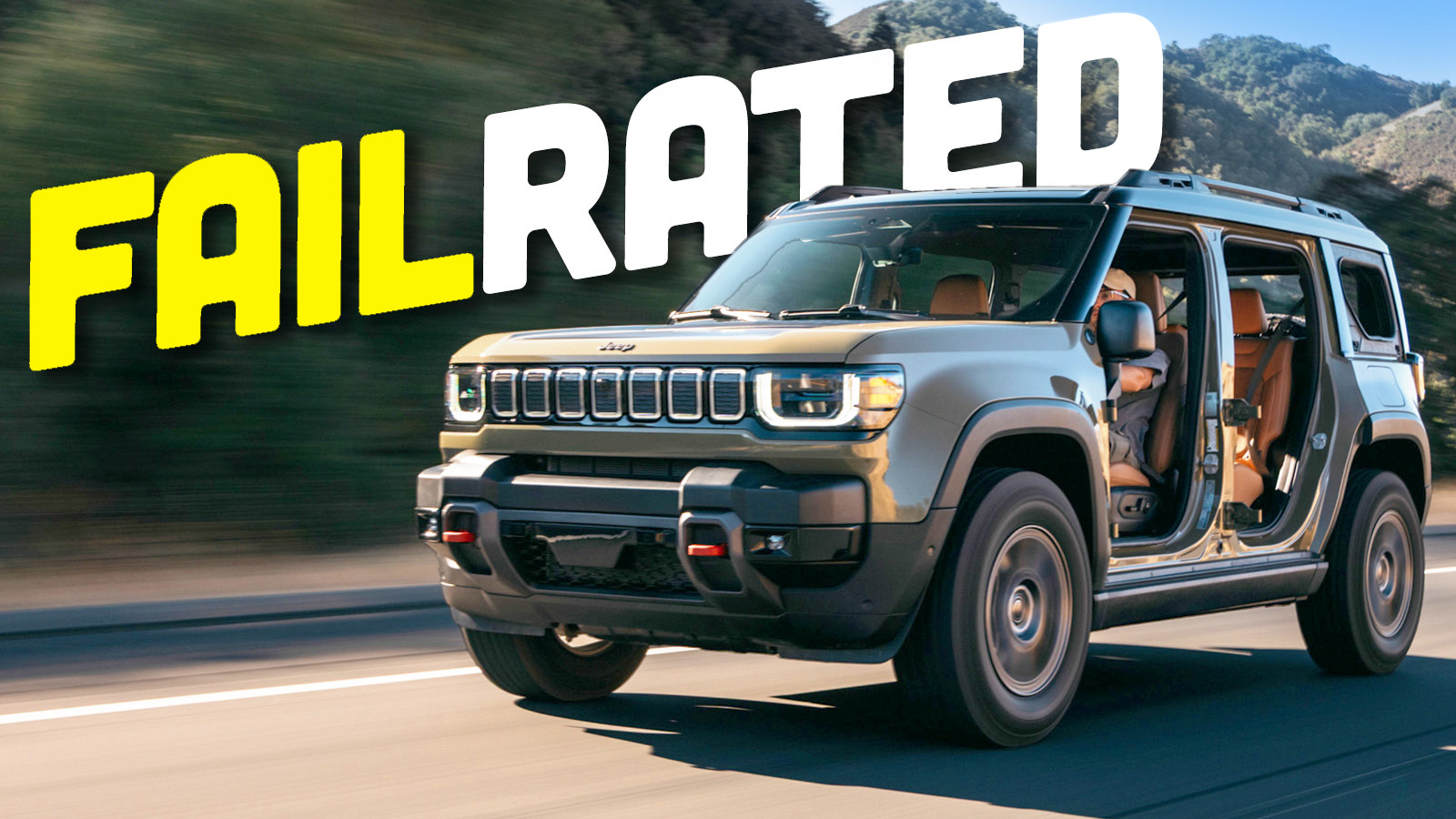
The Jeep Recon was/is the brand’s attempt at making a vehicle that works as both an everyday electric vehicle and an off-roader that’s true to the company’s trail-rated ethos. We haven’t driven it yet, but just from the stats David felt like the Recon could live up to expectations where the road ends.
It’s where the road exists that seems to be a problem for the Recon, and it might explain why the company has sold so few of them so far this year. The most recent sales report shows that the brand has only sold 82 Recons in 2026.


Car And Driver put the new Recon on its highway range test, and the results were almost offensively bad:
The Recon, with its 94-kWh battery pack, managed just 160 miles of range in our test. That result falls well short of the 222 miles of range the Moab launch trim is estimated to deliver, according to the EPA.
That is not great. This isn’t the EPA cycle, but a specific test C/D does that involves charging up an EV to 100% and getting on the highway and driving at 75 miles-per-hour. In this way, it’s probably more indicative of how Americans drive than the EPA test.

A range of 160 miles is just not acceptable out of that big of a battery. An efficiency of just 1.7 miles per kWh puts it in the same company as the original Hummer EV Edition 1 (1.4 m/kWh) and Mercedes-Benz G580 (1.4 m/kWh). The difference between those vehicles and the Recon is that they’re both gigantic.
A better comparison, sizewise, is the Rivian R2. Here’s the range and performance chart for the R2:

The Rivian, with a smaller 87.9 kWh battery, manages to get at least 330 miles even with two motors and AWD on the EPA range test compared to 220 from the Jeep. In the C/D test, the R2 was able to go 260 miles.
We haven’t done a side-by-side comparison, and it’s possible the Jeep is better off-road than the R2 (it’s also possible it’s worse). It doesn’t really matter if you can never get to where you want to off-road.

Even before there were any details out about the Recon, David guessed this might be a problem:
An inefficient overall vehicle design catered towards off-road capability works as an ICE, but in an EV, it causes all sorts of issues. Because it takes so much energy to get down the road thanks to those tires and aerodynamic inefficiencies like high ground clearance and sharp corners, range decreases just like it does on a gas car. But increasing the “tank size” on an EV is both heavy, expensive, and environmentally taxing. I could probably dig up some ABC coefficients from the EPA and roughly calculate how big of a battery, approximately, one might need in order to score 250 miles of range on a modern Jeep Wrangler (I’d have to make a few assumptions); suffice it to say: it’d have to be big. And thus, the vehicle would have to be expensive and heavy and filled with precious metals.
While the Recon has a more aerodynamically efficient design than a Wrangler, it doesn’t seem to matter much. The combination of the elevated ground clearance, inefficient motors, and all-terrain tires just seems to sap real world range.
I like the way the Recon looks (not a universal thought) and the concept of an electric off-roader is appealing to me. I just don’t understand who the customer is for such a compromised vehicle when Rivian’s most expensive R2 is less than the Jeep’s $70,000 price.
Top photo: Jeep


All of the comments about what constitutes acceptable range are really interesting to me, as someone who also has big thoughts and opinions about how far I ought to be able to go on a charge. I’m also someone who passed on the opportunity to buy an ID.buzz (as a longtime VW bus pilot) for the same reason.
This is especially top-of-mind for me given that two weeks ago, I embarked on a 3k mile roadtrip in my aircooled VW Westfalia, from Tulsa to upstate NY and back, making a bit of a loop in the process.
Given a 16-gallon tank and a forecast 14-15mpg, my initial plan was to stop for fuel about every 200 miles. In practice, however, I found myself wanting to keep a closer eye on the general state of the mechanicals, and also wanting to stretch a bit more frequently, so I ended up stopping at 100-mile intervals. Keeping a log of all of my fill-ups, I averaged closer to 17mpg across the breadth of the trip, and I was generally topping up with ~6 gallons of fuel per 100 miles. Using this basic schedule, I was able to travel 758 miles in a single day, from the Eastern Shore of Maryland to a rest stop on I-40 about 30 miles east of Nashville. Not bad!
All of that being said, I was traveling solo, so the time needed to add six gallons of fuel, check the oil, and maybe take a leak added up to 10 minutes max. Having to wait at least twice that amount of time to add meaningful battery capacity seems like it would get annoying in a hurry.
Well Jeep is batting 1000 (3 for 3*) when it comes to their evs as in each utterly and totally uncompetitive in the market, so congratulations I guess?
*
1) EV Charger over priced and under range
2) EV Grand Cherokee… same
3) Ever Recon… same
Fool me once…
Shame on you…
Fool me Twice….
You can’t fool me again
Don’t forget about the Wrangler 4xe fire issues.
Ah in my head I was thinking Jeep attempts thus far at creating full evs and the Wrangler 4xe was a gas-electric hybrid.
Though automakers Do love to throw in their hybrids along with evs calling them ‘electrified’ vehicles.
And in that context you are correct, making it 4 for 4 of failures.
Pls keep in mind I do think ‘dunking on’ any company is not helpful and I do want them to succeed in the move to evs.
In fact this is somewhere I would hope just Maybe David may be able to get some inside baseball insights in to Jeep since once upon a time he worked there.
Learning how and more importantly the ‘whys’ of Jeeps ev failures could prove extremely helpful for other automakers and possibly (hopefully) insightful for engineers, product designers and leaders at Jeep as well.
Possibly with a partnership article / video with a product breakdown company like Munro Associates
Basically, Jeep wasn’t ready to do this right and shouldn’t have done it at all.
I don’t get why these car makers want to dabble into the EV world. They put out a one off that stinks, it won’t sell, then they’ll kill it off in two years. Why bother?
I think that you ought to track down and interview the 82
suckerspeople who actually bought one… I’d be curious of their other life decisions.The low number sounds like a special deal through the employee purchase plan, hoping the visibility spurs sales.
I think Jeep has missed the EV boat, figuratively speaking. Those huge, heavy battery packs are the Achilles heel to off-roading and towing. IC vehicles are better in those areas due to superior energy density in combustible fuel versus batteries. If solid-state batteries ever make it into production EVs, then maybe the field will start to level off. However, solid-state batteries, which have been touted as the cure-all to energy density and lighter battery packs, still appears to be a pipe dream. It is interesting to note in a recent article that heavy duty transport is the new, niche industry for electrification experiencing tremendous growth, quietly thanks to sky-high diesel fuel prices. Cheers.
So, manufacturer of agricultural vehicles and implements fails to make on road vehicles. Who would have thought
There’s a saying – stay in your lane. Jeep brand needs to just make what they are known for. If Stellantis wants to start up an EV brand – just do that.
The bigger surprise to me is that it’s on sale at all. I didn’t realize it had even been released yet.
It surprised a lot of us.
As I Jeep owner, I closely followed the development of the Recon and at one time thought it was a viable option. Last week I took delivery of an R2. Excellent. Does it do off road as well as my Jeep Wrangler JKU Rubicon. Depends on what your doing. It is so nice and quiet. Easy to go at whatever slow speed you choose. It does handle some pretty rugged terrain, but no, it doesn’t have the rock crawler ability of the Jeep. On the road, it is great. So, it is a much better dual purpose vehicle. It is sad that Jeep couldn’t do better. The Recon would have been somewhat OK two years ago, but doesn’t make sense now.
Dude how did you get an R2? I thought they weren’t released yet
They’ve been released for about 2 months now.
I saw a couple of transports loaded with R2s while I was traveling through Virginia last week. I was surprised to see them in the wild, too!
Shit like this is why I went cross country in my Corolla hatchback and tent camped. The thought of stopping to charge every 100 miles is incredibly stupid and the fact that anyone thinks this is a good idea is nuts. You’re destroying everything about your journey to make accommodations for your car. Rubbish
I see your point, and I’m not an EV driver myself but let’s not twist this. Modern EVs can go far, far further than 100miles between charges.
Yeah, in the case of the Jeep Recon they can go 60 miles further!
That’s almost 70 miles!
That is true. But any EV for the trip I did this summer would have required significant compromises, to put it mildly. Couple thousand miles overall with specific destinations at each end that counted on timely driving. As it was, Chicago traffic nearly boned us in the way home. Waking in Minneapolis, drive to Chicago for a movie (Odyssey in IMAX), then immediately driving to see the White Sox game, then hotel out of town. Not impossible with an EV, but no clue where I would charge once I left the hotel that morning. And the EV chargers were broken/dead at the hotel in Indiana. Some not too please people there as a result.
But, yeah, every ICE vehicle is not good for every purpose either. My wife loves her F150, it’s super comfy on the highway, and we take it every time we take out our travel trailer (which is quite a lot). But she hates parking it downtown and will take a smaller more maneuverable vehicle if she is making that trip. Right tool for the job, yadda yadda yadda.
Of course. I did take a Toyota Corolla hatchback…quite nice in the cities
If you drive an EV – your car plans stops at their super chargers in your trip plan. 300 miles of driving is 4 hours plus on the road. Unless you’re some type of savage – the 30 mins break to recharge after 4 hours of driving is a welcome stop any sane human. Also, all hotel chargers are a joke. They just put that so they can say they offer it. Even if they had one – they’re useless.
I will take that first sentence on faith.
Regarding the trip: we went from home to South Dakota, and wanted to do stuff when we were there, so we moved pretty good. Home to Wisconsin, then Wisconsin to South Dakota. Tent camped for a week or so. SD to Minneapolis with enough time to check into the hotel, then went to a Twins game. The next day was the hard one. Minneapolis to Chicago for a movie, then after the movie right to the White Sox game. There was no room for error.
Potty stops (and snack stops) when we stopped for gas. Filling a Corolla tank at 10 gallons is pretty quick.
I never suggested I was sane. But the events mattered, so they took precedent
To be fair, my Mach-E gets 250-ish miles of range on long trips, and I’m ready for a break well before that point. Stop off at a charger, grab some lunch, and it’s topped up enough for the next leg in no longer than I would have wanted to stop anyway.
Now that’s for trips of no longer than 8 hours each way. I’m not interested in cross-country driving no matter what the fuel type is, I’ll just fly.
So, I used to be able to drive forever. Like, cross-country by myself forever. But I’m an old now.
However, after being a guinea pig on the strip, I realized that for me, the key is this: no breakfast. If I have anything for breakfast, certainly anything with carbs, there’s no way I can last too long. I probably can’t make 3 hours without some large amount of caffeine. But on this trip, I didn’t have breakfast on the mornings that I was going to have to drive a long way and I was able to easily pull 12 hours. My daughter slept most of the way, or did her school work on her iPad or laptop. So it worked out perfectly. But again, the key for me is no breakfast.
And I flew this summer to Montreal, which is an international trip. Even though it’s just Canada. I will tell you that Montreal’s airport is the reason why next year, when the wife and I take a trip, we’re driving instead of flying. Montreal’s airport is in the process of construction and it’s a nightmare
All of Montreal is in the process of construction.
I will take your word for this. The Old Port was lovely and largely construction-free
It’s all those ducks on the dashboard that are the problem.
What does an electric duck look like? Is it any different?
Why not just quote Car and Driver for the Rivian range too? They went 260 miles at 75 mph in an R2 performance which costs 62k. 100 miles more for less money!
Very few EVs exceed their EPA rating at 75 mph because most cars, both EV and gas are happier at a lower speed than that. I think the be CLA EV is one of the few that did because it has a 2 speed transmission.
I genuinely forgot about the Recon’s existence. More so, I somehow missed it going on sale. That lack of media blitz is even worse than the total lack of range. Jeep dropped the ball or likely gave up all the way around. It’s a shame, the Recon is a compelling looking package.
Yeah, I didn’t know this existed. I honestly don’t remember reading anything about it at all or ever seeing one or really anything. Did I pass into a parallel world overnight?
I’m with ya there. I remember the Bishop’s article about the doors-off look, but since then I don’t recall this site mentioning anything about it.
How far does anyone want to go without doors?
It’s almost like geo a $100 fare from JFK to AKL but you have to be strapped to the outside of the plane.
When I was younger, the answer was about 100 miles. 80 miles freeway driving and the rest puttering around. This was in a 70’s CJ5. The buffeting from the wind was neck-straining and the outside weather and wildlife was often in my face.
Now, preferably never over 20 mph anywhere. And prefer doors to that “open air experience.”
The range might suck, but at least it’s overpriced …
* half the range you routinely get in 2026
* $70k
Sign me up!
Just want to point out that used this is a very Autopian vehicle. The bad ones are sometimes the good ones
This feels like a vehicle that will be cool to own down the line (especially since they’ve sold essentially none of them), but good lord there is just no way to justify the price given the crap performance. It’s embarrassing!
I realize its apples and oranges, but there is a company that will EV swap an 80 series with a leaf (battery and motor) and with only 30 kwhr they can do at least 45 miles of range. 45 miles of range is damn near worthless, but its an EXTEMELY inefficient car with a lift, big tires, and a shed conversion. How did it do SO bad?
Given current battery chemistry constraints, I’m usually of the philosophy of “throw more battery at the problem” in order to achieve the desired range.
But there is a limit. 160 miles out of a 94kwh pack is embarrassing no matter the shape of the vehicle.
To get a decent 250 mile highway range to match the R2, it would need a 150kwh battery. To get a more desirable 300, it would need 180kwh.
And that’s just extrapolating these figures, it would almost certainly need more due to the efficiency loss of even greater weight.
I honestly don’t think aero and tires are the only culprits here. The Hummer being nearly as efficient shows something is seriously wrong with the way this Recon is set up beyond just general shape.
“ To get a decent 250 mile highway range to match the R2, it would need a 150kwh battery. To get a more desirable 300, it would need 180kwh.”
You would need even more battery pack for the ranges mentioned because you are adding more mass and reducing your range efficiency (miles/kWh).
This phenomena is known as the Law of Diminishing returns and in this case is due to mass compounding efficiency loss.
The only reason as time cares about range is because charging takes so long and is not uniformly available or cheap compared to home charging.
Tesla figured that out, I don’t understand why nobody else is selling accessibility to charging rather than range,
Nothing is keeping automakers from selling ice cars with 3,000 Miles of range other than total lack or demand
The recon has a different problem being an “off-road” vehicle. With only 160 miles of highway range there are trailheads that are essentially impossible for this vehicle to get to and get back to a level 3 charger.
I guess the EV equivalent of a Jerry can is still on the to do list.
“Diminishing returns” is what Stellantis excels at, unless we’re talking recalls.
Well played!
Weight has very little effect on (highway) range of an EV so battery only a few percent bigger.
I agree. Aero would have a more significant impact at highway speeds. It’s still not a linear relationship between mass/battery capacity and range.
Height adjustable air suspension and active air dams are the solution
In fairness, a bigger gas tank that gets used is also environmentally-taxing.
To be fairrrr!
Is it? A few more bucks of Metal a tiny loss at the beginning because a few more pounds. But really of the tank is 15 gallons or 30 gallons I doubt the environmental damage is any different. In fact the biggest tank might be more friendly due to fewer slow down and refill miles
I was more referring to the idea that either “bigger” was facilitating a larger and more inefficient vehicle that would use more fuel regardless.
On an identical vehicle used in an identical way, you’re probably correct. More refill stops would add up in a way more charging stops probably wouldn’t.
Missed the point entirely.
I think the point hasn’t been missed so much as ignored.
This was always not going to get great range do to the inherently draggy body style, but Stellantis’s heavy underinvestment into EV tech exacerbated things. The Wagoneer S which uses similar/same components gets 15-20% worse EPA range/kWh than others in the segment despite having a pretty egglike rear (and hiding the profile with a wing), and real world range seems to be another ~10% lower.
If it had a best-in-class powertrain and less knobby tires, I think the Recon would get low-200 miles at 75mph, but nowhere close to 250mi without increasing battery capacity.
Gee – it’s almost like driving a fully-loaded backyard shed-shaped-thing on stilts with big knobby tires down the road at 75mph isn’t the most efficient way to propel oneself…….regardless of what kind of motor you use to push it.
Who knew?
Did they run the test with the doors off? The photos indicate they ran the test with the doors off. I’m fairly confident that aerodynamics are significantly worse with the doors off. If so, how bad is it with doors on? If not, why do all the photos show it with doors off?
75 without the doors? That’s certifiably nuts
Yeah, that’s pretty extreme masochism.
It’s a Jeep Thing.
It’s preparation for when the thing rusts out and the doors fall off.
It’s only for an hour and a half
That’s worth finding out as it would make this whole article moot!
You could tow it with a Ram 1500. Might help Stellantis sales figures. Could be used as a power source when you get to where you are going.
Thats why they’re counting on Ram sales growing so much. You have to buy one to tow your Jeep Recon to the trail.
Didn’t ram sales actually beat jeep sales for the first time ever?
But it wouldn’t have any power left. Charging it at the campground only to use it at the campground then nothing to get home that’s Ridiculous. Image Ridiculous popping in here since we can’t do memes yet.
That’s why you need to buy a 1500 to tow it with. Stellantis could come up with a package deal. You could install a generator to charge your short range Jeep in the bed of the 1500. I’m sure it’s a practical solution in there somewhere.
I just bought a new Rivian R2. It doesn’t get anywhere near its stated highway range either, especially with the all-terrain tires and smaller wheels, as mine has. This is because of the boxy shape and how Rivian chose to rate the thing.
But it’s much closer.
And with fast charging, I’m fine with the range it gets.
I bet those tires are the culprit. How’s the R2?
I mean, even with the 21″ wheels and street tires, the all-highway range is still not fantastic. The reason I went with the smaller wheels is that it’s more sidewall and there are more options for tires with that size, whereas there’s just one tire option readily available for the 21″ wheels. I can absolutely switch out the all-terrain tires for regular all-season ones, if I choose.
Experience-wise, the R2 is a bit glitchy, but surprisingly less so than any number of vehicles I’ve had from legacy automakers who ought to know better, and it even seems to be going better for me than for other people with new R2s. For example, I’ve not had any trouble with the Phone-as-a-Key operation. It locks when I walk away from the car with my phone, and unlocks when I approach it and allows me to start it just fine. Fit and finish is short of Lexus or Mercedes-Benz levels, but it’s competitive with, say, GM (and the Cadillac Lyriq I had in the past). And if you’re not doing a 75-mph trip on the highway, it’s pretty efficient, too; I’m averaging about 3.6 mi/kWh currently.
For me, I understand that new cars are going to have issues, especially new products from a fledgling automaker. So it comes down to:
a) To what extent those issues can be remediated post-manufacture and post-purchase, and
b) What the customer service experience is like when I do bring up those issues
I’ve had it for just over a week, but so far I’m impressed with the customer service. I made an appointment to get the slightly misaligned panels corrected and address some interior rattles; the local service center gave me a loaner and had it done within a few hours.
I am less impressed with the cultiness of some of the Rivian fans, who can’t seem to tolerate any criticism levied toward the R2 or Rivian itself, and when people voice very valid concerns about the present state of QC—or who let us know that they’re going to go with another brand/product because of it—the fanboys respond with rude, sarcastic and unhelpful rhetoric. It’s reminding me a lot of Tesla Bros, or the Toyota Truck people, for all the wrong reasons, and I don’t want to be associated with it.
I need to ask regular vehicles can switch from seasonal to snow tires, race cars can change tires 4 times in a race, they can switch from slicks to rain tires, why can’t these switch from road to off road tires?
I suspect that headlight aiming, and brake dive as well as brake proportioning are all factors. All of those could be electronically dealt with. Modern stability control can give the greasiest of pigs cutting horse handling.
They can and they do. If I were living somewhere with real winter weather, I would absolutely have winter tires.
Congratulations on the purchase!
A lot of ink has been spilled regarding the R2 not meeting its range estimates. I think the EPA having multiple tests the automaker can choose from (and the consumer being blind to which one was used) is a huge transparency issue in the whole rating system.
330 EPA for the R2 in no way means it should do 330 at 75mph. But that’s how a lot of naysayers are choosing to interpret it.
In any case, super jealous from an American living overseas where we don’t get Rivians!
Winter is coming. My range drops 20% in the cold.