

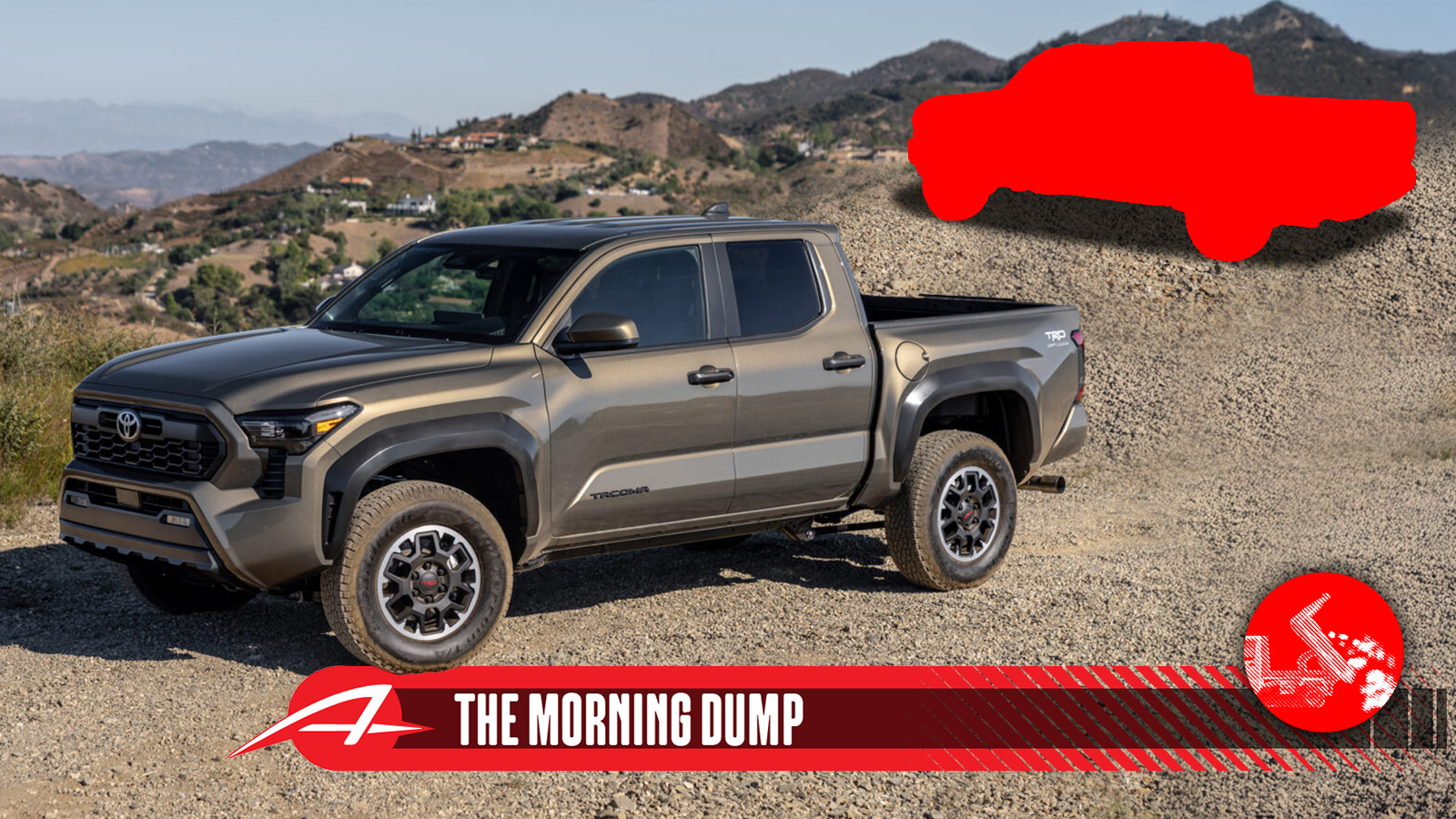
It’s happening. Kia has officially announced that it’ll be bringing a pickup truck to the United States. Not only that, it’ll offer a mixture of hybrid and EREV powertrains. This is the future we’ve all been waiting for, although it’s going not exactly going to be the near future. The Morning Dump has time. The Morning Dump is patient. The Morning Dump is starting to worry that it’s talking about itself in the third person. Is The Morning Dump sentient? Maybe.
While Kia is going to wait a while to get a truck to market, Ford seems to be hoping to get relief from the government on tariffs so it can build trucks now. The response from the White House is a little puzzling. GM’s response to a bunch of Chevy Malibu rear-view cameras failing is a little more straightforward.


And, finally, China’s exports boomed in March. Coincidentally, maybe, Mercedes has seen its exports fall at the same time.
Will The Kia EREV Truck Beat The Scout To Market?

Full disclosure: If you ask me the name of the truck above I will say it’s the Kia Talisman. That’s kind of a cool name, right? The Talisman! It’s actually the Kia Tasman, named for the Tasman sea, which means it’s one of the only cars I can think of named for a Dutch seafarer.
The truck looks strange, and was developed mostly for the Australian and New Zealand market. It’s not for us Yanks, but it is Kia’s first modern attempt at building a body-on-frame truck. Given how strong midsize truck sales have been in the United States, it makes a lot of sense that Kia is trying to get into this market.
What will it be though? There are now numerous electric trucks on the market (R1T, Cybertruck, Lightning, Sierra EV, Silverado EV, Hummer EV, and maybe the Slate truck soon) all fighting for a tiny share of the total truck market. A purely electric truck probably doesn’t make sense.
At Kia’s big Investor Day in Seoul, Kia CEO Ho Sung Song outlined some ambitious targets. He expects the brand, which sold about 850,000 cars in the United States last year, to hit the million mark by 2030. More hybrids is a big part of it (a K4 Hybrid is in the works), and that includes a hybrid/EREV pickup. Here’s what he said according to the transcript:
In 2025, Kia successfully entered the pick-up truck market in emerging economies with the launch of the Tasman, demonstrating strong product competitiveness. Looking ahead to 2030, Kia will expand into North America —the key global pick-up market —by introducing a dedicated HEV/EREV pick -up, built on our core HEV technology.
According to Automotive News, there’s a teaser of the truck out there, but I haven’t seen it yet as the company hasn’t posted its 2026 Investor Day video. If someone has seen it please send it over to me.
The plan is to hit around 90,000 trucks annually starting around 2030, reaching 7% of a market currently dominated by the Tacoma by 2034. That’s not a lot of trucks. Ford sold roughly 70,000 Rangers last year, by comparison, and 155,000 Mavericks.
Because it’ll almost certainly share a platform with the Hyundai truck previewed by the Crater concept, the fact that it’ll be hybrid and EREV isn’t much of a surprise. The big open question is whether or not they’ll be a full EV version. I guess the other question is whether it might end up beating the Scout to market given how slow that truck has been to develop.
Ford Didn’t Beg The White House Hard Enough, I Guess?

It’s hard to say what Ford’s sales would be if it wasn’t constrained by two fires at its main aluminum supplier, which is a necessary material for the F-150. Ford has said it has a plan, although supply isn’t likely to catch up to demand until the second half of the year.
Normally, an automaker would just try to grab whatever aluminum it could find on the global market. The challenge here is that Ford has been getting aluminum from a facility in New York, and the only automotive grade aluminum that isn’t spoken for seems to be available outside of the United States. The White House has put tariffs on imported aluminum, meaning a potential hit either to Ford’s profits or to the price of these trucks.
Because of that, Ford has reportedly reached out to the White House for temporary tariff relief and, per Reuters, didn’t reach out hard enough, with an official telling them:
“While Ford and other automakers have raised supply concerns in light of the Novelis incident, they have not requested tariff relief on this matter in a particularly pronounced way,” the official said
What does that even mean? They didn’t beg hard enough? That’s so weird!
GM Recalls 270,000 Cars For Backup Cameras That Might Fail

Here’s what’s interesting to me in this recall report from General Motors involving backup cameras on its 2023-2025 Chevy Malibu. It’s not that a backup camera might fail, as that’s something that’ll happen with certain cars. It’s not great, but it seems like an easily fixable problem.
What jumped out to me is this number: 271,770.
That’s the potential number of vehicles affected. That means that GM sold more than 270,000 sedans in recent history. That’s a lot of vehicles. Maybe we need more sedans?
China Is Exporting A lot Of Cars

No surprise, the total number of cars exported in China jumped a bunch according to Bloomberg:
Overseas shipments jumped 140% from a year earlier to 349,000 units, according to data from China Passenger Car Association released on Thursday. BYD Co., the world’s largest EV maker, accounted for about a third of the total, with Geely Automobile Holdings Ltd. and Chery Automobile Co. rounding out the top three exporters for the month, it said.
Rising fuel prices due to the Iran war are enticing buyers back to EVs and hybrids, with showrooms across Asia bustling in the past month as consumers look to shield themselves from volatile pricing at the pump. While it’s unclear how much of a lift the sector will get from the energy shock, data from the UK released earlier this month showed electric car sales climbed to a record in March.
“Chinese automakers can quickly increase their global reach during the Strait of Hormuz crisis,” PCA Secretary General Cui Dongshu said at a briefing. There was a similar shift toward fuel-efficient vehicles made by Japanese carmakers during the oil crisis of the 1970s, he said.
Strike while the iron is on fire, I guess. At the same time, another Bloomberg report shows how much Mercedes has faltered in its own exports in this complicated new world:
The manufacturer’s global deliveries dropped 6% to 499,700 vehicles, as a worsening slump in China outweighed gains in Europe and the US. Its sales in the world’s largest auto market tumbled 27% — a steeper fall than the 19% decline in the fourth quarter.
Demand for high-end vehicles in China remains subdued, while domestic brands continue to gain share. Mercedes has refreshed key models, including its flagship S-Class, to fend off competition from rivals such as Huawei Technologies Co.’s Maextro S800 sedan. The German company previously warned that margins will remain under pressure this year.
Maybe the new CLA will help?
What I’m Listening To While Writing TMD
Here’s another one from my buddy who owns more digital music than any other 20 people I know combined. It’s Chiaré with “Zanzare”
The Big Question
What does a truck need to do in order to succeed in the United States?


To succeed a truck just needs to make people have the impression that they do tough outdoorsy things way off pavement instead of just commute to desk jobs.
That feels like everything these days.
Along with “How angry can your car make you look?”