

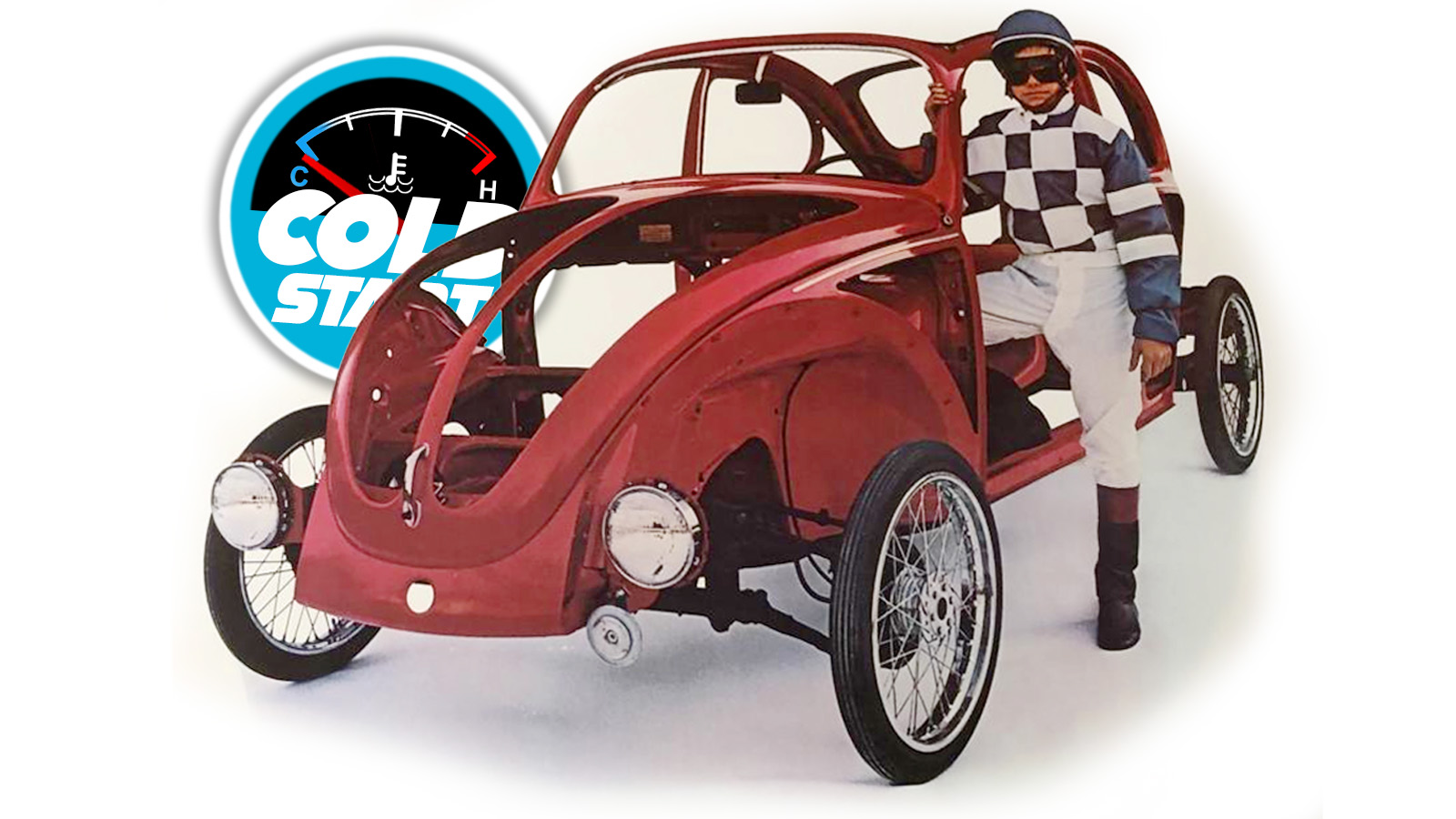
Volkswagen was once known for their advertising. The golden age of VW advertising is long gone, but back in the ’60s and ’70s, Volkswagen’s Dole Dane Bernbach-led ad campaigns were the stuff of legend, and are still taught in advertising classes today. They were honest, witty, simple, and powerful. I want to talk about one of their ads today, maybe not one of their best or even best-known ones, but an interesting one nevertheless.
It’s an ad from 1974 about fuel economy, and features a Beetle that gets 84 mpg.


That is, of course, significantly higher than what Beetles actually achieved MPG-wise, which, in my many years of experience seems to be somewhere between 25 and 32 mpg or so. Which was great for the time! 84 mpg is, of course, bonkers, and the whole point of this ad was to show that you can’t really take most cars’ mpg claims at face value.
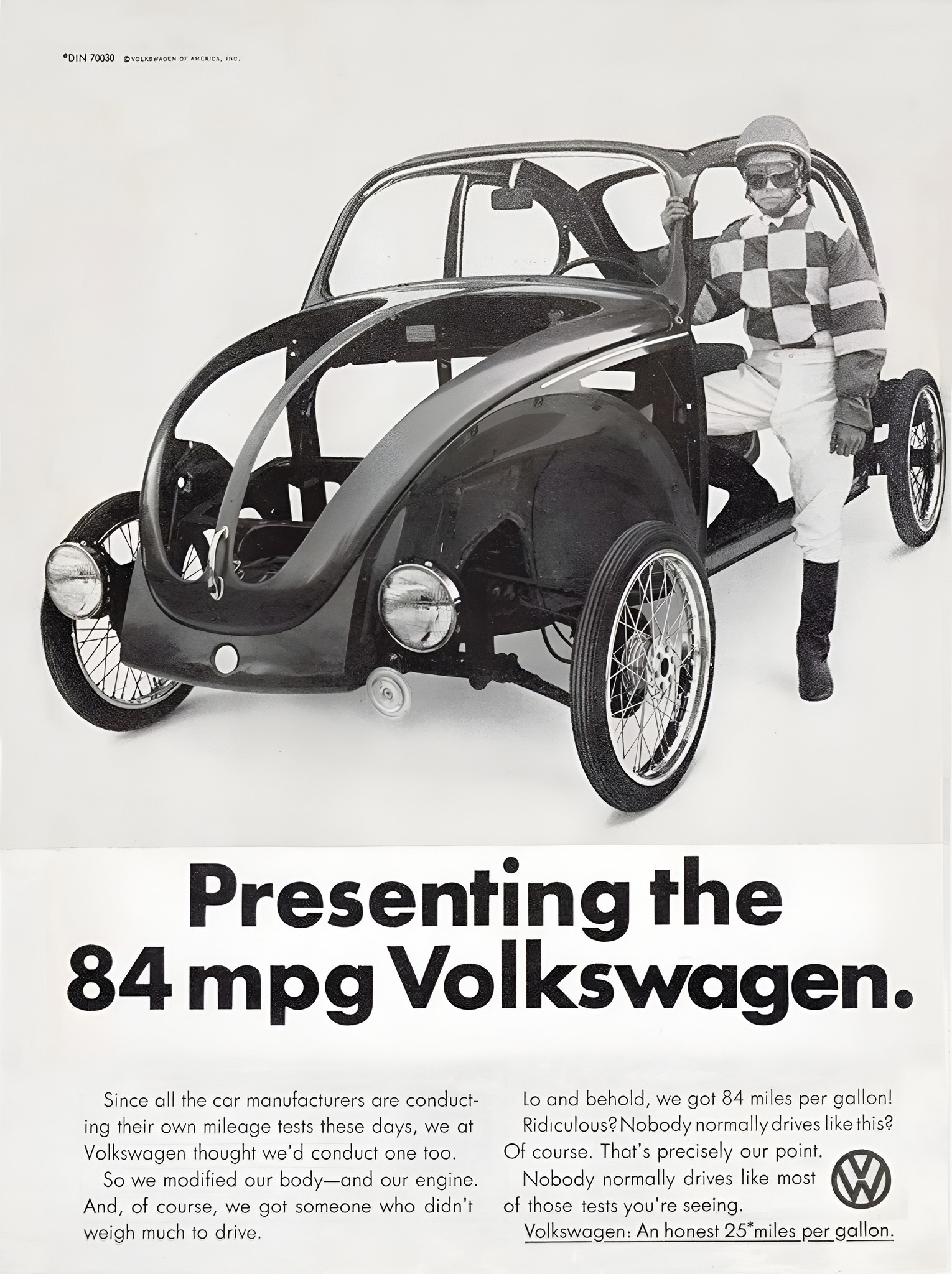
The ad shows a Beetle that gets 84 mpg, and as you can see, it’s pretty dramatically stripped down, a skeletal sketch of what a Beetle should be, an open framework with one plastic seat, bicycle or maybe motorcycle wire wheels, and driven by a small jockey, in full jockey regalia. I bet they could have gotten to 85 if they made the jockey drive nude, but society wasn’t ready for that back in 1974.
There was a television commercial version of this ad as well:
I’ve never really seen much about this modified car, online or otherwise. I do not believe VW currently still has this car in any of their collections – I could be wrong, and hope I am – because I’ve never seen it displayed or even mentioned by the company, and you’d think it’d have surfaced at least a few times, right?
I’m very curious about what was done to the car, exactly. Clearly, most of the bodywork has been cut away, usually following the character lines of the car. All four fenders are gone, with the headlights and taillights (and horn) mounted to the front and rear aprons, the front apron even lacks the little round access hole cover, it appears that much of the floorpan has been removed, as has all of the glass, interior, and I think rear brakes, even? The front and rear shock absorbers seem to have been deleted, too.
I can see the battery, near its usual location under where the back seat would normally be (but centered here, on the backbone of the chassis), but I can’t quite tell where the fuel tank is here; it no longer seems to be forming the floor of the trunk up front there. It’s funny they left the front hood handle, even through the hood is mostly air.
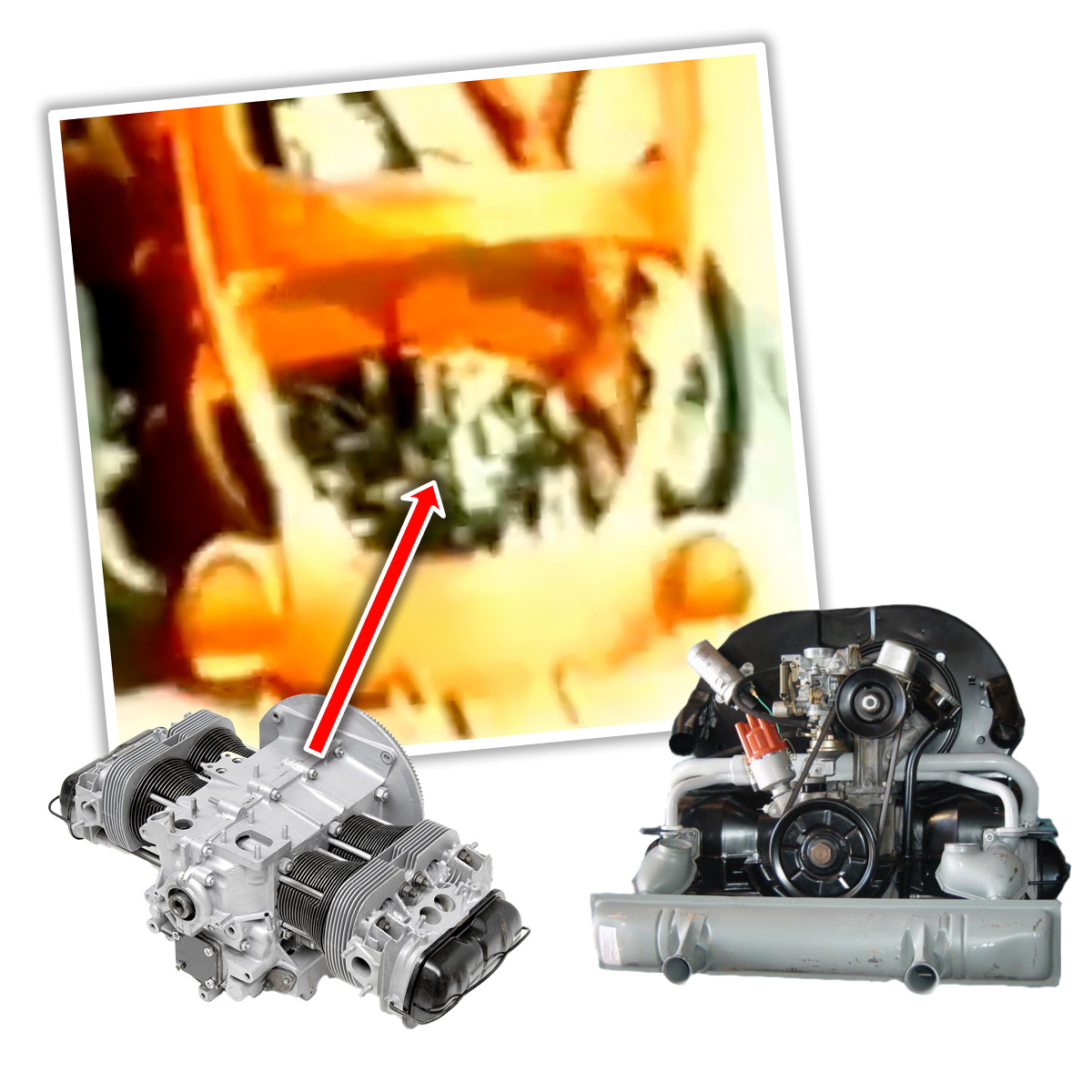
Around back, it looks like the engine is missing most of the cooling tin, and along with that the fan, alternator, oil cooler, and really most everything above the intake manifold. Above you can see a normally-outfitted VW engine, with fan shroud and alternator and cooling tin in place, and on the left is a bare VW longblock, which seems to be close to the condition of the engine in that stripped-down 84 mpg Beetle. So I’m guessing they didn’t drive this for long periods of time, seeing as how it seems to lack not just an alternator but also most of the cooling hardware.
I wonder how light they got it down to; a normal Beetle of that era would have weighed between, oh, 1600 and 1800 pounds or so; I bet this is something like 700 pounds? Maybe?
I’d really love to see some better pictures of this remarkable and absurd experiment in efficiency, but all I can find are the one from the ad and these grainy old commercials.
Speaking of the commercial, I also find this typography puzzling:
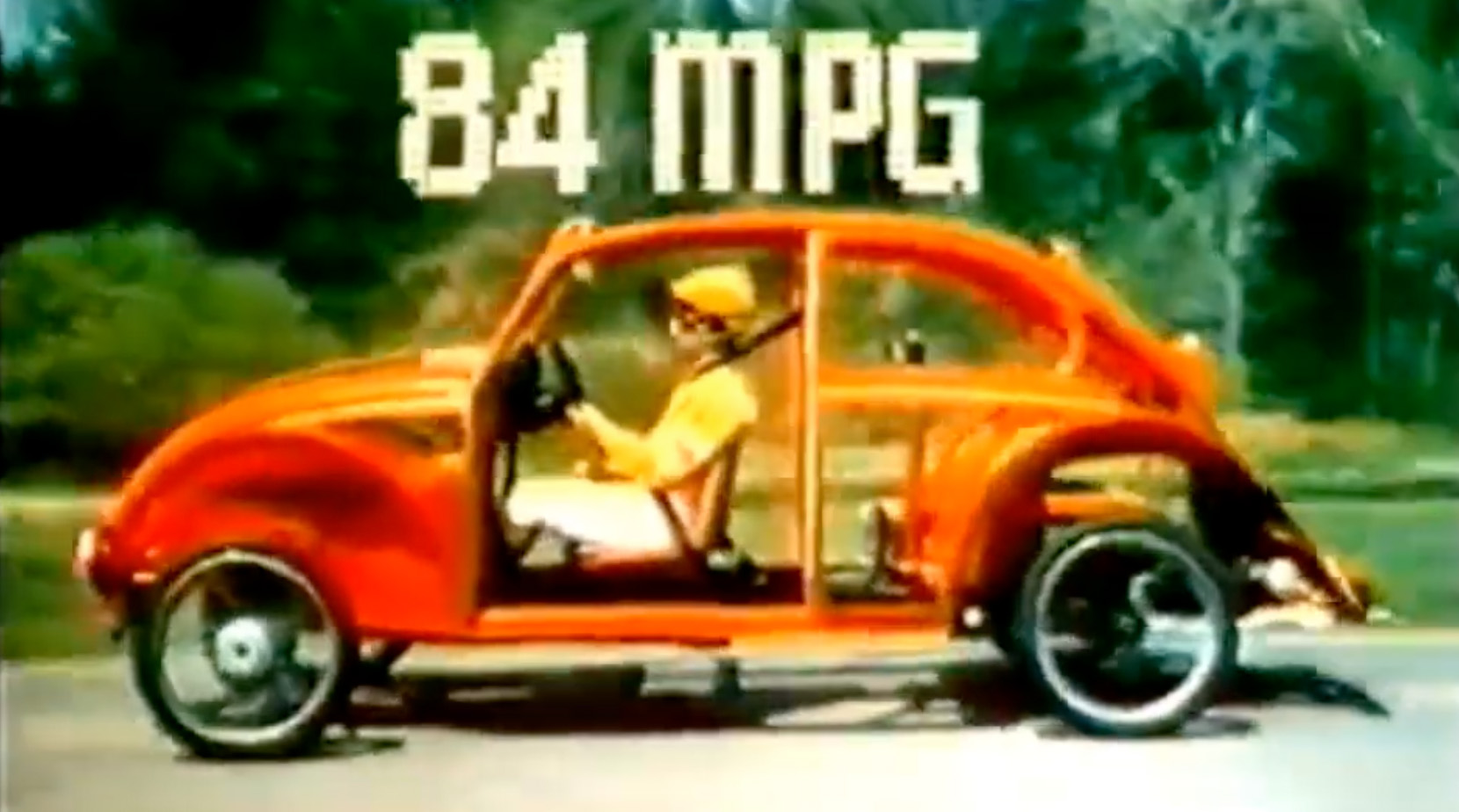
What’s with that very pixellated-looking text there? Are those letters and numbers made of Legos? They look a little dimensional. 1974 was too early for lo-resolution typography like that, and those don’t look like crude character-generator letters. They really look more physical, and, yeah, like Legos. This was not a normal sort of typography for the era; what exactly is going on there?
So many mysteries! I’ll keep looking for more information about this breezy 84 mpg Beetle; I bet more pictures have to be around somewhere, right?
I bet this thing was a good bit quicker than a normal Beetle, too? I wonder if they tested that as well?


I love the horn hanging down low on its left side.
The stripped-down engine looks a lot like the 100 HP Continental O-200 in my old Cessna 150G. It was a shared airplane in the early 90’s. I bought my quarter share for $3,500. I was shocked to see what they are going for now. Spoiler alert: you are not going to find one for $14K. Or even the inflation adjusted rate of $30K. Most are going for double that. I sold my share after 9/11 when airspace around Seattle got so weird and Avgas was $6/gallon.
It was a fun, easy plane to fly. Not fast, but sturdy like a John Deere. Which it wasn’t much more complicated than.
Imagine being able to fit in a VW Beetle with a driver’s seat THAT close to the steering wheel.
I read once that when homologating the mpg of its 605 to UTAC mpg tests, Peugeot ran it with 145 tires instead of the regular 205 or 215 and with 600cc of engine oil total. Those were the known things.
Well, yeah, if you can’t afford a pinto with a lawnmower carb.
Torch I feel Autopian is getting away from the weird and the reg6car things. Maybe get back to that.
Someone call Bertel Schmitt and ask him. I bet he knows. Not saying give him a byline…
It was not in my bingo cards to see Bertel mentioned anywhere in any context. That’s a deep TTAC reference.
Some of those “back in the day” advertising stories were epic, but the behind the scenes on the LFA was peak.
Doyle.
Dole were the bananas – and the politician 😉
Scott Joplin’s The Entertainer (second part of the song) was not what I was expecting as that commercial’s background music, but it fits perfectly.
I went to school with a kid who played that on the piano ALL THE FUCKING TIME. A the end of the year I graduated and figured I wouldn’t have to hear the entertainer ever again. Little did I know that the kid’s father was directing The Sting, and in a few months that song would ubiquitous.
The movie is great, the music, although also great, still makes me want throw rocks and small furniture when I hear it.
You went to school (and were annoyed with) with George Roy Hill’s kid? That’s incredible! I’m getting an extra lolol out of the whole premise as I was that kid. Well, with the exception of having a famous director as a dad, but I did play that song all the time throughout high school as I didn’t start learning piano until late in 6th grade and that was the first “real” song I learned. I ended up learning three other versions, the final being the actual song from the Scott Joplin Complete Piano Rags songbook. Got to play the entire thing with all the repeats and had a flute accompaniment at a high school music concert my senior year. I finally had it in memory with the bugs worked out.
It had became a sort of signature thing and a number of class mates seemed to like it as the student council hatched a plan to have some classmates push me out on the floor during commencement while playing it. That certainly would have been fun, but the principle said yeah… no.
I see now that it may have actually been annoying the shit out of some of the other students 🙂
Two of them actually, in boarding school. Owens and John. John was the one playing The Entertainer all the time.
At least the entertainer has the advantage of being endlessly mutable in terms of timing, so it’s almost improvisation; to hear it played very mechanically, as one usually does, is especially annoying.
They kept it a secret until a class where we were studying Slaughterhouse Five. There was something the teacher said about the film adaptation that his daughter couldn’t let go. “My father and Kurt were talking about that, and Kurt said…” pretty much blew their cover.
GM did the same thing with an Opel station wagon and got 376 miles per gallon in 1973
https://www.greencarreports.com/news/1046792_world-record-gas-mileage-champ-for-sale-from-1959-for-425k-ahem
Interestingly a lot of effort was put into making the engine run as hot as possible, which totally makes sense when you think about it.
Gotta run deeply lean if you want the MPG’s.
I have not read about the Opel car in years, but I think the fuel mixture was not uniform in the combustion chamber, so that over all it was very lean, but around the spark plug it was richer. Sort of like what Honda did with the CVCC. Of course now with fuel injection, that’s a piece of cake. With carburetors it was a bit more difficult. Opel used a Tillotson lawnmower carburetor and boiled rather than atomized the gasoline. I don’t know how they achieved their localized charge.
My ’00 Honda Insight 5-speed had a very effective lean burn, a feature they didn’t give the automatic. Then via a factory recall, Honda updated the BMS and EMS systems which took away both lean burn AND programmed the hybrid battery to both accelerate and regenerate slower in a bid to squeak the IMA battery packs jussssst past the warranty expiration dates.
Voila: my 70mpg car became a 55mpg car and was far less fun to drive. I was so upset about that and my $5000 battery cratering two weeks after the warranty ended that I vowed to not buy another Honda ever again. This should’ve been a class action lawsuit …
if you guys want a challenge make a hypermiling Beetle and see if it can beat 84mpg
The aero on that looks horrendous! They could at least have taped on some cardboard panels over the holes
I’m reminded of the ultra-stripped “Minis” that get used for Gymkhana that are basically a flat pan with an engine up front, one seat, and a roll bar. (https://www.youtube.com/shorts/spXj-LVSBWs)
At first glance that top shot made me think this would be another update on your 2CV.
I’ve heard that the Lego faithful don’t pluralize with a trailing S because “Lego” is a system. Therefore the characters in the ad are not “Legos” but rather “Lego” or “Lego bricks.”
Well, that’s what I heard!
*LEGO
Calling the bricks ‘legos’ seems to be peculiar to the US. In UK English they’re Lego bricks.
I know the company would prefer to be called LEGO, but I can’t be bothered to type that every time.
That is correct. Also I’m glad others bridle at that or at least notice it, because it drives me crazy.
Nobody normally drives like this, but lots of people drive for better mileage. And some of them wrench for it, too.
Starting in 2006, Hot VWs Magazine started a series they called “Project Mileage Master” and it’s really something. Starting with an as-square-as-possible (without using custom components) they built up an engine that actually delivered pretty good power on the dyno, freshened everything up, increased the rotating mass (for reasons I don’t remember) and balanced everything. They didn’t even screw it into a car until about the fifth or sixth installment.
One thing they did was do a before/after test on the car that got the new engine. Unimproved as received, it delivered 20.2 MPG. Not bad for an old aircooled machine that hadn’t received more than minimal maintenance.
Simply swapping in the new engine yielded a big bump: 28 MPG. The new engine made a lot more power than the original and hadn’t yet received the benefit of regearing to take advantage of the new, fatter power curve, but already it was doing better than could be expected of an old Beetle.
For good measure, they then gave the car a good chassis tune, making sure all the wheels were pointed the right direction (they weren’t), that none of the brakes were dragging (they were) and that everything else was more or less sorted. This was a comprehensive piece of work and yielded big results: nearly 30 MPG and now the car was handling really well.
I won’t give it all away but the final results were banging deep into the upper 30s repeatably and in normal traffic, keeping up with 65mph highways and some surface streets too. It’s one of my favorite magazine article series and I come back to it and read it again every few years.
Find it here: https://www.cbperformance.com/Articles.asp?ID=300
Thanks for sharing! Will definitely spend the rest of the day reading the series.
Wanting to keep the rotating mass high is a weird goal. It might help with conservation of energy at highway speeds, but it’ll definitely hurt in stop and go which is arguably where you probably want to make the most gains as it’s the least efficient.
I think it’s to smooth out the engine – it being an opposed flat four though, I wonder if that’s even necessary – and improve driveability. A big, heavy flywheel makes pulling away from stoplights easier once you’ve developed the habit of giving the throttle a little goose before engaging the clutch.
I once went from a 22lb flywheel to an 8.5lb one and that thing rev’d just from the forces exerted by looking at the throttle. Heavier mass is definitely way more streetable! Plus the lightweight flywheel amplifies gearbox noise and the car sounded like it had a woodpecker under the hood when idling.
Makes me wonder how far those older air cooled engines could go with modern engine management. Direct FI, electronic ignition, modern emissions, maybe use the Atkinson cycle, etc.
Or fuck it, swap in a Subaru motor 😉
Looking at car ads and car brands today, no one is planting a flag on being inexpensive. I suspect that 30 years of MBA thinking has made every marketing department believe that “cheap” is a dirty word that will “devalue” the brand.
That’s pretty weird. 1970s VW, Datsun, Honda and Toyota ads were ALL about saving money. With high(er) interest rates, expensive gas and horrible pressure on working people it really feels like the moment to dust off that strategy and give it another shot.
Every body wants to be “up market”. Follow the herd…
If you set a higher price, you can have a “sale” and everyone thinks they are getting a bargain. Set a low price and raise it and people think they are getting gouged.
Most people presented with their choice of a $60,000 car and a $50,000 car for $50000 will choose the $60000 car.
That’s the Jos. A. Bank business model – sell “$500” suits “on sale” for $99.00 buy one/get one free, except for the like 3 weeks a year when they’re not running a sale
Macy’s of California used to always be having everything in sale all the time. Then the state told them not to do that, so they had a sale every day except Tuesday.
Oh, they still talk about how being affordable is all the rage.
But it’s all measured on payments, rather than the actual price you’re paying.
$99 (small print: per week) FINANCING (small print: for 96months for approved applicants only with limited discounts applied)
That’s only on the one stock number and that vehicle is most likely gone by the time you get there lol
Years later, and in a similar vein, Hot Rod Magazine had an article called “Caddy Hack”. However, their goal was performance instead of fuel economy.
They started with a 472 ci RWD Cadillac Coupe deVille. In stages, they removed everything that wasn’t necessary for the operation of the car. In the end, they cut 4 seconds off the 1/4 mile time and added 20mph.
The article is archived here: https://www.hotrod.com/features/caddy-hack-february-1987-982-1348-26-1
I still recall the 80’s rabbit (Beatle Replacement) with a 1.6 diesel and a 5 speed manual trans. Mom really wanted and loved that thing, to which she promptly wrecked it. But it supposedly got 50+ MPG. I was too young to confirm really, but yeah, 50 or so HP and probably weighed less than a full dress Harley of that timeframe.
with a tiny diesel, and a 55 mph speed limit, totally doable. My first car was an 82 civic with a 1500cc and 5spd. Even at almost 15 years old by the time I got the old girl it would return low 40s as long as I didn’t go above 65. That 55mph speed limit helped a lot!
I kept accurate records for my 1980 Rabbit Diesel. It was a USA manufactured 4 door. It was getting 45 mpg until I started using Arco Graphite oil. It then got 48.
I’ve been a diesel driver ever since.
Volkswagen complaining about other manufactures achieving test scores by running the car in a different configuration than real life? Hmmm…
That’s where they got the idea! 😉
The text overlay looks like some kind of crude digital signage made up of a grid of lightbulbs, like used to be outside a bank that told you the time and temperature.
Torch, my young friend, let me tell you about the streaking fad of this era. If VW had really been ‘with it’, they might have reached 85+ mpg with ease!
I hollered up at Ethel, I said, “Don’t look, Ethel!”
Too late, she’d already got a free shot.
…Fastest thing on two feet.
If there’s an audience to be found, he’ll be streaking it ’round.
That’s why they call him the Streak!
MPG “races” were a thing in the 1970s, which inspired this episode of the old high school dramedy Room 222.
https://youtu.be/2gLogjEI1EE
The rules varied, but it was typical for cars to crawl around the course and get stripped down as much as the rules allowed too the point where they weren’t really safe. This looks like an extreme version.
Probably the only episode I can remember from that show. Gonna watch it now.
Can’t wait for the Toecutter review of this Beetle.
That MPG figure would only be achievable at speeds < 25 mph given the added aerodynamic drag from removing the panels. Drive a normal Beetle at that speed, and it might get 50 mpg.
Part of me wants to believe that the weight savings here are substantial and quite helpful towards high MPGs.
But the other part of me believes that the same thing could have been accomplished with body panels made of lightweight fiberglass with some wheel skirts? The Beetle was already pretty aerodynamic, no?
I get the ad, ‘keep the car’s image the same…’, but wouldn’t the negative aero impact of the ‘weight loss via giant speed holes’ outweigh the benefit at a certain point?
I’m guessing they kept it around 20-25mph at which point aerodynamics wouldn’t matter much. There’s no rule that an MPG test has to be run at freeway speeds.
I’d guess they felt the entertainment impact wouldn’t have been there without the skeletal look of the car. They probably wanted you to see that the thing was totally gutted. That said, they could have just driven at 15 or 20 mph to achieve the fuel economy, where aero plays a much smaller role anyhow
As per Hemmings, the VW Bus (after some tweaks) was more aerodynamic than the Beetle (0.42-44 vs 0.48), which makes it seem baffling they didn’t think to take the Beetle to a wind tunnel as well. From what I can find, a Fiat 500 was 0.38, and by the mid 70’s, low 40’s looks pretty normal (like the Mk1 Golf at 0.42).
https://www.hemmings.com/stories/which-had-better-aerodynamics-the-volkswagen-beetle-or-the-volkswagen-bus/
A minor but important nitpick here: the drag coefficient is only part of the story. It tells you how aerodynamic the shape is, but it’s independent of the size. To get the drag for an actual object, you have to multiply by the front-facing area… and the bus is much larger. If the drag coefficients are that close (.42 or .44 vs. .48) it’s likely that the bus still had higher drag than the beetle.
Yes. An object with a low Cd of .30 and a frontal area of 6 m^2 will have the same drag force as an object with a high Cd of .60 and a small frontal area of 3 m^s.
Yeah, I always wondered why everyone always quotes CD and it’s really hard to find effective drag area numbers, when that’s the number relevant to actual performance.
Because they want to sell you a larger (more expensive) vehicle, and they can make the Cd of an SUV look good, but they can’t make the Cda look good no matter what they do.
The split window type 2 bus was the first car VW designed after the war. They extensively tested to be as aero efficient as possible because there was no money to buy what little gas there was. I wouldn’t call it a knock against the beetle, it had a design dating back to the 30s. Aerodynamic theory jumped a whole generation, or two, with WWII airplane design.
Yeah, just following the story that VW designed the Bus, realized how blocky it was, and redesigned it accordingly, it’s interesting that in all the updates the Beetle got in ~70 years, aerodynamics wasn’t one of them (at least from what I can find, which wasn’t an intense search).
I always assumed my 1969 VW Bus had all the aerodynamics of a loaf of bread.
We need to get an actual loaf of bread in a wind tunnel, for science.
Hell, the Weinermobile too, and any other food-shaped cars.
Well the longer it gets the higher Reynolds number. I imagine laminar flow could be maintained at lot higher speed too.
The opposite is true: laminar flow is harder to maintain at higher Re. Re is the ratio of inertial to viscous force in the flow; viscous forces tend to damp disturbances which are amplified at higher Re (where inertial force dominates). Amplification of disturbances at certain frequencies –> turbulence.
Arrg.
I meant the longer the lower renolds number. The last time I actually figured anything out that involved flow, was figuring out how big a mile long ditch had to be to pass 3 acre feet of water a day, and that was 40 years ago. And that was with a cheat sheet made by an actual engineer.
Other than it’s mostly looking at long skinny boats and saying “that looks fast”
They didn’t specify how long it took for the car to cover 84 miles. I doubt it was fast enough to even experience crosswinds. Though, at some point you would be moving so slow you would be idling, which is effectively 0 MPG.
That’s like the Bugatti Chiron Super Sport 300, that will go 300 mph.
Oh, the production tires are only good till 248. So 248mph and you have to stop for fuel and tires every nine minutes. The wheels need to be sent to France to have the tires changed, or tossed if it’s the second set of tires, but if you have a gas station and a set of wheels tires every 37miles and someone to change the wheels, you should be able to cover 300 miles in two or three hours. Maybe considerably less if you drive slower.
Actually, it doesn’t seem all that fast at all.
I wonder what they do with all those Bugatti wheels?
The Beetle was not aerodynamic, it was Hitler’s conception of what he assumed aerodynamic vehicles should look like (he sketched the shape of the nose and sent it to Porsche with a note that it “should look like a beetle”, because “you have to look to nature for true streamlining”). It often follows that what we assume to be aerodynamic and what actually performs well in a wind tunnel are two very different things, the Lamborghini Miura has a drag coefficient of .42, while the Volvo 740 is .39
Actually the Beetle’s aerodynamic drag is pretty bad at around 0.48. My pickup is 0.44. Curved shapes are good, to a point. How you punch a hole in the air makes a difference, but how you let the hole close behind you makes an even bigger one, and the Beetle does it pretty badly.
Wheel skirts make a big improvement, the Haddon Mileage Maker spoiler (good luck finding info about it, let alone finding one in person) makes a big improvement. The underside is aerodynamically messy so a full belly pan or, barring that, a chin spoiler makes a big difference there.
Yeah, this thing full of holes is even worse than an unmodified Beetle where aerodynamics are concerned, but TV wants a spectacle.
The 1970 Porsche 914 has a CD of .365 and the 1970 911 had a CD of .38
Looking aerodynamic and being aerodynamic are entirely different.
I think the Volvo 740 wagons were more aerodynamic than the sedans.
When Volvo was racing station wagons, they said it was to embarrass the other teams, but actually the wagons were faster that the sedans in early testing.