

I don’t listen to music on Spotify, but the app was apparently telling listeners how old they were by their musical taste. That’s rude. Apple Music did no such thing. Instead, it let me know I was one of the top 100 listeners of Elastica on the planet. I’m pretty sure no member of Elastica listens to as much Elastica as I listened to this year.
My instinct this morning was to write about the big Oval Office meeting featuring various leaders from American automakers. Thomas already wrote about the surprising Kei car announcement. There was a lot of discussion without a lot of detail. I think I’m going to wait for the details.


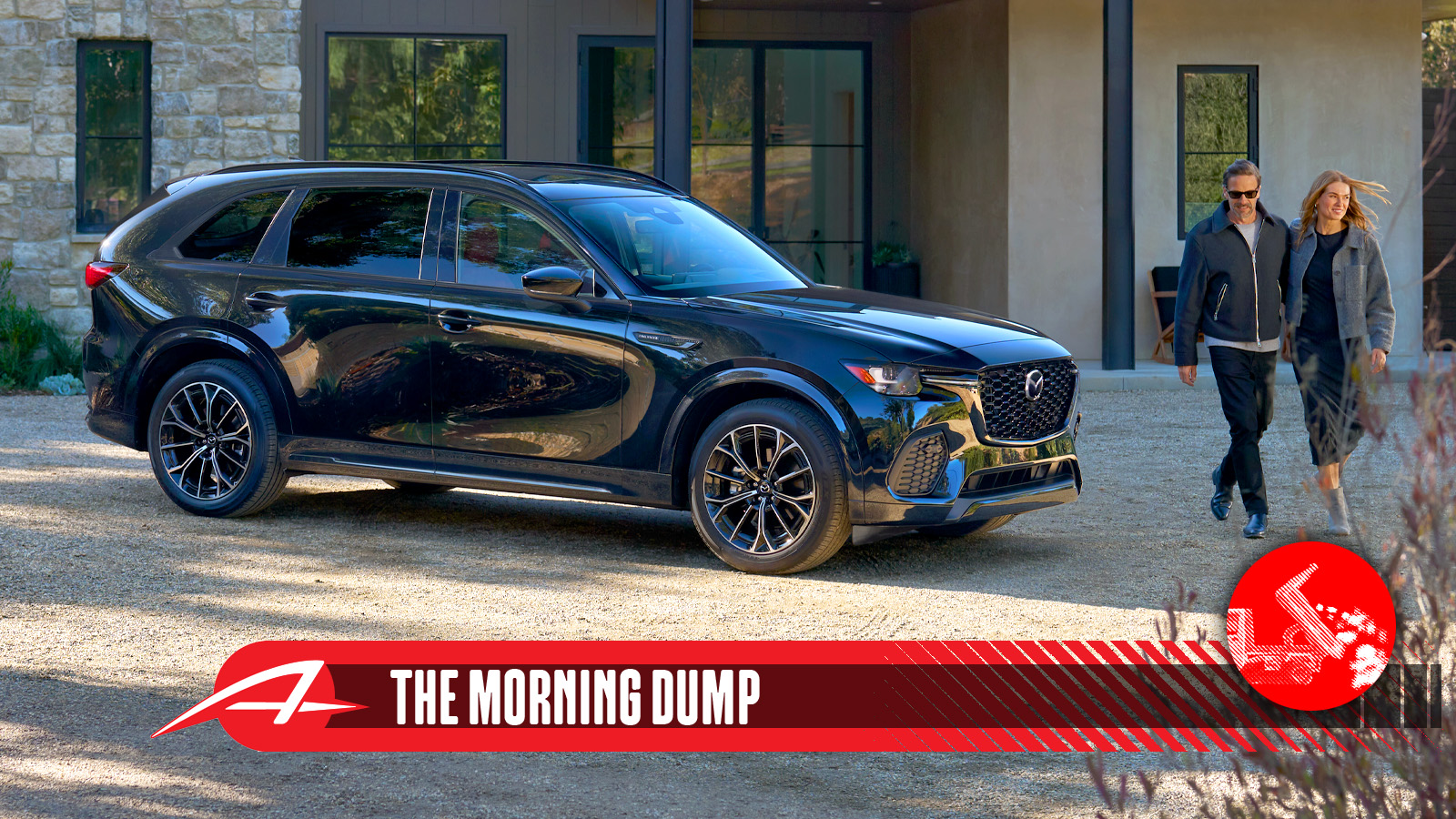
What’s worth talking about today is Mazda, which finds itself doing slightly better than you’d maybe guess. It’s made its average car more expensive, while also increasing market share. How it did this is important when considering that dealers, on the whole, have a negative view of the market since the pandemic.
Honda dealers probably feel good about things overall, given where its sales have been, and there’s a fun little nugget this month about Prelude sales. And, finally, The Morning Dump will take a look at hybrid reliability.
What Can We Learn From Mazda?

When I was on the launch for the Mazda CX-70, I was surprised to see that the company parked a brand-new BMW X7 next to it for comparison. The X7 is an exceptional SUV and nicer than the Mazda.
How much nicer? The price delta does suggest that the Mazda is probably a good value (An X7 is now like double the price). That seems to be the strategy for the company as it tries to enter the gray space between what a Toyota offers and what a Lexus offers.
It seems to be working, as in the last eight years the company’s market share has recovered to 2.6% from 1.7%, which is a reasonable turnaround. More importantly, the average transaction price has climbed to $33,000 per vehicle from $24,000. Hans Griemel did an interview with CEO Masahiro Moro, and the focus was on the difference between the retail experience and the product itself:
“For a long time, people said Mazda relied too much on product-led growth, because we were very strong on product,” Moro said in a Nov. 19 Talk From The Top interview at the company’s Tokyo high-rise office.
“But in North America, especially in the U.S. and now Mexico, we are now seeing something very, very different. We see retail-driven growth. This is maybe the biggest change in recent years,” he said.
Premium cars, increasingly, demand an even more premium price, and trimflation means your theoretically affordable midsize crossover is now what you’d have paid to buy a BMW a few years ago. That space in between is greater than ever, and your average Kia dealer is going to have a hard time replicating that luxury experience.
One big advantage that dealers can still wield over online retailers is a positive, perhaps luxury experience when buying a car. Subaru has already started doing this with its REI-fication of its own stores.
Obviously, there’s a lot of grey space at the bottom of the market as well, but in this environment, it’s harder to fill.
Dealer Sentiment Drops To Lowest Level Since The Pandemic
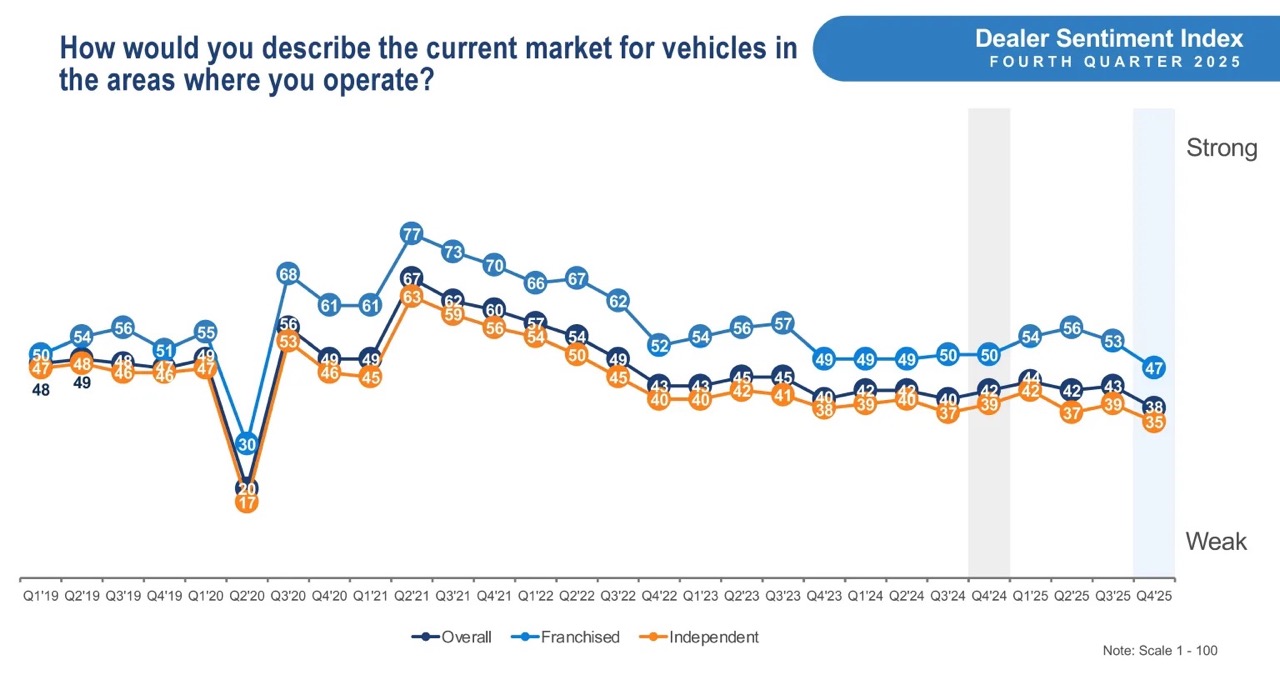
Yikes, the Q4 Cox Automotive Dealer Sentiment Index (CADSI) data is out (you can see the question being asked at the top of the plot above), and it’s rough, with huge declines in sentiment.
“Dealers are signaling caution as 2025 ends,” said Mark Strand, deputy chief economist at Cox Automotive. “Persistent economic uncertainty and fading consumer confidence are weighing on sentiment. Compared to the rest of the year, the current market feels like it’s running out of gas. As we look ahead at 2026, renewed market momentum is entirely possible, especially if we get material interest-rate relief and a rebound in consumer confidence.”
Something is going to have to give for the market to improve next year, whether that’s products, the economy, or interest rates.
People Are Buying Preludes; At Least 30 People
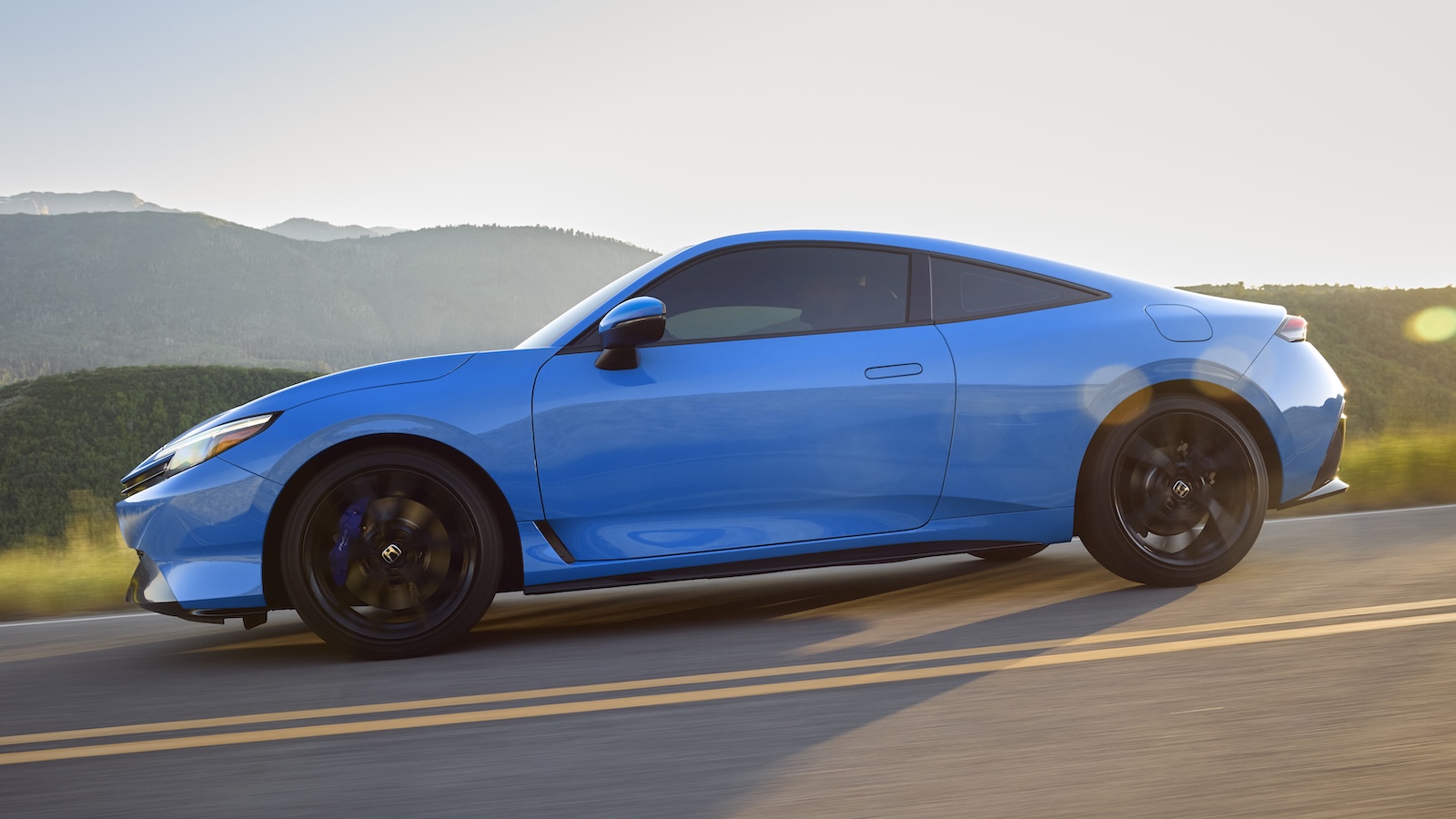
I still have positive feelings about the 2026 Honda Prelude, and I look forward to driving one when I get the chance. It’s a little expensive, but so is everything else. Will it sell?
As noticed by someone on Reddit, there were at least 30 of them sold in November. This is a brand new car, and it only got to dealerships at the very end of the month, so this data is mostly entertaining and not actually meaningful. Given how long it takes to ramp up production and sales, it’ll probably be the end of Q1 2026 before anyone can make a completely fair judgment about the vehicle.
I hope it succeeds. We need more coupes and more hybrids, and this is both.
Survey Shows Hybrids Are More Reliable Than Non-Hybrids
Something about this news feels familiar to me… but Thursdays often feel like Tuesdays to me, and vice versa.
Hybrids have been in regular usage in the United States for a quarter of a century, meaning it’s a fairly established technology. Perhaps my “decade of the hybrid” language is too late. Maybe it’s not 2024-2034, maybe it’s 2020-2030?
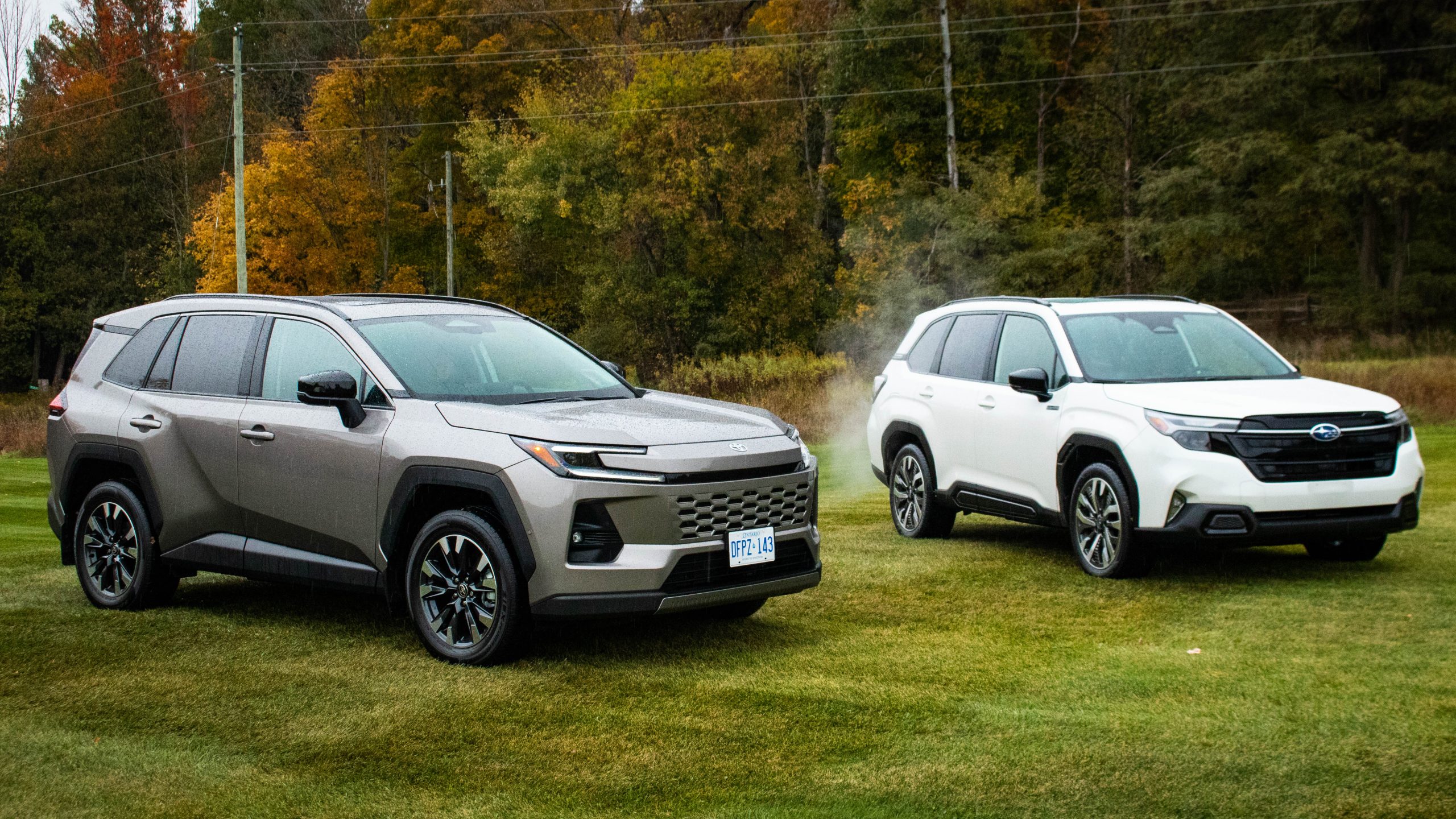
I say all of this because our friends at Consumer Reports are out with their annual scorecard, and Subaru and BMW are right at the top. The Subaru bit may be somewhat surprising given some of our experiences around here, but as I’ve mentioned before, there are some good reasons for this. Specifically, owner satisfaction is high, the cars come with a lot of standard safety equipment, and Subaru makes no truck-based vehicles to pull down the score (as Toyota does, for instance).
“I’ve always been very honest about this. Consumer Reports does not rate vehicles based on what Jake likes, or Stef likes, or a bunch of us who are auto enthusiasts like,” Jake Fisher, senior director of auto testing at CR, explained to me. “These are definitely not ratings for an auto enthusiast, these are ratings for that small niche group… that are like 90% of the market [and aren’t] looking for rear-wheel-drive, stick shift sports cars.”
Owned. For his part, Jake recently bought a Honda Civic Si, which is both a reliable and CR-recommended car, as well as an absolute hoot.
What really struck me from the press release was this:
When it comes to the reliability of electrified powertrains, hybrids continue to stand out. On average, hybrids have about 15 percent fewer problems than internal combustion engine (ICE) cars, a significant boon to the growing number of Americans who are buying hybrids. A record 1.6 million were sold last year, according to U.S. Department of Energy.
Of the approximately 30 hybrids for which CR has sufficient data, only the Hyundai Sonata Hybrid, Lincoln Nautilus Hybrid, and Mazda CX-50 Hybrid have below-average predicted reliability scores. CR’s survey shows both EVs and PHEVs continue to experience growing pains. On average, they have about 80 percent more problems than ICE cars. For half the brands in this year’s rankings, the least reliable car is a plug-in hybrid or fully electric vehicle. Seven of the 10 least reliable cars are either PHEVs or EVs, with issues related to EV battery, charging, and drive systems being among the commonly reported problems.
Fisher expanded on this with me, pointing out that “You’re just not relying on your brakes as much because you have the regenerative braking,” and the engine is under less stress in certain situations. Driver behavior, also, is likely gentler with your average hybrid than, say, a WRX.
Of course, as pointed out, plug-in hybrids aren’t faring as well. Some of this comes down to which automakers focus on which technology. Honda and Toyota are the leaders in hybrids (which is probably affecting why hybrids fare so well in reliability), whereas Stellantis is the leader in PHEVs.
“Stellantis as a whole has always had issues with reliability. They’ve changed ownership a few times, [and] bringing in FIAT helping them out with reliability… certainly is not the best strategy,” Fisher said.
Yup. Jeep, as per usual, is at the bottom.
What I’m Listening To While Writing TMD
Did I have any choice? It’s Elastica with the rockin’ and extremely mean (probably to Damon Albarn) “Stutter.”
The Big Question
Which brands need to move upmarket? What about down?
Top photo: Mazda


I have a 2017 Mazda6 Grand Touring. The road noise is atrocious. The ghost touch infotainment is a travesty since they knew about it years earlier from the Model3 roll out. The corrupting SD card for navigation was apparently still occurring in 2022. The clear coat flaked off the dark color rims about 4 years in and the soul red paint is the most delicate paint I have ever seen. Frankly the cosmetic and electronic issues with this car have soured me on Mazda and I would be hard pressed to consider another. The interior sure looks nice, though.
All things considered, did you enjoy the play, Mrs. Lincoln?
Came here to comment before I read the article, glad there is more than 1 Elastica aficionado here
They don’t rate things based on what Stef likes? Why do they hate parsh??
I am but one data point, and my thoughts on my very reliable parsh needs other people to chime in with their experiences to see some kind of trend or running theme among multiple vehicles, models, and such. Is my car representative of the norm, or did I get a special parsh? (All parsh are special in their own way, but you know what I mean.)
“I need to take an ownership survey!” is a great excuse to buy a 911 if you need one, IMHO. You’re welcome.
My gf has started making eyes at Caymans and I am HYPED.
yessssssss
When Mazda talks about retail driving their growth, one thing I’m surprised they’re not mentioning (though their dealers would) is that a big driver of this is their partnership with Toyota- specifically Toyota Financial Services replacing Chase for their captive financing business. This has greatly expanded their buy box, driven more competitive lease rates, and given them a much better partner to move metal.
I am only going to look at used Mazdas when the time comes to buy another car.
I owned a 92 Prelude. The new does nothing for me. Blob shape. No manual option. Just terrible in all facets, for me.
They all need to stay away from he “premium” or “luxury” marketing traps. Just build a decent reliable car at a decent price. Toyota did it for years and had everyone except the bad financial decision people who are drowning in debt and seem to pay anything on a whim. Buick for its faults has kept an interesting approach to that with it’s imports. As far as I’m concerned Mazda has been price gouging for 10 to 15 years.
Almost exactly a year ago, I was shopping for a used compact CUV. I bought a low-mileage 2017 CX-5. The equivalent Honda and Toyota models hold their value much better, so the Mazda becomes a real bargain on the used car market. I paid about 20% less than I would have for a comparable CRV or RAV4. Having driven all 3, the Mazda is indeed a notch or two better than the competition.
My father just bought a CPO CX-5 after cross shopping every small to medium-sized SUV there is, from base model Blazers to Volvos to Benzes.
The Mazda was my recommendation as well for what he wanted, which is exactly what Matt said – near luxury at a still affordable price. He loves it just like I loved my previous two 6’s and CX-9.
Mazda wants to be turn-of-the-century VW but without the reliability issues.
Many have tried to fill that niche and most have failed. That said, Mazda has three special ingredients:
Mk5/6 VW PQ35/46 were peak VW IMHO – well on their way to being premium-esque.
And then VW decided, instead of pursing this strategy, to make the US-volume-market Jetta, Passat, and Atlas. All cars cut to meet a price – dragging the Golf, a car that genuinely felt better than its peers, down with it.
Absolutely. I’ve owned a 2009 GTI, a 2012 CC, and currently daily a 2014 Sportwagen TDI. The Sportwagen and GTI share a platform. All of those vehicles punched above their weight at the time. I’ve driven Golf/Jetta competitors from those years and the VWs drive nicer, have better interiors, and have more standard equipment. Go drive a Golf and a Corolla from 2012 and you’ll see what I mean.
But yeah, as soon as they started selling US-specific vehicles, that pseudo-luxury image faded. They have one of the dullest lineups of any car company (in the US) today. Yeah they still sell the GTI, GLI, and Golf R, but those are performance variants. I miss when having a regular VW meant you were getting a bit more of everything than you’d get on another car in the same class.
Mazda wants to be turn-of-the-century VW but without the reliability issues.
Zoom-zoomvergnügen.
Don’t do it, Mazda
Mazda is the Japanese Pontiac, thats what Pontiac should be doing today if they survived 15 years ago.
I never thought about it that way, but you’re spot on. Commuter car that isn’t entirely devoid of excitement or emotion.
I’d say they’re more like a Japanese BMW, but with a better grasp on what luxury means. Comfort and UX, not failure-prone gadgets and over-engineering.
I agree with the caveat that Mazda is what Pontiac aspired to be but was never able to achieve with their whole lineup.
The Japanese car most likely to result in an unexpected high school pregnancy in 1984?
That “gray space” in between Toyota and Lexus used to be occupied by the likes of Oldsmobile, Mercury, and DeSoto. Buick, Chrysler, and Dodge also played in this league during various stages of their histories.
Too bad we never got the Amati. The stillborn Amati turned into the Millenia, which was a damn good car.
Yes, the old Medium Price Field, which used to be further broken down into Lower Medium (Dodge/Pontiac), Medium (DeSoto/Oldsmobile), and Upper Medium (Chrysler/Buick), with Mercury, Edsel, Comet, Clipper, Frazer, and Hudson all playing in there, too. Also Monarch and Frontenac in Canada
In the automotive world, just like in Higher Education there is the:
Appeal to wealth fallacy. People Assume more expensive is automatically better.
This has driven things like vehicle and college costs up way faster than inflation.
We need more affordable cars.
Automobiles have not increased faster than inflation.
Base price of a Camry over time:
1990 – $11,600 ($29,600)
2000 – $17,500 ($33,700)
2010 – $19,900 ($29,100)
2020 – $24,300 ($30,600)
2026 – $29,000 to start.
This isn’t even accounting for the fact that a new one gets 50+ mpg, lasts 300,000 miles or more, and comes with equipment undreamed of in 1990. Not to mention that it is still built in America.
A similar chart can be made for other vehicles, this isn’t a Camry specific thing.
OK thanks glad our incomes have kept up.
If you prefer the same measure as a percentage of the median household income (per census.gov in all cases), here you go:
1990: Median HHI was $29,943. It took 38.8% of a year’s income to buy a Camry.
2000: Median HHI was $42,148. It took 41.5% of a year’s income to buy a Camry.
2010: Median HHI was $50,046. It took 48.5% of a year’s income to buy a Camry.
2020: Median HHI was $67,521. It took 36.0% of a year’s income to buy a Camry.
2024 (latest available) Median Income was $83,730. It took only 31.6% of that income to buy a $26,420 2024 Camry. Even if someone had to buy a $29,000 2026 model, the ratio is only 34.6%.
I get that people have vested interests for whatever reason in claiming everything is bad all the time, but your assertions are not supported by facts.
This is good data, and I appreciate you tend to stick to the facts in a lot of these discussions, but I will say that it does miss a bit of context when we talk about affordability. It’s not just the purchase price, it’s the reality that many times (not always) that higher purchase price comes along with:
– higher insurance costs
– higher maintenance costs
– higher collision/other repair costs
– less DIY maintainable
And more, depending on what you want to focus on. It also misses the context that while 38% of income in 1990 is a little higher than 34% now, we have arguably significantly less spending power due to massive increases in the cost of rent/housing, healthcare, and student debt, amongst other things. That all in turn can drive up loan length and interest rates.
No disagreement from me that cars are much, much better for that price though, and that the baseline price hasn’t increased all that much (although, again, average transaction price does seem to have, so not sure how much looking at the base end is representative of the whole).
I can only respond to the assertions made in the OP, which are that cars have increased in price “way faster” than inflation, which is flatly wrong and all too common a belief.
You aren’t wrong about insurance, but given how little maintenance most modern cars require, that seems like something that has gotten better over time rather than worse. You also aren’t wrong that some other costs have increased faster than inflation. What I will say is that considering real (adjusted for inflation, including items you listed in the CPI) median incomes have never been higher, many families are still doing better overall despite those high costs.
The last thing I’ll say regarding the average transaction price is that the fact that it’s gone up so much, despite objectively good cars being available for less (like this Camry), tells me that actual car buyers are voting with their wallets that $40K, $45K, $50K are not in fact too high a price for their financial situations. In other words, Americans are wealthy enough to indulge their real preferences, which as always are for larger and better equipped vehicles than basic sedans.
Good points, and thanks for adding them. I think the idea of maintenance being more expensive, but less needed is one I haven’t dug into far enough.
As far as wealth goes, I tend to agree that we are willing to indulge our preferences, although I wonder how much of that is based on debt-loading that only exacerbates the transfer of wealth upwards.
Totally agree that we need to be careful about how we read the stats on income – it’s kinda like crime, where any positive development is basically ignored in favor of preferred (or more profitable/politically expedient) narratives. However, unlike crime, I do think there’s a difference in that there’s a bit more validity to the negative perceptions. For many (if not most), even if more families by raw numbers are gaining wealth, the majority is seeing costs rising massively in many important parts of life along with overall increases in wealth accumulation at the top.
That feeling of being squeezed, along with the statistical reality that the bottom half to 2/3rds (or maybe more now, I’d have to check) is getting an increasingly smaller slice of a rapidly expanding pie, contributes to negative perceptions around income and wealth overall. This comes out pretty quickly in these conversations around affordability of one relatively small, but also kinda major, expense in people’s lives, because even if it’s wrong for this one expense, it’s kinda not wrong statistically in general.
But, ymmv, thanks for sharing your thoughts anyways. I appreciated reflecting on them.
Likewise. *cheers emoji*
It’s a tough one.
I’m struck most by the plethora of surveys that give results along the lines of “I’m personally doing OK to good, but the economy as a whole is awful”, and I’m just not sure how to react to that sort of thing on such a large scale.
It makes me nervous, because if sentiment is so bad now (and people seem very willing to turn to dangerous political ideas to “fix it”), at a time when so many objective measures show it should be otherwise, what’s going to be considered a reasonable policy response when shit really hits the fan like in 2008-09? That’s the kind of thing that keeps me up at night.
I worry about the same thing and think about the last time we had a big populist movement combined with a depression.
I’ve struggled to understand constant negativity when the data shows income outpacing costs for the last 5 years. It is especially odd when considering the percentage increase by income class was flipped from typical with the lowest income individuals getting the largest percentage increase in income.
Something I heard on the topic that seemed to make a lot of sense is the way we as humans react to raises in income vs raises in costs.
Most people believe raises in income are due to merit. “I got a raise because I performed well and EARNED a raise”. Raises are often presented this way to when in reality they are mostly cost of living increases spread almost equally among employees. People feel that if they earn more they should move up in society because they earned it.
On the other hand increases in costs are seen as happening to us. Someone else raised their price and took my money.
Combine those factories and even if someone’s income is keeping up with inflation they don’t feel good about life because their expectations aren’t being met. People expect to move up economical as they get raises not simply tread water.
Rent, healthcare, college tuition – all are included in CPI inflation calculations
If we are adjusting old car prices to 2025 dollars those increases in the other parts of life are factored in.
The change in average (mean) new car prices is due to people moving up classes – especially moving from sedans to crossovers. In the compact class a crossover ($36,517) is on average $9,514 more than a sedan ($27,003). For midsize a crossover ($48,650) is $15,126 more than a sedan ($33,524)
The choice to buy a Highlander instead of the Camry V10omous mentions has huge financial consequences.
<EDIT>
Well shit, I write a comment, and then see someone already made it when I scroll down 2″ more.
Manufacturers and dealers do not want you to have more affordable cars. The margins on affordable cars suck.
Sure, we want them, but we don’t run the store. As far as manufacturers are concerned the new entry-level car is a used car.
I’ve always been such a fervent fan of Elastica! 😀
I also dig Mazda products, though I’ve only had a couple of Miatas so far.
WELLLLLLLLL! STEF likes the Porsche 919 Hybrid Evo, a perfectly practical car built specifically to smash all-time Nürburgring records. What car should you get if you want to be the fastest person around the Nordschleife ever? Consider a nice four-cylinder hybrid! It even comes apart easily for maintenance and has built-in jackstands, saving you man hours and frustration. There’s a no-nonsense cockpit with lots of physical switches that are easy to use without getting too distracted from the track. It’s a good car, folks! Why doesn’t anyone ask me for my opinion? What am I, chopped transaxle?!
I value your opinion and was hoping you would chime in when I read that.
Real talk: I would love to see more Mitsubishi and Porsche owners chime in for the official Consumer Reports survey. If your brand isn’t listed (two of my four cars’ aren’t! and they’re great cars!), definitely subscribe and smack that beautiful survey button the next time it shows up.
Lolol I should have kept scrolling, I figured you’d be all over this.
Going back to the future. In the mid 1980s they had the 323, which was Ford Escort sized but reliable, and if memory serves, cheaper.
One step up was the 626 — my Dad made the step up when he got a better job, and it really was near cheap Mercedes for much less money, especially as the 323 held its worth very well.
The two litre 626 did 0-100 kph in something like eight seconds, and was very well balanced and put together. The folks ended up driving it for 20 years.
So sporty Buicks….probably not a bad place to be
Me – “Can we have Dacia in America?”
Pointing to Stellantis – “We have Dacia in America”
They just need a Duster again. Even if it looks more like an updated Journey.
Mazda wants to be what used to be called “upper middle class”. I like Mazda’s and I hope they succeed.
In my neck of the woods, “Upper Middle Class” and “Wealthy”, are largely dominated by Toyota.
With a smattering of Audi Qs here/there.
That sounds like exactly their target market. Nicer than a Toyota, while being much cheaper than the Audi.
Mazda’s what?
I like Mazda’s in the plural sense.
I generally liked the Mazdas I’ve driven. The puck is a fantastic UI decision, and I’m very disappointed to hear it’s going away. That is one of the few places I feel that journalists hurt the consumer. Anyone who gets a vehicle for a few days won’t be able to fully get used to the puck. But anyone who lives with it, can fully operate it without removing their eyes from the road.
My biggest complaint with Mazda, however, is that they’re so slow. Because they’re comparatively tiny it takes them years to adapt and bring new products to market. The straight six in the CX90 has not found its way to any other vehicles. The Mazda3 and the CX-30 are both on their 7th year. They keep coming out with these amazing concept cars, but nothing ever comes of them. Mazda makes nice cars, but I feel the benefits of a small company are outweighed by the disadvantages.
Also, can anyone comment on the ride quality of the CX-50? I’ve heard numerous reports of it being too harsh, especially on the hybrid. I’m curious if it has been fixed.
The UI Puck is incredible, and I adore it to bits in my ’22 CX-30 Turbo. On the speed side, yeah, anything with the base 2.5NA engine is pretty dang slow although not really that far behind non-luxury rivals, but the Turbo does wonders. The CX-30 with the turbo is easily as fast as I could have asked for for a car that stickered barely over 30k. On the age, for some it’s a feature, others a bug, what you get is a very well tested and proven powertrain with enough modern tech like adaptive cruise to keep you happy, but without some of the horror show haptic-everything panels you get in the premium brands. IIRC the CX-50 has had some suspension changes since launch to help with the harshness, but I don’t know specifics.
I have had a turbo CX-50 for 3+ years and about 45k miles. It’s…. fine. The ride is stiffer than probably any other CUV, but it’s not what I would call harsh. Big pot holes are jarring, larger expansion joints can buck the car, but I honestly don’t mind because it’s not like I’m going over those all the time.
My only complaint about the whole car is that the interior is not holding up very well. The plastics seem to scuff easy, the seats are wearing to the point they warrantied it 1.5 years in with a full replacement and the new one is already starting to look like it has 100k miles on it, the steering wheel is starting to almost disintegrate, and the windows and sun roof squeak/rattle quite a bit when it’s cold. It’s pretty obvious how they are hitting similar prices as other economy cars, but have interiors that initially seem way nicer – that interior niceness is skin deep. Most complaints to the dealer have been met with them blaming me and having to fight hard to get them to fix anything. Which is weird, because I’ve never had similar issues on any other car I’ve ever owned (VWs, a Ford, Toyotas, and a Subaru).
Besides that, the rest of the car is holding up good and doing well. The mechanicals seem well designed and robust, it’s hard to find any surface rust on anything on the underside after 3 salty winters, its got some level of ooomph that a Honda/Chevy/Kia/etc doesn’t, it’s well styled, the infotainment is good and I like the dial, its well equipped, and at least a little bit sporty.
But to be honest, it’s not an automatic re-buy. It’s certainly, not bad, but if I had to buy another CUV tomorrow, my first instinct would not be to head straight back to Mazda.
I wonder if there’s a difference in material between the SUV and sedan models. I bought a 21 mazda3 premium (for the manual) in august with 41k miles and the interior still looks brand new.
I wouldn’t say so… I bought a 2016 Mazda3 hatch in 2021 and the steering wheel was already peeling, the driver’s seat was collapsing, and the paint was coming off. Mazdas don’t like the desert heat.
That might be it, mine has spent it’s whole life in new england
That’s interesting, because up until just a few years ago, they didn’t like the snow belt either. Their rear fenders always rusted out.
In fairness they were forced to cut the cost of rust proofing the rear thanks to Ford. The Ford models on the same platforms have the same symptoms. It can be prevented, though, but most folks don’t realize it’ll be an issue until it’s too late.
I think this definitely varies on model year, trim and how the car is used/maintained. We traded in our 2018 CX-5 last February and the interior could still pass as new.
Don’t think so. I have a 2022 3 with 72k on it and the steering wheel is coming apart and mechanically the only issue I’ve had is an ignition coil bolt snapping off in the valve cover while removing it to change the plugs. I don’t have any squeaks or rattles, and other than the piano black and the steering wheel, the interior still looks and feels new.
The paint, like pretty much all Japanese paint, is super thin and I need to have some paint correction done. But my car is white, so it looks good from ten feet.
I got mine ceramic coated recently, I’m hoping that helps. And yeah the piano black… I think it could get scratched from being breathed on
I think there are a lot of variables at play including model, model year, when the model was refreshed, and trim. We traded in a 2018 CX-5 last February and the interior could still pass as new upon inspecting it.
I vote they keep the design another 7 years. Easily among, if not the best looking cars on the market today. If it ain’t broke don’t fix it.
Fair enough, I never really cared for the C-pillar on the hatchback. I do really like the upper trim CX-90s, with the body matched fenders. I think the Civic is more appealing in either Si or Hybrid form to any Mazda3. I’d consider a stick 3, but my guess is that the Si is probably what I’d end up with for the same money. I’ve driven neither though.
The side profile of the rear is the only thing I don’t love about the design, I can agree there. I bought my stick 3 in august and I’ve loved it, drives like a dream even. It’s a bit slow, but not hard to live with. I don’t need it any faster.
I am for just about all of them moving downmarket, Vehicles are crazy expensive.
So the market needs to change, and the automakers need to adapt downwards? Sadly won’t happen with the way corporate governance and stocks work. Thank the Dodge brothers.
“your average Kia dealer is going to have a hard time replicating that luxury experience.”
Its not that hard. Make some fresh instant coffee, replace the stale crackers with fresh, scrape the mold off the cheese, hose down the staff, brush their teeth and rub their pits with deodorant.
Boom! A luxury Kia buying experience!
We had a telluride, I dreaded going to the closest dealer for service, which it needed a bit of. The best was when warranty stuff needed to replaced and they had our cars for days but wouldn’t provide a loaner. Or when the dealer charged me a 4k add on fee because we were out of state buyers, despite living on the border of the state and Kia telling me they were my LOCAL dealer. Had to drive 4 hours to get msrp.
I’ll never ever buy a kia again. I’ll never recommend them again. The worst part is I LOVE HOW THEY LOOK. Although with the new Telluride, it seems they have started to go downhill again.
Also: let your customers leave the dealership when they want to, without aggressively and creepily trying to get them to stay so the sales guy can “just go talk to the manager one more time.” That would be absolute top tier treatment for a Kia dealership.
The staff should be required to wear shock collars and the customers get controllers when the visit the store. If the staff get uppity, lay on some shocks to get their attention that they are there to serve the CUSTOMER!
“they are there to serve the CUSTOMER!”
Mr. Chambers! Don’t go in that dealership! The rest of the book, To Serve The Customer, it’s… it’s a cookbook!
Honestly wouldn’t make the experience much worse if this were true
Depending on the vehicle brand, you might get away and even do better with leaving it on there.
…Until the possible lawsuit, of course.
In the near future all regular cars will cost as much as a BMW costs today. So screw it and just get the bimmer now before it’s even less affordable.
Apparently, yeah. I got a Volvo SUV for mid $50s and that felt like a wildly indulgent purchase. While apparently it’s *checks note* just slighly above average.
As long as you never look at the outside of the X7. *shudder* Btw, I saw an i7 in the wild last night and SWEET LORD it was shockingly ugly. I always thought the smaller grilles on BMW’s sedans mitigated the ugliness because there just wasn’t enough space for it, but the i7 has really upended this.
On the subject of Mazda, I have a lot to say. The upmarket push and margins is actually very interesting. Over the past 8 years “The average transaction price has climbed to $33,000 per vehicle from $24,000.” This is both less and more impressive than it seems on it’s face. 24k in 2017 money is 31.8k in todays dollars, so a very minimal inflation-adjusted increase. What I find so compelling about this is just how upmarket the product portfolio has gone in those 8 years, while keeping inflation adjusted pricing so flat. CX-3 to CX-30 is a massive jump, CX-9 to CX-90 is huge, current gen 3 is a leap over the previous in terms of styling and breadth of options/powertrains, and more.
What Mazda has managed to do is optimize the hell out of their products, to give a slightly more sporty, more premium looking and feeling, but not all that expensive to manufacture product. Things like the 3, 30, and 50 have a torsion beam rear end, yes it is objectively less good, but it’s so much more cost effective while being well tuned that it is not a big hinderance, and it frees up so much cost on the interior to make it a wonderful place to be.
Further, they are not technology driven, until the CX-90, none of their cars even had auto start/stop, automatics were all 6-speed traditional, and their entire North American powertrain lineup was variations of the same 4-cylinder. They have become one of the best manufacturers at analyzing what their customers want exactly and delivering that. It helps that they’re much smaller than Toyota/Honda/Kia/etc so they cant aggressively target a smaller segment of the market. All that said, their sales growth is showing that it’s working, not to mention being fully free of Ford has done wonders for their reliability and reputation for reliability.
I like Mazda (former 2010 Mazda5 owner) and always hope for their success so I was really concerned when I heard they were going upscale. I thought it would do them in but it actually worked! If we were to buy a new car it would be a CX-50 hybrid, in that awesome soul red
IDK about the new Mazdas, but on the used market, in our family, the last 4 cars purchased have been Mazdas (couple of 3’s, a 6 and a NA Miata for us olds), shifting away from small Fords. Twenty somethings prefer ‘cars’, not ‘CUV’s. The other reasons are: they seem to be relatively dependable and more ‘affordable’ to buy than a Toyota or Honda.
“Consumer Reports does not rate vehicles based on what Jake likes, or Stef likes…“
But Mazda, have you considered producing a vehicle that looks alarmingly similar to a second generation RX-7, but with a German badge?
You mean a Porsche 944. the Second gen RX-7 was widely thought of as a 944 clone styling wise.
there’s a reason why I put a Japanese Nostalgic Car sticker on my 944, haha
So Mazda is trying the Pontiac/Buick/Mercury strategy of middle ground non-luxury semi-premium?
That’s a bold strategy, Cotton.
And yet it makes sense.
A lot of people want something a bit more special than basic – but don’t want to pay for/be perceived as splashing out for full-on luxury.
It’s what I wanted, and exactly what I got. My ’22 CX-30 Turbo (base turbo trim) has a really nice interior for the money, all the features I wanted with none that I didn’t and a hilarious amount of power and torque for both the size and price, and there was nothing new or even slightly used at my price point that could deliver what I wanted. Knowing several other owners of modern Mazda’s (not counting my family which has many) the story is the same. It’s 80% of the German/Japanese luxury experience for 60% the upfront cost and under 50% the running costs.
Semi-premium brands had a serious extinction event 15 years ago. Something has to evolve to fill that niche.
carcinization of the atuo industry
As the article stated though, the price gap between luxury brands and mainstream automakers has widened massively, so there’s a large space where they used to be closer together. And they’ve been heading this direction for at least 5-7 years at this point, and it’s going well for them. Seems like they can make it work. I look at it as the Mazda will start about where the high end Honda leaves off, then the top of the line Mazda will fall just overlap with a cheap MB or Audi. And probably be better equipped in many cases.
Hey, some of us miss Oldsmobile. Oldsmobile had some zoom-zoom in its history, though. Mazda can’t abandon zoom-zoom if it’s gonna play in a space that used to have Rocket V8s.
Others of us miss Mercury.
In the Lincoln Continental tradition.