

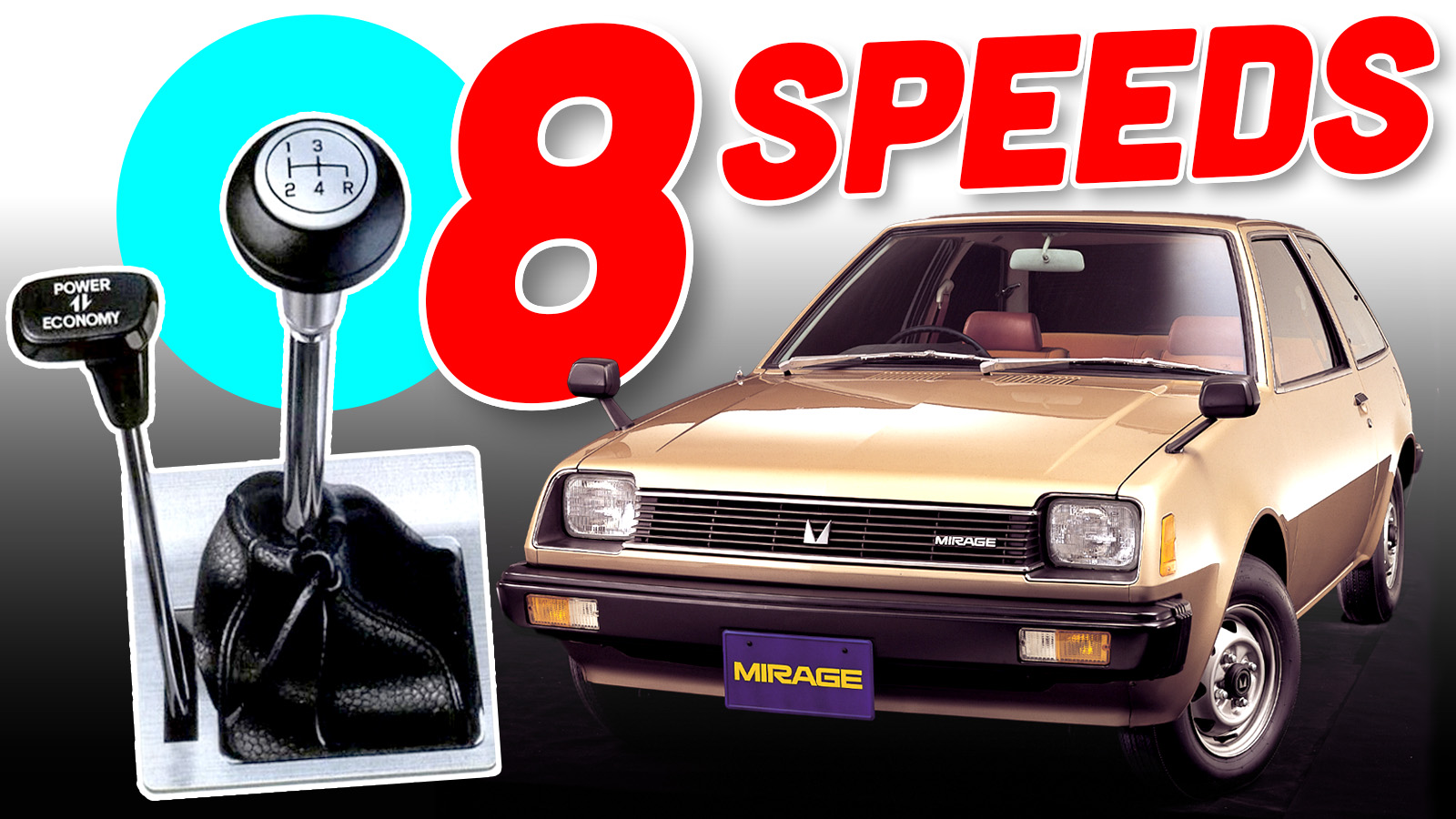
The oil crises of the 1970s undoubtedly reshaped the direction of automotive history. The demand for more fuel-efficient vehicles spiked, bringing a deluge of smaller engines and cars to the market. The crisis also accelerated a host of automotive innovations, like front-wheel drive, turbochargers, and the use of diesel in vehicles other than gigantic trucks.
It’s fun to think about what would’ve happened to the car industry had oil prices never spiked back in ’73 or ’79. We’d probably still be driving around in absolutely humongous, V8-powered land yacht Cadillacs that got 7 mpg. Sadly, we’ll never know for sure.


I’d argue the most interesting piece of tech to emerge from the energy crisis of the ’70s came from Mitsubishi. Known as the Twin-Stick, it was a second gear selector placed next to the shifter in the center console, responsible for controlling a two-speed transfer case between the four-speed manual and the engine. It only came to be thanks to Mitsubishi’s strange drivetrain arrangement.
The Wonders Of Front-Wheel Drive Engineering
By 1978, the shock from OAPEC’s oil embargo had sent waves throughout the industry, with manufacturers scrambling to pivot to more efficient offerings. Front-wheel drive layouts, a rarity in vehicles before the crisis, were becoming mainstream due to their more efficient packaging and better economy figures.
Mitsubishi wasn’t going to be left behind. That year, it revealed its first-generation Mirage hatchback to do battle with the collection of other “two-box” front-wheel drive hatchbacks entering the market. Like those cars, it used a transverse layout. But instead of putting the gearbox at one end of the engine, like you’d normally see in a transverse layout, engineers did something peculiar: They put the gearbox under the engine.

Finding documentation on why Mitsubishi went in this direction is tricky. While front-drive had been around for decades at this point, the layout had yet to be perfected, with manufacturers coming up with different packaging solutions that suited their needs best. Having the gearbox underneath the engine meant a narrower engine-transmission package, allowing designers to squeeze the most out of the Mirage’s footprint. Such a compact drivetrain setup likely made the car’s assembly easier, too.
[Editor’s Note: I just want to note that the first really significantly successful transverse FWD car, the Mini, had its transmission under the engine as well. So this wasn’t exactly unheard of. – JT]
The Twin-Stick Is Born, Thanks To An Icy Carburetor
Originally, Mitsubishi engineers had no plans to incorporate the twin-stick (known originally as the Super Shift transmission) into the Mirage. The car was going to get a four-speed manual, putting it slightly behind the competition, which had mostly switched to five-speeds. But a discovery in prototype testing would reveal a unique possibility. From World Cars 1979:
This neat dual-range transmission with an alternative pair of transfer gears was a product of logical development work. The design criteria specified the use of the company’s Orion SOHC inline 4-cylinder engine. Placed in the Mirage prototype shell, it had a forward-facing carburetor and quickly ran into icing problems. Turn around the engine, then you would have to change the direction of the revolution.
Here, engineers could’ve simply installed an idler gear between the engine and the transmission to reverse the direction of travel and call it a day. Instead, they went the extra mile:
Chief engineer Kisuna and his designers and engineers came up with a clever solution. Insert a transfer gear train, give it two alternative ratios, and they could kill two birds with a single stone. And the cost consideration was about the same as if they had developed a brand new 5-speed gearbox. Everybody else had a 5-speed box, but not a twin lever, 8-speed one.
Here’s How The Twin-Stick Worked
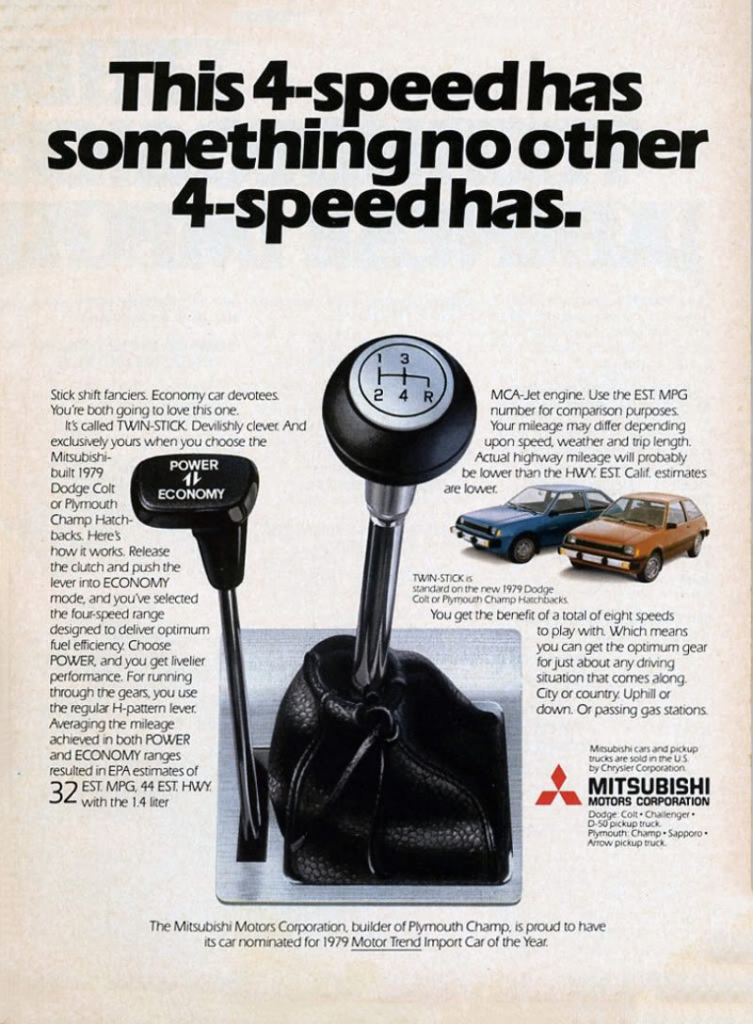
If you know anything about how two-speed transfer cases work on off-road-ready trucks and SUVs, understanding the Twin-Stick should be easy. In the center console of the first-generation Mirage is a normal four-speed shifter, with an H pattern for gears one through four, and reverse hanging down and to the right. Next to that shifter is another shifter with only two possible positions, showing markings for “Power” and “Economy.”

Leave that second knob in Economy, and the four-speed would act like any other four-speed manual transmission. It’d be as if Mitsubishi never installed a twin-stick in the car. You could theoretically go your entire life behind the wheel of a Twin-Stick-equipped car without ever using the second stick, and you wouldn’t notice a huge difference in gearing between it and any other four-speed car of the time.
The magic behind the Twin-Stick lies in that Power position. The second stick acts as a selector to switch between high and low range for the transmission. The Economy position is effectively the “high” range in this scenario, while the Power position is the “low” range. Though unlike an off-road low range gearing, which is often too low to be used on the road, the Twin-Stick’s low range is still high enough to be used on highways. The difference between each gear in Power and Economy modes was just a few hundred rpm.
This meant that, effectively, drivers had eight forward gears to choose from: Four in the Economy position and four in the Power position. The second stick can even be shifted while the car is moving, allowing drivers the ability to shuffle between whichever gear they need at the time without having to come to a stop. Watching it in action is trippy:
Because the Twin-Stick transfer case is simply a ratio modifier between the engine and the transmission input shaft, it even worked in reverse. That means Twin-Stick-equipped cars effectively have two reverse gears to choose from. You know, for when you have to leave your driveway extra-quickly to make it to that too-good-to-be-true Facebook Marketplace deal.
The Twin-Stick Cars And Their Legacy
In addition to the Mirage, the Twin-Stick also made its way to other Mitsubishis, including the Colt, the Cordia, the Tredia, and the Chariot. Most people in America know of the Twin-Stick through its availability in the fourth-generation Dodge Colt, which was just rebadged Mirage sold in North America.

Undoubtedly, the coolest car to be available with the Twin-Shift setup is the Dodge Colt GTS Turbo. It was around for just one year, towards the end of that generation’s production cycle. You got an updated honeycomb grille fascia, a front air dam, side skirts, front and rear sway bars, and sticker tires. Under the hood is a turbocharged version of the available 1.6-liter inline-four, making 102 horsepower and 122 pound-feet of torque—a big step up from the 72 horsepower and 85 pound-feet.
That might not sound like much, but thanks to a curb weight of under 2,000 pounds, according to Automobile Catalog, the Colt Turbo wasn’t a slouch by prime Malaise-era standards. It was able to sprint to 60 mph in 9.4 seconds in the Power setting, or 9.7 seconds in the Economy setting, according to testing done in-period by Motor Week:
The Twin-Stick survived until 1990, when it exited production alongside the Tredia and Cordia. Mitsubishi never officially gave a reason for dropping the Twin-Stick, though with the use of more traditional five-speed manuals on the rise and the growing popularity of torque converter automatics, it’s easy to see why the more complex Twin-Stick was cast aside—for most people, having to worry about shifting two separate selectors was probably just too much work. Plus, while switching to the Power setting might’ve felt like you were unlocking more speed, instrumented testing like Motor Week’s showed the numbers weren’t all that different.
Still, the Twin-Shift was a defining moment in the metamorphosis of the industry, showing the lengths manufacturers were willing to go to stand out. With most Colts having gone the way of the great junkyard in the sky, they’re now a rarity. If you have one, cherish it.
Top graphic images: Dodge / Mitsubishi




I have an automatic 4 speed with a manual lockup option.
Lockup is on off, no idiot proofing.
You put it in lock, then run through the gears to 4th, and it will lockup then, or you can select any gear, and lock in that one.
I remember Mazda had something like that in the early automatic Miatas — a “hold” button which you could push to delay shifting into further gears until you were ready.
The lockup is an electrically activated high torque clutch that only releases when turned off.
A special setup offered by Goerend for automatic transmissions.
If you slow down or over rev, you must release it manually.
I typically see a 200 rpm drop in high when engaged, then it drives noticeably like an engaged manual until released.
Citroën LN/LNA
Citroën Visa
Peugeot 104
Talbot Samba
All used the PSA-Renault X-Type engine which had the gearbox underneath, My first car was a Samba, The spare wheel sat on top of the engine and changing the clutch was quite easy, Not as easy as the Cavaliers and Astras from a certain time though.
It might not have been common in the US but here in the UK we had a few cars to choose from with that setup. Including as mentioned the Mini and the early Metro, They even made an Automatic gearbox that shared the engine oil.
Ya got me all excited when ya said twin stick. I had visions of a looong nose kw with a buzzin dozen and two sticks…. then I saw the picture…
Yeah yeah
https://youtu.be/8lEYaTvvq4g?si=nzSTGxovavBiBGlL
I remember these but never drove one. I’m disappointed most people drove them 1,2,3,4, Economy instead of splitting gears like a truck with a 2 speed axle. I still sort of want an old dump truck or flatbed so I can do that. I have spent my life driving 5 speed transmissions, apart from some pickup trucks
You can put 6 to 8 speed transmissions in pickups from heavier trucks.
These were 1980s trucks so 5 speeds would be exotic. If it was feasible I know someone who would put a Road Ranger in his Square Body
I think key to the conversions I ran across is the transmission adapters existing.
When my friend built his jeep he was in high school and had a budget, so I think he has a 4 speed Eaton plus a transfer case to multiply those gears, always a fall back option.
There are always the crazies willing to pay for custom adapters or build them, but nice when they exist, as with the Cummins, and in robust form.
I think the practical limit would be when the size and weight become impractical for the vehicle, as with some semi transmissions I’ve seen.
There are hotrods out there based on V16 semi engines, but they’re looking at practical in the rear view mirror.
You mean like; 1stP, 1stE, 2ndP, 2ndE etc? I feel like you would need the two stick to be similar height, yeah? The article notes a 500RPM delta, a big deal in a big diesel but not much to gain but fun I guess in a little 4 cylinder.
yeah, splitting like that would be easier with an electric switch like a truck, or an early Volvo 240
The transaxle is not underneath the engine it sits beside it like the typical transverse FWD layout.
It also isn’t a really a transfer case it is a two speed input.
As I mentioned elsewhere once Hyundai licensed the Colt design they quickly figured out the twin-stick set up was stupid, confusing and customers wanted to see “5” on their shifter. So they turned it into a 4sp + OD with a vacuum actuator and electronics doing the duty to shift between the normal and OD ranges once the lever was moved to the “5” location while simultaneously reengaging 4th.
Now the Colt Vista “4WD” had a transfer case hanging out the back of their transaxle.
The first model of Mitsubishi Magna (an Australian market widened Mitsubishi Galant from 1985 onwards) had a 5 speed that worked that way, with vacuum actuation for 5th gear. All subsequent Magna 5 speeds were a ‘conventional’ setup, and when I swapped a later engine/box into my mother-in-law’s TM Magna I discovered that meant the shift pattern was completely reversed! (Turns out the remote shifter was completely different and had to be swapped as well).
I did get to drive a twin-stick Colt in about 1990, when doing work experience at a local Council that had several as fleet cars.
A 1946-1964 Willys Jeep with up to six manual shifters has entered the chat. One of which is for the Warn/Saturn gear splitter was marketed as an “overdrive” but was quite similar to this.
It works in high range, low range, 2wd, 4wd, forwards, reverse…
A Mercedes Unimog says “hold my beer”.
My Honda Trail 90 says hold my Saki
A Honda 90 has more than six gear levers and 18+ gears forward and back?
Yikes no. That Mog thing does that? The 90 has a simpler version of 4 regular or switch 4 low for offered. I would love to see a repair bill for fixing the Unimog trans.
They have multiple gearboxes depending on model, plus separate forward and reverse.
https://matarama.com/en/unimog-406-gearboxes-shift-patterns-and-maximum-speeds
That doesn’t look confusing at all. Plus if you have to ask you can’t afford pricing?
It’s really not as bad as it looks. You fundamentally choose a range for the job you are going to do, then shift the main transmission within that range. You would not normally change ranges on the fly, though you certainly can. So for the 20spd, if you are going to go on the highway, you disengage the cascade gearbox and it’s just a normal 6spd. For hard work, you engage the cascade box then select which of the three ranges is appropriate for the speed range you need for what you are doing. Slow, really slow, and “is this thing actually moving”.
And of course you have the same capabilities in forward and reverse, because you may well have an implement that requires you to go backwards to use it. Some Unimogs even have reversable cabs or forward and backward facing driver’s seats.
Unimogs are very, very capable vehicles and priced accordingly. They are really more like a tractor that can go highwayish speeds than a regular truck.
I had a CB900C with the high/low range transmission as well. No idea why they did that but it was fun-ish.
Some Trail 90s came with double sprockets, so while not as convenient as the shifters, you could swap your chain over to the high or low sprocket and get a whole new set of ratios.
Certainly better than the various cars with Laycock de Normanville overdrives. The overdrives were fine, but every car seemed to have a different way of mucking up the actuator.
I prefer the switch on the gearstick’s knob in my Spitfire over putting it on a stalk in my TR6.
The switch on my Volvo’s shift knob seemed to have a like of its own or more likely it was dead, interrupted by sporadic reanimations. I never got around to rewiring it to some arbitrary location.
Before the switch on the knob, it was a small lever on the steering column, such as on my buddy’s 1972 164E.
My later 240s have the switch on the shifter.
I never had any trouble with that, but Ipd carried the parts for fixing them, so I know some did.
I prefer it the other way around having driven both. Keeps your hand on the wheel. Plus the wiring to the column stalk is simpler. And more reliable.
And that’s why I like column shifters too.
What were there besides a button on the shifter or a lever on the column? A few lower-powered cars like my Spitfire allow using it in 3rd and 4th, though there is very little difference between 3-O/D and 4-direct. My car has the shifter button, but I actually prefer the older column lever.
Just curious – what mechanism was there to not allow the OD to operate on 1st and 2nd gears?
A lockout switch. It’s electrically actuated, so easy to disable it other than in whatever gears it is allowed in (or enable it in the ones you want – I don’t recall which way it actually works). Earlier versions (the A-type) were tougher and could be used in 2nd-4th, but the problem is that the clutches can only handle so much torque, so more powerful engines combined with the torque multiplication of lower gears would wear them out very quickly. The later ones (J-type and P-type) were simpler and cheaper but couldn’t handle as much torque, so usually only used on 4th gear. The Spitfire is an exception. It is handy to be able to flick between 3rd and 3rd-O/D around town. I don’t think anyone ever used them on 1st, that would probably be a very bad idea. Technically, you can switch the O/D in and out without using the clutch, but it’s smoother if you dip it a bit to take the load off. And you absolutely can hit the button at full throttle, but that is definitely hard on the machinery and will reduce the lifespan!
Operationally they are hydraulically operated, with an electric solenoid that allows hydraulic pressure to push a piston that engages and disengages a planetary gearset via a cone clutch. It’s that clutch that is the weak link if you try to put too much torque through them. Though that said, the VERY earliest were actually lever-operated, and I think they had a mechanical lockout to keep you from using them in the wrong gears.
“And you absolutely can hit the button at full throttle, but that is definitely hard on the machinery and will reduce the lifespan!“
Hmm, I’m pretty sure that was the default mode of operation on my 740 turbo, probably at peak torque given the way the turbo worked.
I assumed it was an electric fault but maybe it was a failing clutch.
You can do it. You will probably even get away with it for a long time. They are very robust. But it still isn’t doing the thing any favors.
I was at best the third owner, and judging by the cranked-up boost and muffler delete when I bought it, the previous owner did not tread lightly.
They are tough cars – I owned a Baker’s dozen RWD Volvos, including three 740T’s. Sadly, all my turbos were automatics.
OK, so, like the two front chainrings on a bike.
Have fun with subaru then. Lots of “twin stick” there. Lowrange was 1.6:1 for most, 1.2:1 on the rx. Really wanted that gearbox in my wagon, as 1.2 would help fighting the compression of no combined with altitude was a killer.
Subaru was a traditional low range setup – you wouldn’t really want to use low on the road. Mitsubishi was more like normal and overdrive. And realistically, the couple people I knew who owned cars with these did indeed drive them 1-2-3-4-E, just like it was a 5spd or a car with a Laycock overdrive. No point in splitting the gears, they were too close together to bother, and leaving it in Power just made for rather frantic shifting as the gears were really short.
I drove a co-workers. We were both working at Friendly’s and in college. In “power” mode it definitely felt quick to me, with closer spacing good for city driving. By contrast I had a ’83 Civic 1300FE (predates the CRX HF), the MPG champ of it’s day that had very tall gearing in a conventional 5-speed. That was a great car, but if you needed to accelerate from a standing stop in a hurry, you had to do it all in 1st in 2nd, because once you got to 3rd it was a big drop-off and too late. The Civic handled better, but I’d upsized the tires so maybe that helped.
Yummy fried clams.
We were outside the New England heartland, and didn’t have them on the menu. Weren’t they called “steamers” though? I remember them at Howard Johnson’s.
That’s more of an Albany expression.
They were crunchy. Compared to fried clams on Long Island or Cape Cod they were overcooked maybe even burnt. But to a transplanted kid from California’s Central Valley they were great.
Sort of how New Yorkers rave about what they think are great burritos, or pizza anywhere but NYC or New Haven. Eventually you figure out out that it’s not the real thing, but nonetheless pretty good.
Anyway, it’s a gateway to fried oysters. After that, clams sorta don’t do it.
Talk about the CB900/1000c it was a motorcycle with a 5 speed and a two speed transfer case…god I love the 80s and their bat shit crazy transmissions. See also Nash 4+3
We used to live in a rural area in the late ’60s-’70s. My first real bike was a 1970 Suzuki TS 90 trail bike with 4-speed and dual-range transmission. Low range was quite low since it was on off-road bike. The inevitable modification I made after a year or two was installing Suzuki’s power kit which included a modified rotary valve, larger carb, expansion chamber, and some other bits. Talk about a high RPM screamer!
Been many years since I had that bike. It was in fact a street-legal dual sport as OEM-built.
Family friends had His and Hers silver Twin-Stick Plymouth Champs
(same as the Dodge, but from your Chrysler/Plymouth dealer)
They replaced a 1972 Ford Torino GT and something else I cannot recall….
He was a KC-135 pilot out of the old Castle AFB who retired and went to work for United as a pilot out of SFO. Those drives from Merced and back, over the passes, called for a smart, reliable little economy car which could be left in a long-term lot with no concerns, and the Champ fit the bill.
Oh oh oh I’m a nerd for the in sump (specifically the AP automatics) in classic minis, ADO16’s, and all the other fun A and E series powered fwd BL cars. O series cars had the same in sump manuals I believe but a separately housed automatic.
A buddy of mine had one of these. It was a fun car.
Not quite as flexible however as the homemade tractor another buddy of mine put together using a Datsun 1200 engine, rear axle and TWO transmissions, all on a ladder frame of 6*6 redwood fence posts. 17 forward and 4 reverse.
A more complicated system used to exist until just recently in the Jeep Cherokee KL with the dual range AWD option. (activedrive II or lock I think?). It has a planetary low range for the transaxle and another for the rear drive unit.
I’d love that in my Ford Maverick, tbh.
It wasn’t made by Jeep it was sourced from AAM, there is nothing to prevent other manufactures from licensing it, but none of them ever did.
In practical use, this car was driven like any other vehicle with a Laycock/Gear Vendors overdrive. You’d leave the 2nd shifter in “power” mode, shift 1-2-3-4, and then into “economy” mode for the highway “5th” gear.
In a similar fashion to modern “manumatic” transmissions with paddle shifters, you might play around with it for the first few weeks of ownership and then completely ignore it for the rest of ownership.
Kudos to Mitsubishi for turning a kludge fix into a “feature”, though.
Pretty much, yeah. I also tried to shift from Power to Economy while backing up in a big empty parking lot, which if I remember right resulted in a big ugly crunch from the gearbox, but no damage.
Yup that was the way most people did it as 1 OD was pretty steep. Once Hyundai licensed the Colt to become the Excel. Huyndai figured out quickly that twin-stick was stupid and confusing and turned it into a 4 + OD 5sp. The second shifter was replaced with a vacuum actuator, a switch was added and somehow they redid the internal shifting mechanism so that putting it in 5th actually put it back in 4th and activated the switch. That switch controlled a vacuum solenoid which shifted it the input into the OD set of gears.
On time I had a customer who decided they would work on their own car and “tune it up”. The guy at the parts counter said you should replace the PCV valve. So he bought one and while fumbling around instead pulled out the check valve for the range shifter’s reservoir. He then put it in backwards. Somehow there was enough vacuum to shift it out of direct but not into OD. So he was stuck in neutral.
Thankfully for him I worked on too many of those POS and unfortunately knew them all too well. He did show me what he had messed with which I quickly knew was for the shifter, and saw the arrow pointing the wrong direction.
The more low gears the better!
I always wondered if you could split gear like in a semi in them. I for sure would try that if I had one. 1L-1H-2L-2H-3L-3H-4L-4H.
Poor poor throwout bearing.
I had a 4+3 Corvette and I used to shift 1 – 2L – 3L – 4L – 3H – 4H.
That’s actually how I usually drive my Spitfire. Wind it up in 3rd-O/D then right into 4-O/D getting on the highway.
One occasional annoyance of the Spitfire O/D setup is that it’s a slide switch – on/off not a momentary switch as in later Volvos. So if you come to a stop and forget to switch it back off, you merrily run up through the gears until you shift into 3rd, expecting 3rd, but you get 3-O/D and the thing falls on it’s face. HUGE gap from 2nd to 3-O/D, rather more than the poor little 1296 can deal with. But that’s what lets you go from 3rd to 4th leaving the O/D engaged, win-some/lose some.
I had a roommate back in the day who owned on of these. He used to put it in power and shift 1-2-3-4 then shift to economy. He never used the economy range in any other gear but 4th. I suspect most owners were the same.
Yeah there were people that tried that….once or maybe twice as it was pretty pointless as there wasn’t much space between the ratios, so yeah as Bob mentioned the norm was to shift into economy once you hit 4th, though 3rd OD was viable on grades.
1984 Colt Turbo owner checking in. Had one from ’87-89. It would easily chirp second. Both of them.
Image of a younger McMike with a mullet, tucked in polo shirt, standing next to a red Colt Turbo dot jpg
TIL about the Twin Stick and now I want that Dodge Colt GTS Turbo.
This is the first time I’ve ever heard of carb icing problems outside of aviation.
Long a problem in automobiles which is why they had thermostatic air cleaners and the tube leading to the shroud around the exhaust mainfold. Then you had the Japanese cars that had a summer/winter lever to choose fresh or heated air for the intake. The climate in my area is prefect for carb icing, something I found out the first winter after getting my driver’s license since one of the first things I did to my car was yank the OE air cleaner assembly and replace it with a fancy chrome one. Found out about 2 miles from home one foggy morning with temps in the upper 30’s/low 40’s.
Volvo had an elaborate intake for cold weather
Can happen, even parked.
Cordia. Now, that’s a name I’ve not heard of in a long time. A long time.
Don’t you think it’s kinda sportia?
This, with a CB, seems great for anyone who wants to pretend to drive a big rig.
Twin-Stick
Twin-StickTwin-Stick
TWINS DICK!!!!
I am SUCH a toddler.