

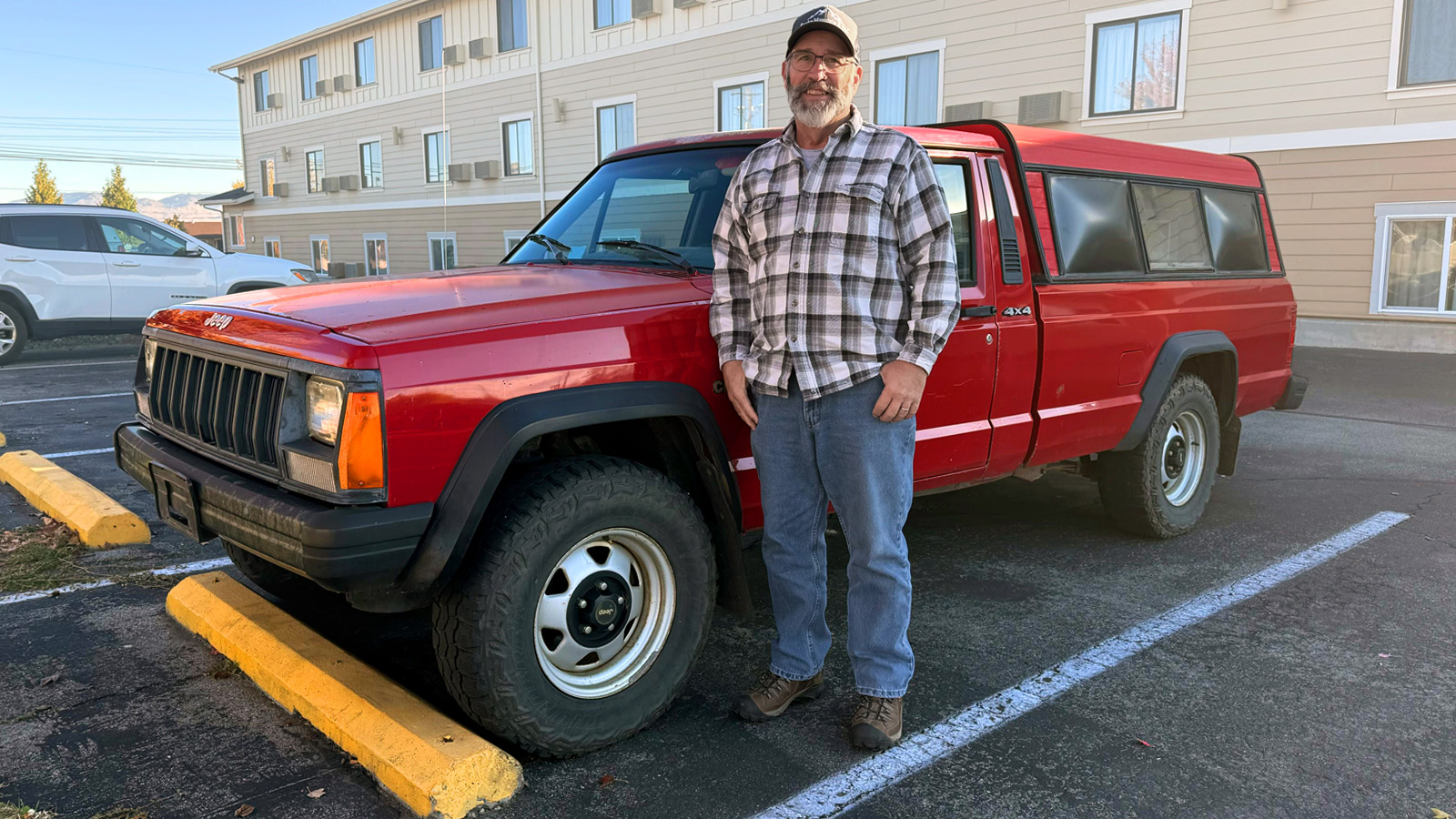
“I told my wife when I bought the Jeep Comanche that it was gonna be a ‘rest of my life’ pickup,” Bill, the man who sold me my new 1992 Jeep Comanche, told me. “[Cancer] is the only reason I’m selling it. I didn’t have any intentions of getting rid of it at all. Needed the money to pay for a pickup to get to the cancer chair where I’m sitting right now, getting an infusion.” So on Thursday morning, Bill parted ways with the truck after waiting multiple months for me to fly up from LA, because even though he didn’t know me, he thought I’d give the truck a good home. And that mattered to Bill.
When Bill said goodbye to the Comanche, it became clear to me that it was both more than a machine and also just a machine.


You see, this wasn’t just some regular pickup truck to Bill; it was his dream pickup — one that he bought from a man named Jim, who also loved the truck.
“He had other pickups. He was a retired sawmill worker and had a small farm,” Bill told me of the older gentleman he’d purchased the truck from about four years ago. “If [Jim] was farming, he was in his farm pickup. If he was fishing or hunting or looking for coyotes to shoot, he was in the Jeep.”
Jim was known in Bill’s small Idaho town for driving the small red pickup at hilariously low speeds, usually on gravel roads. “That truck spent almost its whole life at 35 mph,” Bill joked. “It was his fishing and hunting vehicle, and also a saddle horse, just to drive around and watch the country … Usually had a rifle beside him on the seat and fishing poles in the back.”
The truck had initially been sold in Lewiston, Idaho, about 55 miles from Bill’s hometown, and after 40,000 miles, Jim purchased it, per the Carfax report. Jim loved it.
“[He talked about it] like you and I talk about it,” Bill said of the now-departed red-truck-cruiser. “It was his favorite. And it was a plain-jane, very capable — if you wanted to drive out in the field or whatever — it would go. It was his baby. He took care of it … real well too.”
View this post on Instagram
Speaking of maintaining the Jeep, that’s what Bill — a heating contractor who sold wood, gas, oil and pellet stoves — always reminded Jim to do. “I sold [Jim] a gas stove and a wood stove over the years. And I knew his kids and son in laws … and yeah, I’ve always known him with this Jeep. That was his signature rig.”
“Take care of this pickup, because I’m gonna own it when you’re done with it,” Bill teased Jim.
“It was just a clean old rig,” Bill said about why he was drawn to the small red pickup. Bill’s first Jeep was a 1967 CJ-5 with a “Dauntless” V6 and four-speed manual, and his family had a 1974 Jeep Cherokee 401 and later a 1976 Wagoneer 401. So it was in his blood.
Jim replied to Bill’s joke: “I got son in laws and I got grandkids; they all want it. So it’s probably not likely you’re gonna get your hands on it.”
But then, about five years after Bill first started teasing the man about the truck, Bill got a call. “It was right after my first go-around of cancer … 2022. [Jim] just called me one morning out of the blue and said ‘you still want that Jeep?'”
“I said of course I do!”
Bill and Jim made a deal. And for the past four years, Bill has been taking care of the Comanche, leveraging some of the skills he learned from his dad. “My dad was a mechanical genius. He farmed and then he built and sold and designed lots of different farm equipment. That’s the [type of] house I was raised in.”
“Fixing a complex problem in the simplest of ways,” Bill told me, was his dad’s philosophy, which is why “he was [regularly] talking with farmers all over the country.”
Bill said Jim sold the truck because “He was having health problems, so he was downsizing stuff.” Bill says Jim put his ranch in a family trust, and though he was going to do the same with the truck, he thought twice about it. “A son in law in town was very unhappy. He wanted it … But [Jim] knew I was gonna take care of it. I’ve always drove older rigs and kept them up nice. He knew that about me and I’m sure that’s why he called me.”
Now Bill has to sell his beloved Comanche for similar reasons. “That’s the only reason I’m selling it. I wouldn’t have sold it,” he told me. “I told my wife when I bought it this was gonna be a rest of my life pickup. Power nothing, with a radio … it’s just old school and that’s what drew me to it.”
In November of 2021, Bill was diagnosed with Follicular Lymphoma, a type of cancer — specifically a non-Hodgkins Lymphoma that starts in the follicle of a lymph node. He told me he thinks his exposure to herbicides in the 1980s contributed to this diagnosis. Though Bill seemed in good spirits the day I bought the truck from him — he and I shared a great conversation about family, life, and God during our test-drive in the Comanche — it was clear by the tears in his eyes just before we parted ways just how much he’s been through. It’s obvious for me to say that this cancer has weighed on him in a way I cannot possibly describe. Even today, during our phone conversation, he was actively having treatment done. He has to make that drive from his home up to a hospital in Spokane very frequently. He described what it was like taking a shower with no hair on his head, no eyebrows, and no eyelashes: “You don’t know how useful those are until you take a shower without them.” It has been a long road already, and though the treatments will continue, even through tears, Bill’s tone was one of hope and especially gratitude for what he’s been blessed with in this life so far.
View this post on Instagram
Bill had waited two months for me to fly to Boise to buy the Jeep, even though he’d received all sorts of offers from other folks interested. “I’m a man of my word, and I want to sell it to someone who will cherish it,” he told me during breakfast on Thursday morning. That afternoon, after Bill and I shook hands, he told me it was “just a machine,” and I pointed his former Comanche south towards my home in LA.
As I listened to that 200,000 mile 4.0-liter straight six hum underhood, and enjoyed the perfect synchros of that Aisin five-speed manual, I was overwhelmed by the realization I mentioned at the top of this article. This truck that I was now bringing into my life and into the lives of my wife and child is clearly more than a machine. The sawmill worker, Jim, saw it as his “baby,” cruising around Idaho at 35 mph, hunting and fishing and keeping the truck in tip-top shape. And Bill himself, after spending five years ogling over the machine before Jim finally sold it to him, had no plans to ever sell it. Nobody talks this way about their washing machines or refrigerators. This Jeep Comanche is special.
Though to Jim, to Bill, and to me, it is clearly more than a machine, in the context of Bill’s cancer treatments, and the complexities that come with it, the Jeep Comanche is just a machine. Relative to the bills he needs to pay, relative to the family he wants to prioritize, relative to his need for a reliable machine to get him to the hospital, this truck is just an object. In the grand scheme of life, it does not matter.
And yet, Bill is likely reading these words, keeping tabs on an old truck that, a few years prior, was so much more than just a machine. Maybe him reading this means it still is.
With my left hand on the steering wheel and my right hand on the shifter in fifth gear, I stared out into the nothingness of northwest Nevada and — hour after hour — pondered that thought.


Just… Wow. The story, the comments. Incredible.
I recently bought an old K1500 (my dream truck as a kid) out of a barn after 15+ years of rotting away and revived it so I can work on it with my son (11 months) as he grows up. I wanted a way to bond with him, teach him about cars, problem solving, persistence through adversity (aka; wrenching in general) and have something really special to pass down to him.
At times I’ve thought I was a.collosal moron for doing so. If I ever doubt myself again I will think back to this article and the comments and know I’m doing the right thing.
I’m making arrangements to obtain for David a number of ‘unobtainium’ bits from a salvage Comanche I spotted locally.
I’m trying to talk myself out of a shortbed 2wd Bullnose F150 Lariat in the same neighborhood. It is a rust free, out of state example for $5500. Body is overall dent and rust free, has all major trim. Interior is rough, but replacement door panels are available. Besides, this NEEDs a Mexican blanket seat. AOD, not sure which motor.
I’ve had similar experiences buy and selling homes. People wanted their old home to go to a new family and we did the same when it came time to sell.
When it came time to sell a few cars, I didn’t care as much. I needed them GONE. Most of the time, like 70%, I thought they went to good buyers who would take care of them. But that really was a secondary concern.
It’s nice to know there are so many people out there who understand how someone can get attached to a car. I wasn’t able to keep Dad’s truck, but I do still have the ’97 Grand Cherokee he and Mom had as a second vehicle; it may be a late ’90s Chrysler product, but it’s loaded with memories, and keeping it running has been worth every penny.
My grandmother was diagnosed with non-Hodgkins lymphoma in the early ’80s, when treatment options weren’t all that great. Even though I was only in first grade when she died, I do have very strong memories of her. She even had a cool car story; when she got her first teaching job after WWII, her brothers bought her a Ford through the black market so she could drive herself to work. I wish that car had stayed in the family, but it was sold when my mom was a small child.
I’m sorry for your loss. If it’s any consolation, treatment options weren’t much better by 2001 when my father in-law got it and passed away six months or so after diagnosis.
Thanks for that…condolences to you as well.
Not me, getting the heartstrings tugged on a Tuesday morning. I really thank you for sharing this story. Cars are machines but just mean so much more.
When I lost my grandfather, his old ragged Impala was still in the garage. We had grand plans for it but never really had them materialize while he was alive. Now that its fully restored, every time I drive it I feel his presence in the car. Even with the resto, there is still a crack in the windshield where he hit a rock the day he was bringing the car home. The seat is warn to how he sat in it and it still has that distinctive “Impala smell”. Its family and a connection. Yet its still just a machine that likes to leak some fluid here and there, and be cranky. Its always hard to explain this pull to non-car folks.
Thanks for the story David. It’s great that this vehicle gets to live on, driven, maintained and enjoyed. I also love the fact that you’ve essentially recorded the car’s “family tree” and the people who’ve touched and owned it along the way.
What a wonderful, touching story. Thank you for sharing that with us, David. As a cancer survivor myself, I’m happy to wake up every day and continue enjoying life with my wife and kids and grandkids. I’ve also recently discovered a way of combining my love of cars and driving with my gratefulness for surviving cancer: The American Cancer Society’s Road to Recovery program. It’s an all-volunteer program that’s kind of like free-Uber for cancer patients. There are thousands of cancer patients all over this country who can’t make it to their treatments and either have to miss them or pay for an expensive ride to the hospital, which is too often not covered by insurance. As a volunteer, I have complete control over which rides I accept and which I don’t and all the people I’ve given rides to have enriched my life with their conversation and stories as we drove to their treatment or back to their home. It only takes as much time as you choose to give to it. Please, consider donating your time to volunteer for this necessary service to the cancer patients in your area:
https://www.cancer.org/involved/volunteer/road-to-recovery.html
Thanks so much for sharing this, seems like the perfect autopian-adjacent volunteer opportunity.
Happy for your recovery and I will look into this as something to volunteer for in my retirement. I have already done some other stuff but have been pretty tied up getting my mom into assisted living the past few months. Saved the link in my favorites bar.
As you know, I lost my dad to lung cancer a couple of years ago, and inherited his Chrysler 300. It’s also just a car – but it’s also not.
There’s a little spot on the side of the center console that’s badly worn, right where my dad used to rest his right leg against it while driving. I see it every time I get in the car. That spot, in a way, defines the whole car; it will always be “Dad’s car” to some extent. I drive it daily, and I’ve added 30,000 miles to the odometer in the past two and a half years; another 15,000 miles and the majority of miles on it will be mine. But it will still be Dad’s car.
I can’t say I’ll never sell it; my recent experience has shown me that there’s no such thing as a forever car, but I want to keep it as long as I can, and take care of it, and use it up. If I ever do sell it, it will be after I’ve enjoyed it as thoroughly as I can. I think that’s why he wanted me to have it.
When my dad died, I had no problem selling his (well, it was really my late mom’s) Mazda, but his 88 Country Squire stayed for a few years. It was never mine — it was always “Dad’s wagon.”
I didn’t let it go until my son was born. I finally had another “Hand” to hold on to.
Very well written, and captures the way a lot of us feel about cars, like they are family members. We take care of them, we get frustrated when they fail, proud when they are reliable, and have a hard times parting ways with some of them.
When I think of great moments in my young life, most of them were centered around cars, whether it was watching my father repair them, or building plastic models, or even reading Hot Rod, Car and Driver or Autoweek.
As I am months away from my 6th decade on earth, in the process of restoring my Father’s ’68 Mustang which was parked for the last 25 years of his life, I am thinking about the future, and what it has in store for me, and yes, what happens when I’m gone, including who gets the car.
“Nobody talks this way about their washing machines or refrigerators.”
I’ve read you, David, since you had engine blocks on your dining table, back in Michigan. But this sentence, quoted above, may be the best line you’ve ever written.
Thank you for “getting it.”