

Two years ago, we made a prediction that 2024 would be the year of the hybrid. From a future pivot towards range-extender hybrids to increased traditional hybrid options, all signs pointed towards a tipping point. Indeed, sales of hybrid models did well. Actually, that’s an understatement. Sales of hybrids reached an accelerative tipping point, and like a runaway tractor-trailer, sales have only picked up speed since then. It’s 2026 now, and the sales numbers for 2025 are in. The big story? Nearly half of all Toyotas sold last year were hybrids.
According to newly reported sales data, Toyota sold 1,051,397 electrified vehicles last year, which means that 49 percent of all new Toyotas sold in America had a high-voltage battery pack. A significant jump from 44.5 percent of new Toyotas being electrified in 2024. However, things get even more interesting when you remove cars from the mix that don’t use any gasoline at all. In 2025, Toyota only sold 15,609 bZ and bZ4X electric crossovers, along with 210 Mirai fuel cell vehicles. That’s only 1.5 percent of the total electrified sales, meaning 98.5 percent of electrified Toyotas could run on gasoline. In short, hybrids and plug-in hybrids, and that number is only likely to grow.


It’s no surprise that Toyota’s been on a hybrid tear over the past few years. While the Prius felt largely like an anomaly two decades ago, Toyota entered 2025 with seven models that were hybrid-only: The Prius, the Crown, the Crown Signia, the Land Cruiser, the Sequoia, the Sienna, and the Camry. You know, one of America’s best-selling passenger cars. Guess what? Six of these models had far better 2025 sales years than 2024 sales years, with the only anomaly being the Crown sedan taking a 37.1 percent volume hit that seems to have been absorbed by its Crown Signia sibling.

What about models with a choice between pure combustion and electric assistance? More than 11.4 percent of Tacomas were hybrid models, 20.25 percent of all Corollas were hybrids, 20.69 percent of all Tundras were hybrids, 21.7 percent of 4Runners were hybrids, 29.58 percent of Corolla Cross models were hybrids, 43.97 percent of Highlanders were hybrids, and 50.59 percent of Grand Highlanders were hybrids. The wildcard? The RAV4.
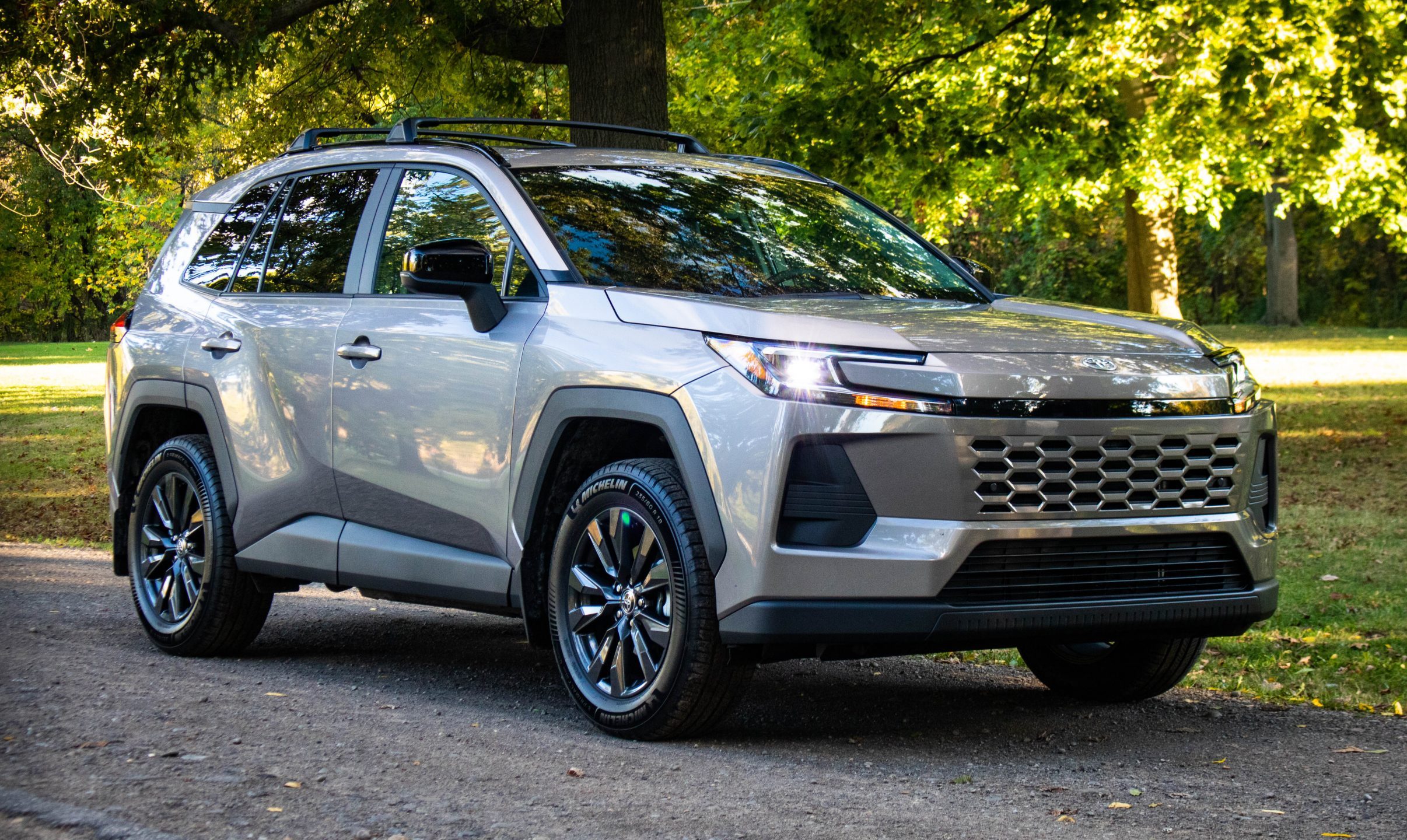
Although Toyota’s best-selling crossover ended 2025 with a 42 percent electrification mix, that’s about to go up to 100 percent. The new RAV4 gives shoppers two choices: Hybrid or plug-in hybrid. No regular gasoline model, that era is over. It’s a bold move, but if the Camry is any indication, don’t expect that to put a damper on sales. If anything, 2026 is looking like the hybrid tipping point for Toyota, with more than 50 percent of sales almost certainly having some form of electrification.

It’s easy to see why hybrids are dominating, especially compared to battery electric vehicles. They require virtually no learning curve, no supporting accessories, no real change to routine. If you’re coming from a combustion-powered car, you simply drive a hybrid like you normally do and see huge savings at the pumps. Plus, the cost add of a hybrid powertrain is typically minimal. Look at the outgoing RAV4—the delta between a base all-wheel-drive LE and an all-wheel-drive LE Hybrid was a measly $1,650. Assuming the national average gas price of around $2.82 holds, the hybrid model will pay itself back in fuel costs alone in fewer than six years, thanks to an EPA combined fuel economy rating nine MPG higher than its gas-powered sibling.

Oh, and it’s not just Toyota putting up impressive hybrid numbers. Last year, 29.35 percent of all Hondas sold in America were hybrids. Nowhere near the sales mix of Toyota, but there are a few things to keep in mind. While Toyota has several hybrid-only models and a whole host of base-model hybrids, Honda offers mid-to-upper trim levels of the Accord, Civic, and CR-V as hybrids, plus the faint trickle of Preludes sold before 2025 ended. Nevertheless, 53.97 percent of CR-Vs and 36.2 percent of Civics last year were hybrids, helping Honda to have its strongest electrified mix ever.

Sure, electric vehicles make more sense as everyday transportation for some people. Those who live in single-family housing, do big miles, and can charge either at home or work for cheap will almost certainly see substantially lower running costs on battery power alone. However, in an age of just about every car being automatic, it makes sense for just about every non-BEV to be a hybrid. Don’t be surprised if that’s the future we arrive at sooner rather than later.
Top graphic image: Toyota



Sees national price per gallon. Cries.
Solid state batteries are coming with 500-600 mile ranges. EVs have a handful of moving parts, unlike ICs and Hybrids. Almost maintenance free except for brakes and tires. No transmission to worry about, no oil changes and no coolant or a water pump to worry about. EVs are the future. Hybrids are a stepping stone to that future.
Not arguing with EVs are the future (for most passenger applications).
However, there is absolutely oil and coolant and water pump in most EVs. The reduction gear and/or differential (depending on architecture) has oil. The battery has coolant. Most traction motors have either coolant or oil.
Solid state batteries have been “coming soon” for years now. I’ll believe it when one is on sale at my local dealer.
All vehicles should be, at least, hybrids! I have no use for an EV; I have nowhere to charge and take frequent thousands of miles road trips. My hybrid Maverick works perfectly for my needs, except when I have to bomb across Texas and MPG slips into the low 30’s.
What else would work better?
EREV?
That’s kind of a hybrid and I actually shopped around for a decent used i3 at one point, because I like driving something unusual.
I predicted this years ago, and it has little to do with consumer choices. Most don’t know what’s under the hood.
Repeat after me: “Automakers can only sell what they are allowed to build.”
The 30 mg/mi corporate average criteria pollutant emissions limit has been in effect since 2024. It is close to impossible to meet without a high voltage energy source (or a microcar curb weight), but a hybrid can generally beat it (by using energy that was generated elsewhere, on someone else’s emissions budget while the catalysts are warming) and make room in the budget for some ICE vehicles
What’s often missed in conversations about hybrids is how much nicer they are than regular auto/cvt ICE vehicles. Auto stop/start is a non-issue because the electric motors will get you across the intersection before the ice engine fires up. Moving the AC off the accessory belt makes for really nice car camping. eAWD is far superior to mechanical AWD in a majority of real world uses. There’s a bunch of benefits besides fuel economy, and the MPG increases are often significant. My next vehicle will more than likely be a hybrid.
This should be talked about more. Non-performance oriented cars have the drivability bar set LOW. Every time I drive some bloated crossover with a tiny turbo-DI motor and too many gears in an auto transmission calibrated to avoid spooling the turbo at all costs I think “I wish this thing was electric”
The one that gets me is auto stop/start. My mechanical sympathy is always piqued when the starter motor fires at the slightest hint of movement on the brake pedal. It feels like the car is hurting itself. And with the AC on the accessory belt, it’s amazing at how quick a car will get hot and humid in the summer after the AC compressor is no longer running.
Another powertrain feature that no one wants but that has a very high take rate, but if ESS is activating while there’s a heavy demand on the compressor, someone in calibration didn’t do their job.
Sorry. What is ESS?
I’ve been making 1500-mile round trips down to N California nearly every other week since early June. (Mom with rapidly progressing dementia) So even a 600-mile range doesn’t quite work for me.
I’m about to start hopping on jets and rent a car while there during winter.
Sorry, industry term. Engine Start/Stop 🙂
Sorry about your mom. Mental declines are rough. 750 miles one way is well past the threshold that I would fly every time unless I needed to bring something big with me. Unless you’re traveling in a peak season it’ll probably be comparable in cost, particularly once you factor in mileage on the car.
Ah. Thanks.
It’s a little over 700 miles each way and then local mileage. I break it up into two days each way, stopping in Eugene or Medford overnight. My ’17 Accord started in June with ~ 60K on the clock and now it’s at 74K. It will be at 75K when I get back home.
A decade ago, during the summer, I could do it in one day. I’m done with that self-abuse.
A decade (and change) ago, I would do 1000 miles in a day to avoid a hotel stay. I didn’t even have cruise control. I’m also done with that self abuse.
A U-Haul van with no cruise control is the absolute worst, IMO. Totatally wound out or governed at 80, loud as hell. Crappy seat.
100% this. I’ve argued for years that start/stop should only be applied to hybrids.
I am not surprised at all.
I’ve driven a regular rav4 and then a hybrid version soon after and the drive feel is so different, like if the hybrid has a much bigger engine.
The regular car feels wheezy while the hybrid feels really good. In those cases, it’s not really a question.
The older Camry Hybrids matched the V6 model in acceleration tests.
Um, no. The Camry hybrids are great, but they are not as fast as the V6s, not even close.
The only real relevant stats are the ones comparing hybrid to gas-only where consumers actually had a choice of if they wanted a hybrid or not. Those numbers average out to more like 30% take rate on hybrids vs gas-only. That’s just averaging the take-rates across the 8 Toyota models with a choice of hybrid or non-hybrid though, not taking into account relative sales numbers.
Came here for this. I’m glad to see how many hybrids. However, looking strictly at Toyota you have to normalize the data. Toyota is shifting to all trims of a model being hybrid. You cannot buy a new Camry without it being hybrid.
It would be interesting to take a closer look at total sales of the Camry (and soon the RAV4) as it went fully hybrid, though.
It seems likely that previously when buyers cared which powertrain was in the car they were more likely looking for the hybrid but would settle for the gas-only version if there wasn’t a hybrid available. There were probably very few buyers who wanted the gas-only and wouldn’t accept a hybrid. So in that case you probably had a higher percentage of buyers who wanted a hybrid than actually got one just due to availability.
Now that hybrid is the only option, everyone who wants a hybrid gets one and the people who don’t really have a preference still buy the car. Unless sales dropped I don’t think there are many people who won’t accept a hybrid over gas-only.
I think you also need to consider the vehicle class and type of hybrid, though. The RAV4 and Highlander both use the planetary “eCVT” system and were at 42-44% hybrid, which tells you how good that system is and how much of an advantage it gives in those classes.
Compare that to the trucks like the Tacoma, 4Runner, and Tundra which use the Hybrid MAX system which are all at ~20% or less. The MAX system offers good power, but is way more complex and doesn’t really get any better mileage than the gas options.
At this point, if I was buying any “passenger” Toyota car or SUV the eCVT system is a no-brainer, but if I was getting a truck I would prefer sticking to the non-hybrid just because I don’t trust the reliability of the Hybrid MAX system and it doesn’t offer much benefit.
The odd thing to me is how low the Corolla and Corolla Cross hybrid take rates are, but I think that’s likely a combination of a higher price delta than in the SUVs combined with the high gas mileage of the gas-only variants in that class. Most people are plenty happy with 40 mpg.
I’m not sure if it’s the take rate or the production rate? When I was shopping, the hybrid Corolla Cross was impossible to find.
But it’s not like customers had to buy a Toyota. All the hybrid only options have non-hybrid equivalent options from competitors. If somebody who really wanted a minivan, big SUV, or midsize sedan was extremely against hybrids, they could have bought from somebody else. It would be interesting to see if sales dropped for the hybrid only models, or if they stayed the same. That would tell us if more people actually had interest in hybrids or not.
I think part of the argument is if the hybrid were really a deterrent, people would be avoiding the models that only come in that, no? Not saying your stat isn’t relevant, but they’re answering two different questions.
40mpg from a RAV4, 45-50 from a Camry and they hit 60 in seven seconds or so. 35mpg out of a Highlander and Sienna. It’s pretty damn impressive. Beware the MSRP and markups on some of these, though. Fuel savings go bye-bye.
I don’t understand the truck hybrids, though. The hybrid Tacoma, 4R, and LC are so fat and heavy that they kill nearly all of the mpg and acceleration benefits. The instant electric torque probably improves driving feel, but otherwise my ancient 4.0-liter 4Runner posted better acceleration metrics than the new Land Cruiser with 190 more lb-ft of torque.
I don’t understand the truck hybrids, though.
I do. 27 MPG highway out of a full sized RAM is pretty damn good for something that big and bricky. And 40 MPG out of a Maverick is even better.
(That’s not to say there isn’t still room for improvement.)
Beware the MSRP and markups on some of these, though. Fuel savings go bye-bye.
Which is a good argument to by a used Camry or Lexus es300.
The Maverick employs the type of hybrid system you’d see in a RAV4 or Camry. Those get good mileage.
I’m talking about Toyota’s i-Force Max powertrains, notably the 2.4 turbo version in the Tacoma, 4Runner, and Land Cruiser.
Noted.
I wouldn’t consider Ram’s eTorque system a “hybrid” in the same way that the new Tacos, 4Runner, LC, and Tundra are hybrids. Ram just knows how to many aerodynamic trucks and the 3.6L V6 does pretty good on the highway anyway. Toyota’s new hybrid trucks and SUVs only get marginally better fuel economy than their gasoline predecessors. It’s really kinda sad actually.
Hybrid trucks are great!
The issue is that Toyota’s hybridization of their truck lineup in particular seems pointless at best, and maliciously incompetent at worst. Especially within the context of their otherwise excellent hybrid lineup.
I had to go look up Mercedes’ review of the 2023 Tundra hybrid because I thought I was misremembering how bad it was- She averaged 16-18mpg in normal driving, and managed 24mpg attempting to hyper-mile. The actual fuck Toyota?
As a point of comparison, my F150 2.7l *non-hybrid* will do 26-27mpg on easy back roads, with a combined average of around 24mpg.
I’m also wary of the MAX system reliability.
Toyota hybrid reliability using the eCVT system in the passenger cars (including the Highlander, Sienna, and as an option in the GH) is unmatched. You practically can’t build a simpler, more robust system than an NA 4-cylinder matched to a pair of electric motors with a single planetary gearset and no clutches. I’d argue it’s less complex than an NA V6 paired to a conventional auto.
The MAX, system, on the other hand, starts with a turbo four with a conventional auto transmission, then they add all the hybrid stuff on top of that. It’s just way more complex than the NA V6 and conventional auto (or manual!) it replaces.
Never mind the complexity of the hybrid bits- The turbo 4cyl is already proving to be problematic.
Respect where it is due for Toyota’s general pragmatism and engineering prowess, but I do not bow to the alter of “Toyota can do no wrong”. I think their trucks in general are some of most overrated and under-delivering vehicles on the market, and have been that way for a long time.
I think they really went the wrong direction with the TNGA-F platform trucks. They should have gone lighter duty and beefed up the eCVT system (for the Tacoma at least) even if it meant a marginal tow rating. Personally, I know at least one person who regularly tows a large boat with an older Highlander Hybrid. I never see Tacomas being used for much more than that.
Toyota truck buyers were already used to making heavy compromises to performance in the name of reliability. A moderate power, but high efficiency light weight hybrid that matched the capability of the old base-model trucks would have been just the ticket.
For the Taco and 4Runner you need to maintain true 4WD with a low range transfer case, which I think would be a pretty tall order for the light duty eCVT hybrid. Currently the Highlanders use eAWD with a separate motor in the rear which works fine for what it is but falls flat off road.
However, the new Subaru hybrids use the eCVT system that plugs into a true mechanical AWD, so there’s precedent.
I agree the mid-size Toyota BoF trucks could get by with a lower tow rating. I wonder if ~6500 lbs is possible with a 4WD setup, improved cooling, and maybe a slightly bigger engine than the 2.5?
Yeah, I understand they wouldn’t be able to drop in the transverse Highlander drivetrain directly. They would have to reconfigure it like the Subaru setup- Use the eCVT to feed the transfer case. There will be some efficiency compromises like any vehicle that sends power through a driveshaft.
For what it’s worth, almost every modern ATV and SxS that uses a CVT comes with an additional High/Low gearbox to assist in low speed crawling and other high load scenarios.
My Skidoo Expedition snowmobile has the same. It really helps protect the CVT belt while breaking trail in the deep snow, or towing a heavy load up a steep grade.
I am honestly surprised it’s that low.
There were probably still some 2024 model year non-hybrid Camry sales that were logged, plus it’s been hard to get your hands on a hybrid Corrolla or Corrolla cross while the gas ones were actually seeing some discounts. With the #1 selling Rav going completely hybrid and old inventory flipping, it’ll probably be a pretty big jump for 2026.
Well, that kind of lines up with Toyota’s offering. So no real surprises.