

I’ve only been on the bad end of a conspiracy one time, but that’s one too many for a lifetime. What I learned from this experience is that there’s a brief moment of relief that comes from knowing you’re not crazy, followed by the paralyzing realization that all your darkest fears are coming true. That’s a little bit what it’s like to be a publisher of a website in 2025.
LinkedIn is a good industry barometer, and right now, the automotive news industry is split between people hoping to pivot to some sort of membership model and people losing their jobs. I’ve long tried to offer at least freelance work to individuals who lost gigs in one of the now innumerable prior rounds of layoffs, but we’re getting squeezed by the same factors squeezing everyone else, so it’s a lot harder to keep up with the pace of people who need help.


No mega platform owes us anything. I want to acknowledge this. Google (or Alphabet, if you prefer) doesn’t have to send us any traffic or any advertisers, and it still does a lot of both. My understanding was always that we work hard to provide the content that makes Google’s many products valuable, and the company, in return, provides some reasonably proportional level of traffic. This was also the deal with Facebook before Facebook decided to pull the rug out on publishers. Implicit in this understanding is that, is that under the Digital Millennium Copyright Act and similar laws, companies like Google get a “safe harbor” from certain lawsuits because Google isn’t the one making any content. We are. So we assume that risk.
With the push to make everything about artificial intelligence, Google has tried to integrate its own AI systems into its suite of online products. You’ll notice the Gemini diamond on your Google Sheets, an AI assistant in your Google Meets, and generative AI maps in your Google Street… views.
I mentioned this in my previous article on the topic, but as these AI products started to roll out, it seems like Google understood this could be detrimental for publishers who assumed they’d still be at the top of searches, either via Google News or via regular search. This change didn’t have as big an impact on us as we were new and didn’t have a long tail of search results.
What Google did to make up for this is a product you may not even be aware of, but everyone in the industry knows as Google Discover. Basically, any time you go to any Google product, it’ll serve you up some stories, videos, or social media posts. Here’s what my search page looks like:
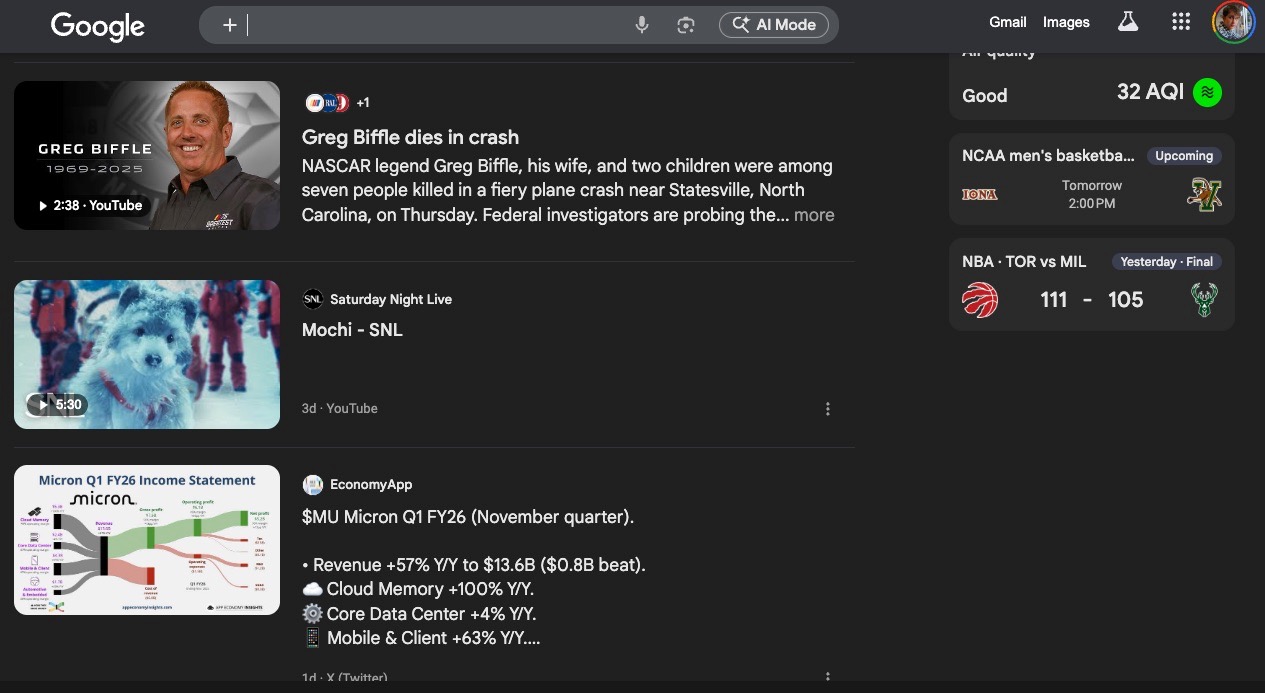
This has been a key way that people have found us, because it’s a more competitive place than search and gets more traffic than Google News. If more people clicked on our stories, Google seemed to show more people what The Autopian was writing. We write great stories and headlines, with excellent thumbnails, so we absolutely killed on this platform.
And then, as I mentioned, it started to go away. I attributed a lot of this to Discover ignoring its own guidelines for content and instead promoting a lot of AI-generated slop that somehow managed to sneak past the company’s own crossing guards (so much for Google’s excellent machine learing). The bulk of it may just be Google itself, as the latest report from web analytics firm Marfeel (full disclosure: this is the one we use) shows:
In key markets like the US, Brazil, and Mexico, AI Summaries already make up 51% of the feed. When they appear, AI Summaries often display multiple publisher logos but provide a single actionable click, which in most cases plays an inline YouTube (77% in the US, 100% in Brazil and Mexico). Deeper in the feed, AI dominates even more, quietly replacing publisher links.
It looks something like the graphic below, and you can understand why suddenly publishers aren’t getting the traffic that they expected to get in lieu of the search traffic slurped up by AI. We often get crammed in with other logos at the top in a way that results in little or no traffic to anyone.
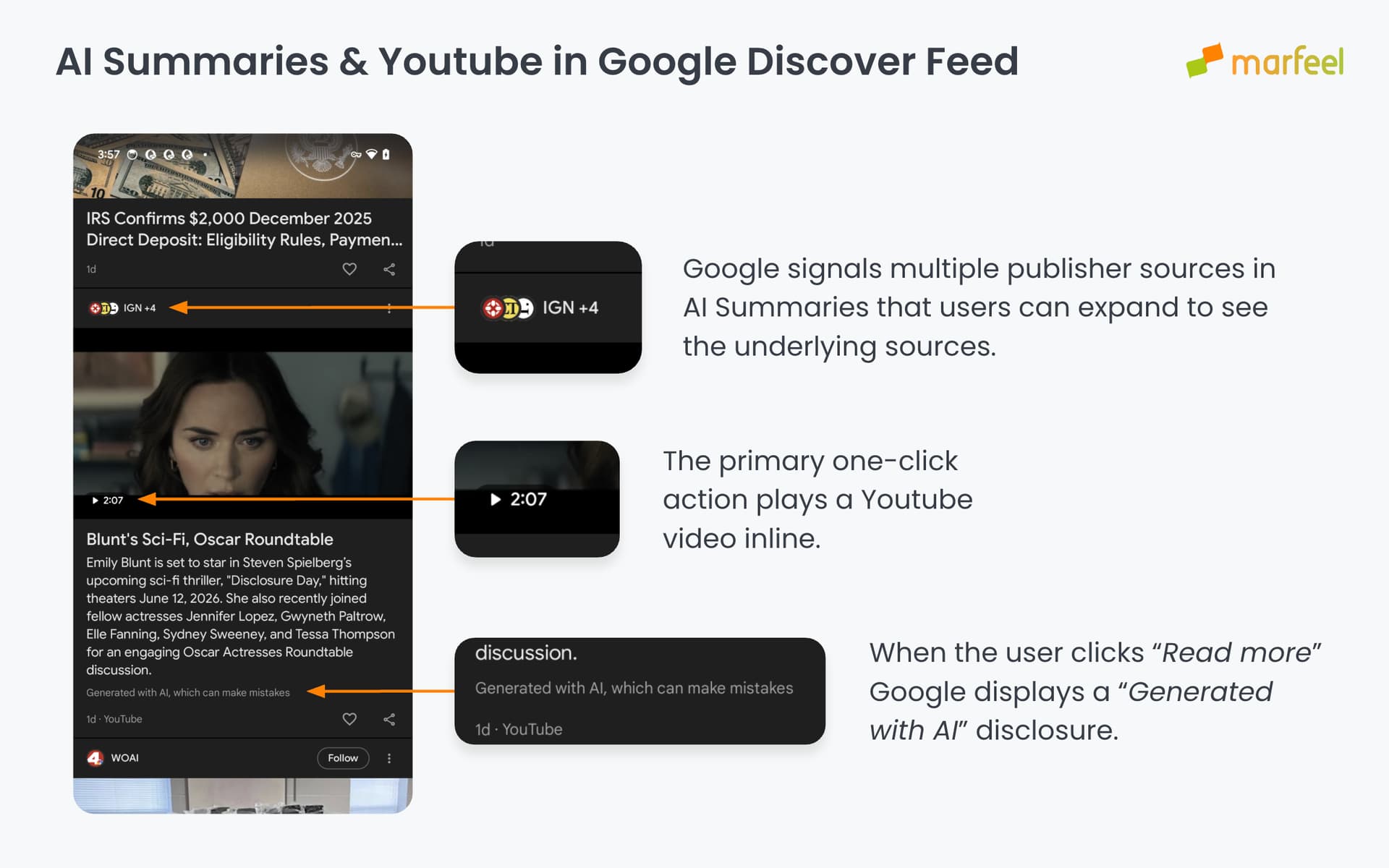
Who owns YouTube? Oh, right. Alphabet.
None of this is a huge surprise, as TechCrunch reported on this summer, but seeing it in our reports confirms the fears of diminished traffic were correct. And it’s not just us. It’s either comforting or terrifying that our main competitors are also being smacked around by the same changes.
If you’re wondering why so many of your favorite sites are suddenly even more ad-heavy than usual in the fourth quarter, this is likely the cause. With less traffic, the only way to get more money is to squeeze more ad impressions on the page, but this causes more supply and then forces prices down, creating a need for even more ads… ad infinitum.
The difference between our site and those other sites is that we’re way more careful about how we roll out ads because we don’t look at display as our major source of revenue (my guess is that if you were out of the industry for even a year, you’d be shocked at how crappy RPMs are). We have a membership business, and that means we care about getting people to check out the page and then want to stick around.
I think about it this way: If your friend told you about this great restaurant with a chill vibe and a perfect juicy hamburger, you’d probably go. If you got there and the restaurant was full of TV screens blaring ads, the menus were dirty, and the waiter kept trying to shoo you away from your table, you wouldn’t care how good the burger was. You’d never come back. That’s what most websites are like now.
When your friend (in this metaphor, Google) sends you our way, we want you to love it here. We want it to be a nice experience. We want the burger to be delicious. And we want you to come back. Slamming the page with ads is counter to this, and other publishers in our space that have experimented with a lot of ads and membership have found that people didn’t really want to become members.
Our goal is to eventually turn as many of you as possible into members by making membership super valuable, but we also want more people to find this place, which means we’re not entirely paywalled. It’s a tough balance, but our plan has always been to lower our dependency on revenue from all platforms, not just Google, while also keeping our discoverability high.
I write this because it’s going to be difficult for publishers who have insisted on the other model to function going forward, and you’ll probably see other automotive websites you love either get smaller or do all sorts of seemingly nonsensical things (AI slop, trending TikTok articles) just to make up the difference. I also expect a lot more layoffs in Q1 of 2026.
Here’s another chart from Marfeel:
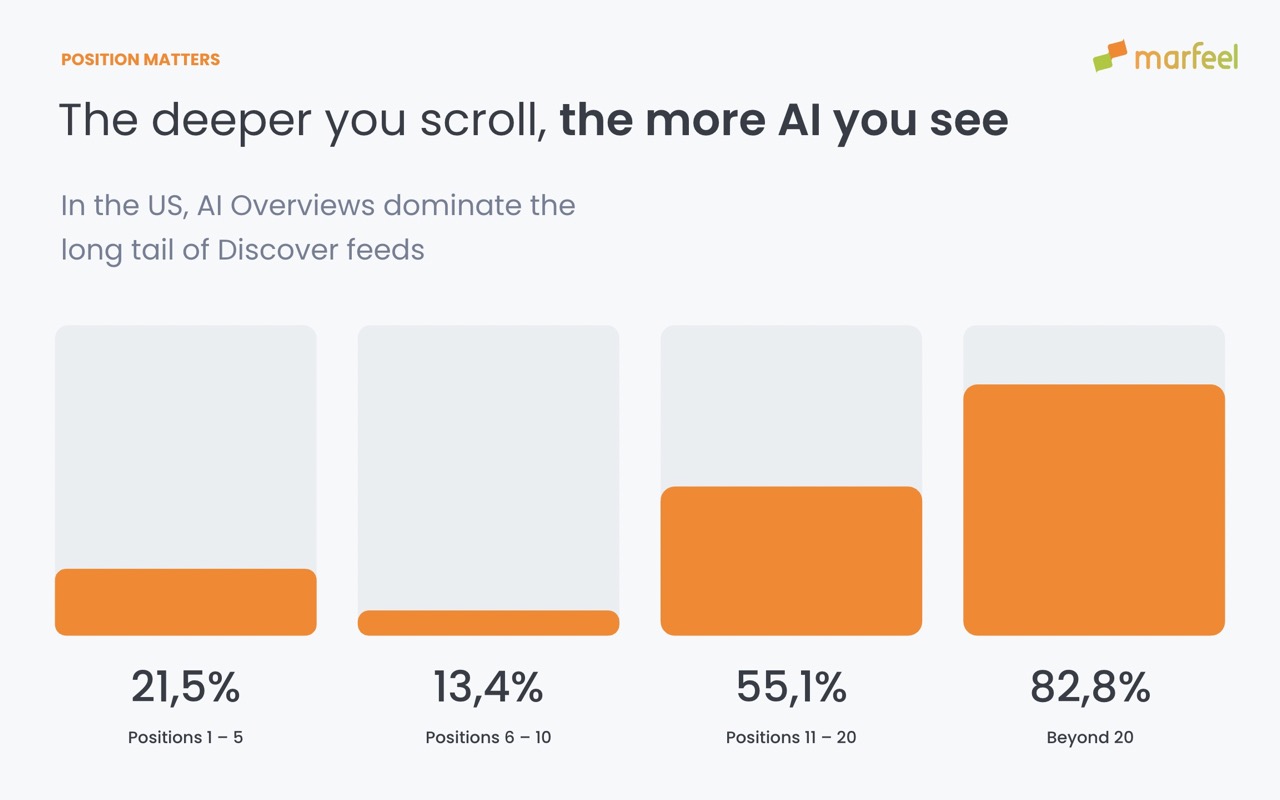
Do you really think the AI summaries are going to stay at the bottom of the page? I don’t.
Marfeel’s report pretty much nailed it when it said “Google Discover is shifting from a traffic distributor to an attention controller.”
This is also bad for Google! Going back to the original conceit of the Google-Publisher relationship, AI needs human thinking to feed its models. We provide that thinking. The more watered down and terrible and sloppy the inputs, seemingly, the harder it is to get a good output and the less valuable that input becomes.
Again, we’re building our business to be resilient against these sorts of changes over the long term. That means merch, toys, partnerships, some display advertising, and, most importantly, membership. If you’ve been thinking about becoming a member but haven’t yet, and are able to, now is a good time to do so.
Our plan is to review what sort of membership we can project out into 2026 based on Q4 of 2025, and we’ll use that data to decide how much we can spend on freelance, the website, more events, et cetera.
And if you’re already a member, as always, thank you for your support. It makes moments like this a lot more tolerable and keeps us focused on making this the best place to hang out on the web for car people.





“When your friend (in this metaphor, Google) sends you our way, we want you to love it here.”
Ah, so I can expect the “block/mute” feature imminently..
I switched to firefox and duckduckgo a couple months back because I just got sick of the AI overview and the fact that you couldn’t turn it off. We were taught as kids to cite our sources, and it appears nobody has any interest in going to the sources anymore.
Is it a worse search engine? Hell yeah it is. But I’ll make that trade.
Add “-AI” to your search requests and it won’t return AI summary or AI results (at least in Google).
I dabble in Youtube and make a tiny bit of content…mostly to share with friends and family. It doesn’t benefit me at all, so any eyeballs or ad revenue goes strait to google. Anyway I played around with a some AI content a while back just to learn the tools and while it is great for telling stories, narrating, making little video clips to illustrate your points, I ended up removing all of it from my channel. I’m just so done with this slop. It’s a plastic shortcut to crapville. I was listening to the kids playing at my son’s piano recital last night and thinking about why AI can’t replace live music. It comes down to this….when a person creates something, music, art, writing, etc… Its not just about the thing they created, it is about the journey to create it. The years spent in music lessons, the teachers and mentors along the way, the nerves at the first recital, getting used to a new instrument, the self doubt that grows into confidence to share your thing with the world. You can see/feel/hear the journey in good art. AI can have the internet, I’m going back to the real world. You guys should publish a magazine and sell print adds. As backyards get turned into data centers, electricity rates spike, and unemployment rises, I think we’re going to see so much backlash against AI we’ll see a whole religion form against it. It will be like the Amish except based on the 1980’s and ’90’s 🙂
Can you add PayPal as a payment option? I don’t like spreading my card # around.
It’s good you guys are thinking of these problems before they become more serious.
Why not use a virtual card number? Or, try a prepaid/loadable debit card.
The Great Enshittification continues (but not of The Autopian, of course).
The single, and only, reason I cancelled my subscription is the fact that you require 2 factor sign in via an email code to log in. I read at work, and automatic sign in’s often fall afoul of our institutional security, so every time I’d visit and log in and try to post, I’m pulling out my phone for the code…not good, so I cancelled.
If you change to allow sign in via password, I’ll come back in a nanosecond. I love you guys, and this site, and would dearly like to support you.
I have noticed that the Google search app has been smashing web pages together with a AI generated header. Google admits that “Generated with AI, which can make mistakes” One had the Commanders having lost the game in which they were losing, but had not lost yet with a 27 to 27 score. To see anything more I have to then open up the item which is an extra step I did not have to do before.
Since I use Google for work and personal items, it becomes weary of trying to keep up with 2 radically different searches throughout the course of the day.
Want to have fun, do searches in Bing, which can be all over the place:)
For most of my career, enshitification was a software/product problem. How nice so see it grow into a widespread societal issue too!