

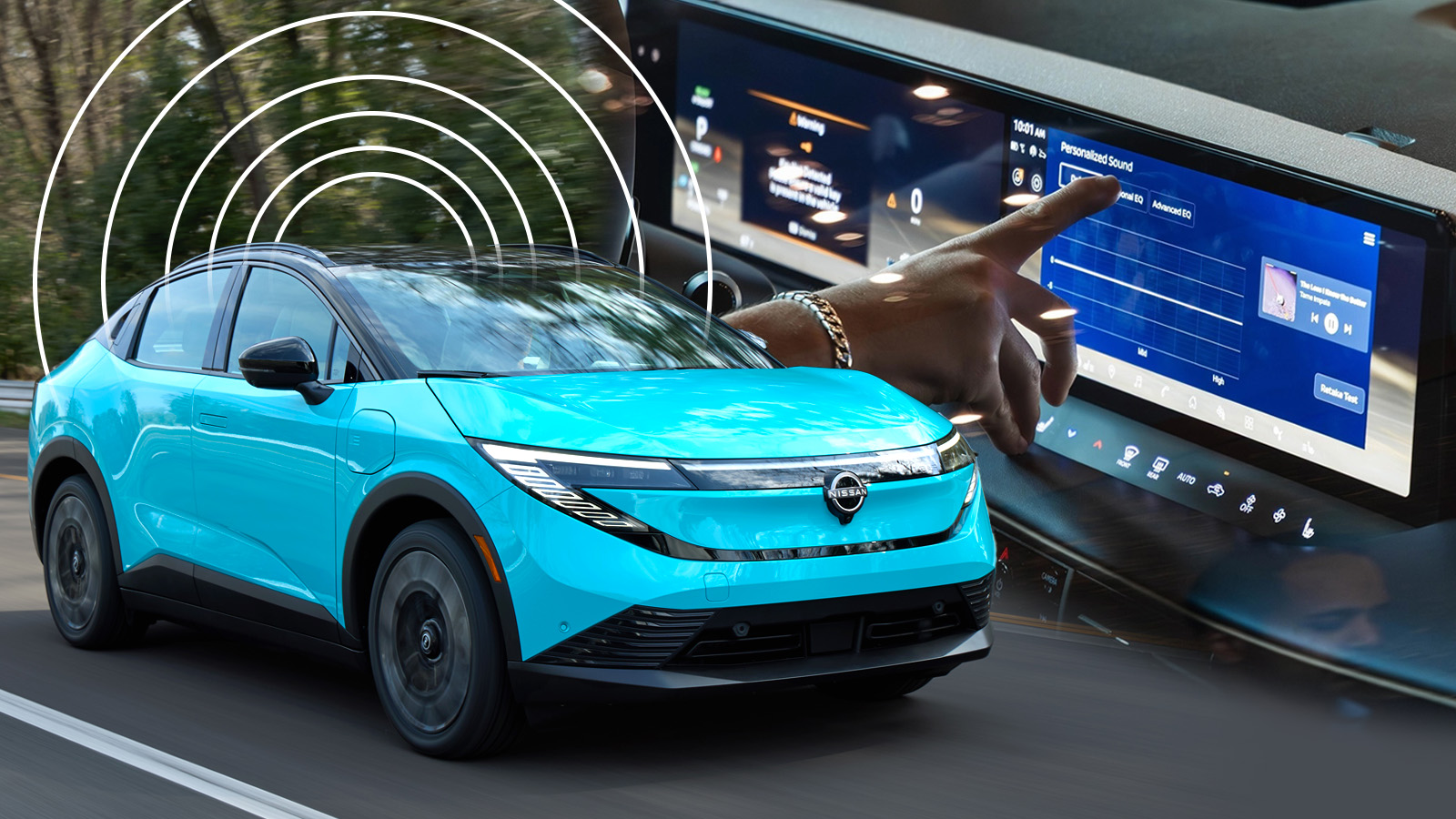
When it comes to sound setting adjustments in cars, most drivers are only aware of more bass and more treble. A 10-band graphic equalizer is more likely to overwhelm the majority of consumers than be meaningful to most users, and the result is usually people messing about with settings too much, potentially making their music sound bad. However, Nissan thinks it has a solution. It’s called Personalized Sound, and on first glance, it’s simply brilliant.
The bare minimum of adjustment these days are coarse shelves for bass and treble, adjusting wide bands of frequencies. Some entry-level systems offer another shelf for the mid-range, but the real standard is a graphic equalizer. It’s worth noting that a graphic equalizer and a parametric equalizer aren’t the same. The former has set frequency bands of adjustment whereas a parametric equalizer lets you pinpoint a frequency and define just how wide of a band you want.


Anyway, the normal way to adjust an equalizer is with noise. Specifically, pink noise and sine sweeps. Pink boasts equal loudness across each octave, which makes it great for making broad adjustments with the goal of evening things out. Similarly, a sine sweep can be used to pinpoint any harshness or deficiencies as the wave sweeps through the range of audible frequencies. While it’s best to start with something like a spectrogram and then adjust based on the human ear if you’re setting a system up from scratch, audio engineers usually try to make things as balanced as possible out of the gate, which is where your hearing and tastes come in.

It’s no secret that humans often lose high-frequency hearing as they age. It’s not just exposure-related hearing damage; the little hair cells in your cochlea start to slowly age, pretty much no matter what you do. At the same time, it is worth noting that some people do suffer from exposure-related hearing damage, and might not hear sound as evenly as they did when they were young. Some people are more sensitive to bass than others, and the list of reasons why a set of speakers won’t sound identical to everyone goes on. Equalizers let listeners compensate for this, but most listeners just aren’t great at tuning them.
I can’t even tell you how many times I’ve hopped into a press car only to discover some horrific crime against music taking place with the equalizer. Some people go for a severely V-shaped profile that drowns the mids, some go for enough bass to make music sound like mud, some have the high frequencies boosted so heavily, breakbeat hi-hats feel like a tinnitus simulator to younger listeners. People need some help, and that’s where Nissan’s Personalized Sound app comes in.

It seems like a pretty straightforward piece of tech, downloadable to any Nissan product with Google built in. That means the Leaf, Armada, Murano, and Rogue, along with the Infiniti QX60 and QX80. When running, the app will play tones of various pitches, and the driver taps the screen when they hear each one, dialling in perceived loudness. That data then gets converted into an equalizer profile, ready to use with Bluetooth, Spotify, the radio, and other in-car sources, with others being developed. Simple, subtle, theoretically foolproof. Granted, it only tests in bands between 50 Hz and 1,200 Hz, or sub-bass through the mids-to-upper-mids, but it’s a solid start.
I’d love to try Nissan’s Personalized Sound app in person, but it already seems like a sensible way of steering people away from ruining their music by tweaking an equalizer without knowing how. Adding a little more sub-bass punch or brightening up the treble by a touch is cool. Maxing out a band with a +6 decibel adjustment usually isn’t.
Top graphic image: Nissan




After the test, it uploads the data to a Nissan-employed audiologist who will sell you branded Nissan hearing aids.
I have had tinnitus since I was 10. Most of the time, with other noise around me, I don’t notice it. But trying to fall asleep on one of those nights when it’s hard to fall asleep, it’s awful.
If they could figure out how to noise cancel that out from the garage, I would buy one, no matter how poorly it drove. And actually, the Sentra I rented in September was pretty decent to drive.
Consumer audio adjustment peaked with the pop out bass and treble knobs of the 2000s. Having to dive into layers upon layers of “infotainment’ menu screens and requiring a sound engineering degree are not the solution. The Hi-Fi folks are probably going to spring for the optional sound system or just go aftermarket
Besides, all that infinite adjustment just makes for infinite fiddling when no two songs are mixed the same. But a bass and treble knob that I can give a quick twist when the next track comes on? Now that’s bliss
I doubt that will be an option in many cars going forward, with the infotainment being integrated with safety systems and, more importantly, monetizable connected service systems that give them a reason to use the former as an excuse to prevent access.
As someone with tinnitus at the “young” age of 40, I appreciate big industries paying more attention to how sound is perceived.
I have some electronic devices with alarms, low battery warnings, etc. that are essentially the same frequency as my ear ringing so I don’t hear them.
Take care of your hearing people. Tinnitus is no joke.
Now if there is a way to level the sound between different songs that would be great.
Apple Music has a “sound check” feature which tries to keep everything even sound wise
My hearing sucks (thanks to abut 20-30 years of drumming and being an idiot for the first 15 of them not wearing earplugs at metal shows)…I’m a scooper. I prefer a loud lowest freq setting (60-80) in the sub sweet spot but always reduce 125-150hz as much as I can. Most audio systems are right at the bottom of their speakers’ curve and once it hits 150 or so the midrange speakers also try and amplify, which just sounds like mud. A proper adjustable crossover is the real answer, but I dn’t think I’ve ever had a car with that stock. From there a gentle, mostly flat U to the highest treble which I crank high.
The best stock system I’ve heard is on my E550 w/the HK. Once tuned, it’s as crisp and clear as can be.
Anyways, I’m glad that automakers are actually making effort to have their systems sound decent. Even the higher end rentals I’ve been in (recently a 2025 5 series) was disappointing with just a bass and treble adjustment. Incredibly underwhelming for a 70k car.
I feel called out and I don’t like it.
Amen
What? Speak up. Especially if you are standing to my left.
Remember when getting the upgraded stereo meant a full EQ (5-7 bands)? For some reason, despite touchscreens making this infinitely possible and incredibly cheap, cars have really backed away from that.
I think there was something about 80s-90s car stereo culture that made it a competitive necessity for the OE manufacturers. It’s also possible that music is so “transactional” in the age of downloads and streaming, people just don’t care enough. They’re not listening to an entire album at once, anyway. Except in my car — I almost demand it 🙂
I’m really sensitive to Bass. The pressure waves really bug shit out of me. I usually keep Bass lower than most and have the mids a little higher.
Same. I get really annoyed if my sliders are just treble and bass, because I usually want the bass low, a little extra mid, and the highs right in the center. I struggle in or next to cars with the bass blasting.
Funny, My son has a friend that drives a newer Jeep SUV. When he came over I always thought he had his bass turned way up. I asked my son about it, and he told me they didn’t even have the radio on that time. Come to find out, the exhaust was the perfect bass tone that bugs my ears, but he couldn’t really hear it.
I have had similar experiences with a couple of pickups that had exhausts with that same feature. And I get miserable when the wrong tires hit the wrong bit of road, while my girlfriend doesn’t even notice the difference in road noise.
Some Jeeps also have active noise canceling. My dad has a new GC and has been complaining about a “rumble” at cruising speed. I was able to hear it clearly when I was last in there too…it’s an attempt at active noise canceling at but somehow just doesn’t work well. It sounds like a transmission or drivetrain issue, which is also never out of the question with Stellantis build quality these days.
Do you have a son named Joel?
If so, don’t leave the keys to your Porsche lying around if you go out of town.
You’re not the boss of me!
I have the bass maxed in both my 2013 car and 1995 truck. 1995 truck never sounds that great, 2013 car can thump pretty well on some songs.
Same with my 13 Civic! the 03 Civic has all aftermarket and does pretty well with a less severe bump, plus that radio has DSP for time alignment and stuff so it just sounds better in general.
I’m not fond of Japanese software. Just ask British Post Office workers how it works out for them.
WHAT?
https://c.tenor.com/rjNfGQUv25wAAAAM/funny-hilarious.gif
But does it go to ELEVEN?
RIP Rob Reiner.
Yes, but
To be valid, you’d want to do this test when road noise was present, and I don’t think you want to be futzing with this test while the car was in motion.
i disagree road noise is going to be different from one street or city to the next and also at different speeds and weather. “road noise” is too un predictable to tune to
If I understand the description correctly, this is a “minimum detectable level by frequency” test, which if done will profile the simultaneous combination of the driver’s hearing and the audio system’s output characteristic at low levels. It would be done at standstill, hopefully in a quiet garage or late at night without strong winds or other ambient noise.
Having done that, and in fact with or without that, I see it as a separate job for the NVH people and the audio system people to jointly develop compensations based on vehicle velocity and audio media volume level.
One additional note, if the Nissan’s audio system is adjusted in compensation for the driver’s auditory shortcomings, the passengers are going to be subjected to those curves, which are wrong for them. Hopefully it can be toggled off when desired.
Really good point about the passenger/shared experience. Cars aren’t headphones, they’re rooms.
Yeah my car stereo sounds quite good parked, but when moving all bets are off.
Plus, it can double as a hearing test. They could have a pop-up appear if certain ranges are exceeded: Go see an audiologist. Your hearing is Fux*ed!
But does the interface have a screen with lots of little colored dots in rows that go up and down?
Samsung has a similar feature on their phones, which is great if you have multiple earbuds/headphones (don’t ask). Stupid thing is the profile is not automatically applied when the earbuds/headphones are connected.
I’ve never tried calibrating my car’s audio though. Something to do before the year ends.
Did this with my Samsung earbuds. They sound great. To me at least.
Likewise with AirPods and iPhones.