

Race tracks are some of the few places in the country where you can enjoy your car to the fullest without fear of consequences. But they’re also dangerous places. With no speed limits, no road markings, and no traffic lines, it’s up to drivers to know how to navigate a race track safely. All it takes is a quick YouTube search to see that not everyone can handle the privilege without causing a huge accident.
By all accounts, Artin Nazaryan and Akihiro Fuchigami, the owners of a pair of imported Nissan Skyline GT-Rs, were following the rules of the track when they were stopped on the front straight of WeatherTech Raceway Laguna Seca in California. Flaggers had deployed a track-wide red flag, signaling a dangerous condition on the track, which required all cars in the session to come to a complete stop.


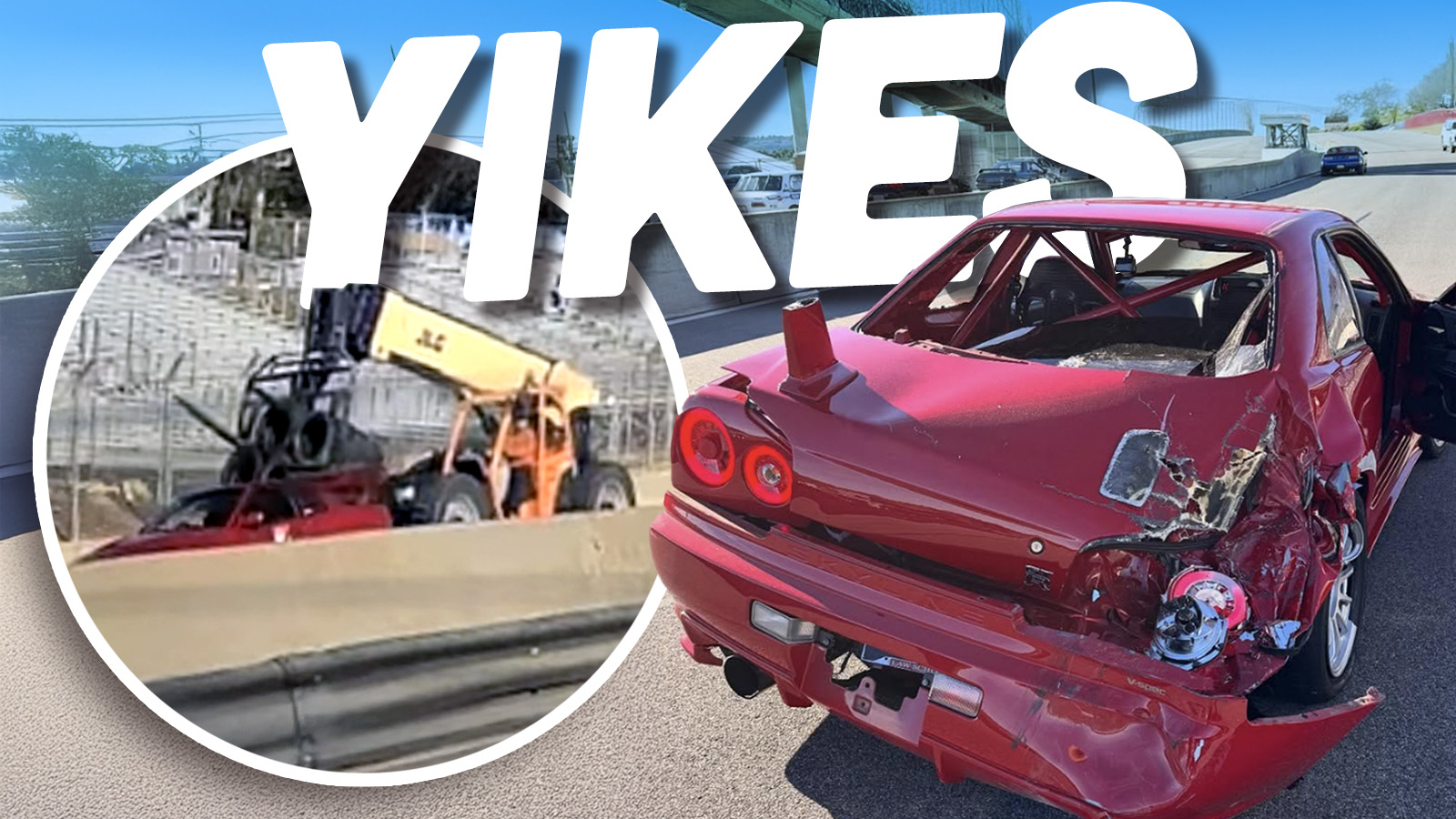
That’s when disaster struck. Videos published to social media show a telehandler (a big type of forklift vehicle) striking the rear of both cars while transporting a bundle of tires, causing serious damage. Now, the two owners are suing the track, the organization that runs the track, and the telehandler operator for negligence.
What Happened, Exactly?
According to the lawsuit, filed on December 16 in the Monterey County Superior Court, the telehandler “proceeded at an unsafe speed for the conditions and the environment,” and did so “without maintaining a safe and clear line of sight ahead and without taking adequate measures to ensure the path of travel was clear,” leading to the collision. From the lawsuit:
The telehandler operator failed to perceive both of Plaintiffs’ stopped vehicles in front of him in sufficient time to avoid a collision.
The telehandler violently collided into the rear of Plaintiff Nazaryan and Fuchigami’s vehicles (“Subject Incident”).
The impact from the telehandler caused substantial force to be transmitted through both Plaintiffs’ vehicles, pushing them forward along the racing surface.
View this post on Instagram
Video published to Instagram earlier this month (above) shows footage of the collision taken from a camera mounted in the rear windscreen of a car parked in the pit lane. It shows the telehandler barrelling into the rear of the red R34 GT-R, which was operated by Nazaryan at the time.
Another angle, taken from the perspective of Fuchigami’s car and published by Nazaryan to Instagram, shows the moments after the initial impact, where the telehandler seems to then strike Fuchigami’s R32 GT-R:
View this post on Instagram
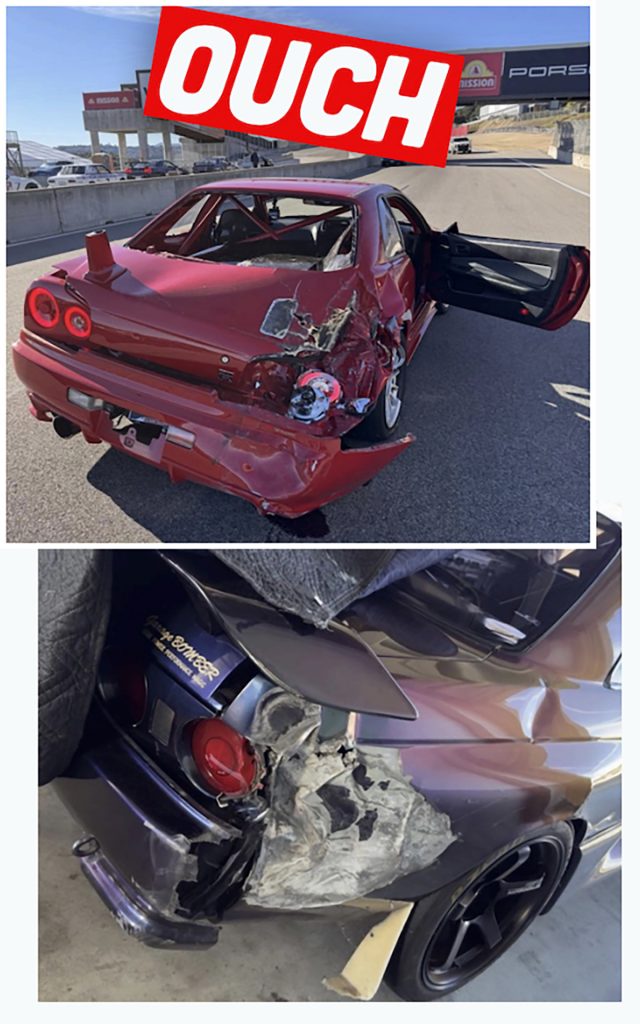
A photo of the R34 published alongside the lawsuit shows the car’s rear end smashed in, its bumper hanging partially, its wing missing, and its rear glass shattered. A photo of the R32 post-incident shows a crunched right rear corner panel, a damaged taillight, and a broken bumper, among other things.
Here’s Exactly What They’re Suing For
Josh Kohanim, a lawyer representing both Nazaryan and Fuchigami, told me over email that the claims against Laguna Seca Raceway, Friends of Laguna Seca (the non-profit that manages the track), and the unnamed telehandler driver include negligence, premises liability, negligent hiring/supervision/retention, vicarious liability, negligence per se, negligent entrustment, and gross negligence. From the lawsuit:
Defendants had the ability to prevent this type of incident by ensuring that heavy equipment was not operated on the racing surface until it could be done safely; by ensuring appropriate communications and confirmations that the track ahead was clear; by using appropriate spotters and/or guidance when operating large equipment with limited forward visibility; and by requiring speed and other operational restrictions.
As a result of the impacts, the lawsuit claims the plaintiffs “sustained life-altering personal injuries,” the full extent of which, according to the filing, is “not yet fully known.”
Plaintiffs suffered and continue to suffer damages, including, but not limited to, physical injuries, pain and suffering, emotional distress, mental anguish, inconvenience, and such other non-economic losses as will be proven at trial.
In addition to covering past and future medical expenses, the lawsuit is asking the defendants to cover past and future loss of earnings and earnings capacity, the cost to repair the cars, and “[f]or general damages according to proof, including but not limited to pain, suffering, emotional distress, mental anguish, inconvenience, and loss of enjoyment of life.”
Where’s Laguna Seca In All Of This?

When asked for comment, a Laguna Seca spokesperson sent over the following statement:
An incident involving a track support vehicle and a racecar occurred at the facility during a privately operated on-track event earlier this month. The track continues to work through the process with diligence and timeliness.
This doesn’t really say much, which is not terribly surprising considering there are lawyers involved. Anything Laguna says to me can be used against it in court, so the less it shares, the better.
While it’s up to a jury to determine what Nazaryan and Fuchigami are owed in this scenario, I’m nonetheless hoping their cars get fixed quickly. Seeing a couple of classic Skylines beat up like that makes me sad, and Nissan’s not making any more of them. So if there’s an opportunity to get them back on the road, I’m all for it.
Top graphic images: Wise Personal Injury & Accident Law


I generally loathe our sue happy society, but in this instance I would too.
Those poor Skylines! I hope Nazaryan and Fuchigami are compensated for all their losses, not just the cars.
I’m now wondering what an entire race of tele-handlers around Laguna Seca would look like.
We could probably do that in Assetto Corsa
So much epic destruction if you look up on youtube nordschleife
I’m not too familiar with GTRs . . . I know R32s and R34s are scarce in the States, but these are more “I got a rare car and built it the way I wanted it” 1-of-1 vs “the only remaining ’83 Corvette” 1-of-1, right?
Yes definitely. From the factory, GT-Rs are all pretty similar, but the customization options are limitless these days.
This was so preventable with a high mount dashcam.
Anyway, the language in the suit is expectedly hyperbolic and there maybe was negligence on the part of the operator (surely, there was carelessness) but regardless of how it happened, this is a risk of taking a car on a track and this is what insurance is for. If your “1-of-1” Skyline getting wrecked at a track day results in a lawsuit then you probably haven’t calibrated your risk tolerance for such events.
Hope they get their cars fixed or replaced and made whole, but that this has already gone to suit is concerning.
**Edit: just read that one of the drivers is a personal/automotive injury attorney, so this is their M.O. – it was going to be a lawsuit no matter what
You’re right, track days come with risk.
But it is a bit different when the track equipment operator damages you because they weren’t paying attention.
However, I was on their side until I read the insane hyperbole and “life altering personal injuries”. They should have been wearing helmets, etc. anyway. And they’re personal injury lawyers? Eh… Fu©& ’em.
10 second penalty to Leclerc.
Rushing forward like Navy in Baltimore last week, right Jesse?!
While I agree that the telehandler was going way too fast and the accident was avoidable, it is hard not to notice that the cars were stopped on the racing line (which is quite wide at that part of the track) and very much not “on the side of the track”. As per pretty much all racing regulations under a red flag you are expected to “safely stop away from the racing line on the side of the track in view of a flag station”. These cars were very much not on the side of the road. Emergency vehicles would not expect cars to be there as they respond to whatever the incident was. This does not excuse the fact that the telehandler driver was going way too fast fast especially given poor forward visibility, but it is a reminder that following flag rules is critically important at all track events.
But is a tire hauler classified as an emergency vehicle? I would think in a flagged emergency a forklift moving tires would be told to stop instead of driving in an emergency? Not an expert but c’mon emergency requires non emergency to stop
I think the first photo in the Instagram post is after moving the car, there is a drip line from fluids and there is no debris as would be expected if this was the location of the accident. They probably pulled the car out into the lane so the telehandler could move. The still from the dashcam shows them much closer to the barrier at the edge of the track.
I was going by the video of the crash itself (which you can find in various places) from people filming from pit late. You can see the telehandler hitting the car on its left rear end, meaning the telehandler was coming down fast on the right hand side of the track and there was more than enough room between the cars and the track wall on the right for the telehandler to (almost) fit, meaning not anywhere close to what you’d call “on the side of the track”. Laguna seca has painted lines along the front straight and there is at least 1.5 car widths between it and the wall (all paved) where you’d want to be to be “on the side of the track”. FWIW I’ve seen this at multiple track days and regional races where red flag incidents result in cars stopping in the middle of trd track and emergency vehicles having to weave around stopped cars as they go by
Sucks all the way around. I hope they get their cars fixed without too much hassle. I’d be curious if they had track insurance from Hagerty, Lockton, etc for their Skylines and if the insurance would even cover something like this.
I’ve heard track insurance isn’t a thing
I’m going to say the red one is almost certainly totaled, the blue one is maybe borderline if you can find a bodyshop willing to touch it
Did they not sign a waiver? I’ve never been allowed on any racetrack without signing waiver of liability.
I’m not a lawyer, but I doubt that applies to negligence on the track’s part, which this clearly is.
A quick google search brought up lots of lawyer’s websites saying gross negligence isnt covered under a waiver. I guess they could be putting that on their website to encourage people to contact them (and effectively make more money), but it seems like putting a known legal falsehood on their website would get them in a lot of trouble. I’m inclined to believe they are telling the truth.
I can’t find Laguna Seca’s waiver online. But they are usually a fairly broad blanket waiver. You usually waive all risk up to and including negligence by ANY party. I think the track probably has a leg to stand on. Honestly it could go either way.
But here is negligence
Most things people put in contracts aren’t binding, and many are blatantly illegal.
They just hope you sign.
I crossed out pages of a hospital admission form, and they never blinked.
With lawyers everything is both legal and illegal until you hire them and they will agree with you to the time of $800 an hour until a judge says you are wrong. They still get paid
Agreed on negligence if there is an emergency I doubt a forklift carrying tires is considered an emergency support vehicle
I suspect that is why this is going to be a legal battle. The track is going to point to the waiver, they’re going to point to the negligence, the insurance company is going to point to the waiver and the negligence, and the court is going to decide the extent of what the waiver can reasonably cover, who is responsible to pay for the damages, etc.
The one thing that I think is the most certain here is that the track’s whole operation is going to be scrutinized by both the court and the insurance company.
They ran into PARKED cars in daylight.
This is only about setting damages.
I was waiting for someone to say this. I was thinking it the second I finished watching the dashcam video. While users who sign a waiver are signing some of their rights away, I’m pretty sure that doesn’t make the track “Thunderdome” where anything goes.
Contracts don’t mean anything until a judge says they do.
Waiver only covers the obvious stuff. Gross negligence isn’t one of them. There was a case at a DH race at Big Bear in the late 90s. There was a piece of rebar sticking up out of the ground off to the side of the course. They put a traffic cone over it. A racer came through, slid out and hit the cone with his rear tire, knocking it off of the rebar. A couple of runs later a rider crashed, impaled himself on the rebar, and died. IIRC the settlement was in the high 6, maybe low 7 figures.
A telehander driver in search of a problem.
*Runs into car at full speed*
“Oh look, a wrecked vehicle to assist!”
Artin Nazaryan is really just Principal Seymour Skinner, now let us never speak of this again.
Another vote for the telehandler just yawing back and forth, the same way certain taildragger planes have to taxi for safety.
Under penalty of torture!
That telehandler was *flying* for one of those things. I am more than a little bit shocked that there needs to be a lawsuit here. The track and other responsible parties should be opening wallets and paying up sooner than later.
There are two primary (not completely exclusive) possibilities here:
They are refusing to pay. It could be in an attempt to enforce a waiver that is overly broad (maybe in an attempt to keep themselves from being opened up to other lawsuits in the future). This may be an instance in which the insurance and the track are at odds, in which case each might be refusing to pay because they believe the other should (the insurance might claim they breached the agreement with the lack of spotter or potentially using an uncertified driver…or they may just not cover drivers’ vehicles if they thought the waiver would avoid payouts for drivers on the track).
They made an offer that was declined.
I suspect both are true. They probably made some sort of offer that covered repairs and/or medical, but required an NDA or some sort of paperwork indicating they were not to blame and were voluntarily paying for those repairs anyway. They probably offered nothing for loss of value, loss of use, lost wages, etc. And they probably wanted their waiver unchallenged and would make no changes to how the track is run.
Sure – this is why lawyers exist. But it’s really too bad that responsible parties can’t just, you know, BE RESPONSIBLE and not cause another big bunch of money to be wasted on attorney’s fees and court costs. Of course, it’s entirely possible the car owners are being not quite reasonable too.
One of them is an injury attorney – it was always gonna be a lawsuit.
Then they are certainly being unreasonable.
Yikes. Assumption of risk is always a big deal at track days, but this is 100% the track operators’ fault. I hope everyone involved gets what they deserve.
I was a telehandler (skytrack) operator for a while. This was preventable and on the operator to ensure he operated it safely. As such, the track and its insurance should be paying out.
Given the load and your experience in the cockpit, would the cars have been visible to the operator under these conditions?
My experience was mostly carrying rocket engines, rarely that quick but did moves stuff quickly on more than 1 occasion. The view is more obscured by the loads I carried and feel like I could have seen both of those cars, even at that speed. There was plenty of lead up, the load was carried relatively high and centralized, and the car was off to the side enough.
Quite frankly, the operator was driving too fast for his abilities, wasn’t ensuring the level of care required when operating a several ton piece of equipment, and hit stationary objects that were visible with enough warning to avoid. This was negligence
With how back the driver is shown to be starting, I would be astonished if he couldn’t see the cars further down the track.
This was exactly my thought. Even worst case scenario, he couldn’t see once he got close, , though it’s off to the left so it’s the most visible there, he should have seen it and slowed down and/or moved.
Well, how often does one get to go full send on a racetrack driving a telehandler?
This is fair, though I can confirm that wasn’t full send. Those jlg definitely won’t do 20 in 4th with the rear steering locked out
Some of the wording in the lawsuit is a bit ridiculous (although it is presumably standard lawyerese), but the owners of the Skylines deserve to get paid. They went out of their way to enjoy their cool cars in a way that doesn’t endanger or inconvenience anyone else (i.e at a racetrack where they followed the rules) and their cars got wrecked anyway. The racetrack screwed the pooch by hiring and/or not training the dipshit operating the telehandler. I hope the track’s lawyers don’t make this more difficult than it already is.
That’s just lawyer speak. They practically have to come at it full send and then fight to maintain as much of that as possible.
Apparently the operator wasn’t forklift certified. Hopefully the track or whoever is involved with the track makes them whole. Otherwise I could see jlg getting a frivolous lawsuit for alleged lack of visibility just to pass the blame.
If true, they should settle quickly as this is a textbook case of gross negligence.
A Jury, Judge, or Arbiter would rule against them and likely award substantial punitive damages.
If that’s true, the track doesn’t have a leg to stand on. I’d expect a race track to have stricter and more vigorously enforced standards than the stock room at a supermarket, but maybe not
I drive a forklift at a supermarket and when I’m out back where there’s the possibility of parked or moving cars (the latter due to neighboring stores’ employee parking) I make sure I can see and be seen.
OK so… yeah, I understand that directly in front of him, this guy may not be able to see. But he’s in a wide open stretch of track, in a wide open cage, going somewhat slowly, and knows that there are participating cars present at the track that day.
Someone please explain to me how this person should even need a spotter to just NOT HIT A CAR? Couldn’t you, at the very least, stop the thing for a moment and step out to make sure that there are no cars before you continue down a strait stretch of the track at a slow speed? Heck, he probably could have just leaned his head to the left a little bit and seen the shiny red thing.
I drive a telehandler regularly. The load can definitely block your vision. You can lift the load higher for visibility, turn left or right to see around it, or like you said, even stop and open a door. If you cannot see ahead, that doesn’t give you the right to proceed blindly.
Good comment. I guess where I’m at is that if I’m driving with a load that blocks my forward vision, that I do not drive forward without stepping out of the vehicle first to make sure that the path is clear.
Is this not common sense? Or are operators taught that you just blindly go forward unless/until someone yells “STOP!” at you? Are they taught to assume that there is always a spotter watching from a tower or something, and that they will radio to you, in which case you just (literally) blindly go about your business and trust that the spotter isn’t at lunch or texting someone?
General practice seems to be to wigwag left and right to see what’s in front of you if you can’t see around the load and don’t have a spotter.
Lifting vehicles can be much heavier than they look, because they often carry large counterweights.
So, at a red-flagged event someone thought it’s not safe for cars but somehow safe for the telehandler to meander around on the track?
That stood out to me as well. Why was the thing even approved to operate on track in those conditions?
The red flag is flown specifically so that emergency services or recovery vehicles can safely traverse the track. If someone went into a tirewall or crashed and sent debris on to the track, machinery might be needed to clear it. You’re supposed to stop off the racing line when the red flag is called (not that this excuses the negligence of the telehandler operator)
I remember an incident at Houston Grand Prix where a Security supervisor ran across the track while HOT. Training is a very important part everywhere including public/private venues. It seems it’s always the first to be cut or limited in the sake of profit.
“Plaintiffs suffered and continue to suffer damages, including, but not limited to, physical injuries, pain and suffering, emotional distress, mental anguish…”
I wanted to smirk and make a comment about how a little fender bender caused physical injuries to a helmet-wearing driver in a car equipped with roll structures and five point harness. But then I saw the video. That’s a pretty good whack and there needs to be an explanation for how the forklift rammed a bright red car on sunny day on a straightaway.
The emotional distress and anguish part, though? Get outta here with that nonsense.
I mean, both these guys had a really shitty day because of this, and now they have to go through the time-consuming, stressful, and annoying process of dealing with lawyers, insurance, etc, to try to get this squared back up. This is just the lawyer speak version of getting back some kind of restitution from the party that caused all that.
Sure, there are lawsuits where emotional distress and mental anguish may arguably be taken further than they should, but I’m all for these guys getting something for all this trouble considering none of this was their fault. It’s not nonsense to want the offending party to make some restitution for time and annoyance.
Moreover, I can’t imagine the time to restore an R-34 GTR in the United States. You need the time of a specialist shop (they may be busy and not have time for you any time soon) who knows them well, you need to get the parts which may have to literally come from Japan, etc.
The time to repair that car properly is non-trivial. Huge amount of calendar time, plus all the work and effort of the owners to get it done, done right, and to keep costs in check rather than “blank checking” it.
EDIT: Heck with “shop.” Shops. You’re probably dealing with a minimum of four, as you have mechanical work, you potentially have structural work, you have body work, and you may have detailing.
I don’t know if it’d even be possible to repair the R34, quite honestly, without running into a Ship of Theseus situation. You’re probably just going to need a whole new shell at this point.
Yeah, I mean there’s not much original R34 left on that car.
Regardless of how much it’s been modded, it’s still an R34 Skyline because that’s what the shell is.
Ok. When the only thing original is the shell, that’s an easier target than replacing a whole car.
This is not a “modded” daily driver. It’s a gutted, caged, track-ready race car. The cage and interior are likely fine…
There’s not really an R34 to restore there… it’s gutted, caged, and likely very heavily modified elsewhere. I mean, certainly there’s a lot of work in it, but it’s not a museum piece.
I hope the drivers can get their cars track ready again.
Tracked doesn’t mean it’s not well-cared for.
When I got tires swapped at an Indy tire shop, what was in there? A Manthey-equipped 991.2 GT2 RS. Cage put in. Coated in tire rubber… but still probably had a near 5-digit PPF job. It is USED, but when the owner cleans it, they intend to make sure it looks great.
Someone who importing an R34 to the US to track it… is likely someone who isn’t half-assing a thing on that car. Sure, there’ll be times when it’s dirty because it’s constantly being used, but when it’s clean, I bet it’s CLEAN. There’s no such thing as a “cheap” R34 in the US being used on the track. There’s a substantial barrier to entry.
I’m not disagreeing with that. I’m saying that it’s not a restoration of an R34 – it’s a repair and refurbish of a race car. They’ll never have to go searching for that one special piece of trim or badging to make it “complete” again.
Expensive? Definitely.
The R32 looks fixable. Still tons of very expensive work that’s going to take a very long time to get done but fixable. The R34 is done for though, he’d be better off starting over with a new shell than fixing that one
If they have to, they will overnight parts from Japan.
Mashimoto ZX tires too
Not to mention that making the track pay is the best way to prevent this in the future. If you can save more money cutting corners than you spend on the lawsuit, most places will keep cutting those corners. This feels like a significant number of errors–I’d wonder whether the equipment operator was properly trained and certified, who decided that navigating the occupied track was the right move, whether there should have been a spotter, whether someone should have been radioing a stop work order before the accident, and whether the track had policies in place around all of these things (and whether there was a history of skirting those policies).
In addition to mental anguish (and I’d think people here would understand seeking compensation for seeing a special car smashed up and being without it for some time), I’d want to seek punitive damages and/or significant corrections (if allowable) to the way the track operates, just to prevent future occurrences. (I am not an attorney, nor am I familiar with California tort, so I’d also assume the attorney drafting these motions is already going for everything possible in an attempt to make sure a fair settlement/verdict is reached.)
“This is just the lawyer speak version of getting back some kind of restitution”
Fair enough. I would have thought this could be achieved through language that doesn’t read like gross exaggeration but law isn’t my field and I’ve never needed to sue anyone. There’s certainly no argument from me on who is to blame for negligence here.
I know you mean legal consequences, but this funny to me, essentially reading that the danger is not a consequence of the speed, but completely unrelated danger, like all tracks are built where there are dangerous animals and quicksand for some reason. Or, I guess, like this instance, where the danger was not the cars that were supposed to be going fast.