

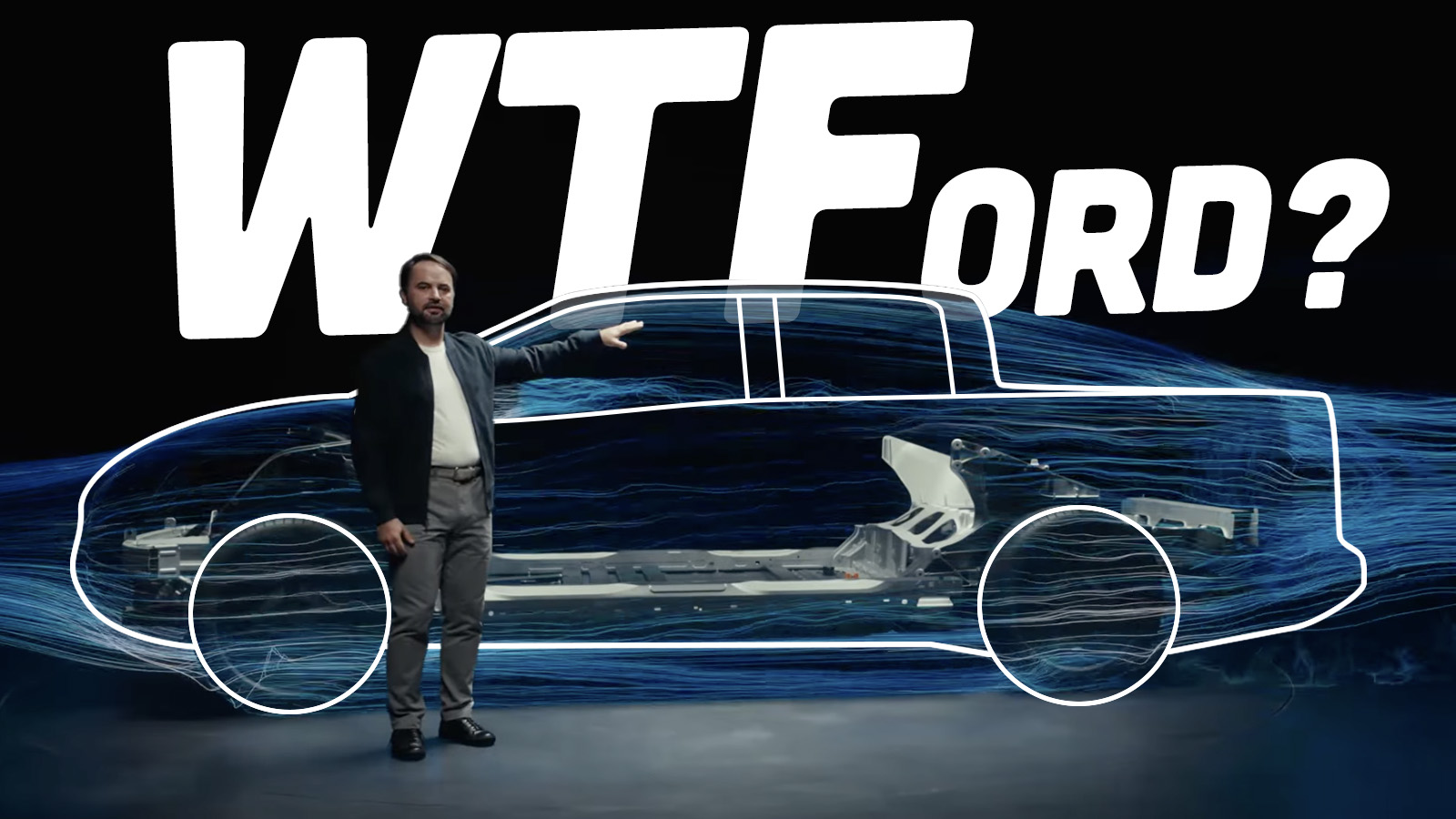
Ford put out a sleek, well-produced video bragging about how it was putting out a “bounty” on various things to save weight and improve the aerodynamics of its $30,000 electric truck. It’s the “the best part is no part” philosophy, and it extends to concepts as simple as having the small motor that adjusts the mirror double as the motor for sucking the mirrors in when you park, or as complex as replacing hundreds of fastners and pieces with a big “unicast” (I guess gigacasting isn’t the cool term anymore). There’s a lot of predictable, Tesla-or-Rivian-did-it-firstness here about advancements such as zonal architecture, and that’s good. Ford is learning from its predecessors. But there’s also an image here I keep thinking about, and I am intrigued by it.
If you somehow missed it, Ford decided that it was mostly cancelling its big electric vehicle plans and putting its eggs in a “skunkworks” plan for a Universal Electric Vehicle (UEV) platform that could sit under a bunch of different models. This is Ford, so the first vehicle is going to be a truck, given that Ford only makes one single car, and that car kinda needs a V8. With the death of the Escape, Ford also needs something affordable-ish, and that means a $30,000 EV pickup. It’ll have an LFP battery, a cheaper battery chemistry than is in most cars, which means the company has to work a little harder to get the same range.


And work they shall. Here’s how Ford itself describes the process:
Historically, engineers in traditional automotive companies can be siloed in departments that match the component or system they are assigned to. They’re expected to advocate for the part they are working on while decreasing its cost, often without the context of understanding how it impacts the customer’s experience or performance of the vehicle.
For example, the aerodynamics team always wants a lower roof for less aerodynamic drag; the occupant package team wants a higher roof for more headroom, while the interiors team wants to decrease the cabin size to reduce the cost. Usually, these groups negotiate until they find a middle ground, one that inevitably ends in a tradeoff led by yet another department tasked with making tradeoffs on behalf of the customer.
Bounties change the negotiation, making the true cost of a tradeoff much clearer by connecting it to a specific value tied to the range and battery cost. Now, the aerodynamics team and interior team share the same goal, and both understood that adding even 1mm to the roof height would mean $1.30 in additional battery cost or .055 miles of range. With bounties, each team has a common objective to maximize range while decreasing battery cost — a direct linkage to giving our customers more.
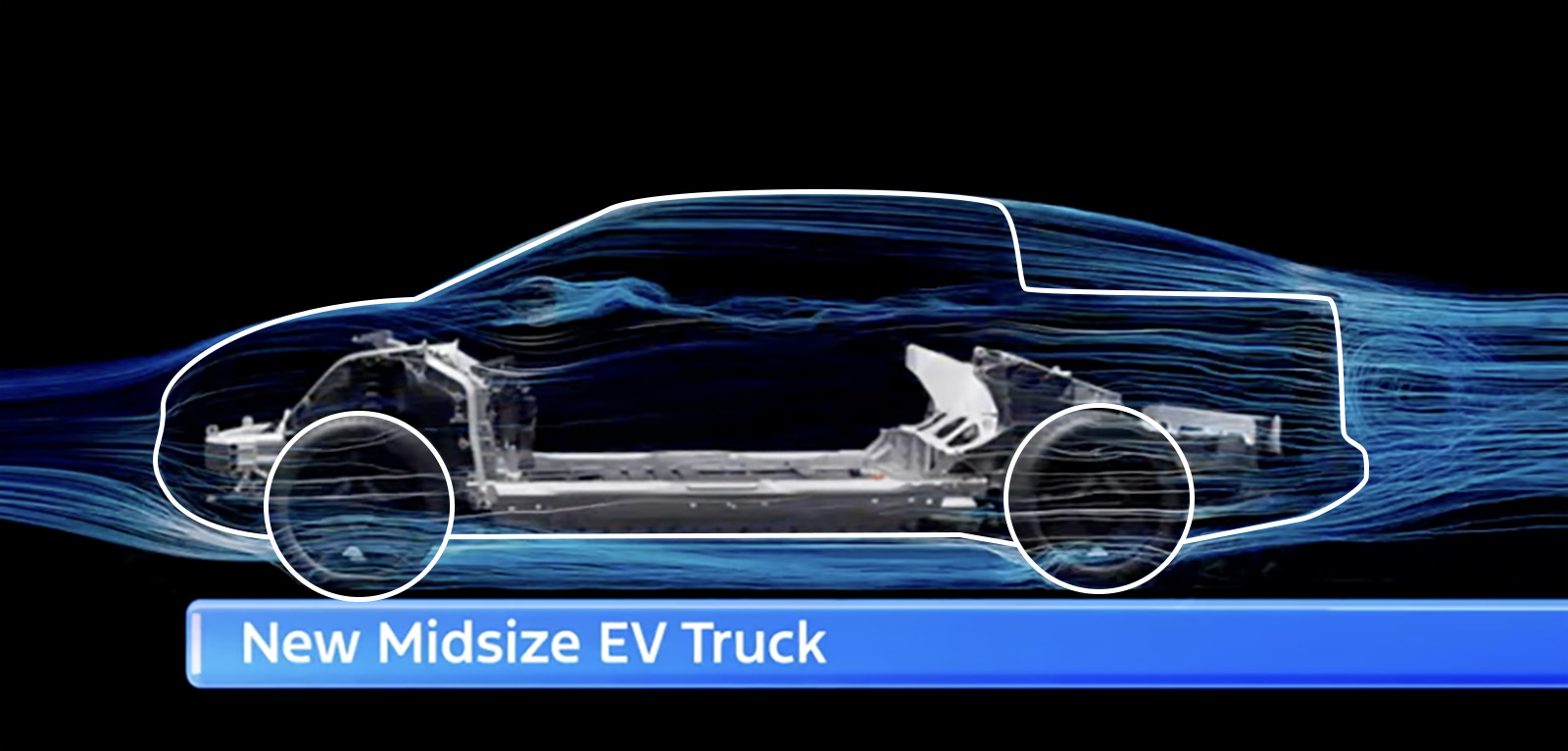
That’s fun, and all, but that means a truck that almost certainly does not look like a regular truck. Right? And this image, which may or may not be real, has me wondering what that’s going to be:

There’s a clear delinator marking a bed, so presumably it has one of those. I do think the bed also looks quite small, which makes me think that it probably has a midgate. Is there a flying buttress there? It’s hard to tell. Jason has written about the Ford Bronco Lobo concept, which did have a pretty aggressive flying buttress setup:
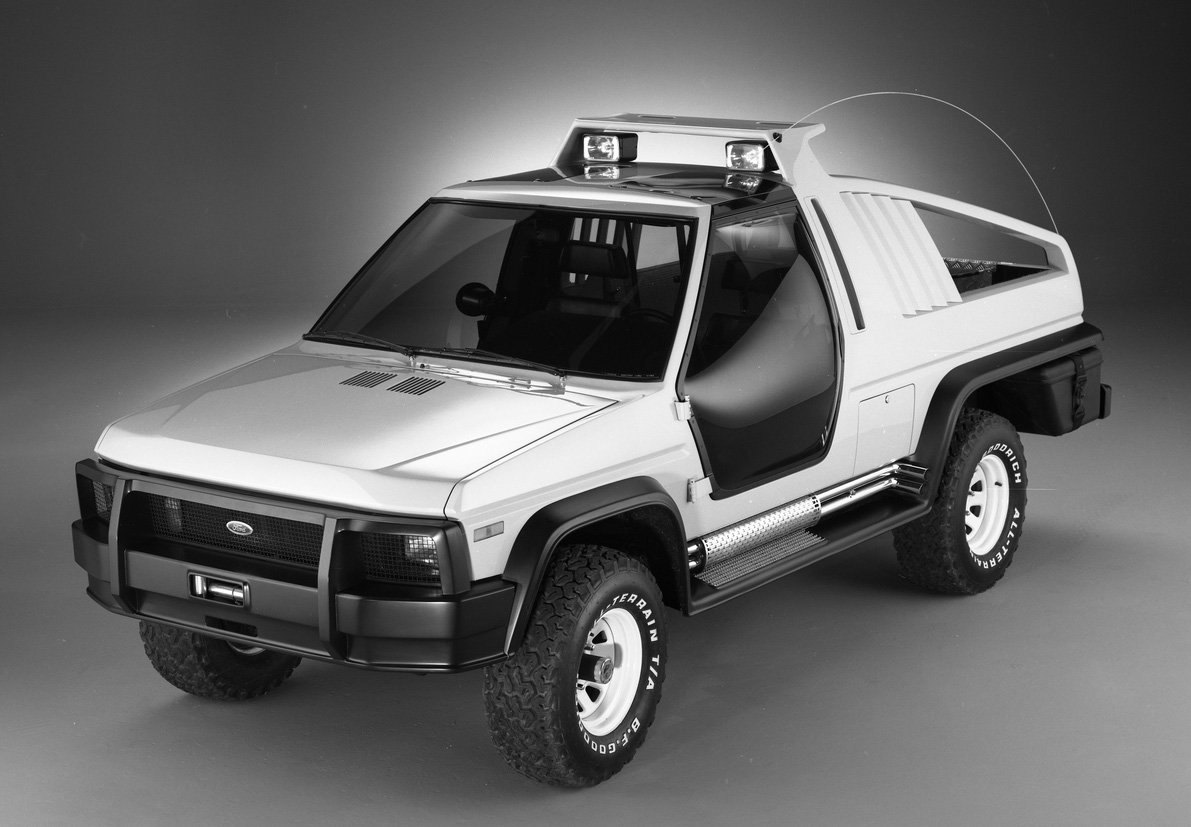
I’m not sure this is that, but it does have me wondering. BTW, it’s worth pointing out that our own Adrian Clarke gave us a preview of what it might look like based on Ford’s existing design language and some other hints:
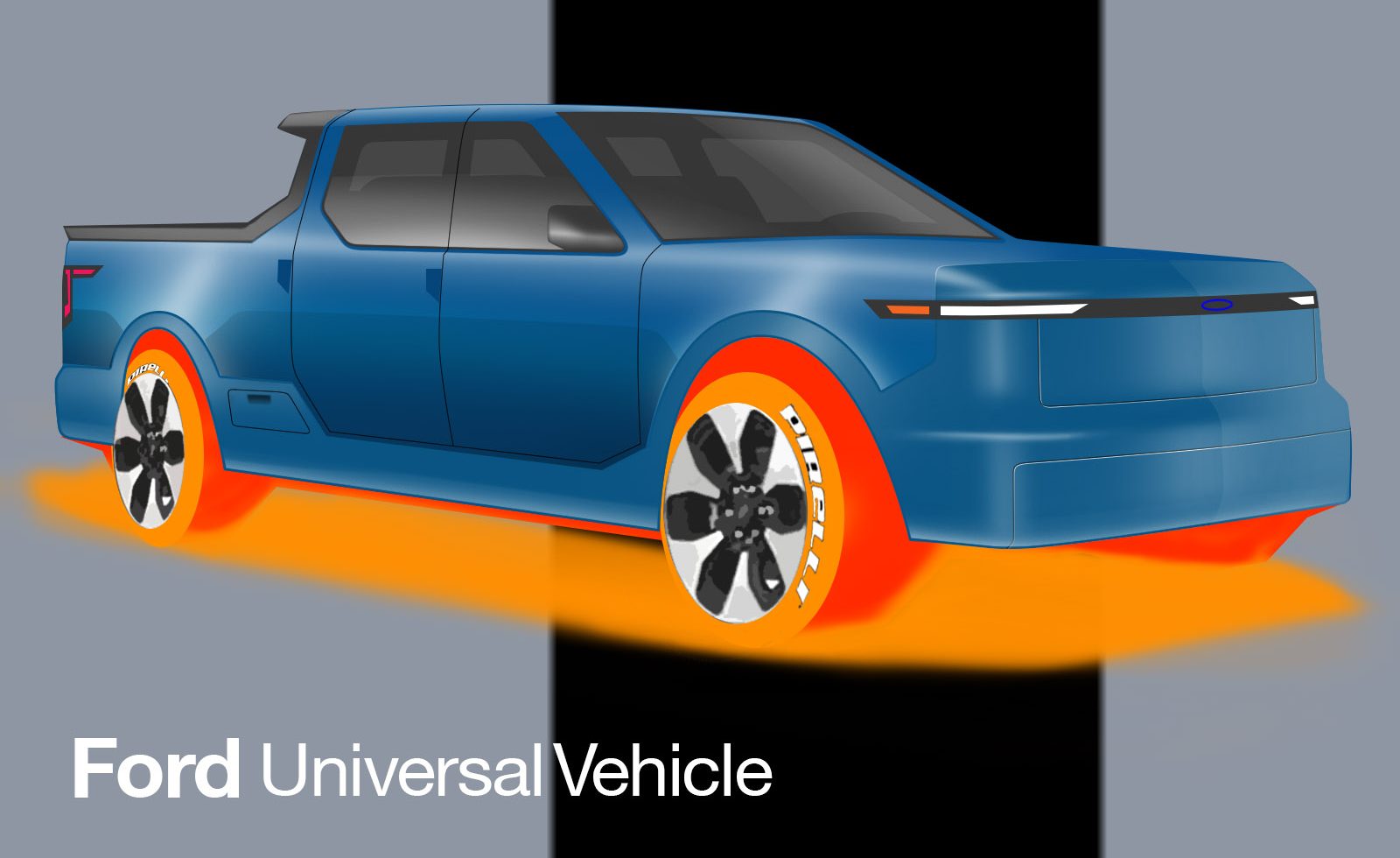
Here’s how Adrian described it:
It’s a safe bet this new truck is not going to be aimed at the heartland F-150 customer, so what do we think it could look like? I’ve written before about how fewer and simpler parts help lower the Bill of Materials (the total cost of all the parts in a car), but here we must deal with the specter of aerodynamics. Aero efficiency is more important for electric vehicles because it makes up something like 80% of their overall efficiency. With ICE vehicles, this number is much lower at around 30%. So even though a truck might not appear to be the most aerodynamic shape, the reality is aero count is gained and lost by things like flushness, sealing, and as few openings as possible. Another factor to consider is that drag doesn’t really come into effect until about 40-50 mph.
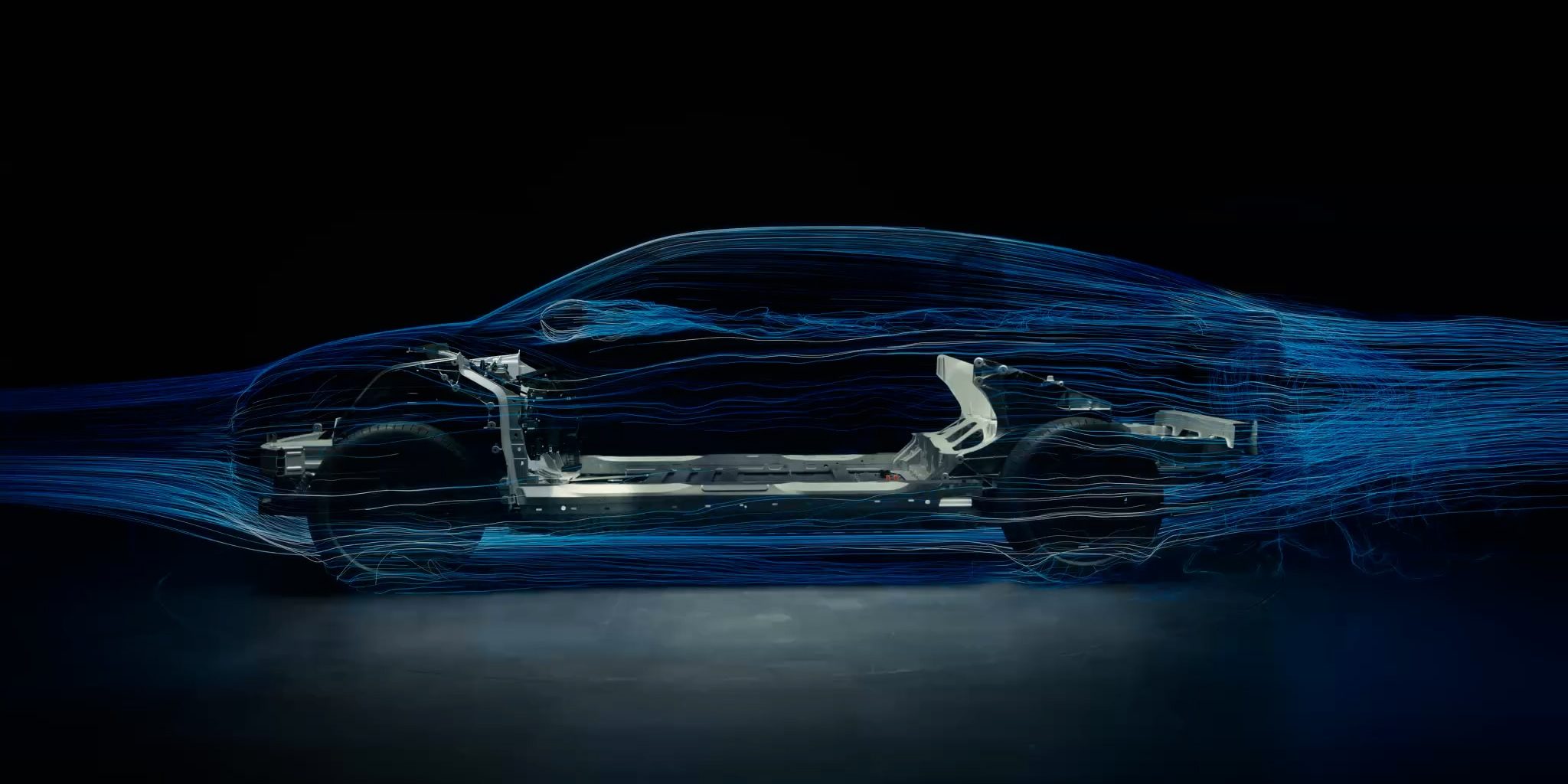
I agree, although the potentially misleading aerodynamic graphic below has a way rounder and pod-like nose than you’d expect from a truck. Even the Maverick is fairly slab-nosed.
I guess the Santa Cruz gets away with not having a traditional truck-like front:

Even looking at that, it looks more truck-y than what the Ford truck could look like. Here’s a version of it from Peter:
In this version, which is more expertly done, you get a lot more bed, but maybe at the expense of headroom.
Here’s the full video if you think there’s more here I’m missing:
Again, I don’t have the answers. I’m just asking the question. How weird is this thing going to look? How weird can Ford get away with it looking?
I’m intrigued and excited.
H/T to zestyg in the Autopian Discord!
Top graphic image: Ford


If it comes in right around the 30K target price, then it might be the perfect EV for me as long as it has a minimum 250 mi. range. I would be happy to give up my VW Atlas for an EV, mid-size truck that doesn’t resemble a traditional truck. As long as the bed is big enough to make a weekend run to the big box, home improvement centers for projects, I will be happy. I can do that today in my Atlas by folding flat the 2nd and 3rd row seats. I can barely squeeze 2 x 4 x 8 lumber into the car. I think this would easily handle lumber with the tailgate down, along with topsoil, mulch, plants and so on and so forth. Sound exciting. I can’t wait. It’s also going to be the last vehicle I own since I am retired now. Good for the planet and good for me. Cheers.
I had a $1100 Ford Ranger truck and it was great. I could haul stuffs and never think twice about scratching the truck or denting the bed etc.
A brand new shiny truck seems idiotic to me.
Shhhhhh… don’t say it out loud. If nobody buys the shiny new ones we never get our beaters
“unicast” (I guess gigacasting isn’t the cool term anymore)
Well giga is a prefix for a billion, and uni is a prefix for one, so it makes sense. A billion castings screwed together with a billon screws, sounds more like a Toyota than a Ford.
TBF “giga” makes no sense since it’s a prefix for 1 billion of something…
“Uni” makes a lot of sense in at least 2.5 ways…
We don’t know – we can’t know that Ford will cut too many corners, and end up with yet another debacle on their hands…but I’ve got my suspicions. I have my fucking suspicions.
how else can you achieve better aerodynamics than cutting off the corners?
COTD
Totally (but not really) unrelated: the Santa Cruz is getting dropped this year for… a larger truck.
To be fair, had they released the Santa Cruz within a year or two of when they initially teased it in 2015, it would have been a huge hit because there was nothing else like it on the market. Instead they waited 6 years and got their butts handed to them by Ford, who built a hybrid small truck that got insane gas mileage and did more truck stuff.
I have a $30k Ford truck (maverick) and its pretty great. I added a bed rack (DIY unistrut ftw) and have moved 16′ lumber and use a receiver hitch kayak rack for hauling 12′ roofing. But its approach and departure angles are already a little sus. I’d have to really check the geometry of this new design. I am concerned its not even going to like mildly steep driveways, let alone stepping off the pavement.
Aerodynamics and Interior on the same team. . . I’ll need to go on a diet soon to fit in this thing.
It will be like getting on any airline flight, but without the stewards throwing you a tiny package of peanuts. ie: effing miserable
Call me crazy, but you could, you know, not have either of those things.
…and historically, they already challenged that method in the 80s with the cross-functional team that made the Taurus. I guess it’s better to market it as a new idea than to admit they forgot the modern car design process they invented themselves 40+ years ago.
probably pulling out old Falcon Ute tooling from mothballs to make this thing.
Let’s start a pool now on when this truck gets cancelled or delayed until it can be made into a hybrid or range-extended BEV.
It really should start with all three options, under 30k. but would that not cannibalize the maverick?
This whole thing feels like a weird, waste of money. F150 Lightning gets cancelled because of poor sales. Basically because a BEV Truck can’t do a lot of truck things well yet. So Ford logic is, build another one.
I think they are testing the waters on the whole price driving sales angle. they did pretty well with the maverick by underpricing certain versions and claiming inability to meet demand. This strangely increased demand and the dealer markup at the time kind of allowed them to raise the price without as much pushback as I would have guessed.
I know, it is still a pretty good price at just under 30k, getting almost 40 mpg and it sacrifices nothing really except a locking trunk. Which is easy enough to fix with an amazon bed cover.
What is a trucklike front, really?
https://cdn.rmsothebys.com/0/5/3/9/6/5/053965a185b4904555768e2b1ec4bd1c07fc3550.webp
https://www.f150online.com/wp-content/uploads/2017/04/1941-ford-truck.jpg
https://hagerty-media-prod.imgix.net/2023/04/message-editor_1614889561343-1973fordexplorercn-7116-16-2.jpg?auto=format%2Ccompress&fit=crop&h=480&ixlib=php-3.3.0&w=640
Evolve or die. It’s time to set aside hidebound notions of “truck” and let the function define the form.
I would be down with a cab forward to maximize bed size (RIP Canoo) or an ohmage to the mid 90s F-150
I too would not hate a cabover design, though it might be a tougher sell to others. Only a few boomers even recall them new on the street. But it would also lend some modularity opportunity to make small vans from the same platform.
I had huge hopes for Canoo. Its EV configuration meant that whatever you wanted above the axles was available, more or less. Same with the GM Skateboard concept.
Form is what sells the vehicle….if you ignore the buying public, do so at your own peril.
And the Americans consumer is notoriously fickle.
A fair portion of what the American consumers want, they want because they’ve been told to want it. Marketing is a significant driver of consumer desire.
Well, the non-buying public has needs, and they are being ignored.
I need to haul my stuff and myself around, I need to be able to see my surroundings, fit on the road, under trees, and into garages and parking spaces.
I am thoroughly impressed with what Ford is doing. At the end of the day it all comes down to cost, efficiency, and quality. What it looks like they are building is the most sustainable cost-effective high efficiency and high quality vehicle you can get. All at a cost that is arguably lower than what others will be able to arrive at. When you consider the cost Factor both on the front end and with ownership, it’s very compelling to Consumers to purchase the vehicle that is lower cost longer lasting and less complicated. Regardless of what it looks like, I think they’ve done an exceptional job thus far. And I’m pretty sure it’s not going to look horrible. Definitely not as horrible as some of the other electric trucks out there.
The only mentions of quality that I see are in your comment – I do think that less wire, less modules, etc. = less failure points and so that should in theory contribute to reliability – but the lack of discussion regarding durability, toughness, and reliability in all the press materials on this to date is notable to me.
I still wish they’d just develop a PHEV maverick instead of going directly to this. I loved my first maverick and they sell like hotcakes, the current hybrid version included. I may be wrong but the Escape was the only car that shared their hybrid system anyway.
So, given Ford’s recent history it will start at $30K and be $45K, 6 months later.
The Maverick started at 30K and is now at 32.9K not even close to what you’ve implied.
2022 Ford Maverick XL: $19,995
2026 Ford Maverick XL $28,145
And did I mention the Maverick? I did not see that in my post.
I wish the maverick had been two or three years earlier. I’d 100% have been in one instead of the f-150 I bought in 2019.
There’s barely even any used Mavericks in my area for less than $30K.
The entry level 2022 USA base price of the Maverick XL was $19,990, and now its over $28,000. So 4jim is pretty dead on with that 50% increase.
$30k to start, $40k with the lux package so you can have heated seats. $45k for the limited trim with ventilated seats and homelink. And of course in modern automotive fashion, the lot will be filled with high trim models and they’ll only be 5 base models scattered around the entire US.
My bad. I said 30K it was 20K but…
The Ford Maverick debuted for the 2022 model year with a headline‑grabbing starting price of $19,995 for the base XL hybrid. As of the 2026 model year, the Maverick’s starting price has risen into the mid‑$23,000 range, reflecting several years of demand‑driven increases and Ford’s updated pricing strategy.
Where are you hearing $23,000? That sounds like an AI hallucination. Ford’s own site says “Starting at $28,145”
https://www.ford.com/trucks/maverick/
And hardly anyone got a Maverick for $19,995, it was considerable more from every dealer.
You are thinking of Tesla.
From the same people who brought you the famous Granada ESS….
It’s a cookbook!
One of the best twilight zone episodes ever. My all time favorite though was the lion stalking the big game hunter who was walking home from his club in NYC. The off screen, he reached his front door noise still makes me smile.
I think the non-bluff front end may also be a regulatory play. Remember there had been a lot of talk in recent years about bluff front ends affecting (impacting?) pedestrian injuries in crashes compared to hits that happened from lower bonneted cars.
No sure the US automakers worry much about pedestrians or cyclists.
What they’re describing is a ute. Just give us utes! C’mon, Ford, you can still pretend like you’re against making cars if you just add a truck bed to a car! Most folks would still think it’s just a small truck!
Still like the Slate better at 30K
If they go with a sloped front end that will be a mistake IMHO. I owned a sloped hood 2019 Ridgeline and now have a stub nosed 2024 Ridgeline. One of the big complaints about the sloped nose Gen2 pre-refresh Ridgeline was the front end. The change was a big improvement looks wise.
I dislike the new Ridgeline as compared to the sloped nose Ridgeline.
The first gen was much better looking to me, and the second gen just looks generic.
Yes, I bought one because it was a distinctive look for a truck!
The Odyssey nose was an abomination, and I miss the funky sail!
I agree on the Odyssey slope nose front end but have never liked the sail in any vehicle.
I’m not a pickup truck person but that white ford is the one I would pick if I decided to have one, It looks like great fun.
The video makes a big deal of reducing complexity, joints, fasteners, buses and harnesses, PCBs, and battery packaging, sometimes radically (146 parts down to 2 parts in the body assembly).
That sounds great for efficiency, but horrible for repairability. Has Ford said anything about repairing malfunctioning or damaged parts?
Surely nothing to worry about. What’re the chances that a new Ford model would have malfunctioning parts?
No chance. Quality is job #1.
But! Crashes happen.
Probably similar to what Tesla did with the structural adhesive for smaller repairs. And for bigger repairs, time will tell. There may be a lot of bits to remove and reinstall to switch out a whole sub-casting, but it may be cost effective if the other 3/4 of the car are still fine.
Well replacing one part instead of 20 parts might be an advantage. It’s more about maintaining a supply of spares, so reducing the SKIs might help.
As stated above, the single part is too big to replace – you’d have to disassemble the whole car. The Tesla model is to cut out a section and have smaller, repair only parts that a tech (that hopefully knows what he is doing) bonds in as a fix.
So that increases the number of parts you have to order (the huge casting for manufacturing, plus a number of smaller repair parts for collision repairs)
My guess is it’ll look like a squashed and lowered Honda Ridgeline with very high bedsides and a tall tailgate (relative to the overall height).
Large wheels with painted on tires and the Motors being nearly inline with the hubs to reduce CV angle doesn’t inspire confidence when it comes to soft roading, I don’t think anyone expects this to be a proper off roader, but one would hope it would be able to handle gravel roads.
Hell, my 25 Nissan Leaf S has more sidewall on its’ little 16″ wheels ffs.
I’m not impressed with all the corporate nonsense in Ford’s post, but I assume the people it’s meant for love it.