

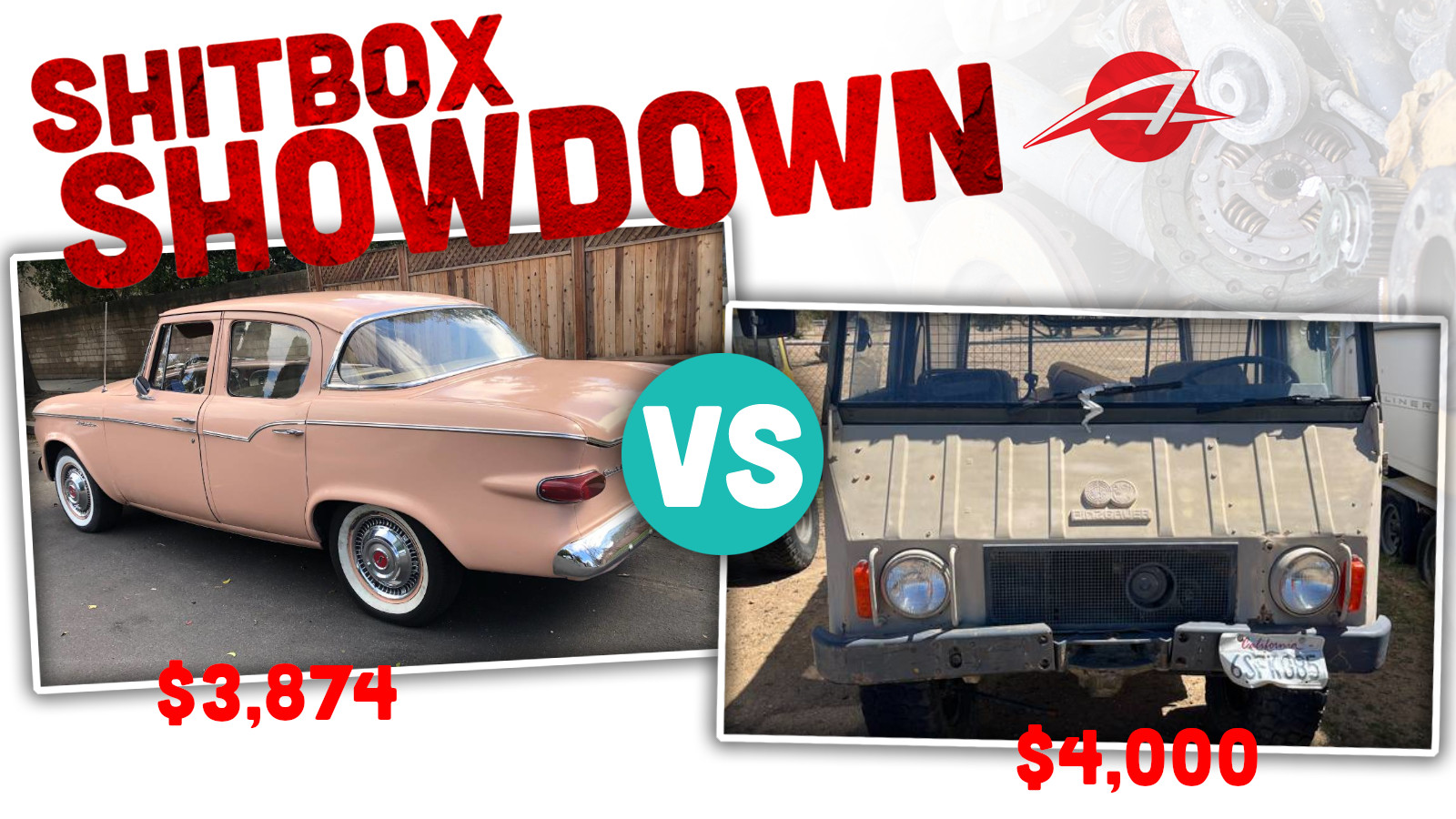
We’ve looked at some weird stuff this week, and for once, it wasn’t all my fault. But it only feels right to finish off the week on an even weirder note. So today for your consideration, I present a pink car from Indiana and a rare 4×4 from Austria.
Yesterday’s cars were a lot more ordinary, just a couple of old Ford Escorts. We had one stickshift wagon and one automatic ZX2 coupe. The wagon’s practicality won the day, and more of you wanted to swap the ZX2’s engine into the wagon than to drive the ZX2 as-is.


The idea of a Zetec-powered Escort wagon does sound like a lot of fun, but I am not the type to bother with engine swaps, as entertaining as it is to think about. I’d happily drive that wagon with the engine it has, however, after sorting out the check-engine light issues.

Long before I started writing this column, I loved window-shopping for cars on Craigslist, especially on the West Coast. Craigslist in Southern California is a gold mine for unusual cars, so whenever I need to find cars in a hurry, that’s where I head. And even now, in the dead of winter, it did not disappoint. Check out what I found.
1959 Studebaker Lark VI – $3,874

Engine/drivetrain: 170 cubic inch flathead inline 6, three-speed manual, RWD
Location: North Hollywood, CA
Odometer reading: 79,000 miles
Operational status: Runs and drives well
American cars in the late 1950s were growing to truly gargantuan proportions, and getting more chrome-laden by the year. But a new wave of imported cars, led by Volkswagen, proved there was a market for smaller, simpler cars. Newly minted American Motors had a hit with its Rambler, and Studebaker quickly followed suit with this car, the Lark. Studebaker cleverly designed the Lark around the center section of its full-size models, which saved development costs and made for a nice, roomy small car.

Two versions of the Lark were available: the Lark VI and the Lark VIII, named for the engines installed. This Lark VI has a flathead inline six and a classic “three on the tree” manual transmission. It runs and drives well, according to the seller, and has a new battery.

It also has new seat upholstery, and it looks like the door panels were redone as well. There’s not a lot to the interior of cars this age, which is kind of refreshing compared to modern cars, but I would suggest at least adding seat belts. It’d probably still be a deathtrap in a crash, but every little bit helps.

Outside, it’s, well, pink. Pastel colors were big in the late ’50s, and it seems like pink was actually pretty common. The Lark wears it well, and apart from a couple of rust spots in the bottoms of the front fenders and doors, it’s in good shape. I like the fact that the Lark only has a little bit of chrome; as much as I like the Virgil Exner-designed Chryslers of the era, they do go a bit overboard on the chrome.
1972 Steyr-Puch Pinzgauer 710M – $4,000

Engine/drivetrain: Air-cooled 2.5-liter OHV inline 4, five-speed manual, 4WD
Location: Hesperia, CA
Odometer reading: 250,000 kilometers
Operational status: Hasn’t run in a few years
I’m willing to bet this is a new one for at least some of you. I know I only discovered the Pinzgauer about fifteen years ago, when someone built an RC version of one. The Pinzgauer is Austrian firm Steyr-Puch’s take on a small, all-terrain-capable 4×4, and unlike so many similar vehicles, it has absolutely nothing in common with a World War II Jeep. Instead of straight axles on leaf springs, it has four-wheel independent suspension, portal axles, and full-time 4WD with locking differentials.

Powering the Pinzgauer is a specially-designed 2.5-liter four-cylinder engine. It’s designed to be tough, easy to fix, and able to run on absolute crap fuel – perfect for use in remote places. It powers all four wheels through a five-speed gearbox and a dual-range transfer case. It has independent swing-axle suspension on all four corners, with portal axles for additional ground clearance. It’s a really cool setup. This one hasn’t run in a few years, since its owner passed away, but these things have enough of a following that getting what you need to revive it shouldn’t be a problem.

The Pinzgauer was designed as a military vehicle, so don’t expect much in the way of creature comforts. It does, however, have a satisfying number of knobs, buttons, and levers. I think I know what some of them do: if I’m not mistaken, the yellow levers are the diff locks, and the green one is likely the two-speed transfer case. Apart from that, you’d have to try them to see what they do.

Pinzgauers were available in a bunch of different body styles; this one is an open-top truck with a soft canvas roof and inward-facing bench seats in the back. It’s a little banged-up and rusty, but a vehicle like this would look funny all shiny and pristine.
Nobody in their right mind is actually cross-shopping these two, but when has that ever stopped us? And besides, I think they’re both cool. But it’s not up to me. Which one would you rather have?


The Pinz looks like it would be REAL fun to wrench on then turn into a mobile camping rig. The top on this one looks a little dinky, so I’d get a nice canvas one and turn it into a tent on wheels. This particular Pinzgauer (judging from the “Action Zipline” decals on the sides) was owned by the zipline tour company in Big Bear, CA. It’s likely lived its entire life off paved roads.
If ever there should have been a “both” day, this is it.
Gimme the Lark, I like birds. Looks like it doesn’t need that much work, seems more fun to cruise in than the Pinz which has gotta ride like a Deuce and I’ve got no need for off road prowess where I live.
The Pinzgauer would actually be kind of useful. I would mount a trailer hitch to if,if not already equipped and use it for runs to the dump and house stuff.
It would also make a great hunting rig.
I’ve seen a Pinzgauer in the wild…well, Utah anyway. I suspect the back was a custom wood design, and the whole thing was nicely restored.
But for the price, that Studebaker is a great deal. I agree about adding seat belts, but that’s a fairly cheap and easy job. The rest looks fine as is and ready to turn heads around town on weekends.
This is the first time I remember voting against a Studebaker. That Pinz just sings to me.
This is a both day but since we don’t have that option I have to go dtei runs pinch housan
Studebaker. It matches my little pink house.
“I’d like this car in barbie pink.”
“Certainly sir, like a cotton candy sort of colo-”
“L i k e h e r s k i n”
In my defense, it looked a lot more bubblegum-pink on my laptop screen.
Lark. I can’t believe I voted for Porky Pig without his jacket.
Neither needs to be an option. Both are interesting, but for someone else.
How many women would want to drive a three-on-the-tree? How many men would like a pink car that looks like 1949 on the inside?
And an interesting but non-running Austrian unicorn? Maybe an Austrian ex-pat who is good with a wrench and likes to go where the dirt road ends. They only need to find one buyer. Try posting it on Craigslist, people.
My wife daily drives a stick shift and has for a quarter century. And I’d totally drive that Studebaker. Maybe I’d need a white sport coat and a pink carnation…
I’d rock a pink car, man. I feel it’s more manly because it demonstrates you have so much confidence in your manhood you don’t need a jacked up truck or angry eyes grill to compensate for whatever horrible accident cut off your junk.