


Creating the right idea at the wrong time is a classic and tragic mistake for many automakers. Chrysler’s wind-cheating Airflow was too soon for the people of 1934 to comprehend, when even buyers of 1986 barely understood the Taurus. The International Scout and AMC Eagle could have been huge hits had they stuck around for another decade or two and made it to a time when SUVs and crossovers were the rule and not the exception.
For today’s Pontiac Pthursday, we’ll look at an innovative but efficient and still relatively powerful engine that this GM division came up with during a time when absolutely nobody needed or wanted it. By the time they did, it was too late.


In case you missed it, last week we started the Pontiac Pthursday weekly series where we dig deep into one of our favorite dead car brands to find some of the lost greats (and greatest fails) that even many hard-core enthusiasts forgot about.
The Camshaft Wasn’t Stainless Steel
Look, I already know the stories. During his time at GM, John Delorean launched the Chevy Vega with a straight face when he knew it was crap. He also came up with a cool-looking but highly flawed sports car, got in trouble with the feds, and saw his dreams go up in a cloud of nose candy. I get it, but that shouldn’t take away from the admirable work Delorean did back at the Pontiac division, which he headed up at the record age of only 40. There are many engineering patents to his name, but his most famous work is likely his simplest: violating the unwritten rule at the time of putting an engine bigger than 330 cubic inches into a mid-sized GM car.
The loophole Delorean found was to offer such a motor as an option, in this case putting the 389 V8 into the Pontiac Tempest as part of a package known by three letters: GTO. Arguably the first true muscle car, the GTO made a name for Delorean and paved the way for his meteoric rise at GM.

However, another one of the creations that he is far less known for but is considerably more innovative was a new six-cylinder engine for Pontiac cars; the first “six” for the brand since the old flathead had been discontinued in 1954. Delorean was a fan of European cars like the Jaguar and Ferraris, and he felt that the overhead cam valvetrains of these cars would be ideal for a motor powering Pontiac’s new generation of smaller cars. Delorean looked at adding this tech to what was usually the “losers’ lunch” powertrain of cheapskate sixties cars: the straight-six.
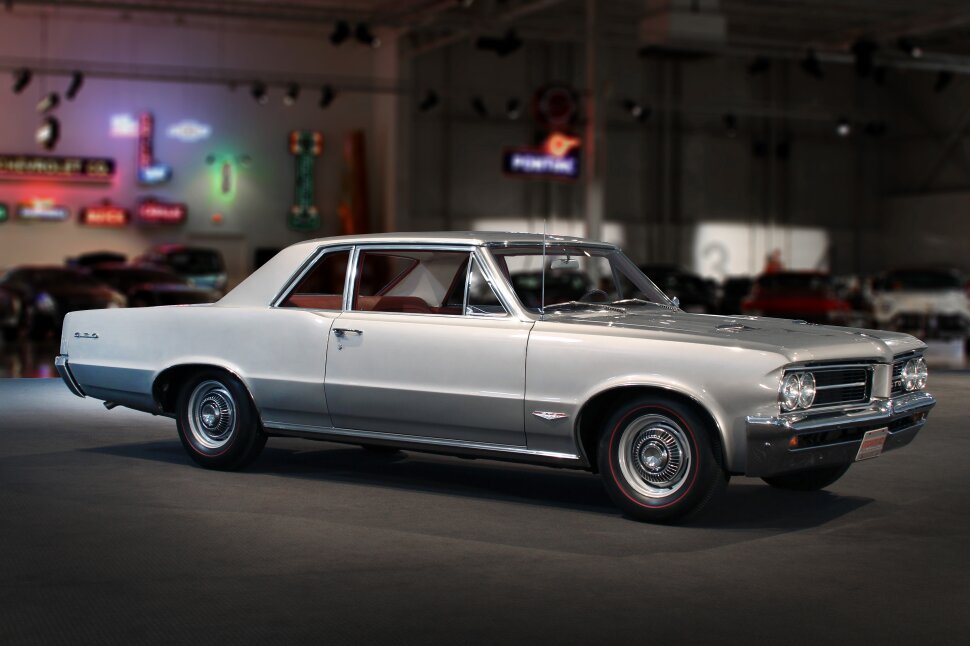
The OHC engine was first seen in the 1964 Pontiac Banshee show car, a machine far too close to a Corvette for GM brass to ever approve, but a great showcase for this new engine.

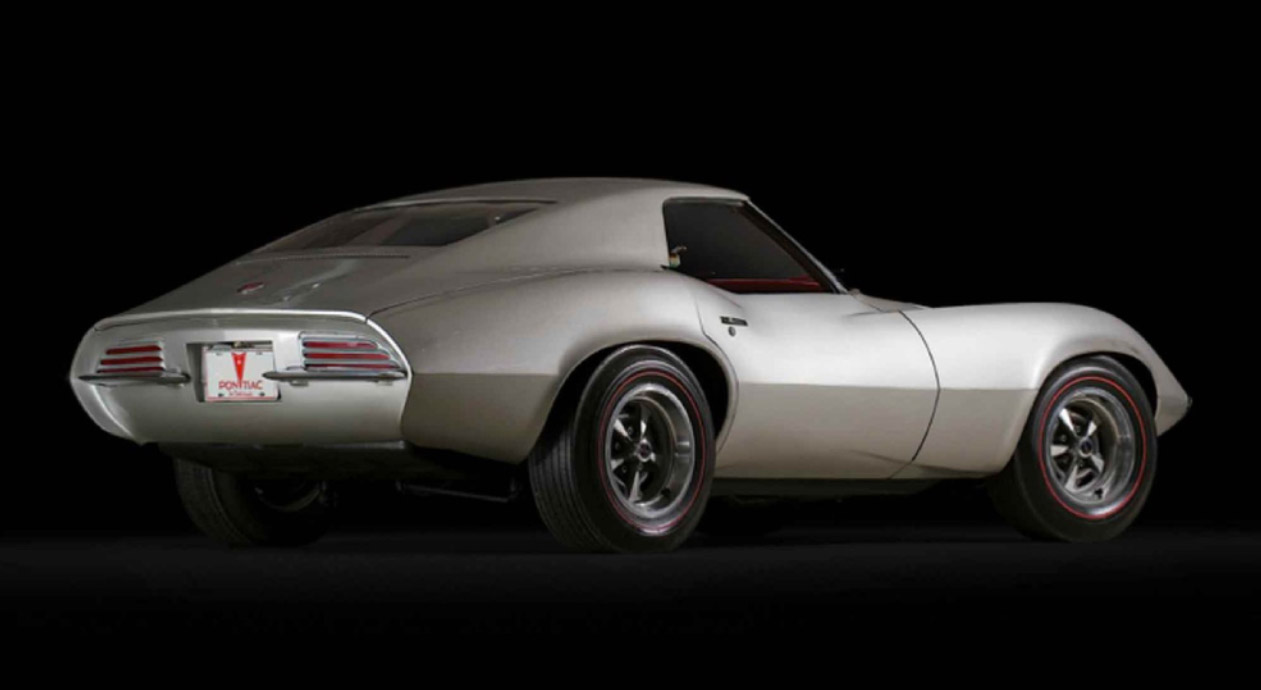
Under the hood, it resembled an Aston Martin DB4 or Jaguar E-type with the long, trim-looking powerplant.

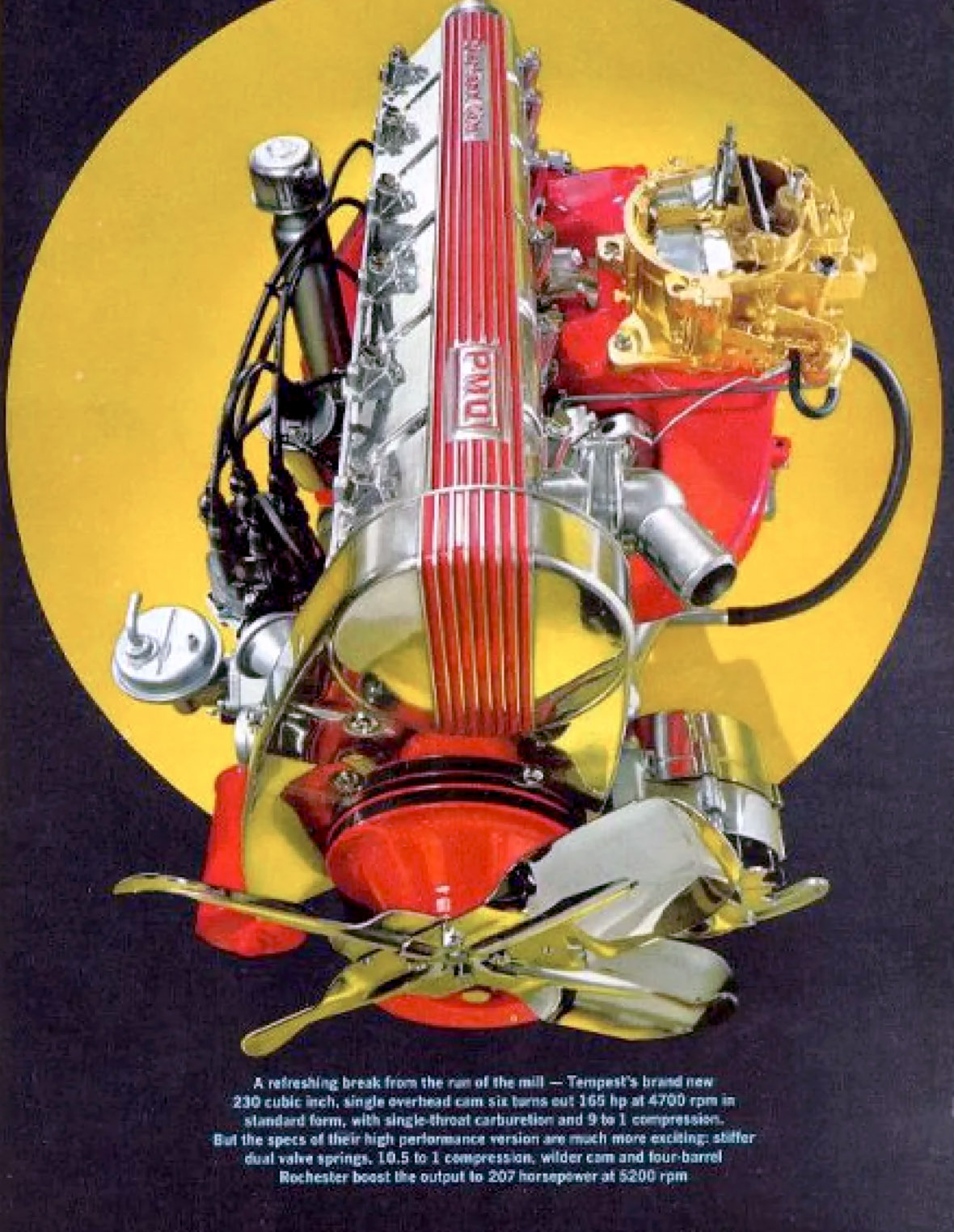
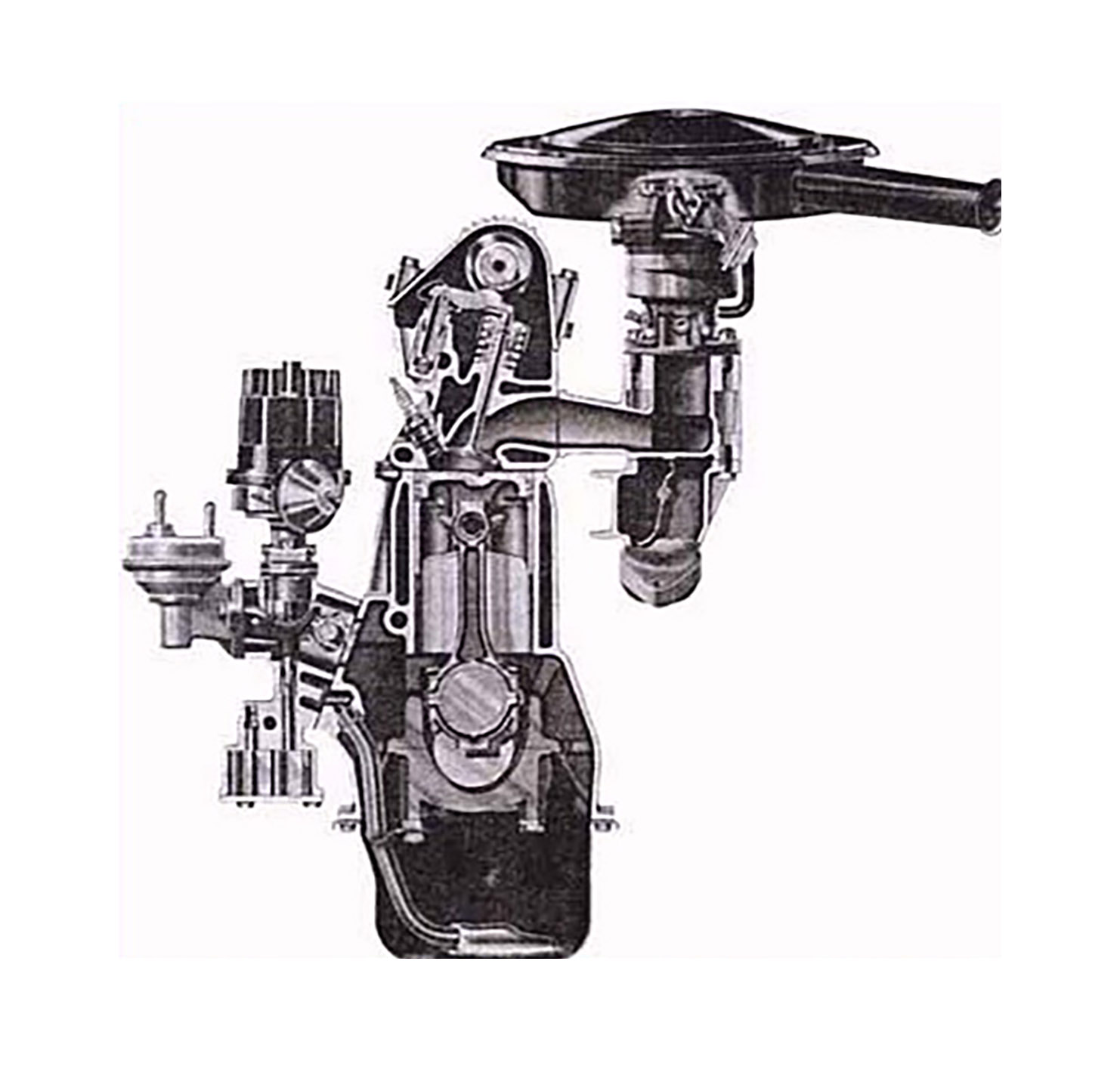
The motor got the go-ahead for production in “normal” Pontiacs for the 1966 model year. Yes, David Tracy, I know that Jeep had offered the first overhead cam motor in America in their Tornado four, but the camshaft was chain-driven. The Pontiac OHC straight-six would be the first one with a fiberglass-reinforced belt-driven camshaft (and one of the first in the world). The motor employed a number of aluminum parts like the cam cover and accessory drive housing; to paraphrase John, with aluminum it’s better than gold because it weighs less (sorry, sorry).
That accessory drive housing also had attachments to support the distributor, fuel pump, oil pump and oil filter; these were driven by the camshaft belt to simplify the manufacturing and service of the engine.
The 230 CID OHC engine with a single-barrel carb developed 165 bhp at 4700 rpm and 216 lb-ft of torque at 2600 rpm, twenty-five more horsepower than the similar-sized Chevy engine on which the design was based (but shared essentially nothing with).
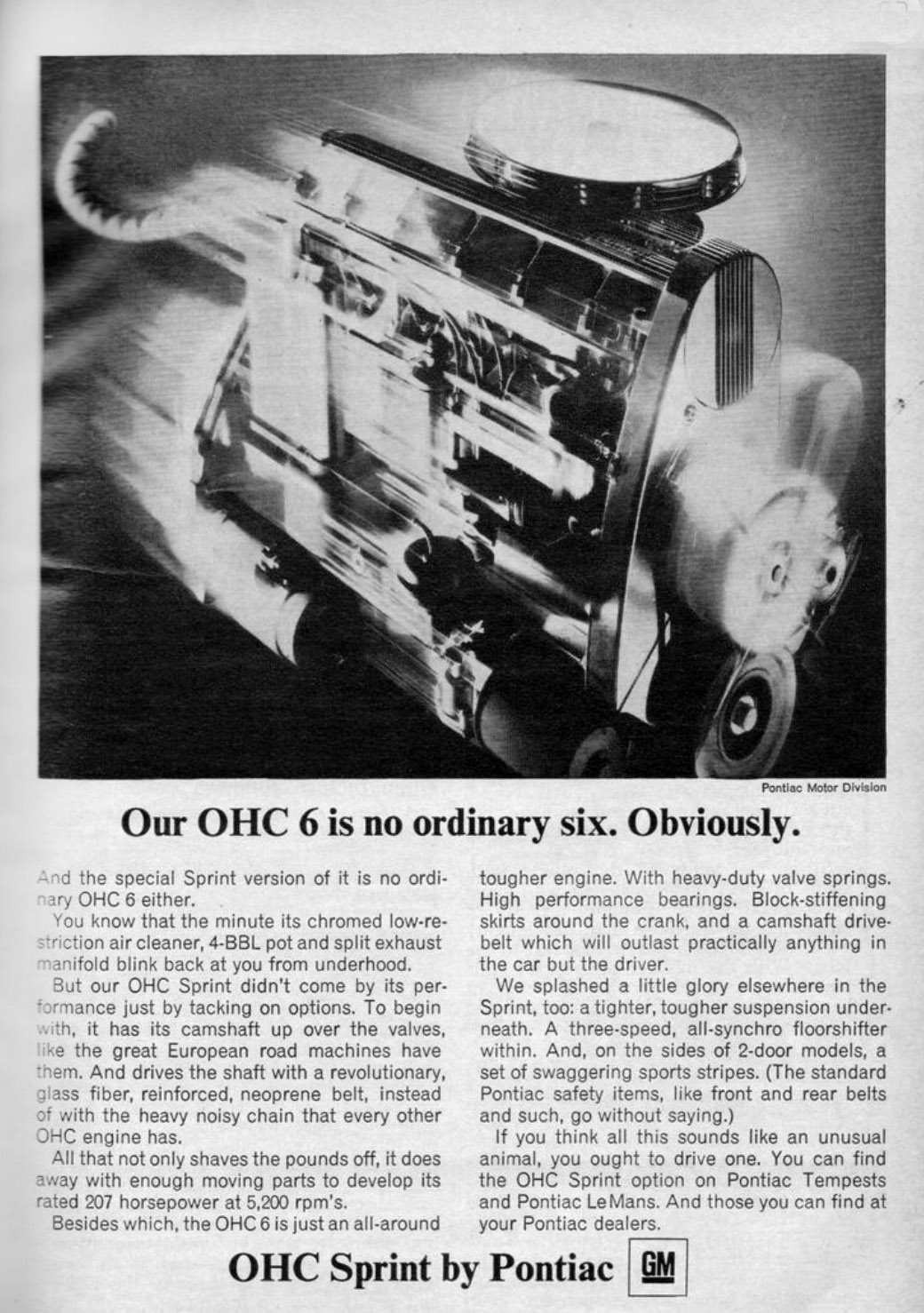
The real news and the true manifestation of Delorean’s vision was the “Sprint” version with a four-barrel carburetor that produced 207 bhp at 5200 rpm and 228 lb-ft of torque at 3800 rpm (later 215hp). The fact that it could be revved to 6500 and beyond was practically unheard of at the time in a run-of-the-mill American car.
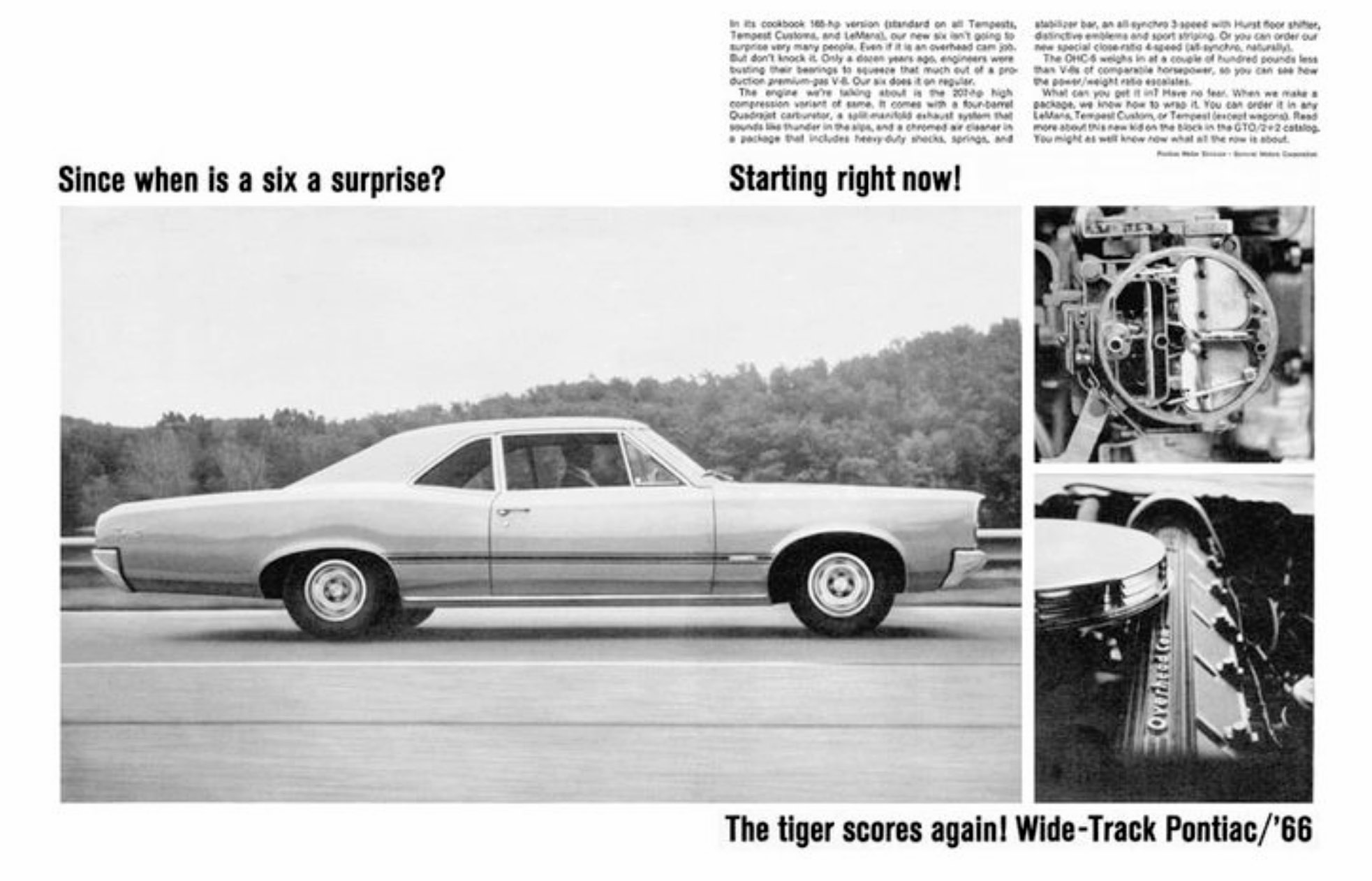
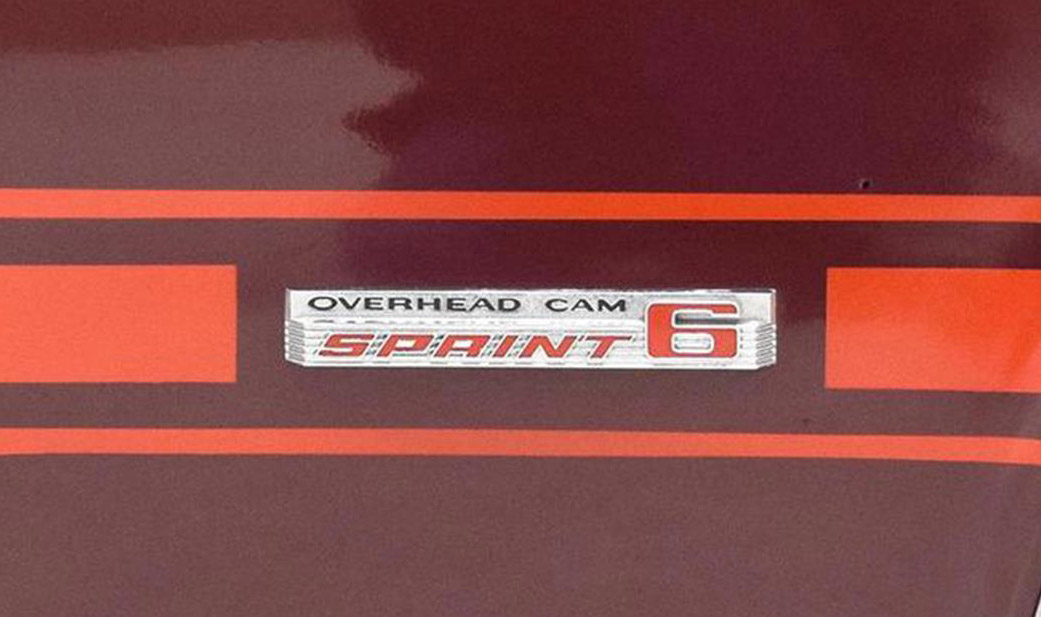
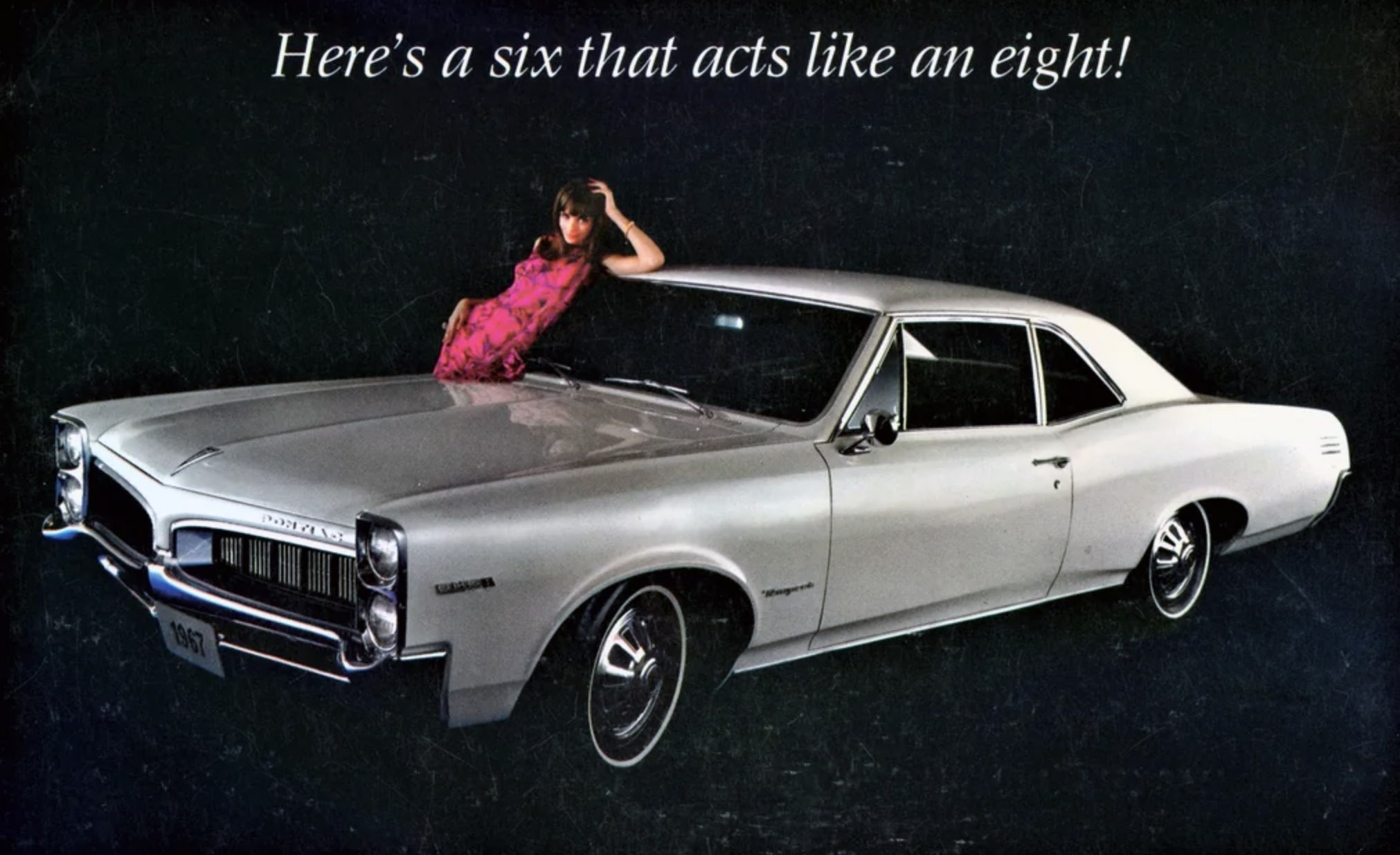
I like how advertising of the time touted the OHC 6-powered sedans and coupes as being cut-rate Jaguars. Sure, that motor was pretty slick, but nobody was going to confuse a Tempest for something from Coventry or Modena (and those Euro exotics usually sported an extra camshaft as well).
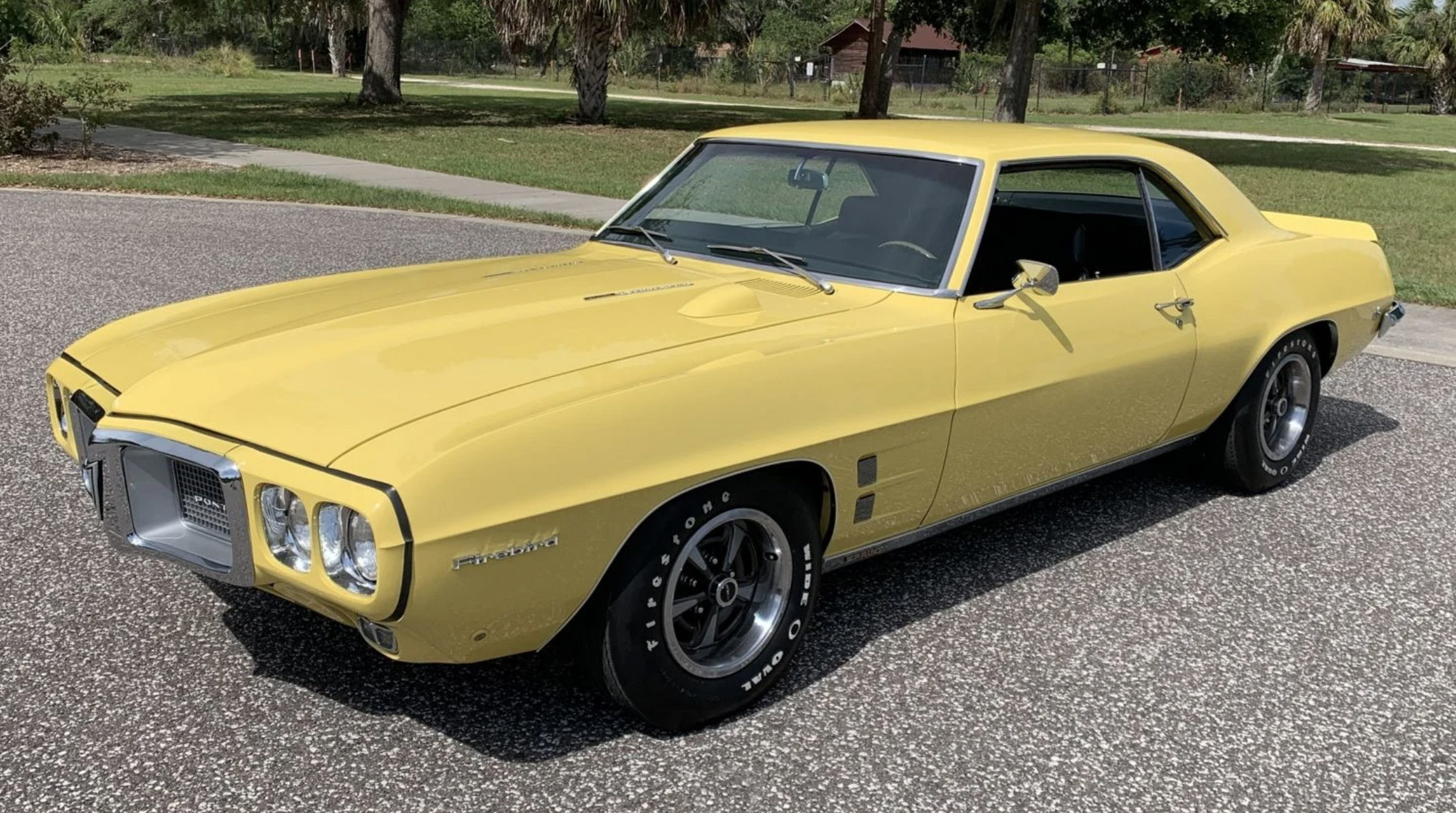
Offered in the Tempest and the LeMans sedans, Pontiac also put the OHC 6 into a Firebird. Jay Leno proudly owns a 1968 example of this rare ‘Bird, and if Jay likes it and actually has one in his vast collection of blue-chip steeds, that says a lot about this overlooked powerplant:
For the 1969 model year, a special “high output” Sprint for manual transmission cars with 230 horsepower was available. That was a pea-shooter number in a world of 400 horse big blocks, but an impressive figure for what was considered such a small motor at the time.

The hood-mounted tach (part of the Sprint package) is always a fun sight to see:
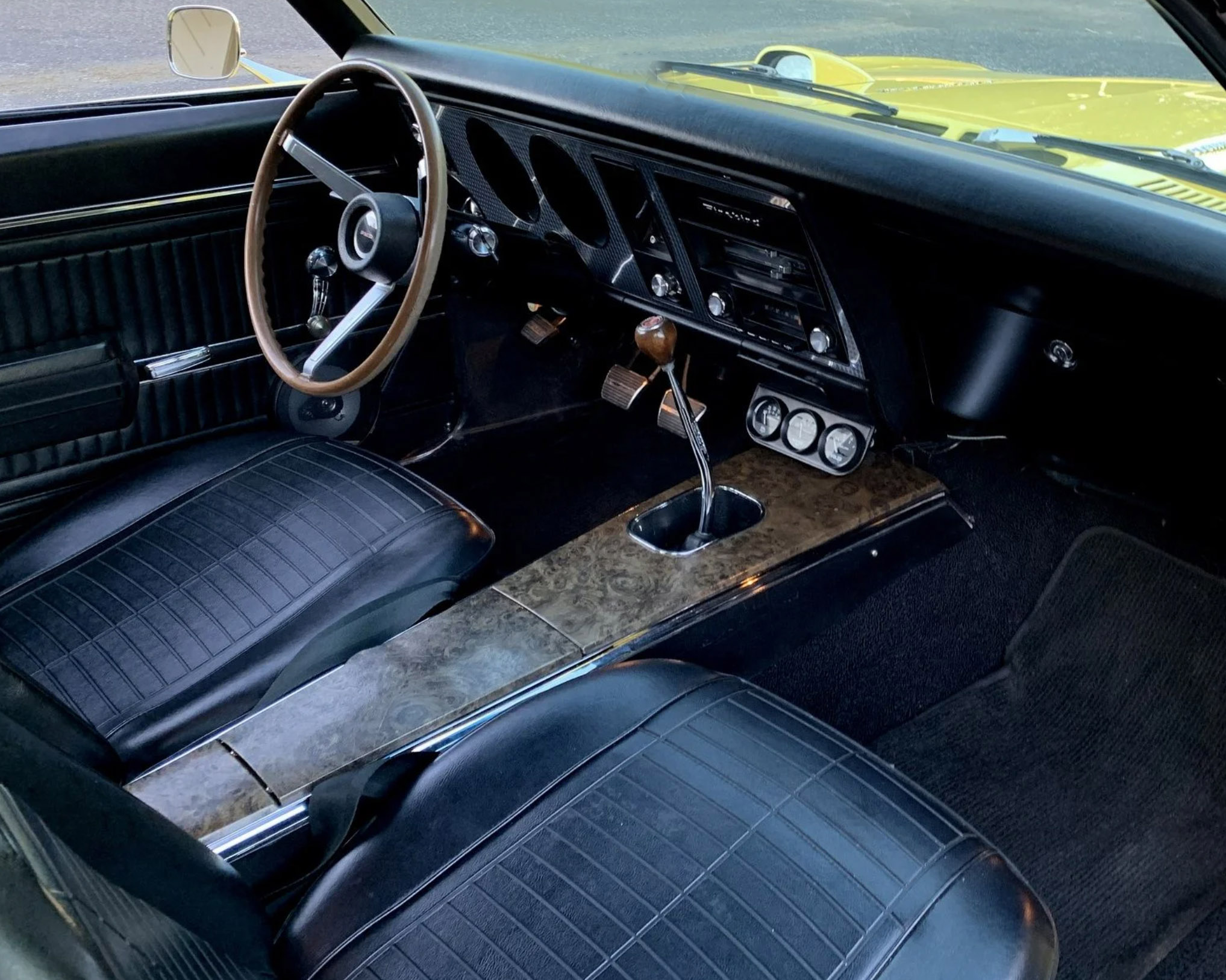
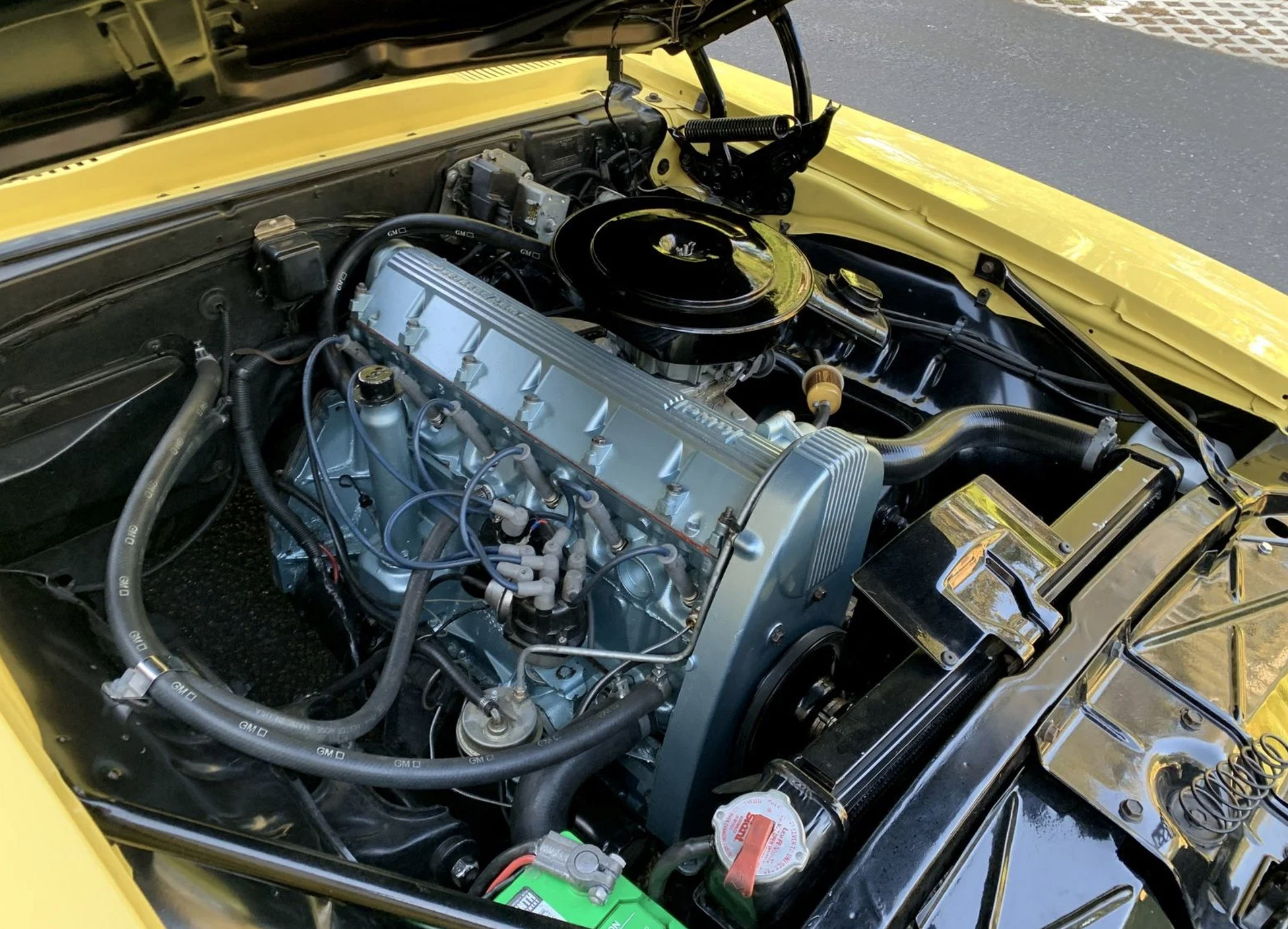
The OHC 6 was actually a great looking engine, too. In this Firebird it seems right at home and has a bit of the appearance of a Euro sports car that John wanted.
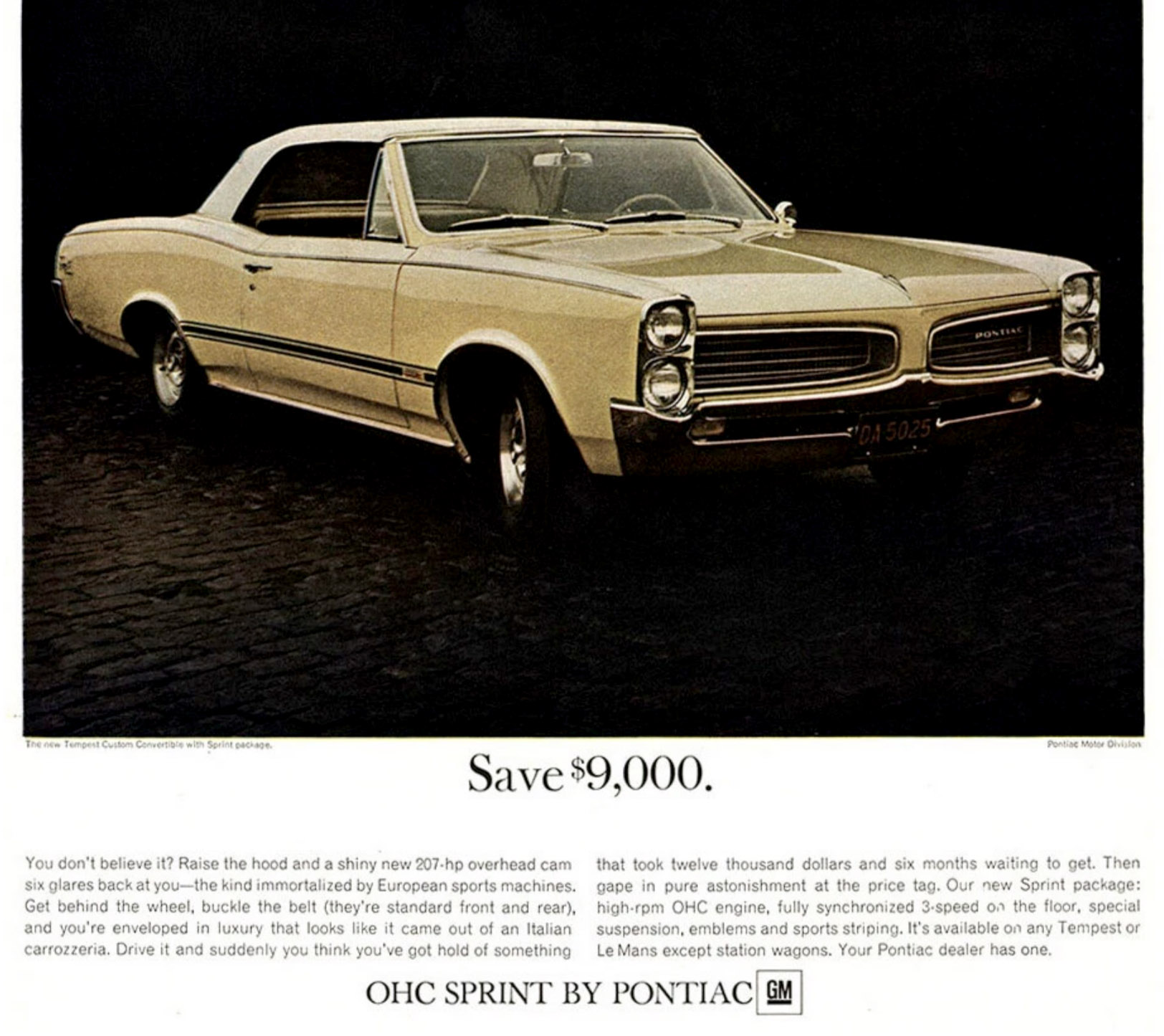
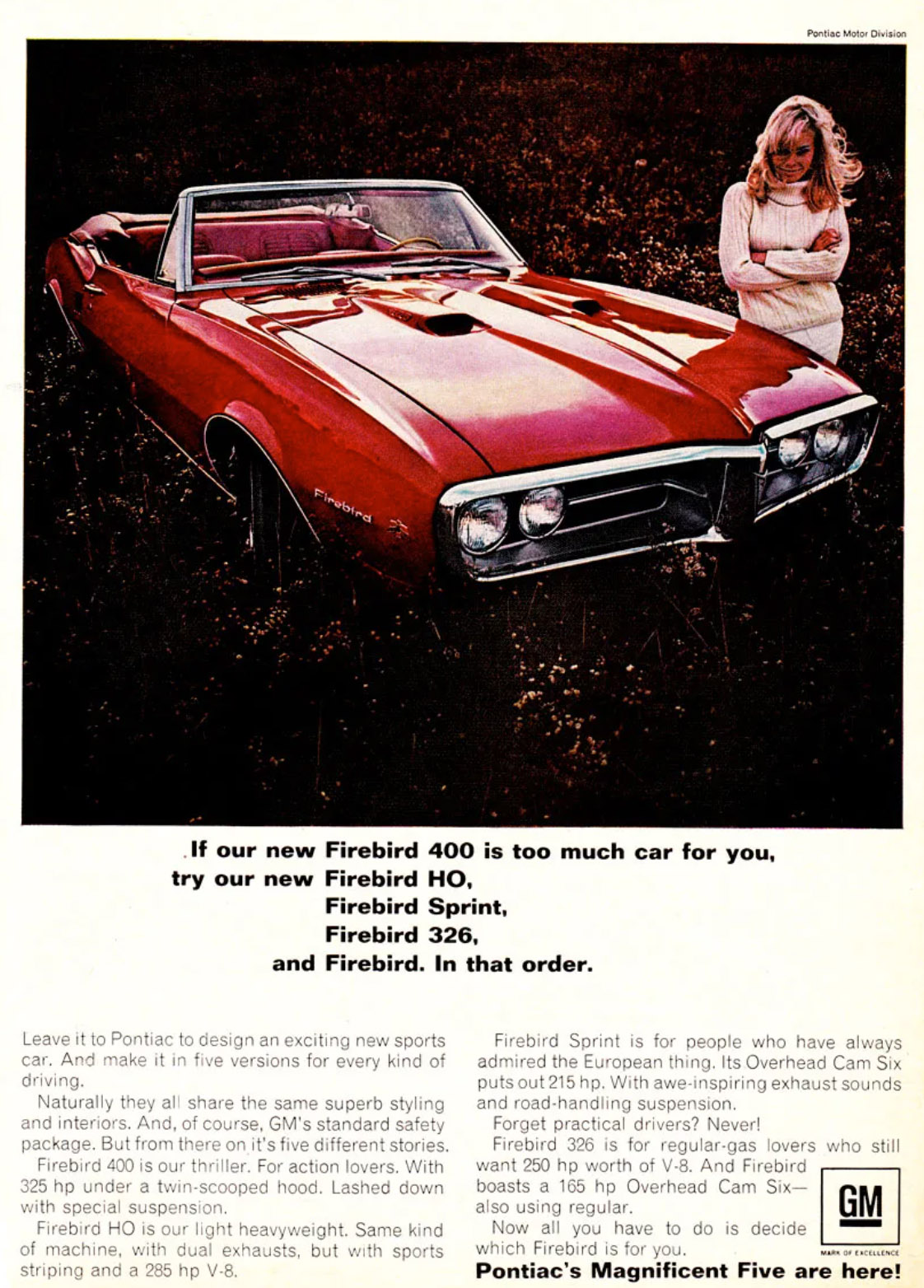
Exactly how to market such an advanced-for-the-time motor seemed to befuddle many at Pontiac’s marketing department. You could see some of the confusion even in Pontiac’s own ads, like the one below, where they had to slot the Sprint 6 confusingly above their least expensive V8:
The OHC 6 was not going to win any stoplight races with a V8 GTO, but contemporary road tests in 1966 typically turned quarter miles in the 16 to 17 second and 80 mph range. That’s still not bad, though even a base ’66 GTO with a 389 could run through the eyes at about 14 to 15 seconds.
Don’t forget that the lighter weight of the OHC 6 made for a better balanced and finer handling car than one with a big iron V8 lump over the wheels. More importantly, the Sprint’s performance could have been had with greater fuel economy than any eight-cylinder selection. Do you know what the EPA estimates were for the OHC 6 compared to the V8? Are you kidding? This was back when we dumped used motor oil into the ground, and your mom smoked cigarettes in the delivery room. What was the EPA?
That was the problem: did anyone care?
You Could Get Faster But Not More Expensive
While a lot of you snarky jerks out there would assume that the end of the OHC 6 came from some GM engineering failure similar to the diesel V8 or Vega four, that’s not the case. Even the new belt-drive for the overhead camshaft proved rather reliable. The demise of the OHC 6 was that it was an answer to a question that, at the time, nobody was asking.
Sales reflected this. To take just one year and model as an example, out of the 107,000 Firebirds the Pontiac made for 1968, a mere 4,662 of those were Sprints.
Sure, I dig sophistication in a drivetrain, but one of the few things that my dad told me that I hold to this day is “there’s just no substitute for cubic inches.” Indeed, with thirty-cent-a-gallon gasoline I’m not sure I’d give up a big honkin’ V8 back in 1966. Most potential buyers in the period agreed. Sadly, most GM executives thought the same way, and not without good reason. You see, nobody was willing to shell out a premium for a motor with fewer pistons, which was a problem since that fancy OHC 6 cost significantly more than a standard 326 V8 to produce. Why would anyone pay that when fuel was flowing like wine, but far cheaper? Pontiac read the room, and the last OHC 6 left the line in 1969 after a mere four-year run.

Of course, nobody at Pontiac could have seen the future: gas nearly doubling in price and people pushing their empty-tanked behemoth cars past NO GAS signs at fuel stations a mere four years later. Suddenly, that power-and-economy compromise would have looked a lot more appealing, but it was too late for the clever Pontiac motor that dared to challenge the muscle car establishment.
Today, that coulda-hada-V8 mentality of the sixties persists, and OHC 6-powered Pontiacs languish in value next to their more plentiful brethren with two more cylinders. As a rough example of this, a Firebird with the smallest V8 that might command around $18,000 today would likely pull about $4,500 less than that with the OHC 6 under the hood. From that standpoint, you get better bang for the buck for a rare performance machine that you won’t see at every cruise night. If you can find one today, an OHC 6-equipped Tempest, LeMans or especially a Firebird is certainly worth a look.
Pontiac Points: 85 / 100
Verdict: Not the King of the Hill, but a valiant attempt that will get you noticed at car shows while avoiding the gas pumps on the way there.



I think peak ambitious Pontiac is this engine in a rope drive Tempest with the rear transaxle. Yes a,transaxle just like a Porsche 944.
Hey, don’t give away some upcoming Pontiac Pthursdays, Joe!
I can’t believe this wasn’t mentioned in the article, OR posted in the comments yet. In 1967, car and driver magazine put a Sprint 6 engine in a Jag XKE. Which seems like a much better fit anyway.
https://www.caranddriver.com/features/a64921922/1967-jaguar-xk-e-pontiac-engine/
Back in high school, a friend had a 4-door tempest with this motor and a Powerglide.
I remember the car had obviously been painted with a brush, and you had to use a screwdriver in the ignition slot to start it.
I agree that the 326 was a better buy, but that OHC Six is gorgeous to look at. Look at those plugs just begging to be changed. What an easy job. Pontiac got robbed on the Banshee deal.
Just wondering about in that age old era what vehicles offered smaller less expensive engines and how many people ordered them? I know for a fact more people ordered the smaller engine mustang over the 8 cylinder. This presentation lacks proof.
Ford’s “Thriftpower” six in was cheaper to make than the V8 and was sold accordingly. The OHC six in the Pontiac was not less expensive than the V8.
In the 1965 Mustang model year, Ford sold 35.6% with 200ci 6 cylinder engines vs 64.4% with 289ci V8 engines.
Memories jogged free again Bishop, thanks.
I remember my father wanting a 1968 Firebird with the SOHC six, he ended up driving home from the dealer with a 350 HO instead, cool Hurst 4 speed shifter though. 13 year old me thought it was almost as great as a 400, Dad wasn’t entirely happy though.
Another PMD SOHC faded memory, the magazine Car and Driver AFAIR had a garage roof collapse on a Jaguar XKE and for the sake of some text and a narrow chassis they found a reason to swap in the Pontiac, which they then modified. No idea if that series of articles made it to the Internet or if they are just moldy hoarded paper somewhere.
Scroll up, my friend. Commenter Woodscraps has the link for you there.
Didn’t GMC put this engine in a Caballero?
Also, the best version of the quote is “There’s no substitute for cubic money.”
Never mind, my teenage self was fooled by both the engine and the vehicle being named Sprint.
Well now I want a Firebird Sprint. Fie.
The ‘67 Firebird Sprint convertible is one of the rarest Ponchos from that era. Only a bit over 1000 were made and most have succumbed to time or dickheads buying the cheaper used Sprint and swapping in a V8. The. ‘67-‘68 Firebirds are my favorites.
Also, 30-cents per gallon gas in 1967 adjusts to $3.50 a gallon today. So gas is just as cheap as ever.
I like these engines. Storytime:
My uncle had a 69 firebird sprint with all the fun performance options and the 6 when he was young. Handled twisty roads like you wouldn believe. I will skip the middle, but the town ended up needing a new squad car.
Yet couldn’t beat a 12 year old Corolla now.
Why go through all the trouble and then not make it a cross-flow?
My immediate thought.
A friend in college had an early chrome bumper Firebird sprint convertible loaded with options that he bought at a police auction for $200 in 1976. He was the only bidder. It was a pretty nice car. After the muffler fell off it sounded amazing.
““there’s just no substitute for cubic inches.””? Okay. I knew that as “Nothing beats cubic inches, except more cubic inches.”. Or as “Hubraum ist durch nichts zu ersetzen”.
(Both of which are literally not true of course, as any number of cubic inches can be replaced by a tram stop right in front of your house.)
Sorry a 4 cylinder with a Turbo could beat the best. New science beats shoveling more coal.
Timing belt 🙁
Picture a Gen 2-3 Vette with this motor…. Low weight, high RPM
My college roommate had a ’67 Firebird with a factory 4 barrel carb OHC 6. It was not slow.
The 6 developed a rod knock and he swapped in a 327 small block. We thought it might need stronger springs in the front, but the car actually sat higher after the swap. The 327 was much faster.
That thing is just BEGGING for a turbo and mechanical fuel injection!
+1 for mechanical injection and turbo. What, like George Montgomery did on the Boss ‘9 or SOHC 427 funny they built?
If I remember, still on a Willys frame.
Seatbelts were optional… Even in the highest, most potent V8 trim. These cars did not have antilock brakes or traction control.
Seems crazy to think these days how many people back in those days bought “too much car than they could handle”. It still happens today of course, but the electric nannies do save lives, and most people wear their seatbelts now too.
But yes, there’s something primal about piloting one of these vehicles at high speed down winding two lane country roads that is difficult to replicate with today’s vehicles.
Derek Bieri rescued one of these from a weed-infested mud pit, as is his usual.
But, when the 1973 oil crisis hit, this engine had been discontinued for less than 5 years. Why not dust it off, update it for the ’70s, and use it?
Probably due to bean counters. Pushrod mill still cheaper to make.
Probably dumped the tooling in Lake Michigan.
Under Giant’s Stadium with Jimmy Hoffa
Yeah, Buick saw fit to buy back the rights to the 231 as a result of the fuel crisis, and that worked out pretty well for them (Pontiac too, for that matter). There’s probably an alternate reality where the OHC 6 was dusted off, and Pontiac started building cut-rate BMW’s as a result, maybe even into the 90’s.
My dad had a Sprint 6 in a Tempest and never had anything good or bad to say about it except that it reminded him of the German straight sixes. I always wished he had kept that car instead of selling it for a station wagon as more or my siblings came along.
A 6 that acts like an 8 was my nickname in high school
Exactly my thought. Also the perfect woman for me
Interesting side note – I’m surprised that this post failed to mention it…
There’s been some hatred around these parts for cars with a timing belt because of the costs involved in replacing the belt every XX,000 miles.
The Pontiac manuals have NO SERVICE INTERVAL for replacing the timing belt. It was claimed to be a “lifetime” belt. Of course, this car was built in an era when driving a car past 100k miles was almost considered miraculous, so there’s that.
If you have a car with this engine, it does appear that there are a few specialists who do offer replacement belts – at a cost of $160+. Ouch.
I appreciate the information!
Late Gen-X – so much this. As a yoot a 10 year old car with 70,000 miles was one step from the grave. Now we expect to run them 200,000 plus without major issue.
Yes every lifetime warranty ends at the failure of the part. Well I guess that was the lifetime
“No substitute for cubic inches” is the worst way I’ve ever heard somebody say NO REPLACEMENT FOR DISPLACEMENT
Given how the Bishop operates, I laughed hard at that line with the assumption he did it intentionally to mess with his readers.
Came here to post this. Glad I checked the comments.
Got to wonder is an 8 cylinder a strongest man who can’t wipe his ass and a 4 or 6 cylinder a track Star
I know nobody would have bought them but what if this cool euro like motor would have been put in a much smaller car, that would have been cool.
I think the Firebird was the smallest car they had back then! Again, I think Leno has far more money in the Sprint ‘Bird than it will ever be worth but he loves it.
John Z wanted the motor in the Pontiac Banshee. That car would have been the vest pocket Corvette that people wanted at an affordable price. Of course it was nixed for the “halo” corvette (before a halo car was a thing”. I posted about my tempest, but my dad’s sister had an orange firebird with a white interior and the 6 with a manual transmission. She lived near Princeton U and liked the twisties in the area. She later owned a 6000 STE and had a Mazda RX-7 as a weekend car.