

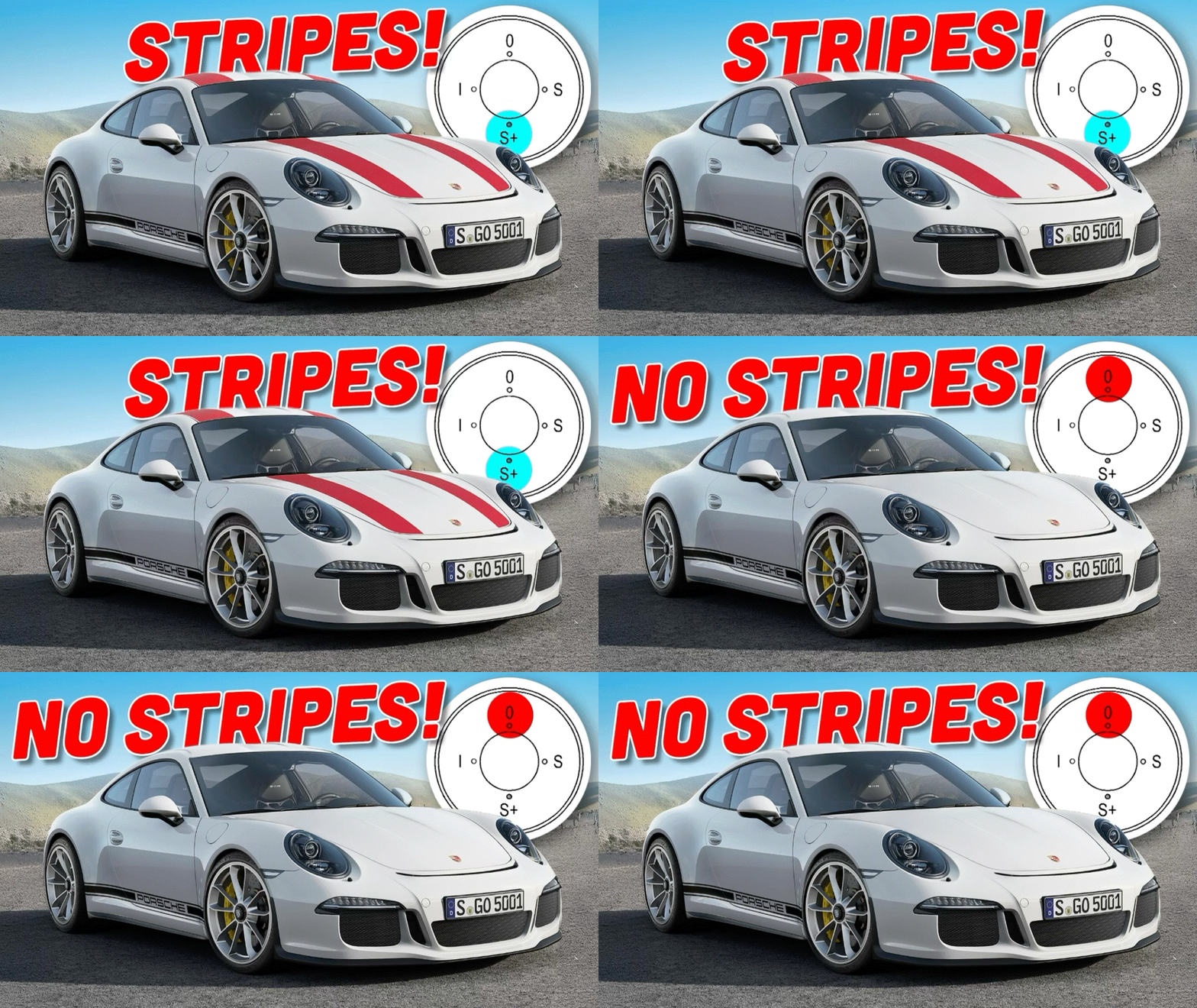
Modifying the exterior of your car is a big commitment. Either you’re applying new paint, which is a pretty permanent change, or you’re installing stickers or a wrap, which takes time, money, and effort. If you end up not liking the finished product, you can’t just flip a switch and turn your car back to how it was before, or get a refund.
That is, unless you have a Porsche with this new color-changing exterior film. The German luxury car maker recently submitted a patent application to the World Intellectual Property Organization (WIPO), describing a material installed on the exterior panel of a car that, when an electronic voltage is applied, changes colors.


Porsche, being the maker of the iconic 911, decided it would be best to use this technology as a way to incorporate racing stripes on demand. The patent application describes the film as changing colors to make racing stripes appear on the hood, roof, and rear decklid when the car is placed into a different drive mode. But Porsche also says it can be used as a way to display an EV’s state of charge, allowing drivers to simply glance at the car’s exterior to see whether it’s charged up enough to drive.
The patent application describes this film as “electronic paper” or “paramagnetic coatings,” which can alter their appearance based on how many volts are running through them. From the description:
[T]here are so-called “paramagnetic coatings” that change color when an electrical voltage is applied. Also known from the prior art are so-called e-papers (electronic papers) that allow their appearance, such as color or contrast, to be altered by applying an electrical voltage. E-papers, for example, in the form of a film, can comprise a multitude of microcapsules containing particles of one type and particles of a second type. The particles of the first type can differ from those of the second type in color and charge. Applying an electrical voltage alters the arrangement of the particles within the microcapsule, thereby causing a color or contrast change.
This tech isn’t exactly new. Companies like Porsche, Audi, McLaren, and Mercedes-Benz use a similar type of coating in sunroofs to adjust the amount of sunlight coming through the glass. In Porsches, this feature is called “Variable Light Control.” Here’s a video of it working:
Where this patent application differs is in how the film is used. Instead of on glass, the electronically charged film is placed on body panels, and, in the case of Porsche’s example, patterned to show a set of racing stripes running down the center line of the car’s exterior.
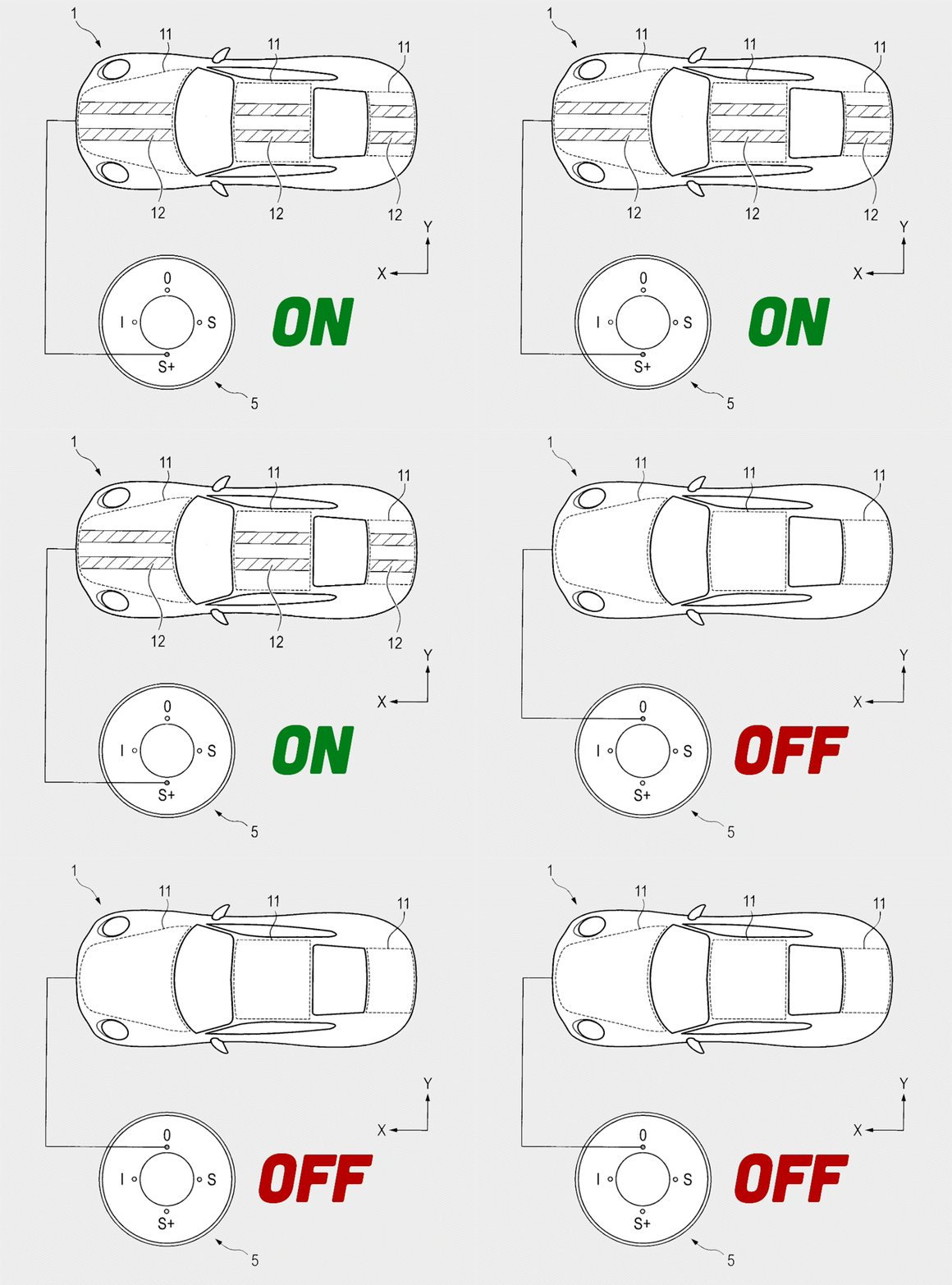
In normal driving mode, these stripes are invisible. But when the drive mode is switched, they appear out of thin air. Porsche describes the stripes as “rally stripes,” and also predicts the film could be used to distinguish cars in a race, which feels a bit more practical than someone trying to trick people into thinking they own multiple Porsches. From the patent app:
[T]he control unit is configured to control the optically variable coating in the second driving mode such that one or more color-contrasting stripes running parallel to the longitudinal axis of the vehicle are formed. Such a design, namely color-contrasting stripes running parallel to the longitudinal axis of the vehicle, is colloquially known as rally stripes. Such rally stripes are used particularly on sports cars when the vehicle participates in a race. The color-contrasting stripes serve not only to visually enhance the vehicle but also to distinguish the different vehicles participating in the race. This is particularly advantageous when several vehicles of the same type or with the same exterior design are participating in the race. This makes recognition and differentiation easier for both spectators and pit crews.
In the case of a road car, the stripes aren’t the only thing that would appear. In an additional drawing, Porsche describes how the sideblade panels behind the rear wheels and the diffuser area could also change color when placed into sport mode, highlighting the car’s sportiest elements to the public.

Adding or deleting fancy stripes from your Carrera Cup car isn’t the only way Porsche proposes this film could be used on the exterior body panels. The company also positions it as an external display of the car’s current state of charge.

Basically, the film would use a computer to signal how much charge the car’s battery has, and display that on a piece of body panel, “such that the color of the coating depends on the current state of charge,” according to the patent application. So, for example, if the film is showing red, that means the battery isn’t charged. But if it’s showing green, that means the car is charged up and ready to drive. And if it’s showing yellow, it’s somewhere in the middle.
While this all sounds like pretty advanced, expensive tech, Porsche points out in the patent application that it’s not too far from reality:
It is considered particularly advantageous to modify the optical appearance of the coating using electrophoresis. The advantage lies in the relatively low energy consumption required to change the color. Furthermore, when modifying the optical appearance via electrophoresis, especially the change in the outer color, it is possible to design the modification in such a way that electrical energy is required to effect a change in the state of the outer color, but no electrical energy, or only a significantly lower amount, is required to maintain the existing state.
Of course, there’s no telling whether color-changing film will ever make it to a Porsche production car, or even a Porsche race car. Many pieces of tech found in patent applications never see the light of day. In this case, though, it seems there are at least a few practical reasons for this to actually exist in the real world. What would you use this color-changing film for? Let me know in the comments, I’m curious to hear what you think.
Top graphic image: Porsche


If they can of course they will introduce this. Perfect subscription service.
Nobody asked, but it was at about 35 years ago when I was in NYC at some fancy restaurant, and a buddy told me to go look at the bathroom stalls. I did, and was surprised to see they had glass doors, which turned opaque when occupied due to an LCD layer. Of course, I then saw similar tech in residential and commercial construction (windows, doors, and skylights) as well as in high-end car roofs over the past decade or two. I myself thought about trying to patent the use of this tech for an active system that measured the eye position of the driver and used a front-facing camera to locate blinding headlights or low sun, and then triangulated to draw an opaque animated shape on the windshield in real time, so as to shade the driver’s eyes from the bright spot. Logisitics and liability aside, I never did anything about this.
Also, I gather that LCD elements age in direct sunlight, so I wonder about how long these expensive items will last/function.
From the sounds of it, they’re thinking about using e-ink instead of LCD, which has the advantage of only requiring power to change state (at the expense of longer refresh times).
I’ve been fascinated by e-ink since I first heard about it years ago. From ebook readers, to simple phones, to the price tags on the shelves at Amazon grocery stores (and soon, some Walmart stores apparently) e-ink is so interesting: little balls half white on one side and black on the other, that reverse their physical orientation to make a black or white pixel (hence the slow refresh time).
Provided the pigments are stable and UV resistant, e-ink as shade or opacity ought to work, though I don’t know whether it would provide 100% opacity without some sort of printed matrix silkscreened on a layer to fill up the tiny gaps between balls. I’ve always thought e-ink might make for an interesting dashboard display… I don’t think the slowish refresh would be a problem.
Personally I love the look of it, the way the image seems to be right on the surface.
You can get e-ink displays which reach ~30fps, but really it’s better for something that only needs to be refreshed every ten seconds or slower
Just give a tablet on the dashboard and let me scrawl random graffiti all over the car.
I promise I won’t write swear words all over it. Honest.
Getaway cars?
what does it look like switched off? obvious clear stripes up close?
Sweet!
Fortunately, its an option on a Porsche so at least we know it will be reasonably priced.
I call the stripe on the left “Mustang” and the stripe on the right “Miata” because they cost as much as their namesakes.