

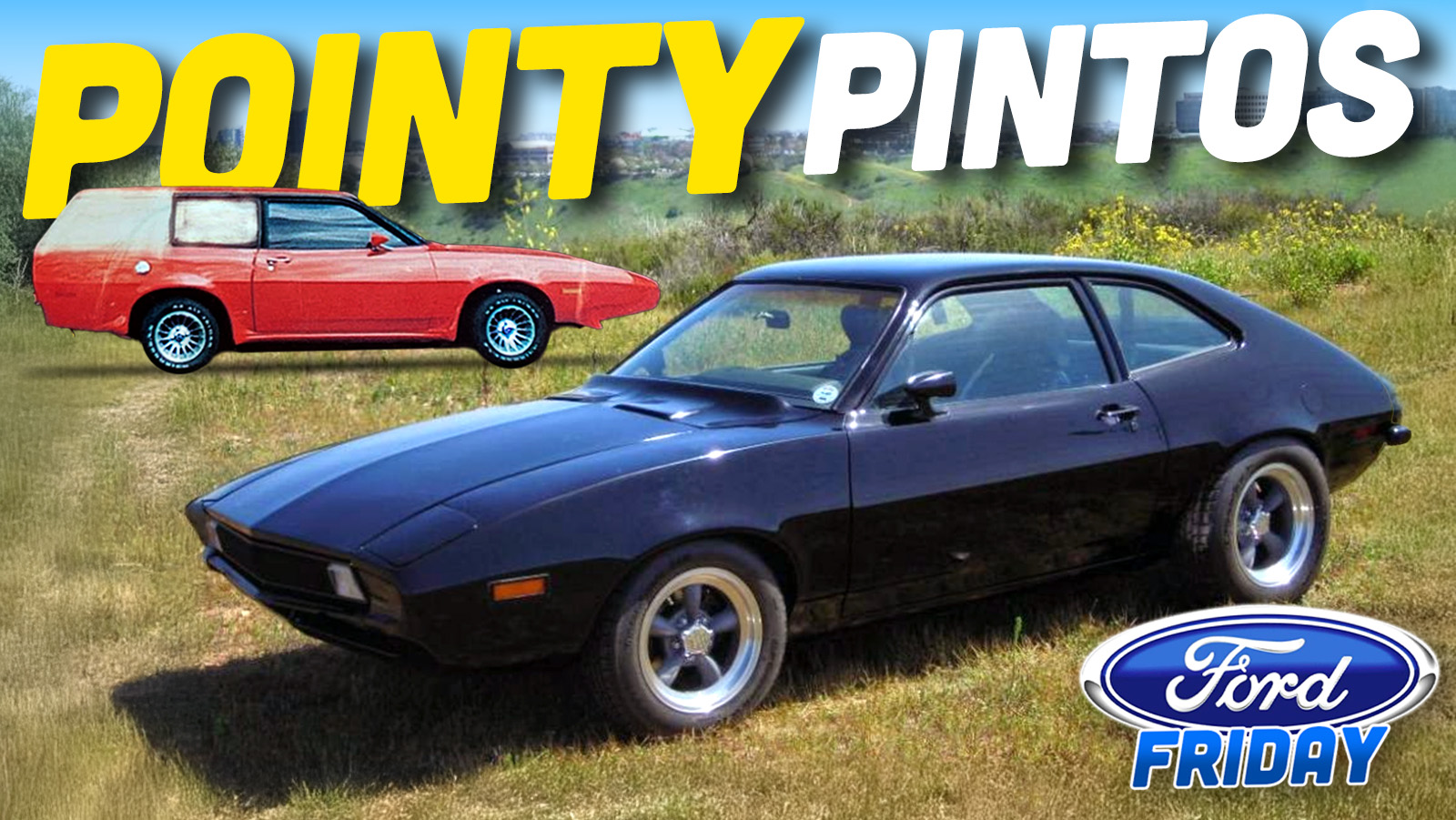
One of the casualties of the modern-car complexity is the ability to quickly and drastically change a car’s appearance. There were entire industries built around turning your car’s sow’s-ear styling into something silk-purse-adjacent. Simply bolt on some new fiberglass body panels, and your Volkswagen Beetle could be transformed into something that looked like a Porsche 917. Briefly, one could buy a phony Ferrari that was actually a Fiero enjoying a little Maranello cosplay. And, for a time, you could change up your Pinto into a wedge-shaped, wing-backed sports coupe. I’ll explain.
These Were Not The Bomb
Thanks to a taken-out-of-context memo and the largely disproven story about it being more prone than other subcompacts to exploding when hit from behind, the Pinto has remained a punchline to many jokes over four decades after it ceased production in 1980. If it was indeed an automotive failure, it certainly failed upwardly. Over 3.1 million Pintos were sold over the ten years it was in production, making it a common sight on American roads during the seventies and early eighties before the vast majority were literally used up and thrown away.



As with anything that is ubiquitous, there’s always an opportunity for people who want to make such a common product stand out in a crowded parking lot. Ford obviously did that themselves with various graphics, trim, and wheel packages over the years to add some color and individuality to their ultra-popular little car. The “Stallion” package paired a slick silver-and-black color theme with chromed five-slot mags that somehow made the lowly subcompact seem like something much sportier.

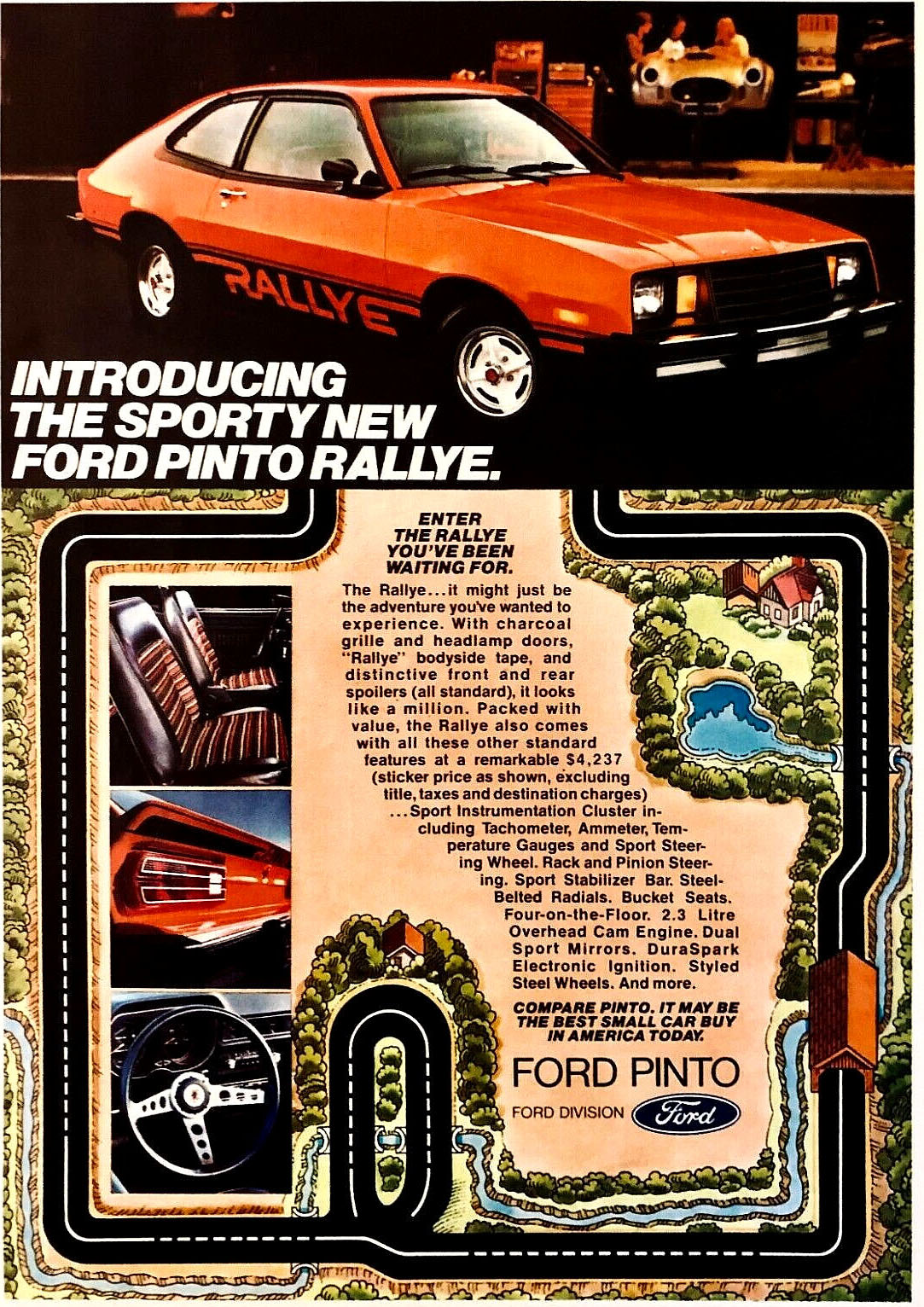
Here’s the Pinto “Rallye” that was likely not going to compete at Pike’s Peak, but the cute advertisement made kid-me want to play with my Matchbox cars on it:
The most famous of these factory Pinto specials might have been the “Cruising Wagon” that blocked off the rear windows of the Pinto wagon with steel panels and featured small bubble windows to capitalize on the custom vanning trends of the time.

If you wanted to take things further with your Pinto, there were aftermarket firms and even dealers that would help you. The conversions ranged from the sublime to the ridiculous to the are-you-kidding, and I’ll show you examples across the spectrum.
Galpin Pinto Pacer
In 1974, Galpin Ford (yes, the same Galpin associated with The Autopian) offered the “Pinto Pacer” that gave the car a new look via a bolt-on front end treatment that covered the original grille like a knight’s helmet, and even had translucent amber trim for the existing turn signals to shine through.

Whether you like the Pacer nose or not, there were almost certainly fans of this restyle in Dearborn. Three years later, the factory’s facelifted nose that arrived for 1977 bore a striking resemblance to the Galpin nose cone.

These were rather subtle changes, but if you wanted to take things a step further, there was another dealership that was happy to help you make it happen.
Pinto Pangra
Down the road from Galpin at Huntington Ford of Arcadia, the general sales manager had the idea for making a fast compact car to compete with the likes of a Datsun 240Z or a Porsche 914. It might sound insane today, but Huntington’s solution in 1972 was to use the Pinto coupe as a basis for this import fighter which they ended up offering as either completed cars sold through the dealership or as a multi-part kit.
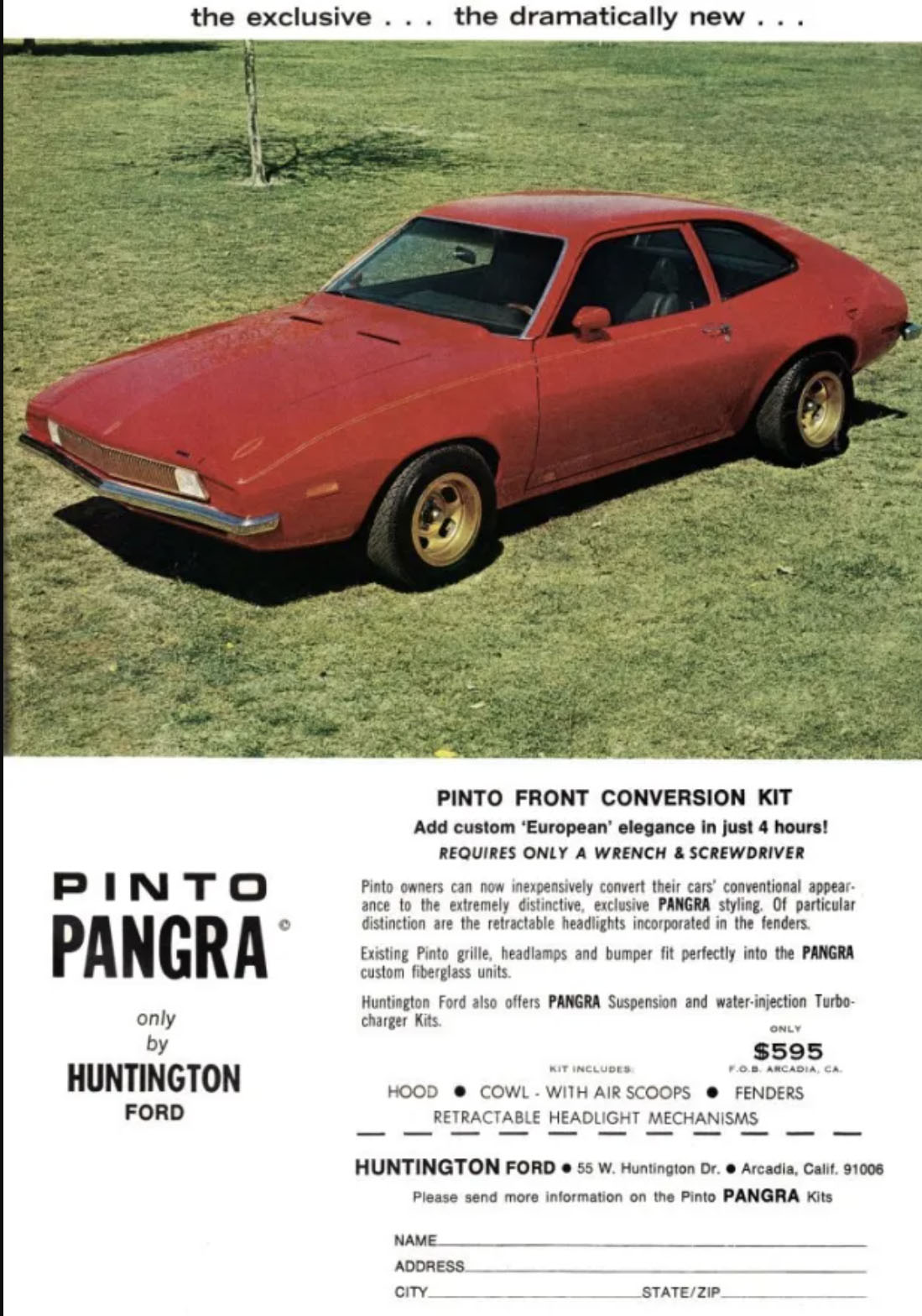
The “starter” kit gave you the Pangra look for $595 and included a fiberglass nose with modified fenders, and a hood that incorporated the stock grille and bumper. Mechanical pop-up headlights were operated via a lever inside the car, not unlike on an Opel GT. There were even cowl intake vents and a shroud that concealed the windshield wipers.
The second kit dealt with the handling and included a Spearco “Can Am” suspension kit with Koni shocks, sway bars and lowering the back by two inches. With the Pinto’s standard rack-and-pinion steering, it could be made to drive a lot better than you’d think (you laugh, but tuned Pintos ran relatively well in Showroom Stock racing back in the day).
Once your Pangra was going around corners better, you’d naturally want more power, and Kit Three had that covered. Putting in a heavy small V8 up front would have been an easy but clunky solution. Instead, Huntington did some pioneering work with turbocharging and water injection, and with a reported 175 horsepower, the zero to sixty time dropped to around 7.5 seconds. The extra power combined with the suspension tweaks it must have been a blast to drive. Also, as the brochure stated, this turbocharged engine still met Federal emissions standards.

A revised dashboard and console with extra gauges (including a digital tach) as well as wider rims and what qualified as “big” tires in 1972 (175HR13s in the front and 185HR13s at the rear) were also available. Even Recaro seats were on the options list, though those and some other tweaks were only available on the Pangras bought as finished cars from Huntington.
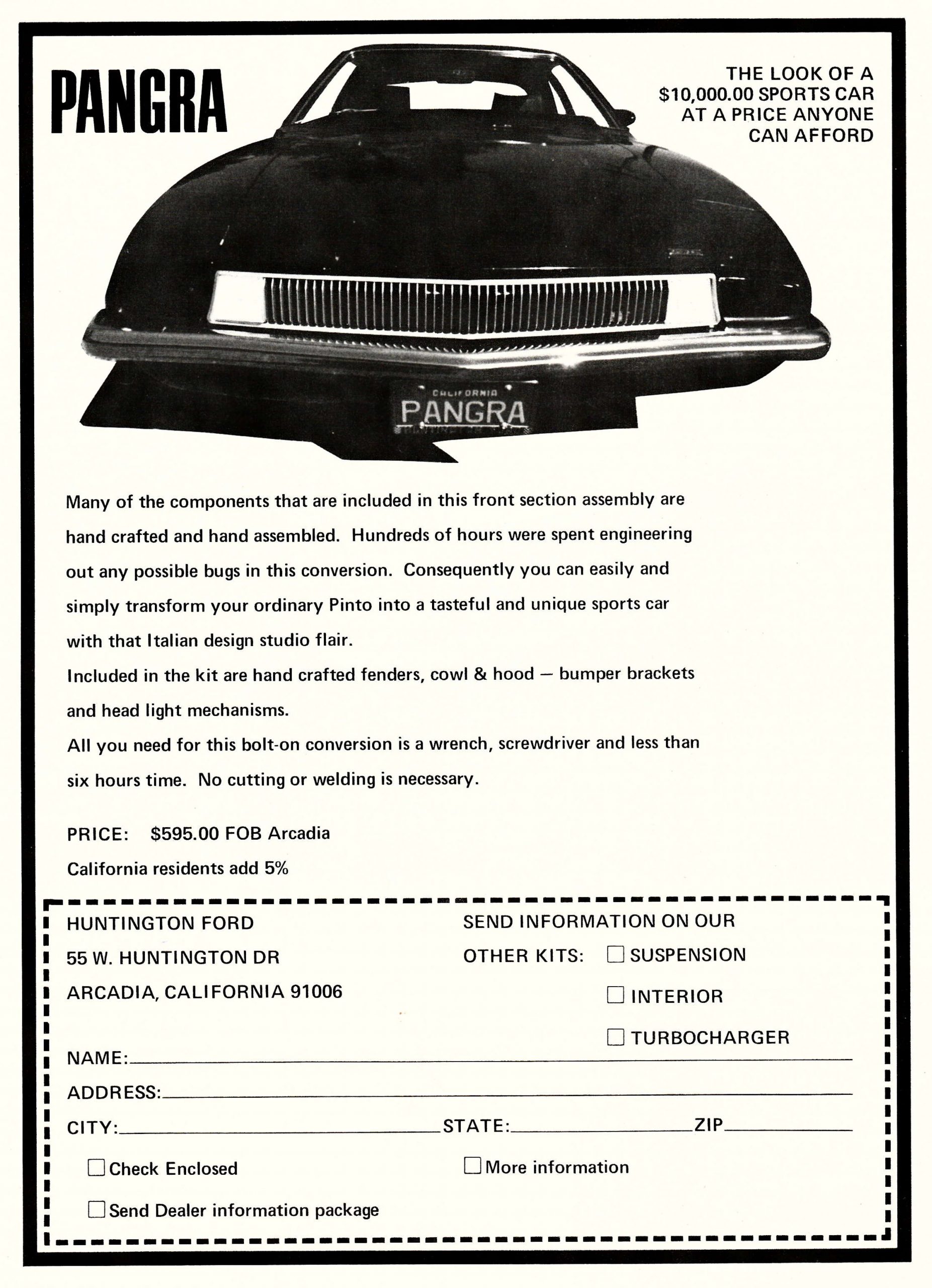
Here’s the total cost for the kits, which seem dirt cheap until you realize that a new Pinto cost like $1995 in 1972 money.

These Pangras come up for sale every now and then, like this modified one that appeared on a Pinto site some time back. Removing the factory front bumper turns this thing- dare I say it- into a rather attractive coupe:

Virtually no Pangras reportedly survive today with the original turbo setup, an installation so crude that it reportedly included a washer welded into the exhaust pipe to limit boost!
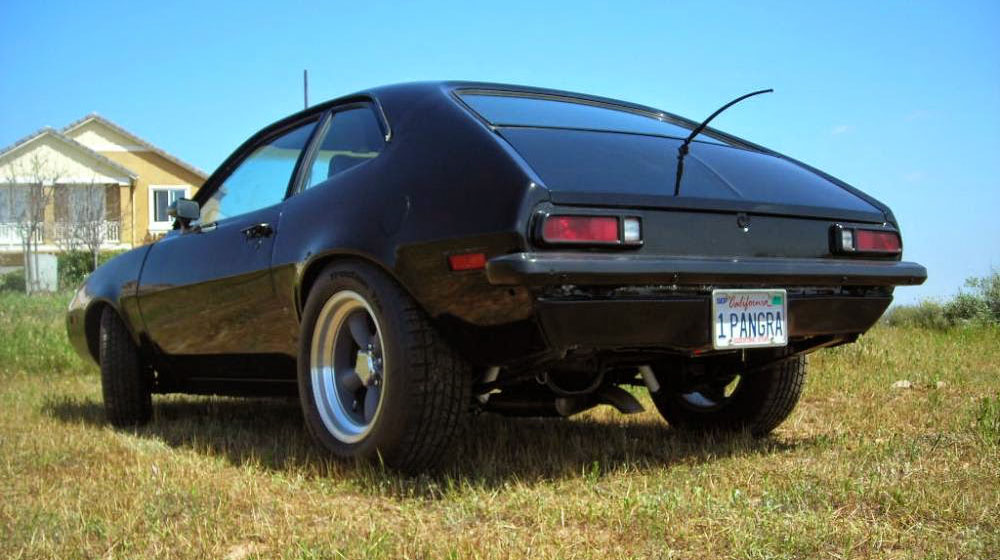
Numbers are hard to come by; while supposedly a few hundred fiberglass nose kits were sold, reportedly only around 20 to 50 of the more heavily modified cars were constructed before Huntington quit the whole experiment around 1973. Ford eventually made their own “sports Pinto” with the Mustang II the following year, but I think I’d rather have the Pangra.
Pinto Stiletto
Now we’re just getting silly. Information about this next one is a bit sketchy, but it seems like it came some time after the whole Pangra project had disappeared. A firm called “Autonique” (a division of Minnesota-based Unifoam Products) must have seen Huntington’s Pinto kits and just said, “Hold my beer.” I give you the Stiletto:

Unlike the Pangra and its rather gently sloped front end, Autonique went for a more aggressive wedge shape. This was not a great idea. A simple side view demonstrates how doing that created an anteater-like nose that extended into the next area code:

Despite being proportionally absurd, the finish level seems like it wasn’t bad. The Stiletto could be added to a sedan or wagon Pinto, though I do see in that one brochure picture of that yellow one above that there was an add-on rear “spoiler” that changed the whole roofline in back that made it look almost like a compacted Lamborghini Espada. If you have more images of this thing, please do not hesitate to share them; this thing is too spectacular to be lost in the sands of time.
In another ad found on the web, the “Super Stiletto” kit adds a Superbird-style wing to the look for Pinto owners with no sense of self-awareness and a high tolerance for whacking their heads, as it appears there’s no easy way to load luggage into rear hatch without banging your noggin on that ironing board.

Some Stilettos spotted online have pop-up lights while others have headlamps in the bumper. Options in the brochure appear to include electric or vacuum actuators for the pop-ups, as well as handling and interior kits plus a “discretionary supercharger.” With such limited details, it sounds like Autonique was not as involved with the mechanical changes as Huntington was with the Pangra. They were all about the look, but you’d want to find a way to make yours faster just to get away from the Taste Police.
Yes, some of these still exist, like this one on Craigslist a while back; for some reason, the heavier-looking back of the wagon works better with the silly nose, but it’s still comically long.

I also see the Trans Am-style wheel arch trims that aren’t particularly well resolved:
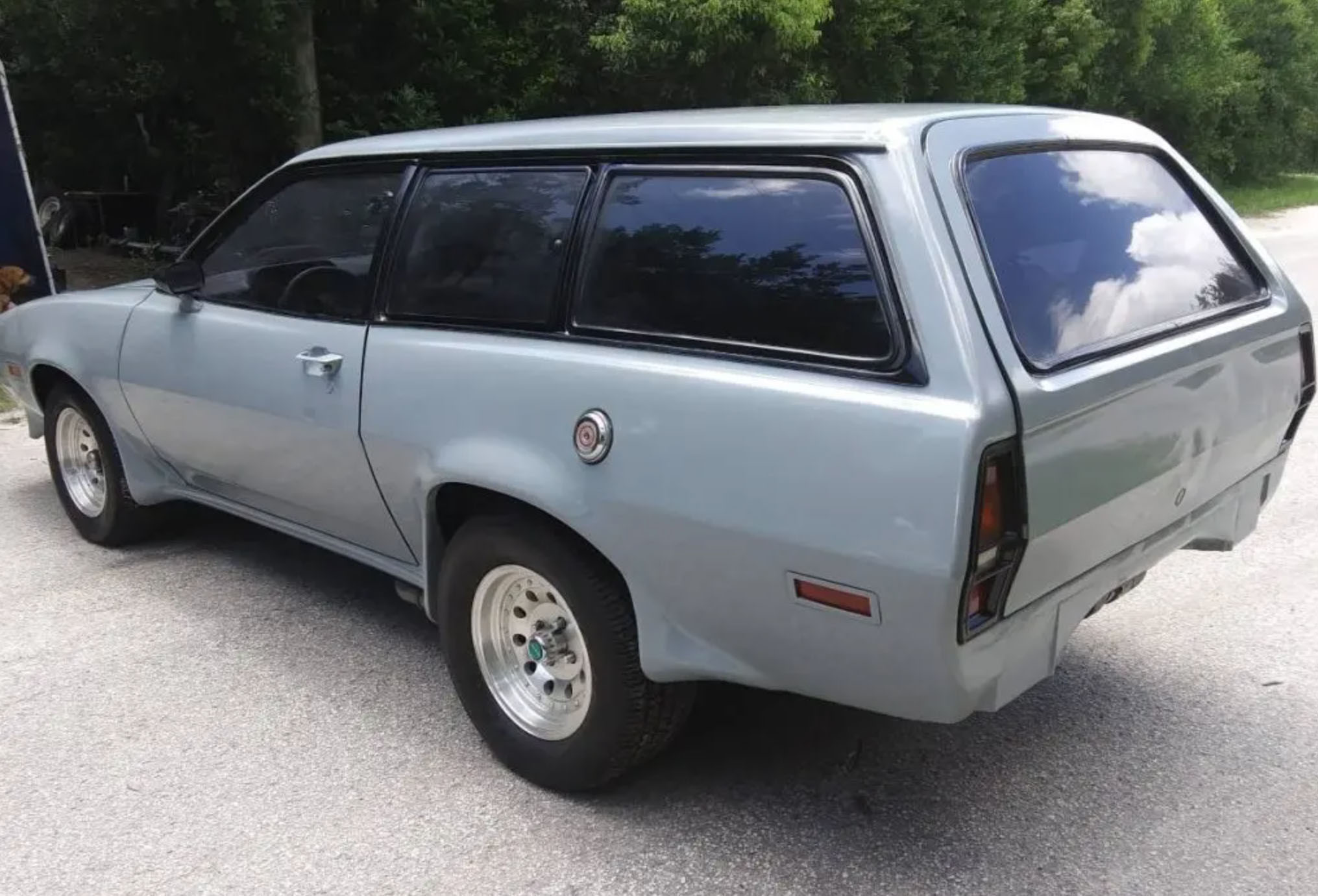
I didn’t find any information online on how many of these kits were sold, but they appear to have built more than one, so that’s another indication that with cars, there’s a butt for every seat.
I’d Prefer To Add More Fiberglass Around The Gas Tank Instead
Yes, I’m laughing at these things just like you are, but at the same time, I’m impressed that entrepreneurial souls decided to take a car that nobody loved but everyone bought (3 million of them!) and attempted to turn it into something a little different. Actually, in some cases, a lot different. Maybe better, probably worse, but different nonetheless.
Top graphic images: FordPinto.com Classifieds; Unifoam Products



As someone who didn’t live through the 70s but saw the Blues Brothers a bunch of times, I can’t see a Pinto wagon without immediately thinking of Nazis (Illinois Nazis to be specific).
just noticed that the mailing address on these is for Arcadia CA which is where the current Mercedes dealership has been located for a very long time now.
My Auto Racing career began in a Pinto at age 15. Back then you could get one for $200 or so, put a simple cage in it, and be racing circle track for under $1k. 33 years later I still race cars, and still have a soft spot for hatchbacks and 4cylinders.
Racing is where all the Pintos went.
I’ve seen one in recent times and it looked mint.
Can’t recall the last one I saw before that.
I saw one or two of the streamlined Pintos.
It was extremely dramatic at the time, as even sports cars often had flat faces.
Never heard of the wing before.
My brother and I rebuilt a Pinto engine after it ate a timing belt. A great exercise in wrenching for a couple of teenagers, My Dad said he’d pay for the parts if we could fix it, and so we did!
He later sold it for a Mustang II my sister had to suffer through!
When I was in high school, my brother was working as a machinist for a small chain of auto parts stores that had a machine shop in the largest store. They had a delivery fleet of a dozen or so ratty pinto hatchbacks. Each was identical, 2,000 cc, 4 speed manual. The owner surmised that having all the cars the same helped with parts interchangeability and brand identity. They all needed engine rebuilds, so he hired my brother and I to work Sundays over a winter, doing the worst cars. Engine rebuild and send the trans out. You could turn a car around in 2 Sundays.
After we did 5 or 6 of them, we decided it would be cool to make one a flagship car. Have it at the drags, maybe. Early version of the shop truck. The owner wouldn’t agree to an engine swap, but he did spring for tiny cragars and new tires.
My brother did some work on the head, oversized valves, and he milled the block a bit for higher compression.it was all done by feel. He made an adapter plate to get a 2 barrel on it, and we found an header in Jegs or JC Whitney catalog. One of the guys in the shop piped it through a cherry bomb. It had decent pep and sounded like a giant chainsaw. Even slow cars are fun to drive with a manual transmission.
We found junkyard red seats, shackled the back and jacked it up with air shocks. I painted “RUSH DELIVERY” on the back in the style of the Rush band name. The exhaust guy put a fake roll bar in. We used some window tint on the marker lights. In the end it was pretty damn cool! The Fidelity Auto parts Rush Delivery. Wish I had pictures, but this was back in 1981.
You know, the basic design of the Pinto wasn’t different from the Mustang or Camaro. Certainly less overall weight was a big plus. Back in the day, considering the overall state of performance cars, a hot rodded Pinto was not a bad idea at all.
disclousureo. Our family had a 72 Pinto wagon. Was definitely more fun tomdrive than the Buick Electra my dad drove.
And sorry, I never worry about cars that might hit my a$$ and cause a fireball. Life is too short for that.
No, it did not.
The Super Stiletto made my freaking day! That wing looked silly on the Superbird but at least it was, sort of, functional. In this application, it is just stupidly hilarious.
I was doing OK and remembering the Pangra and then I saw the Super Stiletto and my head blew clean off.
In the picture with the breakdown of features, it mentions that the Pangra has a “twenty-pound turbocharged engine.” I’m racking my brain trying to figure out what that means. There’s no way that’s referring to maximum boost pressure, not on a carbureted setup — didn’t these max out at around 10 pounds of boost? The entire engine obviously weighs more than 20 pounds, but maybe they’re just referring to the weight of the turbocharger and piping? I don’t know.
Maybe it cost 20 GBP?
I had the fortune of attending the very first Concours d’Lemons in 2009 and among the machinery there was a Pangra wagon. I took a pic of their lengthy explanation if you’re into squinting at photos:
https://flic.kr/s/aHsmvdibox
Thanks for sharing!
I have never seen one of these conversions, but the ad copy shown in this article made me laugh out loud several times. So, thanks!
I never saw one in the wild, but the “Stallion” package looked good, although neither occupant in the picture was wearing a shoulder belt. Were they so burdensome that you felt the need to take them off at a Sonic or wherever that food was being served by some beautiful, under-compensated server?
Pinto drivers often drove with no seatbelt, one hand on the steering wheel, one hand on the door handle and one eye on the rear view mirror.
72 Pinto survivor.
Wow. I’ve never seen a Pangra, but in the 1980s I drew one just like it after a friend bought one as cheap transport. I saw it had real possibility as a rather nice mod-able body style. He just laughed at the illustration, “No way! It’s just a Pinto”. The stigma toward anything in regard to Pintos and Vegas has never gone away, despite being excellent designs.
I love the look of the Vega, but I doubt I’ll ever see one in decent shape because they were just so disposable when new.
When I was in high school, a youth group leader at my church had a Vega wagon which looked so cool. He was a senior in college and I have no idea what happened to him or his Vega. But, yeah. The Vega looked so much better than the Pinto.
In college, I had a friend who had a Pinto, with a stick! It drove kind of ok. But I liked my ’68 Datsun 510 wagon better.
“Disposable” is a very kind word for how its many design defects limited its lifespan. They were good-looking cars, though, without a doubt.
Almost all the styling and durability of a coke bottle.
I bet if you got a Cosworth, you got all the thrills of a pack of Trojans, and for just as long.
I remember reading a road test in Motor Trend of a Pangra where they compared it to a Porsche 914-6.
I didn’t subscribe to MT back then (or now). What were the results? A 914/6 should have absolutely demolished a cosplaying Pinto, but inquiring minds want to know.
The Galpin grille wasn’t bad at all. Especially with Speed Stripes on the hood.
Currently watching “Stranger Things” with the family. I was just telling the kids how my parents had a Pinto (like Will’s mom). I, uh appreciate the enthusiasm of the kit maker I suppose!