

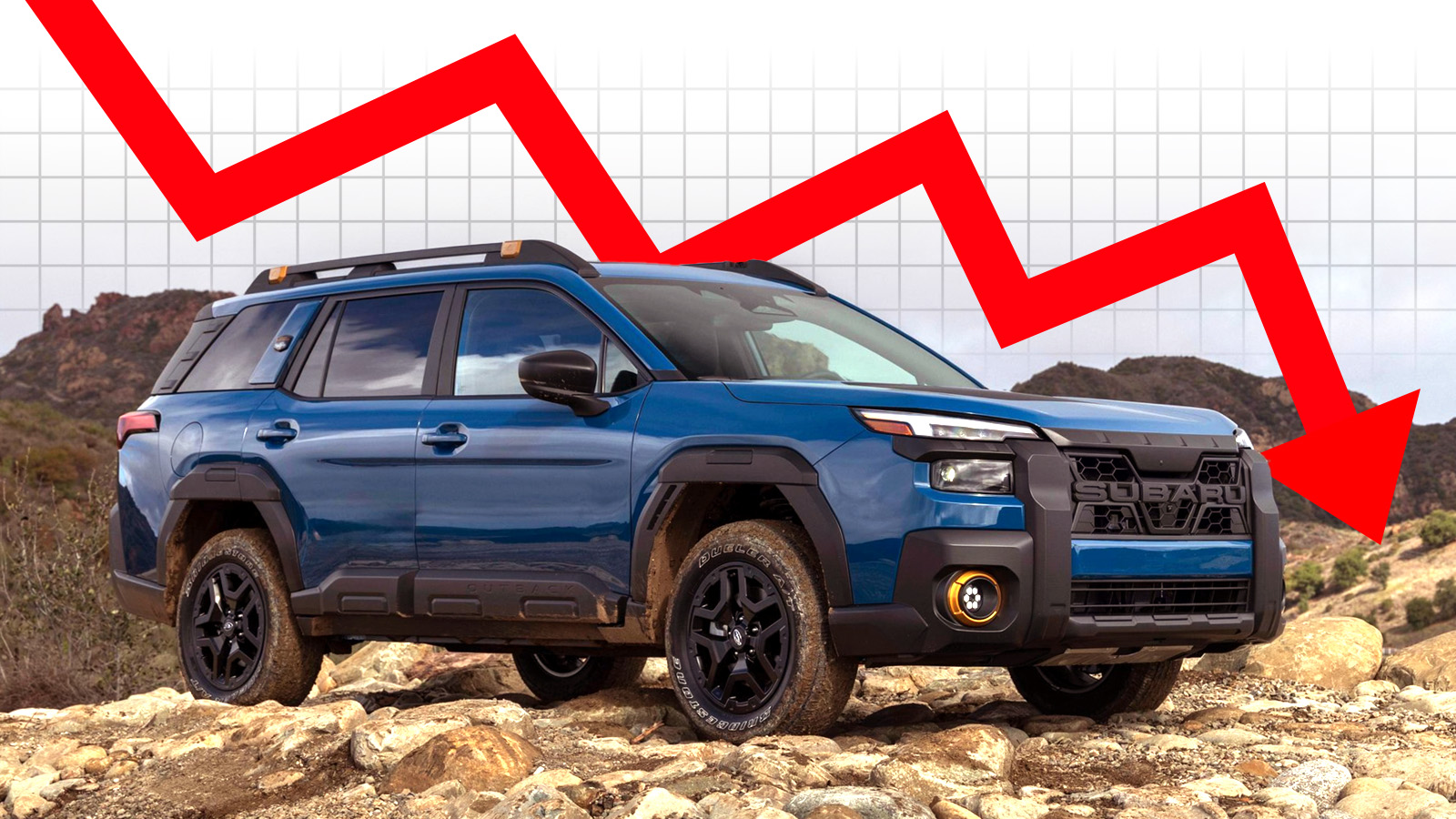
Aside from the drama surrounding whether Subaru will ever bring back the STI, the Outback is definitely the most controversial vehicle in the company’s lineup right now. Historically one of the Japanese brand’s best-selling models, it made the switch from a lifted wagon to a far more SUV-looking bodystyle for 2026, drawing the ire of critics online.
Back when the new Outback debuted at the New York Auto Show last year, Thomas predicted Subaru might be making a mistake by pushing the Outback into full crossover territory, rather than keeping the Outback in its own, wagon-esque lane. Contributor Andrew Ganz doubled down on the new Outback’s questionable design when he reviewed the car for us in November (it’s worth noting he did like how it drove, though).


Now, sales for the first quarter of 2026 are out, highlighting the Outback as one of the biggest losers in terms of sales volume in the lineup. Deliveries fell by over 32%, from 17,539 cars in the first three months of 2025 to just 10,004 units in the first three months of 2026.
Surely, then, the Outback’s drastic design switch is causing sales to plummet, right? Well, that might be a cause. But there are a handful of other, more sensible reasons why Outback sales have fallen off a cliff. Let me explain.
Factories Can’t Magically Switch Cars Overnight

Dips in sales can often be seen when cars switch from one design to another, whether for a normal mid-cycle refresh or for a full-on design change, in the case of the Outback. This is because the factory has to retool to incorporate all the new gear to make the new car. Factories can’t just flip a switch and go from making one car to making an entirely different car without some pauses or slowdowns to make changes to the assembly line.
With the new Outback, Subaru had to deal with this switchover on an entirely different scale, since for 2026, it moved production of the Outback from its plant in Indiana to an assembly plant in Japan, to make room for more local Forester and Forester Hybrid production. Doing that kind of stuff takes time, so supply through the first quarter of 2026 was limited.
When I reached out to ask about the dip in sales, a Subaru spokesperson pointed out to me that the Wilderness trim, which has quickly become one of the Outback’s most popular submodels, only just started arriving at dealers sometime in January.
Remember That Thing Called Tariffs?
Another big reason why it appears like Outback sales are deflating is because of how unusually well the Outback sold during the same period last year. Those 17,539 cars represented a 13.4% increase over the year prior, which is a pretty substantial jump for an aging car that was one year away from being phased out of production.

According to Subaru, this increase was due to people swarming dealers to buy cars to get ahead of tariffs, which went into effect later in the year. We covered this phenomenon last year as it was happening—several brands experienced panic-buying in the months leading up to tariffs taking effect. So theoretically, this dip can be at least partially attributed to sales normalizing in a post-tariff environment.
On a more basic level, the slump in sales could also be affected by the Outback’s new price tag. Thanks to tariffs and the new design, the 2026 model starts at $36,445, making it a full $5,030 more expensive than the old car.
My point is, there is pretty much a perfect storm of reasons why Outback sales are down. The model year changeover, the switch in production to a place halfway across the world, the previous year’s one-off success, the bigger price tag, and the questionable looks are all factors that could be contributing, some more than others. How heavily the car’s design is affecting its success will likely become clearer later in the year once all of that other stuff balances out. A model year changeover is an excuse Subaru can only use once.

Personally, I think Subaru’s decision to turn the Outback from a lifted wagon, where it dominated in a segment mostly to itself, to yet another crossover was a weird one. It already had the Forester and the Crosstrek, and people who bought Outbacks purchased them specifically because they weren’t just another crossover (at least, that’s what my dad says to me—he was one of the people who grabbed a 2025 Outback last year before the tariffs hit).
I’d love to know what you think. Once the dust settles, do you think Outback sales will continue to decline based on its new design? Or is leaning into the holy land of crossovers the right call here? Let me know in the comments.
Top graphic image: Subaru


I’ll be the black sheep. I like the design, it’s muted and it accomplishes something that Subaru buyers seem to be seeking – durable without projection of a tough aggressive feel. It feels like it’ll get hit with shopping carts, bumped onto trash cans, etc and bear the story as a scar and continue on its life unphased. And yeah, it doesn’t feel like a Subaru at first glance… But it doesn’t feel like we’re in reality at first glance so I’ll give it a pass and a hug.