

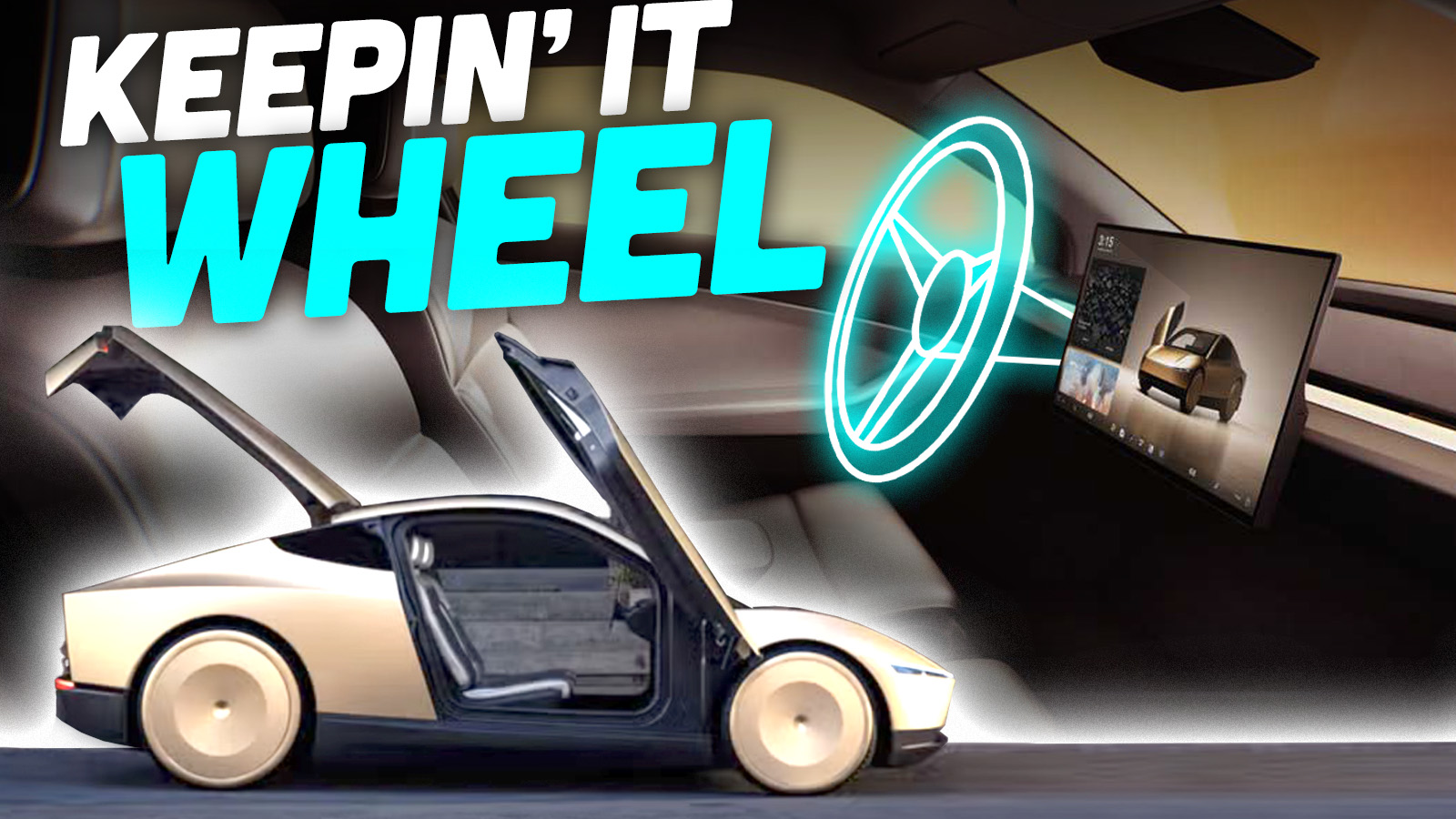
For a while, everyone thought Tesla’s Cybercab—known by many an analyst as the Model 2—would be the brand’s affordable car to slot below the Model 3. Those hopes were dashed last year, when CEO Elon Musk declared a $25,000 Tesla would be “silly” and “pointless.”
Still, slowing demand and a need for more volume meant plans for cheaper cars went forward. Earlier this month, Tesla Model 3 and the Model Y Standard, two trims that remove many previously standard features to reach barely-lower price points.


I assumed these Standard models would be a cheap as Teslas get, but according to one executive, there’s still hope for the Cybercab, the company’s upcoming autonomous two-seater with butterfly doors, to undercut them in price.
The Cybercab is interesting for a lot of reasons, but its most important feature—or in this case, lack of feature—is that there is no steering wheel and no pedals. It was presented just over one year ago as a fully autonomous vehicle, with no need for any input from its occupants.
Robyn Denholm, chair of the board of directors at Tesla, revealed to Bloomberg that the company could pull an about-face if it means actually selling cars.
Tesla Inc. sees the forthcoming Cybercab as its long-promised more affordable electric vehicle — and it’s willing to make fundamental design changes to sell the car in high volumes.
In short, it’s willing to make it more like a normal vehicle that human drivers can control.
“If we have to have a steering wheel, it can have a steering wheel and pedals,” Robyn Denholm, the chair of Tesla’s board of directors, told Bloomberg News in an interview Tuesday.
The Cybercab is interesting for a lot of reasons, but its most important feature—or in this case, lack of feature—is that there is no steering wheel and no pedals. It was presented just over one year ago as a fully autonomous vehicle, with no need for any input from its occupants.
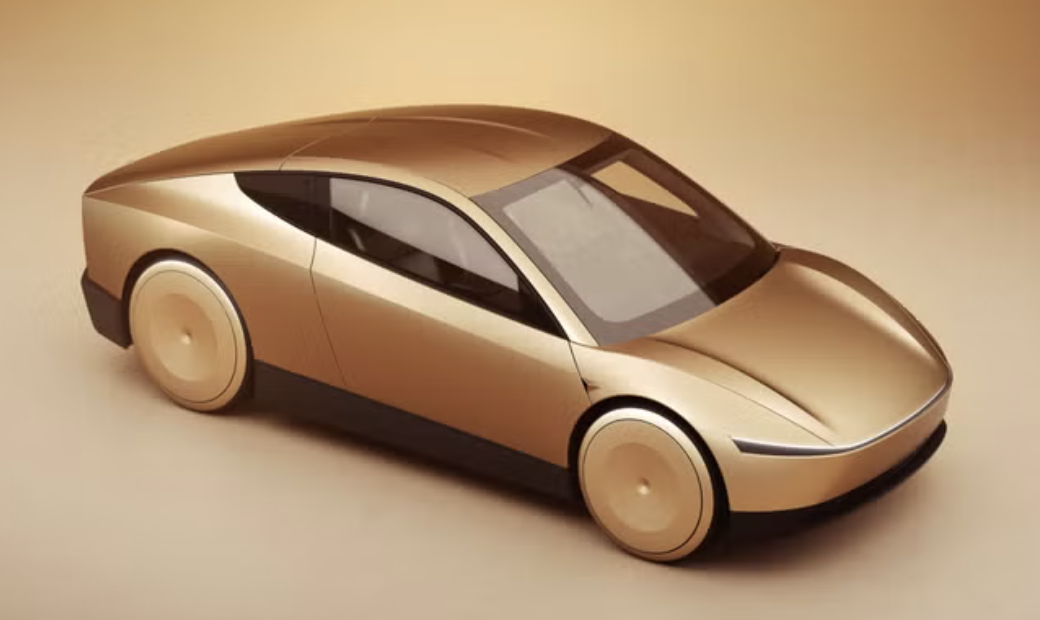
The problem with that is it’s not legal to sell a car to the public without those controls, according to the NHTSA’s Federal Motor Vehicle Safety Standards (FMVSS). Tesla knows this, yet it went ahead and revealed the car without those features—probably because Musk thought he might be able to secure an exemption from the government. From Bloomberg:
Denholm’s stated openness to modifying the Cybercab — which is scheduled for volume production next year — suggests an evolution within Tesla over the past year. Regulators have been reluctant to budge on certain longstanding safety standards even despite Musk’s lobbying Washington to do so. The US, for example, requires cars to be equipped with a steering wheel and pedals.
Seeking exemptions from those rules can be a long and arduous process. The US National Highway Traffic Safety Administration didn’t act for more than two years on General Motors Co.’s attempt to get authorization for its purpose-built autonomous vehicle, the Cruise Origin. GM ended up scrapping plans for the Origin last year before shutting down Cruise altogether.
And as Bloomberg points out, even if Tesla somehow did secure an exemption, it still wouldn’t solve the company’s desire for more volume. Currently, the NHTSA only allows carmakers to deploy 2,500 autonomous cars without traditional controls. For a manufacturer that sold nearly 460,000 cars last year, that’d be a drop in the bucket.
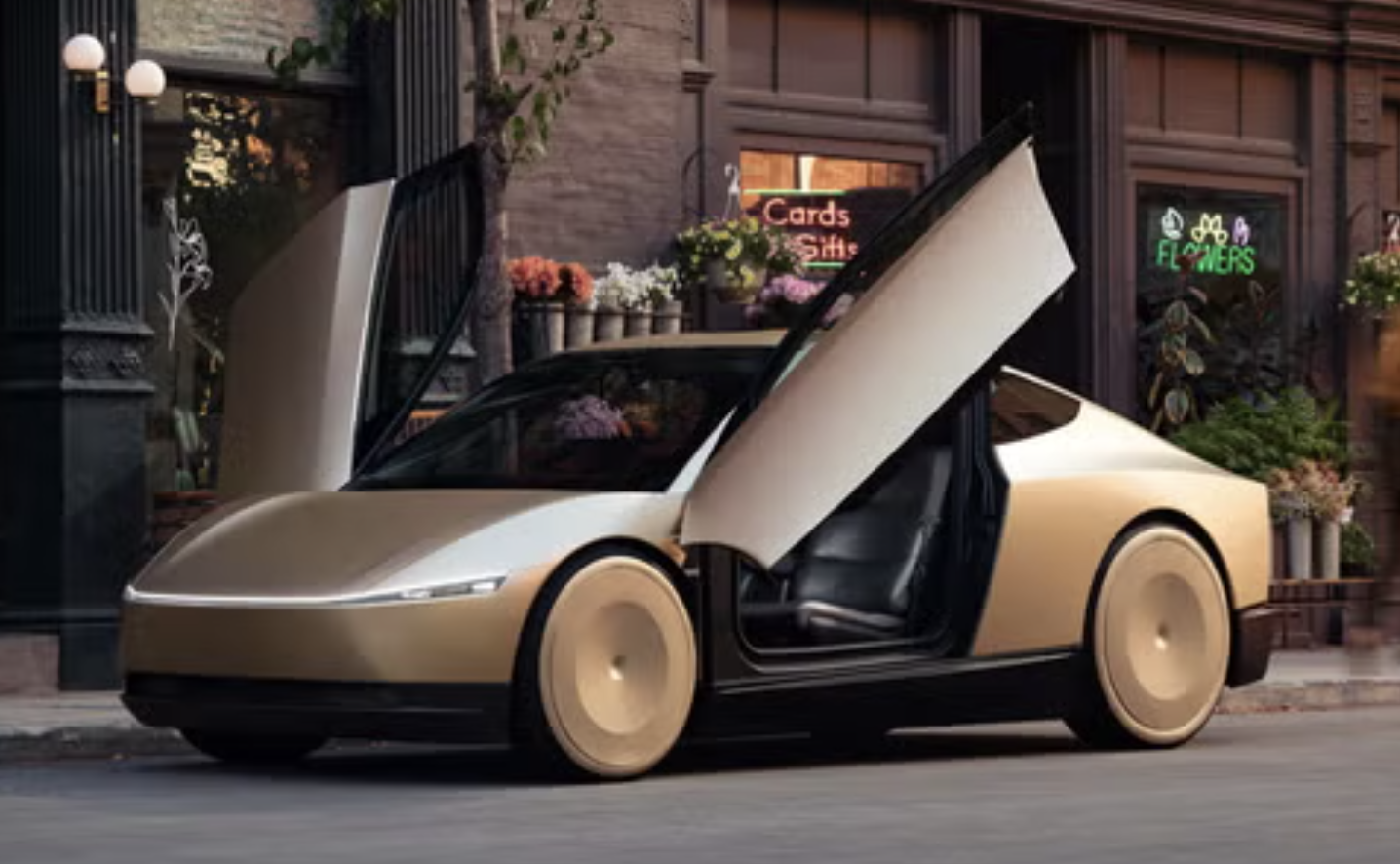
This isn’t even the first time Tesla has done this exact script-flip. From Bloomberg:
“The original Model Y was not going to have a steering wheel, or pedals,” she said. “If we can’t sell something because it needs something, then we’ll work with regulators to work out what we need to do.”
I think the Cybercab will become a far more appealing vehicle if it came standard with controls, especially if it came at a price point lower than the Model 3. At its core, this car is a low-slung two-door hatchback with butterfly doors—it’s hard not to appreciate that as an enthusiast. Hell, if Tesla is willing to add physical controls, it might as well follow The Bishop’s suggestions and throw in a simulated manual gearbox while it’s in there. It’s the least the company can do for years of Roadster 2.0 delays.
Top graphic images: Tesla


2 seat economy car…that’s sounds like how the Fiero was pitched at GM to get approved
I wouldn’t buy one because Musk, but after him teasing the press and bumping stock prices for the better part of a decade, I almost think he should HAVE to actually sell a $25K EV. If it’s just a cybercab thing with a steering wheel added, and then rebadged the Model 2, so be it.
“c’mon, you have to admit this thing looks pretty cool.”
no, i don’t, because it doesn’t, it looks like shit
Yep. I mean, it manages to look worse than the Cybertruck, although I think that comes down to the color and the wheels.
I’m still going with complete Vaporware. Who is the consumer market for a 2 door, 2 seat, “driverless” cab? Lyft? Or will they all somehow be bought by The Boring Company and SpaceX?
IF they are actually delivered, how long until we find out that they are just remote controlled cars by an army of people in the Philippines or Bangladesh making $3.50 a day?
Although two seats is usually a pretty huge turnoff for car buyers, I think the reality for a lot of households is that there’s going to be a larger ICE vehicle for road trips/hauling, and an EV for commuting. If people put it together, and if this is cheap enough, I think this could be a good option for such households
I have considered this set up for a two commuter two teenager household. I like the idea of going with a two-seater, but because each commuter needs to move both teenagers at the same time, sometimes, we went with two five-seat EVs. Next set up will likely be one EV and one AWD PHEV.
The EV market is healthy with competitive products.
There is no reason for anyone to bat an eye at Tesla, or give a shit what they are doing. The only reason to spend your hard earned money on a Tesla at this point is if you want to make a political statement.
So if someone wants an EV sedan without spending BMW dollars, but they don’t like the Ioniq 6 for whatever reason, then they are SOL because politics?
Don’t make your car buying decision based on my beliefs.
Make your car buying decision based on your own beliefs.
As I’ve said many times before, someone’s racial makeup is not a political stance, and standing against hatred and racism is not a political stance either.
You said the market is full of competitive products. That is not the case with relatively affordable EV sedans. Do you disagree?
And you stated that no one should consider a Tesla. No one?? As if everyone should agree with you that Elon’s politics should invalidate Teslas? Sorry, our bi-racial family doesn’t like the Ioniq 6 and can’t afford an i4, guess we can’t have an EV sedan?
I said pretty clearly, buy based on your own beliefs.
In the apartheid system that Musk misses so dearly, bi-racial families were illegal.
The existence of your own offspring would be illegal. Their existence is not a political stance.
That statement stands in stark contrast to your first. That is my point. Everyone should make their decisions on their own. Musk is a POS. That is hard to argue. The Model 3 is also a great car in a segment with few options. Also hard to argue. What am I missing?
This kind of black and white decision making that you suggest is a huge problem in the world today. People should be free to think for themselves.
Honestly, for the third time now, make your own car buying decision based on your own beliefs.
I was a huge Tesla supporter before Musk came out as full racist, and of course the cars are pretty good. Musk created the EV market, and now the competition is healthy.
Unfortunately, my ethnicity is not a choice, so I’m obligated to side with myself. And a person being a POS is more than enough reason for me to never give them a big pile of my own money.
For the fourth time, think for yourself, and act based on your own beliefs.
This is a stock pumping device, not an autonomous taxi. As Tesla has proven for more than a decade that they are not capable of building an autonomous vehicle. With cameras only, they have no chance of success. Tesla does not have the Secret Sauce and at this point they’re not even really trying. Past performance does not guarantee future success and their current driving tech can be fooled by Wile E Coyote with a paint brush. So called FSD is unsafe garbage and can mistake the moon for a traffic signal while lining up to ram an emergency vehicle parked on the side of the road with all lights flashing. Tesla has actually given up on self driving and now they’re going to take over the world with robots that they are also incapable of building. Or maybe battery storage, which is more a commodity business and margins are tight, so maybe not. Or maybe underground tunnels. Or racist AI. Or maybe he’ll just self-deport to Mars (I wish).
Also, a 2-seat “taxi” with a steering wheel (and a driver) is either a taxi for one or a rental car. We have those already: not disruptive.
I expect to see Trumps affordable healthcare plan implemented before Tesla builds a self driving car that actually works.
Its a vision-only sensor suite. Making it without pedals and a steering wheel is basically a rolling suicide pod with a timer. It’s not a matter of IF it will crash, simply when and how badly.
I have said it on here so many times, but I will continue to say it, Vision-Only ADAS is a complete and utter fools errand, and there is a reason ZERO other companies have gone down that direction. The only thing it saves is cost, everything else is sacrificed in the process.
So, what’s your expertise? How is vision slower to react? And you’ve ridden both a vision-only and a LiDAR in the same situation? Can you tell us more about how LiDAR works and why you have to shoot your own photons out instead of what’s already being reflected? Why do we need to shoot lasers and damage cameras while traveling? Please enlighten me on how LiDAR is the only way to solve autonomy. If Tesla’s vision-only approach is so bad, why does it consistently rank high on tests?
I’m a mechanical engineer and in my undergrad I spent 2.5 years as a part of a design team with direct GM backing towards Hybridizing and adding ADAS features to a new Blazer. Part of this involved extensive cross-team work that included my team on the mechanical side working on the sensor suite integration. With that in mind, I’ll give you the hard technical limitations as well as an SAE autonomy overview that explains the issues at hand. All of this to say, I’m not exactly an industry expert, but I have far more experience than the average person. Sorry if my tone is harsh at any point, I’m doing my best to be objective and informative, and I cast zero judgement, but engineer = no-words-goodly.
The SAE autonomy scale often used to measure the capabilities of ADAS systems is broken down as 0-5, with 0 being nothing (or regular cruise) and 5 being a 100% autonomous, zero driver interaction system. Most if not all systems currently deployed in the US are a higher level 2, maybe a lower level 3 at a stretch in terms of capability. These systems can, at best, cover a reasonable but limited number of driving functions but both legally and operationally require driver attention in order to operate. This is because these systems are not advanced enough to notice and react to everything around them at all times. Only a level 5 system is considered something able to take on 100% of the driving load, including every single edge case imaginable, which is obviously something that does not yet exist.
Now what does this have to do with Vision-Only versus Lidar/Radar/Sonar/Ultrasonics? The reason the sensor suite comes into play in this discussion is that every technology has it’s limitations. The difference between LiDAR and Cameras is actually massive, while LiDAR can be thought of as much more similar to Radar, but using light instead of radio waves. This allows both LiDAR and Radar to receive high fidelity high-absolute-value data, that a camera cant. This absolute value data is crux of the problem. A camera cannot tell you what you have in front of you. You and I can explain what is in an image, roughly how things align, etc, but cannot be certain if that image of a car is 5 feet or 50 feet away, without other references in that image.
What a lidar, radar, sonar, or ultrasonic sensor can do is scan the surroundings and create a 3D plot of what is around you with extreme precision. Vision-Only can leverage machine learning and data processing to create a high-percentage prediction of it’s surroundings, but it is simply that, a prediction. The Lidar, et all sensor types have the distinct advantage of being nearly agnostic to any and all environmental conditions around them, while Vision-Only systems are impeded or entirely defeated. If it is foggy, raining or snowing heavily, some other event, a Lidar-etc system is able to still see it’s surroundings, while cameras simply cannot. Furthermore, vision systems have to train for day, night, overcast, sunny, rainy, snowy, and more types of environments to adapt to their surroundings, while Lidar-etc systems don’t care and do not see the world differently.
These issues all compound to a vision-only system that may work well in a Level 2+ type environment, but in order to break into the 4 and 5 range, it inherently MUST be capable of dealing with any and all edge cases thrown at it, including weather cameras cannot see through, obstacles not encountered by training data (a cow in the road is not common, for example) and more. What a Lidar-etc approach can do is accurately determine what sort of obstacle is approaching at an exact velocity, and avoid it, even if you yourself (like a camera) could not see it. This is doubly important for higher rates of speed, as cameras are far more limited at distance than Lidar, which can see hundreds of meters ahead, while cameras cannot. All of this is why Tesla’s system as it currently sits can work nearly as well as the Radar/Sonar/Ultrasonic systems like GM’s SuperCruise and Ford’s BlueCruise, but Tesla’s vision-only approach is inherently limited.
Also Autopilot/FSD has been under much more scrutiny recently due to having a far higher incident rate, and has the highest incident rate resulting in crashes of any brand, because the system has been rolled out so brazenly. So I will not go so far as to say an exact combination of sensors in what locations is the exact solution for the future, but Vision-Only is a true fools errand for all reasons other than cost. But Elon is king of Tesla, so if he says vision-only happens, the companies hands are tied. I’m sure I’ve missed things, so feel free to ask clarifying questions.
I love this reply! But still does not answer the last question: Why does Tesla rank high on tests? I mean, I keep seeing LiDAR is superior, but tests show other wise. Shouldn’t the LiDAR equipped cars show to be above Tesla, but why does it show the opposite like in the Chinese videos?
So Tesla tends to rank very high in customer satisfaction and some highly controlled instrumented testing. The customer satisfaction side is due almost entirely to it being extremely if not recklessly relaxed. Tesla has a big data and first mover advantage, they gather data from cars on the road to refine their algorithms. What this means is that most other companies at a similar Level 2+ state of autonomy have a slight disadvantage.
The one thing I hadn’t discussed in my initial response is sensor fusion and vehicle integraiton, which is it’s own massive challenge and special sauce. Tesla designs and manufactures just about everything in their cars, meaning they can very tightly control how everything talks together, which can steamline things massively. Also when you only use cameras, the analysis of that data is relatively simple, compared to a combo of radar, lidar, sonar, etc, which all have to be processed, combined together, and a response fed back to the vehicle.
Also most OEMs use 3rd parties like Bosch and Continental to design various modules that handle thigns like the brakes, the power steering, the radar, the airbags etc individually, so that signal has to be processed in one place, fed to another, and combined with other signals to turn into a command for what the car is to do. This is what Tesla can avoid with their tighter integration. It should be noted the industry, or at least some companies, are trying to move away from individual modules to a zonal architecture where fewer modules command more data/tasks in localized places to streamline all of the above.
The fact that Tesla uses vision only as somewhat discussed has lead to their well above average/competitor rates of incidents and accidents. The problem is that Tesla has allowed drivers to be very hands-off when using FSD, but not clear on it’s limitations, leading to people building a sense of safety and security when FSD is enabled. People love it because it’s more user friendly, but because of this, drivers often are not able to respond in time to failures in FSD can crash far more often than the more locked down systems of other OEMs.
Thanks for this detailed response.
I’m not qualified to discuss the actual real-world performance of autonomous driving systems like Alexk98, but I do know optics.
(EDIT: read Alexk98’s reply first)
Passive cameras only measure a 2D perspective, and cannot measure depth, and can only infer it from context and object recognition. Even with stereo vision, the distance error scales with the square of the distance, and inversely to the camera baseline. So practically, beyond very short ranges, it isn’t that good.
“why you have to shoot your own photons” Well, why do you have headlights? Passive cameras, especially visible silicon cameras, like what Tesla uses, and like your own eyes, do require photons “already being reflected”. They cannot work nearly as well at night. We solve this by “shooting out photons” from headlights. And, importantly, silicon cameras have a much lower resolution and dynamic range than your eye. They are much much worse at night. The only way to make them “decent” at night is to make large pixels (decreasing resolution) and/or to increase the integration time (like shutter speed) resulting in terrible motion blur when moving and very slow image update times.
LiDAR emits it’s own photons that are much better tailored to the problem. It uses a specific wavelength and a very short pulse, with a very precise timing circuit to measure the difference between when the pulse is emitted and the exact timing of the reflected received pulse, per pixel. This gives both the 2D spatial image, and a distance measurement per pixel. So with LiDAR it is actually getting a fairly precise 3D measurement of the world.
The longer wavelength penetrates fog/haze/dust slightly better, but the pulse mitigates this too. Instead of an intensity camera being confused by all of the light scattered in the fog, the LiDAr is looking for a specific return pulse profile. Some return light will be broadened and returned from the fog, but a temporally consistent pulse will still be returned from a hard object, even through a reasonable distance of fog, and this tight pulse, in time, is what is registered as an object; not the general background off of the fog. LiDAR will be limited by attenuation, when the fog scatters enough so that the pulse intensity is too low, but this is much better than trying to just image with a camera based only in intensity.
“shoot lasers and damage cameras” is mostly nonsense. First, visible silicon cameras are only responsive to 400-1100nm. Most cameras include an IR filter that blocks anything above about 750nm. LiDAR operates in either 950nm or 1550nm. So, the lasers will be reflected or absorbed by the lens/filters, and the damage threshold of those materials is very high. Besides, the output of most LiDAR is very low, and in fact, has to be “eye safe” according to ANSI Z136, which will limit them to very low power. LiDAr only needs very short pulses of low power. Now, are there sky-is-falling posts out there about people holding their camera at close range directly at the LiDAR sensors, or zooming in, thereby focusing more energy, and therefore damaging a few pixels on their camera? Yes. Is this a valid concern? I don’t think so. A person also shouldn’t stare at lasers either. ANSI Z136 Class 1 assumes that a person will stop staring after about 20 seconds, and Class 2 requires a human’s natural aversion response to bright light when classifying a Class 2 visible laser. Could someone be dumb enough to continue to stare at a laser? Yes. They might also decide to go play in traffic, so I feel responsibility is limited. Police speed LiDAR guns also use 950nm light, at higher power, so don’t stare or zoom your phone in on those either.
Love this reply! Thanks for enlightening us. What do you think of US Patent Application 20250282344. How does this compare with LiDAR?
This patent is the Computer Scientist’s approach to try to estimate range from a 2D image based on object recognition, context clues, and other processing. And this patent is only for parking lots and finding empty spaces.
I feel like there is a lot of CS hubris that if a human can do something, then it’s “easy” for a program to do it too.
I can’t speak to their approach, I’m not a CS, but I do work with the end results of AI/ML computer vision algorithms, and I’ll offer my opinion.
So, how hard distance estimation as either a human or computer?
First you have to recognize what you are looking at.
Can you recognize a car in a scene? That’s not too hard. Cars are distinct. Incidentally AI/ML has been able to do this for a while, labeling dogs, cats, cars, and other clear objects. But they are limited by what they’ve been trained on, and they have a hard time knowing that something is new and unknown, they tend to want to bin things as objects that they already know, or to completely ignore things they don’t understand.
Okay, you know it’s a car; now how far away is the car? That’s exponentially harder. You have to recognize the specific type of car and know how big they usually are, how is it oriented / what is the aspect, is there context for scaling, if it’s moving, how fast is a car and how much is it moving across your vision? How hard is it to do all of that? Now, do that for every single object in the scene, real-time, as you drive. The human brain is highly parallel and has “networks” of trillions of neurons that have been trained through evolution and through every hour of every day that we’ve been alive to be able to do this and other functions. And people still aren’t THAT accurate at estimating distance, and barely good enough to drive.
That is part of this patent (and other programs/models have already done range estimation at various levels of success for 10-15 years now). It seems like a joint patent with repeated content from a parking lot navigation user interface or something.
But no matter what, just as humans make educated guesses, AI models are really just advanced statistics and probability.
So, can a computer recognize an object and then extract distances from a 2D image, just like a human?
Yes, with massive training data, processing power, and within a probability tolerance. Just look at the patent’s computational flow in figures 2A and 2B to see how many processing steps are required! This also needs done for all conditions where things look different. Day, night, rain, fog. And the image quality (object contrast ratio) significantly degrades at night and in weather, if it’s there at all.
But, you know what’s easier and consistently more accurate than all of that AI image processing probabilities?
Just measure the distance to the car. (i.e. LiDAR)
Tesla has taken on the much much harder approach, but they had a head start, have collected massive amounts of data, and are requiring a lot of in-car processing.
My personal opinion is that LiDAR solutions have caught up, and will surpass Tesla, if they haven’t already. It’s just a fundamentally easier and more accurate approach.
EDIT: I’m talking only about the computational complexity of distance estimation within the sensor itself on a camera vs a lidar. Not the overall system integration complexity as in Alexks98’s replies below.
If LiDAR is as accurate as you say, why do we still see videos of Waymos colliding with objects?
Good question. I don’t know.
I don’t know exactly what field of view Waymo Lidar covers, or where they are pointed. It may NOT be 360deg around the car, from the ground near the car to the horizon. There may be blind spots.
Or, I suspect it’s actually something at the system integration level where the Lidar may see it, but something else in the system is giving conflicting instructions, or there is a timing/decision loop error, and therefore a system-level “bad-decision”.
I’m just pointing out the difference in accuracy and complexity between AI probabilistic range estimation from 2D cameras versus Lidar direct range measurements. I can’t speak to any particular system integration/implementation.
Tesla has a headstart on other OEMs with the most valuable thing you can have: data. They have what, millions of cars on the road with cameras all feeding back to the mothership? You can’t beat that kind of headstart because it’s all time-dependent.
Another example of government stifling progress.
I think that after Musk exposed the leader of the government for all the sex with kids on the private island, it might be difficult for Tesla to lobby the US government for anything.
What I find the funniest is that this looks like what we think people in the future will sit/drive in.
When In reality we all know it’s going to be an SUV.
Tesla could save money buying the wheel and pedal components from Logitech or Corsair/Fanatec. Add a USB port to the car’s “brain” and job done.
À la Oceangate. Hopefully with a better ending.
If it’s a 2 seater, at least make it a convertible.
Newport Convertible can at make it happen aftermarket, they’ve already cut the tops off of some Model Ses
Everything is by wire so I don’t see why it would be a big issue to add a steering wheel and pedals. They could probably even make it really complicated where they recess into the dash. It should be significantly cheaper then the 500e new. Price was a huge factor why the 500e didn’t do so well. I suspect the 500e will do well with lease returns for city drivers.
Are accelerator and brake PEDALS required or just actuation for them?
Like you say, with drive by wire it can all go in the steering wheel similar to paraplegic hand controls for existing cars.
I have an electric go kart that’s set up like that.
I don’t think FMVSS specifically says pedal for acceleration but possibly does for brakes. But it’s not like FMVSS makes any sense
When JonnyCab crashes the Cybercab – The Yoke will be on you.
The problem with this is that it’s only a two seater. As a cab that doesn’t make sense. And as a volume seller it also doesn’t make sense. I’m sure they’ll sell some of them, particularly if they lean into the “sporty” image of two seat coupes, but they won’t see numbers anywhere remotely near their Model 3/Y sales. It’s the same problem the Cybertruck had. Too expensive, not practical, and no mass appeal. And for Tesla, a mountain of money spent developing something only a small amount of people will actually buy.
I bring up mass market appeal, because that’s what Tesla needs right now. Once again, instead of developing something fresh that will sell in volume numbers, they’ve built one of Elon’s fever dreams. And I genuinely don’t see why on earth you’d build a cab and limit it to two seats, even if you are expecting to have no driver controls. It seems like a strange self-imposed limitation.
To be clear, I’m not saying this would be a bad car. It could be a great car! For all the people out there who want a car like this, I hope it is a good car! I like the idea of a small, sporty EV. But there’s lots of great two seat coupes out there, they just don’t sell a ton of them because they’re a niche product. And again, Tesla needs to think about the future of their existing lineup before adding another niche product.
They can always market it as a cheap, economical commuter car for going to/from work or just running out to do some shopping, have a Cybertruck or Model 3 at home as the family car, run errands in the little Cybercab
I could see that! I think it really depends on how they price it. If it’s not substantially cheaper than a Model 3, there isn’t much reason to buy one. The problem is that in the US people want their car to be capable of things they’ll never use it for, and I think the two seat thing really limits the appeal. But if they price it right they could sell it to commuters and people who want a quick, small EV for the fun factor.
I think Tesla has already carved out a good niche of people who are OK with buying vehicles that only suit most of their needs instead of all possible needs that could potentially come up, they know how to handle those sorts of customers. Hell, they have managed to sell over 60,000 Cybertrucks, and I have no idea who or what those are supposed to be for
I agree, If they somehow magically sell this thing for under $16k they wouldn’t be able to make them fast enough. as a parent of an upcoming new driver less seats and less range sound like a benefit. Not an ordinary situation.
I could see even $20k working.
It’s a 2-seater purely for cost cutting, smaller interior volume, minimal glass (front and side glass only), basic shapes for the body so no complex stamping, and likely as much reused parts as possible. It’s built to as low a cost as possible. It’s the same reason Elon has dictated vision-only from on high, not because it’s better, but because it’s cheaper than Radar, Sonar, Lidar, and Ultrasonic sensors.
It’s absurd, like one of those pushbutton phones with the buttons arranged across a rotary dial-looking space. If you are going to make a driverless car, then take advantage of it, rather than make a space-inefficient attempt at a sporty-looking vehicle which just ends up looking swole and outdated.
As someone who is ready to stop burning dead dinosaurs and has my name on the list at my dealer for a (probably not coming or affordable) electric Cayman, I would absolutely be in the market for this! And I say that as someone who doesn’t want to give Elon a damn cent. Any chance someone at Tesla is paying attention?
No
An affordably priced RWD 2-seat hatch would be a nice shot in the arm of an increasingly boring and homogenized new vehicle market, that its electric is almost beside the point, but would likely also guarantee that it will be pretty fast
Also, it really isn’t a bad looking vehicle, its more in keeping with the S and 3’s design language, and they are reasonably handsome sedans