

If you ask anyone what wheel size they’re running, there’s a good chance they’ll give you an answer in whole numbers. Whether your car is running 16-inch steelies or 20-inch forged alloys, it’s not often you see a wheel that doesn’t conform to this norm.
I say not often because there are several exceptions. On medium- and heavy-duty trucks, semis, and buses, you’ll regularly find wheels measuring 19.5 inches or 22.5 inches, including trucks like the Ford F-350 and the Ram 4500 Chassis cab, used for their unique load characteristics and ease of maintenance. In the 1960s and 1970s, many trucks and other heavy-duty vehicles utilized 16.5-inch wheels for the same reasons.


These days, though, the 16.5-inch wheel is all but dead. No manufacturer sells a vehicle with them new, and only a handful of tire manufacturers offer suitable rubber. The reason? They kept getting people killed.
Why 16.5-Inch Wheels Fell Out Of Favor
It wasn’t the lack of built-in safety features that saw the use of 16.5-inch wheels go by the way side starting in the 1980s into the 1990s. The fact that 19.5-inch and 22.5-inch wheels, which use a similar design, are still in production, is proof of that. The problem was that 16.5-inch wheels were way too similar to 16-inch wheels, and mechanics kept getting them confused, sometimes with fatal results.
“A big part of the reason that they’ve gone away is safety,” says TJ Campbell, Senior Manager of tire information and testing at Tire Rack. “On almost every tire, especially 16s and 17s, depending on the manufacturer, you will see specific verbiage that says, ‘Do not attempt to mount on 16.5-inch wheel.’ They were so close to both 16s and 17s that technicians would try to mount them unknowingly on the wrong size wheel. People die from that because the failure of that is under high pressure, and it’s catastrophic. It’s like a small explosion.”
There are numerous instances documented online of this type of mistake causing grave harm. In 1998, a man in Spartanburg, South Carolina, was killed after attempting to mount a 16-inch tire to a 16.5-inch wheel. From GoUpstate.com:
Walker was standing over the tire when it flew up and hit him under his chin, careened off an open garage door and bounced off the back window of a nearby car before landing on the ground, Smith said. Walker died at the business.
Winters Salzetta O’Brien & Richardson, LLC, a law firm in Chicago, Illinois, won a $900,000 settlement against Budd Company, a wheel manufacturer that supplied wheels to Ford, and Uniroyal Goodrich Tire Company (the makers of BF Goodrich tires) after a 17-year-old was killed attempting to mount a 16-inch tire onto a 16.5-inch wheel. In a separate lawsuit involving Budd and Uniroyal in 1998, a jury awarded a man over $10 million after he was injured while attempting to mount a 16-inch tire to a 16.5-inch wheel.
Then there’s this case out of Tennessee in 2015, when another 17-year-old was badly injured while working at his father’s repair shop, trying to do the same thing. While the kid didn’t die, his injuries are a good depiction of just how dangerous this kind of mistake can be. From VitalLaw.com:
The explosion blinded [the child] in one eye, deprived him of part of his jaw and much of his sense of taste and smell, and left him with partial use of his left arm and hand. His injuries and rehabilitation were extensive, involving many different medical specialists.

These incidents were common enough back in the ’90s that Rice University in Houston, Texas, performed a study (the details of which are behind a paywall) that analyzed 13 occurrences and determined user error and insufficient warning labels as the causes. From the study’s abstract:
The data indicated a number of consistent findings. In ten of the accidents an “entrapment” situation existed in which the person inflating the tire and subsequently injured was not the person who selected the components and placed the tire on the rim. While there was great variance in training, experience and knowledge of tire busters, virtually all were unaware of this mismatch hazard. Tire busters typically did not look for size information on rims, and such information was either not displayed or displayed poorly. Regarding task feedback, because the outer flange diameter of the 16 inch and 16.5 inch rims are virtually the same, placing the tire on the 16.5 inch rim did not provide feedback that something was wrong due to greater task difficulty. Also, the fact that the tire did not properly seat was not attributed to a size mismatch but rather to other more common seating problems. Efforts to warn about the mismatch hazard on the products have not met warnings design criteria and generally have not been effective.
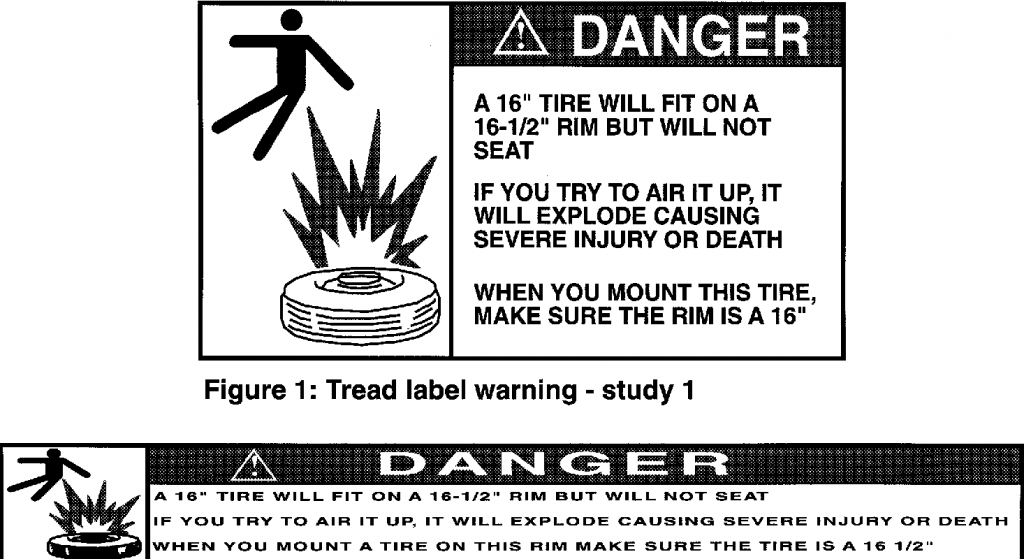
Rice University published additional studies that same year, analyzing the effectiveness of warning labels in preventing the above incidents. In the first study, scientists attempted to trick tire installers by mixing up differently sized wheels and tires together. Some installers failed to check the warning labels and fell for the trap. From the study’s abstract:
In the first study a 16 inch tire, a 16.5 inch tire, a 16 inch rim and a 16.5 inch rim were taken to service stations where employees were requested to mount the tires. The 16 inch tire contained a tread label warning and a warning label was located in the drop center of the 16.5 inch rim. The rims also contained size stamping information. At the 27 stations visited, 5 employees started to mount the 16 inch tire on the 16.5 inch rim and 3 started to mount the 16.5 inch tire on the 16 inch rim. All others would have mounted correctly matched tires and rims.
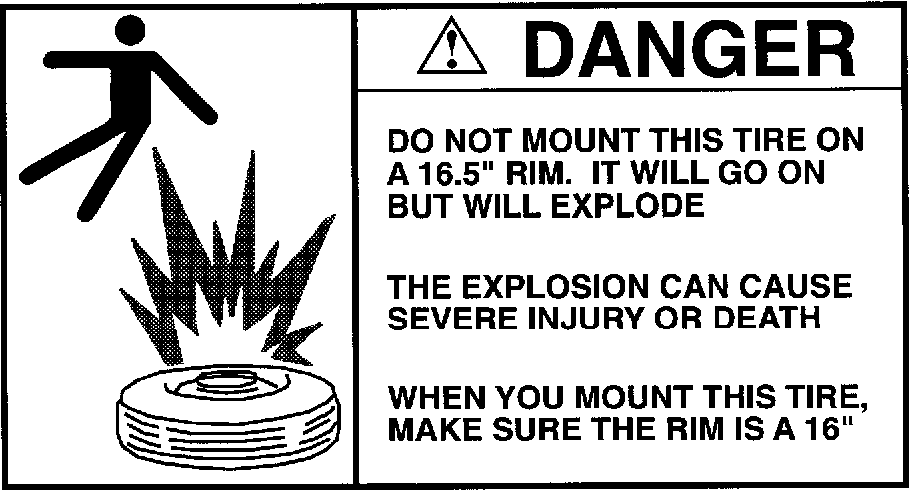
In the second study, researchers used a more straightforward approach, asking installers to install a 16-inch tire on a 16.5-inch wheel to see what would happen. Despite presenting warning labels on the wheels, nearly half of the installers proceeded with mounting the tires anyway. In a control group without the warning labels, nearly every installer attempted to mount the wheels:
The second study consisted of taking a 16 inch tire and 16.5 inch rim to 28 service stations to be mounted. At 18 stations a label containing size and warning information was on the rim. At 10 of these stations the employee refused to mount the tire. As a control, the same tire and rim were taken to 10 stations without the rim warning, and the employees at 9 of these stations proceeded to begin the mounting task.
The lesson here? Make sure you know the equipment you’re working with. Read all of the printed information, check for warning labels, and even take measurements, if you have to. A little extra work is better than an injury or worse.
Why The 16.5-Inch Wheel Came To Be
It’s worth explaining why half-size wheels came to exist in the first place. To do that, I have to show you how normal passenger car wheels are designed. Here’s a cross-section cutout of a standard 16-inch wheel:

See those bead humps, also called safety humps? There’s one near the inner rim of the tire, and another near the outer rim, spaced just under 20 millimeters from their respective outer lips, with a 5-degree taper downwards in between.

These humps are there for two reasons, according to Campbell.
“[These safety humps] help support the tire laterally,” he told me. “It [also] helps prevent the tire from de-beading in the case of loss of inflation.”
That means, in the case of a sudden flat tire, the safety humps will keep the tire mounted along the outside of the wheel, so the rubber doesn’t immediately collapse and tear itself away. This means drivers will still have at least some control when a flat tire occurs. This type of wheel design has been the industry standard for decades, but it does have one significant drawback.
“[The safety humps] do make [tires] a bit more difficult to mount,” Campbell told me. “You have to inflate enough pressure to force the bead up over that safety hump, but then it sits.”
If you’ve ever been near a tire shop in action before (or mounted a tire yourself), you’ve probably heard the “pop” as the bead of the tire—that is, the edge of the rubber that sits on the wheel—is inflated enough to overcome that safety hump. Here’s an example of that pop occurring:
When a tire is popped out of these humps while in use, through extreme lateral load or underinflation (or a combination of both), it means the tire has de-beaded. Getting a tire bead to overcome that safety hump is difficult without the use of proper equipment. A popular method for people who might have no alternative (like when they’re stuck on an off-road path miles away from the nearest paved road) is to spray a flammable liquid along the edge of the rim and set it ablaze, using the pressure from the resulting explosion to reset the tire to the bead.
This method is incredibly dangerous, both to people and to equipment, and it doesn’t always fix the problem. In no way does The Autopian endorse using this trick. But it does make for some cool video when it does work:
This is where 16.5-inch tires come in. First popularized in the 1960s, these wheels were designed to accommodate tires and were better suited to the heavy loads handled by trucks, trailers, buses, and heavier recreational vehicles, while being easier to maintain. Here’s a cross-section of a typical 16.5-inch wheel:
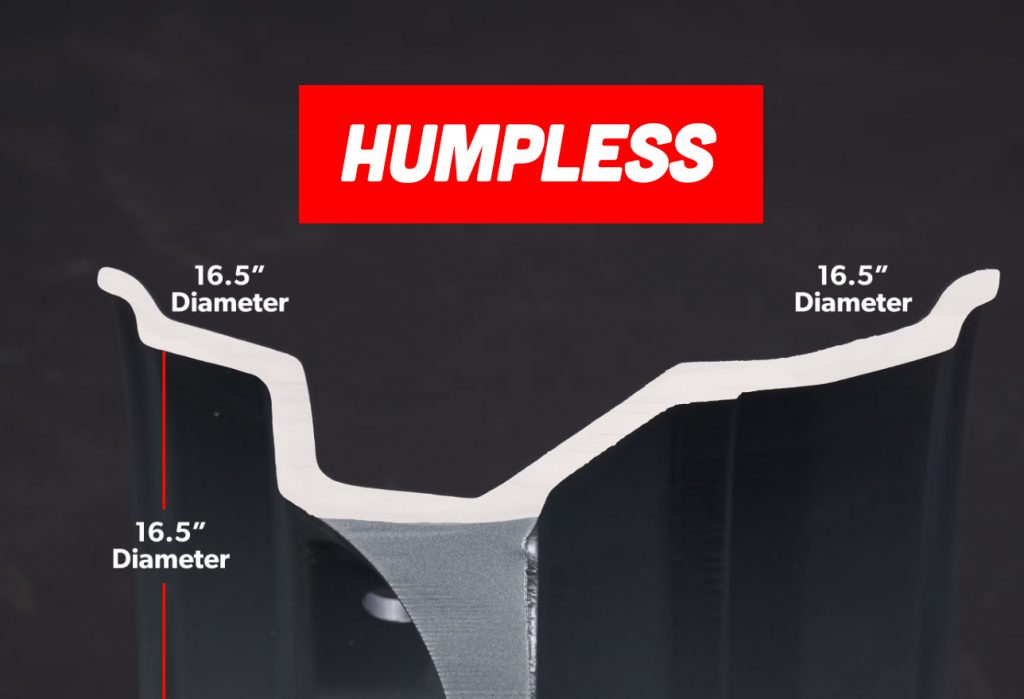
Notice what’s missing? That’s right, no safety humps.
“You’ll notice [that 16.5-inch wheels] don’t have safety humps,” Campbell tells me. “[They are] designed so they can be repaired, they can be worked on on the side of the road. With these work vehicles, downtime is lost money, inconveniences, whatever. So they don’t have the safety hump there with the intent that if you get a flat on the side of the road, you can replace the tire right there, using hand tools. It doesn’t require specialized mounting equipment.”
If you’re curious just how easy it is to get a tire on and off a 16.5-inch wheel, here’s a guy switching out a tire on a backhoe in less than three minutes using only three simple hand tools:
The lack of safety humps isn’t the only difference you’ll find on half-sized wheels. The area where the tire seats itself to the wheel is drastically different, with a steep 15-degree taper to better spread out the load:

“This helps spread out the load more,” says Campbell. “It also helps reduce some of the lateral load that is concentrated on the flange of the wheel, because on standard inch tires, it’s much more upright, and that helps support the lateral forces of the wheel. But when we have these heavier vehicles [with] heavier loads, we need to spread out more of the load over a larger surface area.”
Without the safety humps, 16.5-inch wheels rely more on tire pressure to keep the rubber seated properly, rather than pressure and the inner beads. This is why, at least according 4×4 forums, it’s generally not advisable to air down tires for off-road use on wheels of this size (or other half-sized wheels), as the loss in pressure makes the tire far more susceptible to de-beading versus a normal wheel and tire setup.
Hanging On By A Thread
Despite the industry’s widespread pivot away from the 16.5-inch wheel, there are lots of vintage vehicles, such as Ford F-250s and F-350s, General Motors C/K series trucks, older medium-duty vans, and a slew of commercial and farm vehicles that still run that size for wheels and tires. As such, there are plenty of places online, like BB Wheels or Gallagher Tire, where you can buy new 16.5-inch wheels, even if OEMs have given up on the size.
Gallagher sells 16.5-inch tires, too, as do bigger tire suppliers like Tire Rack and Discount Tire. BFGoodrich, Firestone, Coker, and Interco, the company behind Super Swampers, all still produce 16.5-inch tires in limited sizes.

The AM General Humvee military vehicle, as well as the civilian Hummer, also used 16.5-inch wheels from new, many of which are still in service today. These wheels are a bit different than your average 16.5-inch wheel, as they usually have a beadlocking system installed to keep tires from dismounting from the wheel. Goodyear makes a tire specifically for the Humvee called the Wrangler Enforcer, which feels like a very appropriate name for a tire designed to go to war. The tire is actually available straight through Tire Rack—though according to Campbell, you need permission from Goodyear to order them. Something tells me that if your title doesn’t start with “Sergeant,” you’ll probably have a tough time getting your hands on a new set.

Used sets are far easier to come by. Militarytires.ca, a Canada-based website that sells surplus military gear, has lots of used 16.5-inch wheels and tires taken from Humvees and other vehicles on its site. While buying used tires is always sketchy, it could be the only way civilian owners can get their hands on this type of rubber if they want to keep their ex-Army truck on the road.
Now, the next time you see a vehicle with a 16.5-inch wheel, you’ll know why that size isn’t really a thing anymore outside of some vintage truck enthusiast circles.
Top graphic images: Ford; FastCap


WTF – the rim diameter is in inches but all the detailed numbers are in millimeters?
I haz a confuse.
Are European wheels sold in cm/mm rather than inches?
No, wheel sizes being measured in inches are so widespread that even VW in Germany will sell you “15 zoll” (15 inch) wheels for your brand new Polo.
Although I’m sure all the engineering documents will be in metric, the size in inches is more of a marketing term.
Mind you, I think even in the anti-metric US you might buy 17″ tyres, with a 215 section (which is the width in millimetres). So we’re all mixing units I guess.
Exactly. Tires are the one area where we’re just one big beautiful confused world of units!
205/60R16
Where 205 (mm), 60 (ratio), 16 (inches).
It’s a beautiful mess that makes my head explode.
Yes, FFS I goddamn HATE the tire system. I want absolute measurements. Absolute diameter, absolute TREAD width (measured tire rack style) and then the rim they’re supposed to go on.
No more frickin MATH to figure out what will fit on my car when upgrading width for performance or changing wheel diameter for either that, appearance, or both.
Thanks for the clarification!
TI finally L about the technical differences between 16″ and 16.5″ rims and that it’s not just diameteric. Thank you!
Wondering if tire shops are required to use regulators on their inflation equipment to limit the explosive force. It’s an important requirement in the aviation wheel/tire business and many fatalities occurred when people over-inflated aircraft tires.
As someone who’s worked on a vintage Schwinn, I know the pain of weird tire sizes. Not quite deadly in that case though. Just that a standard BMX tire won’t fit on a Stingray front rim. Always important to know your wheel size no matter what you have.
Ugh; Schwinn. 20-something years ago a friend rescued some bikes from a dumpster near his apartment. We donated a couple of them to a used bike charity, but I took home a 1960’s Schwinn. It might have been a Breeze, I don’t recall. I did a complete overhaul and polished it up to give to a girl friend. Everything was going swimmingly until I bought some tires from Target; that’s when I found out about Schwinn’s proprietary rim sizes. Suddenly, my free bike was costing me more money than I cared to spend. I did of course, the girl never knew, and she loved the bike.
That’s actually quite sweet of you. Not very nice of Schwinn with their intermediate and lightweight tires (1-3/4 and….1-1/8, I think were the respective widths?), but I’m glad you went through with it despite them.
I restored a ’71 Stingray Deluxe a couple years ago, a bike my brother took apart as a kid and it didn’t go back together until I did. I was going to put modern freestyle BMX tires on it, but then I learned about that dratted front wheel. It has reproduction tires on it now.
1-3/8 is the narrow number I recall. I worked at a bike shop around the turn of the century and quite vividly remember the Schwinn tires being fractional while everything else was decimal.
My 78 Gitane road bike doesn’t have proprietary wheel sizes, but its Mavic wheels use tubular tires (boyaux), which suddenly became much rarer for some reason in the last year or so. The budget-friendly tires I used to get are nowhere to be found anymore (online or in actual stores), and the second least expensive option costs twice as much as the ones I used to get (and nearly as much as a tire for my Renault 4, actually). I’d much rather keep it period-correct forever, but I’ve started to consider upgrading to newer tubeless tire wheels to cut down on costs down the line.
I inflated a fat bike tire in my basement trying to convert it to tubeless until it exploded. I’m glad I learned my lesson on something that “small”.
A friend of mine ordered four 16″ off road tires and was delivered three 16″ tires and one 15″ tire, all otherwise identical. He managed to get the 15″ tire on the 16″ rim, but the bead wouldn’t seat. Fortunately he noticed the mismatch before going full send on air pressure and getting killed.