

If you ask anyone what wheel size they’re running, there’s a good chance they’ll give you an answer in whole numbers. Whether your car is running 16-inch steelies or 20-inch forged alloys, it’s not often you see a wheel that doesn’t conform to this norm.
I say not often because there are several exceptions. On medium- and heavy-duty trucks, semis, and buses, you’ll regularly find wheels measuring 19.5 inches or 22.5 inches, including trucks like the Ford F-350 and the Ram 4500 Chassis cab, used for their unique load characteristics and ease of maintenance. In the 1960s and 1970s, many trucks and other heavy-duty vehicles utilized 16.5-inch wheels for the same reasons.


These days, though, the 16.5-inch wheel is all but dead. No manufacturer sells a vehicle with them new, and only a handful of tire manufacturers offer suitable rubber. The reason? They kept getting people killed.
Why 16.5-Inch Wheels Fell Out Of Favor
It wasn’t the lack of built-in safety features that saw the use of 16.5-inch wheels go by the way side starting in the 1980s into the 1990s. The fact that 19.5-inch and 22.5-inch wheels, which use a similar design, are still in production, is proof of that. The problem was that 16.5-inch wheels were way too similar to 16-inch wheels, and mechanics kept getting them confused, sometimes with fatal results.
“A big part of the reason that they’ve gone away is safety,” says TJ Campbell, Senior Manager of tire information and testing at Tire Rack. “On almost every tire, especially 16s and 17s, depending on the manufacturer, you will see specific verbiage that says, ‘Do not attempt to mount on 16.5-inch wheel.’ They were so close to both 16s and 17s that technicians would try to mount them unknowingly on the wrong size wheel. People die from that because the failure of that is under high pressure, and it’s catastrophic. It’s like a small explosion.”
There are numerous instances documented online of this type of mistake causing grave harm. In 1998, a man in Spartanburg, South Carolina, was killed after attempting to mount a 16-inch tire to a 16.5-inch wheel. From GoUpstate.com:
Walker was standing over the tire when it flew up and hit him under his chin, careened off an open garage door and bounced off the back window of a nearby car before landing on the ground, Smith said. Walker died at the business.
Winters Salzetta O’Brien & Richardson, LLC, a law firm in Chicago, Illinois, won a $900,000 settlement against Budd Company, a wheel manufacturer that supplied wheels to Ford, and Uniroyal Goodrich Tire Company (the makers of BF Goodrich tires) after a 17-year-old was killed attempting to mount a 16-inch tire onto a 16.5-inch wheel. In a separate lawsuit involving Budd and Uniroyal in 1998, a jury awarded a man over $10 million after he was injured while attempting to mount a 16-inch tire to a 16.5-inch wheel.
Then there’s this case out of Tennessee in 2015, when another 17-year-old was badly injured while working at his father’s repair shop, trying to do the same thing. While the kid didn’t die, his injuries are a good depiction of just how dangerous this kind of mistake can be. From VitalLaw.com:
The explosion blinded [the child] in one eye, deprived him of part of his jaw and much of his sense of taste and smell, and left him with partial use of his left arm and hand. His injuries and rehabilitation were extensive, involving many different medical specialists.

These incidents were common enough back in the ’90s that Rice University in Houston, Texas, performed a study (the details of which are behind a paywall) that analyzed 13 occurrences and determined user error and insufficient warning labels as the causes. From the study’s abstract:
The data indicated a number of consistent findings. In ten of the accidents an “entrapment” situation existed in which the person inflating the tire and subsequently injured was not the person who selected the components and placed the tire on the rim. While there was great variance in training, experience and knowledge of tire busters, virtually all were unaware of this mismatch hazard. Tire busters typically did not look for size information on rims, and such information was either not displayed or displayed poorly. Regarding task feedback, because the outer flange diameter of the 16 inch and 16.5 inch rims are virtually the same, placing the tire on the 16.5 inch rim did not provide feedback that something was wrong due to greater task difficulty. Also, the fact that the tire did not properly seat was not attributed to a size mismatch but rather to other more common seating problems. Efforts to warn about the mismatch hazard on the products have not met warnings design criteria and generally have not been effective.
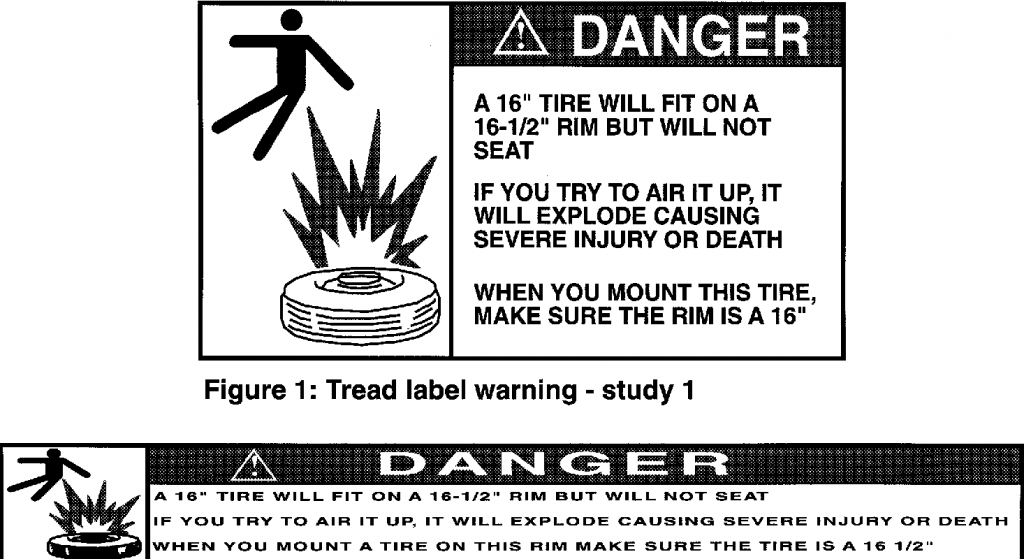
Rice University published additional studies that same year, analyzing the effectiveness of warning labels in preventing the above incidents. In the first study, scientists attempted to trick tire installers by mixing up differently sized wheels and tires together. Some installers failed to check the warning labels and fell for the trap. From the study’s abstract:
In the first study a 16 inch tire, a 16.5 inch tire, a 16 inch rim and a 16.5 inch rim were taken to service stations where employees were requested to mount the tires. The 16 inch tire contained a tread label warning and a warning label was located in the drop center of the 16.5 inch rim. The rims also contained size stamping information. At the 27 stations visited, 5 employees started to mount the 16 inch tire on the 16.5 inch rim and 3 started to mount the 16.5 inch tire on the 16 inch rim. All others would have mounted correctly matched tires and rims.
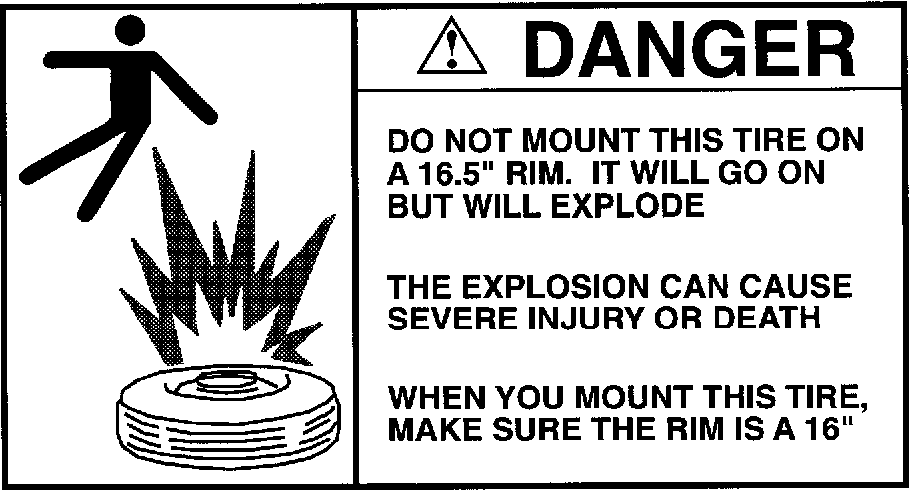
In the second study, researchers used a more straightforward approach, asking installers to install a 16-inch tire on a 16.5-inch wheel to see what would happen. Despite presenting warning labels on the wheels, nearly half of the installers proceeded with mounting the tires anyway. In a control group without the warning labels, nearly every installer attempted to mount the wheels:
The second study consisted of taking a 16 inch tire and 16.5 inch rim to 28 service stations to be mounted. At 18 stations a label containing size and warning information was on the rim. At 10 of these stations the employee refused to mount the tire. As a control, the same tire and rim were taken to 10 stations without the rim warning, and the employees at 9 of these stations proceeded to begin the mounting task.
The lesson here? Make sure you know the equipment you’re working with. Read all of the printed information, check for warning labels, and even take measurements, if you have to. A little extra work is better than an injury or worse.
Why The 16.5-Inch Wheel Came To Be
It’s worth explaining why half-size wheels came to exist in the first place. To do that, I have to show you how normal passenger car wheels are designed. Here’s a cross-section cutout of a standard 16-inch wheel:

See those bead humps, also called safety humps? There’s one near the inner rim of the tire, and another near the outer rim, spaced just under 20 millimeters from their respective outer lips, with a 5-degree taper downwards in between.

These humps are there for two reasons, according to Campbell.
“[These safety humps] help support the tire laterally,” he told me. “It [also] helps prevent the tire from de-beading in the case of loss of inflation.”
That means, in the case of a sudden flat tire, the safety humps will keep the tire mounted along the outside of the wheel, so the rubber doesn’t immediately collapse and tear itself away. This means drivers will still have at least some control when a flat tire occurs. This type of wheel design has been the industry standard for decades, but it does have one significant drawback.
“[The safety humps] do make [tires] a bit more difficult to mount,” Campbell told me. “You have to inflate enough pressure to force the bead up over that safety hump, but then it sits.”
If you’ve ever been near a tire shop in action before (or mounted a tire yourself), you’ve probably heard the “pop” as the bead of the tire—that is, the edge of the rubber that sits on the wheel—is inflated enough to overcome that safety hump. Here’s an example of that pop occurring:
When a tire is popped out of these humps while in use, through extreme lateral load or underinflation (or a combination of both), it means the tire has de-beaded. Getting a tire bead to overcome that safety hump is difficult without the use of proper equipment. A popular method for people who might have no alternative (like when they’re stuck on an off-road path miles away from the nearest paved road) is to spray a flammable liquid along the edge of the rim and set it ablaze, using the pressure from the resulting explosion to reset the tire to the bead.
This method is incredibly dangerous, both to people and to equipment, and it doesn’t always fix the problem. In no way does The Autopian endorse using this trick. But it does make for some cool video when it does work:
This is where 16.5-inch tires come in. First popularized in the 1960s, these wheels were designed to accommodate tires and were better suited to the heavy loads handled by trucks, trailers, buses, and heavier recreational vehicles, while being easier to maintain. Here’s a cross-section of a typical 16.5-inch wheel:
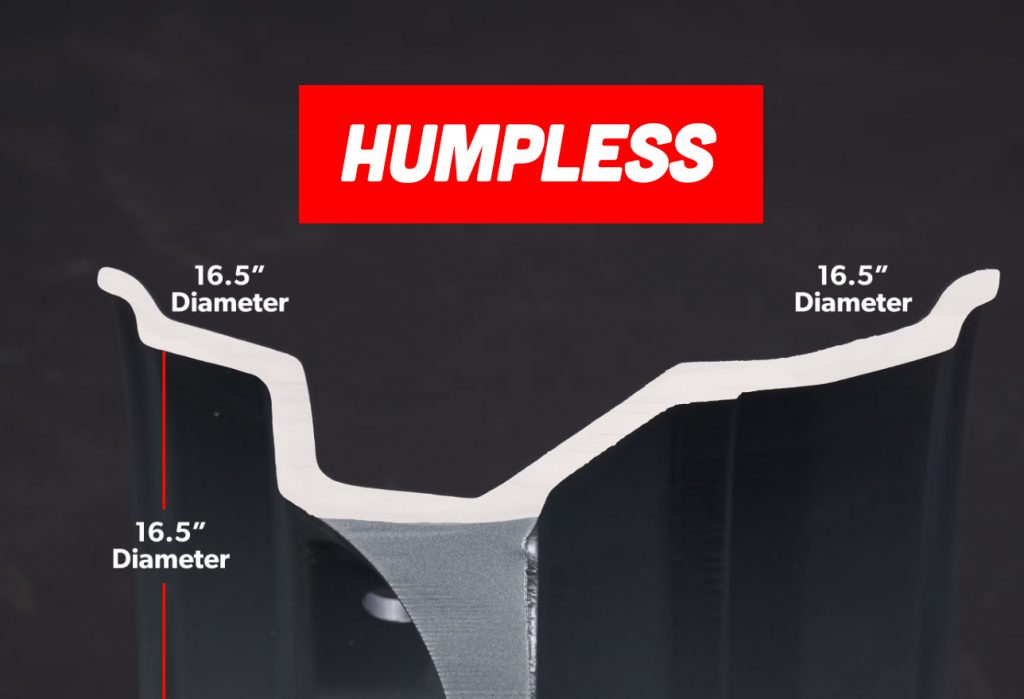
Notice what’s missing? That’s right, no safety humps.
“You’ll notice [that 16.5-inch wheels] don’t have safety humps,” Campbell tells me. “[They are] designed so they can be repaired, they can be worked on on the side of the road. With these work vehicles, downtime is lost money, inconveniences, whatever. So they don’t have the safety hump there with the intent that if you get a flat on the side of the road, you can replace the tire right there, using hand tools. It doesn’t require specialized mounting equipment.”
If you’re curious just how easy it is to get a tire on and off a 16.5-inch wheel, here’s a guy switching out a tire on a backhoe in less than three minutes using only three simple hand tools:
The lack of safety humps isn’t the only difference you’ll find on half-sized wheels. The area where the tire seats itself to the wheel is drastically different, with a steep 15-degree taper to better spread out the load:

“This helps spread out the load more,” says Campbell. “It also helps reduce some of the lateral load that is concentrated on the flange of the wheel, because on standard inch tires, it’s much more upright, and that helps support the lateral forces of the wheel. But when we have these heavier vehicles [with] heavier loads, we need to spread out more of the load over a larger surface area.”
Without the safety humps, 16.5-inch wheels rely more on tire pressure to keep the rubber seated properly, rather than pressure and the inner beads. This is why, at least according 4×4 forums, it’s generally not advisable to air down tires for off-road use on wheels of this size (or other half-sized wheels), as the loss in pressure makes the tire far more susceptible to de-beading versus a normal wheel and tire setup.
Hanging On By A Thread
Despite the industry’s widespread pivot away from the 16.5-inch wheel, there are lots of vintage vehicles, such as Ford F-250s and F-350s, General Motors C/K series trucks, older medium-duty vans, and a slew of commercial and farm vehicles that still run that size for wheels and tires. As such, there are plenty of places online, like BB Wheels or Gallagher Tire, where you can buy new 16.5-inch wheels, even if OEMs have given up on the size.
Gallagher sells 16.5-inch tires, too, as do bigger tire suppliers like Tire Rack and Discount Tire. BFGoodrich, Firestone, Coker, and Interco, the company behind Super Swampers, all still produce 16.5-inch tires in limited sizes.

The AM General Humvee military vehicle, as well as the civilian Hummer, also used 16.5-inch wheels from new, many of which are still in service today. These wheels are a bit different than your average 16.5-inch wheel, as they usually have a beadlocking system installed to keep tires from dismounting from the wheel. Goodyear makes a tire specifically for the Humvee called the Wrangler Enforcer, which feels like a very appropriate name for a tire designed to go to war. The tire is actually available straight through Tire Rack—though according to Campbell, you need permission from Goodyear to order them. Something tells me that if your title doesn’t start with “Sergeant,” you’ll probably have a tough time getting your hands on a new set.

Used sets are far easier to come by. Militarytires.ca, a Canada-based website that sells surplus military gear, has lots of used 16.5-inch wheels and tires taken from Humvees and other vehicles on its site. While buying used tires is always sketchy, it could be the only way civilian owners can get their hands on this type of rubber if they want to keep their ex-Army truck on the road.
Now, the next time you see a vehicle with a 16.5-inch wheel, you’ll know why that size isn’t really a thing anymore outside of some vintage truck enthusiast circles.
Top graphic images: Ford; FastCap


FYI, a scissor jack and a chunk of 2×4 between the tire and the truck’s bumper isn’t “proper equipment”, it’s the “difficult”.
I was actually around the opposite situation in college. A friend got new 16 inch wheels for his Ram and didn’t realize he actually had 16.5 inch tires. They went on fine and I was standing next to him while he was adjusting tire pressure when all hell broke loose. Thankfully no one got hurt and nothing went flying but the BOOOM from the tire debeading was enough to where I felt it in my chest and my ears were ringing the rest of the day.
The article fails to say *why* they fail. Obviously you shouldn’t put the wrong size tire on a rim, but what’s the exact nature of the failure when you put a 16″ tire on a 16.5″ rim? If anything you’d think it would be on too tight, so what causes the explosions?
Ok, it’s not just me then. Good. I kept re-reading and I couldn’t find the mechanism that leads to explosion.
The only thing I could figure out, but never found any evidence of, is that people use pressure in the tire to get the tires to “pop” into place, but since there’s no safely hump the distinctive pop never happens, so they keep putting the pressure to it and eventually the tire fails due to excessive pressure.
Exactly that.
I’ve accidentally aired up a motorcycle tire to almost 60psi because someone was using a power tool in the shop and I didn’t hear the bead pop when it seated.
Luckily I stopped, figured out what had happened and let the air out.
We now have a new air hose which has a limiter so you can’t overpressure a tire too much…
At a guess, because the bead will be stretched out longer than it is supposed to be (especially as it is forced up those 15 degree tapers), it will snap and fail catastrophically.
Modified Hummer bead locks and 60-80 percent tread military takeoffs from ebay are the low cost offroad setup on many a jeep on 1 ton axles. Getting the run flat rings out on a fully assembled wheel/tire can be tough though.
Based on the $800 per tire for the new Goodyears shown on TireRack, I can definitely understand why there’s a market for used.
you can get pretty nice 80% tread versions that will just get cut up on rocks anyway for around 100 bucks per last time I bought some.
GF Goodrich……Wut? Have i fallen into an alternate universe?
GF Boodrich
That was fascinating! I had a 1980 F-350 beater truck with 16.5s. Thought it was odd and never knew the reason until now. Thanks for the great article!
The milimeter TRX tyres, we had over here in EU, were also killing people, but that was with the insane prices on them!
I do recall here in the UK the Metro coming with metric tyres, I am sure they where 315mm diameter. The historical inertia of imperial wheel sizes meant they never stood much chance though. I wonder if you can still buy them for your classic Metro ?
Ford had a pretty big issue with this in the US in the 80’s on Mustangs as I recall as well.
I think the SVO was the only Mustang with metric tires from Ford. But, yeah, it is an issue finding replacements. I think our beloved Adrian has similar issues on his Ferrari.
They were common on 1979-1982(4) models as part of a handling package, though I don’t recall SVO being a thing until later.
The 84-86 SVO was actually the first Mustang that came stock with 16″ wheels and tires
Yep, I stand corrected. It was the 79-84 Mustangs and Capris with the TRX tire/wheel pkg.
Escort GT also had a TRX option. 365mm wheels where the Mustang had 390s
The prices here in the US were pretty crazy too. I worked for Firestone in the mid-late 80s when the original set on Mustangs and Escorts wore out and the owner got a big surprise when they went to replace them at the Michelin dealler. We kept a couple sets of basic chrome “mod” 14 and 15 inch wheels in stock with their bolt pattern as we could sell the customer a set of new wheels and tires for several hundred less than the TRX tires alone
Isn’t the real difference that the 16.5 wheels are a tube tire design, and most other modern wheels are tubeless designs? Old wheels don’t have that extra bead and are all more like the 16.5s. I remember the first time I encountered a double bead wheel and thought something was broken. The first time I had to patch a tire not on a farm truck of 1960s car I was shocked that standard procedure was to stick a plug in from the outside rather than just reach inside and put a patch in.
I thought the 16.5s were great, so much easier. It never occurred to me that anyone would expect to be able to drive on a flat tire.
It’s not the ability to drive on a flat tire so much as the fact that the loss of pressure isn’t as immediate so you don’t careen off the road all of a sudden.
In a similar vein, OEM wheels are tested for rim impact durability not with the expectation of surviving intact, but fracturing in such a way that the pressure loss is not immediate.
Just like split rims, 3 wheelers and firearms. Idiots kill themselves not the equipment they’re using.
Did you read the article? Most of the time, they found someone else had chosen the incorrect tire and provided it to the grease monkey for mounting. Should everyone have had better training? Sure. But poorly designed products without adequate poke yoke are squarely to blame when there are perfectly usable alternatives which won’t kill people.
There are reasons regulations like this one (and 3 wheelers, and lawn darts, and so on) exist, and they are good reasons. Your indifference to human death and major injury is a little sad.
Also, it’s too bad we’re completely indifferent to regulations on firearms because we absolutely should. What a stupid fucking country.
Keep in mind, when these were made, standard car tire sizes were 13″,14″ and 15″. Only these HD truck applications used the 16.5″ tire. There was almost no chance of a size screwup back in the day and tire techs were used to them.
Things changed in the ’80s. Every 16″ and 17″ tire I have ever bought has a 16.5″ rim warning label. I agree that nowdays they should be specifically called out on the rim.
Holding corporations retroactively liable seems ill advised to me. This was the best tech at the time. Over the last 60 years the safety culture has changed (for the better), but the old stuff still exists and must be accounted for.
I’m not sure what the best answer is, but at some point, perhaps we should simply stop making those tires.
This brings to mind lead paint, asbestos, and aluminum wiring in houses. It’s fine as long as it’s left alone, but if you start messing with it, all bets are off and it has to be removed safely and not reinstalled. Yank off the bandaid.
Over the last 60 years the safety culture has changed (for the better)
Tell that to my congressman who thinks abolishing OSHA is a good idea.. Every time I hear people say “call your congressman” I think, umm he’s probably causing the problem you’re hoping to solve.
My dad was a foundry manager in the ’70s when OSHA debuted. Some of the stories he has told me… I worked for nearly 20 years in the steel industry (maintenance engineer) starting in the late ’90s. At least each day you felt fairly secure in returning home whole. All thanks to OSHA.
To quote my favorite British broadcaster “should we send children back up chimneys then”? I firmly believe there is a faction of the GOP that would be happy to go back to employing children and their nimble fingers. The problem with OSHA is the underfunding of OSHA
Curious what industrial safety regulation on firearms would look like?
Well: 250 years ago when the 2nd Amendment was written, a firearm was a muzzle loaded smoothbore longgun. It used blackpowder and probably flint lock. Revolving pistols existed but were rare. Rifling was rare and the minne ball and cartridge were decades away, let alone any modern breech loading cartridge. I’m honestly not sure what to make of our current situation. We DO need restrictions, I think the ’90s era Assault Weapons bans had merrit and should not have expired.
I’m a gun owner, and get weirded out when I see people open carry in public. If I feel I need to carry to be safe, I have no business being there. We live in an overall safe society. Mine stay locked up.
I’m a gun owner as well and I agree with all of that. This country is nuts.
Ugh, I’m annoyed that we’re going off topic, but I guess I’ll hop on the crazy train…
You often see people bring up that things were different in the late 1700s, and that is true to a large degree, but so what? They had privately owned artillery and warships, and that didn’t seem to bother much of anyone other than the British (for obvious reasons). 100 years later, all of that was still perfectly legal, and small arms were now safer, more reliable, had longer range, and had much higher practical rates of fire. Still, no one is bothered.
It wasn’t until the 1920s and ’30s when there was a massive spike in violent crime (hello, 18th amendment, among other things) that people started panicking, and even then, it wasn’t so much that ordinary people were in that much danger, it’s that the police couldn’t afford to arm themselves equally to well-funded gangsters. But that hasn’t been an issue for decades (if anything, it’s now quite the opposite).
So what’s the point of an assault weapons ban? To be clear, I’m not opposed to making significant changes to our legislation, but I feel like the “good idea fairy” has gone and visited many people with ideas about banning this or that (or unbanning this or that) without anyone stopping to think what the problem actually is, and what the ramifications are of the solutions that they are proposing. I don’t claim to have all of the answers, and even if I did, I don’t feel it’s appropriate to discuss them on this forum. I just hope that people think critically about issues such as this.
Your analysis is correct based on my knowledge. I have no answers either. I respect our rights, but feel there must be limits as well.
As a gun owner as well I full agree with this statement!
OK, I thought it was from an industrial safety side. You’re just speaking from a basic regulation side. So up until the 90s, civilians had access to better firearms than the military. I’ll argue the AWB was silly in as few words as possible: I own an AR that’s chambered in 7.62×39 and would be allowed in the AWB and all recently suggested ones. I have accurately fired this rifle at 500 yards, and this round has proven dangerous to personal body armor. I just think AWBs are a poor use of time and political capital. In fact I have cynically thought politicians purposely propose hard to pass legislation, as an excuse to get reelected and “stay in the fight”. Far better use of time would be improving the NICS, make background checks free, and create a strong federal framework for red flag laws (a floor, obviously states can go higher) We need to take a Kaizen approach, rather than big steps (which I applaud Biden for trying). I believe in gun rights and I’m a gun nut, but I also know that unless you’re willing to allow change, change will run you over.
I have no real answer on an industrial safety side. At least modern breeches no longer rupture in one’s face due to design and metalurgy? I thank your thoughtful response.
Yep I read the article. I have also ridden & raced three wheelers and changed split rims. Splits are easier to change by hand, no spoons needed and able to do it on the trail. Just changed over to 16s from 16.5 on my 85 dually PowerWagon since I had an unlimited supply of used 16s and 16.5s were getting hard to find. Few years ago we found a set of yard darts at a garage sale…yea we still play sometimes, just don’t include any of our idiot friends, lol
If there’s more than one way to do something, and one of those ways will kill you and/or innocent bystanders, that’s a good incentive to make it impossible to do it that way.
Agreed as a friend told me what happened years ago when a co-worker at a Canadian service shop kept skipping the safety chains while working on the split rims of semi tires. The owner’s son had been warned, but he was always in too much of a hurry. One day there was a very loud boom, a split rim went thru the shop wall and the owner’s son’s head went flying across the shop with blood everywhere and everyone was puking, or even pissing themselves…
It drives me mad how shops tend to prioritize doing everything as fast as possible. Yeah, time is money, but you know what else is money? Damaged equipment, damaged parts, damaged vehicles, damaged buildings, damaged people, and damaged reputations.
Fun fact. Due to the dick waving contest that is full sized pickup truck payload/towing capacity, the dually rears are most often 19.5″ in size to force people into using a TBR (truck and bus radial) so that you are guaranteed to meet the required load rating.
Unsurprisingly, having TBR tyres on the rear at 80psi can make the rear ends a bit skittish when empty.
My 72′ F250 had 16.5s mounted with ancient bias plys. Couldn’t find decent tires, so in 2013 I salvaged 16s off a newer F250 at Pick-a-Part.
Mounted used radials. Holy Porsche 911 Batman, that thing suddenly “handled”.
Never thought that people would mix up the tires/wheels and get hurt. Yikes.
This was a great article! I learned a bunch.
There’s also confusion between 15″ car and motorcycle wheels- The motorcycle wheel is slightly larger. A few people have none the less pried the car tries onto the motorcycle wheels, often damaging the tire in the process.
And here I thought this was going to be about the old split rim design that also killed and maimed many a person back in the day!
That’s what I thought too! But once again, now as then, I’m indebted to the Autopian for cluing me into yet another grisly aspect of our hobby with which I can accost friends and colleagues. I’m a hoot at parties.
Well said sir. Insert the classic The More You Know meme
Do you show up at parties with split rims and compressors and go “check this out”?
Hold my beer…
Same.As a friend told me what happened years ago when a co-worker at a Canadian service shop kept skipping the safety chains while working on the split rims of semi tires. The owner’s son had been warned, but he was always in too much of a hurry. One day there was a very loud boom, a split rim went thru the shop wall and the owner’s son’s head went flying across the shop with blood everywhere and everyone was puking, or even pissing themselves…
Holy crap!
Amazing something so dangerous had no controls. When I sold shoes, hold the Al Bundy references, we had a measuring tool that would display your foot size and every pair of shoes came with the size on the box and inside the shoe. I guess shoe salespersons were smarter than tire persons.
Whaddya know! In a small town in Ontario that I used to live in, I always saw this Military Tires facility, but never really knew what their business was, and nothing much ever seemed to happen there.
Now I read this article, and see a link to militarytires.ca. I go to the website, and sure enough, it’s the same people! It’s weird to have such a local connection come up on an international website!
A couple of years ago a co-worker who had an ’80s Dodge W-250 was looking for retro-looking turbine wheels to put on his truck. One day he proudly proclaimed he got a set dirt cheap, which is when I saw they were 16.5″ wheels and told him that tires were going to be expensive, if not impossible to find. That deflated his enthusiasm (pun intended).
I was smart enough to buy 16″ replica TRX wheels for my Ford Fairmont instead of trying to find tires for the original 390mm diameter wheels.
I’ve always wondered about the TRX situation these days. Does anyone (Coker maybe?) even make the original spec tires?
Yes, Coker still makes them in small batches ~$400-$700ea, depending on size. For the concours crowd who HAS to have the car 100% original. Absolute crap by modern standards. To be honest they weren’t that special even in period, but they were always HELLA expensive.
Hella parts, however, are generally affordable.
Depends on the part…
Yep, but as mentioned a set would cost me about what I paid for the whole car.
Awesome article!
One of the first things I was taught at my first job (tire shop) was how to identify 16.5’s just by looking at the edge of the wheel on the outside. You could not trust customers to give you the correct information.
We still had a lot of old farm trucks and trailers that ran these, and quite often we’d go into the office, grab the slip from Bev, calling for a set of 16” all terrains, pull a set of 16” tires, we’d jack the truck up and then you’d hear “Sixteen Fiiiiiiiives, Bev”
Crisis averted. Training is everything, folks.
I think training is key, you dismount a tire and the wheel looks – funny – pause and take a break.
I’m conflicted about which stupid music-related comment to make:
or
Stop whatcha doin y’all
Humpty humps my name
No two people goin to do it the same
You know your doin it right
When you appear to be in pain.
Start funkin jumpin
Ow We Want The Hump!
Gotta Have That Hump!
The humpty dance is a chance to do the hump
I was listening to Parliament-Humpadelic earlier today!
Do a bactrian and embrace the two humps.
We’ve hit upon one of the big reasons why despite owning a set of Humvee wheels I have yet to swap the yellow vantruck over to them. The 37″ Enforcer does not even begin to fit on the Econoline chassis without a massive lift and cutting fenders.
Also the hokey offset to fit the portal hubs of the Humvee, but I can put holes in a piece of metal in a somewhat controlled fashion so not too concerned about that.
(Firestone does sell the Transforce commercial tire in 9.5R16.5, but….. highway tread on military wheels is a degree of poser I’m not sure I want to hit yet)
I thought military humvees used bead locks.
Sergeant
Canada?
Unless you are Dick Sargent who replaced Dick York as Darrin on TV’s Bewitched. Dick York, Dick Sargent, Sergeant York!
uh yeah… that’s definitely what I meant… yeah… (that has been fixed, thank you!)
I’m afraid not, private.
> Something tells me that if your title doesn’t start with “Sargeant,” you’ll probably have a tough time getting your hands on a new set.
I’m happy to inform you that you will not be reporting to the kernel for this. Unfortunately though, the colonel wants to see you ASAP!
Back in the ’80s, I had a friend whose father owned a towing company.
Not sure of the tire or wheel size he was working with, but when he was 16 he had a tire explode while he was mounting and it caused that mechanical prying arm to fly out and hit him in the face – knocking out his front teeth.
He lived, but having to wear dentures while still in high school was pretty embarrassing for him.
changing a 16.5 tire is basically done the same way as a bicycle tire
Not exactly. Bicycle tires generally have tubes that press the tire against the rim, it’s a different application of the air pressure inside the tube versus directly in the tire.
“… these wheels were designed to accommodate tires …”
Euhm, I hope so
I think it was supposed to be
“these wheels were designed to accommodate tubes”
Because they sure look like tube type wheels to me.
Steel is an alloy.
Your mom is an alloy.
^COTD!
Typical automotive steel wheels are stamped, not forged, so the contrast between “steelies or… forged alloys” remains valid.
Most alloys are cast.
And stamping technically is forging.
Although lots of steel wheels are made by forging rolling and stretching a small cylinder of steel, into the rim, then welding or riveting a stamped center into it.
There used to be custom wheel shop near me in Stockton that made steel wheels to order. I think they were the last place that would make a one off steel wheel.
Cheap alloys are cast, good alloys are forged. Not to say you are wrong, as most of them are cheap, even OEM ones.