

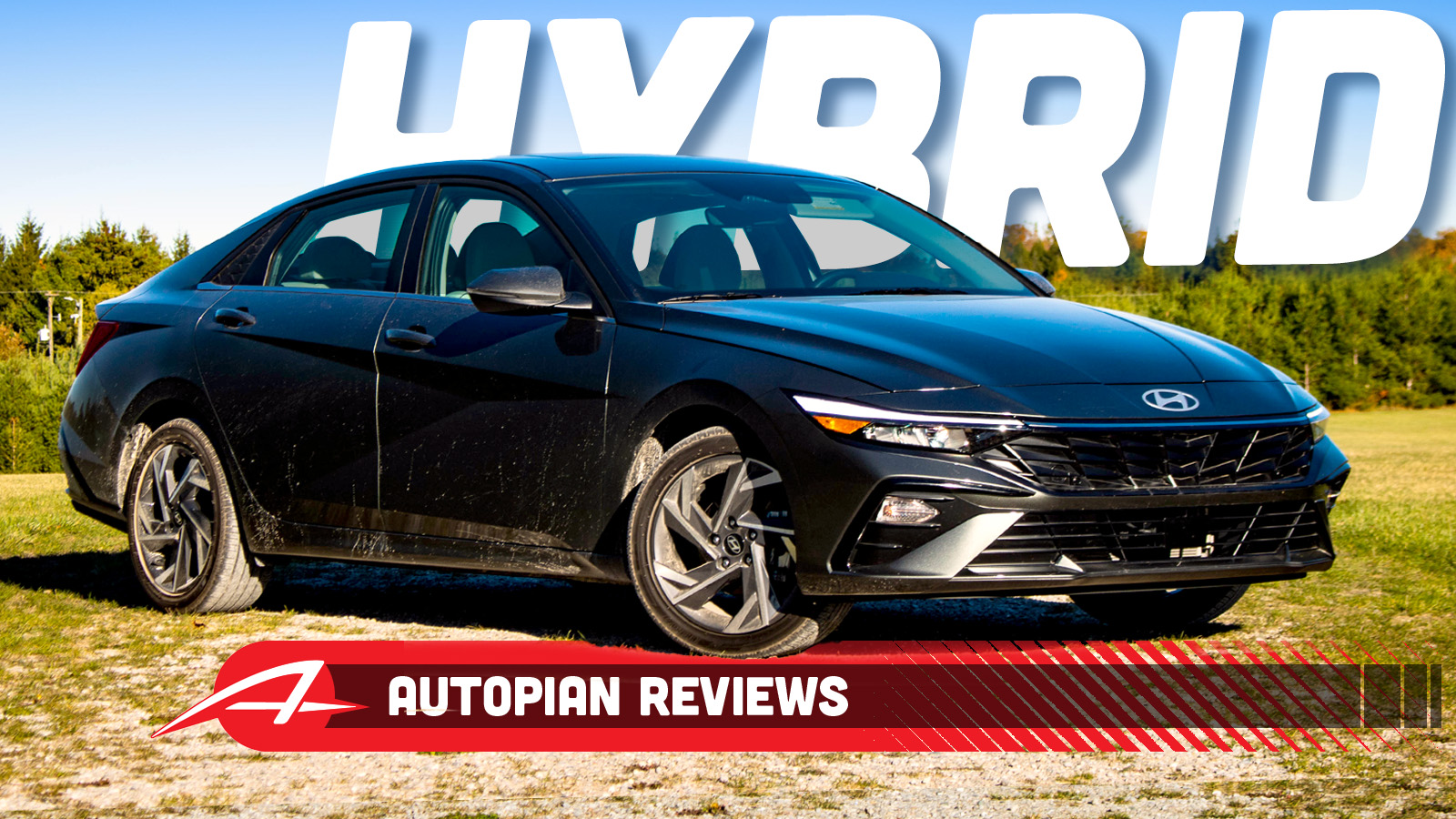
New cars are way too freaking expensive. Sure, they have more showroom appeal than ever before, but a lot of people who could spend about $30,000 on a new car ten years ago can still only spend about $30,000 on a new car. At the same time, fuel’s become more expensive, and the number of cars out there for less than 30,000 greenbacks is smaller than ever before. Thank goodness the Hyundai Elantra Hybrid still exists.
This isn’t the first time we’ve been behind the wheel of Hyundai’s electrified compact sedan, but a lot has changed since 2023. Not only did the Elantra get a facelift, the whole new car market has grown even more wild. Just last month, the average price of a new car in America crossed the $50,000 barrier, and while part of that was due to a rush on EVs before federal tax credits ended, it still means we’re living in a world where a four-figure car payment is increasingly normalized. So what can you still get for less than half that? An excellent daily driver, as it turns out.


[Full disclosure: Hyundai Canada brought this Elantra Hybrid to AJAC TestFest, where I was finally able to take it out for a proper evaluation.]
The Basics
Engine: 1.6-liter Atkinson-cycle twin-cam inline-four.
Battery Pack: 240-volt nominal 1.32 kWh lithium-polymer.
Transmission: Six-speed dual-clutch automatic transmission.
Drive: Front-wheel-drive, open differential.
Output: 139 horsepower, 195 lb.-ft. of torque.
Fuel Economy: 51 MPG city, 58 MPG highway, 54 MPG combined on 16-inch wheels; 49 MPG city, 52 MPG highway, 50 MPG combined (4.8 L/100km city, 4.5 L/100km highway, 4.7 L/100km combined) on 17-inch wheels.
Body Style: Four-door compact sedan.
Base Price: $26,695 including freight ($32,999 in Canada).
Price As-Tested: $31,045 including freight ($32,999 in Canada).
Why Does It Exist?
In case you haven’t looked at the new car market in a decade, hybrids are hotter than those glowing metal balls you see while doomscrolling, so it simply makes sense that Hyundai builds an Elantra Hybrid to do battle against the Toyota Corolla Hybrid and the Honda Civic Hybrid. When it comes to reasonably priced fuel-sippers, this is one of the big three.
How Does It Look?

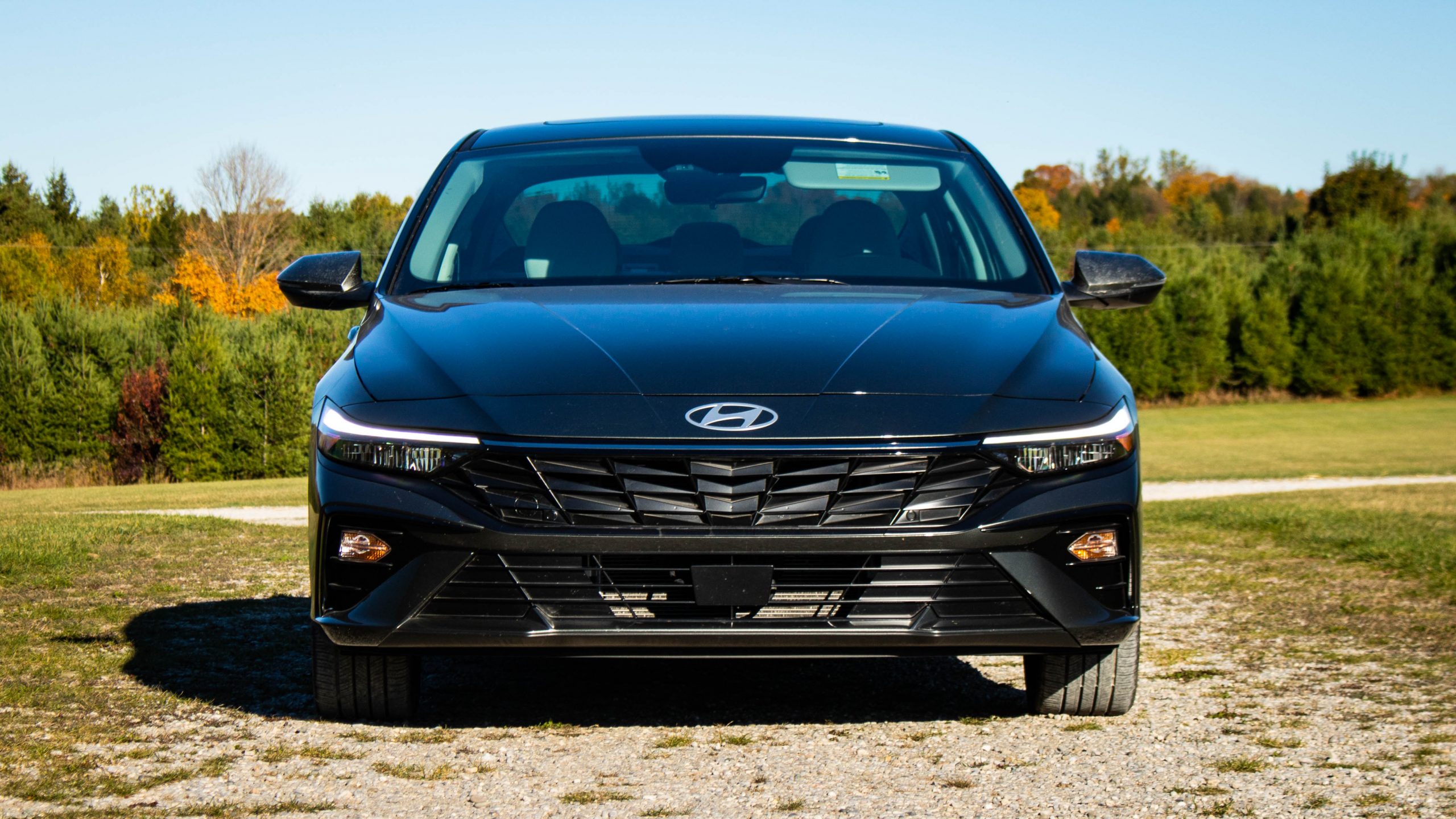
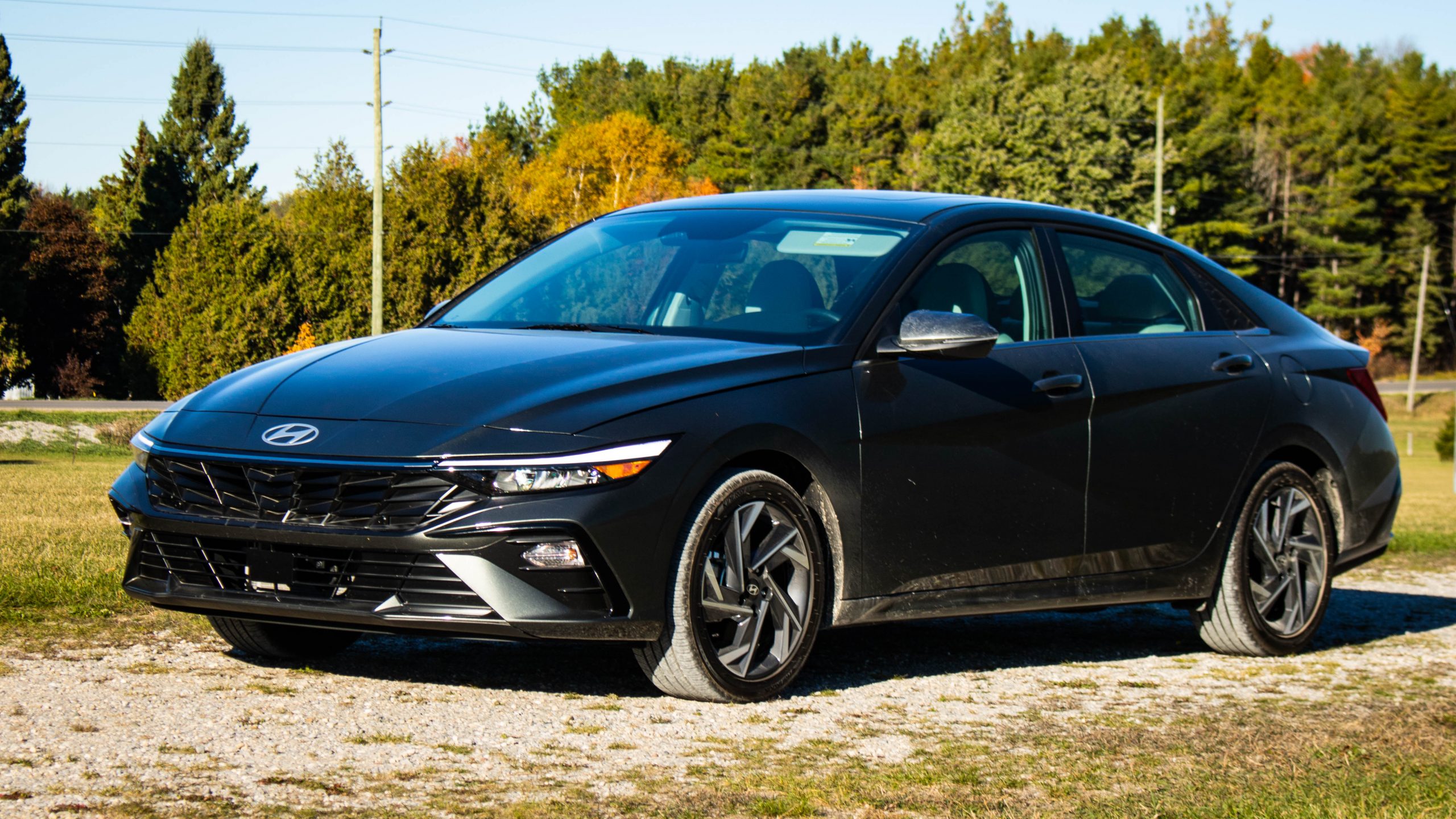
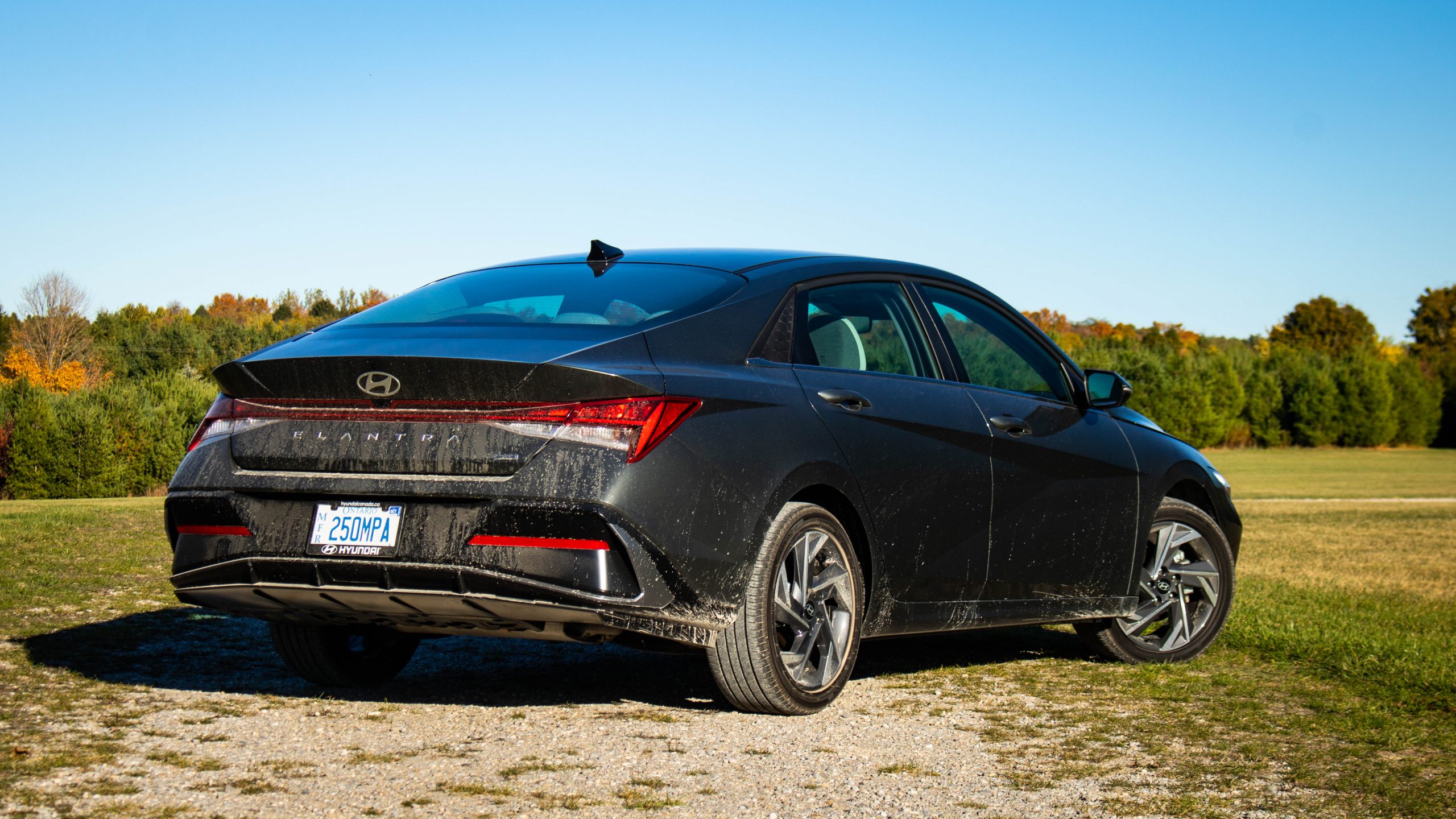
You know how baby pangolins always look like they’re about to sheepishly deliver some mildly sad but not day-ruining news? I know we humans are prone to anthropomorphizing everything under the sun, but I swear there’s a hint of endangered scaly anteater to the look of the Elantra. Maybe it’s the interplay of the bulbous silhouette with the angular character lines, maybe it’s exacerbated by the diamond pattern in the C-pillar filler panels, but like the strange-looking animal, this is one strange-looking car. Still, sometimes good things come in strange-looking packages.
What About The Interior?
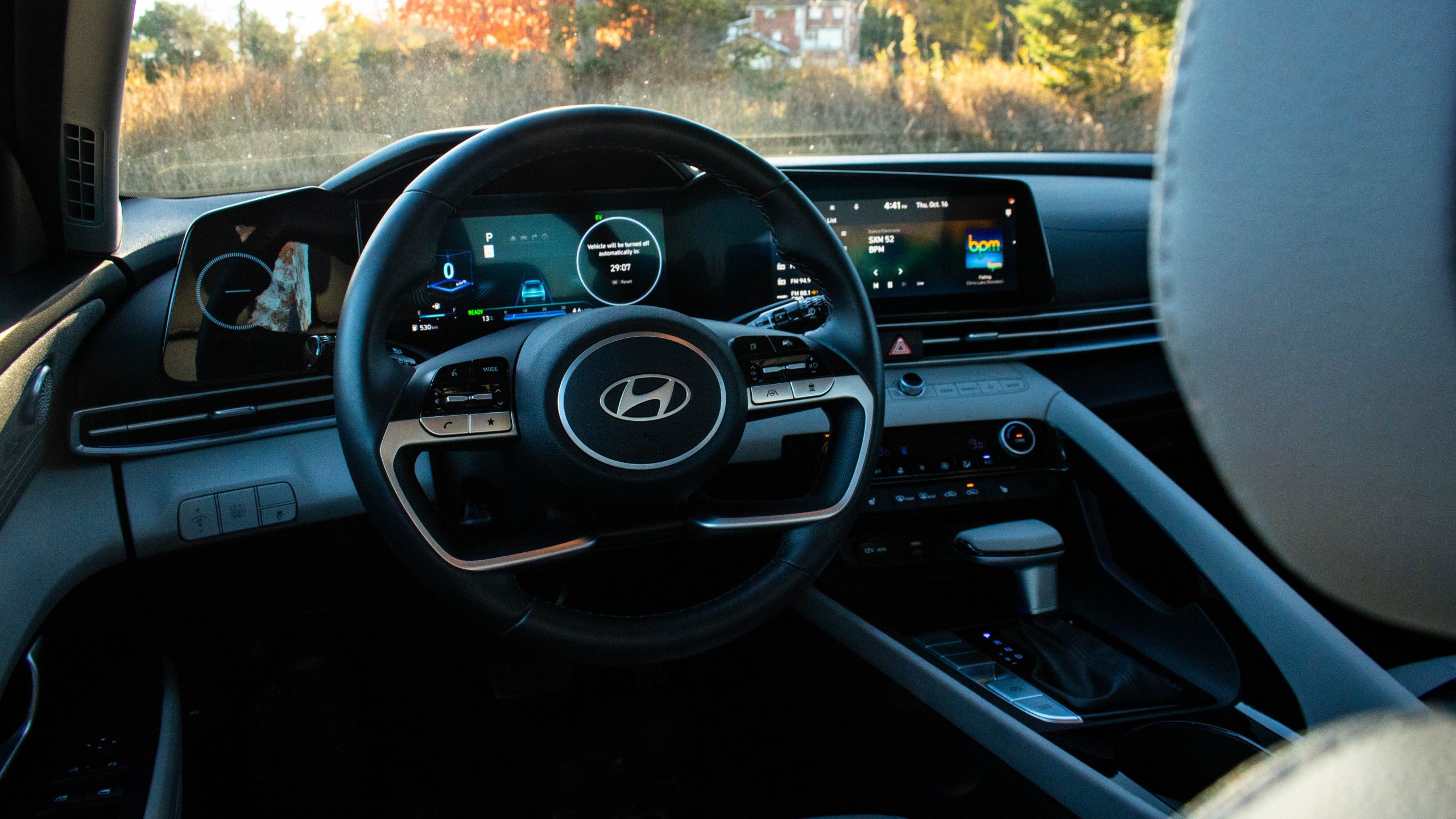
Maybe it’s just me, but as the average car continues to grow more expensive, I’m warming up to the cabin of Hyundai’s value sedan. Alright, I wouldn’t trust the console grab handle to withstand much more than the weight of a chicken shawarma platter, but apart from that, nothing inside the Elantra feels flimsy or egregiously cheap. Some of it’s properly nice, like real metal trim and available denim-like cloth on the door cards. The only real complaint I have when it comes to usability is the metal trim on the steering wheel. It’s right where the edge of your palms rest with your hands at nine-and-three, and it gets frigid when the mercury hits the zone that tells you who’s wearing too thin a shirt.
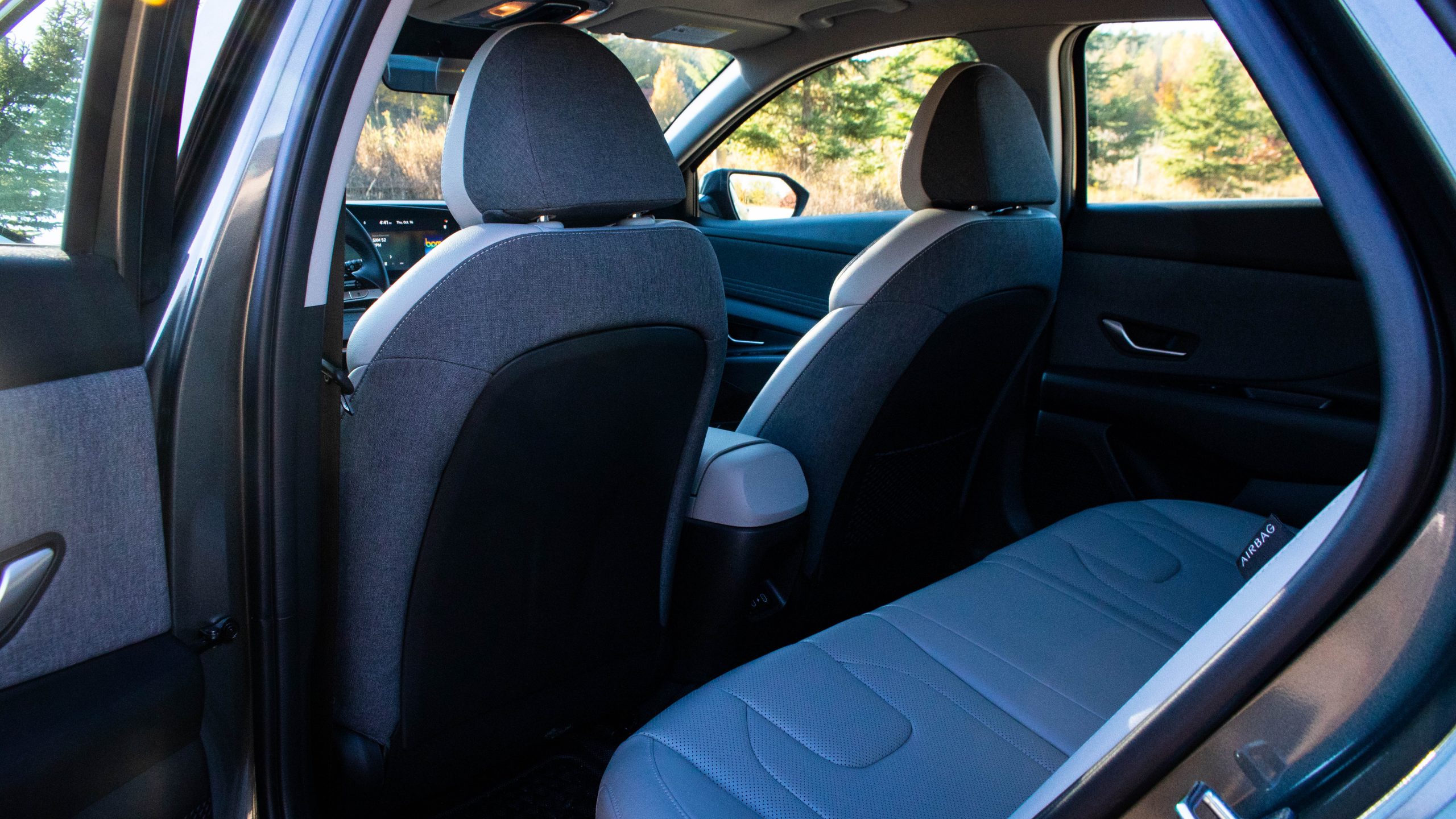
Besides, the big story here is space and comfort. It’s no secret the Elantra is big-boned for a compact, but that just means you can get three real adults in the rear seat, and all of their luggage for a weekend away fits in the 14.2 cu.-ft. trunk. Of course, the best seats in the house are still up front, with a surprising amount of support for compact car thrones. We’re talking cushions that don’t seem like topographical maps of Kansas and instead actually feel designed for real human beings, a good reason to consider the Elantra Hybrid over the Corolla Hybrid. I do wish the tilt-and-telescoping steering column telescoped further towards the driver, but the overall driving position is perfectly comfortable for someone of average height.
How Does It Drive?

Of course, if you’re considering making a Hyundai Elantra Hybrid your next daily driver, it’s probably not simply due to its spaciousness and out-there looks. After all, you can get those in a regular non-hybrid model, but the hybrid powertrain really is something special beyond its headline fuel economy figures.
On paper, it may only pump out 132 horsepower, but 195 lb.-ft. of combined torque mean that off the mark and when changing lanes, the Elantra Hybrid always feels perfectly quick enough. What’s more, because this sedan uses a six-speed dual-clutch automatic transmission instead of a CVT, you aren’t forced to listen to an atonal wall of sound should you need to put the skinny pedal to the carpet. Score. Of course, this test car has the big wheels that knock fuel economy down a touch, but it still returned an honest 51 MPG with journalists treating the throttle pedal like a stompbox all day.
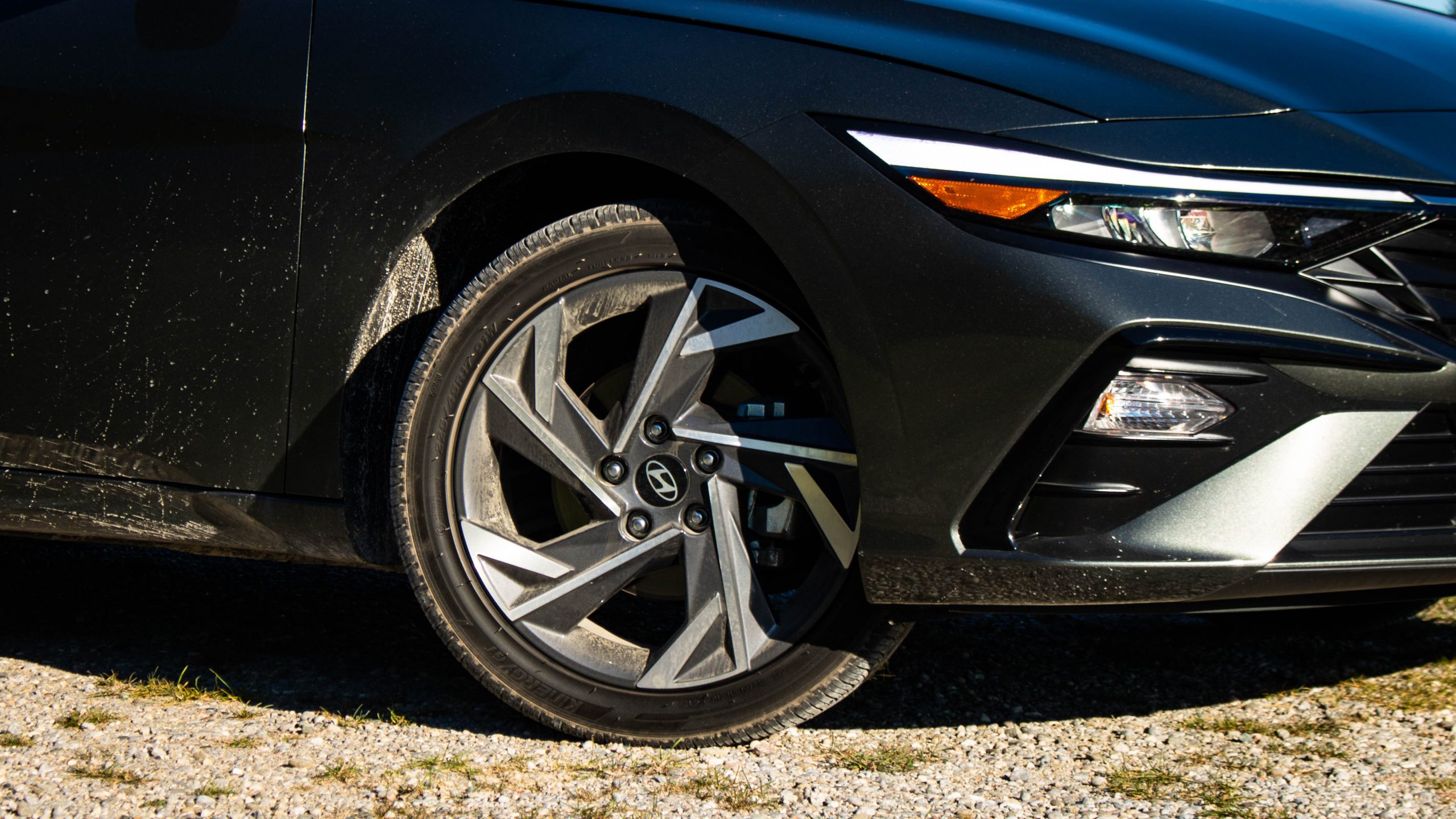
Even though the Elantra Hybrid gets multilink rear suspension, don’t expect it to feel like a sport compact car with hybrid efficiency. This thing leans firmly toward comfort, because most people just want a smooth ride home after eight hours in the cubicle. It turns out that all the fuss Hyundai made about structural adhesives means the comfy suspension can actually do its job, so this compact sedan glides over bumps with the grace of a midsizer. See, the operative word here is “natural.”
The steering weighs up like you’d expect steering to. The brake pedal feels normal, almost like it doesn’t have to blend regenerative braking from the electric motor with hydraulic braking from the, um, brakes. Even the shifter’s normal, so you could give the Elantra Hybrid to someone who’s been driving a 2006 Civic for the past two decades, and nothing will seem weird to them. Fantastic.
Does It Have The Electronic Crap I Want?

Sort-of. All the gadgetry inside the Elantra Hybrid feels a bit five years ago, but in ways that aren’t exactly a letdown. Apple CarPlay and Android Auto only work over a wired USB-A connection, but Hyundai’s previous-generation infotainment system is still reasonably slick, with logical menus and plenty of physical controls. The digital gauge cluster might not show you what song’s currently playing, but you can set it to this fun cube-themed skin that delivers a bong hit of when-the-internet-was-fun nostalgia directly into your hippocampus.
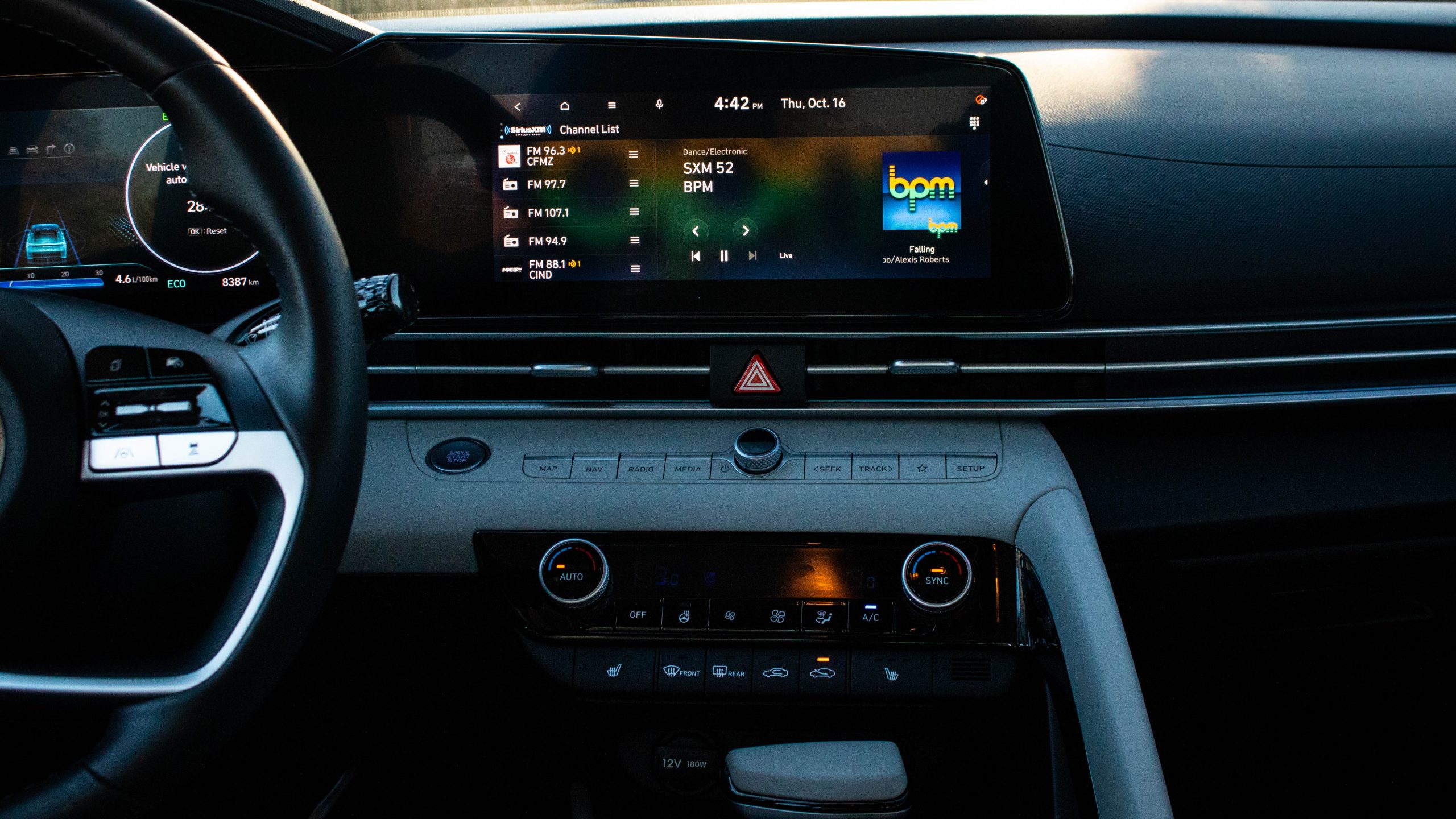
This fully-loaded trim gets a moonroof, dual-zone climate control, wireless smartphone charging, GPS navigation, heated seats, a heated steering wheel, an eight-speaker Bose sound system that isn’t too shabby considering the segment, and ambient lighting, all for a shade over $31,000. That’s a lot of kit for the money.
Three Things To Know About The 2025 Hyundai Elantra Hybrid:
- Diesel-like torque means it doesn’t feel slow.
- It uses a subdivided section of its hybrid battery pack to power its 12-volt electrics, so you’ll never have to buy a replacement lead-acid battery for it.
- You can get one loaded to the gills with toys for about the same price as the cheapest Civic Hybrid.
Does It Fulfill Its Purpose?
Absolutely. The Hyundai Elantra Hybrid is a lot of good, economical car for the sort of money normal people can actually justify. Whether you’re looking at the $26,695 Elantra Hybrid Blue or the $31,045 Elantra Hybrid Limited, it feels like your money’s going far. While a comparably equipped Honda Civic Hybrid is quicker and more premium-feeling, it’s also thousands of dollars more expensive. At the same time, a Corolla Hybrid doesn’t feel much nicer than the Elantra Hybrid, is a whole lot slower, isn’t as comfortable, and costs about the same as the Hyundai. Even though Toyota has a rock-solid hybrid system, you still have to sit in that driver’s seat every day, so the Elantra Hybrid gets my vote hands-down.
Believe it or not, the Elantra Hybrid is an even better deal in Canada, where its single loaded trim level undercuts the cheapest Civic Hybrid by several thousand loonies, and works out about even with a mid-range Corolla Hybrid on price while offering a handful of features unavailable on the Toyota.
What’s The Punctum Of The 2025 Hyundai Elantra Hybrid?
With loads of toys, a great price, proper hybrid fuel economy, and solid comfort, welcome to the happy medium of the hybrid compact sedan market.
Top graphic image: Thomas Hundal


Thank the lord they got rid of the old ‘boppit’ shifter. That shifter and the touchscreen being 1″ out of your natural reach ruin a very good rental car.
Not wild about the wheels, but IF my Honda Accord got wrecked, you did a really good job of selling me on this. And Hyundai/Kia have come a long way since they showed up on this continent. I would consider this as a replacement even down south in the US. The molding of the bodywork might make me wonder whether it got hit by something, depending on the lighting, but overall, it works. I don’t use Apple CarPlay and if I did, I would have to use a USB cable so that’s no big deal.
The back seat of my Accord is almost limo like, but it’s also almost never used.
Curious to use DCT in this Hyundai hybrid and conventional 6 speed automatic in other Hyundai hybrid.
Real knobs and butts on the dash. Soooo sexy…
“HEY, My screens are up HERE!”
To me, Hyundais always look fairly striking, but I’m not always sure they actually look good. In this case, I *am* sure that the Elantra does not look good.
The dual clutch auto is one of the worst piles of CRAP ever put in any car. Hyundai quality and dealers are pure crap. There is a reason Toyota owns the hybrid market…..extreme reliability. Besides, this car is just hideous.
Every time I see an ordinary new car that looks good, it turns out to be a Hundai.
But not an Elantra.
Every time I see an ordinary new car that looks good, it turns out to be a Hundai.
But not an Elantra. Some attractive Venues, some too damn big but still attractive Palisades, but not those deflated banana Elantras.
And what’s all that crap between the front seats impeding one’s grasp of their beloved’s knee?
I swear these doors were designed by a cabal of corrupt body shop owners.
I dunno, I’m pretty sure you could open the door into a pole and no one would be sure if the crease you left was intentional or not. 😉
I’ve frequently considered an Elantra Hybrid Blue. I only drive about 100 miles a week but my current car’s 18-20 mpg means 5 gallons of 89 a week, closer to 7 in the winter. Getting that down to 2 or 3 gallons of 87 a week would be amazing. But I can’t justify a car payment at the moment and long term reliability of a Hyundai is still questionable for me.
Koreans coming on but yeah still best to wait a bit
First, let me say that I always enjoy these ‘straight’ or ‘regular’ car reviews here at Autopian, even if it’s of a car I’d never consider purchasing myself. So, thanks yet again for your writing Thomas. 🙂
Every time I drive my 36-year-old Volvo daily around town on errands, I have a fleeting thought of ‘what if this were a new(ish) little Japanese or Korean car instead?’ It’s not that I need to save on gas (being mostly retired, I usually only drive a couple thousand miles a year lately) but rather just me wistfully pondering the convenience and safety that I could be enjoying in a modern vehicle.
All the small cars that I’ve liked over the past couple decades are gone now: Element, Cube, xB, Soul (gone soon), and Fit/Jazz. So: no fun little runabout in the $20Ks anymore. 🙁 At today’s $30K entry price for anything remotely appealing in some way, you’ve got the base Camry, Prius, and Maverick, along with nicer versions of the Corolla, Civic, Mazda 3, and Elantra. Not sure which of that bunch I’d opt to spend $30K on (it does seem like so much money, even compared to just 5 years ago dammit!) but an Elantra Hybrid would now surely be on my to-testdrive list after reading your review Thomas.
I’ve driven Hyundai’s dual clutch automatic before and didn’t like it, but that was some years ago, so maybe they’ve worked out the bugs by now. And I’d rather have some analog instruments instead of all that screen, but that’s just how things are these days. 🙁 Also, I know that Hyundais/Kias have worse resale values than their Toyota/Honda counterparts, but that doesn’t matter for a long-term driver. The bit about Hyundai using a portion of the hybrid battery as the 12V battery is interesting… figuring a new 12V is needed every 3-7 years and they usually cost $200. now… that’s a fair bit of cash over the life of the car. Only time will tell if there’s some downside to that arrangement… Hyundai has had some bloopers over recent years.
Also, I like pangolins a lot, and I suppose I see a bit of that here, but I’d not have minded if they leaned into that harder design-wise. Perhaps some actual scales somewhere? 😉
I know pangolins, pangolins are my friends, and you, sir, are no pangolin.
So how about that Venue? At least they look nice from the back as I drive past them, and they come in colors.
I drove both the automatic and manual (which they probably don’t offer anymore) versions of the Venue when it first came out (I don’t think it’s changed much since then). It was fine, and even a bit entertaining to drive in the manual version. It’s just a lifted economy car of course, not a real SUV or anything like that, which is fine for what it’ll be used for. I think they look pretty good for the price, and though they’re pretty small inside (cargo wise) they’re probably fine if you don’t have a big family or haul tons of stuff. If Hyundai put the hybrid drivetrain in it from the Elantra (maybe next gen of the Venue if there is one?) and managed to keep the price in the low-mid $20ks, it’d be even more appealing.
The Venue hasn’t been refreshed since… before I started working for a Hyundai dealer in 2020. I hope it’ll get refreshed soon but I just fear it’ll get dropped like the Accent was.
I am famously in favor of cars that go for years between refreshes. If it ain’t broke, etc.
I’m all in favor of technical upgrades and bug fixes, but if you have 3 facelift/restyles, that means 3 of them don’t look as good as the best one.
Name one GM car where the second year looks as good as the first. Of course, the first year always has some fatal mechanical flaw, so you are screwed either way.
Me, with a second-gen Volt in the profile pic: Well, aside from the obvious, I felt that the S-series improved with each iteration, though they also went about five years a generation before being cut off in the third. EDIT: Oh, I misread your comment as second-generation, not second-year, not sure if that’s what you meant or not.
Although better than the last iteration, the styling is still a bit odd IMO. Too many lines that serve no purpose and go no where. They fixed the serious case of butt-droop from the last version but they didn’t necessarily make it a whole lot better. Not quite the hot mess of the latest Toyota and Subaru offerings but still not quite there IMO.
That’s crazy good mileage and the no battery replacement is a pretty cool trick!
But these things are so deeply ugly, it could be class leading – I’m not getting over those looks.
Just tell yourself what every new bmw driver has to: you don’t have to look at it if you’re inside
BMWs are actually nice to drive, that’s a big difference.
I’m okay with mediocre to drive if that’s the price difference
My sister had one of these as a loaner for a week while her Iconiq 6 was having recall work done. (She deflected from Tesla and sold her PIF model 3 to buy the Iconic because of Musk shenanigans) I was impressed overall with the materials and feel of it. However, these don’t get near the mpg advertised in real life based on her experience with it. She did admit to being a total lead foot though, after driving ev’s for several years now. She said instant torque is addictive. Maybe they get better mpg in other folks hands. Car did have comfy seats and a great sound system. I was also impressed by the paint quality and overall fit and finish. The arrow theme in the side panels was fascinating, too.
The one you drove cost more than a base Prius. A Corolla LE Hybrid costs less than the base Hyundai. Either way, I’m picking the Toyota.
The Toyotas may be the better choice in general, but there’s no way that this Elantra as spec’d is more expensive than a base Prius out the door.
For that matter, I’m not sure how one even sources a base Prius. In my region, I’ve never seen one, and I assume the local Toyota dealers would have me commit to some sort of blood oath to obtain one. Meanwhile the local Hyundai dealer has like, 12 Elantra Hybrids to chose from.
They’ll also sell you one for four figures under MSRP and finance it for 0-3% APR. The Toyota will have a $5,000 ADM and their in house interest rate for people with the best credit is still going to be like 5%+. I do get the longevity/residuals argument but you’re saving so much money in the first few years I’m not sure if it really adds up in the end.
My local dealer has (4) “Sports” (lol) listed at 26k. Honestly, especially with all the frustration with the new car market being hot garbage, if you’re looking for simple transportation, that’s a pretty screaming deal in 2025.
Nobody is finding a Prius within 5k of that price. If you genuinely do not care for acceleration or equipment, the Corolla for an extra 1-2k might be the more responsible choice, but I can’t blame someone for going with the better equipped Hyundai.
I have this same setup in a Kia Niro, and my car is closing in on 175,000 miles. I generally average between 46 and 53mpg, but with the convenience of a hatchback. I was skeptical about the DCT at first, but it is nice. In some ways I prefer the Toyota eCVT, particularly taking off from a start, but the DCT does provide quick shifts and a bit more excitement when driving. Overall, I like the car quite a bit.
The NIRO has to be one of the most under rated vehicles in modern times.
My dad also has an early Niro, he bought used as it was the right crossroads of value + easier entry/exit + efficiency. Despite having the larger 18″ wheels it’s almost always met the EPA rating, often even the higher rating of those equipped with smaller wheels, and on highway stretches.
It’s nickel and dime-ing with things like the locks but so long as it keeps running well (knock wood) I expect he’ll hang on to it for a bit. I was also skeptical about the transmission in context of other DCT issues but the hybrid setup seems to have avoided those. What maintenance/when have you done on the DCT? That’s something that seems to have conflicting info out there. I think one Kia dealer even said something like “we’ll tell you if it needs it” as though they didn’t want to bother with it.
DCT clutch fluid is a regular maintenance item. It uses DOT 3/4 brake fluid for the clutch actuation system, and is supposed to be done pretty frequently to keep the system from being sloppy in clutch actuation. Mines actually due for the fluid change now, so I need to get on that.
Mine has the 16″ wheels and has occasionally exceeded 57mpg, but almost always does better than 50mpg – the times it gets less are usually those of fast (75+mph) highway running. If I can keep it to around 55mph the electric motor can kick in to keep steady-state cruising and really maximize the mileage.
The only real problem I’ve had with mine is that the HVAC has started to lose the ability to follow the temperature setpoint. Some days it will meet the setpoint, but other days it will be way off blasting either the heat or A/C until I adjust the setpoint one degree up or down, which seems to resolve the issue. Sort of funky, but not a big deal either. My past Hyundai/Kia vehicles have had much worse issues with a fraction of the mileage of my Niro.
Locking gremlins have been the main thing on his – actuator went out on the passenger side then started working, now the keyless access button on the driver’s door fell off so at some point we need to try and pop off the panel to replace it (supposedly common on the earlier ones) but til then just using the remote. Nothing major. Cosmetically the black paint on the rear spoiler is fading but rest of the paint – pearl white – is fine which H/K white isn’t known for, but that seems to be occur more on US-built H/K products. The “eco/hybrid” badge has delaminated which I noticed has happened to every Niro but at least it’s not prominent like early 2010s Fords that lose the blue in the ovals.
No issues with the locks on mine, but the “eco/hybrid” badge is half delaminated like all of them are. Mine is pearl white as well, though had I bought it new I’d have gone for the nice dark blue-green color they offered, and the spoiler paint is fine but the spoiler is a bit loose and does rattle on hard bumps or when the hatch is closed.
If it didn’t have all of these stupid drag-adding styling cues(that grille and all of those creases are aesthetically hideous, IMO), and the rear end was tapered a bit better with some rear wheel skirts added, it might get 80 mpg highway.
Consider the GM Precept with its 0.16 drag coefficient as an example of what is possible.
That grill can be fixed with a roll of duct tape. As a bonus it’ll looked like a gagged fish.
The gagged fish look would be an improvement over what it is now, IMO. I’d like some no-BS honest design, please. At least the Tesla Model 3 sort of gets there.
I don’t know why Toyota tends to have such terrible seats. What about making comfortable seats is so damn difficult?
Toyota are not the only ones who can’t make a comfy seat. My 2 kraut wagons (admittedly sporting spec) tire my overweight bum after a couple of hours.
A toyota econobox is going to be on the road for 20 years, the seat materials have to stand up to a lot of butts on them for a lot of miles.
There’s no excuse for shit ergonomics and a lot of cars in the past had comfortable seats that lasted plenty long in terms of both mileage and individual time-in-seat. Seats overall have gotten worse over the decades (and the cabins of these increasingly massive vehicles more cramped, but that’s a separate rant). An ex’s Volvo 244 was about 20 years old and I drove it 1500 miles without issue. My Legacy that I drove cross country in under 50 hours and had 270k+ miles on it was more comfortable than anything I’ve been in built this millennium as its an industry-wide issue, but Toyota tends to be the worst offender. The seat in my ’08 Camry was unacceptably bad, the absolute worst seat I’ve ever experienced, like it was built for a different creature altogether. “Lumbar” support was about 4″ too high and I’m 5′ 11″, so who did they design it for? The bottom seat “cushion” was church-pew stiff and the shitty leather meant I slid all over in a car that had the handling capabilities of something that originally came with bias plies. The seat back itself, the one thing that most manufacturers tend to get right, was only barely acceptable. The current Corolla as mentioned in the article is better, but only in comparison. Anything more than an hour and the bottom starts to fossilize. I had early ’80s Subarus with seats that probably weighed less than a shot put that I used to drive MA coast to Detroit and southern VA and they took about 6 hours to start to get uncomfortable with never reaching the lows I’ve experienced in Toyotas and a KIA. There’s no magic technology required and this was a solved problem decades ago. I’d gladly take a cushion that theoretically broke down and became uncomfortable after 10 years than be uncomfortable every day. Plus, since I’ve had to modify some seats to make them tolerable, replacing a seat cushion is generally pretty simple. If I knew more about what densities to use, I’d replace over modify.
I had a side gig as a transport driver for a dealership moving the trade-ins from the big lot to the off site recondition/auction pickup site. I’ve driven literally 100s of VINs on a one-way 24 mile drive.
It’s frightening how people treat their vehicles and the conditions they’ll park their butt in while driving. Uncomfy seats may be a byproduct of what the ‘average’ american does rather than those of us who are into cars do.
And pickups from the subaru dealership… absolutely the worst. stealing the big trash bags from detail to make seat covers for the drive was not unheard of. you can quickly sanitize a steering wheel but cloth seats….
Gross. Some people are incredibly foul. I used to see some disturbingly gross things as a mechanic, but I wasn’t driving those cars much. I’m not a neat freak and I still can’t understand how people can tolerate such a disgusting environment and I can only imagine their homes and personal hygiene.
I did the dealer transport thing part time for a summer, but it was mainly newer Buicks as it was a Buick dealership and I guess the customers were pretty loyal. Because they were also old, but the cars were not, and they were barely driven, they were usually in very good shape. Comfortable, but I swear the Rendezvous minivan handled better than the Centurys and Park Avenues. Worst one was a convertible Mustang Cobra because the seat was stuck in a position that was excessively reclined and the whole car felt EoL at only 60k miles, but it wasn’t gross.
I’d say the best seats right now are coming out of China. Ventilated, heated, massaging, lumbar, side support, almost any seat in any Chinese car is guaranteed to be comfortable. Ergonomics on the other hand………
I love the front end on these; looks like they have popups.
I’d also love to see Hyundai offer a version with a manual, maybe a top of the line performance trim that say keeps the same engine but gives you a better suspension. Plenty of enthusiasts might warm to that.
I’m one of those enthusiasts. I love the idea of an efficiency minded hybrid with a handling package. Everyone is dunking on the new Prelude but I think it’s a really neat idea-take all the suspension upgrades and brakes from your fun model and slap em on an efficient daily.
You don’t need to be going fast to have fun, and a lot of us try to be conscious of our carbon footprint.
I figure as EVs get cheaper, that’s the bang for your buck power avenue (or of course big throwback V8s), so for everything else, why bother trying to compete with that? Instead, maybe offer driver engagement as the enthusiast lure?
That pancake electric motor is interesting its basically an e- toruqe converter. Ecvts are just so bulletproof I’m not sure I would want a hybrid without one. But for the money and warrenty it’s not a bad option. Especially as they can normally be had several $k off sticker.
Wow I didn’t realize they paired the hybrid with the DCT now.
I’ve always wondered why hybrids (and EVs) didn’t just use a DC-DC converter for the 12v stuff – I assume it’s just cost/already-in-place systems. Seems like a great idea to me!
EVs HEVs and PHEVs do use a DC-DC converter to power the 12v system and charge a 12v battery. Having a separate 12v battery is good since that is used to boot the computers and close the contactors to “start” the car. That keeps the HV battery isolated when the vehicle is OFF.
So what’s different here? They’re reserving some cells that are physically in the HV pack but add up to ~12 volts?
I didn’t understand the DCT-in-a-hybrid thing at first, but I had a Kia xCeed rental in Europe. (it’s to a Ceed as an Impreza is to a Crosstrek, I think. Same powertrain as a Niro). Anyway, they always start out in first in EV mode, then shift normal once you get moving. It’s interesting that Toyota, Hyundai/Kia, and Honda all have different engine/trans approaches in their hybrids. I’m sure there are more variations. I have a Civic Hybrid, so I’m biased, but the Elantra is a good normie car for sure. The Corolla is getting old and feels it. It’s probably a good deal if you can find one in base trim at MSRP. Otherwise, I tried, but I just can’t. Same with Prius- which still has visibility and ergonomic compromises that every generation has had since the beginning.
I can echo these sentiments on the transmission. I assumed the Elantra Hybrid leans heavily on the e-motor to start off rather than the clutches because it pairs the best aspects of a torque converter auto with the best aspects of a DCT. Crisp, fast shifts with downright conventional low-speed behaviour.
Does this one have that easily-stolen problem a lot of Kia/Hyundai cars have? That’s probably the biggest thing that would prevent me from seriously considering these brands. That and crappy dealers.
It’s keyless so not the traditional USB no immo to start that was being exploited by urban youth but then you get in to typical man in the middle problem for all keyless systems. But people capable of that are typically stealing other things.
can’t help with the dealers but the whole ‘start them with a usb drive’ thing is long gone.
(also, the USB part was because when you broke the ignition out of them a USB drive was just the right size to go in and turn the start switch. could have used anything that fit. without any sort of tie between the ECU and the key the only thing not making them start was physics.)
“It uses a subdivided section of its hybrid battery pack to power its 12-volt electrics, so you’ll never have to buy a replacement lead-acid battery for it.”
Is this subdivided section serviceable? Or, if just this section fails, do you have to replace the entire pack?
That is what I’m afraid of, killing that portion of the pack and looking down a repair bill that totals the car.
I was confused about this too when learning about this system when helping my parents shop for their next car. High on their list was the Tucson Hybrid with this same battery arrangement.
The 12V portion is really not part of the HV battery. It’s a separate li-ion battery that can (and seemingly often does) go bad and can be replaced separately. It sits directly next to the HV battery under the rear seats.
My understanding why they went this route is that this 12V li-ion battery is smaller and lighter, better for packaging in the Elantra, Niro, and Tucson/Sportage. Santa Fe and Sorento hybrids have a normal lead acid 12V car battery.
Here are a few YouTube videos for anyone that is curious.
…”but a lot of people who could spend about $30,000 on a new car ten years ago can still only spend about $30,000 on a new car.”
Only one person to blame for that. A mirror will help you find the culprit.
Is the mirror displaying a rent bill that has increased 125%?
Your willful ignorance is showing.
Two people who haven’t managed to move up in the last 10 years. More to come.
Im doing just fine thank you very much. But I understand that not everyone is.
That being said I’d argue that anyone who can genuinely afford, in a responsible way, a new 30k vehicle in 2025, is doing rather well.
Based on the US median household income, I wouldn’t argue with you.
I think people are missing the point. If you could afford a $30k car in 2015, but you can’t now, that’s on you. Yes everything is more expensive, but you should be making more. To add to my point, a $30k car in 2015 is around $40k in 2025. So, if you could afford $30k car in 2015 but you can’t now, you are well behind inflation. This is your fault whether you like it or not.
So your claim is that, as the cost of living outpaces the increase in wages, it is the fault of the people working that their income doesn’t go as far. Got it, that makes complete sense.
Something about bootstraps.
The ones they confiscate to deter suicide?
Well I suppose hanging yourself with them is TECHNICALLY pulling yourself up by your bootstraps.
troll be trolling
I wonder if there needs to be a new term for trolls of this ilk now that they have the nuclear codes.
Nothing that can be said in polite society. If that exists. Which it now apparently no longer does.
It’s your fault that health insurance costs increase 10-20% a year every year, that layoffs and underemployment are endemic, that moving for a new job isn’t always feasible due to family or cost issues, that you may have gotten sick, that your spouse lost their job, that your kids’ education is now 2x as expensive as it was in 2015?
Give me a break.
Well that depends on who you voted for I suppose.
And that, ladies and gentlemen, is a fine example of blind privilage. Thanks to TurboFarts for their myopic words.
My “at-fault” mirror is showing a reflection of you, though.
After all the trouble my family has had with Hyundai, Kia and Genesis products, it would be a cold day in hell before any of us bought another one. Plus, I take umbrage with that false quarter-panel window, which Hyundai didn’t even have the good sense (or was too frugal) to make blend in with the glass.
In this instance, I would pay whatever the premium was for a Honda Civic Hybrid, and be glad to do it.
Genesis too?! I’ve seen several new ones in the neighborhood the last few months.
Well sure. The Civic is the Oreo, the Hyundai is Hydrox.
I had a 2018 G90 5.0 Ultimate in which the transfer case exploded, right after I bought it. And the transmission began slipping.
Hydrox was making superior cookies before Oreo existed.
Hydrox>>Oreo all day long.
Hydrox is a clearly superior cookie.
I really, really hate that plastic panel. So much. And I hate every other car that tries the same thing (looking at you 2015 Camry, which tries to make it look like and extension to the rear window admittedly, but has fooled approximately nobody). It looks so damn cheap.
I like most other things about this car but can understand why someone wouldn’t be super-duper stoked about the Hyundai ownership experience.
The worst part about the 2015 Camry was that they had to do new tooling for the door skin anyway, and new glass. Basically everything other than the roof was re-shaped. So why not just put a kink in the glass shape, to give it commonality with the other Toyota sedans? Why add that stupid plastic panel behind it?
The 2015 felt like an exercise in “how little effort can we put into the Camry before loyalists move on”.
Hyundai’s engine problems have been horrendous, and a huge number of their customers are now gone for life. Buyers in the know are leery of H/K, and it’s going to take a few more years for the memories of that debacle to fade.
They need to go back to the 100K mile warranty just for some people to take a chance on them again.
On the other hand, Hyundai/Kia take a lot of styling and technological risks, and their prices tend to be slightly lower than the competition, so they are putting out a competitive, attractive range of products.
Overall quality and long-term reliability are high priorities for smart buyers… but not all buyers are to the right side of the bell curve.
I haven’t driven the Hyundai but we’ve loved the Civic the wife got this year. She is coming from a 5-speed 2011 Mazda3 i, so anything is more luxurious than that. I don’t care about the extra fluff the Elantra gets, and I like Honda’s no-transmission setup better.
Honda’s system truly is a return to their old tag line/jingle, Honda, we make it simple. And thus reliable and cheap to keep.
I have a hybrid Civic. First Honda since my 91 Civic. It really is delightful, and you can feel old Honda DNA in it.
And you will get that premium back and maybe more when it comes time to sell or trade.