


Helicopters come in all sorts of weird shapes and sizes. In the early days of mass-produced helicopters in the 1940s and 1950s, engineers experimented with strange designs and unique concepts, many of which never made it past the testing phase. The most incredible helicopter to meet such a fate was the Hughes XH-17 “Flying Crane.”
Built in the early ’50s at the behest of the U.S. Air Force to move heavy equipment quickly and easily out of strategically important locations, the XH-17 was spectacular for several reasons, most having to do with its absolutely gargantuan stature. It was three stories tall, and carried a rotor diameter of 130 feet—still the largest of any helicopter, ever.


The only thing more interesting than XH-17’s size was the way in which it got into the air. Instead of a normal helicopter, which uses an engine connected to a transmission and a driveshaft to spin the rotor by applying torque at the hub, the Hughes mega-copter used a “tip jet” design to get the rotors spinning. In this setup, compressed air is funneled out the ends of the rotor tips to create thrust, causing the blades to spin.
Like many of the wacky helicopter concepts of the ’50s, the Hughes XH-17 did not meet a heroic end, despite its amazing design and record-holding rotor span. Let me tell you all about it.
Dramatic Beginnings
It was in 1946, right after World War II, when the U.S. military began seeking proposals from manufacturers to build a large helicopter designed to carry particularly heavy cargo. According to Aviastar.org, the U.S. Army Materiel Command, the agency responsible for making sure the military has all the gear it needs to be effective, wanted a copter that could externally carry a piece of cargo measuring up to 8 feet tall, 8 feet wide, and 20 feet long. It also wanted a payload capacity of 10,000 pounds, a range of 100 miles, and a minimum operational time of 30 minutes per flight. From Aviastar:
It was intended for use in transfer of ordnance, equipment, supplies, and personnel, with loads to be lowered into or lifted out of areas in which even helicopter landings were impossible. Moreover, this sky crane helicopter had to be easily dismantled for transport on standard trailer trucks.

After reviewing proposals, the military awarded Kellett Autogiro Corporation a contract to construct a prototype. The Upper Darby, Pennsylvania-based aircraft firm had been around since the 1930s, designing weird propeller-driven vehicles for the military. But this would be its most ambitious project yet.
At first, things were going well for Kellett. The firm got as far as designing and building a powertrain for the helicopter, which was originally called the XR-17. Then, the company hit financial trouble. From OldMachinePress.com:
By 27 August 1947, the XR-17 design had progressed well, and Kellett was awarded a contract to produce a test rig of the helicopter’s rotor system. Kellett went to work constructing the test rig and tried to save money wherever possible by using components of other aircraft. The company was having financial issues, and the XR-17 project had an uncertain future.
It didn’t work out. Just two years into the project, Kellett’s finances were in such dire shape that it couldn’t complete the project. In June 1948, Hughes Aircraft—the company led by none other than aviation legend Howard Hughes—purchased the incomplete project, now called the XH-17, for $250,000, according to the Smithsonian Magazine.

Today, Hughes’ move into the helicopter business is looked back upon as a success, with several designs seeing thousands of units of production, most notably the AH-64 Apache attack helicopter and the MH-6 “Little Bird,” a lightweight helicopter used for special operations. But back in 1948, he hadn’t dabbled in the world of helicopters at all. An engineer for the XH-17 project, Nick Stefano, expressed his doubts to fellow engineer Ray Prouty in a letter about Hughes’s ability to get the project completed. From the Smithsonian Magazine:
“I can remember most of us saying, ‘Do something to get this Hughes guy out of the picture!’” Stefano said. Hughes had never built helicopters or mass-produced aircraft. He was known mainly for his flying boat, the H-4 Hercules, which had made its sole flight on November 2, 1947.
“All of a sudden we have this foisted upon us and we are now in the helicopter business,” said Hughes engineer Jim Crabtree at the 1983 AHS meeting.
Despite Stefano’s doubts, the incomplete XH-17 project and all of its components were moved from Pennsylvania to Hughes’s headquarters in Culver City, California, where testing and development would continue. But it wasn’t without a bit of drama
A Rotor Setup That Sounds Like Science Fiction
With a fuselage measuring in at 53 feet, 4 inches long, an empty weight of 41,700 pounds, and an overall height of 30 feet, it’s hard to understate just how big the XH-17 was. It was also very much a parts-bin special. To save on costs, many of the XH-17’s components were borrowed from other aircraft, including the cockpit, the landing gear, and much of the powertrain. From OldMachinePress.com:
The Hughes XH-17 consisted of a cockpit from a Waco CG-15 glider attached to a custom-built tube steel frame. Its steerable front landing gear was made using the main wheels from a North American B-25 Mitchell, and its rear landing gear was made using the main wheels from a Douglas C-54 Skymaster. The XH-17’s fuel tank was originally a 636-gallon (2,408-L) extended-range bomb bay tank for a Boeing B-29 Superfortress.
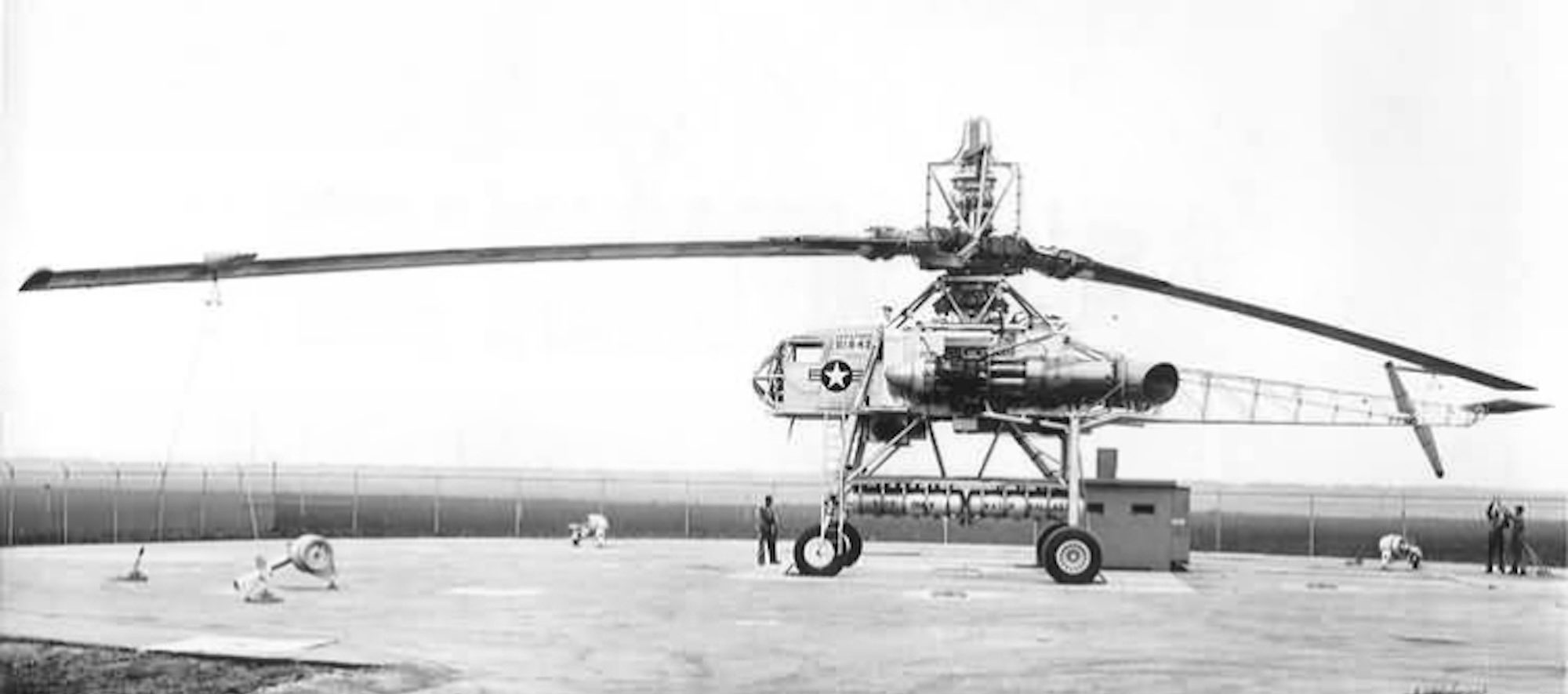
The main attraction, of course, was the 130-foot two-blade rotor system—25 feet longer than the rotor found on the Russian Mil Mi-26, the helicopter with the largest rotor system to enter production. The XH-17’s setup still holds the world record for the largest rotor system to take flight, and it was incredibly complex. As mentioned previously, the rotor wasn’t spun by torque applied at the hub via a driveshaft, but by a little-used method called tip jets. Instead of being mechanically attached to the rotors, the two modified General Electric J35 gas turbine engines mounted on the fuselage acted as huge air compressors that piped pressured air through the insides of the rotor blades.
Air was bled off from the compressor section of the modified engines and was ducted through the hollow rotors. The 400°F (204°C) air was exhausted from each rotor via four pressure-jets in the tip’s trailing edge. The jet of air emanating from the rotor tips caused the rotors to turn. This propulsion system was referred to as cold-cycle pressure-jet, because the air from the engine’s compressor section was much cooler than the air from the engine’s exhaust.
Each blade, according to the Smithsonian Magazine, weighed an incredible 5,000 pounds and measured nearly six feet wide and 12 inches thick. Because there was no counterforce from the blades applying torque to the airframe, the XH-17 could get away with no tail rotor (but it still had a small one borrowed from a Sikorsky S-55 that was used for yaw control, according to ThisDayInAviation.com)
To squeeze even more power from the setup, fuel was sprayed and ignited into the pressurized air as it was exiting the rotor tips. With the jet tip ignition activated, combined power was estimated to be around 3,480 horsepower, according to Avistar. This proved to be incredibly loud, according to people on the ground:
After about three months of testing, the rotor burners were fired for the first time on 22 December 1949. This created a very a loud whop-whop-whop noise that coincided with the passing of each set of lit burners on the rotors’ tips. The noise was so loud that it could be heard eight miles (13 km) away, and the XH-17 caused numerous noise complaints to be filed against Hughes.
Despite the noise complaints, Hughes’s new helicopter division forged on and eventually felt confident enough in the design to begin real-world testing a few years later.
Leaving The Ground During The Fall Of 1952
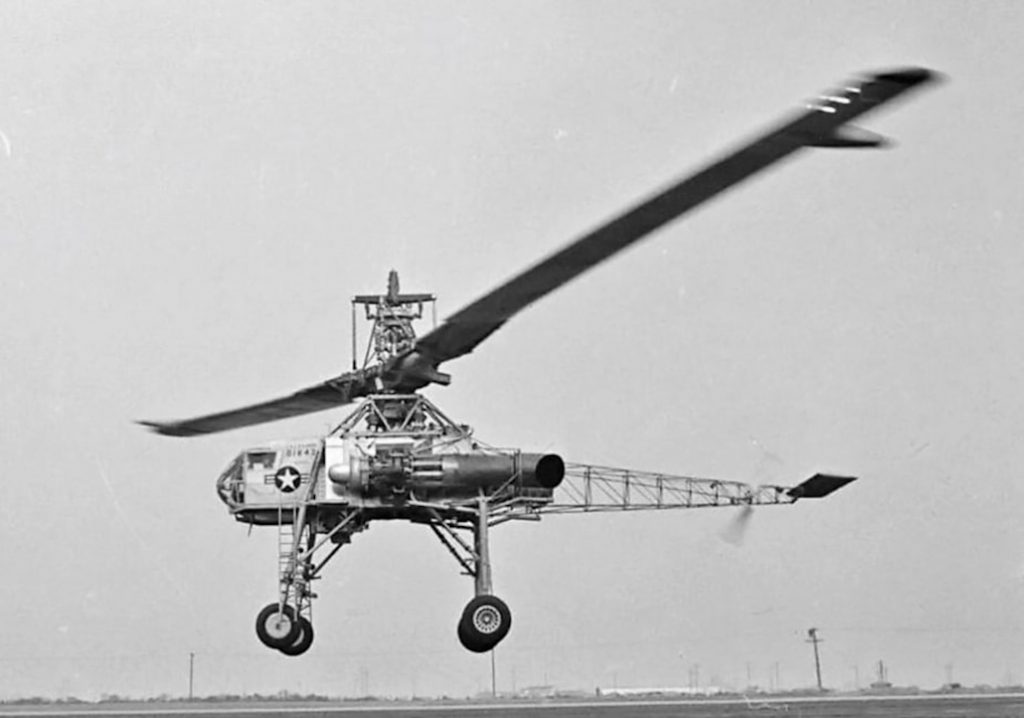
The XH-17’s first official flight was planned for October 23, 1952. But it actually left the ground for the first time over a month earlier, on September 16. On both occasions, it was piloted by Gale Moore, a pilot for Los Angeles Airways who left his job flying Sikorsky S-51 helicopters to take on a new challenge with Hughes. This excerpt from the Smithsonian Magazine describes what that first September liftoff was like:
On September 16, 1952, he had hovered the aircraft, technically its first flight. It rose only a foot, but when Moore slowly pulled collective pitch, the machine lurched into the air, almost uncontrollably. He lowered the pitch lever, then raised it again, all without calming the erratic movements, before settling on the ground with a solid thud. Flight test data revealed the controls were much more sensitive than those of the S-51. “The flight was like riding a pogo stick in a sitting position—up, down, up, down,” Moore said.
Moore got used to the controls enough for the official October 23 demonstration, which had media, including journalists, photographers, and news cameramen present. Even Hughes himself made an appearance to see his company’s first helicopter flight in action.
“I felt very conspicuous as I stepped out of my car,” Moore recalled at an American Helicopter Society meeting in 1983, where XH-17 personnel reminisced about the project. “I hoped this wouldn’t be the day we made any big mistakes. Howard Hughes himself would be in the audience. I had to admit to a little bit of stage fright.”
When the blade-tip jet engines on the helicopter fired up, flames shot from the ends of the rotor blades. “The whoosh-whoosh of the whirring blades sounded like hundreds of artillery shells in flight,” the Los Angeles Times reported. “You could hear it seven or eight miles away,” Moore said.
Video of the event survives to this day, and shows the XH-17 rising into the air as its rotor spins at 88 rotations per minute:
The demonstration involved a vertical ascent and a nine-minute hover, before Moore flew forward, backward, and made full rotations in both directions before safely landing. Everything had gone as the company planned.
Too Big To Succeed
After that successful first test flight, Hughes continued to perform tests, including some where the helicopter actually lifted cargo into the air, until 1955. By then, pilots had reached a top speed of 70 mph and a maximum altitude of 350 feet. Its last test flight involved lifting an 8,000-pound trailer, which, according to OldMachinePress.com, pushed the helicopter’s gross weight over 50,000 pounds. Here’s a test flight video from 1953:
By December of 1955, the rotors had reached the end of their recommended operating lifespan, which was just 10 flight hours. The XH-17 was grounded and never flew again.
The short flight life of those blades, plus the booming sounds from their tips, and the helicopters’ woefully short 30-minute range meant the XH-17 would never make it out of the prototype phase. The Air Force cut funding for the project, and the only example was later scrapped.
The XH-17’s dismantling is a sad end to one of the most fascinating 1950s helicopter designs to make it to real-world testing. It’s a shame Hughes didn’t tuck the XH-17 into some hangar and leave it there for a museum to unearth a few decades later, though I sort of understand why you might not want to deal with a 40,000-pound hunk of unairworthy metal with rotors that span more than half the length of a football field. So it’s not terribly surprising that it’s gone. So long as we have the photos, video, and recountings from people like Moore, I’m happy.
Top graphic image: Wikimedia Commons


Helicopters already fly by taunting the laws of physics and God but this thing is a new level of that
Theories of flight proposed by some old NCO’s:
They’re so ugly, the Earth repels them.
The beat the air into submission.
Whoever thought that 2 blades were the way to go for that kind of lift capacity, hopefully got fired.
There is a reason anything with a significant lift capacity has more than 2 blades.
King of the external load the CH54/S64 lifts 25k on the hook with only a 70′ 5 blade rotor.
The only thing I can think of to explain it is if they were set on the rocket-tipped blade thing and that somehow made it make sense.
Absolutely fascinating.
Geez, at 165 rpm the rotor tips would go supersonic.
I think my favorite part of this thing is the afterburner system on the rotor tips.
I wonder how complicated those blades were?
The 10-hour service life suggests an answer: too complicated.
In flight it looks like a kaiju
Cold Tip Jets are great.
My favorite helicopter used them: Sud-Ouest SO.1221 Djinn
Frankly Autogyros with tipjets for VTOL operations are much safer than Tiltrotors or traditional centrally driven Helicopters
I get why they’d be safer than tilt rotors but what’s the benefit vs traditional helicopters?
Autorotation.
Autogyros fly like planes but using an undriven rotor, and all of them land extremely short and very slow.
Autorotation in a helicopter is a harrowing experience where IF you fuck it up you’re dead, as you use the rotor like a giant flywheel, turning the pitch down to allow it to spin fast then adding pitch to slow your decent using the mass in the rotor, get the rotor too slow and you fall out of the sky, add pitch too late when autorotating and you slam into the ground.
Tiltrotors can autorotate but for example in the V-22 due to the very light prop-rotors and their small disc size the only autorotation practice done with V-22s is in the simulator, and their plane mode stall speed is over 110 knots if you lost both engines.
Since 99% of helicopters are driven from the center of the rotor there is a massive amount of torque going through it, requiring either a tail-rotor to counteract the torque or a coaxial rotor system with an equal sized main rotor on top spinning the opposite direction to counteract the torque of the bottom rotor system. If either the tail-rotor or one of the main rotors on a coaxial rotor system fails to spin fast enough torque wins and the fuselage of the helicopter starts spinning, usually leading to a violent barely controlled crash.
Also transmissions are heavy and take up a good amount of efficiency.
Since tipjets drive from the tips of the rotors there’s very little torque, so you can get away with no tail rotor or coaxial rotor system.
I was told that tip jets wouldn’t work for larger applications, but they pulled this off in the early 50s. With modern metallurgy, modern turbines, etc. I think it’s very doable.
Thank you for the great explanation. So, in short, safety-wise a tip jet > traditional rotor b/c you are not reliant on a tail rotor. Plus benefits of no transmission or need for a hub to handle the torque. Downside is noise and maybe efficiency?
Basically, yes. The efficiency can actually be a lot better than helicopters too – the Fairey Rotodyne used turboprops to provide the compressed air for the jets, but then those same turboprops were used to directly power the aircraft in the cruise phase with the tip-jets turned off and the aircraft relying on stubby little wings for a good proportion of the lift.
It was the noise that killed it off.
What you forgot to mention was that fuel was added to the compressed air and combusted, hence the loud noise. “Cold” air tipjets tend to be a lot quieter
I guess that the ‘hot’ jets radically increase the lifting capacity given their use on such enormous machines though?
Noise is usually an issue for hot tip jets (where fuel is added to the mix and combusted), cold tip jets very less so.
Comparing efficiency is hard as there haven’t been many cold tipjet helicopters made, and those that have been made were made a long time ago.
Personally I think the solution is a dedicated tipjet helicopter, rather it’s an autogyro with tipjets that allow it to takeoff vertically, hover, and land vertically, while flying like an airplane whenever possible (standard rolling takeoffs, landings, cruise, etc. when VTOL is not necessary)
Helicopters are very efficient for VTOL but have awful efficiency in forward flight.
Tilt Rotors are very efficient (for rotocraft) in forward flight but have awful efficiency got VTOL
Stuff like the Harrier and F-35B wre very efficient in forward flight (for VTOL aircraft) but absolutely suck at VTOL operations.
Autogyros are about as close to VTOL as you can get without being VTOL, add cold tip jets to the equation and the proper engineering and you get something more efficient and much safer than a helicopter, while being cheaper and simpler than either a helicopter or a Tiltrotor and still being able takeoff and land vertically (though you wouldn’t have to if you had an obscenely short landing strip)
*isn’t a dedicated tipjet helicopter
*Tilt Rotors are very efficient (for rotocraft) in forward flight but have awful efficiency for VTOL
I thought the shrouded twin-rotor SA-2s depicted in the original Avatar showed promise. I could envision a quad version as well.
” If either the tail-rotor or one of the main rotors on a coaxial rotor system fails to spin fast enough torque wins and the fuselage of the helicopter starts spinning, usually leading to a violent barely controlled crash.”
I learned this as a kid in the 1970s with a free flight gas powered model helicopter much like this one:
https://p1.liveauctioneers.com/7015/241408/125149598_1_x.jpg?height=512&quality=70&version=1647665482
After MANY attempts I only got it to fly ONCE and that was enough. It counter rotated its way around the field according to the whims of the wind, eventually coming back at me with that awful, mangling propeller. After that one flight I was terrified of it. Fuck that s#it, I’m going back to Pong.
About half the things you mention are the reasons I don’t like even being around helicopters.
Tip jets sound much safer.
Tip Jets definitely are safer. Autorotation is still pretty dangerous in a tipjet helicopter just like a regular helicopter.
Autogyros are more my jam, and by giving them cold tipjets you get helicopter VTOL performance while landing like a plane (but much shorter and at lower speeds) in the advent of having to land with not enough engine power to sustain level flight or no engine power.
One could also rig up explosives or a high pressure air tank to use to spin the rotor faster than autorotation can handle for a vertical emergency landing if there was a lack of a suitable patch of ground to land it in forward flight.
Truly the best of both worlds
Autorotation is not dangerous.
It is something helicopter pilots practice pretty regularly because it is an essential safety skill.
I have been in helicopters when it was being done, and it is not that dramatic.
I know pilots who have lost tailrotors and been just fine.
It certainly is dangerous in a helicopter, not in an autogyro though as it’s standard and there’s no messing with the pitch to maintain a given rotor RPM range while slowing your decent.
Of course it is trained for, because if you lose engine power you’re sure as shit gonna need to know how to do it or you’re dead.
Losing a tailrotor at speed with the proper design usually means you can keep flying due to an airfoil built into the tail providing just enough lift to counteract the torque, however now you got basically no yaw authority, and now you have to make a high speed rolling landing in something that was designed to land vertically (and often the infrastructure is built around that military wise.)
That is a lot of words.
And mostly salad.
Compared to powered flight, autorotation is for sure less safe. But the same could be said for engine-out landings in a fixed-wing aircraft. If you are going to declare things dangerous because flying them broken isn’t safe, nobody would ever fly anything anywhere.
I feel safer in a rotary-wing over a fixed-wing powered or unpowered. I have been in both for unplanned engine-out situations. One was a crash, the other was a landing; I will let you guess which was which…
I feel the opposite. I know someone who experienced compressor failure “taxiing” their Gazelle back to the hangar, while everyone escaped without serious injury, the helicopter also melted into a puddle of aluminum with a fenestron sticking out.
With an autogyro the only real downside to it in an engine out emergency landing situation is that it won’t glide as well as a plane, but it’ll still land just as short and slow as it always does, and be a lot safer than a helicopter making an unpowered landing.
But do keep telling yourself that helicopters are safer, go watch the video of the Bell 222 Huntington beach crash and tell me those poor souls are not extremely lucky to be alive.
There are fixed wing gliders, and there are autogiro gliders that are towed, but no helicopter gliders.
Also, do helicopter pilots practice deadstick landings ? Or routinely practice turning their engines off and restarting? Fixed wing pilots do that all the time at my local airport.
I live between an FAA-designated Aerobatic Practice Area and a parachute drop zone and in area full of cropdusters , so the sky is full of weird stuff here.
I’m moving to a house near the old Rhinebeck Aerodrome soon, so I guess weird stuff overhead will still be a thing.
Autorotations in a helicopter are effectively deadstick landings, and helicopter pilots have to practice them way more than fixed wing pilots due to how different it is from regular flight unlike engine out procedures in fixed wing aircraft and autogyros.
Even regular fixed wing pilots when practicing deadstick landings NEVER turn off the engine.
In some planes like the J3 Piper Cub the never exceed speed (VNE) is higher than that of the air restart speed, and many of them lack electric starters, so the only way you’d restart one in the air would be by going out on the wheel and hand turning the prop, which there is a famous picture of, but would highly recommend against doing and instead would try to land in a field of some sort.
Only pilots I know who regularly turn off the engine when flying are motorglider pilots, and even that can be sketch.
I know someone who did so in a Grob 109 and the prop feathering mechanism stayed feathered even after the engine was restarted, so they basically glided there way to a crash landing. There were other factors that didn’t help the situation but that was the main one.
I know another who was worried they were too low to make the runway, so they deployed the retractable engine and the increased drag ensured they crashed before they even had a chance of getting the engine running. Provided you don’t hit anything traditional gliders are extremely safe to land off field due to their low CG and recessed landing gear, and are considered a fairly regular thing for glider pilots when compared to powered fixed wing aircraft.
Good to know.
There are two high wing planes that are turning their engines off and restarting all the time, I think they might be a flight school.
Like I said, the airspace over my house is not typical.
My only experience in intentionally unpowered flight is in a hot air balloon. The local hot air balloon operator would give free rides to all the farmers who’s fields he landed in over the year.
Oh, and that time a B52 blew up over us. Just one thing after another.
They could be Pipistrel motorgliders, but more likely than not they’re only putting there engines to idle, most of the noise you get from prop planes is from the prop, not the engine itself.
Even electric aircraft are fairly loud.
That could well be. They look to be at about 3000 feet, and three or four miles from the airport, and they go quiet for about 30 seconds.
I do notice that they are always flying towards the airport when they do that.
In NYC there are always helicopters hovering overhead. You can tell the police helicopters from the news and film helicopters because the police always are circling in case of mechanical trouble, but the camera helicopters don’t circle. Autorotation behavior is the reason.
I don’t know if it’s still true but for many years, Bell 206 helicopters allegedly had the best safety record for single-engine aircraft. How that was defined, I have no idea.
I had a friend who was a helicopter instructor, and he seemed to spend half his time practising auto-rotation. He was pretty confident that he’d be ok if he had to use those skills, but on the other hand he only flies twin-engined choppers these days.
Exactly. It’s not a simple affair, it’s not the same operation as regular flight.
Single engine Plane or Autogyro engine shuts down mid flight?
Point nose down till you’re at best glide, look for a landing spot, and troubleshooting the engine while keeping your eyes on the best forced landing spot.
Single Engine Helicopter has engine shut down mid flight?
Continually spin up the rotor system at low pitch so you can use the stored energy in the rotor like a flywheel to allow you to increase pitch to slow down your decent then rinse and repeat as many times as necessary to get to the ground safely.
With fuel issues that would cause engine failure having a second engine doesn’t help you any, and contrary to popular belief rarely is an engine ever redundant, it just multiplies the probability of experiencing engine failure by the amount of engines the aircraft has.
In order to fully comprehend large scale sizes, I usually put it in a “football field” frame of reference. The rotor span on this was nearly half the length of a football field. Wild!
they make a 2,500 lb lift drone with 4 blade, I am kind of surprised an 8 blade design that can do closer to 5K has not happened yet.
If anyone builds one, it’ll likely be Ukraine. Russian fighters might call it Leshy or Polkan, mythological figures like the Baba Yaga.
Currently deployed Yaga variants top out at maybe 15kg of payload; a Leshy lofting 1000kg would be a BIG machine and might do better duty ferrying smaller units – like a bunch of Yagas! – and repeating control signals to operators behind the horizon.
Hop in my chopper, it’s as big as a whale, and it’s about to set sail.
Being hellaciously loud is a well known issue for helicopters. The Fairey Rotodyne failed because of noise complaints too. I guess the chopper falls under the “Ambitious but rubbish” classification. The more conventional Sikorsky S-64 succeeded at the job and is still in limited production
I believe that was due to the ramjets on the ends of the rotor blades, “cold” tip jets (just compressed air) are a lot quieter than hot tip jets.
It’s possible these acted like pulse jets which are even more obnoxiously loud than ram jets
Fair enough. I know the Hiller Hornet was quite loud and that used tip ramjets
100 Passengers (oof)
I really admire the optimism of that time.
Hold my beer – Spirit Airlines
Watching that thing fly is disturbing, like a big Amazonian bug that you don’t swat but rather knock out of the sky with a baseball bat. It just doesn’t look like it has any business mid-air.
Yeah. It’s hard to believe those rotors are spinning slow enough to easily see with your eyes and yet it can lift a crazy payload. 10 hr service life on the blades sure seems like a dealbreaker though. At those RPMs it means they’re good for just under 53,000 rotations. I’m guessing you don’t normally measure blade durability like that.