

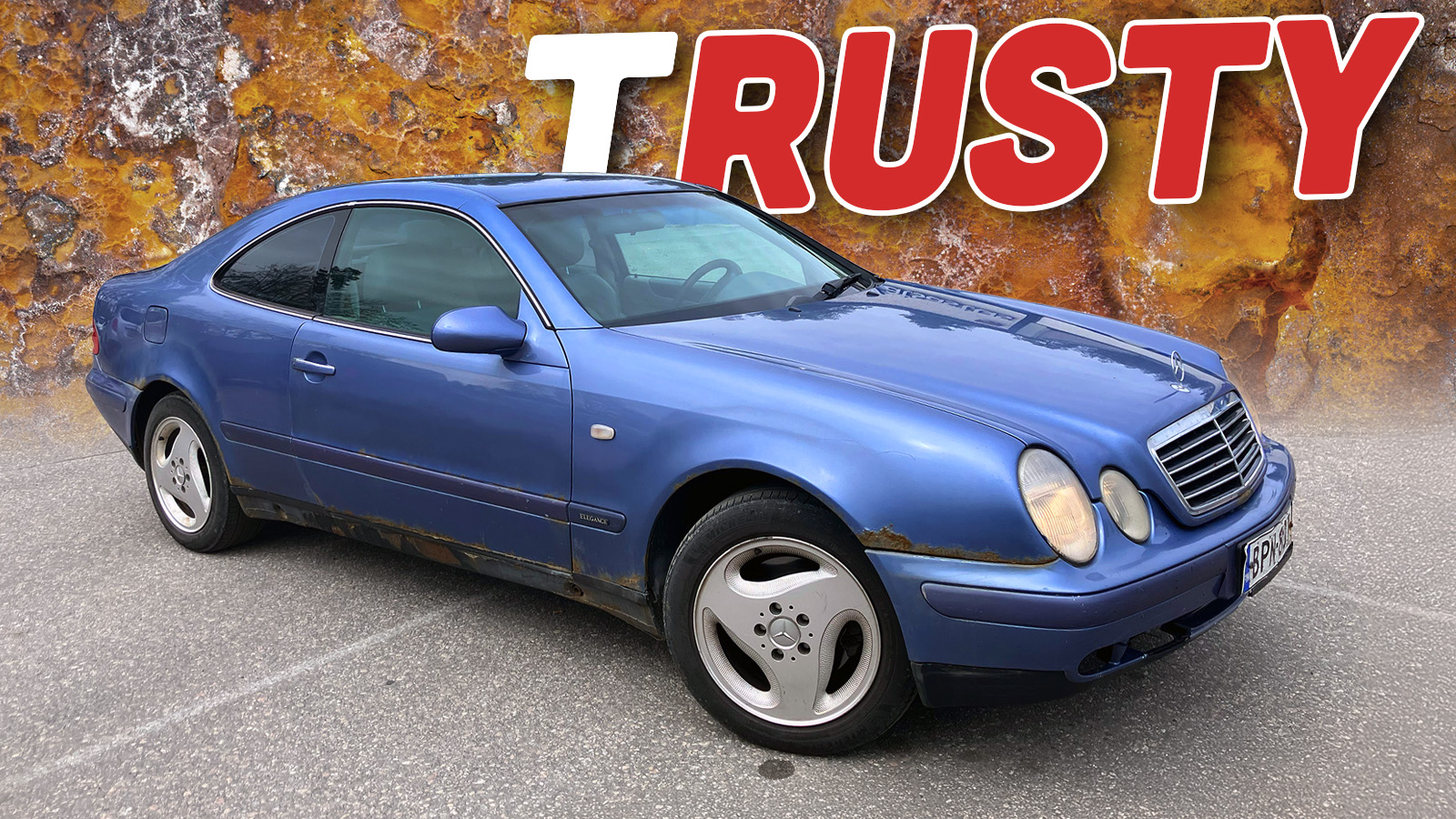
We bought an ice track car last winter. It was a last-minute decision as the car we got a year earlier turned out to be no good anymore, meaning our group of friends needed a new one. Browsing the cheaper end of Finnish used car classifieds for anything rear wheel drive and road legal, we found this dodgy-looking and slightly expensive CLK, which was handily enough located somewhere one of the buddies could go see it on short notice.
The phone call from the car went like this: “Is it as bad as it looked?” “It’s worse.” “Does it run and drive?” “Sure, it’s pretty great in that respect.” “Do it!”


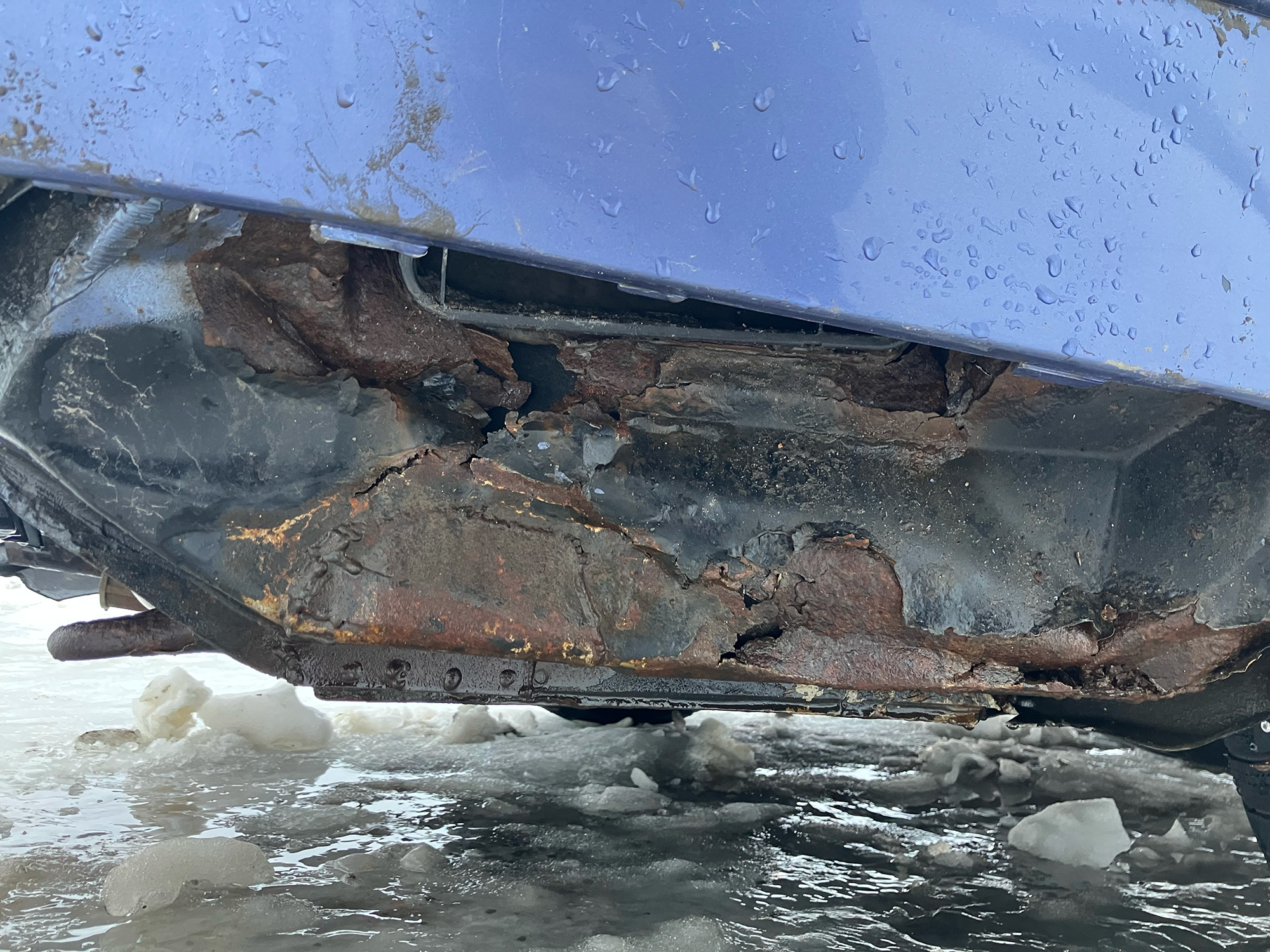
What we got for a grand and a half is an originally Luxembourg-registered 1998 CLK 320 with rust on every panel, including the plastic-looking trim on the A-pillars. A former garage loaner, it seems like it had been rear-ended and badly repaired at least once, sat for a while somewhere damp, before being badly welded and cobbled together again. The spare wheel well and rear quarter bottoms were just as rotten as the inner wheel arches behind the headlights. It had rattle can paint fixes and cigarette burns. One side was far worse than the other.
Importantly, however, it had a valid inspection (Finnish MOT) until Christmas 2025, meaning it was perfectly road legal in the eyes of the authorities. At the time of writing, it’s unclear how anybody could let it pass, especially with zero demerits on the sheet. Finnish road legality inspection is usually quite strict, as I’ve grown to know with my various beater cars.
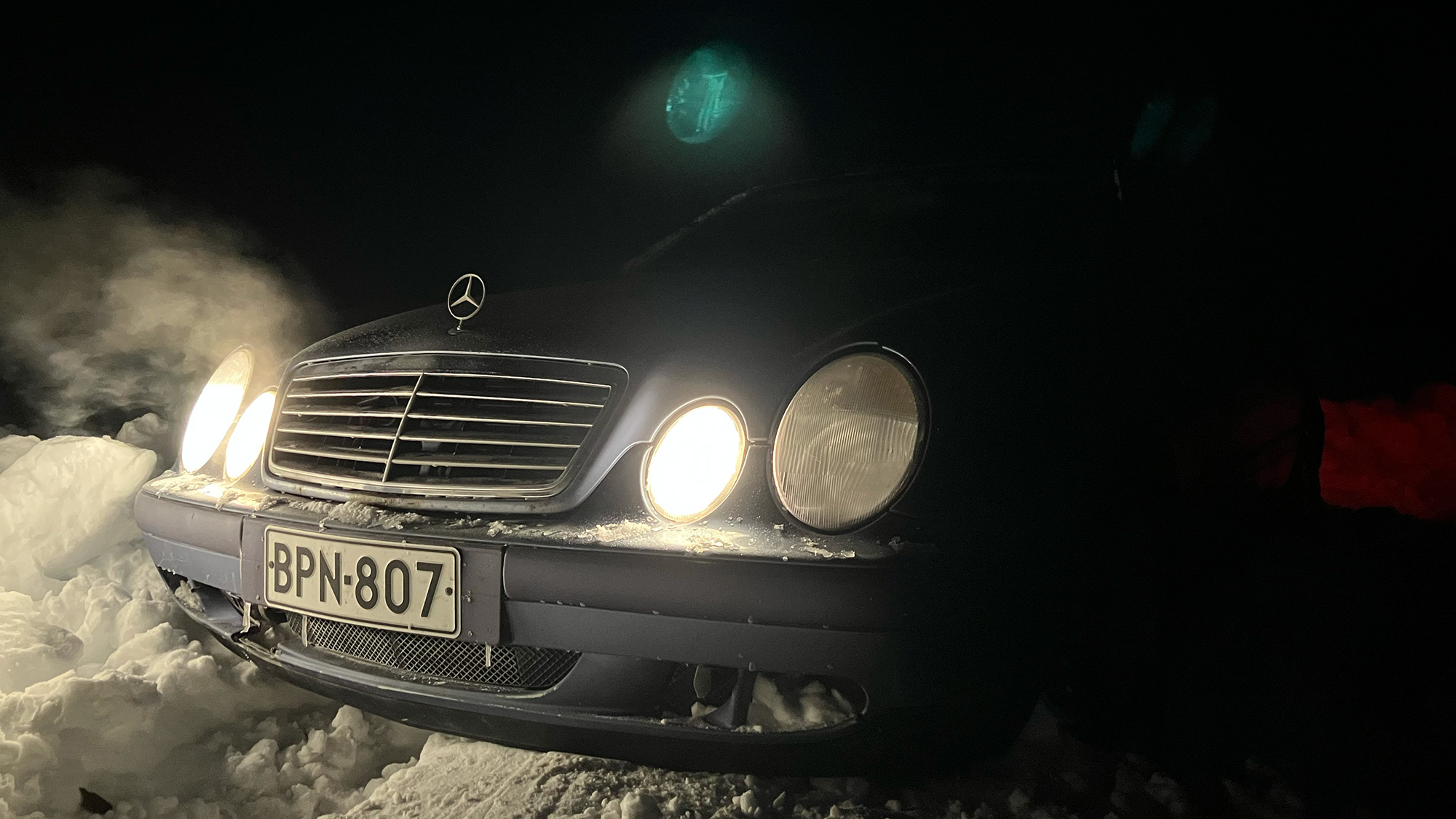
We beat on it for a long weekend in the north of Finland at a disused airfield, where it proved its worth during long slides and effective maneuvers without too much cooling system trouble. We did have some of that, as temps rose and the car displayed a cooling fan warning, especially when it got stuck, with the engine bay packed full of snow. Eventually, we drove it home, a little worse for wear thanks to various snowbank hits, and I parked it in the barn for a few months, still covered in road salt and grime.
Actually Using the Rusty CLK as a Daily
It didn’t take me long to remember that sitting for an entire year between ice track events would do a car no good, and the roadworthiness would go to waste. I put the CLK’s battery on a trickle charger and bought a set of summer tires for it, as it only came with the winters it wore on rusty steelies.

Earlier, I had also stockpiled a set of very weird and rare Mercedes three-spoke alloy wheels from a junkyard, and realized these would be a perfect fit for the organic and rounded CLK coupe shape. I cranked the CLK to life, unstuck all the rusted brakes, marveled at the rust that somehow seemed so much worse than earlier, and started ziptieing the ruined bumpers back together. Since I also had no clue when the car had been serviced the last time, I changed the oil – all eight liters of it.
The Mercedes-Benz CLK: Coupe, Leicht, mit Korrosion?
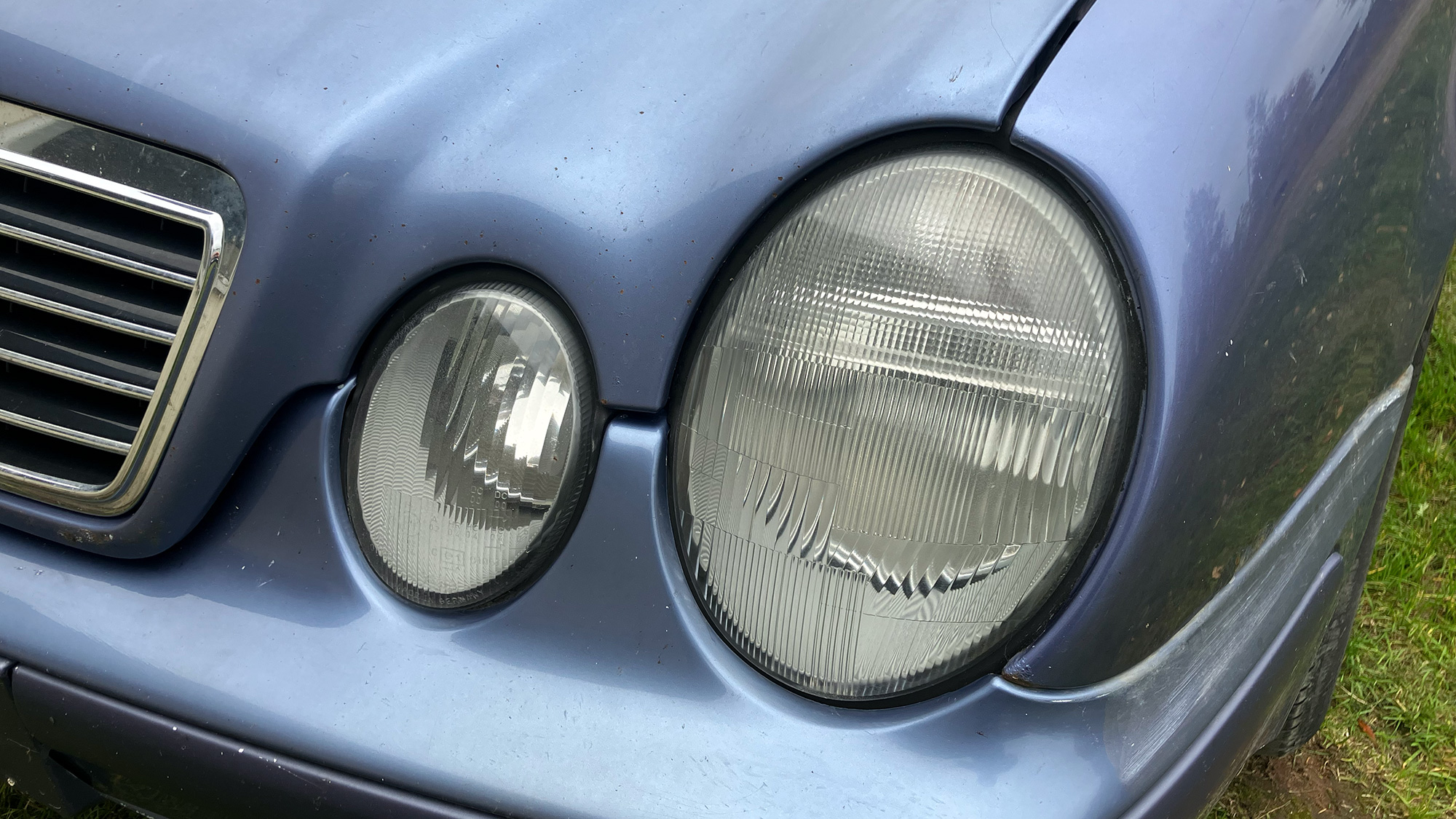
The W208 CLK is a curious thing. It’s ostensibly a coupe version of the W210 E-Class, which is why it wears the front and rear design of those large sedans, but in a swoopy and soft ‘90s coupe package. And thanks to Mercedes’ cost-cutting, it is based on the smaller W202 C-Class, as the “C” in the name reveals. It superseded the C124 generation coupe, a paragon of over-engineering and solidity, but thanks to being made during the 1995-2005 New Malaise Era of Mercedes-Benz, the CLK rusted quickly and showed traits of de-contenting.

The design initially aged badly, but somehow I’m sensing a redemption arc for these funky ‘90s Mercs, probably partially because I’m also pushing for it to happen. Unlike newer cars, these were still available in weird and wonderful colors, especially if you had the budget for a Designo trim level that gave you green wood paneling and green leather if you so desired.
The drivetrains are usually pretty stout, even if the CLK didn’t get the venerable straight six engines the W202 got in its early days. The CLK 320 has a 218-horsepower M112 V6, and at launch it was the range-topper, before the V8-engined CLK 430 arrived. You could also get AMG versions, and in the lower end of the scale, M111 four-bangers and manual gearshifts.
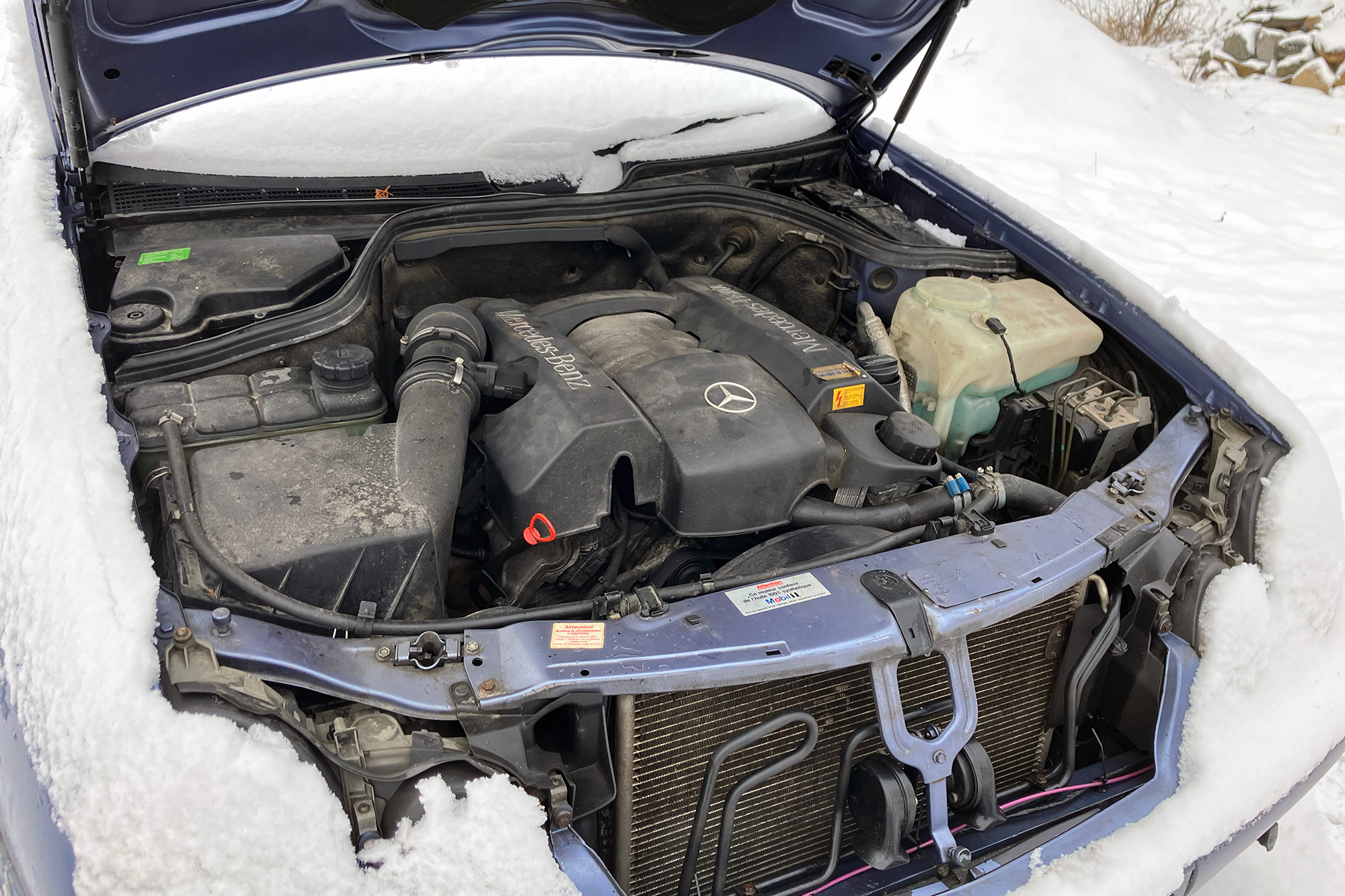
Our purple CLK with its light grey interior and three-spoke wheels is some sort of Mercedes V6 Camaro. It makes these burbly, leaky noises, as well as a few rattles and whines. The 255,000-mile drivetrain feels good and doesn’t sweat or burn too much oil, and on a long summertime road trip east, the car managed a surprisingly good 31MPG.
At highway speeds, it cruises very smoothly, and none of the frameless window seals let in wind noise, and at times it feels like a solid, formerly expensive car. Then you get out of it and all the rust jumps at you. The corrosion even kept advancing at a frightful pace during this time, as the front fender bottoms just let go, their corners crumbled.
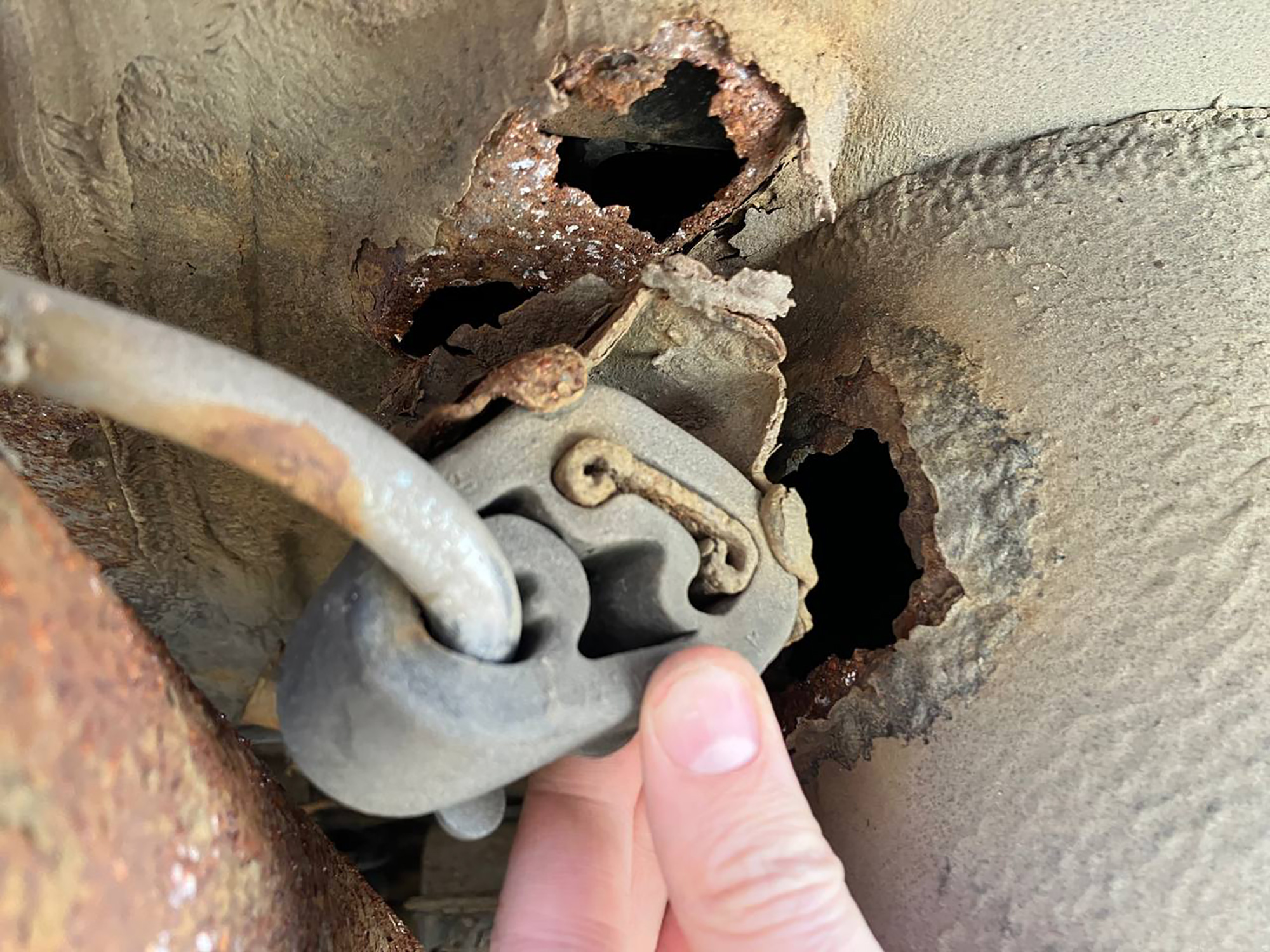
At Christmastime, I showed the car at the local inspection station with the idea they would fail it, but not ban it outright. This worked: I got a long advisory sheet, which came with a two-month grace period before the car would cease to be road legal. For us, that meant two more months of life.
The inspector remarked on the rust holes, and I told him the car was mint up until some salt trucks drove past me on the way to the inspection. He didn’t mention how I had reattached the muffler with a metal band through two rust holes, because somebody had beached the car in a snow bank last winter and ripped the original, now completely rotten bracket off.
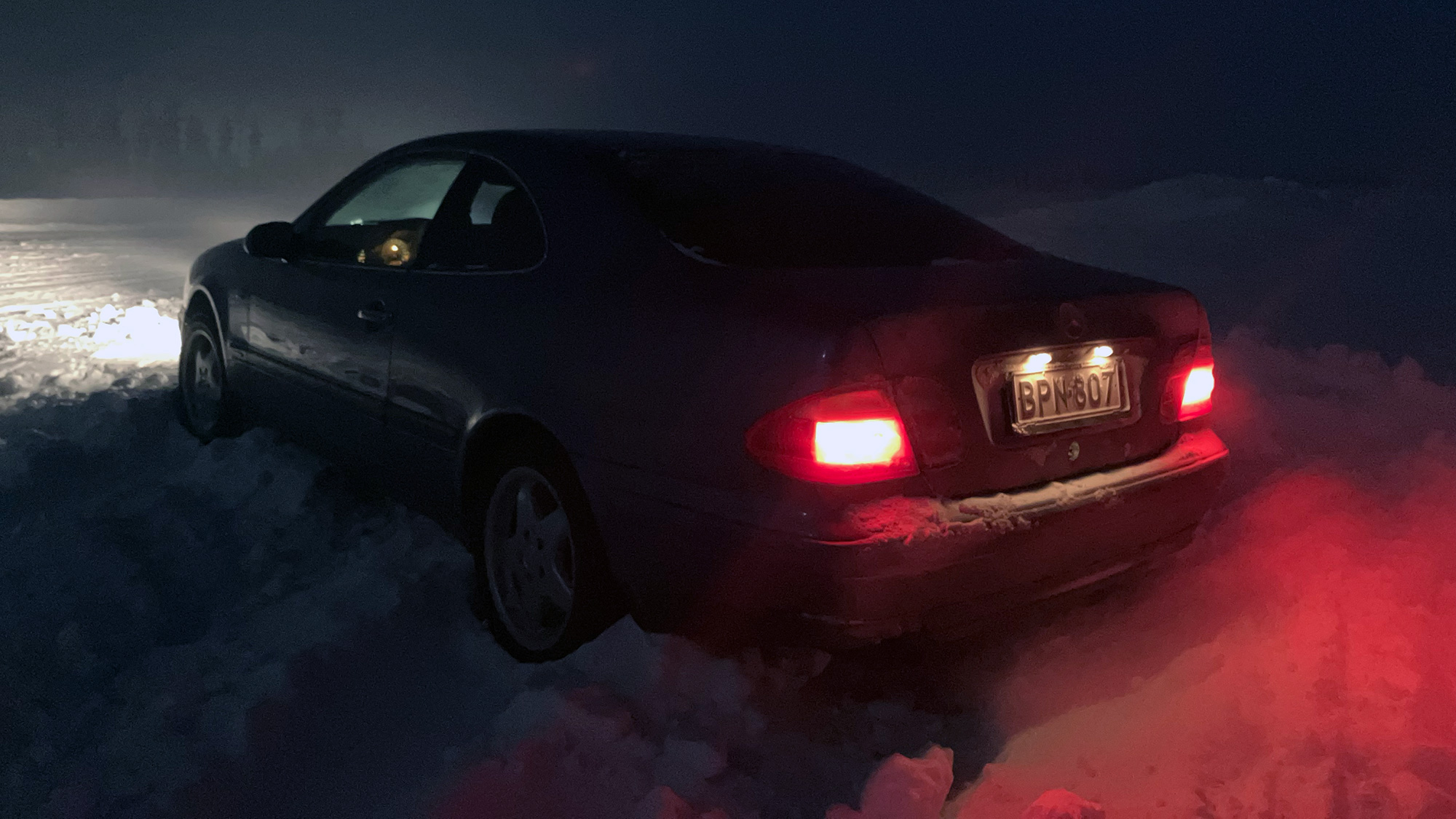
Part of the charm of driving the CLK most likely comes from being the last owner or custodian of a car. You don’t really need to keep it up. If bits fall off, then they must. Rust has already won. I wasn’t keeping this car nice for anyone else, except my group of friends, who would pile it into the first snowbank they could find if given the keys.
Yes, It Died a Frozen Death
I actually wrote the largest part of this post before last weekend. The original ending went like this:
“But importantly, I just want to drive it, make the most of it as long as it starts and runs. Our previous ice track car was a W203 generation C-Class with the same plastic ignition key and ignition lock as the CLK. These have a habit of ceasing to function, as the electronic ignition lock and brain no longer recognizes the key and either refuses to start the engine or refuses to let the key turn.
Sure, you can replace the lock and key, but that costs about as much as you want to pay for a beater car in the first place, so it’s just easier to get another Mercedes that starts. We still have the W203 and it’s still in my name, but I don’t have much faith in us getting it going as it’s on the other side of the country, slowly languishing behind a barn. The CLK still starts most of the time, even if the key’s intermittently dicky on it as well. But when the M112 cranks to life with a healthy burble, it tells me it wants to live. Burn rubber. Do slides. Hit the rev limiter. Hit snowbanks. Live out the road legal life it has left.”
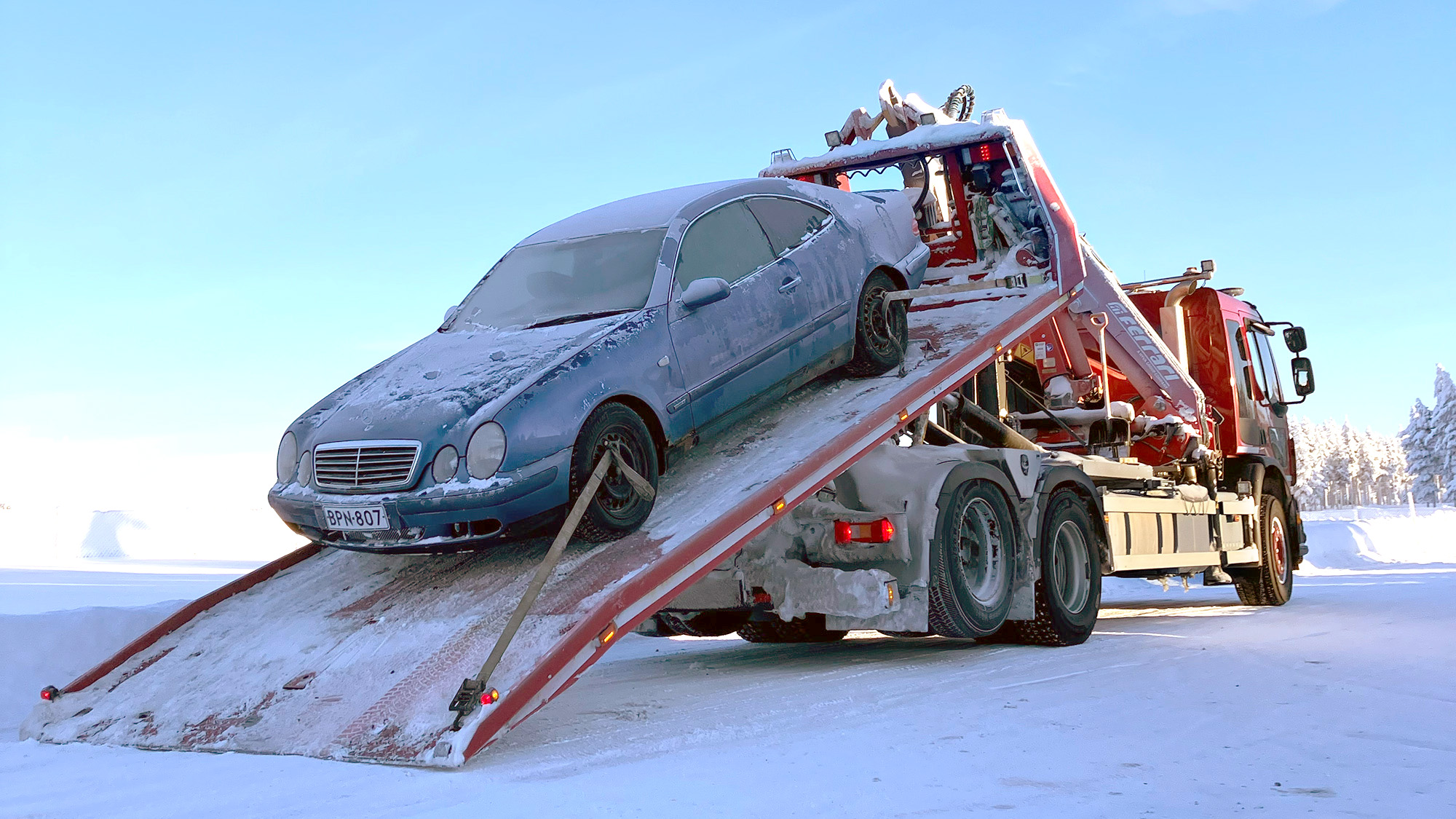
That would be a fine epitaph for the CLK, but the EIS ignition lock module likely failed its full and final time this past weekend in -13F weather. The car was successfully driven north for an ice track weekend, drifted for a bit on Friday evening, rescued from the snow bank once, driven again, and parked. The next morning, it wouldn’t crank despite usual attempts to give it more juice. A tow truck picked it up, and a garage read the error codes that pointed towards electrical maladies between the ECU and the ignition module.
At the time of writing, I feel a scrapyard ride is the economical thing to do, with another terminally rusty Mercedes safely taken off the road. Now, what should I get next winter?
All photos by the author unless otherwise noted
Top graphic image: Antti Kautonen




I don’t know how it works in Finland, but I’m guessing you can find out at least the testing station, and possibly even the person that tested it, and then take your cars there every time you really need one to pass.
A while back I had to take my Polo to a garage I’d not used before to get an MOT. It passed with no demerits, despite having a snapped rear coil spring, which I only found out when I took it to my regular garage a few weeks later.
I keep the dodgy MOT place in the back of my head, for next time I really need an MOT but I’m pretty sure it is going to fail.
I had one of these… the only car I ever bought new in my life. In the mid-90s, I read that there’d be a new mid-size coupe, so I put down a deposit and waited almost two years, eventually getting the third CLK from the Calabasas dealership. I immediately put a set of AMG Monoblocks and Bridgestone Potenzas on it, since the factory alloys looked so ugly and narrow to me. So, about $50K all in.
A pretty car (IMO… I still think the four separate round headlights are among the nicest Mercedes noses in modern times, and much better than the generically ovoid blobs that came after) and a comfortable one too. However, it was by far the least reliable car I ever owned… every time I got in and turned the key, it seemed a 50/50 chance as to whether it’d run, or just light up the dashboard with errors resembling a tilted pinball machine.
It went back to the dealership seven times during the first year… two of those times to fix things the dealer messed up while they had the car to fix other things (paint on a bumper, and scratched wood on the dash). Whenever I was in the service waiting area, there’d be a whole bunch of other recent buyers, waiting for their ML SUVs and other cars using the same six-cylinder engine in various 320 models. In the end, I got rid of the car after about a year, and sold off the original alloys and tires to a guy who put them on an older Benz, where they still looked ugly (to me).
I still see the occasional first-gen CLK around SoCal… sometimes junkers like the incredibly rusty car above, and once in a while a pristine example that someone inexplicably kept going. I still think it’s a decent looking/driving car (it’s a GT/cruiser, not a sports coupe really) but IMO, it’s part of Mercedes’ decline: starting in the mid/late 90s all Benzes seemed to get noticably crappier with each succeeding generation. I’d never buy one again, unless it was manufactured earlier than the 90s for the most part (and even those have some known issues, but at least the cars are more solid overall).
Though it’s unlikely, if ever a really nice/clean W201 or W202 C Class or W123 or W124 E Class crossed my path, I’d be sorely tempted. I also like that entry-level Benz hatchback that looked like a dolphin from the late 90s (I think it was about $30K?; I can’t recall the model number) but it’s from the same generation as my CLK was, so it likely has electronic issues over time.
A shame what’s happened to all three German luxury manufacturers for the most part over the past couple decades IMO. The cars just get more and more complex and expensive, and less reliable and satisfying to own and drive.
Those wheels really are the perfect fit for that car.
The Answer Is Always Catera
I do remember doing wide donuts around an entire house in Finland in an Opel Omega so feel that’s a relevant suggestion. Starting to get a bit rare though
shh, don’t tell me that
(I would like a Catera/mega.)
How about this “Lotus” Impulse available in Heerde, Netherlands?
“If bits fall off, then they must.”
This is a great phrase.
This car wishes it could continue to live with its rusty cousins in Michigan, Wisconsin, etc.
How to filter a search for “inspected until winter 26/27, but will not pass inspection after that” + RWD
Get an older Audi, C4 chassis. TANKS! Real quattro! Best snow car I’ve ever driven by a mile.
We gotta get David on an IcelandAir flight to Helsinki to compare and contrast the Finnish and Michigan varieties of rust-madness. (Assuming they’re still admitting US passports into the Schengen…)
No problems with being admitted into the EU since David is Dualcititzen US/German being born an armybrat with a German mother as explained in the projekt Krassler blogs..
Good point, I forgot he was a duallie.
they are
source: I saw this car break down! Aaaaand I think the random English pound coin we found in the shifter in my jacket somewhere. There was some mild gear-selector surgery before everyone gave up on it.
You were there? AWESOME! (I was in Denmark a couple months ago, but who knows where things will go this year…)
it was so much fun and I desperately need to do more ice hooning
I don’t know much about FWD vs RWD in ice racing, but in my youth, the ice races were dominated by 2-stroke SAABs.
Maybe you could get all patriotic and find a Finland-assembled SAAB??
I was always a fan of the Finnish exploits over at Hooniverse. Glad to see you’re still at it!
I bought a much nicer example of this car in the CLK430 form, instantly proceed to dump much more than I paid in maintenance. I still refuse to add up all I spent in maintenance, and that’s with me doing a lot of the work. Very poor financial decision, but it scratched an itch.
You gave it a good final chapter in life and let it ride off into the sunset hooting and hollering. And corroding.
Clearly, alcohol was involved. 🙂
IDK about Finland, but my experience with one of the “they’ll pass anything” stations in TX was rolling in ahead of a guy bringing a handle of Tito’s.
Tito’s as in Rakija with hand printed labels? : p
Haha, no. Tito’s the vodka. (Rakija would’ve been much funnier.)
Is Finland the Florida of Scandinavia?
Sort of. I think it’s more like the Wisconsin of Scandinavia, except don’t say that to a Finn, because they’re technically (or actually, I guess) not part of Scandinavia. It didn’t make sense to me at first either. Denmark belongs but Finland doesn’t?
Scandinavia is a cultural classification and includes Denmark for that reason. Finland is not Scandinavian. It is, however, Nordic, as are Sweden and Norway.
“The design initially aged badly“, and continues to do so.
These were originally designed to have pillarless bodies – as all proper Mercedes-Benz coupes are.
However cost-cutting.
Between that and the dreadfully cheap interior – this CLK generation is best forgotten.
Cheap, RWD, decent power… here in the states it would be a Mustang, Camaro, or LX platform Chrysler. Maybe an old Panther platform Ford. G and B-bodies are thin on the ground anymore and most still alive are too nice to ruin. Same with the old M body Chryslers. In Finland I suspect all that meets this spec are old BMW and Mercedes, maybe a Jag.
Check your local listings: Mustangs and their ilk outnumber W208s here in the states, but you can buy two of these Mercs for the price of a comparable American car… if you dare. They teeter on the crumbling edge of cheap speed and remind you of that every time you sit in them.
The CLK 430 is the cheapest V8 coupe available, cheaper than an SN95 or F-Body.
Would an F150 Super Cab be considered a coupe? Mine’s bright red with a V8 and leather seats
In Finland? the Correct Winter beater option seems like an eastern block relic. Maybe a Lada.
They are pretty pricy actually. For some reasons russians rushed to buy them back in the 90’s. Not that there were that many tobeing with. They had horrible fuel mileage (and in that pricepoint is a killer), unreliable as hell and not even nice to drive. Niva’s are another matter and one occasionally sees one as offroad rig. Sat in one once, and only car that had surface rust _while in showroom floor_.
My primary driver is an ‘01 CLK. It does not surprise me at all to see these cars described as something you buy when you don’t want to spend the extra money to get a Lada.
That’s what my dad did: he got a Mercedes ML because it was cheaper than a Niva.
How many days did it last?
Both of my brothers have had big merc SUV:s, one GL350 diesel and other ML diesel. The ML was a epic shitbox, about 150tkm and ~7 years old. It was constant moneypit.
By other brothers GL was othervise fine, but ridiculous 21″ wheels kept on braking tyres (he lives on farm with 5km of gravel). After 5 broken tyres in 2 years he got 19″ tyres. Its life ended rather dramaticlaly as turbo failed on motorway and car caught fire. Engine bay wiring was totally ruined and car was finished @ 12 years old and with 250is thousand km in the meter.
It’s otherwise still fine but it no longer has a 5th gear 😀 (ML 230 manual)
weird, OK, then for those of us from across the pond, maybe something equally odd here, but cheap and available there? Opel Mokka? Maybe Skoda Yeti, just to see if the name fits the ride on that one.
They are pretty expensive for ice racing purposes and fwd based. And drive like any econobox. Old rwd ftw.
I was thinking AWD, but I suppose like all racing, steering with the gas pedal/drifting is part of it. and indeed RWD for the win there.
I had a similar story recently. Back in 2024 I bought a 2004 Daihatsu YRV Turbo (in short: weird, boxy-ish, lightweight, comes with happy turbo noises and four-five shades of yellow paint as every panel faded differently). It soldiered on as a daily all this time without any issue (or care on my end) but around end of last year the decision to sell it had to be made due to rusted rear subframe and lots of tiny rusty patches all over along with minor ignition hiccup. Still, that didn’t stop me to take one last 600 mile trip a month before I sold it. The fact that the guy bought the car strictly for an engine swap is kinda soothing, to be honest.
What should you get next? That depends. Did they sell the Scion xB in Finland?
Not domestically IIRC but I suppose he can get an imported one. And yes, some folks were bringing xBs to Europe (both gens, too!), I was very close to get one a few months ago but it was in a sorry state.
A Ford Taunus TC or Datsun 100A obviously, since my knowledge of Finnish club racing is limited to the My [Season] Car games.
A blaze of glory
“Now, what should I get next winter?”
Next week, Shitbox Showdown: Finland edition!