


Nissan previously announced a low (for EV) price of $31,845 for the all-new 2026 Leaf, but that was for the S+ trim. Where there’s an S+, there’s usually an S, and naturally, it’s apparently even less expensive—$4,630 less expensive, to be exact. According to CarsDirect citing “latest order guide data,” the 2026 Nissan Leaf S will start at $25,360 before destination or $26,855 after a $1,495 freight charge.
When S+ pricing was announced, it was already the cheapest new EV in the U.S. and a certified “screaming deal,” but the $27K S widens that gap even more—a hollerin’ deal, if you will. It’s worth noting that the $26,855 MSRP (before any government incentives or dealer-level offers, by the way) would be $2,780 cheaper than the last-gen 2025 Leaf it replaces. We’ve reached out to Nissan for confirmation and will update this story when we hear back.


Spacer
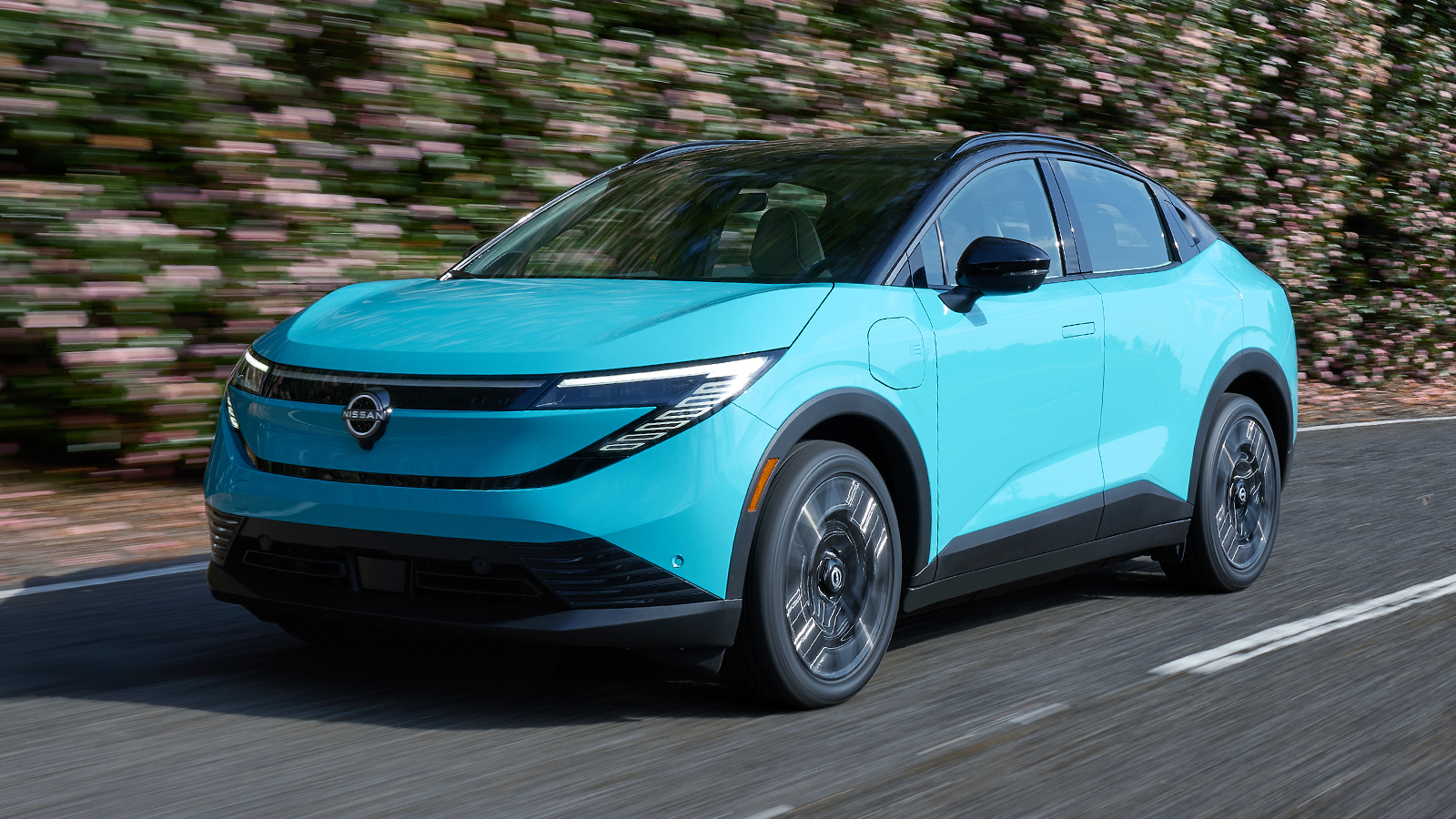
As of this writing, Leaf S pricing has yet to hit official Nissan channels, but the company’s spec literature says that instead of the 160-kW electric motor that comes in every other trim, the S uses a 130-kW motor that results in 174 horsepower and 254 lb-ft of torque. For comparison, the 160-kW motor makes 214 hp and 261 lb-ft. Leaf S also uses a smaller 52-kWh battery instead of the 75-kWh unit of higher trims. Range is TBD, but expect it to be shorter than the S+’s 303 miles. Less serious equipment also means the Leaf S is the lightest of the Leafs, weighing in at 3,955 pounds, 232 pounds less than the S+ and a whole 414 pounds less than the top Platinum+.
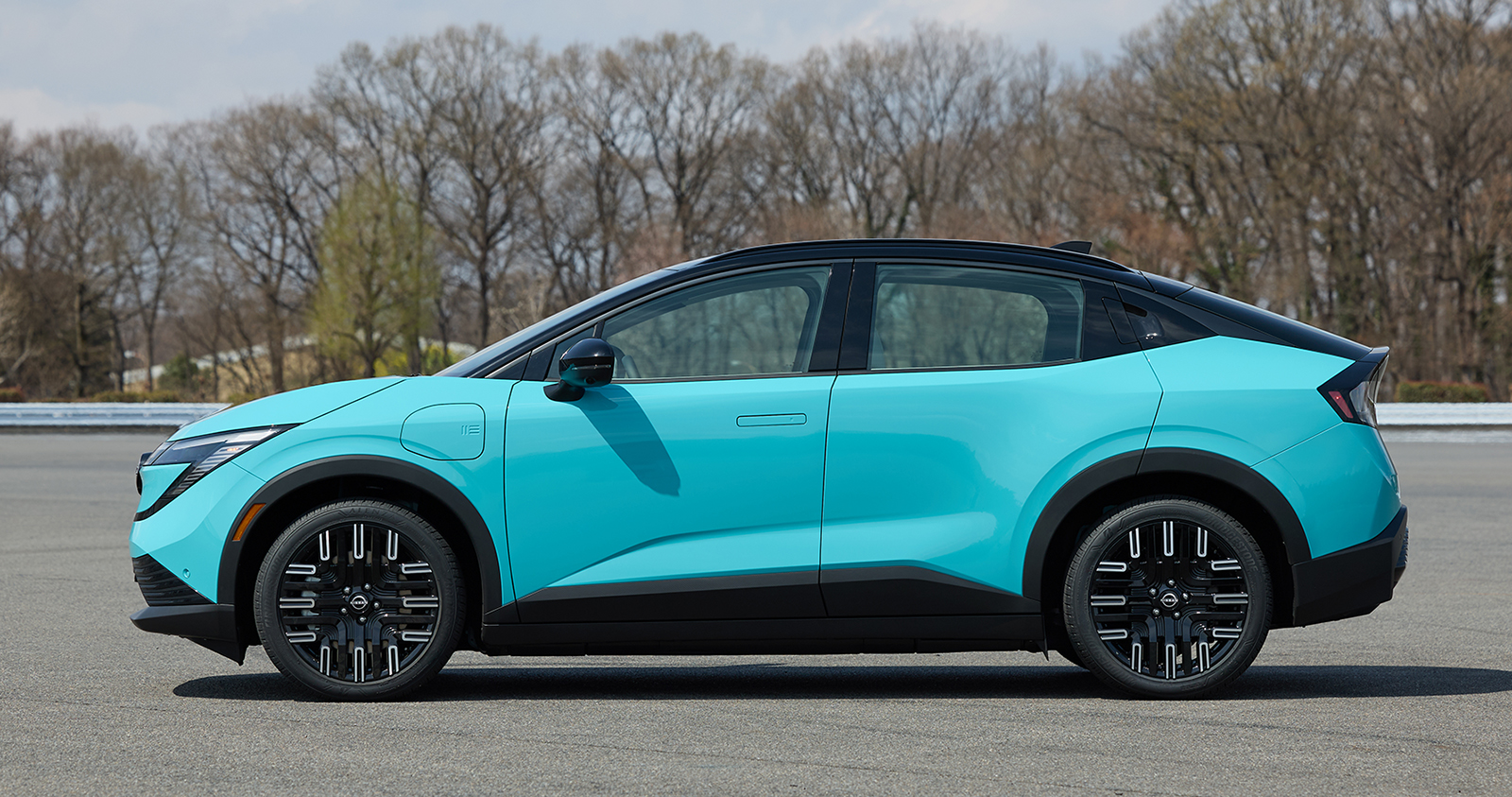
As for creature comforts, Nissan specifies that the S will still get dual 12.3-inch screens with standard wireless Apple CarPlay and wireless Android Auto, as well as two USB-C ports up front. No sad penalty box displays for the base-base Leaf. ProPilot Assist ADAS and keyless entry with push-button start are also standard across the board.
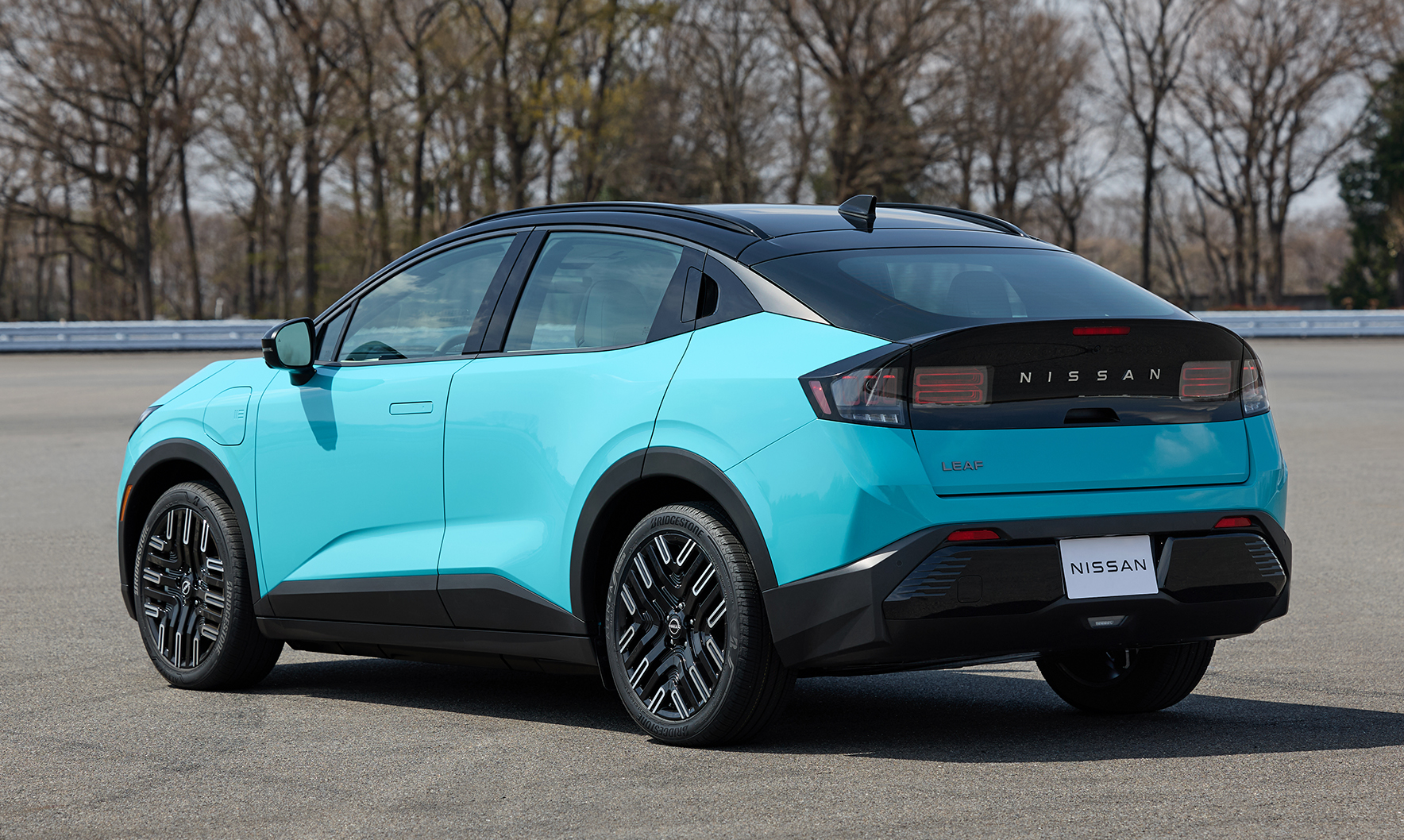
A widely available, sub-$30,000 electric car that isn’t massively compromised as an item you’d actually want to live with has been a bit of a fever dream for the industry for quite a while. Now, it’s here.
Top graphic image: Nissan




I really really don’t like Nissans lately.I find them ugly and at best “meh”. I even refuse to get them as rentals.
But I really really like the style of the new leaf. And it sounds like Nissan actually builds a pretty decent electric car now. I would consider this one.
Hard to tell from the pictures, is there no physical door handles?
The driver door appears to have a flush handle.
Unfortunate, I was hoping it was just a option and not standard to put needlessly complicated door handles on the driver’s door.
It looks like the rear door handles are of the more standard kind, they are just hidden in the C pillars.
The rear doors’ physical handles are in the C-pillars
The shape and details aren’t amazing or anything, but those wheels are interesting, and that shade of blue is delighful. I hope it sells… Nissan needs a win.
PS: I think the body-color trapezoidal thing on the nose would look better if it were black actually, but that’s easily remedied with a can of spray-on rubber stuff, and you could think of it as a cheap car bra to diminish the impact of sand/pebbles…
PPS: watching a lot of police bodycam videos as I do (like a good middle-aged guy) I really associate Nissan with failed DUI checkpoints, chases, and assorted other crimes. Dodges too of course: Altimas/Rogues and Charger/Challengers seem to account for almost half of all motorized crime, at least anecdotally/on Youtube.
From the rear it sort of looks like an overinflated Prius. Not necessarily a bad thing, but I’m not loving it. The color and price are very appealing though!
Finally, the AMC Pacer has been dethroned as the most unfortunately looking car in the world. What is wrong with Nissan?
I’m glad I’m not the only one that thought that . . . and they promo photos features a color destined to be in the bargain bin for any other product. That said, the price is right.
I’d take that color over black, white, grey, silver, etc… even if it cost $500. more. JMHO.
The Fiat Multipla would like a word…
If this vehicle was a slightly smaller, lower, and more narrow liftback sedan with a 20% frontal area reduction, and had a sub-0.20 Cd value(this gen has a 0.26), you could cut the battery size by 1/4 and still probably exceed a 250 mile highway range, and chop a few more thousand dollars off the price tag from the reduced battery size.
As it is now, it is still likely the best deal on the market in the USA today.
I wish the market wanted smaller cars. It’s always shocking to realize how tiny and narrow the 2-door Datsun 510 my brother and I grew up in was. I have the feeling we’re still in a phase where execs think that all EVs must be at least as big as gassers or they’ll be seen as penalty boxes.
We’re still in the “make cars look like carriages so they’re familiar to buyers” phase with EVs here. Can’t wait for folks to get over that so we can throw away the ICE design-book and make some properly sleek EVs.
The execs are trying to sell more car, more battery, more tech, and more components, in order to maximize profit. The problem is that most working people can’t afford it. Even $20k is a lot of money for a car to most people.
I wasn’t even advocating for something as small as a 510, really, somewhere between Versa and Altima, the latter of which provides ample passenger room almost on par with that fat pig of a Mercedes 300 SDL I used to own.
Something Datsun 510-sized in terms of frontal area and footprint, if you keep mass under 2,500 lbs and drag coefficient below 0.20, has potential to be a 120 Wh/mile car at 70 mph. That is to say, 250 miles range at 70 mph with a 30 kWh pack, at least in good weather in a well-maintained vehicle with properly inflated tires. In turn, that makes the battery an inexpensive component, the replacement thereof potentially inexpensive enough that the car isn’t fodder for the scrapyard when it’s time to replace the battery.
Further, if you de-tech the car and keep it mostly analogue and repairable with basic tools, there’s consequently a lot less bells and whistles to fail and brick the car.
We need to start thinking about making cars that regularly last 1+ million miles with very minimal maintenance and upkeep, because with EVs, the technology is there to allow for that. It’s much better for the environment that way.
All of these tech-laden EVs with monstrously-sized battery packs are potentially far worse for the environment than even older ICE cars, and of the battery fails prematurely, can have a total ownership cost that’s also more. Which defeats the purpose of and justification for EVs entirely.
The execs are trying to sell more car, more battery, more tech, and more components, in order to maximize profit. The problem is that most working people can’t afford it. Even $20k is a lot of money for a car to most people.
I wasn’t even advocating for something as small as a 510, really, somewhere between Versa and Altima, the latter of which provides ample passenger room almost on par with that fat pig of a Mercedes 300 SDL I used to own.
Something Datsun 510-sized in terms of frontal area and footprint, if you keep mass under 2,500 lbs and drag coefficient below 0.20, has potential to be a 120 Wh/mile car at 70 mph. That is to say, 250 miles range at 70 mph with a 30 kWh pack, at least in good weather ibn a well-maintained vehicle with properly inflated tires. In turn, that makes the battery an inexpensive component, the replacement thereof potentially inexpensive enough that the car isn’t fodder for the scrapyard when it’s time to replace the battery.
Further, if you de-tech the car and keep it mostly analogue and repairable with basic tools, there’s consequently a lot less bells and whistles to fail and brick the car.
We need to start thinking about making cars that regularly last 1+ million miles with very minimal maintenance and upkeep, because with EVs, the technology is there to allow for that. It’s much better for the environment that way.
All of these tech-laden EVs with monstrously-sized battery packs are potentially far worse for the environment than even older ICE cars, and if the battery fails prematurely, can have a total ownership cost that’s also more. Which defeats the purpose of and justification for switching from ICE to EVs entirely.
I’m with you all the way on this!
I think it has more to do with needing the space to cram batteries in the floor and a crash structure around it. Until we can improve battery density, there’s going to be a certain minimum requirement.
God how I wish someone would do that. Then I’d actually consider a BEV as my daily.
If that isn’t Robin’s Egg Blue, it should be. It’s roughly egg shaped so it fits. I’m not an electric cheerleader but this car at this price could turn me.
Empty nest and now retired, this is (or something like it), we’d like to replace our remaining sporadically driven ’16 Outback (34K miles, city life at its best). What I’d really like is a small hot EV hatchback, preferably with an opening roof, like say a Renault 5 EV. I’m not going to be that lucky. This would do.
This probably won’t be as fun as a Renault 5 EV, but it does look like a perfect city commuter, especially at this price.
I can’t deny they’ve done a good job on the price. I recently noticed every “cheap” EV in the US seemed to be around $35,000; except the older Leaf at $30,000.
I assumed they would “catch up” with their next model, and they didn’t. That’s commendable.
I still see missed opportunities. How much cheaper could it have been with fewer ridiculous anti-features like “hands-free assisted” driving?
Turning a rare hatchback into another (increased frontal area, heavier) crossover with all the latest design tropes is worth some measure of scorn.
Was checking Wikipedia, and the 2023 facelifted example there…it’s better. It doesn’t have the truck nose or massive “void” of black plastic (to make it look less bulky?), and all the extra “folds” are subtler.
I think the Bolt EUV weighed a hundred pounds more and had a bit less range compared to a Bolt with a similar battery. So this could have gotten maybe a few more miles and saved over a hundred pounds.
(Of course, the Bolt name will now be applied exclusively to a crossover anyways.)
I’m just saying, it’s not free to become a crossover, and both range and cost are supposedly very important to EV buyers (who also complain of lacking variety). My subjective frustration has some objective justifications.
Still, so long as there’s nothing wrong with this car or its pricing, Nissan is still leading the industry by making an affordable ~25k EV when nobody else is even near 30k.
I actually think they made the right choice, the EUV is longer where it really matters (behind the rear seats) so you can carry 4 passengers along with stuff. I’d prefer regular hatchback, too, but most people need the extra space in back. I just wish they’d quit jacking up and faux cladding them.
The “jacking up” definitely matters more than length, since that means increased frontal area, which reduces highway range, which means they need a bigger battery…etc.
The faux cladding is seemingly to reduce the appearance of bulk. It’s not a faux off-road thing, the Mach-E has the same sort of black trim around its roof.
So the cheap version has approximately the same torque, but weighs 400 pounds less?
That sounds fun.
You know it would make this look 100% better? Wheel covers with a big wide white stripe around the edge that looked like steelies with wide white wall tires.
Even all-silver wheels would be an improvement. And offer that gorgeous teal as a solid color without the black roof!
Oh, I’ll buy one in that color. That was the color of everything on our farm. The trim on the houses, the tractors, the, trucks, all the equipment, everything that could move. We had a navy surplus air compressor with a 300 gallon tank on a trailer. The compressor itself ran on 3 phase 220, but there was enough air to paint a pickup on one tank of air. We always had a 5 gallon can of enamel in that color.
It was primarily an anti-theft thing since it was really conspicuous, but I guess my grandfather really liked turquoise.
Neat story, your grandfather had style. That’s a smart way to run a fleet!
We use mainly Makita power tools for our building company, and I like to joke about the benifits of ‘Theft-resistant teal’. (In a sea of red and yellow)
Id get a base S to replace my Vibe… In that color.
I want it in that color. Can I get a white roof instead of black? Time to axe my slate order. This is what Autopianna has been asking for. And here it is. Reasonable range. Reasonable price. Reasonably attractive. Dont much care if President il douchi bag has wiped out the tax credit at this price. No more
Petrol for 80% of driving. Charge it in the garage. Lighter car is cheaper, though Colin Chapman is still rotating in his grave at these behemoths of poundage.
With a third less battery than the other trims they’re going to have to pull a rabbit out of their butts to get an acceptable range. The days of 200 mile EVs are behind us.
A 200mi (EPA) EV crossover is perfectly acceptable for some at the right price. It will easily cover people’s 100mi daily needs even in bad weather. $26k for a household’s second car is pretty reasonable.
For a low price EV 200mi is plenty!
Just as an example in my regular travel region:
Bellingham – Seattle: 95mi
Seattle – Forks: 139mi
Seattle – Spokane: 280mi
Seattle – Portland: 180mi
Portland – Tillamook: 76mi
Portland – Bend: 156mi
Portland – Eugene: 111mi
So for me, and where my friends and family and typical recreation areas are, a 200ish mile EV with fast charging is plenty of range. Seattle to Spokane in the winter would be a pain in the ass for sure when compared to our gas powered Subaru. But still doable for the like once a year trip. Charge in Ellensburg. Charge again in Ritzville. And it’s done with tons of safety margin in the 25° weather.
Like I just don’t understand why I’d buy 400mi of range or even 300mi. Even on the Bellingham to Portland run we usually stop once with no traffic. Or twice if we have to sit in traffic. Bladders and stomachs are only so big!
Towing. EV’s need a nominal 300 mile range to get an acceptable 100-150 miles of real world range towing a camper or other boxy trailer. Halve the stated range to figure out a realistic range from 100% charge. A third of nominal range is a rough guide for range out on the road when using public fast chargers. I’ve towed a small popup camper with a Model Y Long Range the past two summers.
I don’t think anyone is going to be towing in a base Nissan Leaf.
Agreed. Or any Nissan Leaf for that matter.
And can we all agree that towing is something done by perhaps not even 1 or 2% of drivers? It’s a niche application, so speccing a vehicle to do it adequately means adding more than the other 98%+ of drivers want, need, or have to pay for.
Also, a Tesla Model Y Long Range has a current MSRP of $46,380., and some of that money goes to the richest man in the world: a white supremicist, hair-plug-sporting, childishly dopey, douchebag. Even if that doesn’t bother a buyer, it’s still $20 grand more than a base Leaf, so hardly an apples-to-apples comparison.
The new Leaf isn’t any uglier than a Model Y IMO. Maybe Nissan will have the sense to make that blue a no-extra-charge color.
I don’t begrudge those who need to tow, or accelerate to 60 MPH in under 3 seconds, but I don’t need either of those things, and would prefer not to pay for them in a daily driver.
Yeah. I do think this new Leaf looks better than the Model Y, especially in this blue. I’ve always thought that everything Tesla makes beyond the Model S was ugly, but evidently I’m in the minority on that one.
People around me tow with most anything that can have a hitch. Utility trailers mostly.
I have to admit that I did install a hitch on my Chevy Bolt, but that’s only to hold a bike rack. I didn’t bother to set up wiring for lights, because it really shouldn’t be towing anything (I have a truck for that).
Yeah, EV ranges are a strange thing. For the vast majority of people, the vast majority of the time range over 200 miles shouldn’t really matter. But that isn’t how people shop for cars. There is a tendency to want to buy something that gives the buyer a big margin of error for their typical use case, especially when there are options you can buy that make that possible.
Bigger battery also equals faster acceleration and longer battery life. The individual cells aren’t being worked as hard so they don’t degrade as rapidly. Or can fast charge in the same time as a smaller pack.
It’s all a question of priorities. Price, speed, range. Pick two. Nissan went with price and acceptable range at the expense of speed for this trim.
Speed is the least of my priorities when it comes to a new car, so I think the smaller motor and battery for the base Leaf is a good option for some. This will be Nissan’s first EV w/an actively (liquid) cooled battery pack, so hopefully longevity will be improved over the first two generations of Leaf.
Nissan could really use a win.
I paid $21,500 with free delivery for a new 2025 Leaf S, so $5,355 less.
A second gen Leaf with NACS and some cost cutting would be a lot cheaper to make than this 3rd Gen Leaf, and since the 3rd Gen Leaf is now competing in the oversaturated Model Y knockoff space I bet a 2nd gen Leaf with NACS at around $20,000 would be more successful.
Unfortunately Americans balk at hatchbacks unless they’re dressed like crossovers. The 2nd gen Leaf is just fundamentally a worse product with its air cooled battery, and the 3rd gen’s chubby sedan profile might actually give it less drag. I don’t think the $20k price point is viable.
Hatchbacks are second best only to station wagons.
The air cooled battery is kind of of a drag, on the other hand it’s easier to repair, and an air conditioner. compressor failure won’t total the car..
The PASSIVELY air cooled battery is better in the cold and as Hugh Crawford said, MUCH SIMPLER!
The difference between $21,500 and $20,000 isn’t that big.
It’s a Nissan, so obviously we need much more information about about battery cooling.
Just changing to “active cooling” isn’t nearly enough after their earlier mistakes. I need more details before I trust Nissan with a big expensive battery.
Ball’s in your court Chevy Bolt
I was under the impression that the upcoming Chevy Bolt was basically the prior Bolt EUV with a smaller Ultium battery pack, no?
I actually think the Bolt EUV was a decent little car, and easier on the eyes than the regular Bolt, but I could never get one quite cheap enough to make me buy one. I still like them though.
The two tone colour is doing a lot of heavy lifting here but who cares? It looks like a real winner for Nissan and if it weren’t still 18+ months away from its RHD market release I’d be recommending that dad put his Kia EV3 order on hold. I’d be interested to see where its pricing lands here (Australia), I think it’ll do well if they can undercut the EV3 even if it’s a smidge more expensive than its Chinese competition. Under AU$40k I think would clinch it.
The Kia EV3 seems awful appealing from the video reviews I’ve seen. I’m not sure, but it also looks like it might have a bit more cargo room than the Leaf.
I’m not sure what reviews you’ve seen, but nearly every review I’ve seen has praised the car. The only thing it really gets dinged for is the price of the top-of-the-line models (dad’s getting the base model, which is still very well-equipped) and the placement of the HVAC screen.
Sorry, I meant awfulY appealing. What a difference the omission of a single letter makes. I like the EV3 and want the base model one myself.
Ha I think my issue was seeing the word “appealing” and assuming it was an accidental autocorrect away from the word “appearing”. Anyway yes, glad we agree the car looks good. I’m keen to test it out when my parents pick it up
For a normal person who needs a commuter that does normal mileage and wants an EV, that seems like a really good deal and it’s better looking than a more expensive Tesla, even if that’s not saying much. Used, these are going to be a steal! I assume they’re water cooled batteries now.
That’s not terirble. They are typically discounted so under $25k should be realistic. Plus some states still have incentives so maybe close to the outgoing with incentives. The actively cooled battery and nacs port are big pluses too. It could actually do well. But their fate is still tired to their dealers who will hopefully be on their best behavior if they want Nissian to survive.
That’s a great looking car, especially if you can actually get the S in that colour (edit: not crazy about the fascia tbh).
I see the lighter weight as a selling point: the benefits of a lighter car might actually outweigh the penalty of reduced range, for a lot of people.
I think we have the next car to join the rarefied club of models that post a major sales increase in a bad year.
The 1958 Rambler for our time.
We are nearing that watershed year that many in the industry have been talking about for over a decade now. The year when EVs actually become cheaper than ICE cars.
The cheapest new car on sale today in 2025 appears to be the Nissan Versa S at $18.3k. The price of this 2026 Leaf S is not that far from that – $8.5k is a nice chunk of change, but I would also guess that the Leaf S has more features than the Versa S, so out-the-door price is probably a lot closer.
So we aren’t at parity yet, but its getting there.
By the pound the EV is a better deal at about $6.70 vs. $7.00.
As you say there is not much in it.
Are Nissan dealers known for thumbs on the scale?
People talk about “price parity’ as an issue of EV technology, but it’s long since been limited by their tech-heavy, premium marketing.
“Why go through the trouble of developing an EV if people won’t pay more? If they’re cheap, they can buy one of the gas cars we already sell, or just buy used.”
Still, price parity has made a lot of progress. Gas-powered cars now cost almost as much as the cheapest EVs!
This…does not suck! I think Nissan is going to have a hit on their hands. Better than the outgoing model + cheaper is a winning formula.