

We all sometimes have delusions of grandeur and will happily accept whatever helps support this distorted vision. Car companies in particular are famous for this, and one of the best examples was Lee Iacocca’s 1975 Ford Granada, the “Maverick Mercedes.”
Ford was not content with just hinting that this inexpensive sedan was supposed to be a substitute for an expensive German car; they even made a version called the ESS that flat-out covered this poor thing in a Halloween costume to (badly) mimic the Benz. Even worse, people actually bought it, and they basically ignored a car sitting right next to it in the Ford showroom that was a far better approximation of a European machine.


Stay Classy, Ford
“Small cars equal small profits” is an old car-biz adage, and Henry Ford II was one of its great believers. Surprisingly, the person he promoted to president of the company in 1970 seemed hell bent on finding ways to disprove that theory.
With the 1964 1/2 Mustang, he created a money-making sporting coupe for minimal dollars that was a smash success. Ten years later, he attempted to repeat this feat using almost the same car. You see, the Mustang was basically a modified and rebodied Falcon, Ford’s mainstay compact car, which had been replaced in 1970 by the similarly laid out Maverick. This super-basic transportation device sold well but was never going to make big car money for Ford.
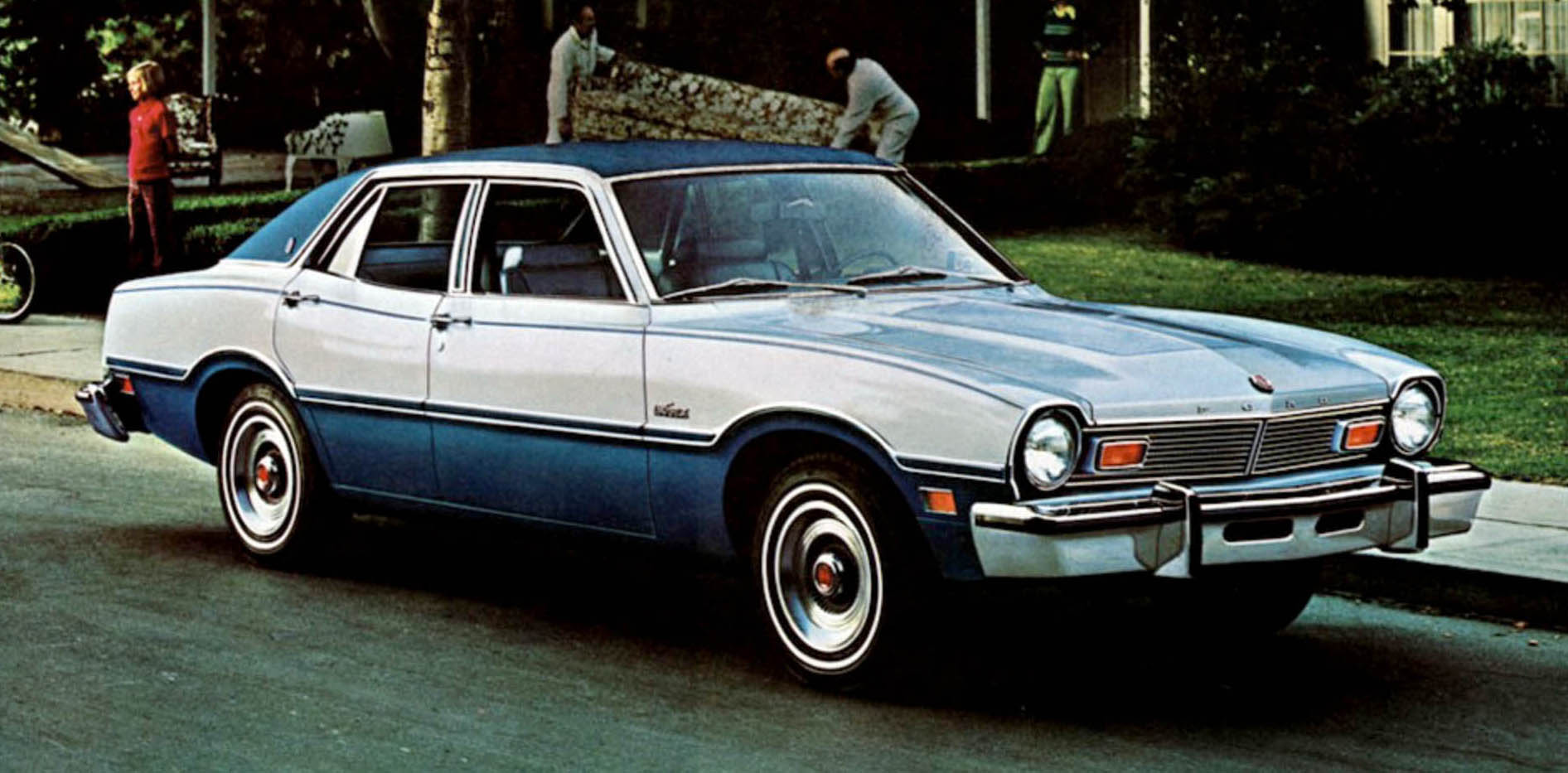
It was understood that tightening emissions controls and the rising price of fuel would turn “standard-size” Fords into dinosaurs, requiring them to rethink what an aspirational car might be for American buyers. For inspiration, Ford looked at rather small, boxy European sedans that were popular with affluent younger buyers, such as cars from Volvo and, most importantly, Mercedes-Benz. Buyers were dropping more than the cost of large Lincolns on these compact cars, a sign to Iacocca and Ford that there was money to be made in downsized products if they somehow related them to these upscale foreign sedans.
The new-for-1975 Granada would not replace the Maverick, but instead be marketed as a step up the ladder with a size and basic upright shape that mimicked the expensive German car.
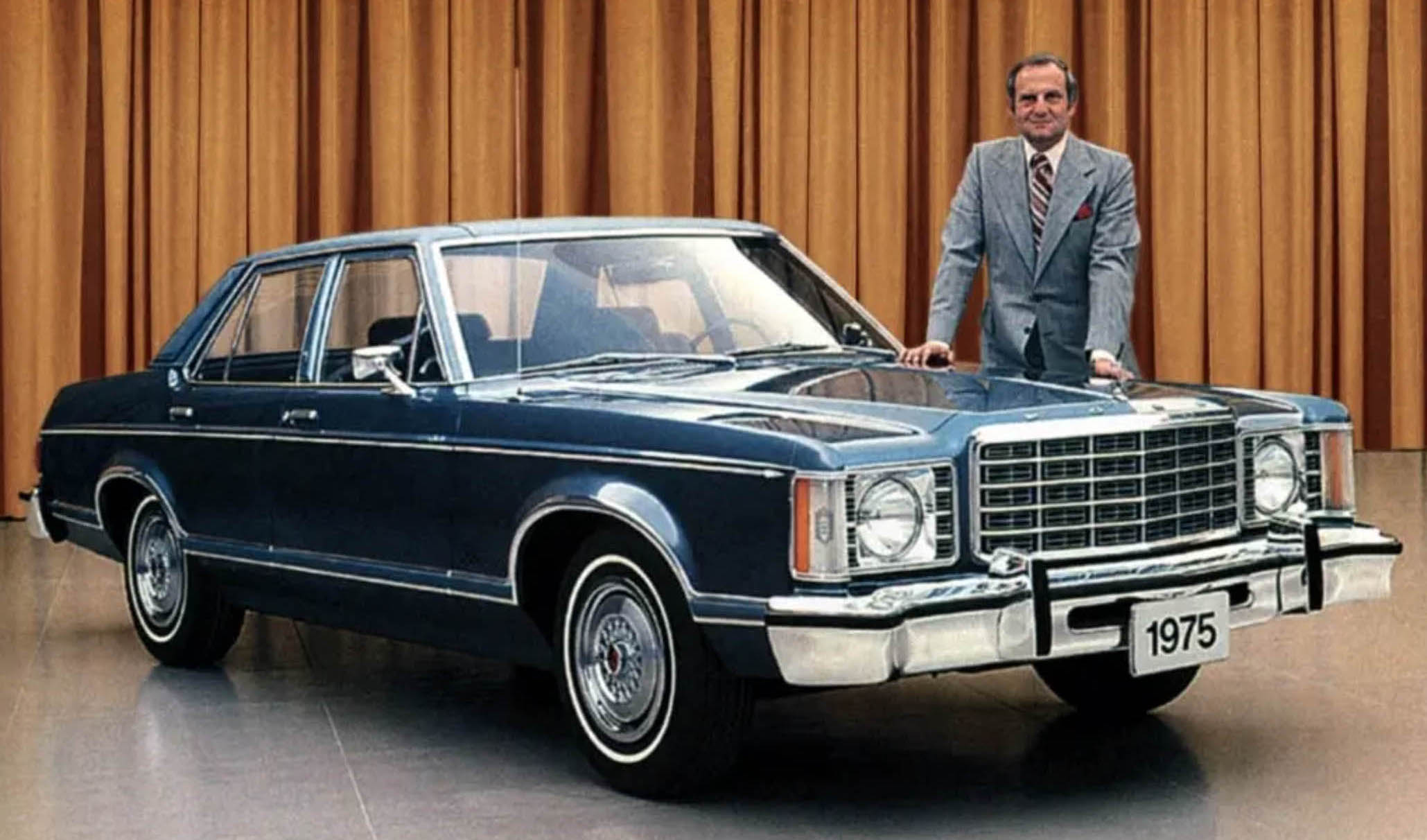
Well, “mimic” is a stretch, since you wouldn’t confuse this thing with a W114 280E or 240D on a dark and rainy night even if you were drunk and wearing sunglasses. Ah, but the average American buyer? This thing was a dead ringer for a Benz!
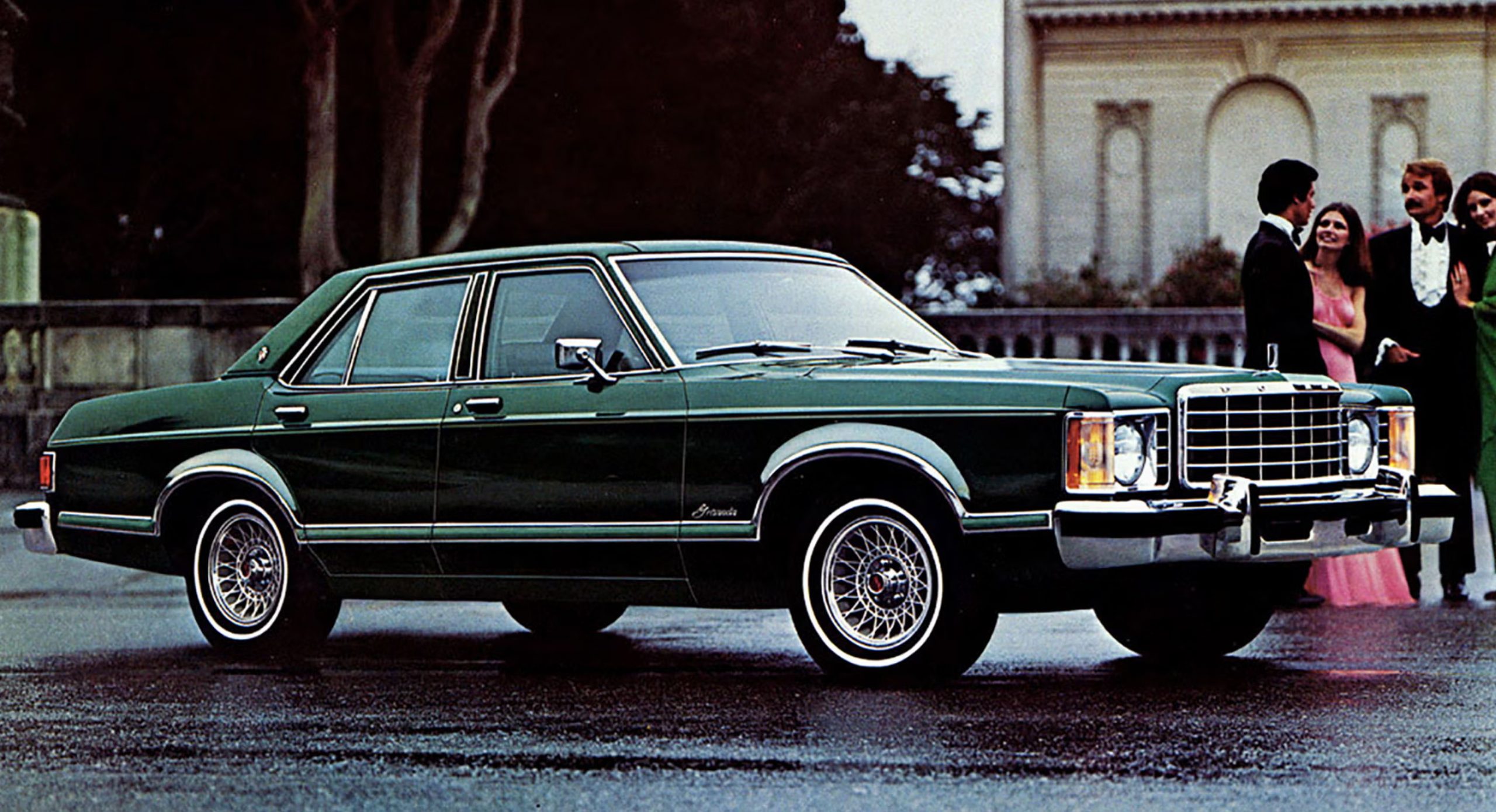
I’m dead serious; the Granada (and its Mercury twin, the Monarch) was an instant smash with buyers, selling over 400,000 in its first year. The chrome radiator grille and horizontal taillights with very-Euro amber rear turn signals were enough to convince people that this car had more in common with a Stuttgart-built creation than the Maverick/Falcon underneath its skin. The best part? The Granada wouldn’t really cost more than a Maverick to make, but they priced the Granada higher yet “still thousands less than a Mercedes,” a marketing move that made Ford gobs of cash on what would typically be a loss-leader size category of car.

Sure, next to a Starsky & Hutch-style Gran Torino the shape of the Granada looked a bit more like a Benz, but come on:
I remember reading a quote in an old car magazine where a Ford spokesman said that they took the Mercedes styling inside and out and added “more showbiz.” Yes, he really used those words, and you can see it.
Inside, that dashboard really shows that ethos. Shiny stuff and plastic wood everywhere, and essentially no instruments but a speedometer and a fuel gauge stashed somewhere amongst the controls.
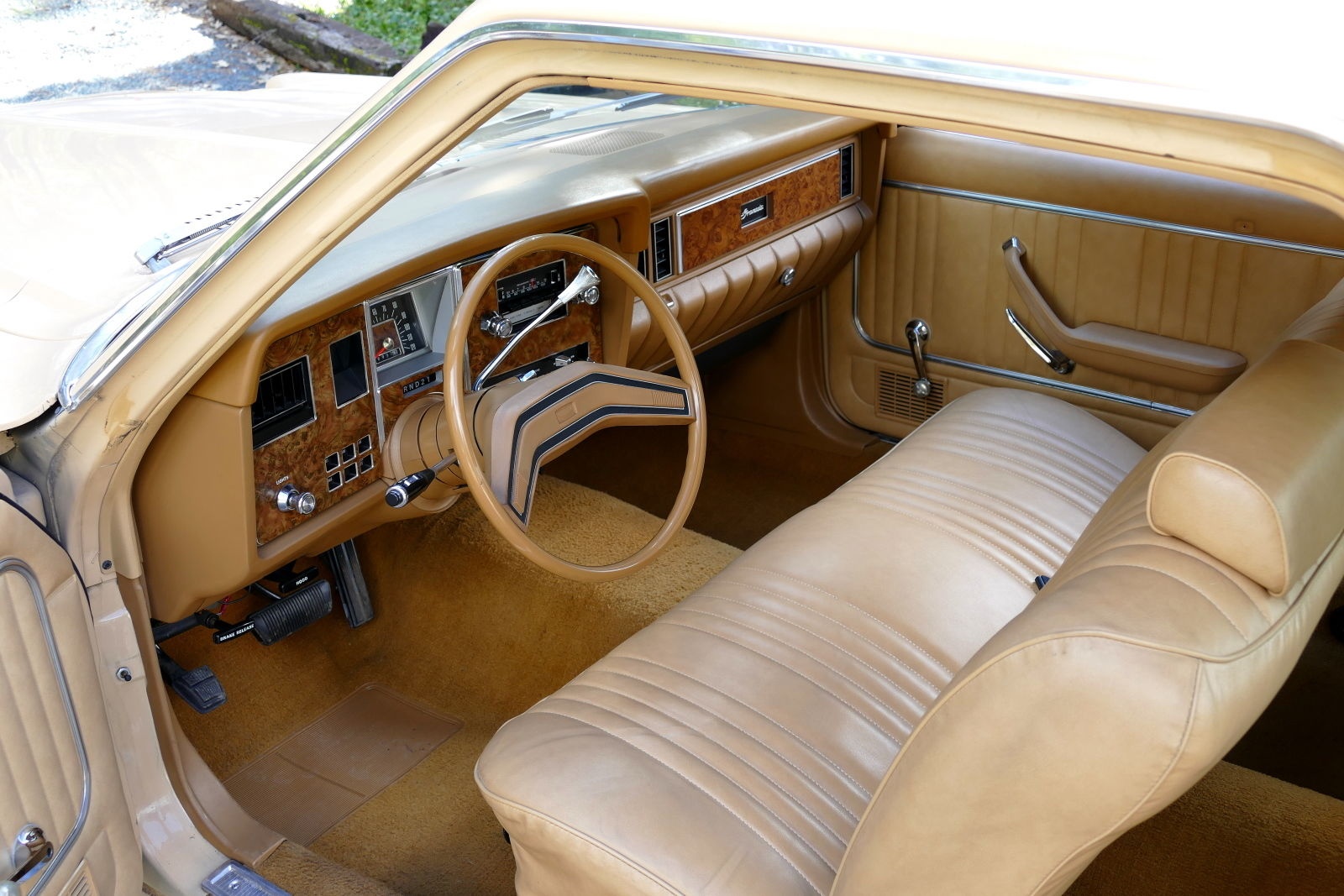
Under the sheet metal, you were just getting an old Maverick complete with the live axle in back on leaf springs. Base Granadas didn’t even come with power steering or brakes to go with the clunky “Thriftpower” 200 ci straight six.
Still, did it really look enough like a Mercedes? No, and just like dedicated-to-the-job celebrity impersonators getting plastic surgery to appear more like their idols, Ford knew they had to make an even more Mercedes-looking fake Mercedes for 1978. Enter the Granada ESS.
Mercedes Bent
Have you ever encountered a person who seems to have no concept of self-awareness? I’m talking about the all-hat-no-cattle types with nothing to back up their boisterous attitude behind their cellophane-thin cloak of respectability. That’s the Granada ESS.
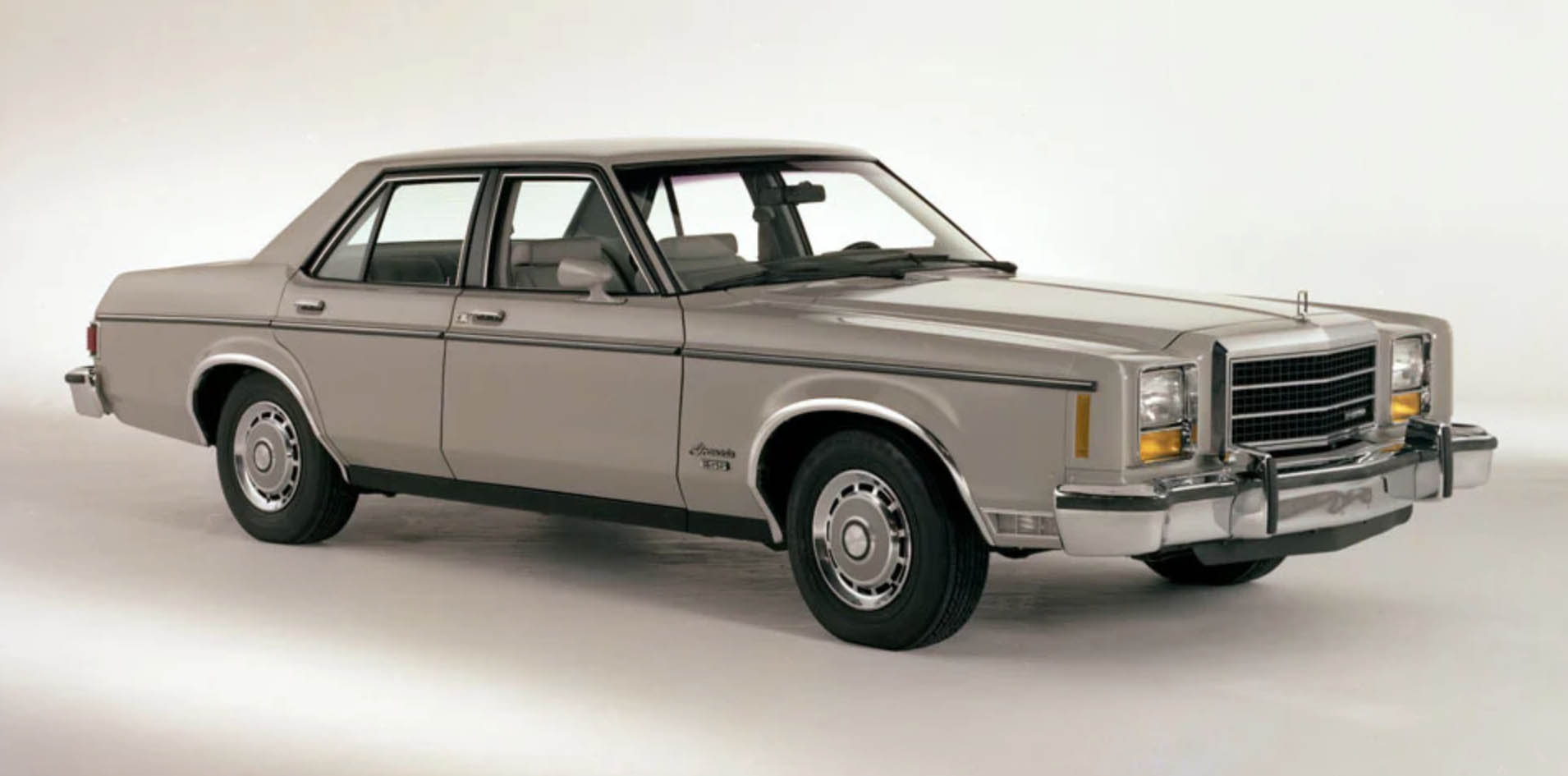
Color-keyed hubcaps with place keepers for three-pointed stars in the center? Sure. Blacked-out trim and logos with a blocky font to copy the trunk badges of a Benz? Got it. Ribbed taillights with amber signals? Yes, but these amber “lights” on later Granadas are just amber reflectors: Ford ditched the separate indicator bulbs and pocketed the cash.

Here’s the coupe with louvered opera windows that the above text says are “in the tradition of a European sport sedan.” What sport sedan would that even be?

Look at those so-called “European-type” Mercedes-shaped headrests! Were they serious?

In an ad, Ford even challenged you to discern the ESS from an actual Mercedes. Don’t peek at the answers first!

They just wouldn’t quit with the comparisons:
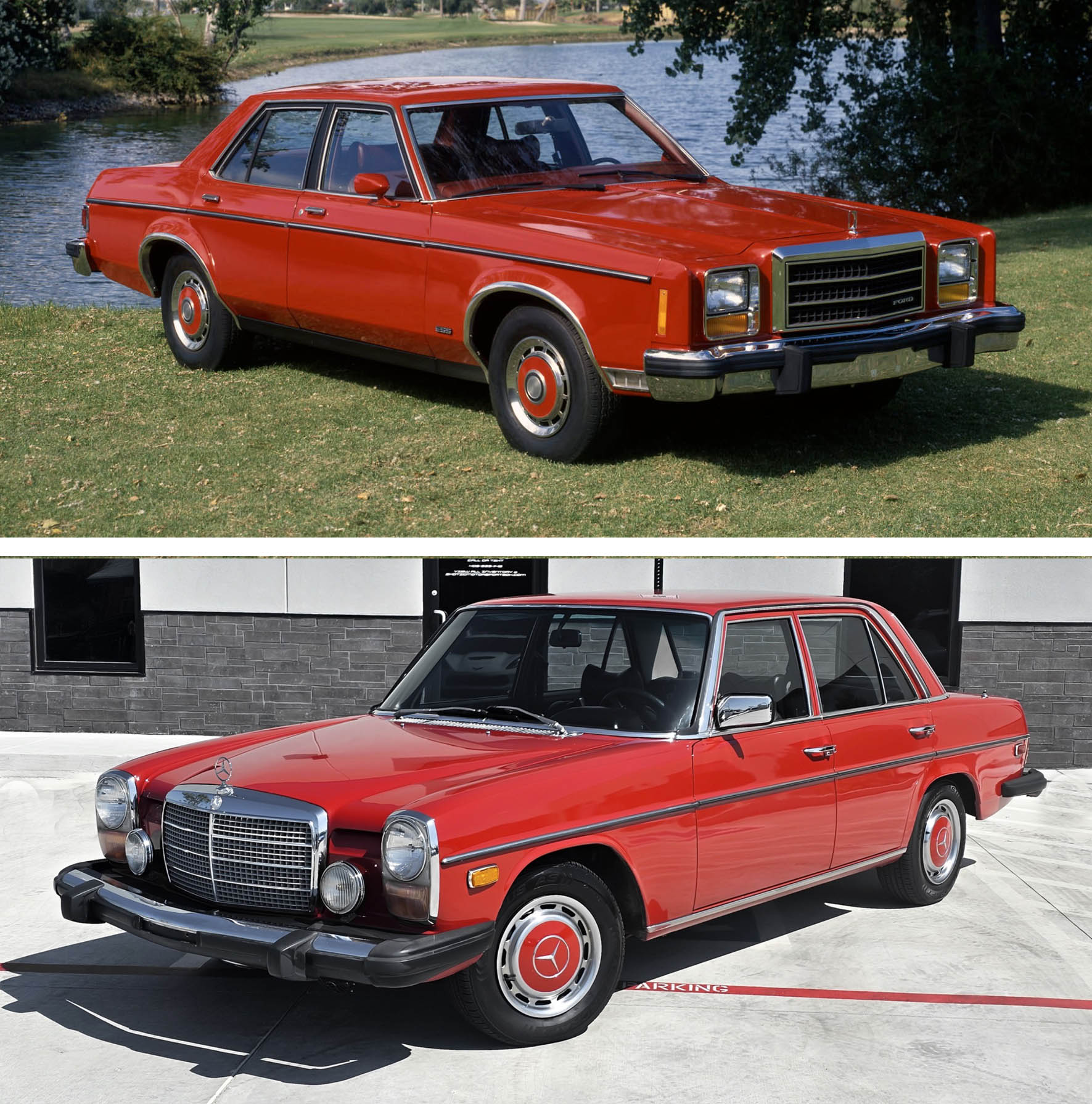
My favorite part of this is how Ford compares the Granada to a W116 S-Class that looks absolutely nothing like the Ford. Honestly, the only Benz it looked remotely like was the earlier W114 pre-E Class that was gone by then:
You want to know the saddest fact? Had the Granada truly been more like a Mercedes, it’s doubtful that as many Americans would have bought it. I think I can prove this pretty easily.
The Foxier Approach
Let’s face it: the Granada ESS was a bit of a joke. If Ford were serious about making a true European-style sedan they should have actually made an attempt to develop something where the “international” flavor wasn’t just pasted on. Ideally, they’d have built something with something like these parameters:
- Lighter weight than the Granada
- At least half a foot shorter than the Granada but more upright and far more space efficient inside
- Clean, purposeful, angular styling and minimal trim
- More modern suspension with something like MacPherson struts up front and coil springs in back
- Rack and pinion steering
- Bucket seats and full instrumentation in a workmanlike dash
Where could you have found an American car sedan at the time that fit that description? Well, if you were at the Ford dealership looking at the Granada or the Mercury store examining a Monarch, you’d have to walk at least twenty feet or so in the showroom over to a car Ford was already building at the time: the Ford Fairmont ESS and Mercury Zephyr ES Type.
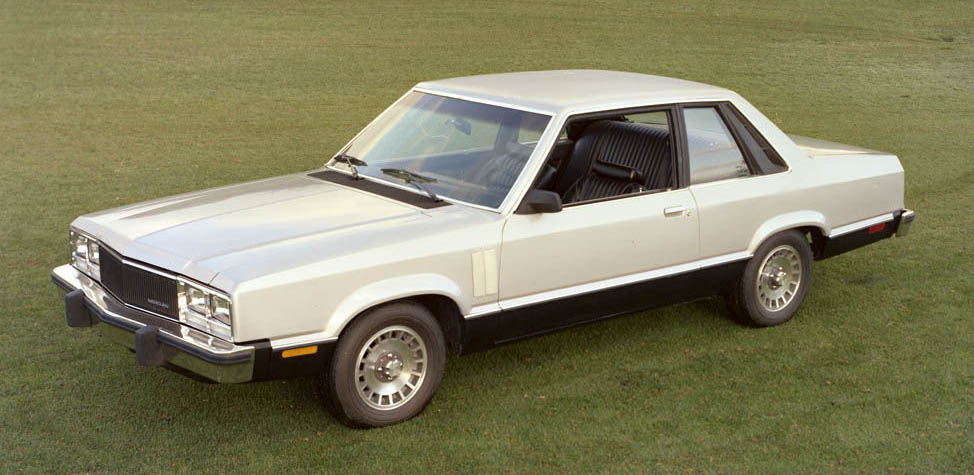
This was Ford’s first Fox body product in 1978, a car that began as an attempt at a “world car.” During the development of the global family car, Ford quickly learned that European and American buyers wanted very different things, and the Fox became a US-only product. Still, the bones of the Fox Fairmont were certainly based on the international design principles of the project. This clean and functional-looking car was not exactly a thing of unparalleled beauty, but then neither was a boxy BMW or a Volvo 240 (a car it was almost identical to in every dimension and basic technical specification). For 1979, Ford offered the “European Sport Option” for the Fairmont and its twin shown here, the Mercury Zephyr ES Type, with those awesome alloys. Just a straight-up no-nonsense design.
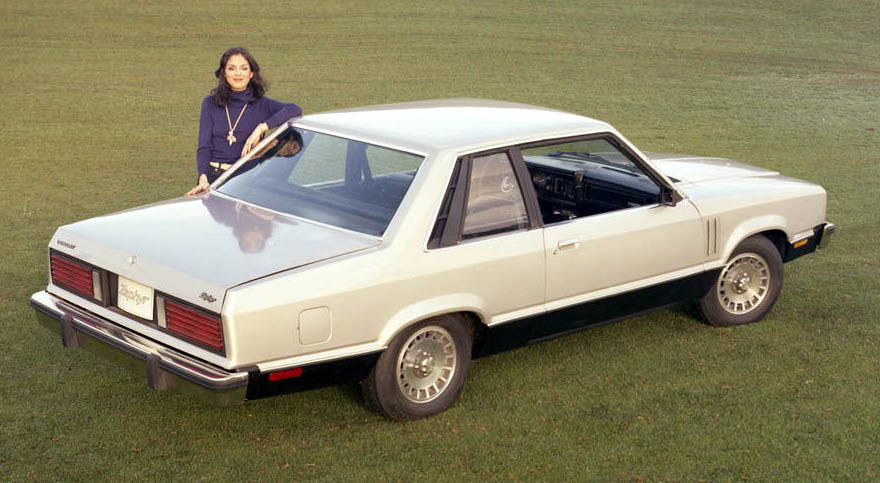
The ESO and ES Type package added a tighter suspension that included a rear stabilizer bar the standard car lacked, plus blacked-out trim, including the grille and rocker panels.

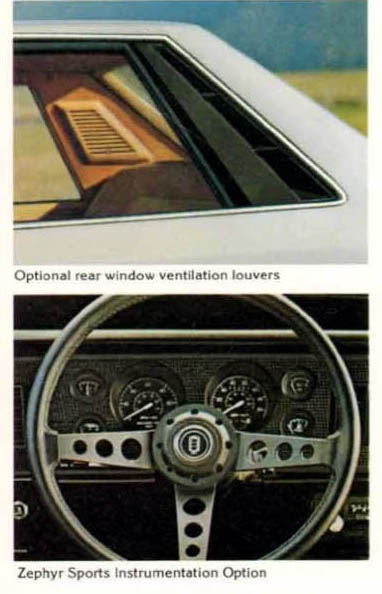
Even the black rear quarter vents were actual, functional air intakes for the back seat. Look at the ES dashboard; there’s a full set of round gauges, including a tachometer inside a decent steering wheel. There’s no “show biz” here, just honest design.
The ESO was essentially a Fox Mustang with a bigger back seat and trunk. You can see by the hood bulge with TURBO logo on the example below that the first four-cylinder turbocharged 2.3 motor was an available option for Fairmont, complete with a four-speed stick. Man, think of things you could do to this sedan with our current availability of modern Fox Mustang go-faster bits.

This Fairmont drove relatively well with a much lighter and more responsive feel than the Torino or Falcon-based predecessors. It was never going to challenge a 528i, but the pragmatic thinking behind it obviously showed that Ford knew better than to attempt the silliness they were doing at the same time with the Granada ESS, but they did it anyway.
There’s A Sucker Born Every Minute
I don’t have sales figures per model, so I can’t give an exact comparison between how many Granada ESS sold versus Fairmont ESO. However, as a car-obsessed Stranger Things-era kid, I was always aware of the vehicles around me; I know that I saw those fake Mercedes Granadas everywhere and hardly ever witnessed a Fairmont ESO.
This seems like unfathomable but undeniable proof that American buyers, or at least those of the seventies, would have rather had a distorted and glitzed-up look version of an imported sedan than a car that more closely followed the parameters of real European design. Once again, Lee Iacocca was right about the tastes of the market. Ain’t that depressing?
Top graphic image: Ford


We called them Granolas in elementary school. (See, granola, ferns and other alleged “California lifestyle” things were taking off then.)
While this story is not about a Granada, I will never forget my friend Bob’s dad bragging about his baby blue, mid-80s LTD.
His exact statement: “It’s got the cut of a Lexus!”
I have a 1975 Mercedes W114 280E. It’s still going, original paint is still nice, needs some engine work but it’s my default ‘I need to go somewhere’ car. Same orange as the one pictured here too, but more orange in person. They call it ‘English Red’ – I assume because it looks more red on an average, grey english day.
I can’t forget a Car & Driver road test of a Granada ESS (Remember, ESS stood for “European Sports Sedan”). After a delightfully vicious review… they finished with the line (OK, from my memory as a ten-year old).
“We think Ford should spell it this way: American Sports Sedan.”
I am still smiling almost fifty years later.
It’s hilarious how bad the trunk shut line looks in Ford’s own promotional photo of the Zephyr. Even on that low-res scan, it goes from a mile wide to almost nothing.
And the marketing slogan was: “Quality is job one” !!!