

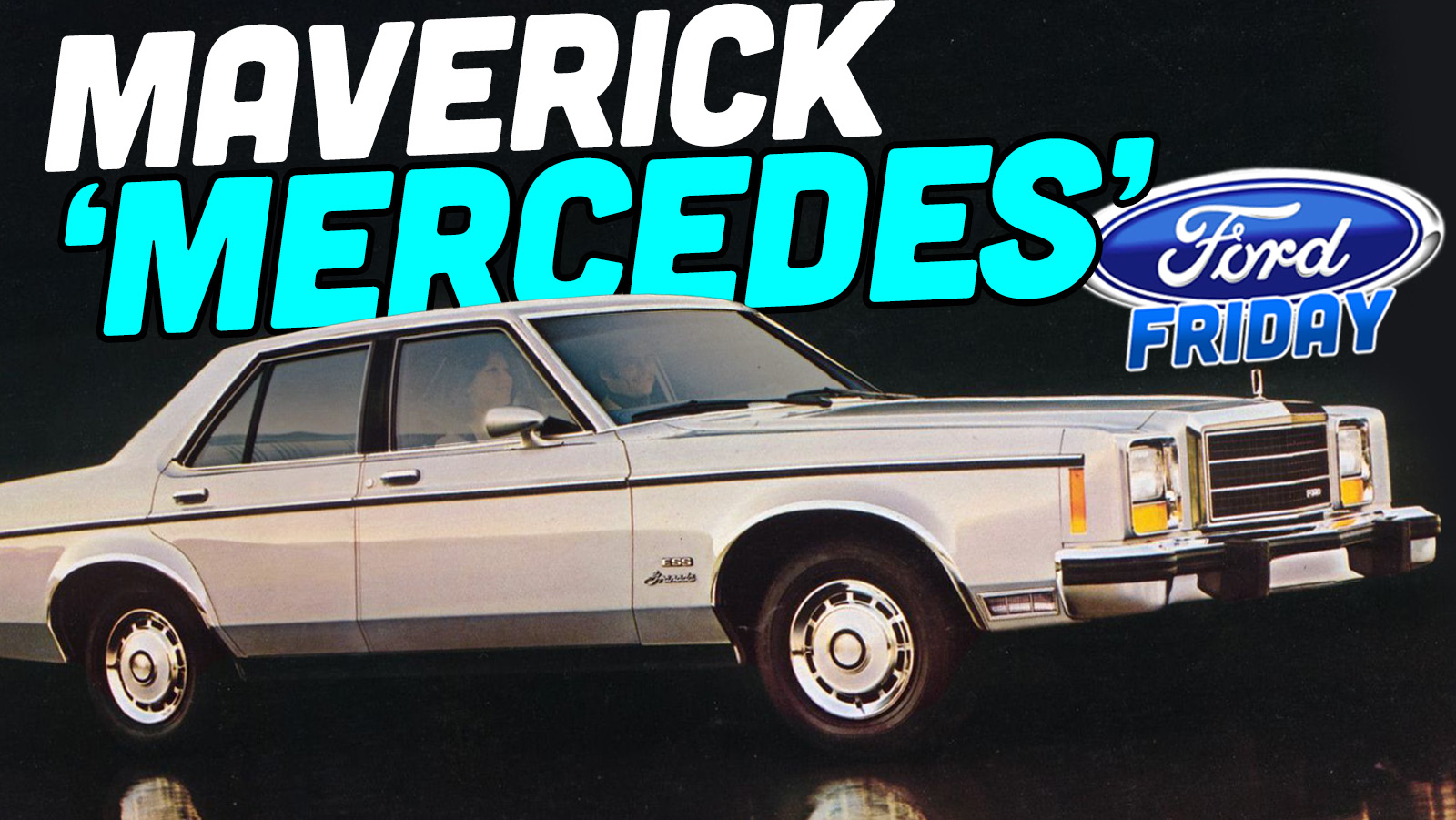
We all sometimes have delusions of grandeur and will happily accept whatever helps support this distorted vision. Car companies in particular are famous for this, and one of the best examples was Lee Iacocca’s 1975 Ford Granada, the “Maverick Mercedes.”
Ford was not content with just hinting that this inexpensive sedan was supposed to be a substitute for an expensive German car; they even made a version called the ESS that flat-out covered this poor thing in a Halloween costume to (badly) mimic the Benz. Even worse, people actually bought it, and they basically ignored a car sitting right next to it in the Ford showroom that was a far better approximation of a European machine.


Stay Classy, Ford
“Small cars equal small profits” is an old car-biz adage, and Henry Ford II was one of its great believers. Surprisingly, the person he promoted to president of the company in 1970 seemed hell bent on finding ways to disprove that theory.
With the 1964 1/2 Mustang, he created a money-making sporting coupe for minimal dollars that was a smash success. Ten years later, he attempted to repeat this feat using almost the same car. You see, the Mustang was basically a modified and rebodied Falcon, Ford’s mainstay compact car, which had been replaced in 1970 by the similarly laid out Maverick. This super-basic transportation device sold well but was never going to make big car money for Ford.
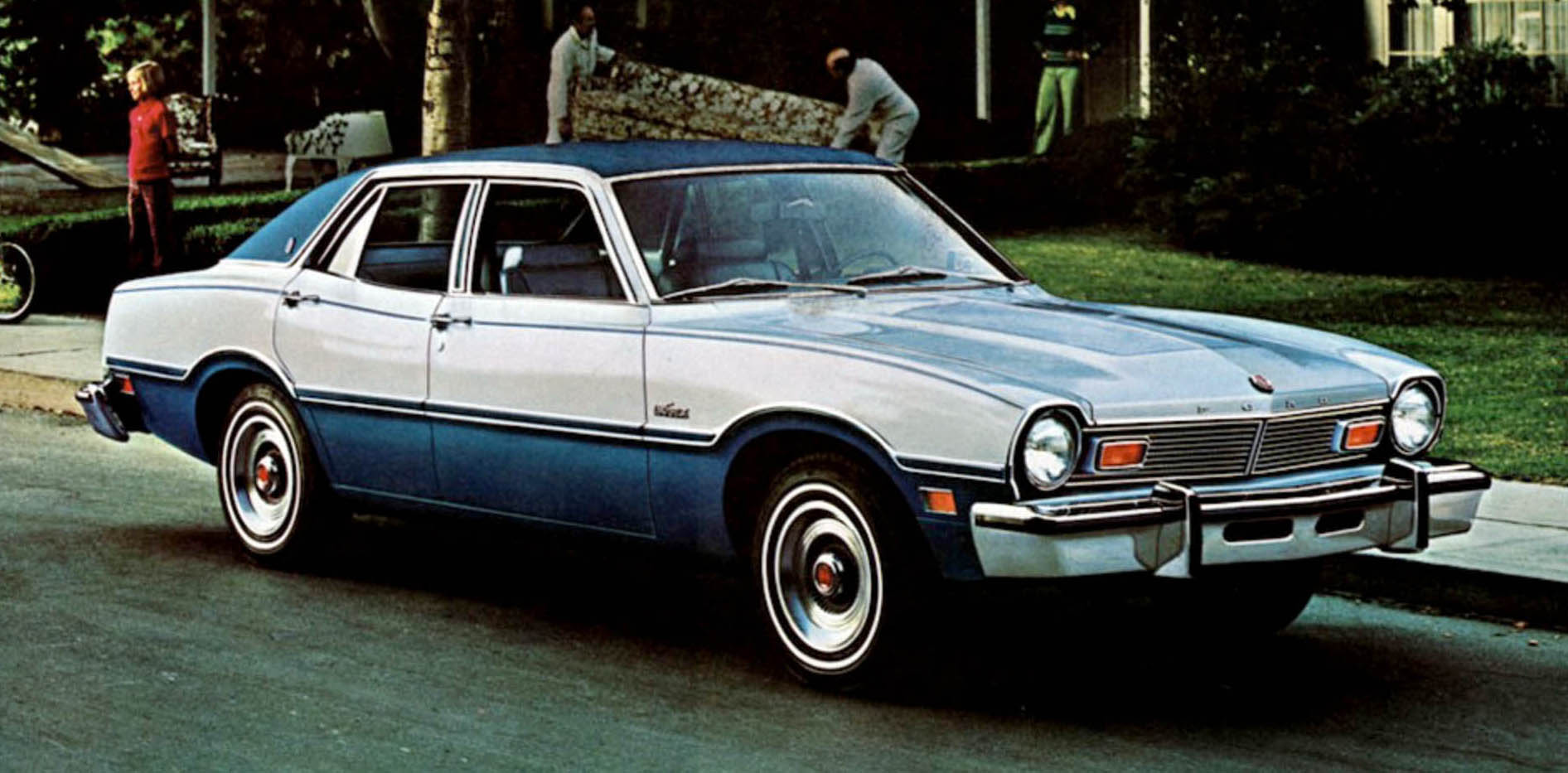
It was understood that tightening emissions controls and the rising price of fuel would turn “standard-size” Fords into dinosaurs, requiring them to rethink what an aspirational car might be for American buyers. For inspiration, Ford looked at rather small, boxy European sedans that were popular with affluent younger buyers, such as cars from Volvo and, most importantly, Mercedes-Benz. Buyers were dropping more than the cost of large Lincolns on these compact cars, a sign to Iacocca and Ford that there was money to be made in downsized products if they somehow related them to these upscale foreign sedans.
The new-for-1975 Granada would not replace the Maverick, but instead be marketed as a step up the ladder with a size and basic upright shape that mimicked the expensive German car.
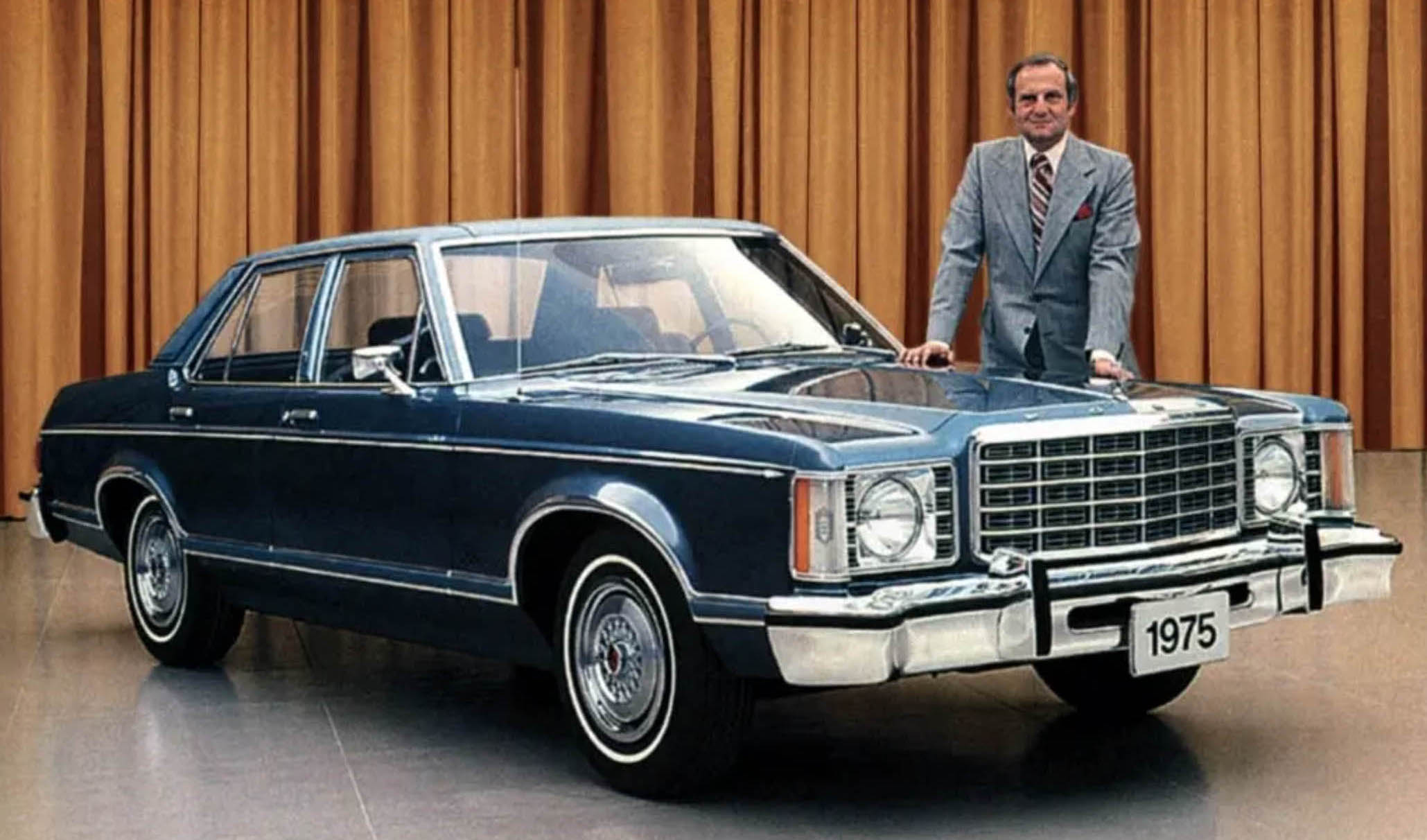
Well, “mimic” is a stretch, since you wouldn’t confuse this thing with a W114 280E or 240D on a dark and rainy night even if you were drunk and wearing sunglasses. Ah, but the average American buyer? This thing was a dead ringer for a Benz!
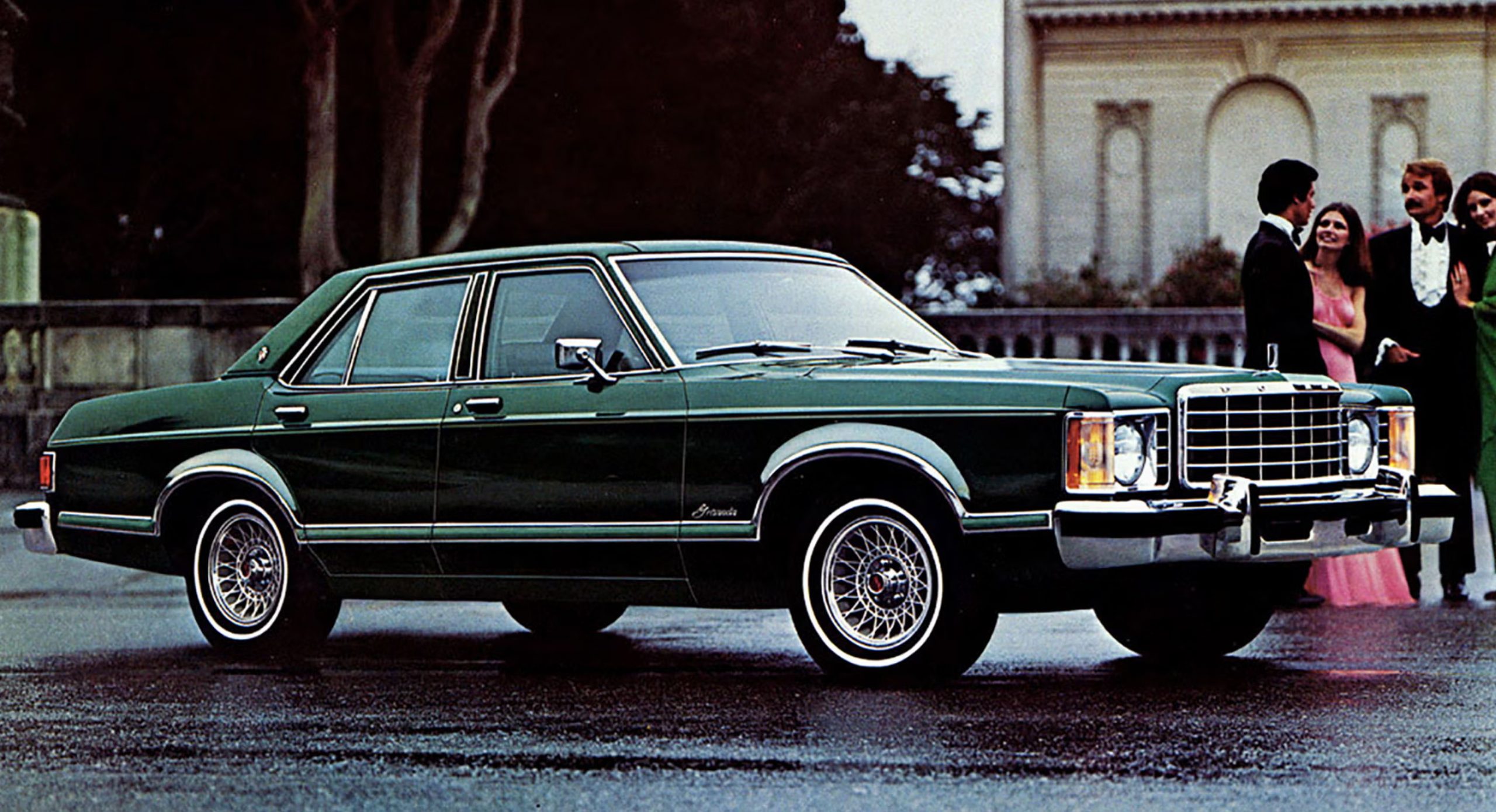
I’m dead serious; the Granada (and its Mercury twin, the Monarch) was an instant smash with buyers, selling over 400,000 in its first year. The chrome radiator grille and horizontal taillights with very-Euro amber rear turn signals were enough to convince people that this car had more in common with a Stuttgart-built creation than the Maverick/Falcon underneath its skin. The best part? The Granada wouldn’t really cost more than a Maverick to make, but they priced the Granada higher yet “still thousands less than a Mercedes,” a marketing move that made Ford gobs of cash on what would typically be a loss-leader size category of car.

Sure, next to a Starsky & Hutch-style Gran Torino the shape of the Granada looked a bit more like a Benz, but come on:
I remember reading a quote in an old car magazine where a Ford spokesman said that they took the Mercedes styling inside and out and added “more showbiz.” Yes, he really used those words, and you can see it.
Inside, that dashboard really shows that ethos. Shiny stuff and plastic wood everywhere, and essentially no instruments but a speedometer and a fuel gauge stashed somewhere amongst the controls.
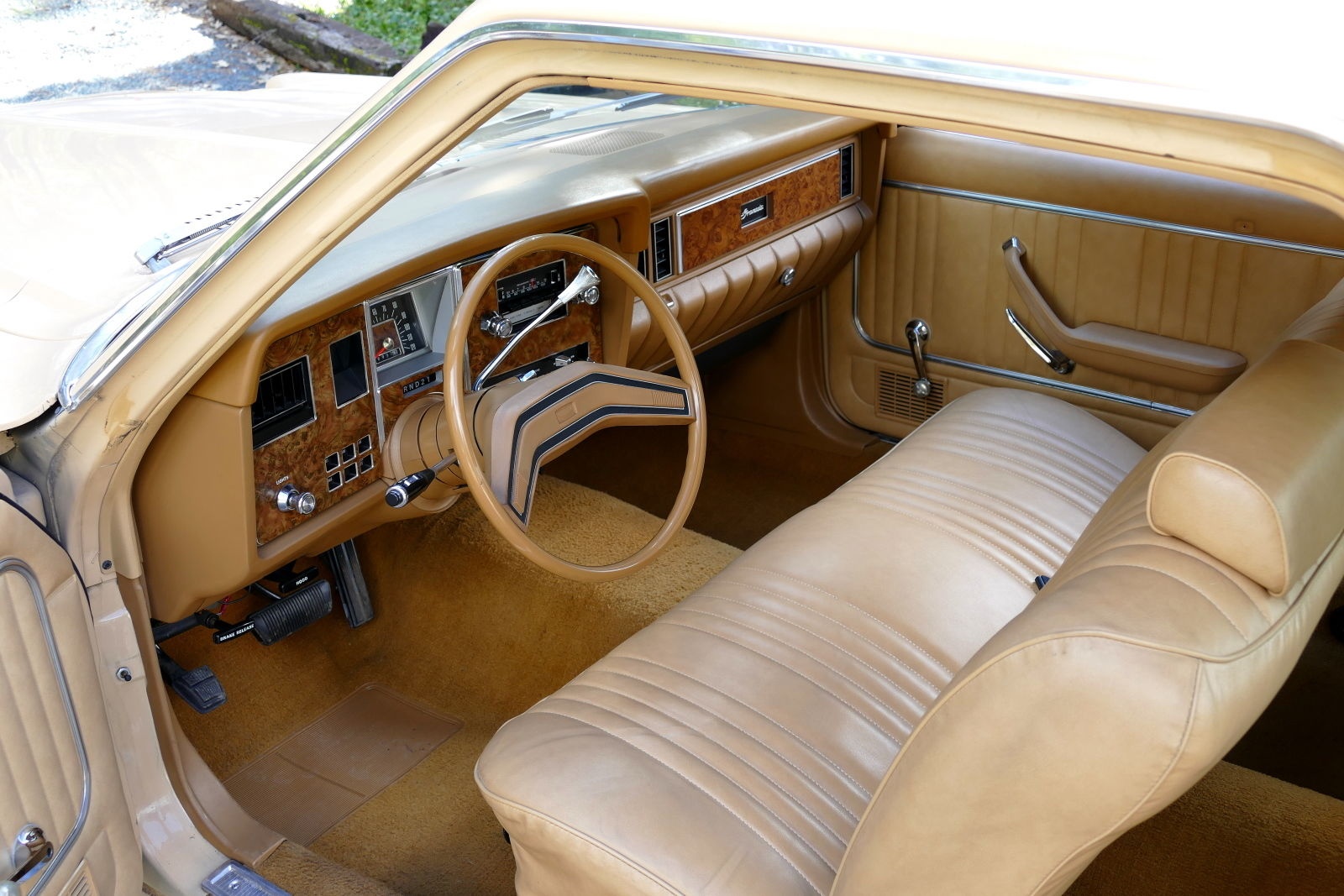
Under the sheet metal, you were just getting an old Maverick complete with the live axle in back on leaf springs. Base Granadas didn’t even come with power steering or brakes to go with the clunky “Thriftpower” 200 ci straight six.
Still, did it really look enough like a Mercedes? No, and just like dedicated-to-the-job celebrity impersonators getting plastic surgery to appear more like their idols, Ford knew they had to make an even more Mercedes-looking fake Mercedes for 1978. Enter the Granada ESS.
Mercedes Bent
Have you ever encountered a person who seems to have no concept of self-awareness? I’m talking about the all-hat-no-cattle types with nothing to back up their boisterous attitude behind their cellophane-thin cloak of respectability. That’s the Granada ESS.
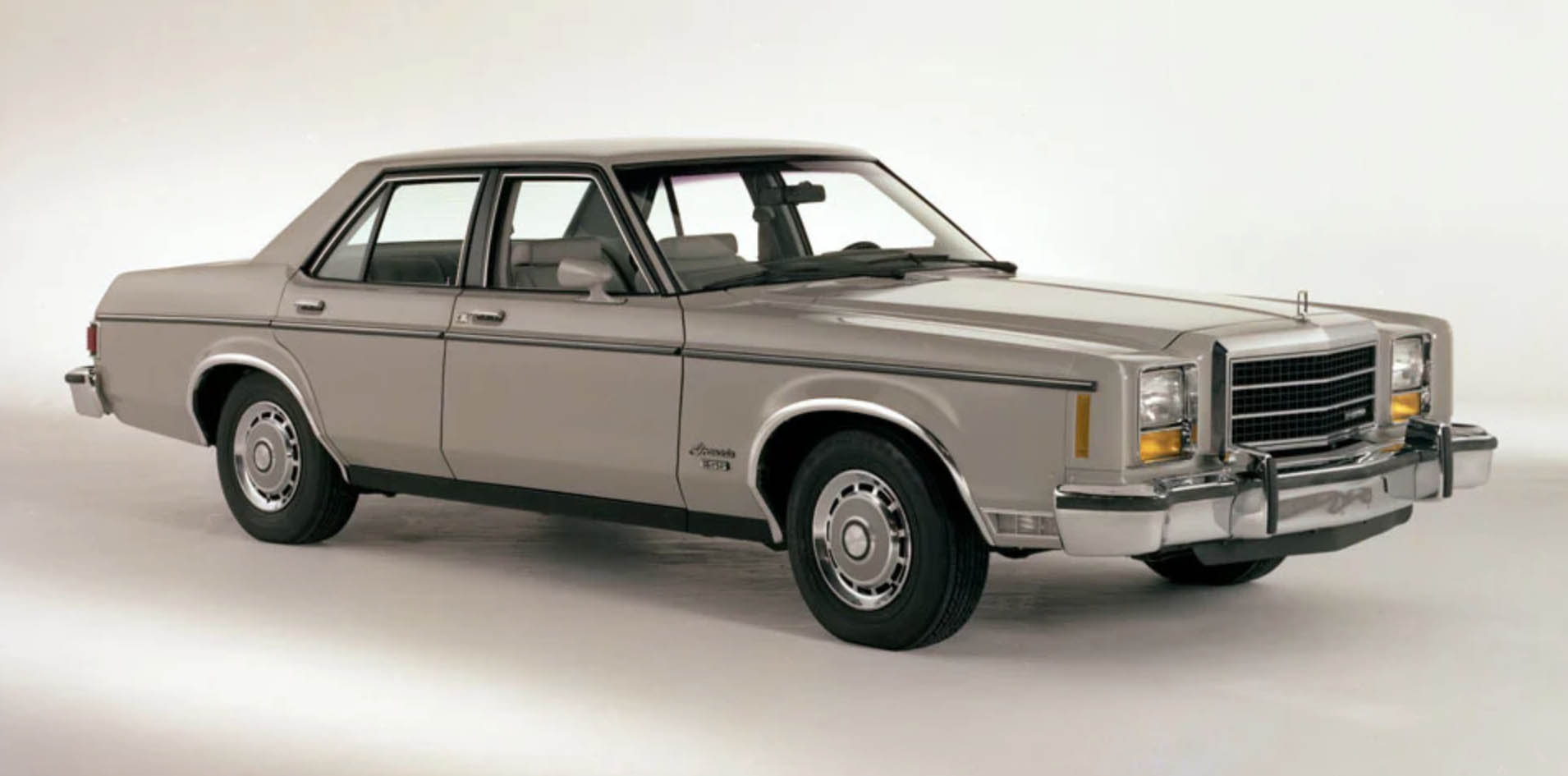
Color-keyed hubcaps with place keepers for three-pointed stars in the center? Sure. Blacked-out trim and logos with a blocky font to copy the trunk badges of a Benz? Got it. Ribbed taillights with amber signals? Yes, but these amber “lights” on later Granadas are just amber reflectors: Ford ditched the separate indicator bulbs and pocketed the cash.

Here’s the coupe with louvered opera windows that the above text says are “in the tradition of a European sport sedan.” What sport sedan would that even be?

Look at those so-called “European-type” Mercedes-shaped headrests! Were they serious?

In an ad, Ford even challenged you to discern the ESS from an actual Mercedes. Don’t peek at the answers first!

They just wouldn’t quit with the comparisons:
My favorite part of this is how Ford compares the Granada to a W116 S-Class that looks absolutely nothing like the Ford. Honestly, the only Benz it looked remotely like was the earlier W114 pre-E Class that was gone by then:
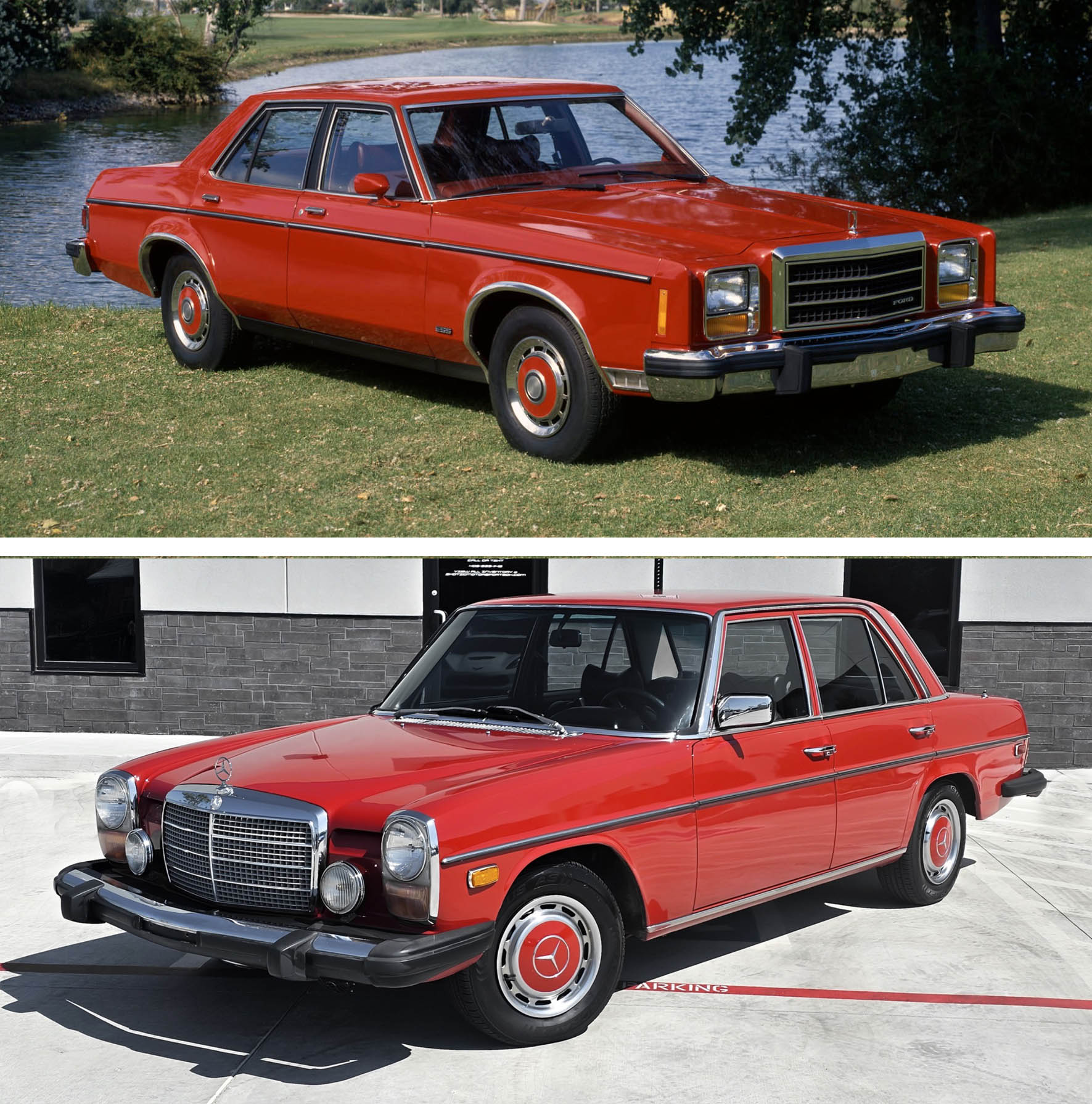
You want to know the saddest fact? Had the Granada truly been more like a Mercedes, it’s doubtful that as many Americans would have bought it. I think I can prove this pretty easily.
The Foxier Approach
Let’s face it: the Granada ESS was a bit of a joke. If Ford were serious about making a true European-style sedan they should have actually made an attempt to develop something where the “international” flavor wasn’t just pasted on. Ideally, they’d have built something with something like these parameters:
- Lighter weight than the Granada
- At least half a foot shorter than the Granada but more upright and far more space efficient inside
- Clean, purposeful, angular styling and minimal trim
- More modern suspension with something like MacPherson struts up front and coil springs in back
- Rack and pinion steering
- Bucket seats and full instrumentation in a workmanlike dash
Where could you have found an American car sedan at the time that fit that description? Well, if you were at the Ford dealership looking at the Granada or the Mercury store examining a Monarch, you’d have to walk at least twenty feet or so in the showroom over to a car Ford was already building at the time: the Ford Fairmont ESS and Mercury Zephyr ES Type.
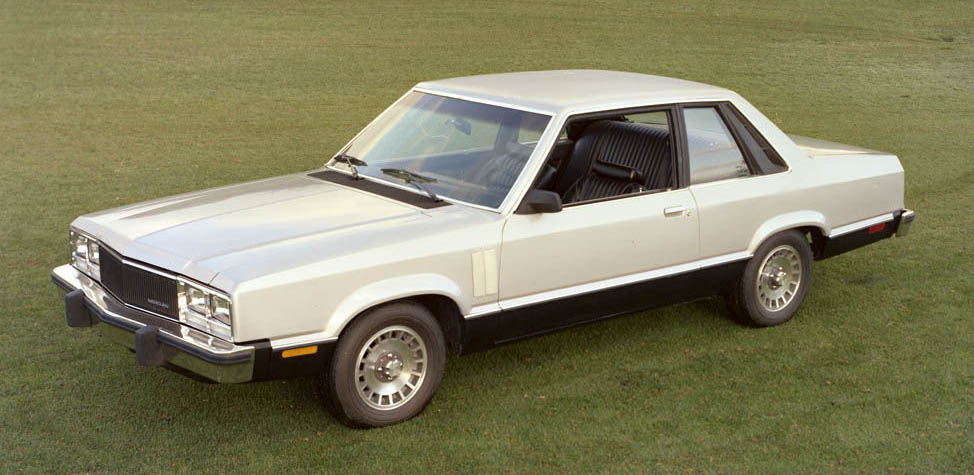
This was Ford’s first Fox body product in 1978, a car that began as an attempt at a “world car.” During the development of the global family car, Ford quickly learned that European and American buyers wanted very different things, and the Fox became a US-only product. Still, the bones of the Fox Fairmont were certainly based on the international design principles of the project. This clean and functional-looking car was not exactly a thing of unparalleled beauty, but then neither was a boxy BMW or a Volvo 240 (a car it was almost identical to in every dimension and basic technical specification). For 1979, Ford offered the “European Sport Option” for the Fairmont and its twin shown here, the Mercury Zephyr ES Type, with those awesome alloys. Just a straight-up no-nonsense design.
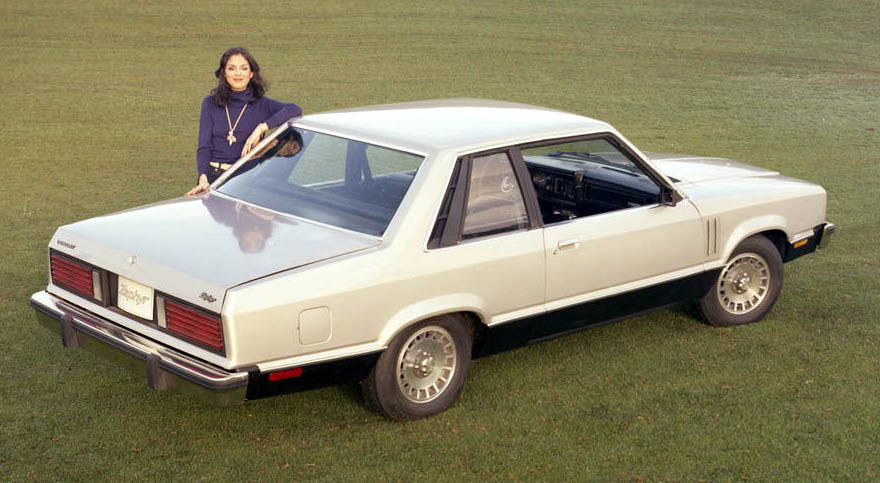
The ESO and ES Type package added a tighter suspension that included a rear stabilizer bar the standard car lacked, plus blacked-out trim, including the grille and rocker panels.

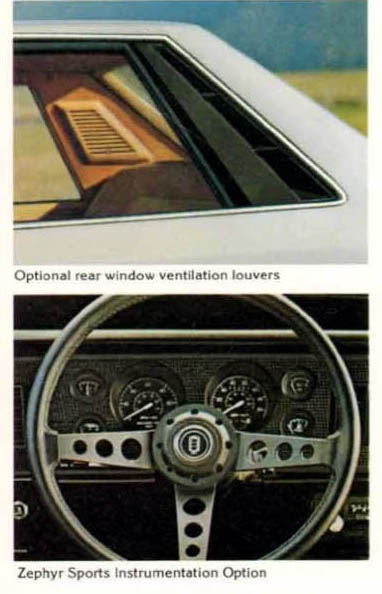
Even the black rear quarter vents were actual, functional air intakes for the back seat. Look at the ES dashboard; there’s a full set of round gauges, including a tachometer inside a decent steering wheel. There’s no “show biz” here, just honest design.
The ESO was essentially a Fox Mustang with a bigger back seat and trunk. You can see by the hood bulge with TURBO logo on the example below that the first four-cylinder turbocharged 2.3 motor was an available option for Fairmont, complete with a four-speed stick. Man, think of things you could do to this sedan with our current availability of modern Fox Mustang go-faster bits.

This Fairmont drove relatively well with a much lighter and more responsive feel than the Torino or Falcon-based predecessors. It was never going to challenge a 528i, but the pragmatic thinking behind it obviously showed that Ford knew better than to attempt the silliness they were doing at the same time with the Granada ESS, but they did it anyway.
There’s A Sucker Born Every Minute
I don’t have sales figures per model, so I can’t give an exact comparison between how many Granada ESS sold versus Fairmont ESO. However, as a car-obsessed Stranger Things-era kid, I was always aware of the vehicles around me; I know that I saw those fake Mercedes Granadas everywhere and hardly ever witnessed a Fairmont ESO.
This seems like unfathomable but undeniable proof that American buyers, or at least those of the seventies, would have rather had a distorted and glitzed-up look version of an imported sedan than a car that more closely followed the parameters of real European design. Once again, Lee Iacocca was right about the tastes of the market. Ain’t that depressing?
Top graphic image: Ford


I can’t remember the last time I saw a Grenada on the road, but I know each time I see an article about the Granada ESS I have this irrational desire to find a nice one and prostreet it. I have no use or desire (or money) for a pro street car, but it just seems like a Mercedes-copying American sedan from the mallaise era needs the silliness of a blown big block under the hood and tubbed drag slicks in the back.
I approve!
Fun fact:
My grandfather bought a Mercedes 280SE new in ’72. I think that’s a W114. He had bought mostly American cars prior to that and his business was doing really well at the time so he thought he’d “step up” to the Benz.
Well, it turned out to be THE biggest POS he had ever owned. The automatic was seriously problematic and the car was in the shop almost as much as it wasn’t. He was an outdoorsman and also a friend of my other grandfather so the two of them often went hunting. Legend goes that the two of them went up to our cottage up in the woods of northern central Michigan and the damned Benz locked up the trans again. Grandpa got under the car and beat on the shifter while my other grandfather tried to get the shifter to move in the car. All they got was reverse so they proceeded to drive the nearly brand new Mercedes BACKWARDS several miles on a two-track dirt road out of the woods and back to town to see if they could get it fixed.
The related part of the story is that when the Granada came out new in ’75, Grandpa traded that POS Benz in for a new Granada, brown, with a 302, and drove that for the next five years.
He hated that “goddam Benz”.
Sometimes truth is stranger than fiction.
A 1972 280SE is a final-year W108.
Its strange hearing about transmission issues, as in general those automatics were practically bulletproof – If shifting was sluggish, they were probably just low on fluid.
The best thing about the Maverick was its clean uncluttered styling and an uncluttered engine compartment.
I wish there was a car made in this century like that. The rwd Volvos were the last I can think of.
Seeing those interior pics of the Granada, I see a lot of recycle parts from the Maverick. Those damn interior front door handles. The internal plastic would break within 5 yrs on every car that had them, leaving a severed/floppy stub that was hard to grab and slam the heavy door.
-Had a 77 Maverick (V8) and my Mom had 70 Maverick, then a 73 Comet.
The cast Zemac interior metal door handles weren’t much better. On quite a few trucks my dad replaced all the handles with some steel handles he welded up, the original handles were so bad.
I learned to drive in my folks’ then new ’76 Granada and proceeded to have all manner of high-school shenanigans in and around it. Yes, the marketing was silly, but it really wasn’t a bad car for the time. A low bar, I know.
I don’t recall seeing these ES and ESS Fairmont/Zephyrs, but they’re legit not bad looking as coupes. The Zephyr wheels are particularly nice and the Ford’s are decent. Both cars are much nicer looking than the more basic ones that sold by the train load. Grenadas and shit like them were abominable and that era of junk tainted my view of Ford as what we’d call today a “Dollar Store brand” until Hyundais became popular and Daewoo came (and went). Even their older, good stuff I dismissed as only one step above AMC all due to the perception I developed from their Malaise era trash. Yeah, the Big 3’s output was pretty much all bad then, but as I was more familiar with their older offerings, Chrysler and GM seemed like they had fallen from a high rather than always being shit. I don’t feel quite that way now, but it took a while to shake it (I even bought two Fords—my only domestic cars).
Shortly before we started dating my first wife bought a brand new ’78 Granada ESS coupe, complete with the vinyl top and opera window louvers. In fairness, it probably wasn’t bad looking by the standards of the day but it was, without question, the most excruciating POS vehicle I have ever been associated with and still gives me nightmares 45+ years later.
The Fairmont ESO looks way better than I remember.
People in the 70s drank Folders and insisted you couldn’t tell it apart from fresh ground coffee. They also drank Tang instead of real orange juice. So a car like the Granada ESS was bound to happen.
To be fair, we were blitzed out of our minds half the time and everything smelled like cigarette smoke and BO.
And broke, don’t forget that. We just pretended all that stuff was just as good.
Not to mention all the lead exposure from paint and gasoline.
I can’t imagine anybody could taste anything with all the smoking.
…I think the saddest part of this is that it speaks to how much many people want a life better than what they have and can afford. It still persists today in the sheer amount of Temu, Amazon and AliBaba knockoff crap of luxury goods. And I don’t think it’s explicitly about trying to fool people but giving them a taste of the good life for a “reasonable cost.” Except in both this case and the no-name discount goods, they ended up being just a bit too cheap. Like all those “hoverboards” that were all the rage but caught fire because the discount versions didn’t have good charge protection.
The “American Dream” of anyone being able to make it big and live the “good life” has long been a target of companies around the world, not just here. All you have to do is promise big dreams at Midwest coupon clipping prices, and you’re making bank. Just make sure that if you get too cheap making it, no-one can find your corporate address.
I feel this: quality is a luxury. Boots that last for decades, cars that don’t rust out or seize the engine in 150k. I’d rather own quality that lasts than some flash-in-the-pan fad. I’d rather spend my money on quality and experiences than superficially keeping up with the Joneses. I’d honestly not mind having LESS stuff in my life, focus on what matters to ME.
I won’t say not everyone can have the “good life”, since that’s just mean. But we could all have better lives if those living the “good life” weren’t so damn greedy.
The Granada and Monarch were essentially automotive fast fashion, designed to give a showy flash of luxury style for a brief period of time before falling apart, but not really to fool any eye who could afford actual luxury
Of course, then there’s the matter of the Lincoln Versailles, which was just a Granada with even more baroque gingerbread stuck on and priced equivalent to $60,000 today, inflation adjusted. Granted, it was still only a little more than half the price of the allegedly benchmarked Mercedes, but, still, $11,500 could buy a decent quality car back then, the Lincoln version was meant for people who were rich, but still didn’t know any better
My great grandparents John Blessing and Irene Crone had an immaculate Granada in Ft. Meyers Beach, FL. He was a dapper, decorated veteran of WW1 and WW2. She was a tiny thing with a firm mind and sharp tongue. I remember two things about the Granada – pop can quality and GPS.
The car looked nice, but the sheet metal was so thin that if you leaned against the side it would dent like an aluminum soda can, then pop back out. I once inadvertently bent the door. No problem – just grab the window frame and twist it back.
As far as the GPS… Grandpa still had lightning quick reflexes, but his eyesight was going and he was a little scrambled mentally. Grandma Crone, who never(!) had a drivers license, rode shotgun and provided guidance. “There’s a car up there, John B! Slow down, John B! Turn here, John B!” Grandma Positioning System. You did NOT disobey The Voice. Wish I could get Apple Maps to sound like that.
I have no idea why my parents let us ride with them when we visited at Christmas, but it was always a thrill.
The quiet authority of the woman in charge.
She was never quiet. After great grandpa died, a college buddy and I decided it would be a cheap spring break to stay in her downstairs guestroom.
After driving all day and night to get there, we woke up at 6am to loud banging right over our heads. Great Grandma Crone made us breakfast and was pounding her cane on the floor exactly over the cots in the basement. Spring break, we discovered, meant a week of eggs and toast at 6am.
I had a Thunderbird Turbo Coupe I was quite proud of at the time. We took her out to dinner one night. After insisting on climbing into the backseat, she was quiet for the first part of the drive. Then we heard one comment: “Doesn’t ride like a Cadillac.”
Ford Granada ESS buyers:
“You look marvelous! It’s better to look good than to feel good.”
Classy vs Trashy
I don’t remember seeing these in the “Euro” trim levels in any numbers as a car-obsessed kid (age 5-15 over the course of the ’80s) but they may not have stood out from the massive numbers of other Granadas and Fairmonts that were absolutely everywhere, both of ’em.
What impressions they did make;
In the progression of cars my mother had while I was too small to really pay attention. A 1970 Pinto that was vandalized into a write-off. That was replaced with a bay blue Granada, probably a 1976 that ate it’s transmission. She replaced the Granada with a 1982 Datsun B210 Hatchback, the first non-ford vehicle she ever bought, much to the chagrin of my Grandfather who had been working for Ford Tractor forever. She never bought another Ford product after the Granada, it was that bad.
Cringe.
Fortunately many years ago.
But always a great story 🙂
I can’t hear/read Monarch without thinking about a cocoon and henchmen 21 and 24.
HEEENCHMEN!!
This wasn’t the first Falcon-derivative which was marketed with “European Styling” Remember the 1967 Cougar? (tho Mercury couldn’t explain exactly which European car the Cougar was meant to look like – but no matter…)
Meanwhile, on the left side of the Atlantic, Ford sold a Granada which actually looked more like a 5 Series/Audi mashup than the Falcon Granada looked like a Mercedes.
Then we got the Fox Granada (which was paired with a Fox Cougar Sedan/Wagon) – which looked more like a Fairmont than a Mercedes. I didn’t last long.
The’s the Alhambra in Granada, but if you were lucky enough to score one of these from Bob Wondries Ford in LA when it was still open, you’d actually have a Granada in Alhambra.
Boabdil is not impressed.
Tho if you saw a Granada on Grenada back then, it was more likely to be an actual European sedan.
Reagan will send people to investigate this.
There was an MPV called the SEAT Alhambra which was variant of the VW Sharan and Ford Galaxy, and there were probably a lot in Granada
All of the road hugging weight American buyers craved.
Ford had intended to replace the Maverick with the Granada. Along the way the 1st energy crisis happened, Maverick sales increased and more importantly sales of the profitable LDO package (Luxury Decor Option) complete with color matched wheel covers took off. That changed the direction of the Granada program considerably. The rubber floor version with minimal chrome was canceled and the Maverick was given a stay of execution. Meanwhile the Granada was such a profitable vehicle when time came for its replacement it too was granted a stay of execution, a little refresh, and soldiered on next to its replacement. It continued to sell well enough that they spun up another generation based on what had been intended to replace it.
I initially read this as Luxury Decoy Option, which seems to also be appropriate.
Ha ha, yes.
Elderly couple up the street had a Fox body Granada when I was a kid. Seemed neither fish, nor fowl. Not a bad looking car, but far from modern – clearly aimed at this exact demographic.
Ford bet on the American public being dumber than a box of rocks. They were right.
Nobody has ever lost money underestimating the intelligence of the American buying public
Is it just me or do all the Granadas shown look like they’re doing the Carolina Squat?
I read enough car magazines back then to not be fooled for a second. I’ve never been in, let alone driven a Fairmont, but it seems far more appealing.
The neighbor of our rental property in town had a Granada ESS. Terrible car, terrible owner. We were in a border dispute – we planted a couple trees to remind her of the property line and she ran them over. No problem for the 70’s 5mph impact bumper.
We responded by setting some posts. She responded by removing the posts and rocking her driveway 20 feet wide, five feet into our neighboring property. We sued for damages and vacating the intrusion – she responded with a letter explaining that she was the heir to an enormous pipe organ manufacturing inheritance and would do what she pleased. My brother and I were tasked with shoveling all the rock off our property and piling it in front of her garage. She sued us for trespassing.
After two years of escalating back and forth her kids took her Granada away and hired someone to stay with her – dementia. Never found out if the pipe organ story was real or otherwise. The renters remained afraid of her for years after she passed. The wrought iron fence we put down the line still stands…
That’s my great Granada ESS memory!
I read the comments for stories like this. Too bad you never learned if your family stood up to Big Pipe Organ.
Maybe you’d have given her a bit of deference had she been the heiress to something truly impressive, like a urinal cake fortune
Yessirree, pipe organs were sold in very large numbers, and were highly profitable…
Crazy old bag!
Well do I remember this comparison. I was a kid at the time, and even as a 10 year old, I remember thinking, “That’s pretty ballsy…” I vividly remember the taillight comparison. And, again, circa 1978, amber for turn signals was really cooooool!
Think German: Cost
Think Italian: Rust
Think British: Build quality and Lucas reliability
Then…Think American
Ha! The ad copy writers of that era.