


This weekend, I took a little pilgrimage to the very edge of my state to see something I’ve been meaning to see for years: the place where the Wright Brothers (I’m actually thinking maybe we start calling them the Wright Siblings, because their sister Katherine was absolutely crucial in making everything happen) took their first world-changing flight way back in 1903. There’s a nice granite memorial atop a big sand dune and a small museum, but considering the scale of what they accomplished, it’s really pretty modest.
There is, of course, so much that can be said about the Wrights and what they accomplished there, but this is Cold Start, so I just want to focus more tightly on one smaller yet absolutely crucial aspect of the whole thing: the engine they built to power that first Wright Flyer. It’s so much stranger than I realized!


I had always heard that the Wrights decided to build their own engine for the Wright Flyer because there were simply no options that met their requirements when they were building that first airplane in 1902. Those requirements sound quite modest by today’s standards, but they may as well have been asking for an engine that ran on dog poop and whose exhaust was pure happiness rays back in 1902. What they needed was something that made at least 8 horsepower (more would be better) and weighed under 200 pounds. No contemporary automaker could do that, especially when faced with an order quantity of one (1) engine.
What they eventually came up with to meet these requirements is one of the strangest engines I’ve ever encountered. It’s an absolute masterpiece of crude minimalism, almost shocking in what it doesn’t have as much as what it does. I first realized I was in the presence of something strange when I was looking at the reproduction Wright Flyer (built in 2003 for the centenary of flight) at the museum in Kitty Hawk (they have the original broken engine block on display there, but the actual original Flyer (which was actually re-built by Orville Wright in 1928) is in the Smithsonian Air and Space Museum in Washington, DC).
Looking at the plane, I tried to identify the engine bits I was seeing:
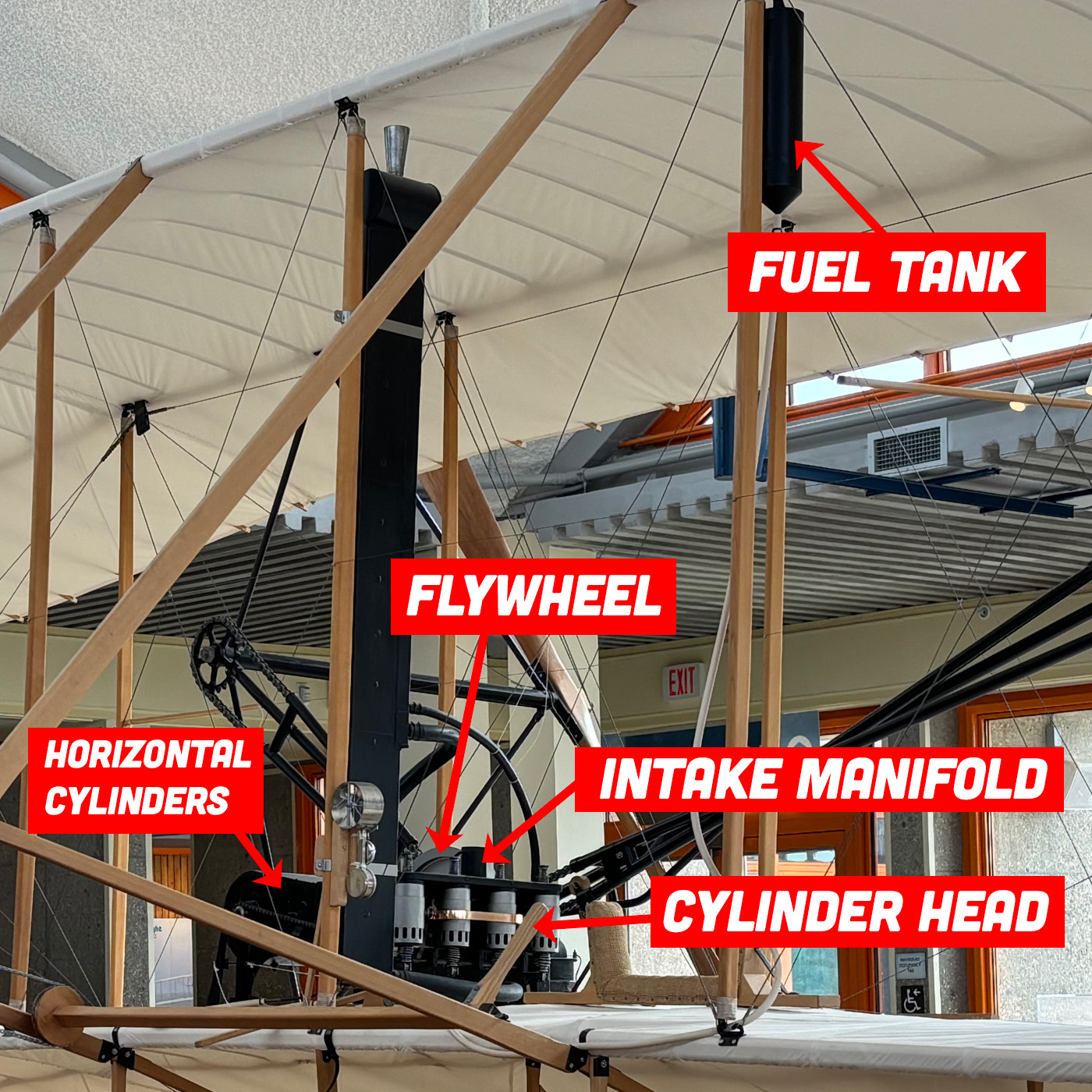
So, most of that stuff made a general sort of sense, at least from a distance, But I still had one big question:
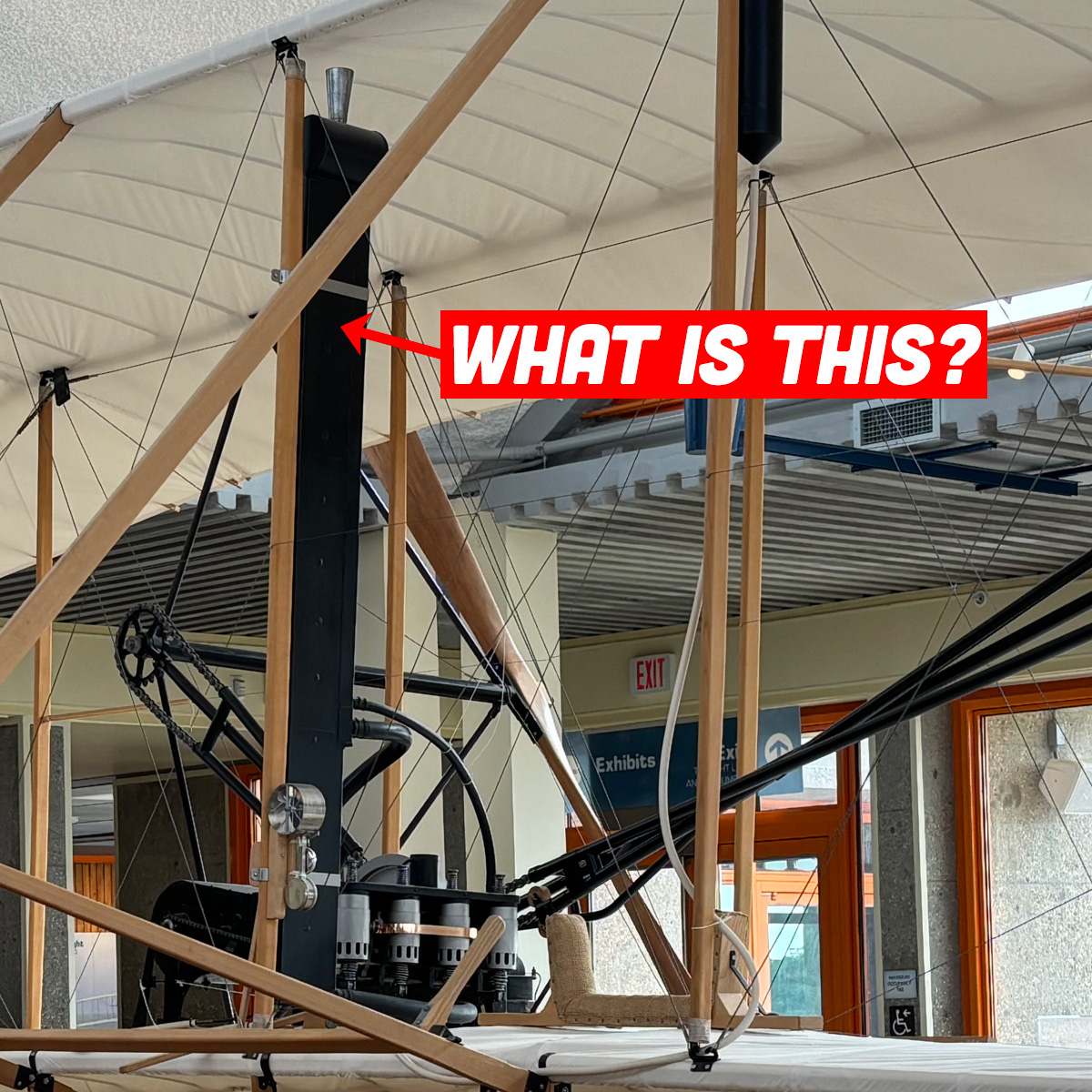
What the hell is that tower thing? It seems to have some sort of air intake funnel on the top? I mean, I thought it’s for air intake, but I now think I was wrong, because I asked a docent about it and they told me it was the radiator. Well, sort of. Here’s a video from the museum’s site that also calls it a radiator:
The problem is that it really isn’t a radiator, but it is the primary means of cooling the engine. It’s really just a water tank, because the way the cooling system worked was that water would flow out of that vertical tank via gravity, get splashed into the engine block, where it would turn into steam, and then more water would replace it. That’s it. That’s also why I now think that funnel up top was just used to fill the tank with water.
This sort of ultra-minimal approach is what defines all aspects of this engine, which was built by the bicycle mechanic at the Wright’s shop in Ohio, Charlie Taylor, using only a lathe and a drill press. Here’s how Taylor described the engine-building process:
“We didn’t make any drawings. One of us would sketch out the part we were talking about on a piece of scratch paper, and I’d spike the sketch over my bench. It took me six weeks to make that engine. The only metal-working machines we had were a lathe and a drill press, run by belts from the stationary gas engine.”
Taylor had the engine block cast out of aluminum, a pretty cutting-edge material and process back then, by an outside company, but everything else was pretty much hand-made by Taylor, even complex parts like the crankshaft, which Taylor lathed from a block of steel:
“The crankshaft was made out of a block of machine steel 6 by 31 inches and 1-5/8 inch thick. I traced the outline on the slab, then drilled through with the drill press until I could knock out the surplus pieces with a hammer and chisel. Then I put it in the lathe and turned it down to size and smoothness.”
This engine was so clever and crude, all at the same time. It was an inline-four, laid horizontally, displacing about 3.3 liters. It weighed about 190 pounds and made 50% more horsepower than they originally required, a massive 12 hp at a lazy 1,025 or so RPM. It actually made about 16 hp at startup, but when it warmed up that dropped to 12.
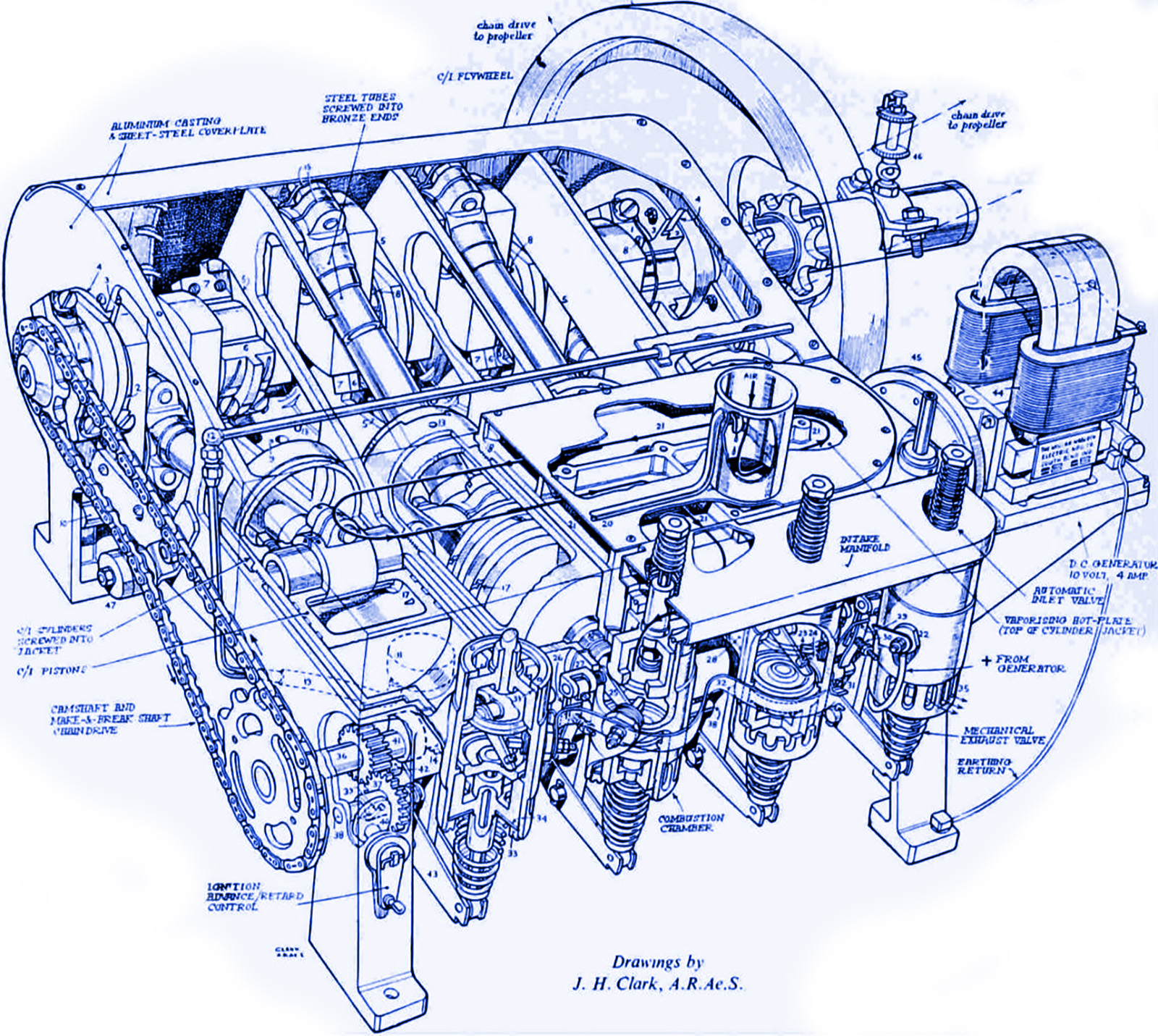
There was no carburetor! There was basically just a tube that raw gas just dripped down into, fed by gravity, which then landed on what was basically a hot tray that vaporized the gasoline, and that vapor got sucked into the cylinders. No throttle, this thing ran flat out all the time. There wasn’t even a mechanism for the intake valves to open; they were just pulled open by the vacuum of the piston in the cylinder during the intake stroke!
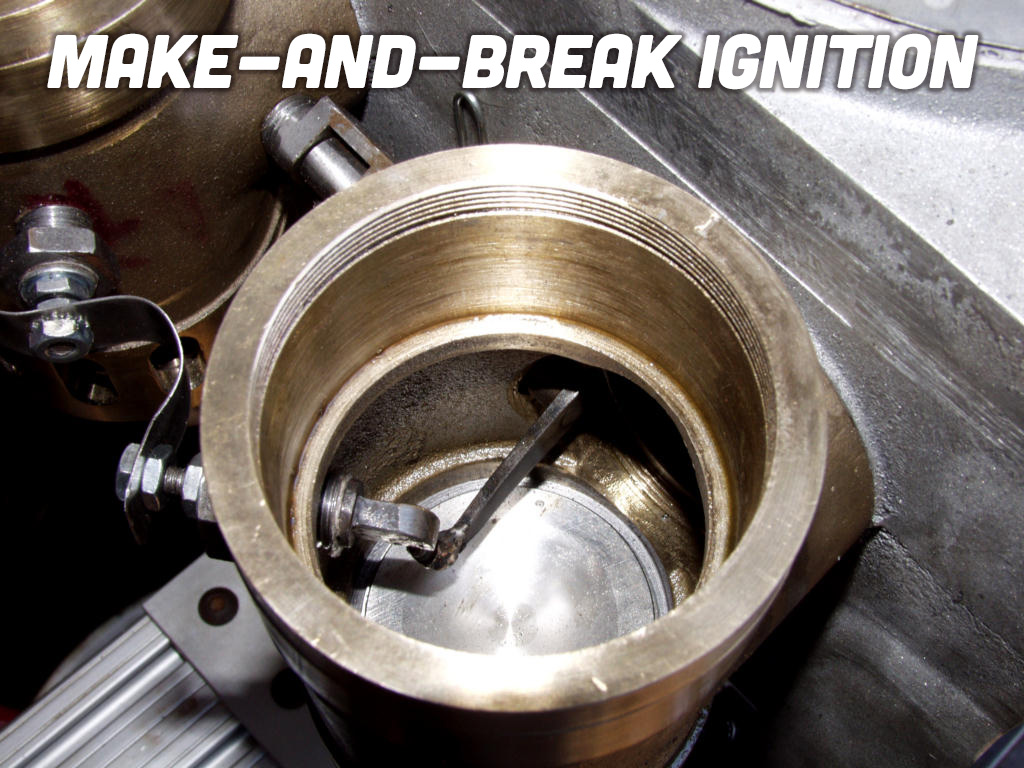
The minimalism keeps going into the cylinders themselves, because there weren’t even spark plugs in here, just what was known as a “make-and-break” ignition system wherein little arms driven off the camshaft would make contact with a point, creating a spark. The electricity for these points was provided by a 10-volt magneto. There was a stationary dry-cell battery used to start the engine, which was kept on the ground. You can see the battery rig in this picture:
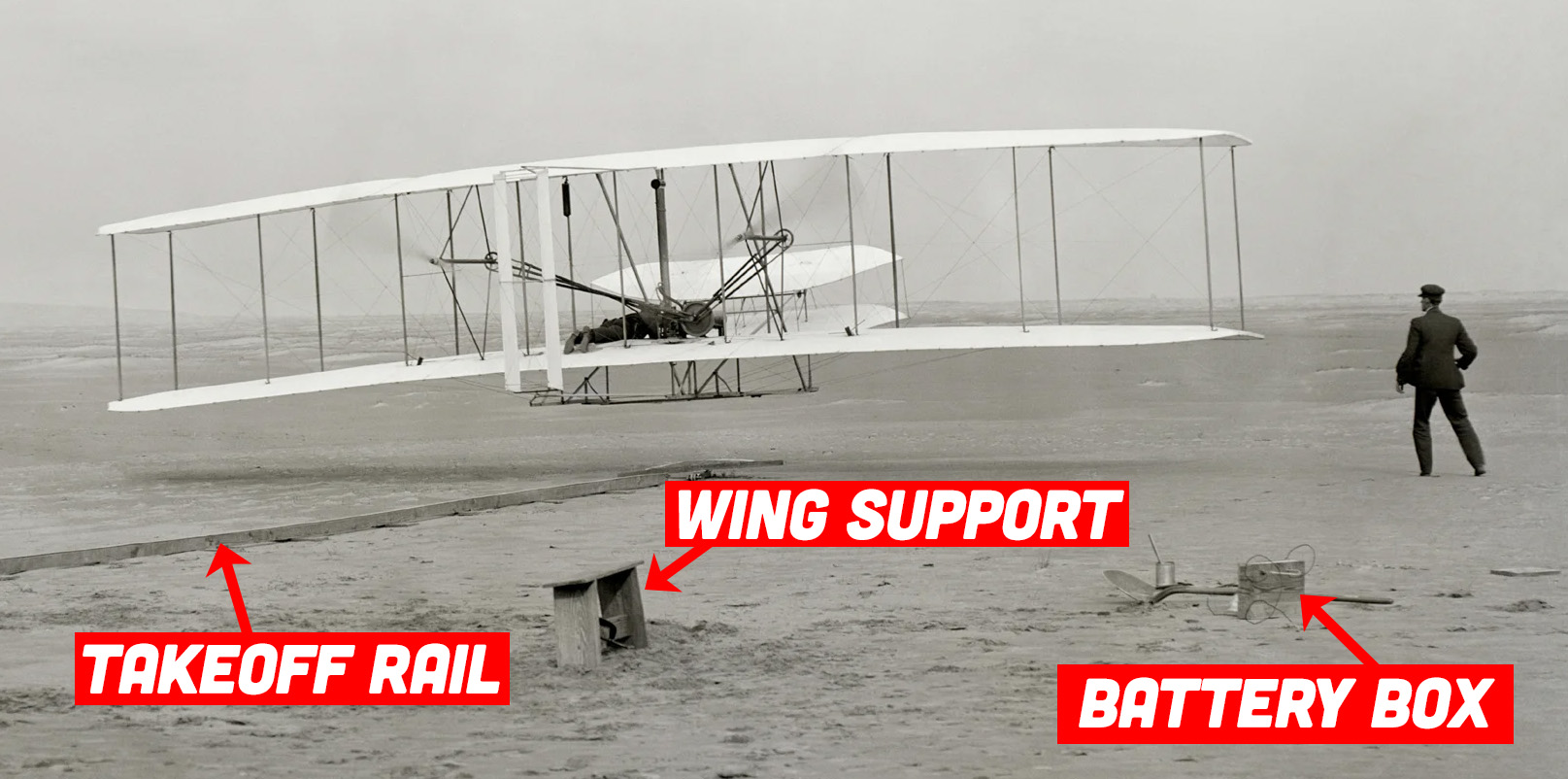
So, we have an engine with no fuel pump, no distributor, no carburetor, no water pump or actual radiator, cylinders that weren’t even actually bored out (they just relied on the piston motion to seat the rings, etc), no mechanical method to open the intake valves, and yet this incredibly crude and stripped-down engine worked well enough to spin two propellers and push the world’s first airplane into the air.
It is clearly not an engine designed to run for long periods of time, and the power-to-displacement ratio is hilariously low by modern standards, but in 1903, there was literally no other machine on the planet that could do what it did. It’s an incredible reminder that sometimes the most advanced problems need the simplest, most basic solutions.
Seeing this place where the world changed forever was genuinely inspiring, and it makes me feel both more determined and embarrassed about my Citroën 2CV, which has a similarly crude and basic engine, and how I need to get that thing finally running right.
How have I never known more about this incredible engine? How is this engine not talked about more when discussing famous, world-changing engines? I think we should all devote a little time today to be inspired by this crude and clever little engine. I know I am.
All images and top graphic, unless noted: Jason Torchinsky


As a NZ’er it’s my duty to chime in about Richard Pearse, who ‘flew’ 9 months before the Wright Siblings <3 he also used a Horizontal engine it appears here https://www.reddit.com/r/aviation/comments/5yrh92/the_original_4_cylinder_engine_from_richard/
I live in Dayton OH like 5 miles from the bike shop location. I’ve seen the Wright B Flyer during parades and events, I wish I could get the courage up to go as a passenger some day.
This past summer the wife and I got up the courage (and the $105 each) to go up as passengers in a 1929 Ford Trimotor. That was an experience we’ll never forget.
Fun fact, you can visit the Wright cycle shop, home, and garden shed! They were picked up and moved to Greenfield Village at the Henry Ford museum in Detroit. While you’re there you can get a tour in a Model T, ride a steam train, and meet farm animals. Edison’s workshop and homestead, Ford’s childhood home, the Heinz (of ketchup fame) home, and many other buildings associated with American historical figures. The most immersive “historic village” I’ve ever seen. Model Ts on the streets, the sound and smells of a working farm, the steam locomotive, and historic buildings arranged just like a small town. Highly recommend!
Oh cut it out already!
This was not the first airplane.
Nor did the Wright brothers invent the airplane.
The Wright brothers can rightfully be called aviation pioneers in a long list of other aviation pioneers.
There were airplanes before that did similar feats (e.g. Aders Eole). And the flyer was not aerodynamically stable. This engine design just adds evidence to the fact that their flyer was incapable of more than extremely short sustained flight.
Clement Ader (and his Eole) want to have a word…