


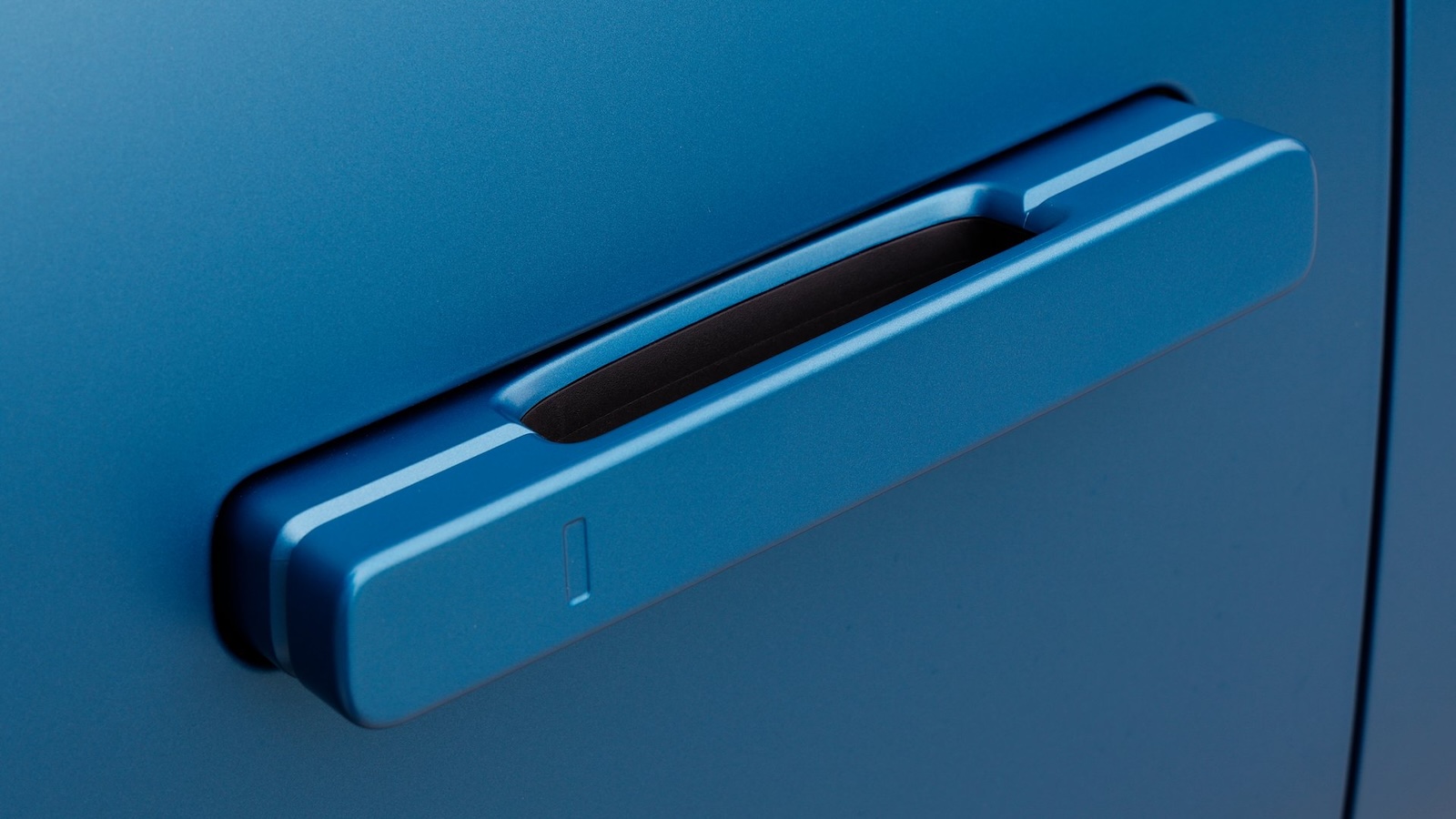
I realize that at this point, I think most people – or at least many of us – have acknowledged the folly of the recent trend for cars to have electrically-powered door handles. The general frustration with these over-engineered components has even grown mainstream enough that it’s being mocked on Saturday Night Live, which I hope carmakers are taking note of. I know our stance is quite clear on this, and I know we’ve covered this before, but we recently got a response from Stellantis regarding a question we had about the new Jeep Cherokee Limited, which our publisher Matt had as a press car.
The question was about the door handles, which are of this modern electrically-powered variety, and more specifically, where the internal rear door emergency door release is, should the vehicle lose power and you or someone you know may decide they no longer wish to be inside a vehicle that has no power and is incapable of motion.


It turns out there are no internal manual rear door handles, so if the vehicle loses power for any reason, the powered door handles are still the only way to open that door. But Jeep isn’t going to just let you be stuck in there – there is a backup plan, which a Stellantis representative described for us (emphasis mine):
Several Stellantis brand vehicles use electric door latch technology, designed with multiple layers of protection to ensure that doors can be opened quickly and safely in all situations. This includes equipping doors with a supercapacitor energy storage device to ensure there is power for the door latch even if the vehicle’s main power supply is interrupted.Rear doors in vehicles with electric latches do not include a release handle, as federal safety standards require a two-step opening process for locked rear doors. Placing a release handle for a rear door would also require that it be covered in order to meet the safety standard.
“As for fail-safes, Ford told me each door has super capacitors in it so that, should the latches in the door fail to receive current from the battery (if, for example, the battery is dead), you can still get into the vehicle.”
So, these supercapacitors – which can store electricity in a way roughly analogous to a battery, but non-chemically, and that electricity can only be released in bursts, not gradually – have been crucial parts of emergency electric door handle/latch design for years. What amazes me about all of this is that supercapacitors are still relatively cutting-edge technology. They’ve been around for a bit, sure, and they may not be bleeding edge, but I’d think most people would agree they’re fairly advanced things.
I would have imagined that at some point in the development of these electronic door latch/handle systems, when it became clear that there needed to be backup systems to provide power for the door latches in the event of a power loss, and right after some engineer said hey, we could incorporate a parallel energy-supply system with supercapacitors to act as a backup, I would have thought that someone might have heard that and taken a moment to really think about it and then say something like “Wait, hold up. We want to add a supercapacitor system to open the door? What are we doing here?”
That word “supercapacitor” should have been the wake-up alarm that these engineers and designers needed to hear. As soon as you start talking about adding in a system like that, you would think there would be some bean-counter – perhaps the only time in automotive history I wished people listened to the bean-counters more – that would have put a stop to the conversation and made everyone take a step back and really think about what their goal was here:
To open a door.
Cars have been able to have their doors opened without power (beyond that of a human-supplied yank, squeeze, or twist) for well over a century. This was a staggeringly solved problem. In fact, look at how many ways to solve this problem automakers have come up with in the past few decades:

There are so many ways to make simple mechanical door handles look and work, and they all work great, on cars with power or without. I know there’s a big emphasis on sleekness of look and actual aerodynamics, but if we compare the latest Cherokee’s door handles with the old Grand Cherokee door handles, is it really all that much better?

I’m just not sold that anything that great has been accomplished here, considering all the complexity that has been added. And besides, if you want minimalistic and sleek door handles, that’s been figured out already, decades ago. Here are some examples, along with one of the few times an electric door opening system made sense (BMW Z1 drop-down doors, just for the drama):
View this post on Instagram
I can’t think of a recent automotive trend that has been as universally disliked and unwanted as these powered door handles. The supercapacitor detail just really drove that home for me in a visceral way. It’s adding components and complexity to fix a problem that doesn’t even need to exist at all. And what about as these cars age and need repair? Supercapacitors aren’t particularly dangerous, but if you’re working on the door, it’s not impossible that one could short one out and get a pretty good jolt, and one that could be unexpected, since they’re designed to work when the car has no power otherwise.
Also, how many times have you actually ever had a door handle fail on your car, interior or exterior? And of those times, how often was the failure just from cheap plastics used for the pull handles themselves? The actual latching mechanisms themselves tend to be pretty bulletproof. Go to a junkyard, and I suspect most of the cars there that haven’t been mangled in a wreck will still have working door handles. I really can’t stress enough just how much of a solved problem this was.
There’s a big lesson here, and I really hope carmakers are learning it. A shocking amount of research and development has been poured into mechanisms that add nothing to the driving experience, and, if anything, have made driving less safe and more of a hassle. It’s taken the threat of making these types of handles illegal in places like China to really get the attention of automakers, and I just hope they listen.
This is very similar to the backlash against all-touchscreen controls and the push to bring back physical controls: in both cases, it’s a situation where technology was available to do something that perhaps looked or felt cool in some auto show context or in a commercial, but in the reality of living with a car, is just an unwanted mess and hassle.
Maybe this is just a process we have to work through to get past. Perhaps it’s just human nature to be so dazzled by the new that all logic flees, but I would hope that we have the capacity to return to our senses. Making great cars does not mean re-inventing solutions to every problem. Sometimes it makes sense to reevaluate how things are done, but sometimes it makes more sense to just accept what works, what has proven itself over and over again, and is just fine.
Nobody was clamoring for more complex door opening systems. People weren’t backing out of buying a car because the way they opened the door didn’t require as much thought as they were hoping, or wouldn’t be confusing enough in an emergency, or didn’t require high-tech equipment to save their asses if something went wrong.
The whole car industry went down the wrong path here, put too much effort into things that just don’t matter, and made everything worse as a result. Let’s just hope they realize it and move on to something better. Like in-car trash management!
(top image sources: Kyocera, Jeep, DC)



I miss the squeeze-type door handles on my old 1983 RN38.
Since you gave us that handy infographic for reference, can we all take a second to appreciate the class 3 & class 4 (and some class 6) door handles? You know, the types that actually have sturdy, fixed handles that you can use to both pull the door open and push it shut without feeling like you might break something? The ones that don’t force you to put your hand on the painted body panels which you might scuff up?
I can attest that a failed mechanical door handle is easy to replace. In fact the entire mechanism was on Ebay for $20 and did it with minimal tools and an hour. I highly doubt a failed electronic door handle would be any of those things.
Actually based on David’s Jeep build Ebay may have it in stock, but that’s where the similarities stop.
I’m gonna say, yes, unequivocally, the new Cherokee door handle looks way better than the old one. Could it have still been mechanical, also, inequivocally yes.
The other thing about mechanical door operators is that on the rare case that there is a failure, you likely could still use that door, if in a more difficult manner, like only having a remaining nub of a broken plastic/die cast metal handle you need pliers to work. Barring any operability at all, it’s still only that one handle that’s broken. Moreover, replacement is short money and a pick-and-pull/ebay away and simple mechanicals an average person can manage. Even remaking one yourself isn’t beyond that many people with 3D printing or readily available mold making supplies. In the far more likely event that these electronic ones fail, chances are that they all fail at once and they certainly won’t be at a P-a-P and they likely wouldn’t be any good if they were. This is Schwerer Gustav/Dora level stupid—smart engineering to bring what’s a fundamentally unspeakably dumb idea to life. Unlike the giant railway guns, electronic door handles aren’t even interesting or humorously ridiculous (humorous thanks to the insulation of time) and anyone who supports these has to be an idiot or a sociopath who’s making money off of it.
They should just all come with the explosive door bolts like the SLS AMG had instead. Battery dies? Congrats it’s now even more of a Jeep. Real badge of honor
I’ve heard first-hand stories of teenagers screaming as they died in a burning Cybertruck. They, and bystanders, couldn’t open the doors after an accident. Pretty sure you can figure out where I stand on this topic.
Related: all capacitors do have a lifespan. What’ll happen in 10 (or more) years when they can’t hold enough of a charge? Or they explode after many years decomposing in the heat of a door panel?
supercaps also don’t age particularly well. ive replaced hundreds over my career. this might be all well and fine right now, but after 10 years of thermal cycles, i doubt they’re going to be OK, which means someone isn’t opening a door, which may or may not be life threating.
The idea of an electric door latch without a manual backup is beyond stupid; it’s dangerous. Then of course once you get to the point of needing a manual backup, why not just make it manual in the first place?
Electronic latches, LED headlights as bright as the sun, and moving vital buttons into the infotainment screen should all be illegal at the federal level.
insert Zoolander crazypills.jpg
I’m with Jason 120% here.
Supercapacitors are usually a sandwich of chemicals and minerals – just designed to discharge quickly rather than slowly like a battery. It’s like having a taser hidden in your car door.
Depending on the voltage and capacity they absolutely can kill you, or at least give you a nasty jolt. That’s why old TVs and radios generally had big, scary warning labels about letting trained technicians service the gizzards.
Well, those caps in the old tube gear were holding 300-600v of charge. Especially on old RC power filters, which would also be large and coming right off the rectifier.
I doubt the supercaps have taser voltages, but as more and more cars move to 48v systems it becomes a much more serious risk.
Tack on screens are almost as bad as these door handles, but in their case they’re not massively important to exiting a vehicle that has lost power.
Give ’em hell Torch!