


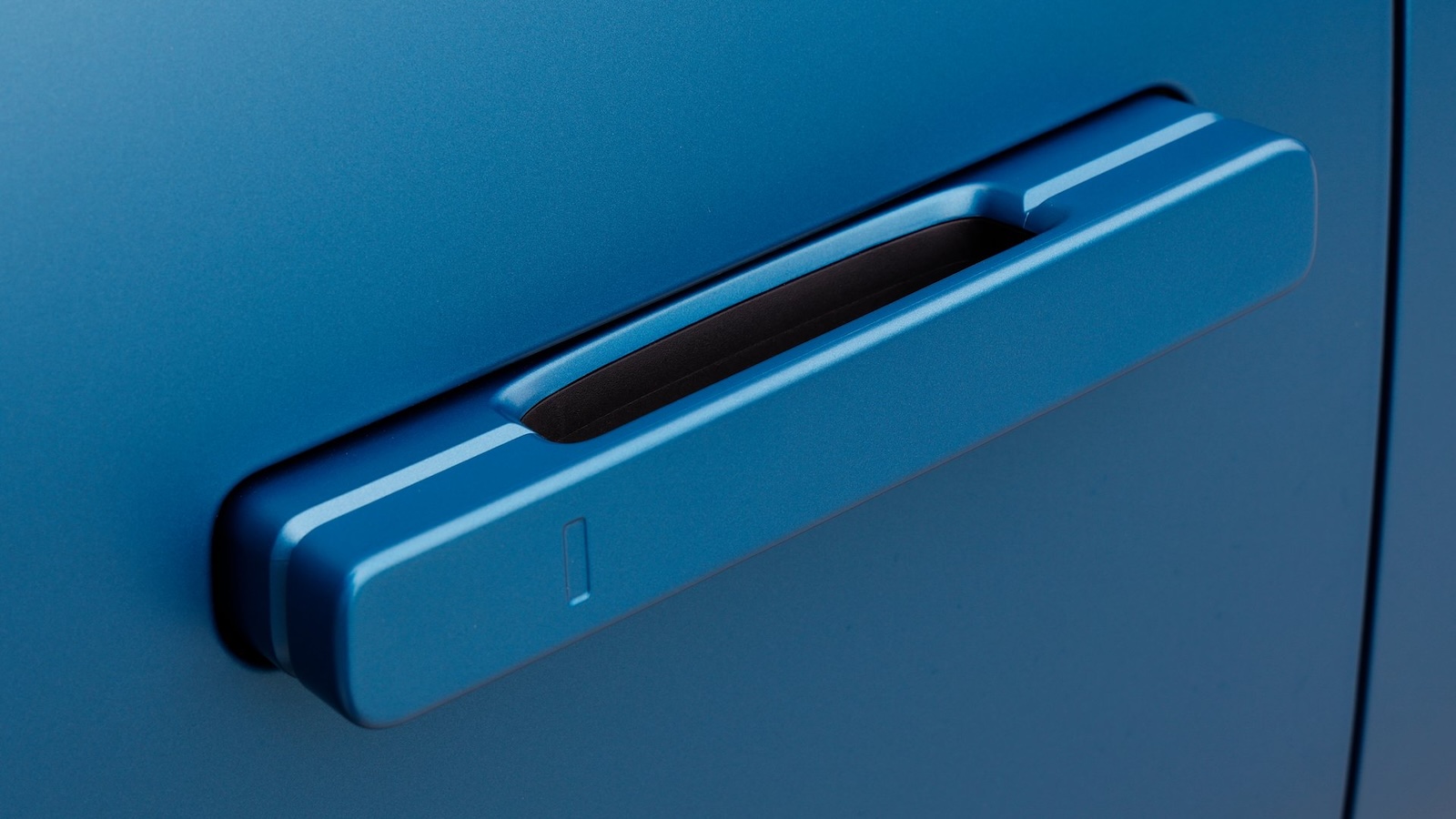
I realize that at this point, I think most people – or at least many of us – have acknowledged the folly of the recent trend for cars to have electrically-powered door handles. The general frustration with these over-engineered components has even grown mainstream enough that it’s being mocked on Saturday Night Live, which I hope carmakers are taking note of. I know our stance is quite clear on this, and I know we’ve covered this before, but we recently got a response from Stellantis regarding a question we had about the new Jeep Cherokee Limited, which our publisher Matt had as a press car.
The question was about the door handles, which are of this modern electrically-powered variety, and more specifically, where the internal rear door emergency door release is, should the vehicle lose power and you or someone you know may decide they no longer wish to be inside a vehicle that has no power and is incapable of motion.


It turns out there are no internal manual rear door handles, so if the vehicle loses power for any reason, the powered door handles are still the only way to open that door. But Jeep isn’t going to just let you be stuck in there – there is a backup plan, which a Stellantis representative described for us (emphasis mine):
Several Stellantis brand vehicles use electric door latch technology, designed with multiple layers of protection to ensure that doors can be opened quickly and safely in all situations. This includes equipping doors with a supercapacitor energy storage device to ensure there is power for the door latch even if the vehicle’s main power supply is interrupted.Rear doors in vehicles with electric latches do not include a release handle, as federal safety standards require a two-step opening process for locked rear doors. Placing a release handle for a rear door would also require that it be covered in order to meet the safety standard.
“As for fail-safes, Ford told me each door has super capacitors in it so that, should the latches in the door fail to receive current from the battery (if, for example, the battery is dead), you can still get into the vehicle.”
So, these supercapacitors – which can store electricity in a way roughly analogous to a battery, but non-chemically, and that electricity can only be released in bursts, not gradually – have been crucial parts of emergency electric door handle/latch design for years. What amazes me about all of this is that supercapacitors are still relatively cutting-edge technology. They’ve been around for a bit, sure, and they may not be bleeding edge, but I’d think most people would agree they’re fairly advanced things.
I would have imagined that at some point in the development of these electronic door latch/handle systems, when it became clear that there needed to be backup systems to provide power for the door latches in the event of a power loss, and right after some engineer said hey, we could incorporate a parallel energy-supply system with supercapacitors to act as a backup, I would have thought that someone might have heard that and taken a moment to really think about it and then say something like “Wait, hold up. We want to add a supercapacitor system to open the door? What are we doing here?”
That word “supercapacitor” should have been the wake-up alarm that these engineers and designers needed to hear. As soon as you start talking about adding in a system like that, you would think there would be some bean-counter – perhaps the only time in automotive history I wished people listened to the bean-counters more – that would have put a stop to the conversation and made everyone take a step back and really think about what their goal was here:
To open a door.
Cars have been able to have their doors opened without power (beyond that of a human-supplied yank, squeeze, or twist) for well over a century. This was a staggeringly solved problem. In fact, look at how many ways to solve this problem automakers have come up with in the past few decades:

There are so many ways to make simple mechanical door handles look and work, and they all work great, on cars with power or without. I know there’s a big emphasis on sleekness of look and actual aerodynamics, but if we compare the latest Cherokee’s door handles with the old Grand Cherokee door handles, is it really all that much better?

I’m just not sold that anything that great has been accomplished here, considering all the complexity that has been added. And besides, if you want minimalistic and sleek door handles, that’s been figured out already, decades ago. Here are some examples, along with one of the few times an electric door opening system made sense (BMW Z1 drop-down doors, just for the drama):
View this post on Instagram
I can’t think of a recent automotive trend that has been as universally disliked and unwanted as these powered door handles. The supercapacitor detail just really drove that home for me in a visceral way. It’s adding components and complexity to fix a problem that doesn’t even need to exist at all. And what about as these cars age and need repair? Supercapacitors aren’t particularly dangerous, but if you’re working on the door, it’s not impossible that one could short one out and get a pretty good jolt, and one that could be unexpected, since they’re designed to work when the car has no power otherwise.
Also, how many times have you actually ever had a door handle fail on your car, interior or exterior? And of those times, how often was the failure just from cheap plastics used for the pull handles themselves? The actual latching mechanisms themselves tend to be pretty bulletproof. Go to a junkyard, and I suspect most of the cars there that haven’t been mangled in a wreck will still have working door handles. I really can’t stress enough just how much of a solved problem this was.
There’s a big lesson here, and I really hope carmakers are learning it. A shocking amount of research and development has been poured into mechanisms that add nothing to the driving experience, and, if anything, have made driving less safe and more of a hassle. It’s taken the threat of making these types of handles illegal in places like China to really get the attention of automakers, and I just hope they listen.
This is very similar to the backlash against all-touchscreen controls and the push to bring back physical controls: in both cases, it’s a situation where technology was available to do something that perhaps looked or felt cool in some auto show context or in a commercial, but in the reality of living with a car, is just an unwanted mess and hassle.
Maybe this is just a process we have to work through to get past. Perhaps it’s just human nature to be so dazzled by the new that all logic flees, but I would hope that we have the capacity to return to our senses. Making great cars does not mean re-inventing solutions to every problem. Sometimes it makes sense to reevaluate how things are done, but sometimes it makes more sense to just accept what works, what has proven itself over and over again, and is just fine.
Nobody was clamoring for more complex door opening systems. People weren’t backing out of buying a car because the way they opened the door didn’t require as much thought as they were hoping, or wouldn’t be confusing enough in an emergency, or didn’t require high-tech equipment to save their asses if something went wrong.
The whole car industry went down the wrong path here, put too much effort into things that just don’t matter, and made everything worse as a result. Let’s just hope they realize it and move on to something better. Like in-car trash management!
(top image sources: Kyocera, Jeep, DC)


I also have yet to see any proof that electric, flush door handles provide a significant enough aerodynamic advantage to justify the cost and potential safety issues. I’m really surprised that internal counsel didn’t quash these from a liability stance.
I know they’re different from a supercapacitor, but my employer deals with lots of aluminum electrolytic capacitors…there’s a fairly strict schedule for powering them up periodically for a set period of time, and also a replacement schedule. To see automakers putting supercapacitors in cars like this with such a blasé attitude (are these even included in the maintenance schedule in the manual?) makes it seem like they’re viewing their own product as disposable.
We rolled our ’76 VW ASI Camper bus in the snow and landed on the right side. This left only the driver door operable from the inside. Recognizing this as a escape issue, when we got a replacement bus (’80 VW Vanagon) I spent some quality time with the rear hatch. Removed the door card and examined the latch mechanism to see what I needed to do to be able to open it from the inside. I found a spot where I drilled a hole in the door card that would allow a finger to push on the mechanism to release the latch. Never needed it after owning it for 14 years, but comforting to know it was there.
My e-mag prof in college used to say “if you learn only one thing in this class, it should be that if someone tosses you a capacitor – don’t catch it”
After over a century of innovation, I think we’ve just run out of sensible upgrades. We’ve tackled the big stuff like electric start, auto transmission, air conditioning. And the little stuff like power locks and automatic lights. I think the only area left is safety improvements, but those don’t sell cars.
capitalism demands never ending improvement, so OEMs are left solving problems that don’t exist.
When I was a dumbass kid, I disassembled a disposable camera (dating myself, I know) and inadvertently touched the flash capacitor. Zzzzzap 330 volts!
I imagine getting shocked by one of these is the same or worse.
current job- engineer?
My freshman-year college roommate was studying EE and they dissected a disposable camera. While doing my design class work, he brought it over to show me…just as he yells “NO WATCHOUT DON’T TOUCH THAT!” I touched it.
Maybe it righted whatever was off in my brain from my earlier 120VAC shocks, but I gave up on design and became an EE, too.
dude. so. fucking. annoying. The escalade has door handles but they DON’T move! it’s a stupid button in the handle
We had freezing rain overnight and I could barely get into my car- there is a Tesla and I wonder how it will fare
Disabled until they can get it into the Tesla repair shop in a few months and costing no more than six grand…
Touchscreen, electric doors, subscriptions… I’m almost 70 years old, I refuse to participate. No wonder cars cost $50k.. plus, you can’t fix them without a dealer resetting the computer. Even power windows can throw a code on most of today’s cars! Nope. Not me.
Actually, most of these things make cars CHEAPER to manufacture. The ballooning price is caused by a combination of inflation, growing average vehicle sizes and some other factors like executive compensation packages (those yachts won’t buy themselves)
Wouldn’t a good win-win option be power-assisted manual handles?
Pull lightly and sensors trigger the electricals to open the door. Electronics fail? Pull all the way and a mechanical mechanism opens the door.
We do this to great effect with brakes and steering already.
The Lexus RX has this, push to open electronically or pull to manually release (on the interior).
I grew up next door to a TV sales and repair business. The owners were surrogate grandparents and watched me after school before my parents got home. I used to be able to watch Duck Tails on multiple 32 inch wooden console RCA and Zenith TV’s in the showroom, and I can still smell the electric scent of the shop. I was also able to avail myself of RCA Laserdiscs anytime I wanted, which was amazing.
One of the things that was drilled into my head was never stick my hands into the back of an open TV, even if it was unplugged. I was warned about capacitors that lurked and had a lot of stored energy tucked away inside. Seems like having “super” capacitors (up to five on a hatchback) could add literal fuel to a fire.
I’m 100% with Jason on this, solving a problem that didn’t need to be solved.
I’m at least a generation older than you and same warning was given and heeded.
I’m also 100% behind you being 100% behind Jason. This isn’t just dangerous it’s simply stupid.
I also remember taking old CRT tubes out back in the field and pinging them with a .22…simpler times.
“supercapacitors” usually have pretty low voltage limits (like 2-4V, too low to really shock someone) and ones designed to just open a door likely aren’t going to store anything close to enough energy to add meaningfully to a car fire.The name kinda oversells it. In this case, it’s basically just a small battery with a long lifetime and large operating temperature range.
There is a type of door handle missing in the Taxonomy list. Cars like the MGA have no external door handle but a cable that you pull on the interior of the door to operate the latch.
The very first Land Rovers had a canvas flap on the door that you could stick your arm through to grab the interior handle.
(Visible here: https://images.williamsclassics.co.uk/wp-content/uploads/2016/03/thumb_DSC_0038_1024.jpg)
I get wanting flush door handles for aerodynamics. But they 100% don’t need power. Tesla has a non-powered version that is fine.
I’m going to add cars that make the windows go down a little bit when you close or open the door. What the shit is that for? Looking at you, Tesla and Mini.
Dave Kindig has a manual one that looks real similar to a Tesla and it works with your vintage car’s existing hardware. https://www.kindigitapparel.com/collections/kindig-it-parts
Chevrolet also uses that window trick. Camaros in particular.
Your last question – it’s so the frameless window can slide in and out of its seal. This method provides a more water and soundproof seal than the old method of the window just resting against rubber on one side.
The one big flaw on my 2007 Mustang GT is those frame-less windows so Ford didn’t have to make two door designs one for the convertible and one for the coupe. Living in the Pacific Northwest I would never own a convertible mold mobile…
I’ll take the spitty, gray gloom of the PNW over the brutal downpours of SE Texas. Seattle: ~40″ on average per year. Houston: ~50″
I lived back there in 2017 when Hurricane Harvey stalled over Houston, Beaumont and the surrounding area. In Beaumont, we got 26″ in one day and 52″ in a week. I had never seen rain like that before and hope never to again.
Frameless windows that don’t roll down when the door is unlatched have to make do with pressing up against one seal, while ones that do can be sandwiched between two seals just like a framed one. Makes a substantial difference for cabin wind noise, and frameless windows are desirable/premium from a design perspective, so luxury manufacturers gravitate towards them.
From a practical perspective, frameless windows are needed by convertibles, so any car with a convertible variant will have them across the range for the sake of parts-sharing.
Class 10 – flaps are also very common on ’70’s BL cars.
Did you pay your subscription to use the fsd door handle?
Another point of concern. How many times have you disconnected the battery before you work on a car to protect yourself from inadvertent shock? Disconnecting battery in this case provides no such protection.
Exactly…
How many times? Ummmm, not as many as I should have…?