

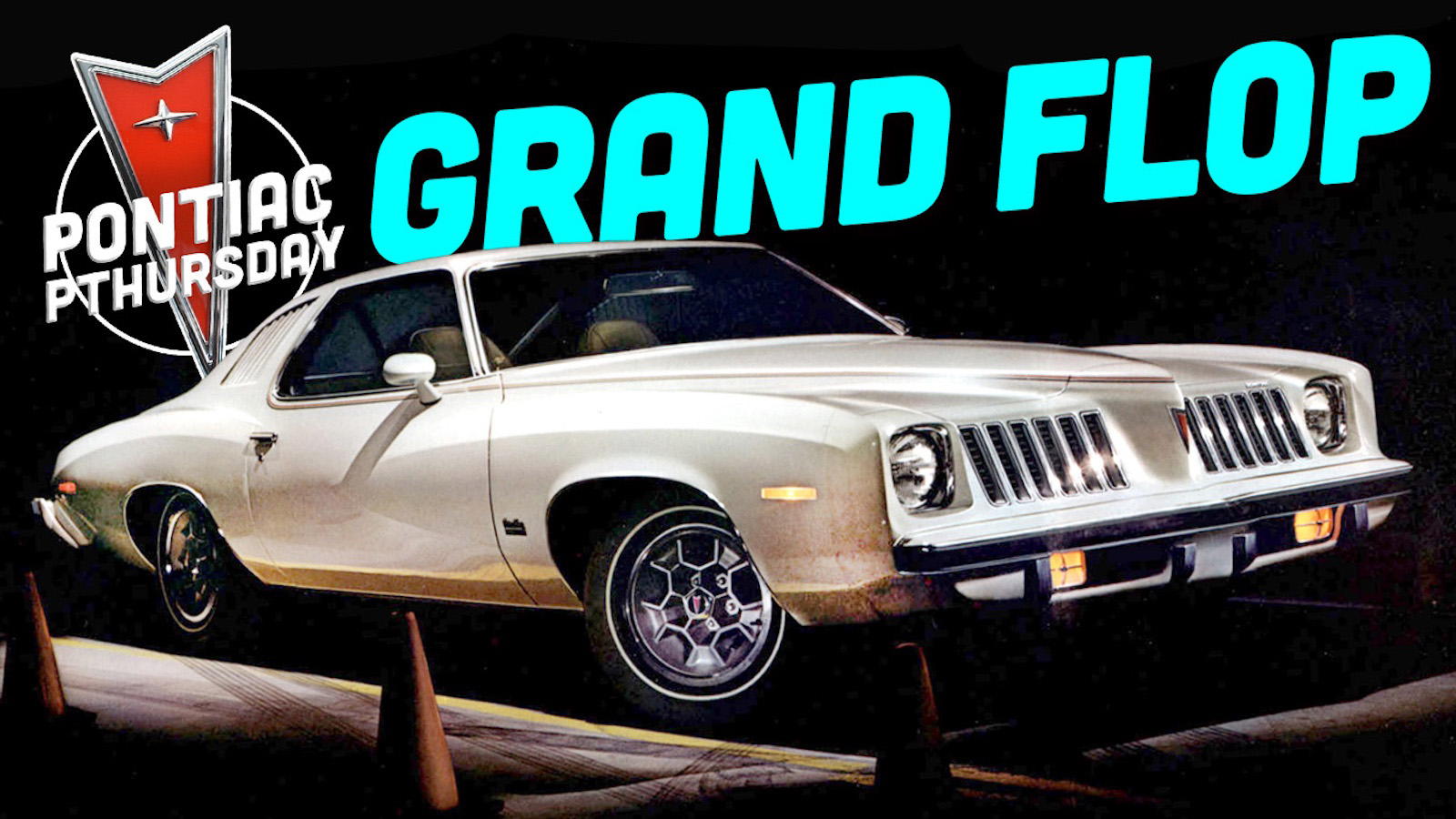
“Euro.” It was the biggest trend of the eighties at the Big Three, with all of them desperately attempting to make products that at least superficially represented the values of cars from across the pond. After years of chrome, vinyl roofs, and wire wheel covers signifying what an aspirational car looked like, all of Detroit fell headlong into topping off model lines with fake Black Forest bombers featuring blacked-out trim and aluminum “road wheels.” Chevy even had a trim level called “Euro.”
Pontiac actually saw this shift in the market happening, but they acted upon it way too early and at the absolute wrong time. It might have failed, but this international-flavored product was ahead of its time and would soon set the template for what turned out to be the brand’s final years.


You Can Get This Or This, But Not Together
Historically, products that didn’t fit neatly into a pre-established niche (like a Porsche 928 or a Subaru SVX) have had a tough time finding buyers. The AMC Eagle is another good example of this; it was considered a total oddball until the SUV crossover market became commonplace decades later.

This was absolutely the case in the early seventies with American car makers. A product was aimed either pure economical transportation, full-on luxury, or a stripped-down performance-oriented machine. That’s it. Middle grounds were not really embraced by brands or buyers. During this time, however, the environment would change rapidly and point the industry toward a new kind of car.
First, the 1973 energy crisis and rising inflation meant that hardcore performance cars were a dying breed; rising insurance rates also contributed to this decimation of factory street machines. The bigger issue, though, was the kinds of cars many younger buyers were aspiring to. Let’s say there’s a young guy who bought a Pontiac Firebird 400 back in the late sixties. General Motors assumed that this once-young lad was now a balding man with a family would move up to a Pontiac Bonneville. They often assumed wrong. In many cases, Firebird Guy wanted nothing to do with that boat; he would have been looking instead at mid-sized European products like Volvos, BMWs, and Mercedes with a sense of performance and even – gasp – nimble handling among their merits. What did brands like Pontiac have to offer these buyers? Nothing of that sort. Performance or luxury? Take your pick. You want both in one car? Forget it.
The Grand Plan
Pontiac saw this as a problem. For 1973, GM would launch an all-new A-Body platform that they would dub the “Colonnade” style, and Pontiac’s plans included offering a number of different versions of this new mid-sizer. The bread-and-butter models were the LeMans coupe, sedan, and wagon, while the GTO was offered as a two-door-only edition of the old performance stalwart. Well, “performance” is a relative word, since the 455 CID V8 in the GTO only pumped out 250 horsepower for ’73, about 50 fewer horses than the year before.

Of course, the GTO was still a relatively stripped-down product with none of what you’d call “luxury” accoutrements inside; a person considering an overseas product wouldn’t be interested in this “greasy kid’s car.” For this reason, Pontiac also offered a model that was all-new to their brand and, frankly, any brand of the Big Three. Named the Grand Am, the title stood for what the car was supposed to be: a combination of their top-of-the-line, slow-selling Grand Ville luxury sedan and their full-on performance machine, the Trans Am.

Sure, a two-door sporting “grand touring” sport/luxury was no surprise to the market in 1973, but Pontiac went all Euro and actually offered a four-door sedan version as well, a move that really didn’t compute with the prevailing thinking in the American auto industry at the time.

Unique to the Grand Am was the “Endura” plastic nose cone that would thoretically flex on impact, as the brochure image below shows. By the way, I would not attempt this with your Pontiac; if it’s under around 25 degrees outside, the paint was sure to crack, and once the car cycled through cold winters and hot summer sun for a few years, that Endura nose had about as much flexibility as peanut brittle.

The interior of the Grand Am appeared to be where Pontiac spent the most effort. The so-called Strato bucket seats in vinyl “Morrokide” (what a name) or corduroy cloth fully reclined and had adjustable lumbar supports just like a Volvo. Again, things we take for granted today, but heady stuff for an American family sedan.
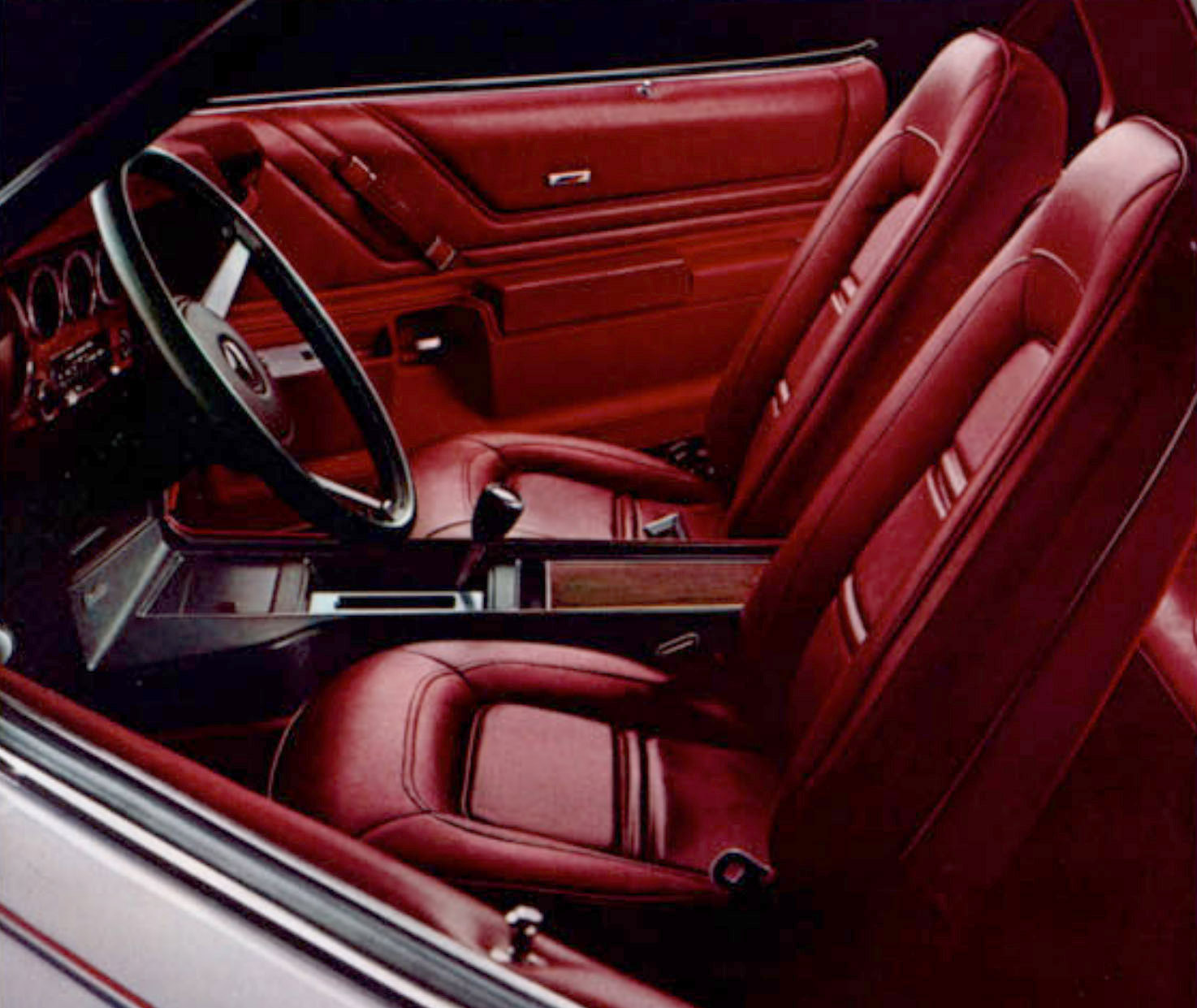
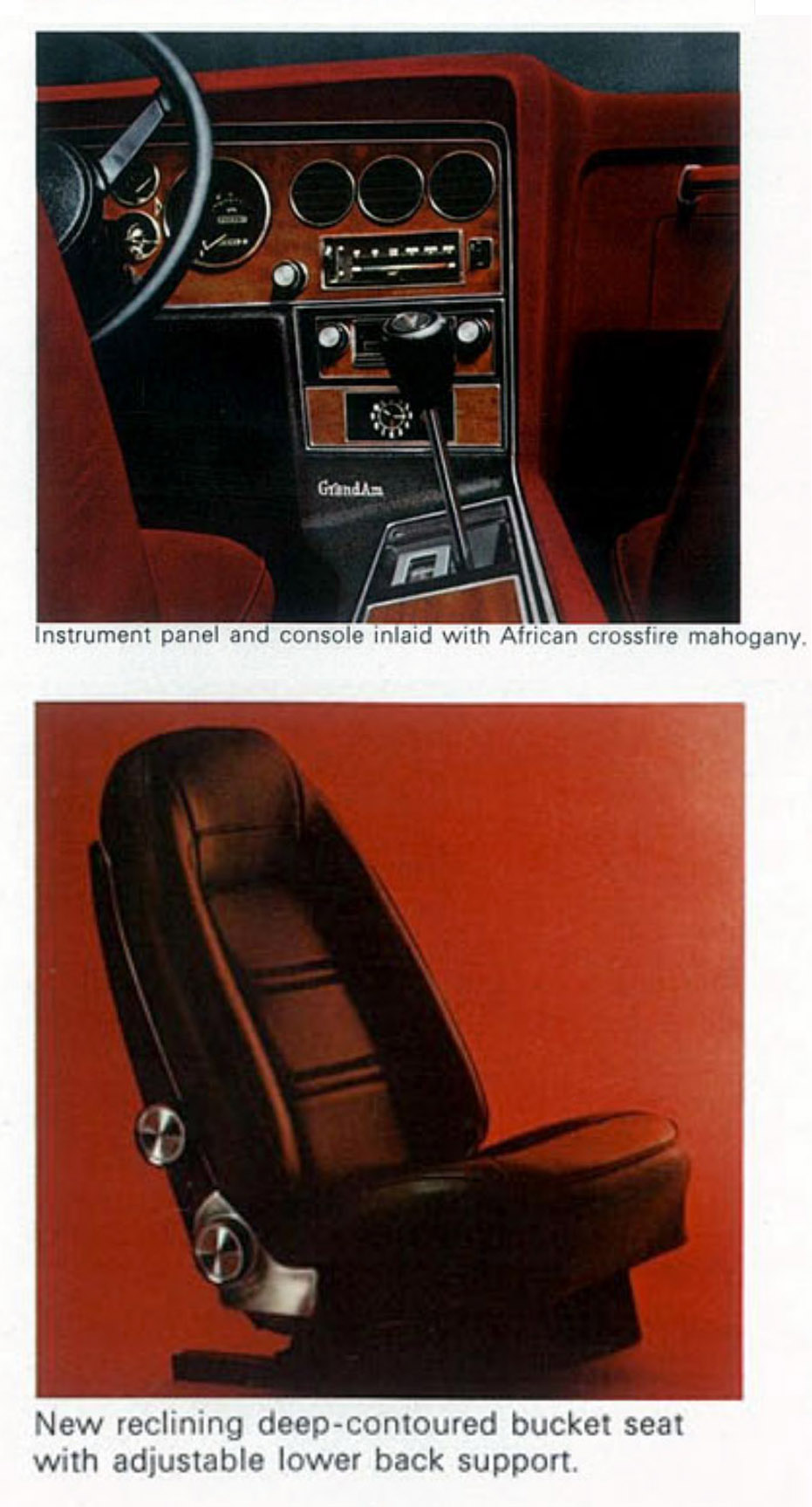
The dashboard out of the Grand Prix was installed and even featured real-deal “African Crossfire Mahagony” (what?) veneer – at least for the first year, until peeling issues made Pontiac go back to plastic. A console with a floor shifter in something that had more than two doors was rather unheard of at the time as well, but you could get your four-door Grand Am so equipped. The clock could be moved to just ahead of the shifter to make room for a tachometer if you really wanted to get full Euro with your Grand Am.
Despite being marketed as a “Euro-style” car, the Grand Am had very “un-Euro” power options. However, at least Pontiac called out engine displacement in liters instead of cubic inches on the trunk lid to try and act all transatlantic.
- 2-bbl 400 cu in (6.6 L) V8 with single exhaust: 170 hp (standard)
- 4-bbl 400 cu in (6.6 L) V8 with single exhaust: 200 hp (four speed manual only)
- 4-bbl 400 cu in (6.6 L) V8 with single exhaust: 230 hp
- 4-bbl 455 cu in (7.5 L) with dual exhaust: 250 hp
With the top motor, contemporary road tests got the Grand Am to sixty in around 6.5 seconds. The 400-powered Grand Am clocked in at around 7.7 with the rare manual transmission – not bad numbers for the time in such a heavy, luxurious ride.
The Grand Am came with standard radial tires and what GM called “Radial Tuned Suspension” with front and rear sway bars combined with special “computer selected” springs and shocks. It seems so silly now, but this was the long-overdue shift from cars that only went fast in a straight line to something that could at least attempt to attack corners.
Perhaps the most interesting Grand Am flavor GM considered (that sadly never saw the light of day, other than a one-off example) was the Grand Am station wagon, which now lives at the Pontiac Museum in Pontiac, Illinois as a reminder of what could have been with a truly pioneering sport wagon.
Yes, the same-year Malibu SS wagon which Mercedes Streeter reported on did get built, but that was more of a muscle-car-oriented product than the Euro sport/luxury proposition of the Grand Am.
Sales Weren’t So Grand
The Grand Am wasn’t cheap; the two-door coupe was the top-of-the-line mid-sized Pontiac and listed for $4,264, which was more expensive than a Trans Am.
Sales of these performance mid-sized Colonnades did not live up to expectations. The GTO only sold 4,806 copies before it was quickly discontinued. Grand Ams accounted for 43,137 sales in 1973 and then dropped off a cliff to 17,083 cars the next year. These 1974 cars were essentially unchanged except for a different grille, five-mile-an-hour rear bumpers, and minor engine option modifications.

As Jason has pointed out, these were the years when Pontiac did their chiaroscuro dark brochure shots like Rembrandt was painting a mid-sized Pontiac instead of The Nightwatch.
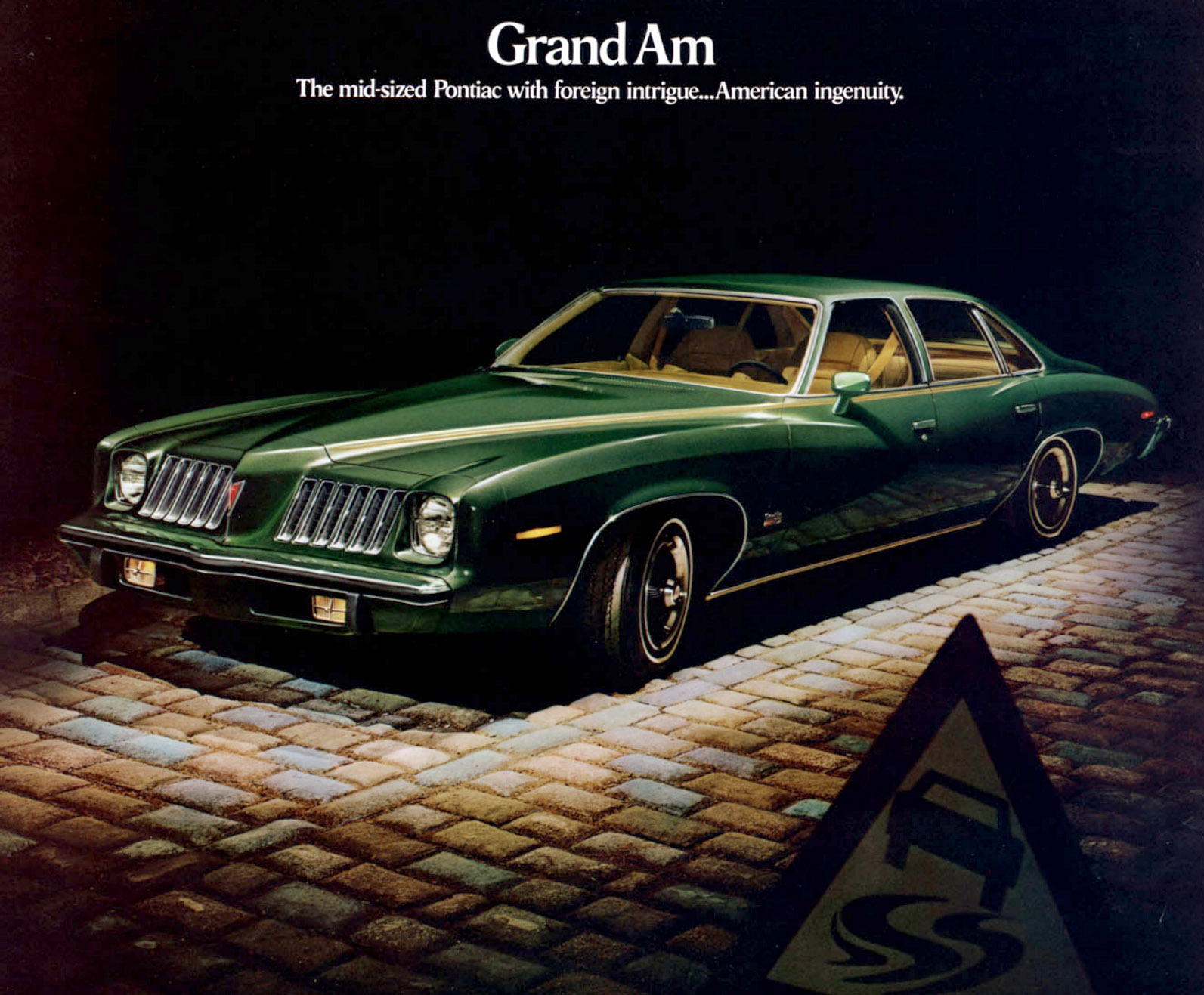
New emissions regulations kicked in in 1975, dropping the top 455 V8’s output to a mere 200HP and extending its 0-60 time to nearly eight seconds. Pontiac could only move 10,679 Grand Ams and cancelled the model at the end of the year. The addition of rectangular headlights for 1976 would have required an all-new fascia that the low sales wouldn’t have justified. Apparently, the guy trading in a six-year-old Firebird wanted a Bonneville after all, or more than likely was turning it in at an import dealer down the block. I like how the later model’s taillights curve up to horizontal and were seemingly designed to be seen from space.

If you like to geek out on sales stats, here’s the sad story. I’d be looking for a four-speed (the M20) in a four-door or one of the top engines in that sedan for ultra rarity:

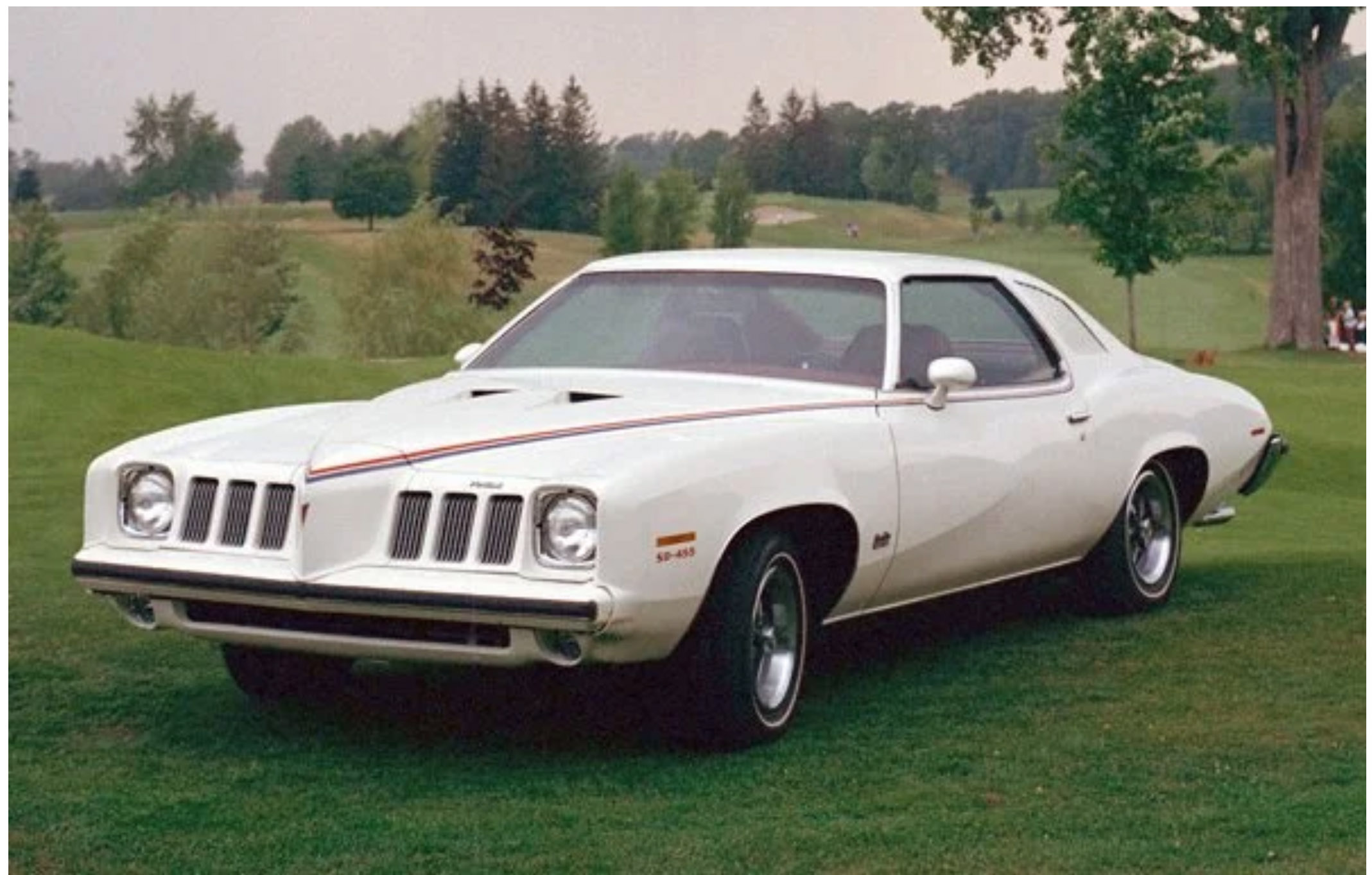
You can see the entire production run of 310-horsepower SD-455 Grand Ams below; this one-off reportedly ran a 14.8-second quarter mile. Now there’s a missed opportunity at a sleeper.
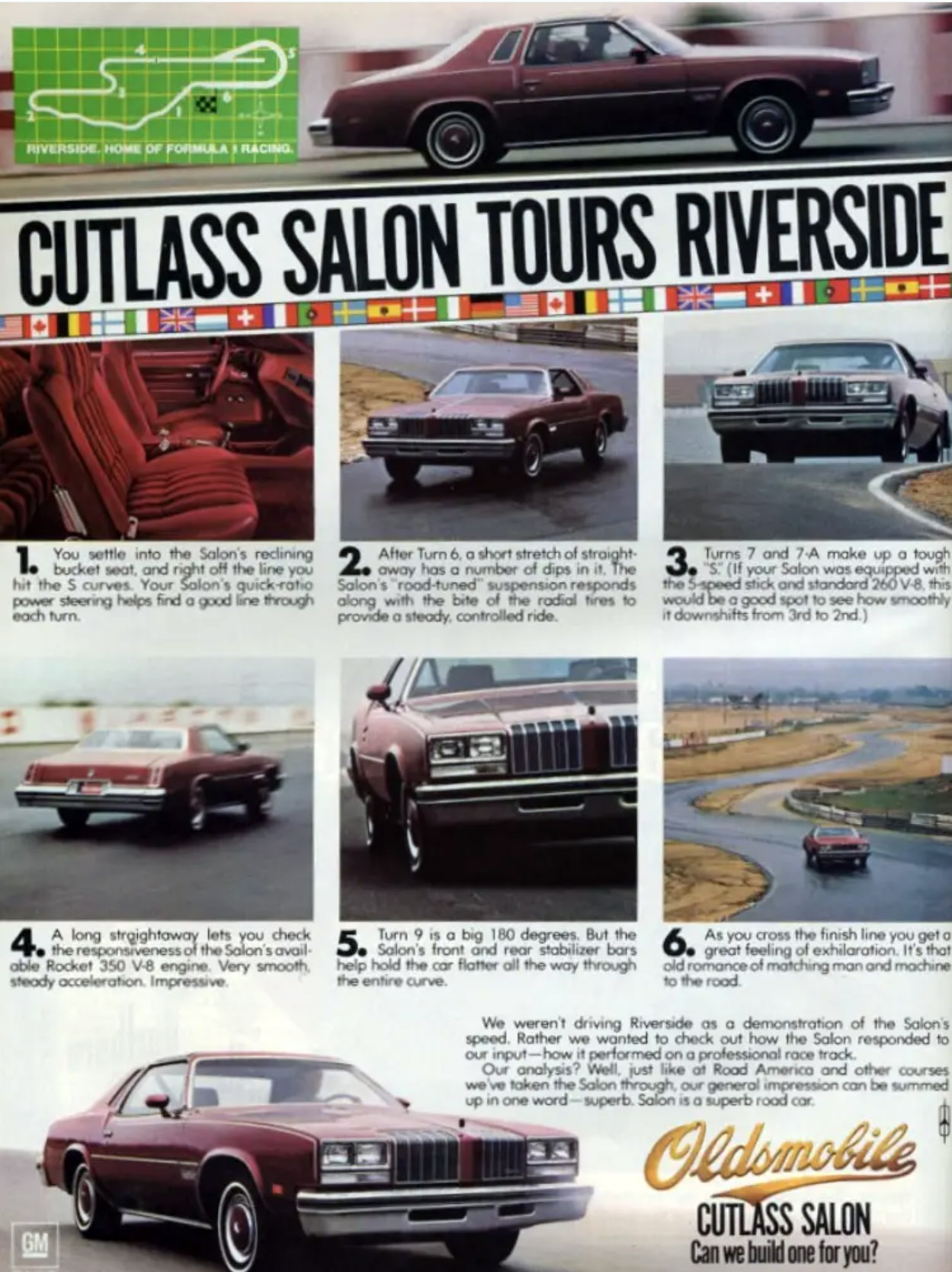
Adding insult to injury, the other “Euro styled” GM products with standard “radial tuned suspension” sold better; these cars included the Chevy Monte Carlo S and the Olds Cutlass Salon, as seen below. Warning: even if Riverside still existed today, I would NOT recommend taking a Cutlass on the track. You can smell the brakes by just looking at this insane ad with what any GenXer would consider to be Aunt Katie’s car hitting the apexes:
Truth be told, the “beak” nose of the Colonnade mid-sized Pontiacs was never well received in general, so it’s no wonder the Grand Am fell far behind the sales of the other GM divisions. You’d think that would have been the end of the Grand Am project: it was not.
Grand Am II: Electric Boogaloo
Surprisingly, after this inauspicious debut, when Pontiac released the all-new downsized A-body (later called the G-body) for 1978, GM reintroduced the Grand Am as well. As with the first generation, a unique nose panel was part of the package that included the radial tuned suspension. Handling was considered far superior to the previous generation in this smaller and lighter car (the Colonnade was actually about the same size as the new-for-1977 full-sized GM cars like the Bonneville).
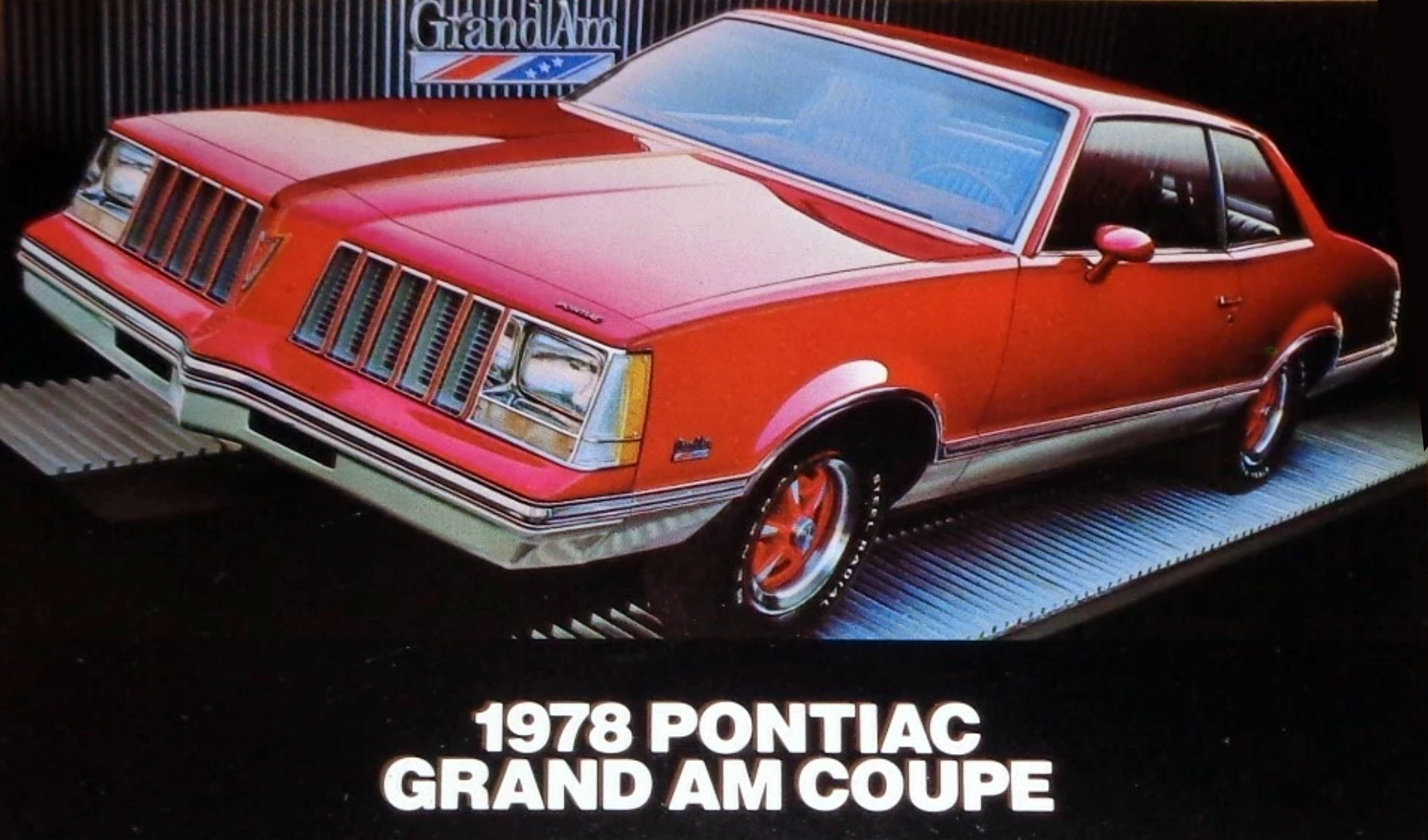
Trans Am-style “snowflake” wheels were a popular option that looked fantastic. Rear windows that didn’t roll down at all were not fantastic.

The Pontiac dashboard-of-many-circles provided a full complement of gauges and a center console.

The Grand Am remained a rather unique proposition in the US auto industry that wasn’t challenged until Ford introduced their “European flavored” Granada ESS in 1978 with fake Mercedes styling flourishes and little else mechanically. Despite being a total paper tiger, the ESS sold relatively well; almost certainly better than the Grand Am and even Ford’s own in-house European-themed Fairmont ESO, a much better car and an even match for the Pontiac. I wrote about this sad state of affairs a while back.

Unfortunately, top power options were limited to a 301 cu in Pontiac V8 with a two- or four-barrel carburetor maxing out at a measly 155 horsepower. A 4-speed manual was actually available as an option, which must be a unicorn with mere hundreds likely produced.
In retrospect, this second-generation Grand Am was even more similar to the LeMans visually and mechanically than the first generation, and it didn’t connect with buyers any better. Sales for 1978 came to only 10,608 cars, and 1979 numbers dropped to 5,866, with fewer than 1,800 of those being four-doors. Only the two-door remained for 1980; after a scant 1,647 cars were built for this final year, the “Euro” experiment was ended again.
Grand Am III: X Marks The Spot
It’s tough to be ahead of the curve with trends, but at least a company with pockets as deep as General Motors had the ability to weather out such missteps. Ultimately, they’d be proved right.
After two attempts at a “Euro” style sedan, the public was finally ready for a cut-rate BMW when the third-generation Grand Am debuted for the 1985 model year to replace the much-maligned X-body Phoenix. Available initially with an Iron Duke four or the “modern day small block” 2.8-liter V6, this time the Grand Am was a true hit, and one that would essentially carry Pontiac as their sales-leading mid-sized sedan for the next two decades. Third time really was the charm for Pontiac’s Euro impersonator, when it finally had front-drive and small engines to match cars from overseas.

Me? I’ll take my fake “Euro” car with a 455 Poncho, thank you.
A Grand Bargain?
With many cars that fail to find a market when new, their values suffer as used “classic” cars. The first-generation Grand Am is no different, with prices for decent examples averaging around the low twenties, even well under $20,000 for very presentable specimens. But as with every rule, there’s an exception – like this 44,000 mile 400 4-speed ’73 coupe that sold for a whopping $58,876 in 2024. Maybe people are finally coming around to the charms of a car whose time came a little too late for it to enjoy.
Pontiac Points: 81 out of 100
Verdict: It might not have been a sales success, but if you’d like your three-pedal big-motor Pontiac thrills with a set of rear doors and real-wood, lumbar-supporting luxury, then this is your car.


Obviously the first generation is the one to have, but a pre-facelift third-gen is still the one I actually desire.
MICHIGAN. Pontiac, Michigan is home to the Pontiac Transportation Museum and, long before that opened in 2024, was where to find the Pontiac Motor Division itself.
Not Illinois!
“…now lives at the Pontiac Museum in Pontiac, Illinois…”
Man, up until this gaff I had convinced myself that the domestic car expert The Bishop worked for a Detroit 2.5 automaker and lived here in metro Detroit.
Now I’m entirely confusified.
The first-gen Grand Am sedan was a handsome car.
I wouldn’t want to drive a malaise-era GM sedan around Riverside either – it was a particularly deadly racetrack. It was open for 31 years and had 21 fatalities – 19 drivers, 1 pit crew and 1 spectator.
Imagine getting only 170hp out of 6.6 liters. How did they manage to stuff so little horsepower in such a big space
Free range horsepower. Lots of room to run around!
LOL
’78+ GrandAm’s are excellent sources of fat F&R swaybars for G/A bodies – if you can still find them in your local Pick’n’Pull. IIRC, they had the largest swaybars of any G/A body. I pulled the set off a 4-door GA (!!!) along with it’s springs for my ’80 Malibu 2-door. Combined with a set of 9C1-spec shocks, it transformed the Landau topped Chevy into quite the nimble machine.
What, exactly, is Euro-Style about this car?
Absolutely nothing except some Ad Department at an agency trying to sell excrement as if it came from europe and therefore aspirational.
I loved the Gen 3 Grand Am, with the body color wheels and ground effects. However they didn’t seem to last long. I don’t think I’ve seen any Gen 3 Grand Am in the wild in 2 decades.
These (along with the other N bodies) used the Buick 3.0 for a V6. And you couldn’t get the V6 with a manual. Chevy’s version on a different platform (Corsica and Beretta) had the 2.8 for a V6, and you could get it with a Getrag. Riding with my uncle in his wife’s new Beretta GT 5 speed with her not in the car, we got out of sight from the house and he laid me back in the seat. Between that and the 2.8 exhaust note, I was in love.
A gen 3 grand am would be at least 35 years old. They lasted as long as other ÚS cars of the Eighties. They went to the junkyard a little sooner than German cars because the Germans had enough resale value to be worth one more repair, and sooner than Japanese cars that rusted out before they stopped running.
“I don’t think I’ve seen any Gen 3 Grand Am in the wild in 2 decades.”
FWIW Here’s a late model 3rd gen in Oregon for sale:
https://www.facebook.com/marketplace/item/1379326276805940/?ref=search&referral_code=null&referral_story_type=post&tracking=browse_serp%3Af10bd0d7-da61-4c7b-99d9-6b11ab827dd5
No V6 but it does have a MT and the ask is $850. I assume the trashed ignition cylinder is just the chef’s kiss for any older Pontiac.
They ruined another colonnade car by switching from round headlights to rectangular ones – the Monte Carlo. It looks great with the rounds, stupid with the 4 rectangular ones. My parents had a 75, and it was the first car I drove. Hood long enough for me (at 6’5″) to lay on it without my feet hanging off, but 1″ of rear seat leg room when I was driving it!
The 68–77 A body coupes had less rear seat legroom than the sedans. The MC had the same wheelbase as the Chevelle sedans, but the length went in front of the windshield, not the back seat.
In the late 80s, a guy in my neighborhood had a second generation Grand Am with the snowflake wheels. Loved how that thing looked. Sounded good too.
I remember seeing a couple of these things rolling around my town, but not many (this would have been in the ’80s, when I actually started paying attention to cars). The whole “euro” genesis in the mid 70’s seems pretty silly – I see it here with this and mentioned with other cars of the era (Granada). To me, they were always just big American cars.
Somebody please help me out with this – seeing the NACA scoops on this one jogged my memory…wasn’t there also an option for a Trans Am-style shaker available as well?
I vaguely recall seeing something about the sd 455 having a shaker for 74, and only that in the grand am. Having seen one in person at the local hardees weekly boomer grab n gab.
But afaik, they were fake in that they drew air like a regular air cleaner and not like the fire chickens used to.
This was the model that David (because producers thought the character’s original name, Bruce, sounded “too gay”) Banner drove in the first episode of The Incredible Hulk. As in real life, that car crashed and burned.
Calling this thing “Euro” -anything is wildly misleading.
Good God that thing is ugly. This car has an awkward beak and was brand new but looked like the rear suspension was sagging on the showroom floor. It really is a study in bad design. Where’s that Adrian guy to tear it apart?
In ’72 I was an overseas GM student studying at GMI in Flint, MI and traded my ’69 SS396 on a new ’73 Grand Am 2-dr with the 400 4bbl/dual exhaust and Positraction, white with the burgundy trim from Moorman Pontiac in Dayton – sticker price 4728,50. Covered 20,000 miles across the states (including 10 days of Flint down to Tx, across through Nevada to Ca, quick trip down to Tijuana, up to San Francisco then across to Salt Lake City, up to Yellowstone, caught in a blizzard so overnight in Cody, Wy then back via I90 to Chicago and home to Flint). Shipped it down to NZ in ’74 and sold in ’75 to purchase the first home. Yes, the styling was controversial but for it’s time it was a great long-distance tourer and definitely sat on even winding roads rather well.
Where is the Euro Style? It’s a big, fat, boring american car.
The styling is EASTERN Euro, specifically grainy photos of Soviet Khrushchevkas.
A 1970 GTO was a major influence on my young life, so, as a 12 year old car geek in 1973, the Colonnade bodies just seemed awful compared to GM’s 65-72 styling. Bloat, big bumpers, etc. etc. Disco was right around the corner, the pet rock was big, my sister’s room had shag carpet on the wall. Forgot what my point was.
I think you were about to go holler at those kids to get off your lawn.