

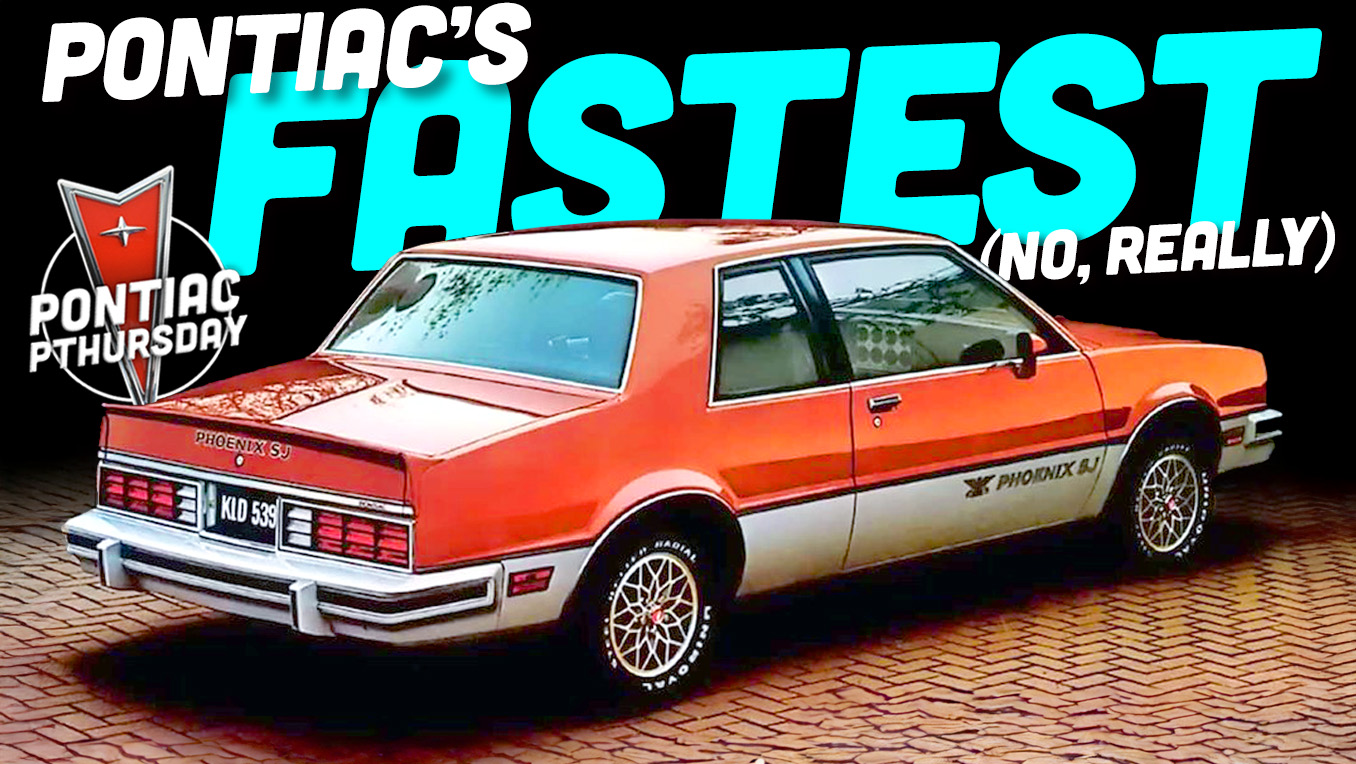
Things are not always what they seem to be. This is especially true with cars. In the malaise era, we got plenty of sleek automobiles that were often covered in flashy graphics, ground effects, and spoilers that all promised lightning-quick acceleration. More often than not, these paper tigers couldn’t even outrun a station wagon from a decade before.
Pontiac was very guilty of this imbalance in the 1980s. In 1982, the brand launched one of its most advanced-looking products ever: the Firebird Trans Am. The new Firebird instantly made a lot of European exotics look old hat. The appearance was of something that would be unbeatable on the street, yet the reality was that it could barely defeat the Pontiac that some (perhaps unfairly) consider to be one of the worst cars ever built. Some tests show the Firebird wouldn’t have beaten it at all. What’s even funnier is that this car was sold right alongside the Firebird in the same Pontiac showroom.


And Now You Find Yourself In ‘82
I fully understand that the 1982 Trans Am was more than partially responsible for the people of Germany being subjected to the music career of David Hasselhoff. With all apologies to the people of Deutschland, I still find the first third-generation Firebird to be my favorite Pontiac of all time, looks-wise. It’s a beautiful car, regardless of being guilty by association of putting The Hoff singing on top of the Berlin Wall.
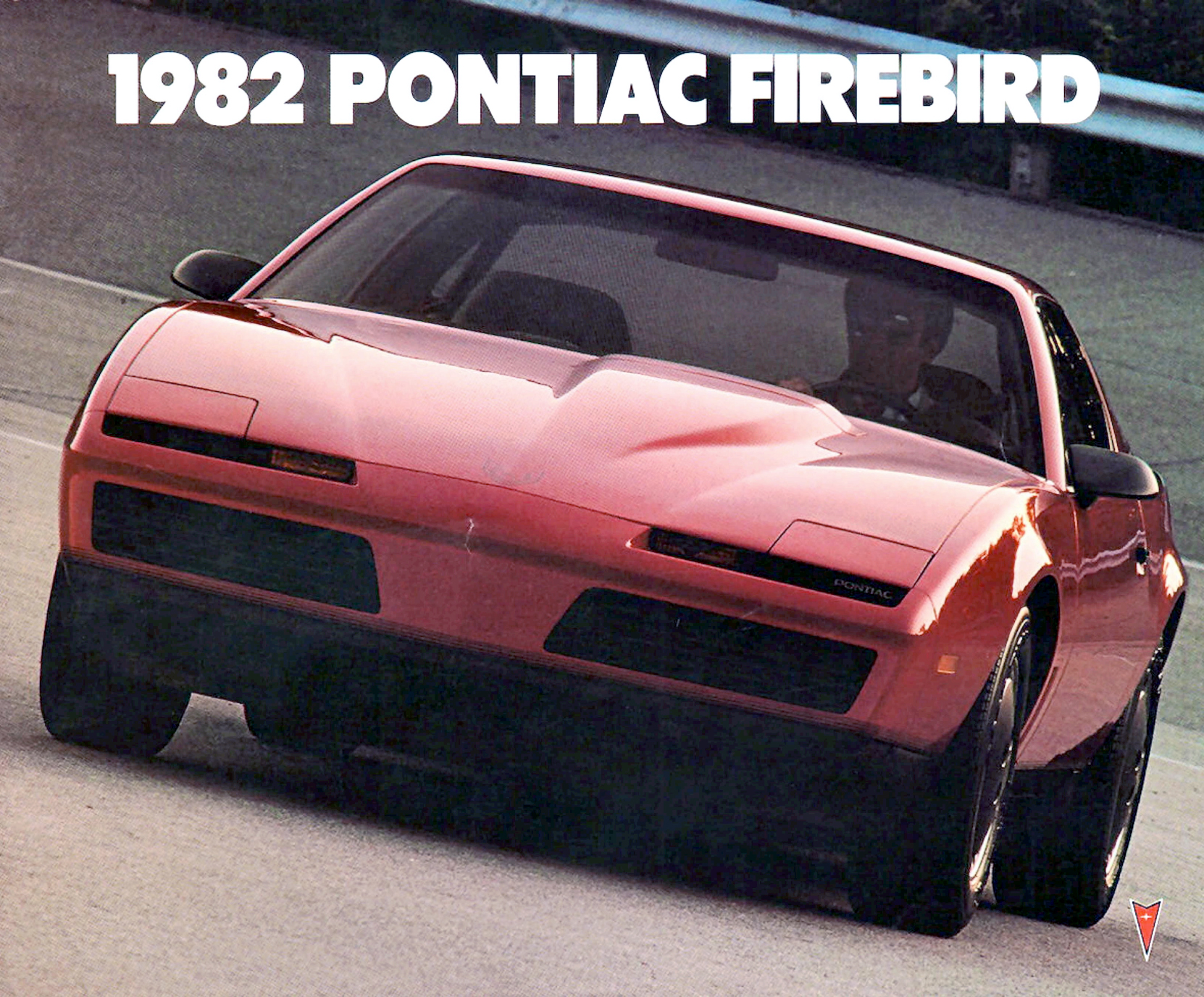
Pontiac design head John Schinella successfully lobbied to have their version of the new F-body feature a lower nose with pop-up lights. Combined with things like the “bowling ball” wheel covers and relatively flush glass, the team created a form with a low-for-the-time .31 drag coefficient. Unlike the Trans Am from the previous model year that wore a “screaming chicken” decal large enough to cover the entire hood, the new, more restrained 1982 model’s chicken sticker was small enough to fit in the palm of your hand.
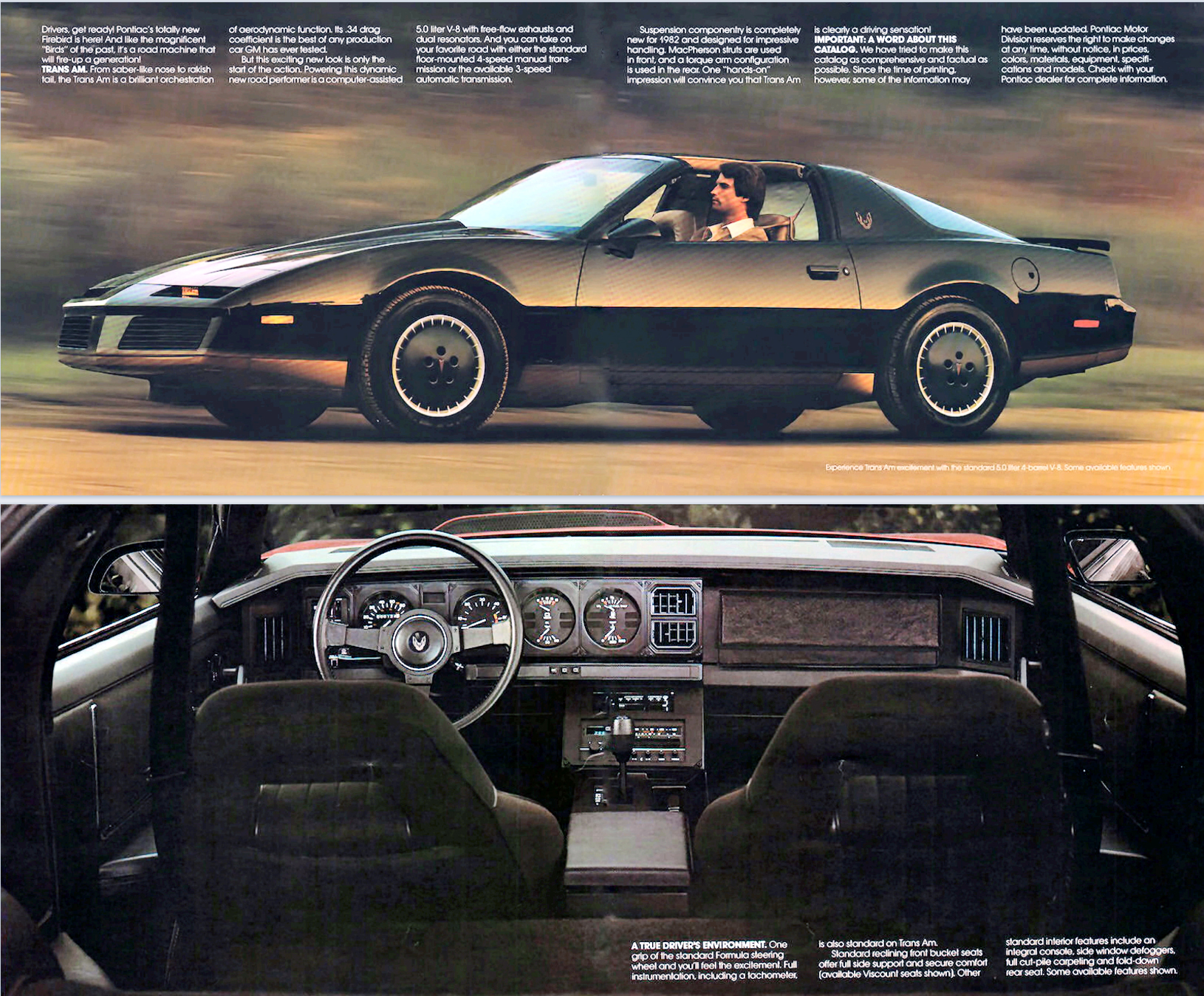
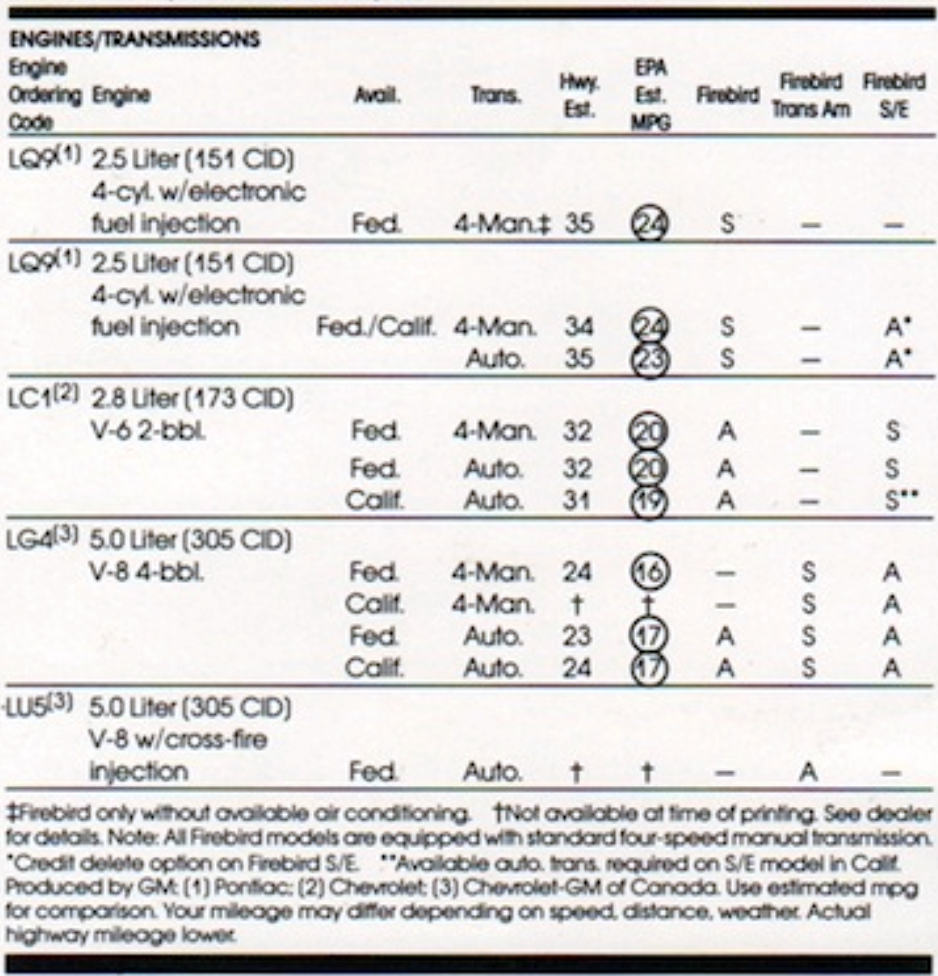
Unfortunately, what was under that hood was not a screamer of any size. Base Firebirds actually got the clunky Iron Duke four cylinder, with an optional 2.8 liter V6 or a four-barrel 5.0 liter (305 cubic inch) V8 with only 145 horsepower. The top powerplant for the Trans Am was that same V8 with the available “crossfire” double throttle body fuel injection system, good for a mere 165 horsepower. That’s not a totally horrendous number for 1982, but at around 3200 pounds, the Firebird Trans Am was a relatively large and heavy car for the time. A four-speed manual was standard on the carbureted V8, but if you ordered the “ceasefire” option, you were stuck with a slushbox.
This meant Pontiac’s hot-looking sports coupe was not such a hot performer. The best that Car and Driver could get out of a four-barrel four-speed manual 1982 model was a 10.8-second slog to sixty. The fuel-injected version could drop that acceleration time down to a better-but-still terrible nine-second range. “Something is desperately wrong,” quipped the magazine, “when a Nissan Stanza econosedan beats the ballsiest four-speed T/A to 60 mph.”
It was actually worse than that. You didn’t need to go to the Datsun dealer down the street to find a family sedan that was faster than the T/A, there was one right on the Pontiac dealer’s showroom floor.
Who Can It Be Now?
General Motors took a major gamble by replacing its tried-and-true X-body compacts in 1979 with an all-new front-wheel-drive design that was unprecedented in America. Would buyers really be good with trading in their rear-drive Chevy Nova with a chassis that dated back twenty years for some newfangled Citation with specifications that more closely matched a VW Dasher/Passat? The answer was an overwhelming “yes”, with an astounding 1.1 million X-cars finding homes for the 1980 model year alone. How did they develop something so new so fast, and how did they successfully keep up with that overwhelming demand?
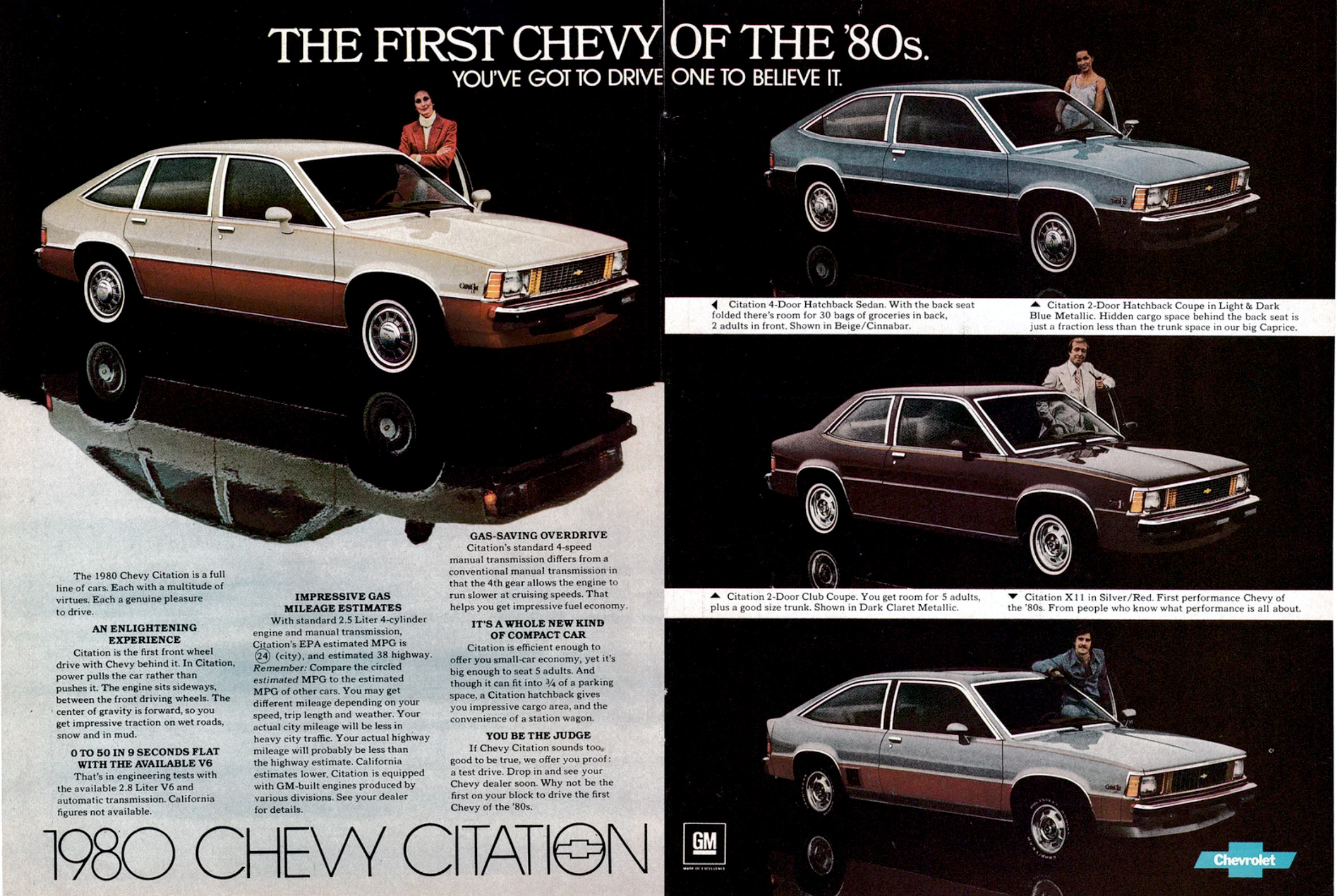
Well, the simple answer here was that they didn’t. It’s safe to say that the front-drive X-car wasn’t fully developed when it was launched, and major issues started to pop up right away. The most publicized problem was a brake proportioning fault that caused the rear drums to lock up prematurely. GM did a voluntary recall of some of the earliest models to modify the brake proportioning valve, though leaked documents stated that they knew it wasn’t going to fix the problem. Eventually, a larger number of cars were recalled to replace additional components, but the NHTSA sued to have every one of the million-plus 1980 cars recalled. They failed in their efforts, however, and the damage from bad publicity was insurmountable.

Further, building cars at a breakneck pace resulted in hit-and-miss quality for the X-cars – mainly misses, and they sealed GM’s bad reputation for decades. As a kid, I knew a family with a Citation that needed five new water pumps over the several years they had it. Some neighbors ordered two Buick X-Cars (the Skylark) at the same time to replace both of the gas guzzlers in their fleet; one was delivered with unacceptably granular paint, while the other one arrived with barely passable orange peel. How do you even do that?
Still, being introduced literally in the peak weeks of the second energy crisis, the X-car succeeded since it might have been the ultimate example of the right car at the right time: small on the outside, spacious on the inside, fuel efficient but actually a reasonable performer with the optional 2.8-liter V6. Pontiac’s version was the Phoenix, available as a four-door hatchback or a notchback two-door sedan.

I have no clue why 1981 Pontiac chose to put the Phoenix in a 1960s-style interpretation of the Wild West in this commercial, but here we are:
The top-of-the-line model had the cosmetically enhancing SJ package, but for 1982, the SJ became a distinct model with a big addition: a standard “high output” LH7 two-barrel version of the V6 that increased power by 23 horsepower to 135 and 145 lb-ft of torque.
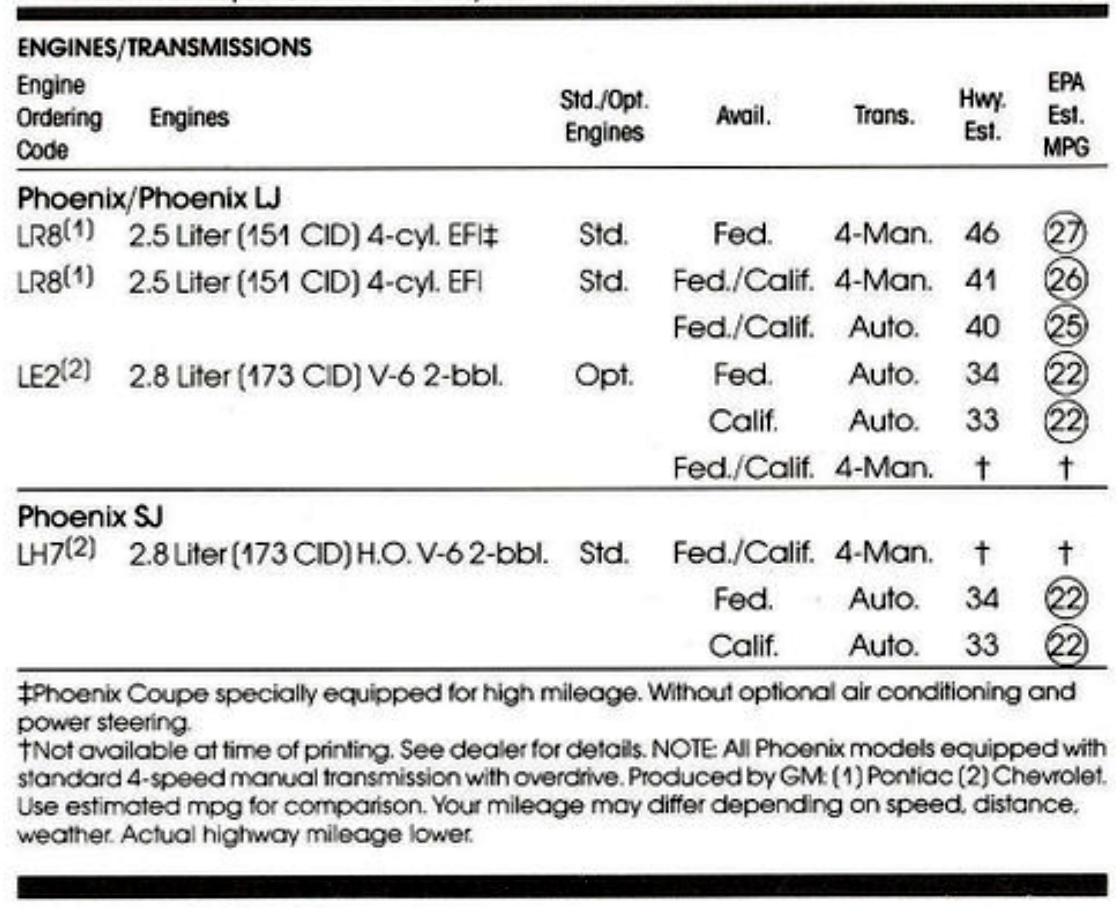
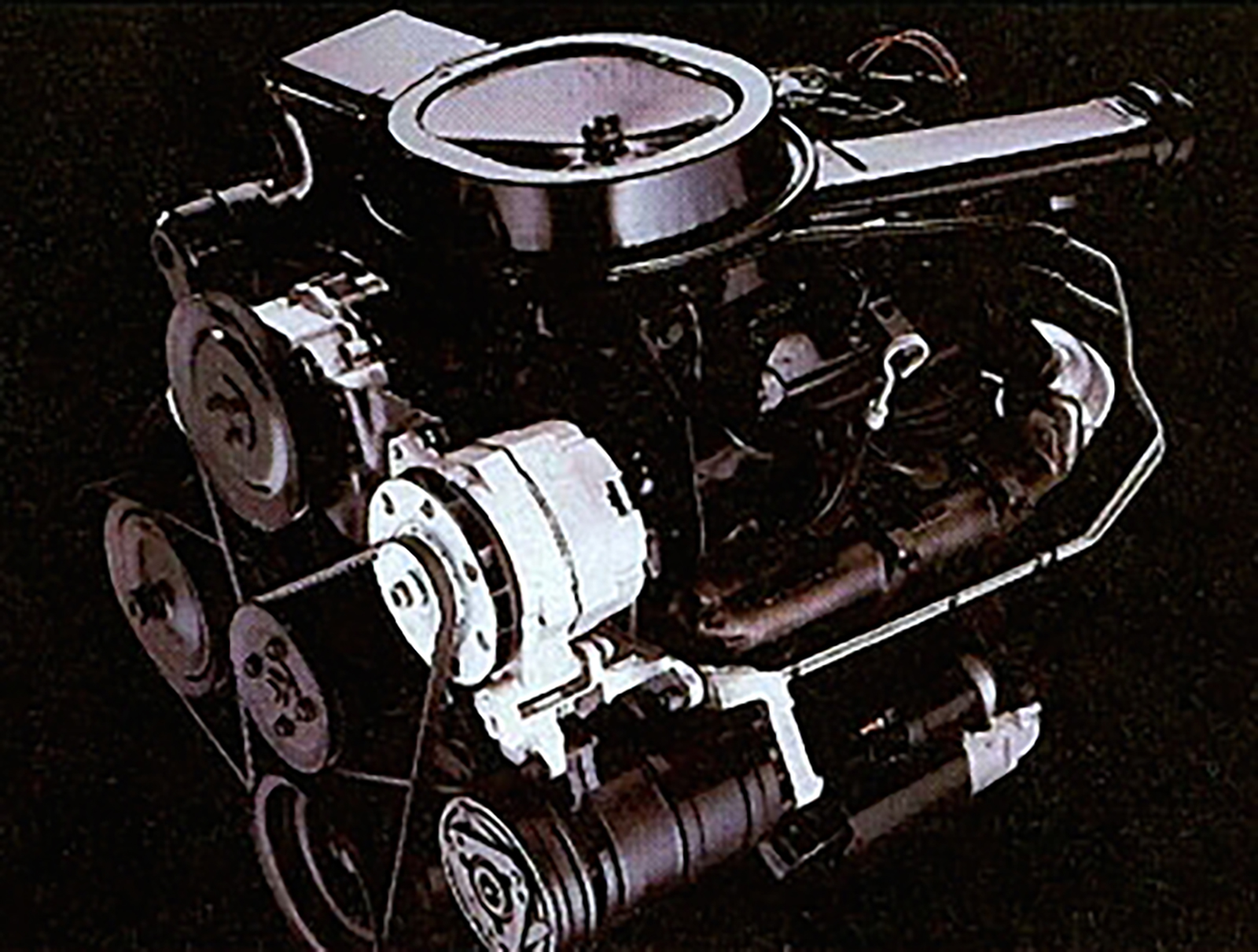
Remember that a 1982 Phoenix SJ coupe weighed only 2,562 lbs, so with the standard 4-speed manual transmission, it was a reasonably quick car with zero to sixty times recorded in the very low nine-second range.
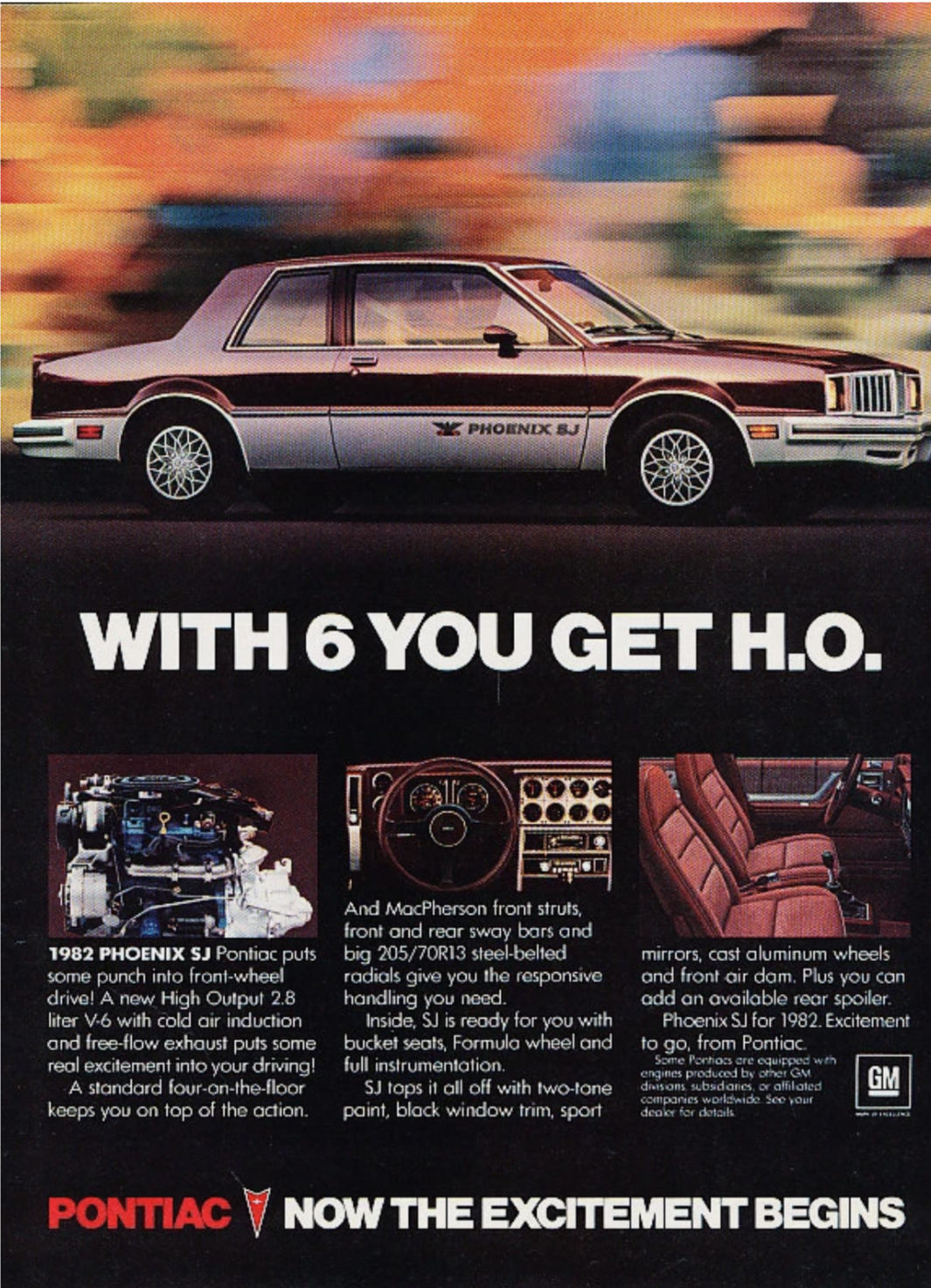
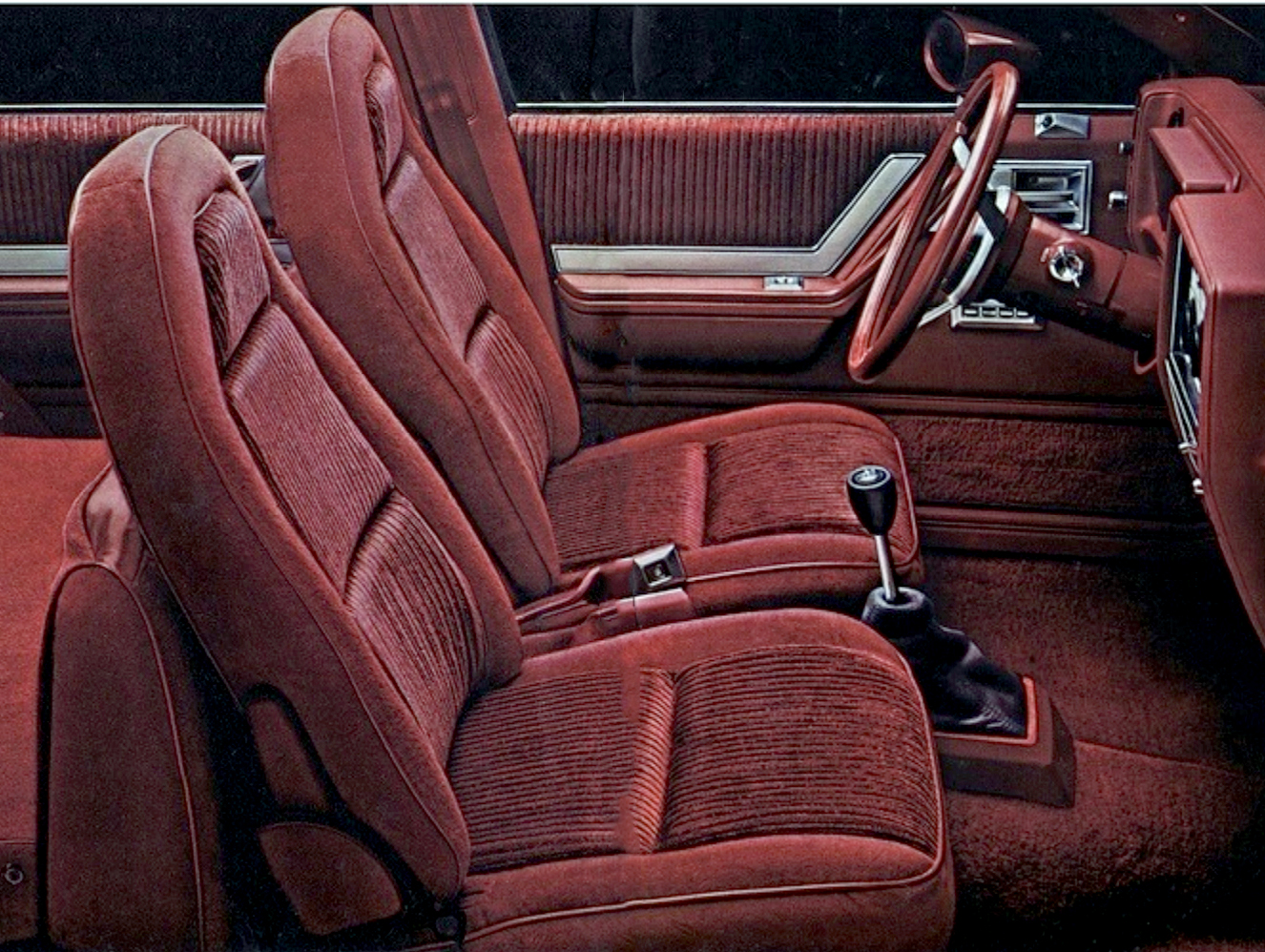
Pontiac gave their top-of-the-line Phoenix some subtle visual upgrades, including a rear spoiler, plus a Trans Am steering wheel and a full set of gauges in the typical Pontiac dashboard-of-many-many circles (though at least on the Phoenix SJ that had actual gauges in them).
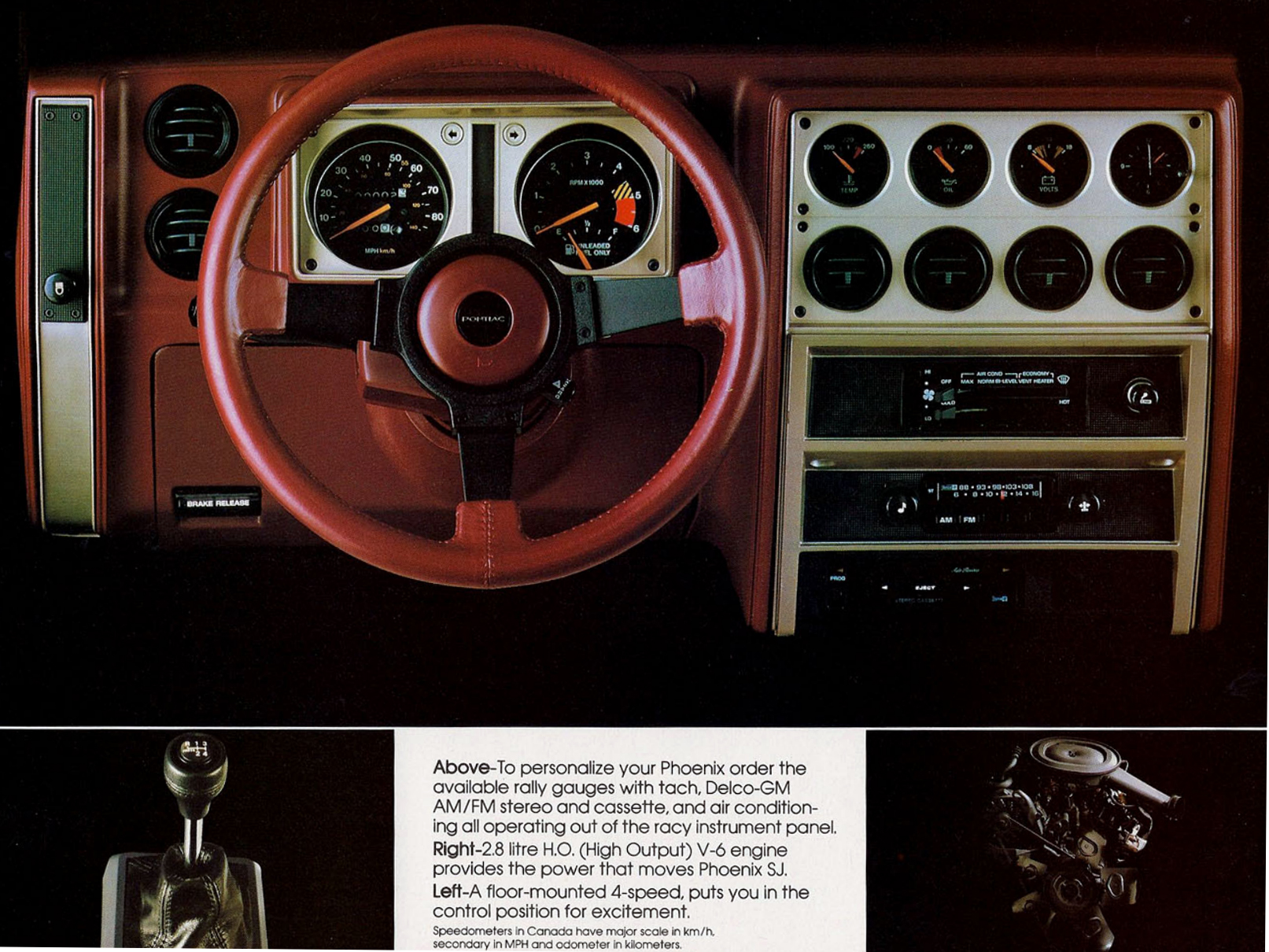
The suspension with front and rear anti-roll bars was supposedly upgraded, along with 205/70 R13 tires. As Old Car Memories stated:
All of this Pontiac bragged about in their sales literature. What Pontiac didn’t mention was the 1982 Phoenix SJ if ordered correctly could out accelerate the fastest 1982 Trans Am that Pontiac offered. The Trans Am was Pontiac’s flagship sports car so it was understandable Pontiac didn’t want to let the cat out of the bag. Pontiac’s hottest 1982 Trans Am was equipped with the 165 horsepower LU5 Cross-Fire fuel injected 5.0 liter V8 was good on the average for high-8 second 0-60 mph times when equipped with the optional 3.23 rear axle ratio. The LU5 Trans Am could only be equipped with a 3-speed automatic transmission. Now here’s where it gets interesting, if an 1982 SJ buyer chose the lighter coupe and opted for the standard 4-speed manual 0-60 mph was obtainable in mid-8 seconds with an experienced driver at the helm. The end result was the 1982 Phoenix SJ was potentially quicker than the 1982 Trans Am.
My research says that “mid eight seconds” range seems a bit optimistic to me; high eights is the best I could find. Hot Rod tested an ’82 four-speed SJ Phoenix and pulled a 16.54-second quarter mile, or about 0.2 seconds slower than the stick carbureted same-year Trans Am they tested. Now, Hot Rod’s figures were for a quarter mile, so it’s entirely likely that the Phoenix and T/A could have been spot-on up to 60. However, I also wouldn’t be surprised if the Trans Am given to Hot Rod for testing was a “ringer,” a car modified in a way that GM almost admitted to having done with the GTO provided to Car and Driver in 1964 (author Patrick Bedard has written extensively about his skepticism of old GM press cars). At the same time, it’s entirely possible that the same massaging didn’t happen with the who-cares Phoenix, so the parity of the figures might be suspect.
Regardless, just listen to what we’re doing: trying to decide if Pontiac’s hottest sports coupe and the basis for K.I.T.T. could beat their same-model-year boxy five-passenger small front-drive coupe to sixty is like asking if your mom could win in a marathon against an Olympic runner. It’s absurd, but here we are. Admittedly, neither the ’82 Trans Am or the Phoenix were exactly going racing.
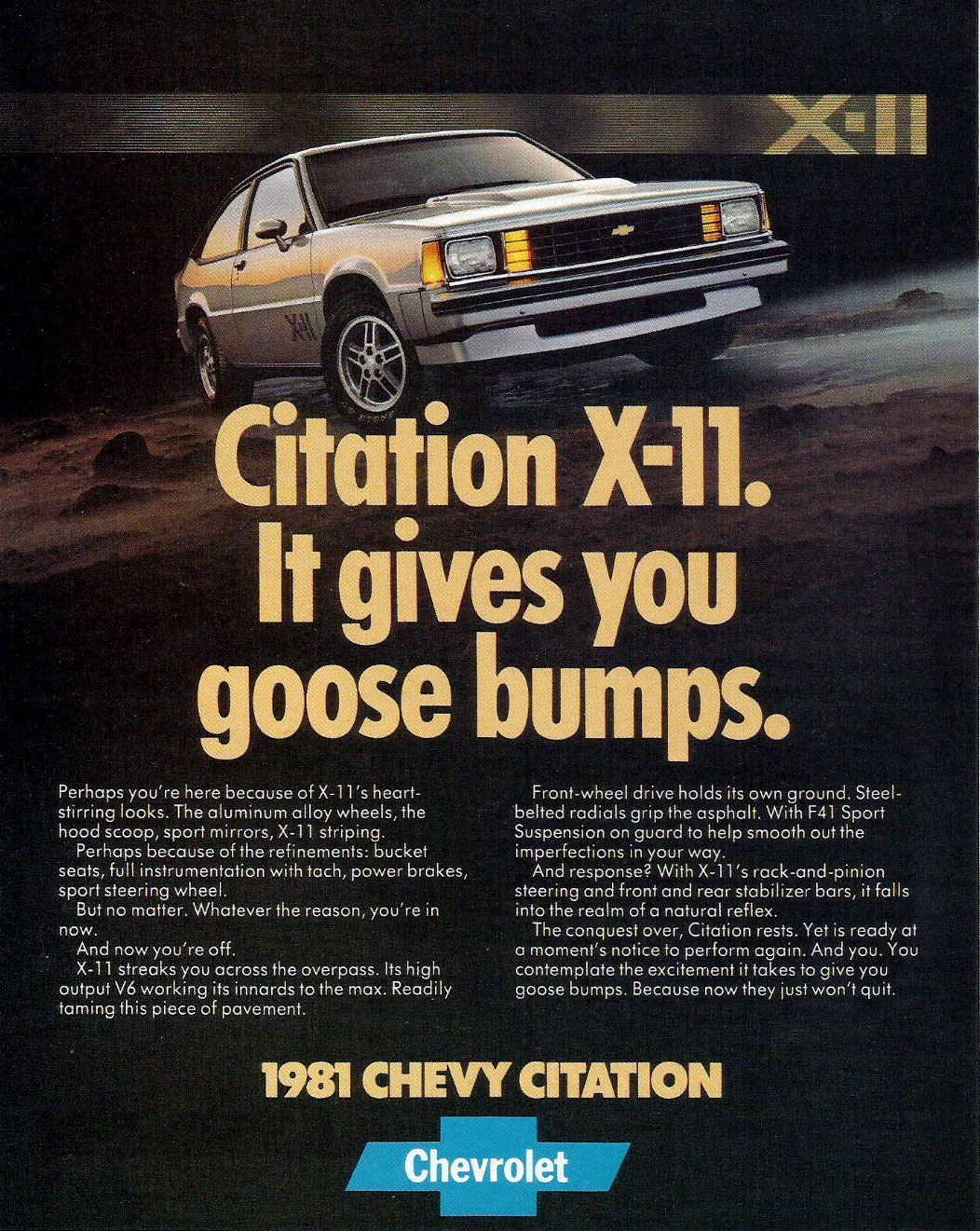
Actually, that’s not entirely true. In 1982 and 1984, the SCCA Showroom Stock Championship for the import-packed Class B was won by an X-body 1981 Citation X-11. I’m not sure if any of the nearly identical Phoenixes were in the race series, but the Pontiac featured the same motor as the X-11, even if the suspension modifications weren’t really the same. Sure, refinement was not a strong suit (one magazine described the manual transaxle as “feeling like a gear bag instead of a gear box”), but the competition records show that on a smooth racetrack, an H.O. V6 X-car proved more than a match for more expensive European iron like Saab 900 Turbos.
Buyers didn’t seem to care. A mere 995 Phoenix SJ coupes and 268 admittedly slower and heavier SJ 4-door hatchbacks were produced for 1982. The high-output powered Phoenix continued into the ’83 model year with the same power and a minor facelift, plus finally getting 14-inch wheels to replace the wimpy 13s on the earlier model.

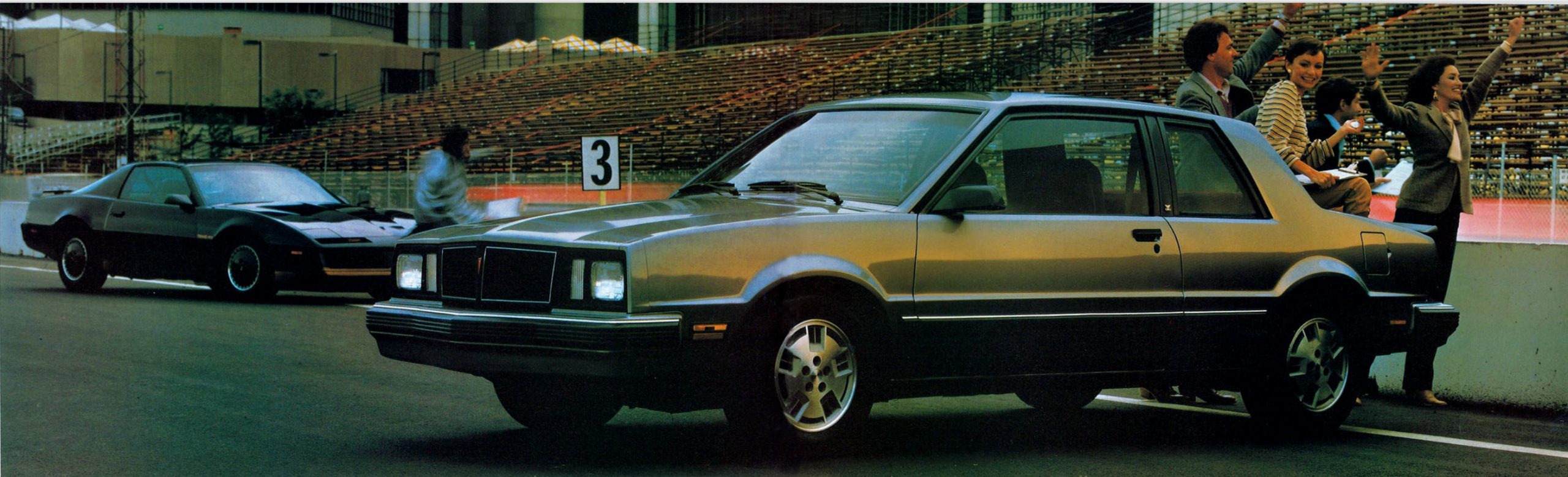
By that time, Pontiac had finally upped the power of the F-body to more respectable levels, so that ’83 Trans Am in the photo below could finally show the Phoenix its cool ribbed taillights.
The Phoenix stopped getting any kind of updating at that point and was a dead car walking. After 1984, the forgotten Phoenix once again returned to the ashes, replaced by the much more successful- but not as quick- 1985 Grand Am.
I Keep Forgettin’ (The Trans Am Was So Slow)
As troubled and lambasted as the X-car was, by almost any measure, it had to be one of the most influential American cars ever built. For better or worse, it changed the template of the typical domestic sedan. Ultimately, front-wheel drive cars accounted for virtually all of General Motors’ lineup, and sadly, their relative later success has to be attributed in large part to the extensive testing and troubleshooting done by, well, the owners of those first X-cars.
Regardless, when it was running right and held together, a Phoenix could have kept up with the most muscley car that Pontiac had to offer in 1982, and absolutely nobody noticed. That doesn’t make it a great car, but it will always have those bragging rights that history can’t take away. It should also make us thankful every day that the malaise years are long behind us.
Pontiac Points: 58/100
Verdict: “Michael, I can’t evade that little family coupe next to us!”
Top graphic image: General Motors


I was recently reading an article on Car and Driver about a 1982 comparison between a Firebird and Camaro. I remarked that only 6 years later you could buy a Honda Civic Si, for less money, that out handled and out accelerated, with an engine one quarter of the size, while getting more than twice the fuel economy, with more interior space and efficiency, in a tidier package than either of those two miserable hunks could do.
I got furious reply questioning my sexuality and insulting me personally (I think it mightve been Todd from Beavis and Buttman). I was just pointing out facts and what one might call “progress” in the automotive world.