

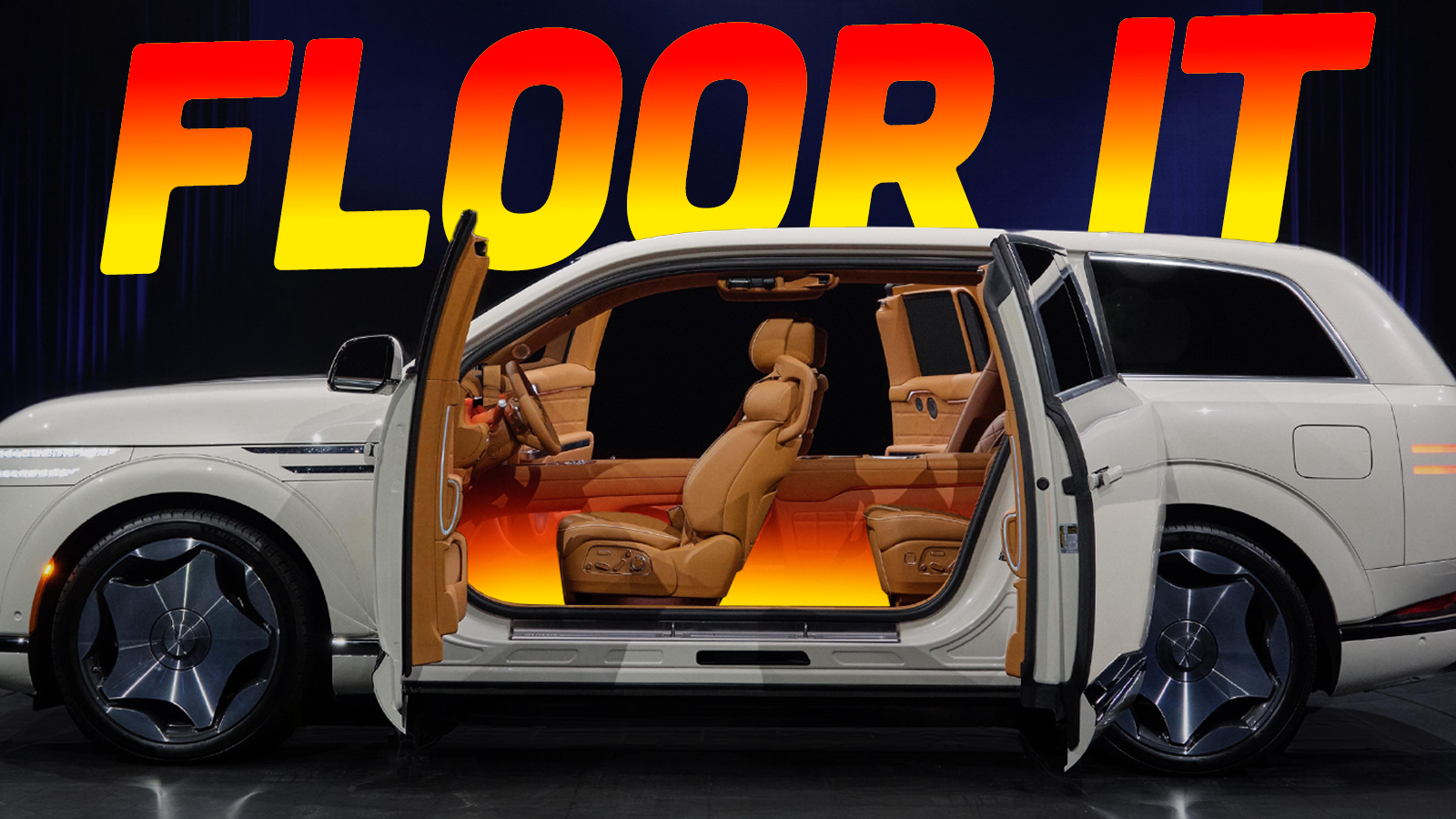
The flagship SUV is a phenomenon that’s here to stay. Range Rover was arguably first, but now you can walk into just about every luxury car showroom in America and buy a machine as tall as it is posh. Cadillac Escalades, Porsche Cayennes, Bentley Bentaygas, Rolls-Royce Cullinans, the list goes on and on. Conspicuously absent: Genesis, until now. This is the production-spec Genesis GV90, and the simplest way to sum it up is that it’s absolutely bonkers.
See, Genesis could’ve benchmarked the feature sets of the Lucid Gravity, Mercedes-Benz EQS SUV, and Cadillac Escalade IQ, and called it a day. The large luxury electric SUV segment has enough space that such a move would’ve been perfectly competitive. Instead, Genesis seems to have shot much, much higher. High enough to suddenly make a Maybach seem a bit tame, provided you spec the GV90 all the way up.


Let’s start with what makes it go. While just about everyone initially assumed that the GV90 would ride on the same e-GMP platform as the GV60, it’s instead the first Genesis model on a new platform called “Electric Mobility Prime” or eMP in initialism-speak. This Genesis-exclusive architecture supports advanced chassis technologies and big battery packs, and Genesis has used that to its advantage. Under the floor of the GV90, you’ll find a 123.5 kWh battery pack with 800 nominal volts controlled by a wireless battery management system. It feeds power to two electric drive units, each with its own electronically controlled limited-slip differential for a combined power output of 657 horsepower and 590 lb.-ft. of torque. Naturally, 350 kW DC fast charging is supported, although expected range is only quoted at 310 miles.

Beyond that, air suspension comes standard with multi-chamber springs at all four corners, permitting independent adjustment of ride height and effective spring rate, and monotube dual-valve adaptive dampers keeping those air springs in check. With a 127.75-inch wheelbase, it shouldn’t be a surprise that the rear wheels can steer by up to five degrees either with or opposite to the fronts in order to shrink the GV90’s turning circle at low speeds or enhance high-speed stability. The chassis itself is made of a mixture of aluminum and high-strength steel, with an integrated roll cage providing the torsional rigidity necessary for one hell of an optional party trick.

See, you can spec the GV90 with four normal doors, but if you pop for the Neolun model, the entry and egress situation changes. Not only are the rear doors on this model rear-hinged like on a Rolls-Royce Cullinan, but they’re powered, and the B-pillar’s been eliminated entirely. This is some straight-up concept-car stuff that you don’t normally see on an SUV this size, but it fits so well with the overall visual treatment of Genesis’ flagship SUV.

Instead of leaning heavily on sharp creases, Genesis has gone all-in on compound curves and soft radii, minutely pushing and pulling the sheetmetal. Most of the surfacing here is refreshingly subtle, with gently contoured flanks adding form without excess aggression. That’s saved for the front valence, where metallic trim punctuates a large latticework of grille. The real trick here is the lack of a visible radar sensor for the advanced driving assistance systems, and I suspect Genesis has found a particularly novel way of hiding it. How wild are those headlights when you stop to think about it? Or should I say headlight, because it’s a seamless jewelled one-piece affair across the entire front of the GV90. Two elements align to form a shield in the negative space, alluding to the marque’s signature grille without faking one. It’s likely that the forward-facing radar sensor’s hidden in that panel, aiding a sleek and refined front end.

If there’s one really strange angle on the GV90, it’s the rear-three-quarter, due to how Genesis has cheated the roofline, then treated the rear glass. With the availability of a third row requiring sufficient headroom in the wayback, Genesis has pulled the roof itself proud of the D-pillars on both the horizontal and vertical planes. That proud area then flows down onto a hatch with a relatively small, inset rear window. No black trim to cheat width here. It’s a bit odd, but you can likely forgive it due to what you see when you open the driver’s door.

Boom, leather in interesting hues everywhere, complemented by metal and crystal and a wild array of nuanced details. There’s an undeniable richness to the cabin of the GV60, a materials-first approach that hides some wild technology. For instance, that enormous infotainment screen’s actually in the deployed entertainment-while-parked position. Press a toggle on the face of the dashboard, and it retracts to a far more sensible height. There’s another little screen in the middle of the combination volume, fan speed, and temperature knob, a 25-inch head-up display instead of in a traditional gauge cluster, and we’ve barely scratched the surface.
See that column-mounted shifter pointing straight up and down like the Washington Monument? The GV90’s eliminated a traditional start-stop button, so when the doors are closed and the infotainment screen’s retracted and all of that, the shifter automatically rotates to a two o’clock position on the steering column as a physical sign this SUV’s ready to drive. At the same time, a crystal sphere in the console rotates to reveal a controller, and the dashboard tweeters for the 25-speaker, Dolby Atmos 7.1.4 Bang & Olufsen sound system rise. Who can say no to a little bit of theater?

You can get the Genesis GV90 with a choice of seven, six, or four seats. Go with the last option, and things get really wild. The front seats electronically rotate around 180 degrees to face the individual ottoman-equipped rear seats for the sake of conversation, and a separate partition seals off the luggage compartment to keep things quieter than the thick acoustic side glass can do alone. A refrigerator? Check. Tray tables in the console? Check. An electronically-frostable panoramic roof? Check. All the right ultra-luxury stuff, but Genesis then adds something we’ve never seen before: Fully loaded GV90s feature wood floors with built-in radiant heating. Exactly like in a fancy chalet. Part of the reason this is possible is due to the floor structure being completely flat, but it’s still a jaw-dropping feature to see in a car.

There’s so much more to unpack on the Genesis GV90. Massaging seats with 15 individual air bladders, a heated windscreen with a thin uniform metallic coating that eliminates a fine defroster grid completely, heated armrests and door panels, a roof airbag, wheels measuring up to 24 inches in diameter, the list goes on. However, one overarching theme stands tall here: Genesis wants it all. It would’ve been far too easy to repurpose the e-GMP platform wholesale from the Hyundai Ioniq 9 like what Toyota does with the Century SUV or Cadillac with the Escalade, but no. It’s very much its own thing.
Flash back twelve years, and Genesis didn’t exist as we know it today. It was just a Hyundai nameplate covering both a scrappy, affordable sports coupe and a reasonably posh midsize sedan. Now it’s competing with some of the world’s biggest and longest-running luxury car brands on pure merit. The GV90 means business, and so long as it’s priced right and a relatively normal range isn’t a turn-off, it should be a success.
Top graphic image: Genesis


“Range Rover was arguably first” I’d definitely like to argue that the Jeep with the Wagoneer was the first flagship SUV about a decade before the RR.
It’s a pretty tenuous claim to “first flagship SUV” for the Jeep Royale with Cheese coming out in the 1960s since the Suburban came out in the 30s, the IH Travellall came out in the 50s.
I guess I’m not sure exactly what the author was going for. Flagship being the nicest vehicle in a manufacturer’s fleet, or flagship as the nicest SUV in the fleet. Suburban was definitely one of the earliest SUVs but it wasn’t a luxury flagship by any means.
The Wagoneer offered all the high end luxuries available in sedans/wagons at the time, but was the only SUV with many of those features. It was also the most luxurious vehicle Jeep made, making it the flagship in my opinion.
Travelall is a similar story, not luxurious, but may have been IH flagship as they didn’t really make anything luxurious at the time. You may have got me on a technicality there.
“I guess I’m not sure exactly what the author was going for.”
The Automotive press has minimized the contributions of the American car makers for decades. Any excuse they can use to say some other country’s vehicles were first at something, they will take it.
I spy real buttons!!
I like it. Styling is better than the Germans (low bar, I know) and just quirky enough to be fun. People are complaining about the gizmos, but unless my eyes are deceiving me I see physical controls for everything that matters, which is the vastly superior option to Scandanavian Touchscreen Minimalism. Also, it’s available in ACTUAL COLORS HOLY COW!
The styling looks like if you had asked me what cars will look like in the 30 years, 30 years ago. I’m not saying I’m a designer, stylist, or clairvoyant. I’m just saying that this feels like the future… now.
Everything I hate about modern cars in a vehicle that isn’t from China?!?
Stupid, pointless gimmick on top of stupid, pointless gimmick.
Tacky, one-dimensional LOOK-AT-ME styling.
Complete disconnect for drivers and passengers from the outside world.
VOMIT
I expect better from the Koreans. This is the type of dumb shit I expect from China.
Of course, this vehicle is going to get soooo much interest from the press that it could very well influence design for other, more sensible carmakers moving forward.
Big fan of Wonder Woman’s Invisible Plane, huh?
That would be pretty darn awesome. 2x if Linda Carter is piloting.
The front end reminds me of Geordi La Forge from Star Trek. If anyone wondered what he sees behind those glasses, I guess it’s a giant center-mounted screen and pop-up tweeter speakers. Not a bad gigl
So, ninety years on, they have made a Lancia Aprillia?
This is a complement btw.
“EMP”? In an electric vehicle? Good job not knowing things, Hyundai. 😀
Well, the previous platform was basically called a G(i)MP, so I personally wasn’t expecting much in the way of naming.
The rear seat looks great and I love the suicide doors. The dashboard and rear three-quarter, not so much.
So it’s like a fancy Honda Element? I bet the back seats don’t even fold up so I can fit all my dog stuff back there
But Rover would love that heated floor on a cold day!
But he won’t fit!
You know the variant with the suicide doors is gonna be in every hip hop video in 2027/2028.
Do people still make videos?
No, videos were stopped being produced after the great YouTube wars of 2029.
Shame, I wish there was a video I could watch about that
Its fucking ugly. Like a bar of soap on wheels, complete with awkward looking trim.
If I turn on all the gadgets at once, will I still be able to get 310 miles of range?
Those floors are resistance heating, that will absolutely drop the range.
The first question that came to mind: What’s the lowest-spec version I can get with the swivel front seats and the heated floors to build a not-van camper van out of?
I may have a problem.
I admire their ambition and I do think there’s an argument to be made that Genesis is the last true luxury automaker in the conventional sense. The Germans are beyond help and are slinging hideous, completely disposable appliances that are ludicrously bloated with technology and will essentially be giant bricks of electronic waste as soon as their leases are up. Lincoln is the same. Cadillac has a handful of EVs that are actually appealing, the Blackwings, and the Escalade, but they’re very much short term propositions aimed at the conspicuous consumption crowd outside of the sports sedans.
Even the most recent Lexus models are getting a lot of crap for looking and feeling generic, which I never thought I’d see. Genesis seems like the last option for someone that wants to have a luxury experience that’s meant to last, focused on interior quality, and timeless-ish design. I know they’re not reliability stalwarts like Lexus used to be but with the length of warranties they hand out to both first and second buyers they’re clearly prepared to support the products for longer than the length of a lease.
Anyway, do I like it? Eh. It’s a little busy design wise and still a little too tech forward to me. I’d rather have a G90 personally, but the average person dropping six figures on an SUV will absolutely love this. It’s huge, gaudy, shouty, and in your face…and unlike the competition it has an interior to match and Genesis will sell you one in an actual color.
These aren’t vehicles for the stealth wealth crowd, they’re for the conspicuous consumption crowd. Mission accomplished on that front, but IMHO the interior materials and quality will probably separate this from a lot of its competitors. Genesis understands it’s not enough to simply look nice, it has to FEEL nice too. Tell that to Ze Germans…
They’ll sell tens of them, and that doesn’t really matter because this isn’t meant to be a volume seller. It’s meant to get people talking about Genesis, and I think it’ll accomplish that mission enough to attract a few new customers. The difference is I think Genesis will manage to keep customers better than their competitors because they’re committed to making products that feel nice and last. In the era of enshitification that’s nearly unheard of….
Genesis’ styling is easy on the eyes.
BMW would do well to pay attention.
Not following the floating roof trend really makes a big difference.
Hyundai and Genesis have some really great styling language these days. Most other automakers are lost — Hyundai has bold, edgy designs, Genesis really hits the spot for me with futuristic….but not overdone. It’s actually restrained a bit. That’s nice on the luxury market right now.
They’ll sell tons in the Emirates and Qatar. Genesis is a big name for the higher end rideshare market (Uber black and the like) and hotel transport over there, actually where I first got clued in to them after noticing their interiors were appreciably superior to the generic Mercedes and BMW ones.
Genesis may now be in the position Lexus was 35 years ago or so. They learned well.
As much as i find this segment and size of car abhorrent and pointless, gotta appreciate the effort of trying to offer something genuinely unique and new.
No B pillar on its own is so damn impressive, cannot imagine the engineering and production complications involved in offering both versions, i kinda wish it succeeds just based on the fact they dared to do it.
Aesthetically i like it a lot, exterior is almost Bauhaus levels of simplicity and logic, the basic shape could’ve been an early 00s Audi.
I’m interested to learn more about the pillar-less version.
I’d assume that side impact requirements would be impossible to pass. But maybe there is a way around that if it’s a small percentage of sales?
On the interior photo you can see the B pillar structure is integrated into the rear door + a thic boi battery pack floor and sill. I’m sure it passes all impact requirements. It’s just difficult and expensive to do.
The most impressive engineering of it to me is that the back door can open without the front door open, if you understand how these work.
Sooo many gadgets and gizmos to break! Just because you -can- do something, doesn’t mean you should (electrically rotating shift knob placement?). Just too much! and I have to wonder, are huge luxury electric CUVs the new monster truck for those trying to compensate for some other ‘short’ coming?
Hard pass, even if I had money to burn. Plus, even if I did want the luxury and tech, I find the front end ‘face’ reminding me of a cartoon character from the movie cars. Sort of distracts from the whole concept.
No mention of the price? I wonder how many Miatas you could get for the price of one of these rolling monstrosities.
My only real concern is that tailgate. It’s not just this Genesis, but a trend in general where tailgates now sit about flush with the rear bumper. Accidentally reverse into something, and you now have both a bumper cover and a tailgate to fix.
I remember accidentally backing one of my Smarts into a brick wall once; the only damage was a deep scratch on the bumper. I was tired after a long day of computer programming and somehow forgot the wall was there. That same hit would have hurt the pretty tailgate on this.
Maybe I’m just stuck in the past? Maybe this isn’t a real issue?
Nope, it’s a real thing. I see many an SUV with a crease in the hatch from tapping something hard.
I think the Tesla ModelY is an egregious example being that it’s hatch has a feature seam in the sheet metal with a thin amount of plastic extending beyond – meaning there’s no easy way to get a small dent out of it. As many sensors as those cars have, I’ve seen too many of them looking like the nudged a concrete post backing into something.
Besides having 360 cameras and multiple parking sensors, this probably (hopefully?) autobrakes before you hit something.
Likely much less of an issue than in the past.
Very true, but only helpful if you are the one doing the moving.
If something hits you, you are still screwed.
My Ioniq 5 has autobraking. It’s so sensitive that I’ve had to cut back a bush that slightly overhangs my driveway. It likes to abruptly slam on the brakes.
I could turn it off (I’m glad it’s a choice in a menu); I’ve lived my whole life without such features. But I’m still trying it out since I can see how it could potentially save some little kids (like my own) life if I happen to be absent minded some day or something.
My thoughts on safety equipment and driving aids changed a lot when I had kids.
I had a Honda where it would show the passenger mirror camera feed when you turned the indicator on for that side. It was distracting initially but I gave myself three months to trial it out, and it saved my bacon from someone doing 20mph over the speed limit, weaving between lanes several times during the trial, so it stayed on.
No – a step bumper is essential if you actually use the roof rack for any kind of cargo bag/box/basket etc. I regularly have used the rear bumper as a step on all 4 of my SUVs (’89 XJ, ’99 WJ, ’05 MDX and ’13 Highlander). I may use a step ladder at home, but I’m not hauling one on a road trip, to the lake, or Lowes.
It’s a real issue it drives up insurance costs, plus without real bumpers how will we ram trash cans out of the way to park our cars?
Not at all shocked honestly. I mean the car itself is shocking, but it’s not shocking coming from Genesis. They’re the only ones with the balls to do anything cool because they’ve really got nothing to lose. That range is gonna hold it back though. It needs a turbo 6 at minimum.
pffft, my car has a heated floor.
Same; whether I like it or not, the floor is heated. It nicely manages to make use of otherwise wasted exhaust energy…
My car has a heated center console. You could pop a burrito in there, go for a drive, and when you get home the burrito will still be toasty warm. As will the side of your leg.
I appreciate this feature much more when it’s cold than when it’s 95 outside. 😉
Is it just me, or are the Koreans some of the only ones left who are truly trying to innovate? I have zero personal interest in this sort of vehicle, but it is nice to see all the effort to make it new and different.
I was going to say the same thing. GLS, X7, Audi Q9, MDX, TX, all of it is just the same stuff, no real innovation just “current corporate design language with size slider maximized.” This is at least something interesting and unique, and that deserves a lot of credit.
Why did they bedazzle the front end? It looks like some trash from the 2000s
I’ll take this over M-B’s 3-pointed stars everywhere garbage.
I’ve had cars like that, too. Usually it turns out to be either an exhaust leak or a bad ground strap. Sometimes both.
My old NA Miata had that from a deteriorating transmission heat shield! AC also didn’t work so the floor heating wasn’t my favorite feature.
It’s giving 1st gen Touareg vibes, and that’s a compliment; simple and strong surfacing.
Would seriously consider buying if they had a PHEV or a 500 mile range model. 300 just isn’t acceptable in this class of vehicle in 2026.
Literally everything else looks amazing and then they fumble the most important thing.
I don’t know if extra range truly matters to 99% of real world use. Say they put an extra ~80 kWh of batteries in this to get the 500 mile range number in a long range version. With 350 kW charging (assuming chargers are available), the amount of time to make up that extra 80 kWh on a road trip for the current version is just under 15 minutes. I’m sure the charging curve wouldn’t support full 350 kW for an 80 kWh charge, but saving a couple of 10 minute charging stops on a 500 mile drive doesn’t seem worth the extra battery.
It would to me, but I acknowledge the point.
I don’t know if I’d call it a total “fumble” as much as I’d call it “keeping the weight below 9000 lbs”. Gonna need at least a 200 kWh pack to get this much size and luxury with that kind of range. The vehicle is already excessive so it wouldn’t be out of the question to go this route, but the Escalade IQ already exists for those interested. I do think the very unique interior options are a nice differentiator from the rest of the otherwise kinda bland “large generic luxurious EV” market.
Nah, you’d have to like double the size of the battery at the very least to get that sort of range, would be waaayyyy too heavy.
It’s 800v architecture, so it will charge way faster than most of the competition. This is not the sort of vehicle you drive flat out no-stops piss-in-bottles, you enjoy the journey and tell the valet to plug it in to the fast charger when you stop for a three martini lunch.
To me luxury includes the ability to take a family on a road trip without spending excessive time at a charger but clearly not everyone agrees!
Certainly there’s a certain amount of luxury to never having to go to traditional gas stations again and starting most drives with 80% charge…
True. A high percentage of my miles are road trips, which informs my thinking.
If it’s anything like it’s eGMP siblings, it should be able to schnork down 250 miles-ish worth of electrons in 25-30 minutes from a proper level 3 charger, which is about right for a break every 3-4 hours. Sure you lose some time compared to just filling a gas tank, but not actually all that much, especially if you use that time to eat, take a good crap, get coffee, etc.
For comparison I roadtripped a route I’ve driven in my gas car many times with a buddy in his Ionic 5 doing repeated 10-80% charge hops, took about 20 minutes each stop. It didn’t take any longer than doing fill ups, and you’d need to be pretty hard core to go faster, pissing in bottles and eating gas station roller food.
Appreciate the anecdote, truly. I don’t see it as hardcore to stop and fill up for 5 minutes, eat gas station or fast food, and use the bathroom pretty quickly. No piss bottles required. No significant difference in total time spent even if below zero outside or if driving above most efficient speed.
Different strokes I guess. I’ll continue to hope for real improvements with the next generation of EVs.
As someone who’s been road tripping an EV the past 2 summers (a Buzz with crappy range but a good charging curve) I’ve had experiences that have me relating to both Wuffles’ comments and your concerns… the last trip back on July 4th had a few stops where we were waiting to top up the van and the family was getting a little restless out in the heat. A 400-ish mile range EV would potentially have us in 1-stop territory for our most common road trip (still only happens 1-2x / year).
If your road trips are getting closer to 1k mile or above, the range matters very little compared to the charging curve, but in that 400-700 mile area, an extra 100 mile headstart can make a world of a difference.
500 miles is my most common trip, that I do several times a year. That’s why that number is so important to me, or the ability to reliably make the trip with one short stop (10 min tops). 400 miles of range probably means a single recharge even in cold weather and/or driving 80-85 mph, 300 means two stops under those conditions.
Never having to stand outside for 5 minutes at 6am on my morning commute when it’s windy and 0degF outside to pump gas once a week is way way way more luxurious to me than it is to tell my kids we are taking a pause on the road trip to go to the bathroom, stretch, and get milkshakes a couple times a year.
Understand, and agree to disagree given my own circumstances (primarily that I don’t commute).
It’s worth also noting that this isn’t entirely aimed at the US-market. Genesis’ main appeal is on the KDM with executive customers, and I think 300 miles is probably plenty in South Korea.
yeah, that rear 3/4 view down on to the rear hatch looks quite a bit like a vintage RV. Its a bit odd, though not completely offputting. I think the front looks quite nice.
The best thing Ford did was put suicide doors on the Lincoln Continental.
I don’t care how inconvenient is is that the kids open their door the same time you do in a parking lot and you can’t get out together.
It got noticed.
And in a sea of grey-shade SUVs that blend in together (heated floors included), we could do with a splash of fun & whimsy like suicide doors