

The year 1999 was a fascinating time for the sport compact segment. The Fast and The Furious had yet to hit theaters, but the boy-racer scene was already heating up. Hondas like the Civic Si and the Acura Integra Type R, as well as other imports like the Nissan 240SX, the Mitsubishi Eclipse, and the Subaru Impreza, rose to prominence as young buyers chased cheap speed through the rapidly growing aftermarket industry.
By the late ’90s, the Dodge Neon, Chrysler’s compact sedan and coupe, had already been on sale for years. It was a resounding success, but imports from abroad were beginning to take up more and more of the car’s market share. And Chrysler wasn’t about to let that slide.


To capitalize on the rising popularity of the sport compact segment amongst younger buyers, the company needed to embrace the culture head-on. In speaking with Marques McCammon, who worked in product development at Chrysler at the time, that’s exactly what happened. But not without a bit of headache.
The Idea For A Boosted Neon Is Born
The Neon wasn’t totally without its sportiness. Buyers wanting to get into autocross or track work had the ACR trim, which was homologated by the Sports Car Club of America (SCCA), needing only a roll cage to qualify for on-track action. It came without air conditioning or a stereo, and added adjustable shocks, thicker sway bars, and disc brakes all around. If you opted for the two-door, you also got a dual-overhead cam version of the 2.0-liter inline-four, making 150 horsepower (21 more than the single-cam version).

This stripped-out model, as well as its toned-down successor, the R/T trim, didn’t appeal as much to the younger crowd, though. It didn’t have any flashy bodywork, huge wheels, or forced induction. Tom Gale, chief of design at Chrysler at the time, took inspiration from the competition, which he witnessed firsthand, to greenlight something more extreme. From Car and Driver:
DaimlerChrysler’s design chief Tom Gale was so intrigued by the slammed Honda Civics he saw when visiting the West Coast that he wondered if his engineers back in Michigan couldn’t do the same to a Neon, beyond the 2001 R/T package.
Marques McCammon, who currently runs Karma Automotive, landed at Chrysler during this time. In an interview with The Autopian during CES in Las Vegas, he recounts how he got involved with the SRT project.
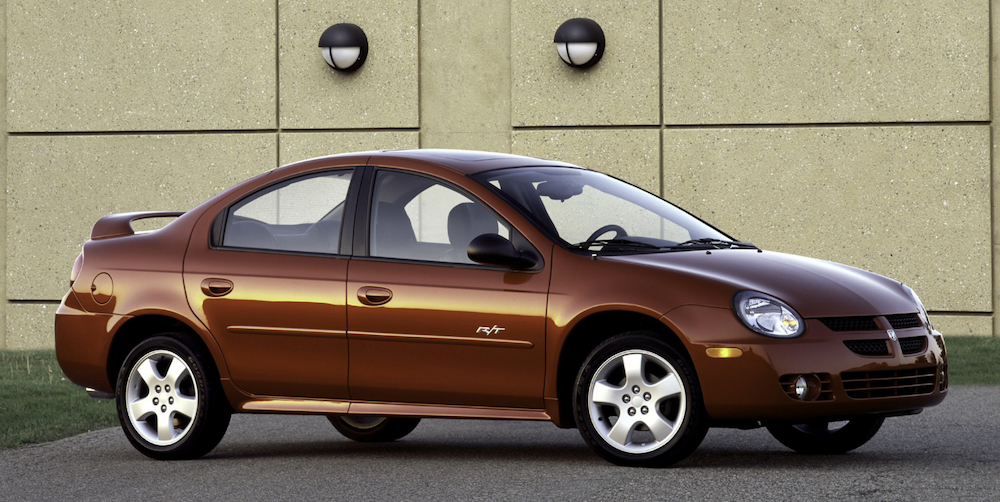
“The Neon was the number-one selling small car in the U.S.,” he told me. “And then its volume started to taper off. And the COO at the time had just started a program called Advanced Product Creation. And my boss was the head of Advanced Product Creation. And so I happened to be in the office one day when the question came down. Honda’s rising, Nissan’s rising. It’s the pre-Fast and Furious era, right when Sport Compact was really a grassroots thing. ‘Why are they not using Neon?’ That was the question.”
McCammon was chosen, alongside a technician named Dave Steck and a designer named Eric Stoddard, to create a concept for an SRT-branded Neon. One of the reasons he was picked, he says, was because he drove the competition and wasn’t afraid to defend his choice to his boss.
“I drove a Honda to work every day,” he said. “And in that era, if you drove a Japanese car, you ran the risk of getting your car keyed. So at the Chrysler Tech Center, there’s a parking deck right at the entrance. But if you drove an import, you had to park literally a mile away. So I, in the dead of winter in Michigan, would walk a mile in. [Ed. note: Chrysler still does this at some locations!] My boss looked at me like I was crazy. And he said, ‘So why do you do that? I said, ‘Because I like [the Honda] better. Period.’ I was young and stupid, and bold.”
McCammon was given one directive: Assemble a plan on how he’d make a car that he’d actually want to buy. And so he did.
Meet The Neon SRT (NOT The SRT-4)

The original Neon SRT—the concept did not have the “-4” moniker at the end of its name—is a fairly distinct vehicle, compared to the production version. For one thing, it uses a supercharged version of the regular dual-overhead cam 2.0-liter inline-four.
“Dave introduced me to a guy named Mark Musial,” McCammon told me. “Unfortunately, Mark passed away, but Mark was an engine rat, a ‘dyno rat,’ is what we called him. He had taken a Neon R/T engine and put a supercharger on it. So we grabbed his engine, we shoehorned it into a Neon.”
The engine, making 11 pounds of boost, delivered 208 horsepower and 180 lb-ft of torque, far more than any production Neon at the time. It got power to the front wheels using the short-geared five-speed manual from the ACR. Of course, that wasn’t all. From MotorTrend:
Completing the driveline are a Torsen limited-slip differential, low 3.94:1 axle ratio, and a street-friendly, overdrive fifth gear-for when you’re just out cruising. Eibach springs and Tokico shocks help slam the SRT 1.5 inches lower than a standard Neon. Grip is optimized courtesy of sticky 205/40VR17 Yokohama A520 tires mounted on 7.0-inch-wide TSW aluminum wheels, while the SRT’s four-wheel disc brakes feature vented, cross-drilled rotors up front.

“I specced wheels, tires, brakes, suspension, seats, [an] exhaust system, and we built [it] up,” McCammon told me. Stoddard, the designer, meanwhile, came up with the car’s new look. In addition to the wheels, the Neon SRT concept got a new fascia with Dodge’s signature crosshair grille, as well as a set of fog lights. A bulging hood with a hood scoop was added, as was a big rear wing, reminiscent of Europe’s and Japan’s sport compacts of the time.
Inside, the Neon SRT got a smattering of blue leather inserts, from the steering wheels to the Momo Street Racer seats. There were also Sparco aluminum pedal covers, silver air vents, and a 4,400-amp sound system.

According to McCammon, the Neon SRT was an instant hit.
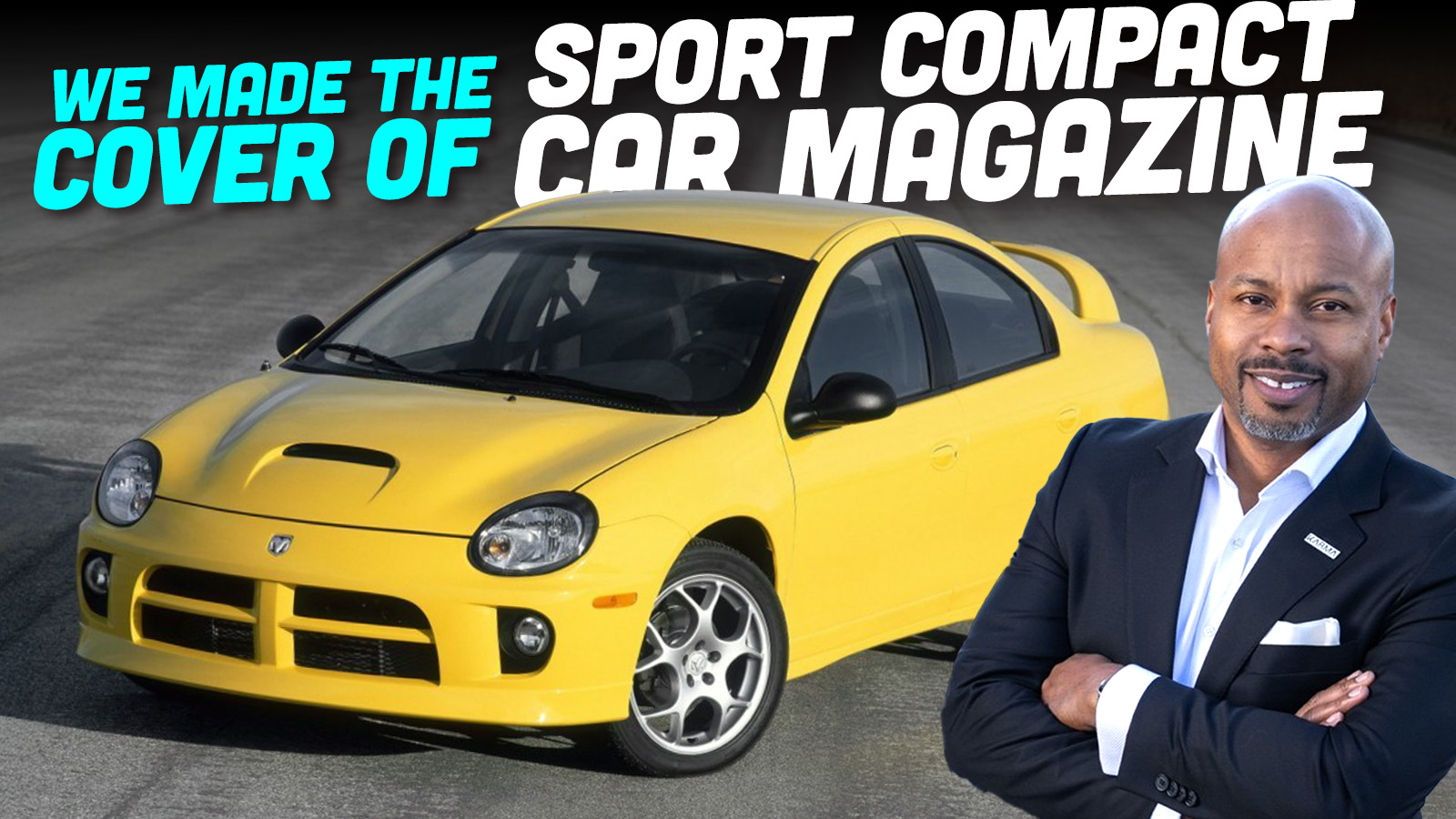
“We brought it to Las Vegas, to the SEMA show,” he said. “And then, the sport compact world just dropped in on it. We hit the cover of Super Street magazine, and then the COO was like, ‘Take it to the LA Auto Show.’ [We] took it to the LA Auto Show, and the same thing happened again. We made the cover of Sport Compact Car magazine, the first domestic to ever do that.”
To prove the SRT was more than just a kitted-up show car with no real guts, Chrysler even allowed journalists some time behind the wheel. And they liked it, too. From MotorTrend:
We had a chance to sample the SRT and, unlike most concept cars, this pocket-rocket really had plenty of go to match its show. How quick is it? Dodge claims to have run 0-60 mph in 6.0 seconds flat with the SRT, 1.5 seconds quicker than the last 150-horsepower box-stock Neon we tested.
[…]
The SRT drives like what it is: an extremely well put-together tuner car. We found wheelspin off the line a formidable issue, but torque steer was not. Well-balanced handling and decently compliant ride characteristics actually make the SRT both competent and fun through the corners.
Car and Driver echoed a similar sentiment:
We quickly discovered that an Eaton supercharger breathing 11 pounds of boost into a 2.0-liter Neon produces wheelspin on demand in first gear. The exhaust plumbing is 2.5-inch tubing feeding a Borla muffler, and it issues a virile tone from the twin tailpipes.
The Long Road To Production

Despite the public’s positive reaction, the SRT’s chances of actually entering production weren’t set in stone. In fact, it was pretty unlikely at the time. But McCammon was determined.
“Then [the COO] said, ‘You know, it’s a pity we can’t make it in production,” he told me. ”I heard that as, ‘Marques, go make a production version.’ So we just kept working on the program until the accountants said yes. And that was a three-year process.”
As it turns out, the original Neon SRT concept wasn’t a very economically viable car. A lot of stuff had to be changed to convince the bean counters. The biggest switch-up came under the hood, where the supercharged 2.0-liter engine was swapped out for a turbocharged 2.4-liter unit that already existed within the Chrysler portfolio.
“We took a 2.4-liter turbocharged engine that was only for sale in Mexico,” McCammon said. “It was in the Mexican Dodge Stratus.”
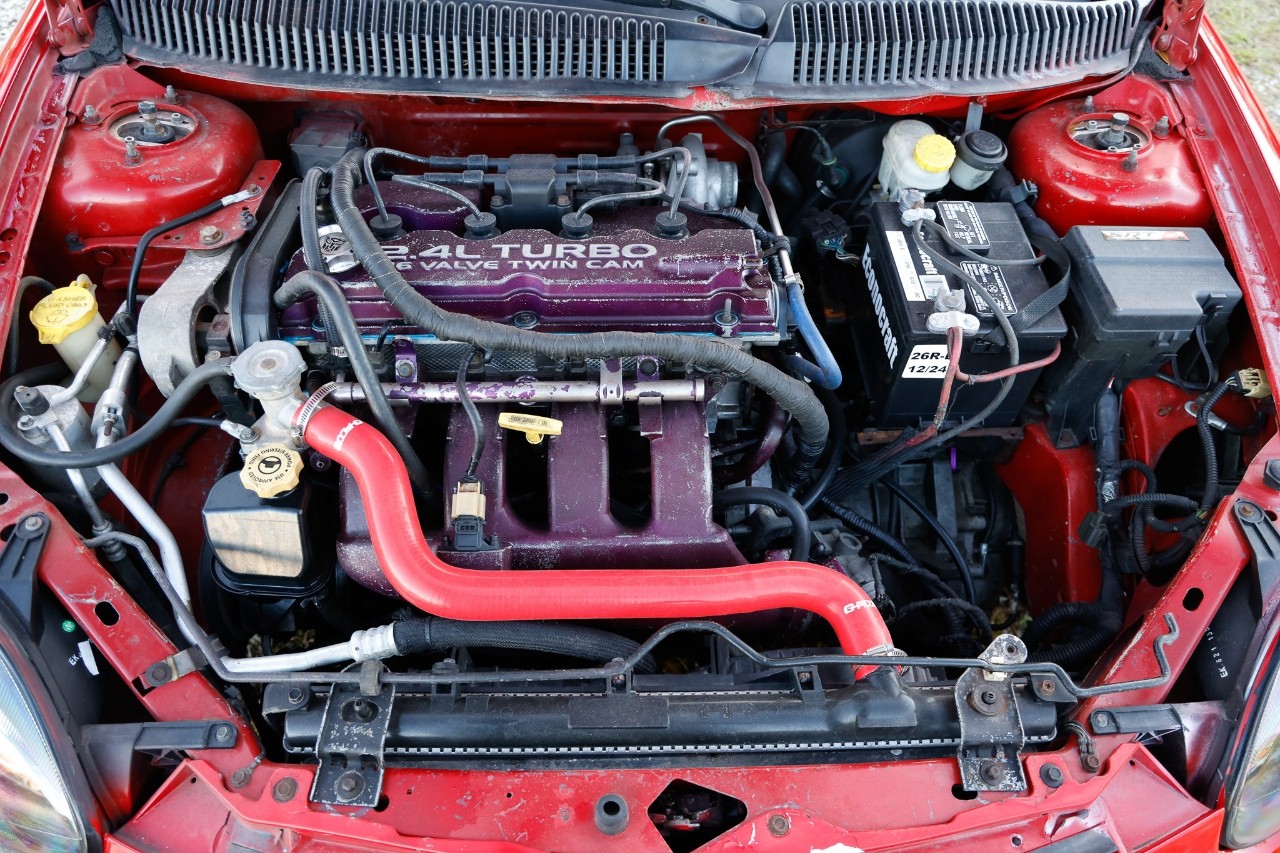
The 2.4-liter inline-four was used widely throughout Chrysler’s lineup from the mid-1990s into the 2000s, but before the Neon, the turbocharged version, which used a turbo supplied by Mitsubishi, was only available on the Mexican-market Stratus R/T and Chrysler Cirrus. Mopar heads will also know this engine was used in the sportiest version of the Chrysler PT Cruiser, the GT.
The production version made 215 hp to start in the Neon SRT-4 when it debuted in 2003, before rising to 230 hp thanks to bigger fuel injectors and ECU calibrations in later models. The engine was connected to the wheels via a different five-speed, this time from Tremec, along with a high-end clutch from Sachs. Both of those pieces were unique to the Neon.

It wasn’t just McCammon that wanted to see the Neon SRT-4 program succeed. He had the weight of the company behind him.
“The guy who ran suspension for [the Small Car program] was an avid SCCA rally racer. He helped us to design that system. [The car] developed this cult following inside of the company. So everyone who’s a gearhead started getting involved. It grew and it grew.”
According to Car and Driver, the production car didn’t leave anything on the table, chassis-wise:
For all its wheelspin potential, though, the SRT-4 is a balanced package, capable of stopping and turning with the same kind of zeal it brings to going straight-ahead. An accomplished Sports Car Club of America racer himself, director John Fernandez doesn’t want any one-dimensional specials coming out of his Performance Vehicle Operations shop. Thus, the SRT-4 has upgraded knuckles, sturdier control arms, higher spring rates, firmer valving in the Tokico struts, a steering rack adapted from the PT Cruiser GT, and heavier anti-roll bars—24 millimeters up front, 19 rear, versus 22 and 17 in the R/T package.

Despite all of the changes underneath, the Neon SRT-4 retained its boy-racer looks from the concept. It still had the crosshair grille, the hood scoop, and that big rear wing. It was also just as loved by journalists at the time. From that same Car and Driver article:
Getting the best launch is tricky. As you’d expect, the SRT-4 has bigger footprints than its R/T counterpart—205/ 50ZR-17 rubber versus 195/50TR-16s—but even so, it’s easy to overpower them with a careless throttle foot. On the other hand, shameless wheelspin will be this car’s biggest appeal for many owners. Hey, baby, watch this!
For all its wheelspin potential, though, the SRT-4 is a balanced package, capable of stopping and turning with the same kind of zeal it brings to going straight-ahead.
It wasn’t just the journos who liked it. Buyers did, too. The power-to-price ratio (the SRT-4 started at $19,995) proved appealing to those wanting something truly sporty without having to break the bank.
“We were only supposed to build 3,000 SRTs,” McCammon told me. “We ended up building 10,000 a year for three years.”
Was he surprised by the demand? “I wasn’t,” he said. “The best sport compact car at the time was the Integra Type R. So we took the Integra Type R, and I said, ‘I want to beat it on every measure.’ Then Ford came out with a Focus Cosworth, so I said, ‘We have to beat that too.’ We designed it to win.”
While the concept of a sport compact like the SRT-4 from an automaker like Dodge in the modern day is certainly a fantasy, it’s nice to know that once upon a time, Chrysler, for a brief moment, had something that could truly compete.
Top image graphic: Dodge; Karma


looked long and hard at an ’04 srt-4 when i was car shopping. i was looking for a truck and i was just about set on the new chevy colorados but i wanted to see an 04 dodge dakota had going on because you could get it with the 4.7 and the colorado had this new fangled inline 5 going on. the neon caught my eye and even my dad stopped to look it over and was impressed for what it was. i ultimately went with a z71 crew cab colorado in the press release sunburst orange metallic and have been satisfied. i needed a truck more than the hot neon. later on a friend had one with the stage 3 setup. it was a sneaky little monster.
What an enjoyable read! One of my roommate’s best friends had a yellow SRT-4 freshman year of college. This was about a year before I got my first “tuner” car, and his little angry yellow Neon was extremely cool to me. I have unfortunately never had the pleasure of driving one, but they sure did make me smile when I’d see them on the road back when they were still around before the midwest salt ate them all. These also always sounded so good in stock-form, too! Almost like a little turbo-diesel.
I missed out on the SRT-4 when it was a thing as I already had a 4WS Prelude Si that scratched the itch of leaving people behind in the twisties, even if it wasn’t exactly a brute going straight.
But.
The 2013 Abarth 500 that I’ve happily owned for the last eight years is in every way the spiritual – and better – Chrysler successor to the Neon SRT-4. Mine has a Madness ECU that promises a solid 190hp in a much lighter and smaller package.
That said, the SRT-4 is still extremely rad, but anyone looking for something similar, the Fiat is the ticket.
100% agree on the Abarth being a proper SRT-4 successor. They both had that stock angry, turbo-filled, muffler-less sound that was soooooo good too!
Two Neon stories:
I bought a 1st gen.blue 4 Dr sport (SOHC manual) when these first came out. I had a live /hate relationship with the car. I loved the handling, power and feel of the car. I hated that water based paint (new then, commonplace now) had adhesion problems (thankfully I only had a quarter size missing spot in my roof. The suspension squeaked and groaned from new. The cheapness of the interior was appalling. The cherry on top was the composite clutch that detonated into a billion pieces at 65K mileage. Fixed that and sold the car several months later.never had the Head gasket issue that plagued many of these cars.
A Coworker had a later SRT-4 and it was a beast. There were some improvements in the interior and the powertrain was potent. Still had an unrefined feel about it but could easily be forgiven for the power. I think the main problem is that many first gen buyers were stung by the litany in reliability and paint problems.
Your neon was either Lapis Blue or White. Those are the only ones with paint adhesion problems, I remember that! lol
Headgaskets were paper on 95-97 cars, and yeah they were an issue. The factory switched to MLS gaskets in mid 97-98 somewhere, and afaik the cars did not have headgasket issues with the newer MLS gasket since it allowed the aluminum head/iron block to expand/contract at different rates without losing the seal.
The switch to the MLS head gasket was partway through the 1998 model year.
Probably. It’s been a while. Off a year I guess, not bad for recalling useless information from 2 decades ago 😀
These are cool. I remember when sport compact car magazine put one on a dyno. It made over 230 hp at the wheel… Meaning stock they were more like 270 at the crank. And MORAR had the stage 1, 2, 3 turbo toys you could buy to make a reliable 300 wheel horsepower.
I still have my 1997 Plymouth neon dual cam five speed with 65,000 miles on it in mint shape. I swapped the turbo and other goodies from the SRT 4 onto it way back in 2005.
It’s kind of like a two-stroke dirtbike. It’s either on or off, but it turns heads everywhere because you never see a first GEN neon in the wild that often.
This is what I really wanted to hear about. I remember the astounding WHP numbers that SCC got with these cars stock. They missed a good opportunity here to actually find out why that was.
The answer is BOOST. And they underrated the car so it would destroy the competition in magazine tests, and keep insurance costs lower.
That makes sense. Toyota famously did that with the MKIV Supra.
I feel like SCC tested more than one car, but I could be remembering it wrong.
Here’s why the horsepower number on SCC’s chassis dyno test was so much higher than the official number given by Dodge: In 2003, there was not a standard for intercooler efficiency during the SAE J1349 rating test. Rather than assume a best-case scenario for intercooler efficiency which would inflate the rated horsepower and torque numbers, Dodge chose to rate at a hotter, less-efficient intercooler as they felt that their number would be more representative of typical use on the street. The SAE standard was updated in 2004 to codify a process for determining intercooler efficiency.
J2723_202110 : Engine Power Test Code – Engine Power and Torque Certification – SAE International
That’s very interesting and seems pretty reasonable. Other turbocharged and intercooled cars of the era would produce close to expected numbers when it came to WHP, so it was just the Neon that stood out for being so far off.
Most dyno tests I’ve witnessed would just have a large fan blowing at the front of the car, nothing really calibrated or scientific. This method usually produces close to the rated power figure. SCC did the same thing.
When the first generation Neons were new, I lived in Manhattan. Whenever I needed a rental I made sure I got one. I particularly remember an emerald green DOHC in Wisconsin on those terrific back roads. I preferred the 4 door for easy access, and unfortunately they were automatics. I still want one, even though they have a terrible reputation for reliability. I didn’t cotton to the second gen. I’m still shopping…
Reliability was bad due to a paper headgasket used on 95-97. They switch to Multi layer steel (MLS) gaskets in 97-98 or so, no reliability issues after that change. By now almost all of the earlier cars will have an MLS gasket by now anyway. Don’t let your dreams be dreams 🙂
Something I’ve been wondering about since I started reading this article. I know they have mid engine cars for better balance and I get how they weigh it for balance. But I have never seen anything about balance for right to left and making it 50/50 and adjusted for weight of the driver. I know racing does it but do auto design do it and how?
The ride height on the standard Neon is something to behold. You could take on the Rubicon in that thing. Jesus.
For some reason in that era a lot of cars were like that. I remember my 03 Mustang GT looked like it had a lift kit on it when it was stock.
Part of what was happening was that they weren’t filling the entire space between the bumper and ground with an enormous front air dam, imagine, tapping a parking curb didnt cause $1500 in damages
Speaking of which, I have noticed on my new GTI, the parking sensors let me know when I’m getting close to the curb or parking block in front and sides. I love that. My Audi Q3 which had front and rear sensors did nothing of the sort. It could be the 10 years of technology advancement which allowed this. Look what we achieved in 10 years lol
Seeing that pic of the ACR reminded me of how much I like the first-gen Neon. I lived in the town where they were built back in the 90s, so they were EVERYWHERE, so I didn’t really pay them much mind since they were basically part of the scenery. Now, I can’t even remember the last time I saw one on the road. They went from completely ubiquitous to basically extinct in like 10 years.
The big reason is resale value. It’s hard to justify maintaining something if it’s not worth anything.
Very true, but I’ve seen people waste time and money preserving worse things than a Neon. I once knew a guy who collected and “restored” Omnis. And not just GLH Omnis, all of the Omnis.
I test drove one of these when they came out. It was astonishing in all the good ways, but also for the nuclear-grade crappiness of the interior. I decided to gently — very gently — press the headliner to see how sturdy it was, and I creased it. It felt like it was between copy paper and card stock in stiffness. It probably would have cost them a buck a car to make it better and they didn’t.
If course the Viper-esque seats creased my butt, so maybe it isn’t well-made either.
I still want one of these, they had the coolest exhaust sound, IMO. An SRT swap into a 1G Neon would also be my huckleberry.
Absolutely!
Someone at work had a blue SRT-4 with a stick and a super loud blowoff valve – it would sound every time he shifted, even when he wasn’t standing on it. Even as a gearhead, I found that pretty obnoxious.
“a 4,400-amp sound system” is that right? Assuming it’s 12V, that’s 52.8kW of power, or 71hp. No wonder they needed the supercharger!
That’s gotta be a typo. Audio experts – what is going on here??!!
Pretty sure they meant Watts, not amps. But even that sounds awfully high.
4400 watts is high, but believable. Typically those kinds of numbers are determined by “peak” numbers, numbers only achieved with 0-gauge speaker wire and the amplifier being struck by lightning. In other words, you will virtually never see that power.
Its probably about 2000w RMS, and once you account for the fact you’re playing music through speakers instead of max amplitude sine waves into a resistor, you’re outputting well under 1000 watts most of the time. Enough that you’d want to pay some attention to the car’s electrical system, but you aren’t likely to have massive issues with supplying enough power.
Last year I saw a cherry Neon SRT-4 at a tuner car show. The owner was an older gentleman who tweaked and autocrossed it. He was getting major respect from the young guys with their glowed-up Fast & Furious imports.
Hard to imagine Chrysler doing anything this cool now. Truly a case study in how to ruin an awesome company in just a decade or two.
Just what do you mean by older gentleman? I assume 80s or 90s?
I would guess 60s? “Older” more in relation to the tuner car crowd at the show, which were in their 20s and 30s.
Chrysler never should have killed the Neon.
It could have been the Civic equivalent. Then again the reliability would have let them down.
They can’t seem to help shooting themselves in the foot, especially with reliability issues. But replacing the neon with the caliber, oof.
The Caliber had the right concept but they flubbed the execution in every way possible.
The reliability issue of the neon was from the paper headgasket used in the 95-97 cars. The cast iron block/aluminum head expanded and contracted at different rates. 98 onwards all cars used MLS gaskets which solved the issue.
Yeah, the Caliber was a big mistake, as was the length of time between the Caliber and the Dart. There’s been a real habit of replacing popular products with less popular products and then replacing less popular products with nothing
And then saying “no one wants to buy X type of car anymore, nothing we can do.”
They still sell a Neon in Mexico and the middle east, a rebadged Fiat Tipo. They should’ve sold it here.
I always thought it was hilarious that the SRT-4 came with power front windows and crank rear windows. I mean, come on!
That’s a step away from our 2022 GLI which has nice front door cards and Playskool rear ones
My wife’s GTI has a power driver’s seat, a manual fore & aft passenger seat with a power recliner & a hand pump style up & down mechanism. The problem with the last bit is, anyone over 5’-6” tall will hit their head on the door frame gettin in or out if the seat is pumped up at all.
Says everyone driving an older Asian car.
I agree especially since it was difficult to get in the back seat. Shouldn’t the back be automatic and fronts manual?
I was selling to Chrysler 8 or 9 years ago and every time I went onsite, I made sure the rental car was a Chrysler product of some sort. Even if that meant I had to sit and wait for the rental car company to find something, and half the time it was a minivan. I wasn’t going to show up there with a Hyundai or whatever.
Working smarter not harder. Today’s yutes would be smart to copy your sage advice.
Heh, Honda flew me to Chicago for a job interview once, and they actually asked during it what my rental car was, it was a Kia Rio, and the manager leading the panel said that he naturally assumed it wouldnt have been one of theirs
We made the Sport Compact cover of CAR MAGAZINE, everyone!
You’ve never heard of Sport Compact Car magazine? It was kind of a big deal in the late 90’s – early 2000’s.
I was just trying to make a joke about reading the top shot differently than intended. No disrespect intended to Sport Compact Car Magazine, I promise.
I wish the Ultimate Street Car Challenge stuck around beyond the magazine.
Very nice write up on a car that I didn’t get to know much about in Europe (saw more PT Cruisers than Neons).
Your age? They were not built at the same time unless I am mistaken?
Fantastic write up and thanks for taking me back! A buddy had a blue 2004, god I loved that thing (I drove a tuned Integra GSR and had boost envy…).
I hope nobody minds, but the original first-test of car&driver on this car is definitely worth a read. I was about to turn 14 when this issue came out, and I remember reading this particular article and becoming completely obsessed with the idea of this car. I grew up in a backwards union democrat only area where driving a Nissan, Toyota, or Honda got you cussed out by people. I looked at Japanese tuner cars with a forbidden lust only a 13 year old boy understands, so this thing coming out about exploded my brain.
I never got to own one, but I did get to drive a very nice bone stock example, and the hype was for real. These cars are amazing.
https://www.caranddriver.com/reviews/a15135877/dodge-neon-srt-4-road-test/
This story is the spirit of car culture. Thank you for sharing.
This is great history. I would love a deep dive into history about cars and their warranties. It used to be American cars had 12 months 12,000 miles warranty. But once the Asian cars came it started growing now we have 10 years 120,000 miles warranty and 8 bet it would not have happened with just the hapless management and the lazy union building cars.
It was Marc Musial, not Mark Musel
thank you for this! Had a hard time finding the correct spelling
Cool story. I’ve always had a soft spot for Neons.
I always wondered at what point the car gained the extra grille slots right under the nose, and why. The lede image shows what was probably a prototype without the slots.
They were doing hot weather track testing in Texas. It was pretty late in the development process and they were finding engine temperature was over the target. They cut a couple of rectangular holes at the top of the fascia and that fixed it. So, the design was modified. A now-retired SRT transmission engineer named Kevin was doing the driving – I think I heard the story from him.
They ended up using the original fascia design (without the extra holes) on the SRT Design version of the neon. That car had an ordinary 2.0L SOHC non-turbo engine but had the SRT hood, the hole-less front fascia, a rear spoiler and a dual-tip muffler.
I hoped someone here would know. Thanks!
I wonder what’d happen if you parked one of the Korean GM rebadge jobs at a Chevy plant. I guess it’s a domestic, but is it really?
Or a Honda/Chevy Prologue/Blazer
You walk the mile. They know. trust me. They know.
Considering it’s a Chrysler not a GM Product I assume you would be walking a long distance
I have always enjoyed these things. I hear they are pretty reliable as well.
From the late 70s/early 80s well into the 2000s, if you drove any non-Chrysler Corp product, you had to park in the more distant “competitive vehicle parking” lots. This was true at Highland Park HQ as well as CTC.
You were a brave soul if you walked from the CVP lot in Highland Park. (I grew up there.) BTW: It really sucked that we had to use Oldsmobile Firenzas for driver’s training. I know LeBaron GTS would’ve been a pipe dream, but couldn’t Chrysler throw us a few Omnis at least to represent?
Typical of American auto manufacturers to cheap to build a new car but will spend a fortune to hurt the competition. GM bought control of Isuzu and forced them to build shittier cars instead of using their knowledge to build better cars.