

There’s no denying that SUVs and crossovers have taken over the auto industry. What was once a niche bodystyle at the corner of company lineups has become a mainstay with several subsegments, dominating showrooms to the point where it’d be weird if a manufacturer didn’t have five dozen distinct crossovers to choose from.
The explosive popularity of crossovers has meant sales of other bodystyles, like station wagons, sedans, and hatchbacks, have suffered. In America, the sales of sedans are a shadow of what they used to be, and while there are still some hatchbacks available here, they make up an incredibly small portion of sales. Wagons, meanwhile, have essentially disappeared from American roads, aside from a couple of low-production German performance longroofs.


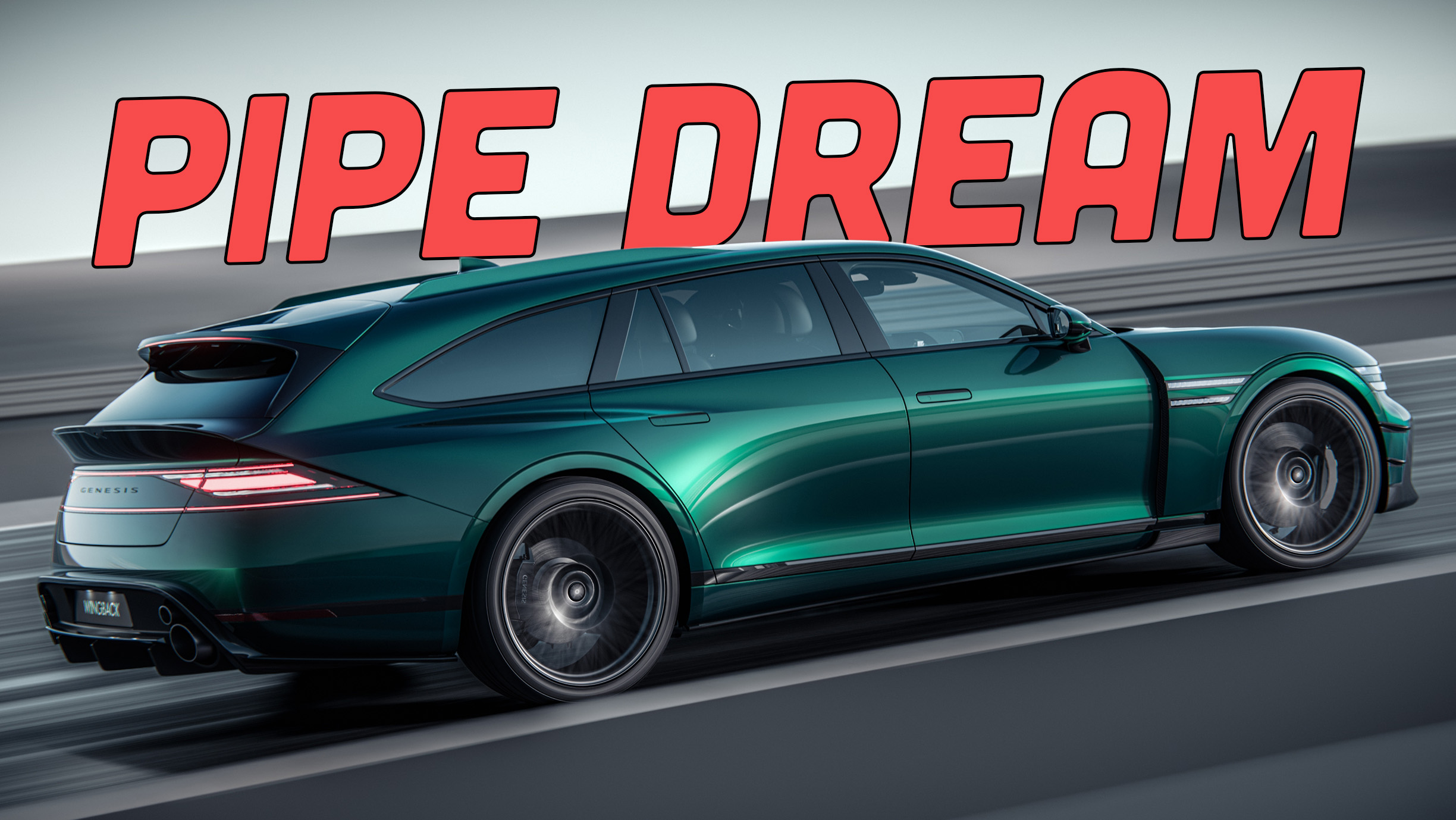
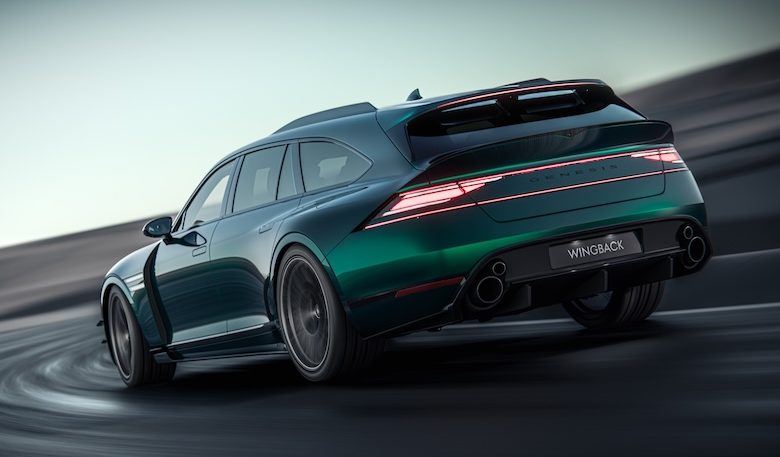
Still, giant conglomerates like Hyundai haven’t given up on wagons. The proof lies in a new concept from the company’s luxury sub-brand, Genesis, which recently unveiled a one-off wagon based on its biggest sedan, called the G90 Wingback. The company’s chief creative officer, Luc Donckerwolke, believes SUVs have saturated the market so severely that people will eventually want something else. But I’m not so sure.
Donckerwolke Makes A Point

Genesis first revealed the Wingback concept last month during the company’s 10th anniversary celebrations, where it also unveiled a supercar concept it plans to put into production. Today, the company released more photos of the car, showing off its absolutely stunning design. In the release was a quote from Donckerwolke that extended beyond the typical corporate-speak design execs are famous for:
“At the moment there is, let’s say, a multiplication of SUVs. And this fast growth will create a saturation,” said Donckerwolke. He continued, “This is when other typologies of cars are going to become attractive again. This is why I strongly believe in not having a typology monoculture.”
Firstly, I’d argue the saturation is already here, and has been for some time. For the past two years, a crossover was the best-selling vehicle on the planet, with the Tesla Model Y taking the title in 2023 before having its crown snatched by the Toyota RAV4 in 2024. In America, the top three best-selling vehicles that weren’t trucks—the RAV4, the Model Y, and the Honda CR-V—were crossovers.
It goes beyond just the numbers. Take a look at Toyota’s lineup right now. There are no fewer than nine different crossovers and SUVs available from the brand, versus just two coupes, two hatchbacks, and four sedans (five if you count the hydrogen-powered Mirai, but I don’t). It’s the same story for luxury automakers, too. BMW sells nine different crossovers, compared to six sedans and a small handful of coupes. Manufacturers have become SUV-makers first, carmakers second.
On its surface, Donckerwolke’s thinking makes some sense. Owning an SUV in the Year of our Lord, 2025, is the equivalent of owning an iPhone or liking cheeseburgers. People naturally want to be different and stand out, so when they see 27 different kinds of the same body style in their Walmart’s parking lot, they might think twice before buying a crossover over the sleeker wagon or hatchback sitting in the corner of the dealership.
I’m Still Hesitant To Agree
On appearance alone, I can agree with Donckerwolke’s argument. Except, it’s more than just looks that sell SUVs. People buy them because, as prices continue to rise, they simply want one car that can do everything they might conceive as necessary.

SUVs tower over sedans thanks to their higher ride height, giving drivers a more commanding view of the road. SUVs usually offer more space for legroom, headroom, and cargo. Some even provide more seats. And thanks to advances in drivetrain efficiency, they can deliver these advantages with little to no penalty in fuel economy. SUVs can often be optioned with all-wheel drive or four-wheel drive, assuring buyers they’ll have something to assist them in case they’re faced with rough terrain or slippery conditions (even though it’s seldom necessary). SUVs are perceived as safer thanks to their more substantial size and weight.
Most importantly, SUVs are not any more expensive than their sedan counterparts. That trope disappeared years ago. The cheapest vehicle Hyundai sells isn’t a tiny hatch or sedan—it’s the Venue, a crossover. The scaling of production has meant prices can undercut less practical, smaller cars, giving buyers no reason not to choose the crossover.

To Donckerwolke’s point, some buyers are willing to make that trade-off and buy the less practical car if it means owning something more interesting. I think that’s why we’re seeing cars like the BMW M5 Touring have some success, even though it weighs about the same as an X5 M. It’s probably why Genesis chose the G90 to turn into a wagon concept at all—it’s only the upper end of the market where wagons are viable right now. But even then, we’re talking about incredibly small percentages of overall sales.

It’s important to remember that Genesis already makes a wagon version of its entry-level G70 sedan. But it doesn’t sell the car in America because the company must think, probably accurately, that absolutely no one would buy it. And I don’t expect that to change any time soon. If the G90 Wingback were to make production, I’m sure it’d be met with endless praise from the industry and even a handful of enthusiastic buyers. But the idea that buyers, on average, might begin to defect from SUVs simply because SUVs are everywhere doesn’t take the whole picture into account.
Top graphic image: Genesis



So I asked, what could be worse than all automakers deciding not to make wagons?
So they only made beautiful ones that are insanely fast and completely out of my reach.
I have to stop asking these questions.
“SUVs usually offer more space for legroom, headroom, and cargo.”
More than what?
Dollar for Dollar: SUVs have less space than the equivalent valued car because SUVs cost more due to AWD, raised ride height and manufacturer markups. So you have to move down a size class to get an SUV for the same amount of money as a larger car – or you have to move up a price class to get comparable interior space in your all-purpose SUV.
Yet there’s not a single SUV that has as much space as a Minivan.
And that seems to be what most people are overlooking. A minivan is a superior platform in every single way to an SUV, unless you’re going offroad, and even then, most SUVs these days aren’t any better off-road than an AWD Sienna.
The packaging is better, the space is better, the driving experience is better, and usually the fuel economy is (slightly) better. There’s literally no downside to a minivan… and I say this as a single guy who uses mine for camping, hauling around building materials, and as my winter weather and light-offroading vehicle.
One advantage of wagons that is seldom mentioned, is that you can load stuff onto the roof rack a lot easier. I could stand on the ground next to my BMW 330i wagon and load all our skis onto the roof rack in a jiff. With an SUV I would have to, at the very least, open the rear door and stand on the door sill. And that is not fun with ski boots on and also annoying for the passenger sitting inside. Same with bikes, kayaks and whatever else. These things are pretty heavy to lift over your head.
I worked in landscaping for 20+ years and I really agree with anyone who speaks against monocultures of any type. They’re never good/healthy. I also LOVE longroofs so I am with Mr. Donckerwolke on those two fronts. I am not totally down with the rear haunches and the trailing edge gaps on the front fenders. Wingback is nice but not perfect.
I’ve got a 2023 Audi A6 Allroad. These were not hot sellers back when I was looking and mine was an 8 month custom order from Germany. (I placed the order during what was the ongoing chip shortage of the time which slowed production.)
I love it. It’s fast, handles great, blazes up to the slopes for skiing in winter and is precise in puddle slop rain. (I live in greater Seattle.). My wife’s XC90 gets way worse mileage, handles like a barge, but does have a third row, which just makes it a cliche soccer team hauler. 🙂
I do agree with the author, it’s tough to see consumer appetites changing in favor of wagons, but I’m ok with that. I like driving a car I love yet rarely see. (But I do highly recommend them!)
There is another timeline where a family is trading in their 2022 Mazda5 for a 2026 Ford Flex right now.
I want to be in that timeline! They are also considering the 2026 Element.
One of those things I very much WANT to be true but doubt will be.
Random consumer indifference coupled with focused dealer indifference has put the nail in this coffin. Early last year we were new car shopping and I really, really wanted a Volvo V60 cross-country wagon. The salesman at our local Volvo dealer did everything in his power to try to talk me out of it and push me aggressively into an XC60 SUV (of which they had a bunch in stock, as opposed to a special order V60). They pissed me off so bad I just left, and the next Volvo dealer is 125 miles away on the wrong side of a very large mountain range. So we drove to the very nice Toyota dealer in the next town (where we bought our 4Runner) and they were extremely happy to let us custom order a RAV4 Limited hybrid to the exact specs I wanted. With no bullshit. It’s actually a very nice vehicle – other than not being a V60 wagon.
That’s a shame that happened to you. The V60 is a such a nice car, I never fail to rubberneck in appreciation when I see one. Or a V90.
Fashion is cyclical. I fully expect “longer, lower, wider” to come back around again. And maybe actual gauges and buttons/knobs/levers? One can dream.
This
I may have no business commenting on this subject, but I will anyway. We have owned a two-seater (86 MR2), sedans (e.g., 81 Corolla, 2004 TL still), minivan (Plymouth), and an SUV. We plan on keeping the SUV (2001 Highlander) until it dies. High enough for driving among the monster trucks and newer SUVs, yet easy entry and practical. Besides people (mostly just the 2 of us), it hauls, wood, pipes, rugs, compost and gravel (in bags or on a tarp), etc. We can fit bicycles and other large gear in a pinch. We’ve done decent road trips in the past. It is a good all around vehicle and is only missing better gas mileage. My argument is that it is a good all around vehicle (not an enthusiasts choice) that is made better as a hybrid.
I’m only considering giving up the TL because California may offer me $10,000 toward buying a plug-in hybrid to get my TL off the road (!?). It is tempting me, because after 30 months I could sell the plug-in and I’m not sure how much more driving I’ll be doing at my age. Besides, I just applied to another California program that will electrify my home. In the past, I got assistance for bolting down my foundation for earthquakes. I may still install solar panels and batteries, if I can get a good deal after loss of Federal funding (I procrastinated). For most of my life, I did not avail myself of these assistance programs, but now that I’m on retirement income and so many big businesses get government hand-outs and tax breaks, I don’t feel bad about putting my hand out.
Really? What rebate program is this? I’ve never heard of it.
Clarification: It is a program from the (SF) Bay Area Air Quality District. Sorry for the error.
In addition. The electrification program is just for my town, Menlo Park.
There just isn’t that much downside in the SUV shaped object for most consumers anymore. 10-20 years ago you still had to trade efficiency and performance for the better view, ease of ingress/egress, and capability (real or perceived) you got in an SUV or Crossover. In some sense I guess that tradeoff still exists, but they’ve gotten so good almost no one notices.
I notice, every time I drive one. Which is why my daily drivers are both proper station wagons. But I freely admit that I am not an average US motorist.
ACTUAL SUVs with genuine off-road ability have a (small) place in my life, but not crossovers.
Maybe not a popular opinion but I don’t think sedans should exist. A wagon or hatchback version of the same vehicle always makes more sense. The one and only feature of a sedan that has ever been useful is you can keep food cold in the trunk in the winter.
my cousin thought you could keep diet coke in the trunk and keep it cool but she was from southern Arizona and tried that in Fargo ND. boom!
I’m with you – sedans are completely and utterly useless. Especially any that are smaller than battlecruiser size, and modern ones that are fastbacks in shape for aero with a letter slot trunk opening.
Yeah. The mail slot trunk is the dumbest trend ever. They should just be hatchbacks.
Some people say the sedans are more comfortable for the passengers: when they sit in the car and someone opens the trunk, the cold/hot air from outside does not hit them that hard.
I prefer a sedan. Having secure storage that people can’t see into is nice, especially for business travel where I’ve got a computer with me. Yes, I know they can break the window and pop the trunk. But thats two steps compared to one when breaking into an SUV, plus the uknown of if anything is in the trunk.
You can’t really see what’s in the back of a hatchback/wagon/CUV because of the cargo cover.
Yes. Although 99 times out of 100 the cargo cover is gone the day the car came home from the dealer.
That’s quite strange to me. I remove it and leave it at home when I need to, and put it back, when I’ve returned.
I’ve utilized those when I owned them, if they had them. For a long time I drove mid-sized pickups and after losing a laptop in the backseat to a smash and grab there I’ve just been traumatized and can’t get myself to leave a bag in anything other than a real trunk.
Without being sarcastic or condescending: if it works for you and makes you worry less, then I have no counterargument.
Modern hatchbacks and SUVs tend to have mail slot rear windows, which is a pain. Even wagon versions of sedans have smaller rear windows. Plus the acoustics are different; that open space behind the rear seats just add something. Not saying it’s good or bad, it’s just…different.
Agreed. Modern sedans are a mostly a design compromise that don’t do a good job at the things they are supposed to do. Cargo access is usually limited, rear passenger comfort is an afterthought. I think a full sized sedan is probably the only kind that is good at what it does. I think the rest are all for drivers that wish they could have a two door coupe, but felt the need to be ‘practical’.
There are still quaint laws on the books requiring rifles to be transported in the trunk.
I prefer wagons, but noticed four door versions of the same model have much lower road noise.
Joke’s on Luc… I’VE NEVER BOUGHT AN SUV/CROSSOVER!
<Nelson Muntz, “Ha-haa…”>
The Wingback seems to have the perfect amount of everything. Most cars lean too heavily into design tropes (Kia) or not enough into something else (Audi). I’m a huge fan of the M5 Touring, but the Wingback makes it look ugly and boring.
So many buyers may not be able to tell the difference, just call wagons crossovers or SUVs and tell buyers, if they ask, they are lower for ease of loading stuff and getting in, they will not know any better.
Ease of getting in is very subjective. My father is an incredibly healthy 67 and walks like 5 miles a day, but he definitely had to work a little harder to get in and out of my sedan last week when I gave him a ride somewhere.
Loading stuff? Yeah. But depending on people’s knees and back, getting in is usually easier when they just slide into an SUV at close to standing height, rather than slide into a wagon at sitting height.
I was not making a factual argument and and sales people do not care about reality or about if loading and getting in is easier or harder, most sales pitches and marketing are all lies anyway.
At 67 6’5” and quickly closing on 68 I’ve no problems getting into my 18 accord. The Subaru SUV is a little easier. I am fairly healthy for my age.
Toyota played that game with the Crown Signia but didn’t seem to know what to do beyond that . . .
I’d argue that Subaru won that game with the Forester & Outback.
But lost itself after that point.
Amusingly, Kia has been doing that for years with the Niro. It is a hatchback with the ground clearance of a car, the seating and viewing position of a car, but classified as a crossover.
for a while KIA had the Soul listed as a SUV on its website.
Our 2024 Trax LS is a wagon to us, even though GM classifies it as an SUV. The EPA considers it a wagon, and it’s only 3″ taller than the wife’s 2015 Cruze.
I like the Trax. It’s better looking than it needs to be. Looks like a wagon to me, too.
We’re in agreement, which seems to be rare. Demographics are aging in pretty much all the more affluent economies and, while those people tend to have more money to spend, they also prefer the higher seating position of a CUV. People buying on the low end need a car that does everything well enough and is adaptable, which a CUV also fits well. A lot of people, too, don’t like to stand out from the crowd, so there’s a disincentive for something unusual. I think the old argument of people not wanting their parents’ cars is broken with the younger people, who don’t see a car as an extension of their image as much, they buy a car because they need it. Many are also unfamiliar with a car that doesn’t suck to drive, so they don’t know the difference. The modern world of traffic, cops, cameras, cost of insurance, etc. also discourages the idea of something that’s fun to drive. And what is fun anymore? Corporations have heavily commoditized hobbies (for those who can afford them) and people living vapid, fake IG lives have turned any kind of leisure time enjoyment into a “side hustle” at the risk of being criticized for “wasting time on something useless”. People aren’t enjoying their lives, but they’re somehow afraid of losing them, so safety (or “safety”) and surveillance takes precedence over accountability, learning, developing, and freedom. CUVs are safe and full of electric “safety” and monitoring nonsense and convenient self-driving tech that doesn’t work. (But that’s OK when a corporation sends them out to murder people on the roads, that’s just a coding error they’ll OTA update later on—that collateral damage is just the price of the disgustingly rich getting richer, am I right?! No, because it’s not about the dubious benefit of a self-driving car, anyway—that’s merely the giant horse you wheel into your city, what’s inside of it is command and control by corporate-government parties.)
I think there is a market for other body styles, but it’s smaller, which probably means higher MSRP, which will be even better as they can sell to people who have multiple cars, but it’s still going to be a small market. This might be an unusual suggestion, but I think a segment that could see a revival is a truly comfortable car, be it a sedan or whatever, but it pretty much has to be lower than a CUV so that the suspension isn’t compromised to be stiff by needing to counter a high cg and pendulum effect on the passengers who are sitting higher off the pavement. Something like an old land yacht, but obviously more efficient and with better braking and handling. It might be a good idea for EVs as the inherent weight is actually helpful in that case and the packaging allows for a more open interior for something like a bench seat (with a center seat that could be convertible into a center console of traditional use with a simple flip of the cushion or something along those lines).
Higher seating position is futile PR nonsense when everyone around you has the same thing, blocking your sight lines.
How is that PR nonsense? If everyone is driving tall SUVs/CUVs/trucks, and you drive a car, then you are staring into their tailgate. If you drive a SUV/CUV/truck like everyone else, now you are looking through their windows to see braking ahead, or see oncoming cars when trying to turn out into traffic or pull out of a parking spot.
If anything, it’s MORE important nowdays to have a higher seating position.
LOL – every S/CUV has rear windows so heavily tinted you can’t see through them regardless.
When everyone else around you is in higher riding vehicles, it means choosing to be in a lower sedan, coupe or wagon means having their headlights right at your eye level.
So’s AWD most of the time, but people want it. It’s not just the sight lines, people find it easier to get in and out of a higher vehicle or dealing with kids and those BS NASA training chairs they force kids into until they’re 10 or so and it’s still easier to see being at about the same height as everything else than it is being lower.
And let’s not forget the semi truck you are stuck behind.
Yep, age of the average new car buyer in the US is 50.
Average age of US home buyers is 59.
I will continue with pure sports cars for another 30 years at least, with ~20 already under my belt. I did a rally recently with an 81-year old woman in attendance (she was driving!), and she’s nearly been sports cars only since the early 1960s. In fact, that’s how the couple met — he noticed her because she was racing!
In a short time, most buyers of new cars will be dead, and not as much in need of transport.
Busy few years for hearse production lines?
Following the money
E46 was peak wagon design. Im a huge wagon fan but they all got ugly after the E46. Magnum was decent… but a Dodge – near instant disqualification.
You misspelled “e91” but I will let it slide this time. 😉
Haha, I wont push back too hard on that. The e90/e91 years might have been peak BMW sedan years. The design philosophy didn’t translate into the wagon quite as well as e43 for me. I guess I have to change my original statement of all else being ugly because I do like those also.
I think they are peak BMW, at least in n/a form. The turbos, eesh, I don’t need to go that fast or spend that much to do it.
i just want the manufacturers to bring over something affordable for the general people….i.e. Mazda 6 wagon.
The only advantages a wagon has over a crossover are styling (debatable, subjective), and better dynamics at 90+% percent of the limit.
This is weighed against all the advantages (and lack of tradeoffs) in the post, which some of us have been saying for years.
There’s no accounting for styling taste, but the amount of people who appreciate more ground clearance, better visibility, more space, and better entry height far far far outweighs the number who value handling at the limit. Crossovers and crew cab trucks are both basically perfected for the normie lifestyle. There isn’t going to be a shift to another bodystyle; sedans, truck based SUVs, and especially wagons, will never overcome the objective advantages of the crossover/truck shape.
You left out a lower center of gravity. That is affective at any limit.
What difference does that make besides a small benefit to at-the-limit handling, which was mentioned?
Basically why should a normal car buyer care?
Because you are wrong and it is not only “at the limit”. Even my girlfriend, who is not a car person, can feel the center of gravity shift and driving dynamics from a raised car in every day driving. Now I am not arguing that that it is not a fair trade off for ease of ingress but the whole “driving dynamics at the limit thing” is not accurate.
Just because normies don’t care, doesn’t mean that basic physics aren’t still at play.
A modern car-based CUV on modern tires is not going to drive like a “raised vehicle” in any normal driving maneuver. The stability control is going to cut in for anything that isn’t a dedicated performance vehicle before there’s even a chance of it making a difference.
“Feeling something” doesn’t mean it’s actually a negative attribute.
I always believed the insurance industry, at some point, would wake up and realize the reduction in active safety afforded by these higher, center of gravity design vehicles and priced their premiums appropriately, looking at the higher statistical probability of loss or injury.
If you tune both for acceptable sensation of body roll the higher cg car is on stiffer springs and bars so it’s less compliant over bumps. Most can’t describe it, but they do generally notice that even closely related platforms where one is higher the lower one “rides nicer”.
This. Suspension tuning is much more complicated than just raising the car. Tires have nothing to do with the center of gravity like his statement above.
What are you guys driving that has sensations of body roll in normal driving?
The best riding vehicles I’ve been in have had long suspension travel, big sidewalls, and a long wheelbase. Traits associated with SUVs.
The median person also isn’t going to do anything more dynamic than a highway offramp. This I think is the disconnect here. It simply doesn’t cross the mind of an average person to wonder or care what the cornering capability of their vehicle is.
I’ve urged relatives to lean to high performance tires.
When they say they don’t need the better traction, I suggest that at some point they may want to stop, NOW!
Almost every time I see a CUV that has been in a crash with another car and not just run off the road, it’s on its side or on its roof. THAT is what the difference is. Particularly when combined with a soft suspension, they are shockingly easy to roll when hit from the side. EVs on skateboard chassis must help that a lot though.
Sadly, here in God’s Waiting Room, FL where the Cryptkeepers run wild, seeing that is a weekly thing. Granny or Gramps makes a left turn across traffic and gets hit, and their Rav4 or whatever rolls right on over. Sedans and hatches just slide.
Easier to roll over in a crash. Wagons and sedans tend to slide out.
High performance handling suddenly is high value in emergencies.
Ever get sideways?
Now you’re road racing.
Smaller frontal area with the current state of EVs has some relevance to range and efficiency.
This one I agree with, but it’s not as if lower ride heights alone are the key to unlocking serious ranges either. Lucid aside, no one seems to even want to bother trying.
Wagons inevitably ride better. You can make a tall, heavy vehicle ride well, or handle well, but without getting into air suspension or sundry mega-dollar electronic suspensions, not do both at the same time. And I find that obvious even at normal speeds, because even mainstream CUVs either ride like a buckboard wagon, or they are mushy and tippy feeling. And all of the high-end ones that stop short of fancy suspensions ride like buckboards. My e91 BMW glides where an X3 thumps and crashes.
I predict that “longer, lower, wider” WILL come back in style eventually. Some automaker is going to try to differentiate themselves from the herd.
Wagons (and sedans and hatchbacks) are also more efficient at higher speeds because of their smaller frontal area. And this would be about the only reason for me to stay away from crossovers.
I hate CUVs, but I understand why they’re popular. I don’t know why it’s so difficult for some people to understand the market just because the majority of buyers value different things in their vehicles than themselves. Research is showing more and more animals have Theory of Mind, so why is this so hard?
Have never understood it.
Complaining about an inch of CG height is the definition of enthusiast brain.
If it’s big inside, rides high enough, is decent on gas, and they can finance it, Americans are going to be interested. The rest doesn’t matter.
I wonder how they can apparently not know normal people. A small decrease in handling capability? Have they seen regular people drive? Billions upon billions of dollars in chassis and suspension development over more than a century and so many drivers corner as if they’re in a Conestoga wagon (they buy Jeep Wranglers and SD pickups with live front axles to purely drive on the roads!). Even many of them with performance cars only know to mash the throttle in a straight line because they bought for the image over actual enthusiasm. These people do not approach limits outside of a crash, they buy Laufenn tires on sale, they literally do not care as long as they’re not bounced all over the place like some dumbass enthusiast rolling an old Accord through their potholed neighborhood on cut springs. They don’t want to test handling and find out how well they may or may not have installed the plastic child throne or send Fido through a side window. In normal driving that normal people do, most CUVs don’t drive that much different than a car and the little bit that they do, the drivers don’t care because they’re easier to get in and out of and deal with those kid seats or load stuff without having to duck to avoid banging their heads, they can see better in traffic, and they have ground clearance to not have to worry about gravel roads, snow, or those potholed roads. Hell, I’m almost arguing myself into one!
In the advantages column I’d add aerodynamics / efficiency (frontal area) and improved ride, if they’re designed right.
Most cars are tuned way too stiff in roll, so that even if they do have independent suspension it doesn’t matter – hit a bump with one wheel and the whole damned car rolls like a MIG15 who just spotted an F86 on its tail. But at least there is the *option* to tune that out of a vehicle with traditional car ride/CG height, but in an SUV you can’t, for rollover protection reasons.
And it is the aero benefit that I actually expect to curb the crossover-ification of everything trend, in combination with EV’s – range is king, and you only get that with some combination of efficiency and battery size – and battery costs have flatlined while still firmly in “the most expensive part of the whole car” territory. EV’s are completely intolerant of irreversible losses, which for a car is any friction at all – aero resistance and rolling resistance being the two major categories. With aero resistance all you can do is make the car slipperier (lower drag coefficent) and make it smaller (reduce frontal area). With cars in production with Cd values in the 0.19 territory, there’s not much more to gain in the former category, and lowering ride height is one of the least-bad tradeoffs when trying to attack the latter category.
One can hope. Perhaps that is all wishful thinking.
That may be true, but there is still a sizable demographic of people who don’t care for higher riding vehicles, myself included. Every time I think I could live with a certain SUV (pretty all coupe crossovers, and I will fight anyone on that because I am not afraid to die on that hill), I see one IRL and lose interest once I see just how tall they are. Not only do the taller vehicles I’ve driven not feel stable in the bends without slowing down considerably, they get blown around on windy days at highway speeds and just never feel all that fast; it’s kind of like how being in an airplane doesn’t feel all that fast because the ground is so far away. Why should our choices be so limited? Why should we be forced into vehicles we don’t really want?
But there is hope on the horizon, possibly. Rumors are swirling about that axing all but their most iconic performance cars isn’t working out as well as hoped for GM and Ford, and new sedans – possibly RWD – are on the horizon.
The lower drag of wagons vs taller vehicles seems to be wildly understated.
Sport ugly vehicles always seem shocked when my 70s Ford wagon can easily pull away from tall vehicles at highway speeds.
Stock engine with the EPA power reduction too.
I see it happening in Mainland China. Tycho has shown us so many new EV ‘shooting breaks’ and the implication seems to be that Chinese ‘yuppies’ are looking for something more spacious than a sedan yet less fuddy-duddy than a blob-shaped crossover. For all the car design failings we blame Mainland China for inciting, if they begin a new era of wagons and get Western brands to jump on it I feel like that’s the only way the wagon is truly reborn.
Just beautiful. I want one right now. Which guarantees a) I will never be able to afford it b) I will do endless useless research re a 6MT swap
I understand this line of thinking. In the 1980s, minivans became popular because they weren’t station wagons. In the 1990s, SUV became popular because they weren’t minivans. Perhaps the cycle will continue.
Or not. At least in the US, where we seem to be in a vehicle height “arms race”. I drive a crossover (CX-5) primarily because I was tired of feeling invisible in a low hatchback. I wanted a Mazda3, but I feel more secure in something taller. And I’m an enthusiast; people who aren’t just want the height, because it makes them feel safer.
I’m afraid the crossover and SUV will continue to be the “default car” until the height arms race is over.
The SUV became popular not because they weren’t minivans, but because the auto industry marketed them so heavily that people were brainwashed into liking them.
In case you are wondering why they went to all of this effort, it was simply because SUV are not subject to the same regulations that cars are, and they could get a higher margin by not having to adhere to those regulations.
I’m not so sure. At least some minivans, the GM and Ford RWD vans, were also categorized by EPA as light trucks.
Marketers had to pick a lane and then stick to the lane.
Let’s hope. I’m done with this consumer trend.
I used to think that and always said it would cycle back around to wagons some day but I’ve been saying that since the 90s and it ain’t happened yet.
I attempted to order a Golf Wagon at one point early in the build year. VW told me that I would not be able to order in the options that I selected – even if I were willing to wait. So I purchased something else.
Genesis is in an good position to offer a 6-digit luxury wagon and pull a profit from it. They can easily shoot their mouth off about how successful they are with it. America really has no options, with no competition barring BMW & Audi at the top of the price ranges for a luxo-wagon.
Different story for the rest of us.
I think there may be something to it from a generational perspective.
People who grew up with wagons when wagons were the family car went with minivans instead.
People who grew up with minivans when those were the dominant family car went with crossovers instead.
Will the kids who are growing up with crossovers today want something different?
Now, as someone who grew up with a wagon in the minivan era, I still want a wagon…
My parents had hatchbacks, wagons, and (finally) a lone minivan when I was younger. After the minivan, they went back to a slew of wagons, before switching finally moving to an SUV.
Maybe I’ve a bit of Stockholm syndrome but I’m all in for hatches & wagons.
You explain my thoughts on the matter well here. The primary “family car” typology
(to steal Donkervolke’s word) seems to change every generation to 2 generations. Any minivan fan will tell you that they are the actual best case “one car to rule them all” design, and that they should never have fallen out of fashion. The fact that they have is enough to indicate that people already sacrifice useability for “fashion”. I am confident he is correct and the primary focus will shift again. The only constant is change.
Kids growing up with crossovers today will want…clean water and air?
A wagon is the answer. Not being able to buy a Mazda 6 estate is why I(happily, it’s really good) have a CX-5 in the drive today.
It’s all about mothers not wanting to become their mothers.
Fashion changes, as do regulations. There will be a time when vehicles become low again. It happened through the ’50s, it can happen again. Heck, the CUV is already lower in many cases than earlier SUVs. Something will change. But predicting when? And how? I could ask a forecaster about next week’s weather in the Midwest and be more certain about it than what cars will look like in 10 years.
If we ever get legitimate pedestrian safety regulations vehicles will have to change.
And the current gutting of fuel economy standards may have a silver lining, that if there is a later backlash it might be fixed so as not to encourage larger footprint vehicles, or not punish wagons relative to minivans and crossovers.
I also think that as Millenials start getting into middle age and the aches come in, we’ll be seeking vehicles easier to climb into. Nevermind midlife crises kicking in, changes in attitudes we don’t see coming…
I could say anything right now and I could be entirely wrong. Kinda like trying to forecast 9 days out in a landlocked region where cold air from Canada and warm air from the Gulf of Whatever You Call It show up and have a big fight all the time. Don’t like the weather? It will change. How? Who knows!