


Have we been too hard on the 1974 GTO? Any list of “worst cars of all time” inevitably includes this GM X-body-based “Goat” as a crime against mankind. I’m guilty of this as well, as I’m pretty sure I’ve dumped on this poor Pontiac in previous posts. Looking back, it simply wasn’t what fans of the GTO name were expecting or wanted, despite the fact that current circumstances meant that they couldn’t get a “traditional” GTO anymore. Regardless, it was the best they could do at the time, and also a fun little car in its own right. And hey, could you go camping in a ’69 GTO Judge or a Tri-Power ’66? I mean, in the car itself? No, you couldn’t, but the ’74 had you covered there. I can explain.
The Goat Gets Fat
Nothing can be looked at out of context. The hottest songs of the year 1483 likely couldn’t hold a candle to the ones from the year 1983, and that’s understandable. In the Middle Ages, they had lutes and flutes instead of electric guitars and Mutt Lange, so they couldn’t have possibly recorded something like, say, Photograph or Rock of Ages even if they wanted to. Cars need to be viewed in the same light.


Today, the difference between a 2016 and 2026 Camry to me seems rather minor in the scheme of things, and that’s largely due to the environment that created these cars staying rather similar. That isn’t even remotely the case when comparing cars from 1964 and 1974, especially with the GTO.
Introduced in 1964, the first GTO was John DeLorean’s internal-regulation-busting mid-sized car with a motor meant for larger Pontiacs. If it wasn’t the first muscle car, but it was certainly the one that got the most coverage and arguably kicked off the genre. This LeMans-based coupe featured a 389 V8 and a four-speed that famously (and disputably) ripped off zero to sixty times in under five seconds.

As the sixties wore on, GTOs and the motors that powered them got bigger, but emissions controls started to choke the power output while now-required safety equipment added weight. The new-for-1968 fastback body style looked slick, but needed a 455 V8 to keep pace with the earlier models.

Upcoming 5 MPH bumper regulations and increased emissions standards eventually took their toll, as I mentioned in an earlier post. Within a mere eight years, it was all over. When the 1972 LeMans on which the GTO was based got replaced by the new 1973 “Colonnade” bodystyle, the malaise era had truly begun. The hot 300-horsepower 455 CID V8 in that car now only pumped out 250 horsepower as cars slowly and steadily lost power in an effort to improve gas mileage. The new styling didn’t immediately find favor with the public either, and the launch of the Lemans-based euro-styled Grand Am meant that the “muscle car” style-GTO was out of step with Pontiac’s marketing plans for the mid-sizer, so this Goat barely lasted a year.

This wasn’t the end of the GTO, though, though it easily could have been. In 1973, escalating inflation and the first energy crisis hit, adding even more obstacles that would eventually block all muscle cars. To make a GTO that was the economical, affordable performance car Pontiac had always portrayed it as, there was no choice but to go smaller.
Nova Scorcha
Going smaller at Pontiac meant putting the GTO name onto the X-body chassis; these were sometimes called the NOVA cars because of the first letters of the names of the products on the platform:
- Chevrolet Nova
- Oldsmobile Omega
- Pontiac Ventura
- Buick Apollo
Truth be told, the Nova was closer in size to the original GTO than the 1973 “mid-sized” version, and you simply couldn’t get enough performance out of early malaise-era powerplants to make a larger car go fast. Also, those Colonnade cars probably drove better than a 1964 GTO, but they certainly were never what you’d call tossable.
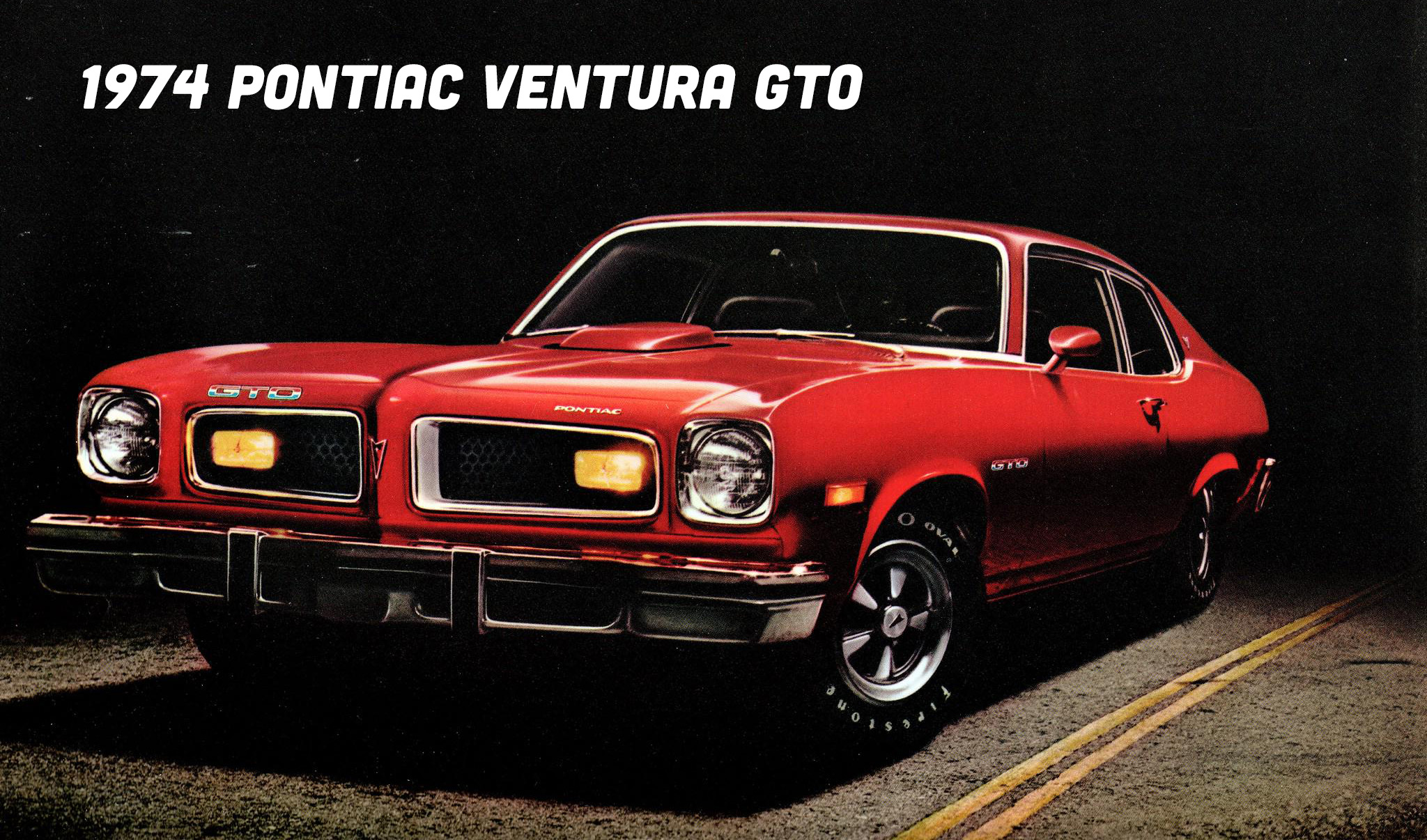
The GM X-body was a much more manageable size to be thrown about. Don’t believe me? Watch a few minutes of Roy Schieder’s character doing just that with a Pontiac Ventura in The Seven Ups. There was never a convertible version of this car, but the expert stuntman in this chase certainly tries to make one in a crash that’s still hair-raising to watch:
For $461, you could trick out your 1974 Ventura or Ventura Custom with Code WW3 GTO package. The only engine available was the Pontiac 350 V8 (5.7 liters) with a 4-barrel carburetor sitting under a shaker hood scoop just like on the big-brother Firebird Trans Am.
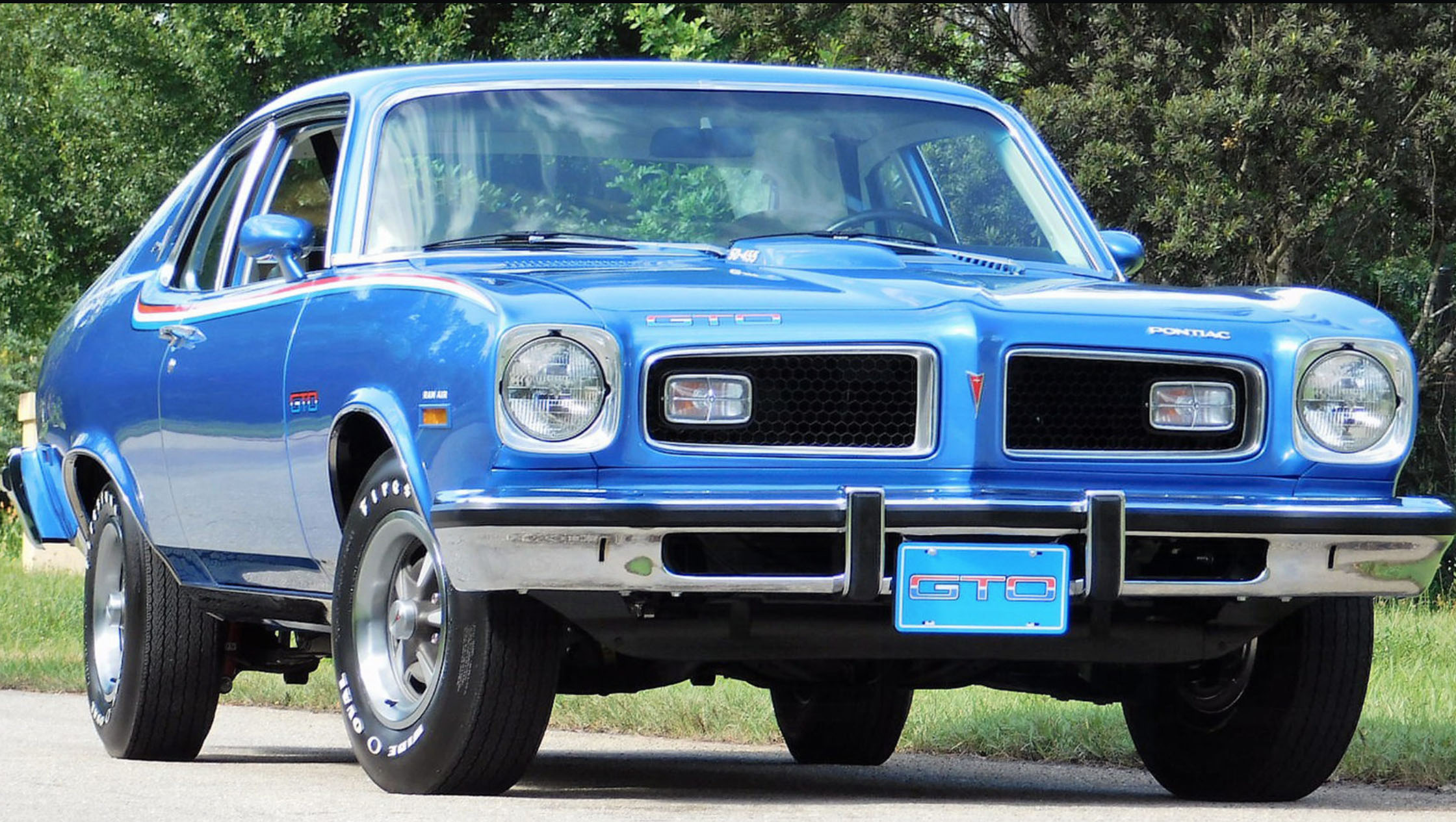
The 200 horsepower at 4,400 rpm and 295 lb-ft of torque it produced at 2,800 rpm was reasonable for the time, if laughable today (and to those in 1974 who remembered the 1964 GTO from a mere ten years earlier). A standard Hurst-shifted three-speed manual could be switched out for a four-speed or three-speed automatic.
Heavy-duty suspension with front and rear anti-roll bars could be taken a step further with the Radial Tuned Suspension package that included springs and shocks “optimized for steel-belted radials.” In typical American fashion of the time, power steering and power front disc brakes were optional instead of standard.

Inside, you could get a taxicab-basic bench seat interior, but many, if not most, owners checked the boxes and shelled out the extra cash to get their GTO with bucket seats;

The interior was spiced up a bit with a sport wheel, but it’s still very much a rather basic, non-flashy compact, which is obviously what the GTO was supposed to be about from the beginning.

“Strip” speedometers are not my favorite but at least a tach was available.
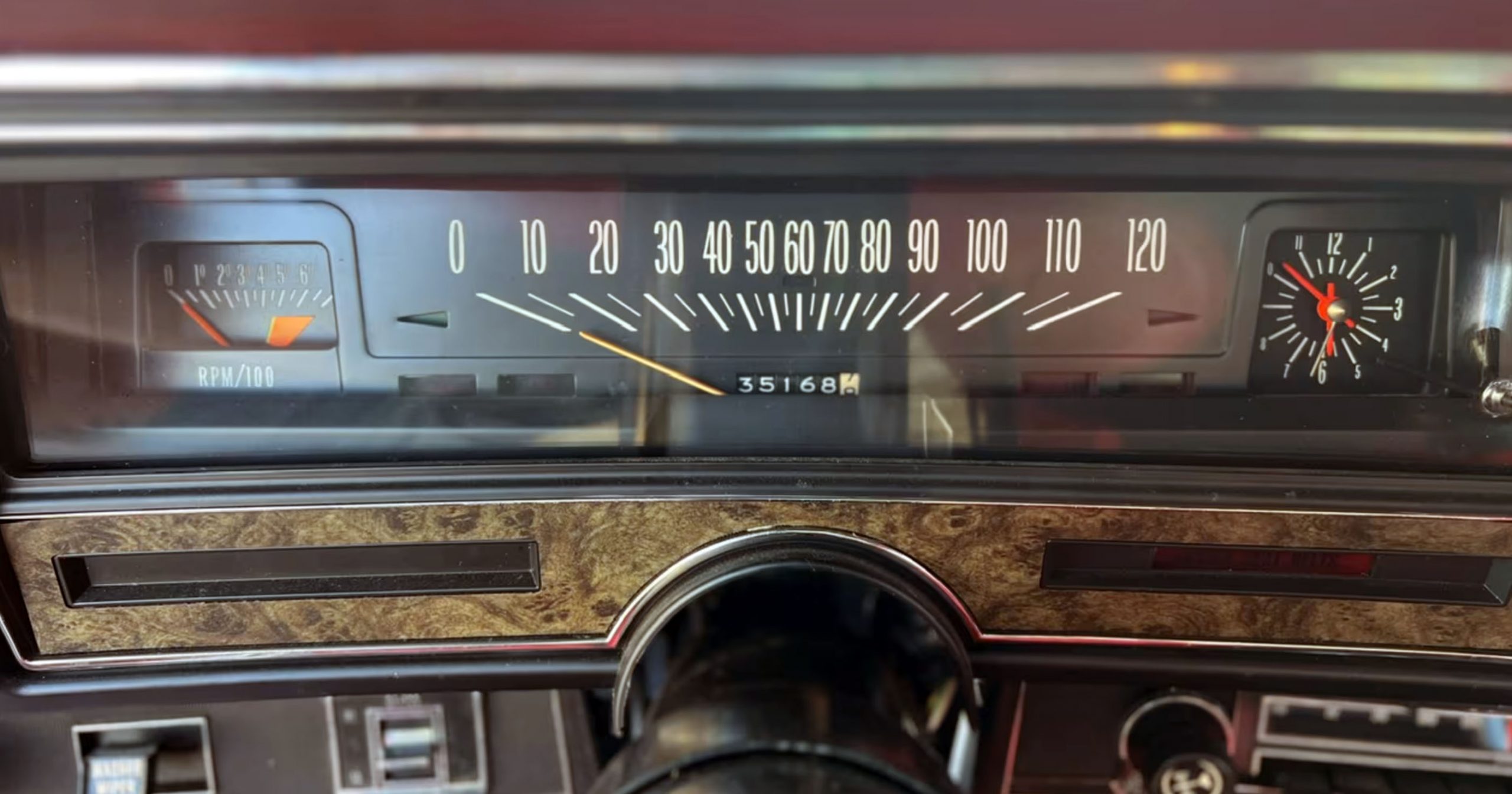
If you chose the tach and clock, you needed to get an optional center console with early Camaro-style “terraced” secondary gauges that look very cool when illuminated at night.

On the outside, there wasn’t much to distinguish the GTO from the lesser Ventura other than the special blacked-out grille, graphics, sport mirrors, and the rallye wheels that most came equipped with.

In retrospect, it’s a pretty nice-looking car, and the styling makes it look far smaller and sportier than the identically sized 1964 model. Still, who cares about appearance? Does it actually go?
Well, the 200 horsepower on tap was much less than that of GTOs from the glory years, and fifty horses fewer than the output of the 1973 455-powered GTO from the year before. The 1974 GTO may have been down on power compared to its predecessors, but, at 3400 pounds, it was about 400 pounds lighter than the previous year’s mid-size models. For a car deep in the worst of the malaise era, performance wasn’t bad. Motor Trend was only able to get an automatic 1974 GTO from zero to 60 in 9.4 seconds and through the quarter-mile in 16.5 seconds at 84 mph, but other publications did better.
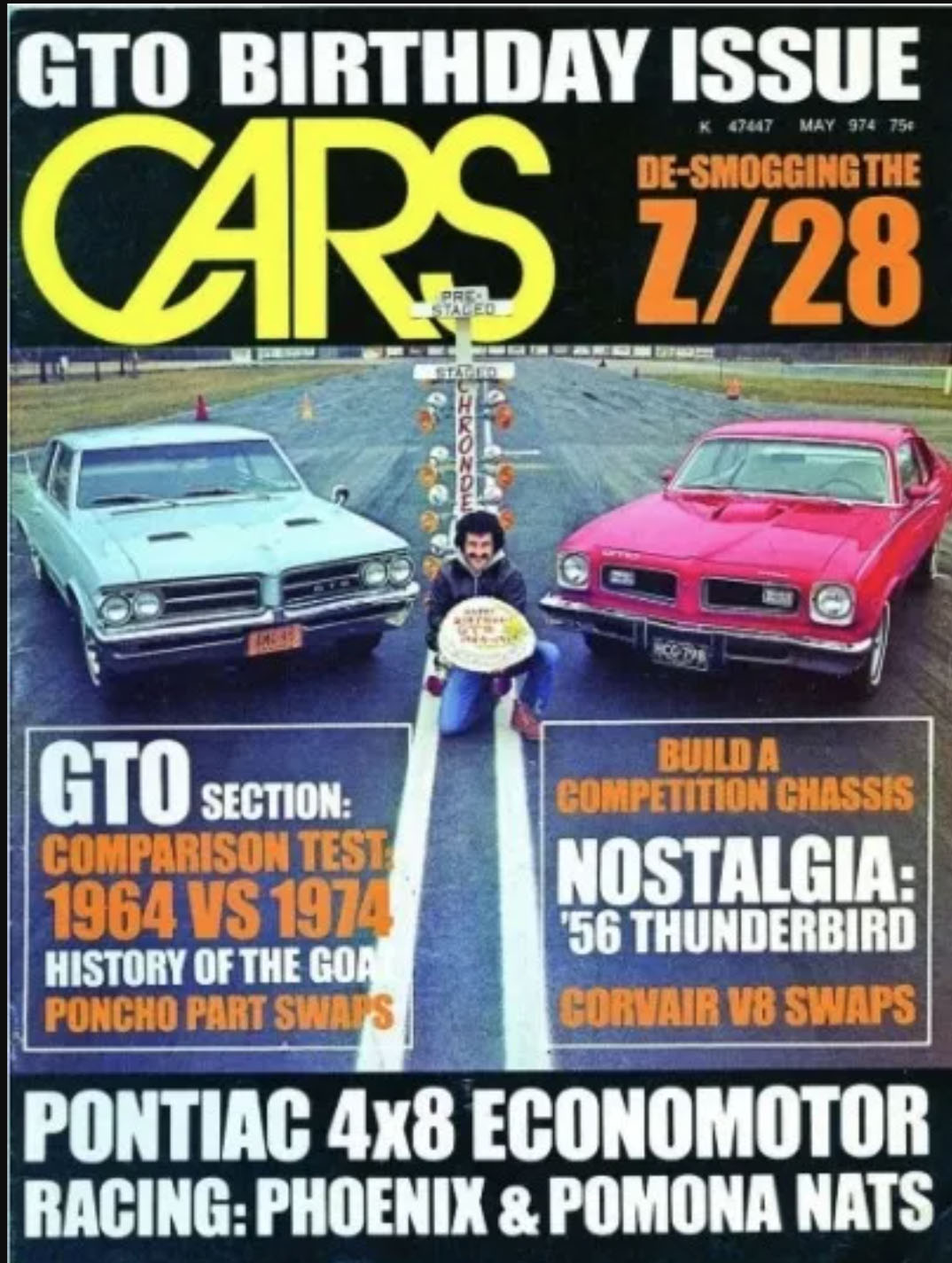
To celebrate the tenth anniversary of the GTO, CARS magazine decided to compare the new ‘74 GTO with a 3.08:1 rear axle to a ’64 model equipped with a 389 four-barrel and 3.55:1 axle. A professional drag racer got the new car from zero to 60 in 7.7 seconds and down the quarter-mile in 15.72 seconds at 88 mph; not much less than the 15.64 at 90 mph they got from the 1964 they used in the comparison. Spoiler alert: the 1974 car had a four-speed manual against the 1964 car’s two-speed automatic, but considering that the newer car was saddled with the absolute worst of the power-sapping emissions controls imaginable and safety equipment like the highway-guardrail 5MPH bumpers, it’s not bad. CARS magazine also noted that the Ventura-based car handled far better than the ’64 or the ’73.
Sales of the ’74 GTO improved over the previous year’s model year to 7,058 units with 5,335 coupes and 1,723 hatchbacks, but it wasn’t enough to justify continuing to market the GTO option package. With the oil embargo, gas rationing, increased insurance costs, as well as tighter emissions requirements that lowered engine compression ratios to use unleaded fuel and catalytic converters, the interest in performance cars dwindled quickly. The GTO went the way of the Dodge Challenger, Plymouth Barracuda, and AMC Javelin, which were also dropped after 1974. The Goat would not return for another three decades.
Wait, did I just say “hatchback” GTO above?
GTO Stands For “Go To Outdoors”
Yes, there was indeed a one-year-only hatchback version of the X-platform GTO. With the seats folded down, you had 27.3 cubic feet of space; that’s not exactly a Saab 900 (which gave you around 22 cubes with the seats up), but it’s a lot more utility for larger objects than any other Goat.
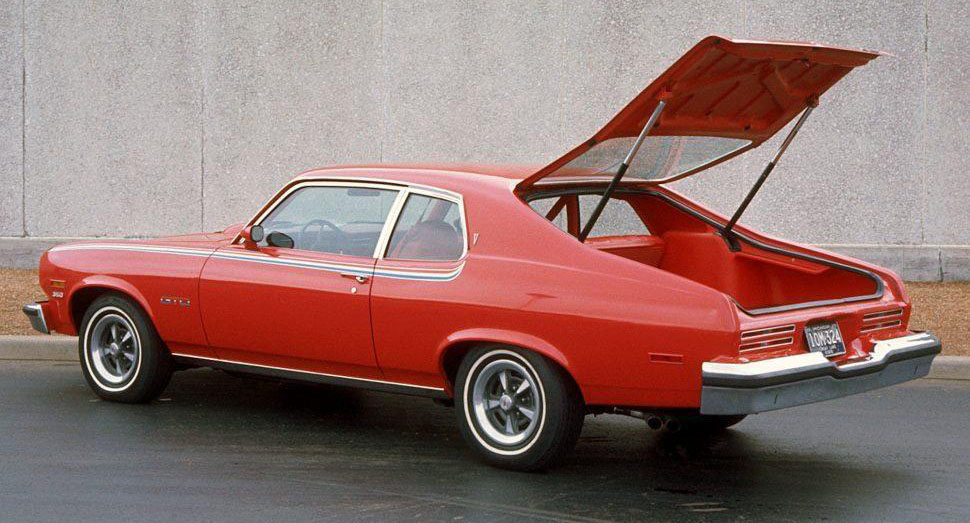
It also meant you could do something with this GTO that you couldn’t do quite as easily with any other GTO, let alone most any other coupe or sedan: camp in it. If you bought something like a Pontiac Ventura, a Chevy Nova, or really any GM X-platform hatch, you could equip your car with a tent GM marketed as the Hatchback Hutch.

As Mercedes Streeter reported, this thing worked a lot like the modern Pontiac Aztek tent. GM hatchback owners opened the hatch, draped over the tent, and secured it by strapping it to the car. If you’re lucky enough to find one of these tents today, you’d be looking for part number 726903.

A similar tent was available for a Chevy Vega, but that hatchback had a mere five feet or so of space between the taillights and front seatbacks. At least the Ventura-based GTO had a little more space back there, though I doubt that it was still enough. Still, as the ad says, “at today’s accommodation rates it pays for itself in a week or less.”
This Goat Wasn’t A Turkey
From leisure suits to the music of Donny and Marie Osmond, many things from 1974 don’t hold up well when compared to, well, anything else from any other era. The Ventura-based GTO suffers equally, but that doesn’t necessarily make it a bad car. It’s absolutely not the same thing as the earlier Goats, but in retrospect, it was a far better product than it gets credit for. In many aspects, it was superior to the earlier models songs were written about.
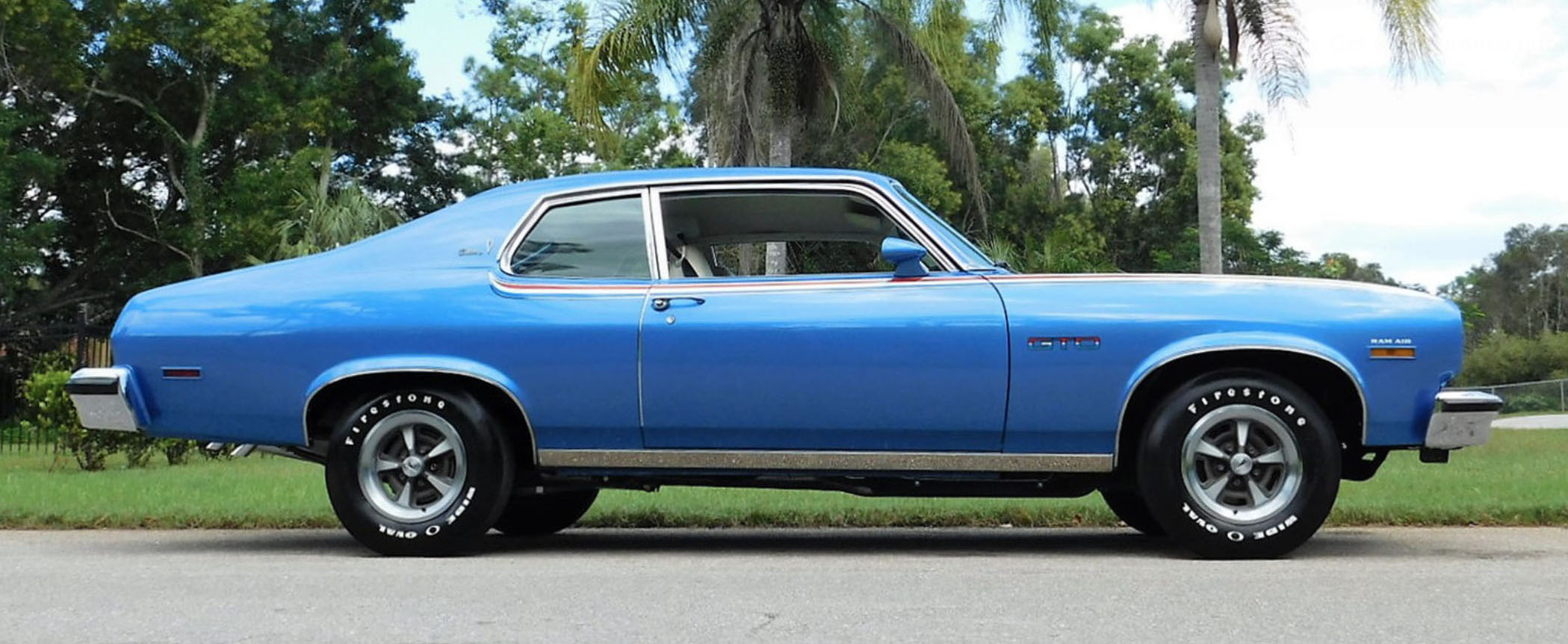
Such endless and rather unjustified criticism will likely continue to keep prices low. A good one can be bought in the $15,000 to $25,000 range, though pristine lower mileage ones have gone for over $40,000. You’ll need to shell out far, far more for a Boomer-favorite sixties or early seventies GTO that might not even drive as well on the way to a cruise night. I’m willing to bet that you could easily tweak and make that 350 really sing and shut down some more respected Goats in this “worst GTO ever.”
Now get over to eBay and start looking for a Hatchback Hutch.
Pontiac Points: 79/ 100
Verdict: Don’t believe the anti-hype: after half a century, the unfairly unloved GTO deserves a second look as possibly the best overall driving experience of the originals.
Top graphic image: Mecum Auctions




As a self-proclaimed Pontiac dork, I always thought the one-year X-Body GTO was cool. That said it’s strange that these came with the 350 instead of the 400 or 455, which would’ve just plopped in there just the same (there’s zero difference in external size). But by that time, the Trans Am and Grand Am were the “it” cars in the lineup, so making the GTO a stripped-down, back to basics performance car make sense.
But imagine for a moment that the engineers got their way and offered an engine option that allowed the final GTO (at that time) go out with a bang: the SD-455. This thing with the SD-455 that ended up in the Trans Am would have been one of the fastest new cars in 1974, if not THE fastest. It would’ve been nuts!
One thing that rarely gets mentioned is the ground clearance on these old muscle cars- even at 100% stock they’ve got ground clearance that would make a subaru proud.
A Nova SS by another name is still a fine car for the time…
The ’74 GTO is not a bad car. It’s a GM X-body with some performance upgrades, and that’s not a bad thing at all. The shaker hood and taillights are awesome. Unfortunately, the ’74 GTO served as the lightning rod for the public’s lament toward the metastasizing of the malaise era. Even the GTO, which ushered in the muscle car era 10 years earlier, was not immune to the detuning of the auto industry.
My brother has owned a ’74 GTO hatch for many years, and I have owned a ’66 GTO for nearly 30 years. My brother’s ’74 GTO now has a 461ci (stroked & bored 400ci) with nearly 500hp, and it’s a very fun car. It has noticeably poorer build quality everywhere compared to my ’66, but that’s not the GTO’s fault. The build quality of most cars sold in the US took a huge nosedive by the mid-70s.
even the Pontiac 350 was not necessarily bad, it just was at a bad time and place. retarded cams, choked exhaust, carbs that were sealed to avoid proper tuning. Still a person in the know could do fine with even the 350 poncho. and of course on the outside the block was the same as the 400 and 455, so adding displacement and or earlier/better performance variants was easy.
I’d take an xbody from 68-74 hands down any day of the week. im sure that scoop is a block off plate away from functional too. the 74 gto is a mona lisa compared to the train wreck the 73 gto is.
I think the ’73 is unfairly maligned. The chassis is a better handling platform than the previous ’68-’72 generation. The Grand Am was really the GTO successor, and the LeMans GTO was just a trim option, unlike a separate model as years before.
the platform itself is fine, the packaging got sat on. the rump on the pontiacs just didnt do it for me from 73 on. the 77 can am fixed it with a spoiler tho lol!
I do think the Pontiac has the best tail lights of the X body. For the front ends I’d say it is better than the Olds and Buick but still less attractive than the Chevy.
We need cars like this again. Two doors for style, large enough for comfort and hatches for utility.
My unpopular opinion is I always liked the styling of these x bodies. I got a free 74 nova sedan to get it out of my friends front yard. I put a new battery, starter, and brakes on it and drove it until I traded it for a Honda cl360 and a ps3
The performance wasn’t good, but then again the performance wasn’t good on any 1974 car. It was odd to move the GTO to the x-body platform which by the way was the same basic sub-frame used under the 68 Nova and 67-69 Camaro/Firebirds with rear steer. The Camaro went to the improved front steer subframe in 70-1/2 but the Nova lagged behind until 1975.
“basic sub-frame used under the 68 Nova and 67-69 Camaro/Firebirds with rear steer. “
Rear steer… on a Camaro/Firebird????
Steering arm to the rear of the spindle vs front of spindle.
Ah ok. I thought you meant steering from the rear wheels… And then thought ‘I don’t recall any early Camaros doing THAT’
LOL.
accurate. probably the only good thing about that era of nova was junk yard Disk Brakes for a 60’s Camaro.
As a ’74 Buick Apollo owner, I am admittedly biased, but I’ve always thought the X-body GTO looked really good. 200hp and 295 torques are a nice chunk more than the Buick 350 in my Apollo puts out too.
Oh man! That chase scene is epic, and you can make out quite a few landmarks that still exist in Manhattan and over the GWB into NJ. They may have been speeding up the film, but it looks like they were really beating the crap out of that Detroit iron!
Heads, cam, and exhaust is all you need to wake up those engines.
I think they called them the NOVA cars because they all looked like Novas.
“someone’d” Not sure I’ve ever seen that grand contraction in print before.
I was looking for my typo and then I realized where you saw that.
This gen Nova and its NOVA derivatives aged really well.
I can understand the disappointment when it was new and the derision that held for a while after, but as a (presumably) cheap to buy and run classic that’s a little bit different to cruise around in today, it looks like a fun proposition. It’s got a shaker hood, some nice colors, the V8 noise most people like, no touchscreens or wuss tech, the performance is enough to be fine in modern traffic, and I’m sure it feels faster than the modern econobox that would give it trouble at a light. Some surviving old dorks might still give you “not a real GTO” nonsense if you happen to end up at one of those sad old domestic car shows with endless lines of tri-Chevies and nearly identical paint-by-number ’32 hotrods, but to normals and younger people, it’s an old car with bright colors and stripes and it will cruise at the exact same low speeds the old dorks in the “real” GTOs will be doing.
And thus did Martin Brody leave NYC for quiet, peaceful Amity Island.
Pretty sure he saw that Grand Ville and thought, “I’m gonna need a bigger boat.”
After Jaws ate the helicopter in Jaws 2, he definitely decided he needed a better chopper and stole Blue Thunder.
Hopefully after hitting the salon for a better dye job. When he got out of the wreck…just, no Roy…
I think the issue was how poorly they managed to hide the Nova underneath. Corporate standard items like motors, rear ends, and transmissions seemed to make sense to bean counters, but I think they should have really taken this 74 GTO to heart as far as styling and brand identity.
By using a not very well disguised Nova design, that was already at this time pretty long in the tooth for the time, and using a 350(albeit still technically pontiac) the thing had a lot to prove when compared to say a new body style Camaro, and it was not stand out enough to do so. Oddly the kissing cousin Trans Am got a pass, but at least the outer shell was enough different and only the basic rockford file cars got the wheezy GM corporate sixes and SBC’s
By this time and certainly starting with the ’75 facelift the RWD X-bodies basically were Camaros with a usable back seat and cheaper insurance.
Which is why police departments everywhere loved them so much.
So when is David going to have Autopian buy one of these and then camp in it? Once we get another dose of subscribers?
I really like these Ventura “GTO’s” I think they are cool looking and I like them better then their Nova counter parts. I think the hate is no different then the 04-06 not “GTO” Holdens hah.
This continues the proof that a name really can change the perception of a car. Is the Mustang Mach-E a bad car? How about the new Blazer EV? Neither are bad cars, but they don’t cash a check that the name promises.
Holy cow, the editing and choreography (car-eography?) in The Seven Ups chase is fantastic by any era’s standards.
Can you imagine the cost and hassle of closing streets in New York for weeks to film that chase?
One shot looks like they’re next to Central Park, which seems unimaginable.
Yep, Central Park West, and then west on 72nd St. across Broadway and up Riverside Drive…all super-populated areas. The 70’s were a wild time!
Though Bourne Ultimatum had a pretty epic car chase through mid-town and lower Manhattan in the early 2000’s.
The siren and tire-squealing were hard on my ears.
I like to imagine they didn’t bother closing the streets. It was a different time!
Oh, man – it’s permanent 70s-80s “bad guy” Richard Lynch in the passenger seat in that Seven Ups clip, isn’t it? A long fall from there to The Sword and the Sorcerer, ain’t it?
And permanent bad guy wheel man/stunt coordinator Bill Hickman driving. He drove the Charger in Bullit, among others.
I can see why he went to New York. Things got a little hot for him in San Francisco.
Thanks for that. I was getting such a vibe and assumed he was just Temu Charger driver…
Pretty sure the driver is Bill Hickman.
Yep. I love the way he looks like he is wetting himself early on in the chase. I’d say he hit his low point a few years before Sword+Sorcerer in Galactica 1980.
I used to be one of those folks that got irked when a manufacturer used a legacy name on an entirely different car. Eventually I just got over it. Owning a $500 beater NUMMI Nova helped. I’d probably enjoy owning a modern Ford Maverick, too, but if I got one, I might just put some old-school Maverick badges or decals on it.
I need to point out, in the name of pedantry, that there are no “big block” and “small block” Poncho motors – they’re all the same externally – so the weight difference between a 350 and 455 Pontiac V8 isn’t much.
Noted- and removed!
True.
Also, anything >388 cubic inches is still a big block to me, though “big-cube” would be more accurate with regard to Pontiac V8s.
My AMC AMX is running a 401 and it is not considered a big block. But AMC…